


For a food or drink brand, AI should take the orders, shipping and subscription messages and answer ingredient questions only from verified label data, while every allergy or spoiled-product claim goes to a person. If you run Gorgias on Shopify, start with its built-in AI Agent. If you want one AI across helpdesks, an AI teammate like eesel answers from your ingredient sheets and past tickets, and you can replay old tickets before it goes live. With the eesel CLI, a coding agent can upload your approved ingredient sheets and allergen matrix, then ask test questions and check the answers; connecting the helpdesk itself still needs someone with admin access.
Why do food and drink brands get such a mixed inbox?
I work in eesel's support queue, and a food and drink inbox sorts into the same buckets from brand to brand. Where is my order, it arrived melted, skip my next coffee, is there palm oil in this, does it contain gluten, how do I brew it. When I asked ChatGPT what AI could handle a food and beverage brand's inbox, it split the questions the same way: ingredients, allergens, product picks, shipping, orders and complaints like damaged or leaking items.
That makes it a good fit for AI customer service, with one catch most ecommerce guides skip. A message that says "my son is allergic to tree nuts, is this safe?" is a safety question, not a ticket. So the useful question is not "which chatbot?" but "where does the AI stop?" I made the same argument for pet food brands; the logic carries over here, with different risks.
What can AI answer, and what needs a person?
Think of it as three groups. The first is answered from a page you already own: brewing guides, storage and shelf-life notes, ingredient lists. The second needs a live look-up or action: order tracking, skipping a subscription. The third is judgment: spoiled or damaged deliveries that need a reship or refund, and anything about someone's health. The AI answers from your pages and never judges whether a food is safe for a person.
Tap a message below to see how I would split it.
What did the customer send?
Tap a message to see who should handle it.
The rule I use: anything the customer could answer by reading your website is safe to automate. Anything that moves money or touches someone's health needs a person. That is the same line most teams draw for any support AI, and it is the whole reason handoff rules matter more here than a headline automation rate.
How should AI answer allergen questions?
This is the part that makes food and drink different from fashion or beauty, so I want to be precise about what the rules actually say.
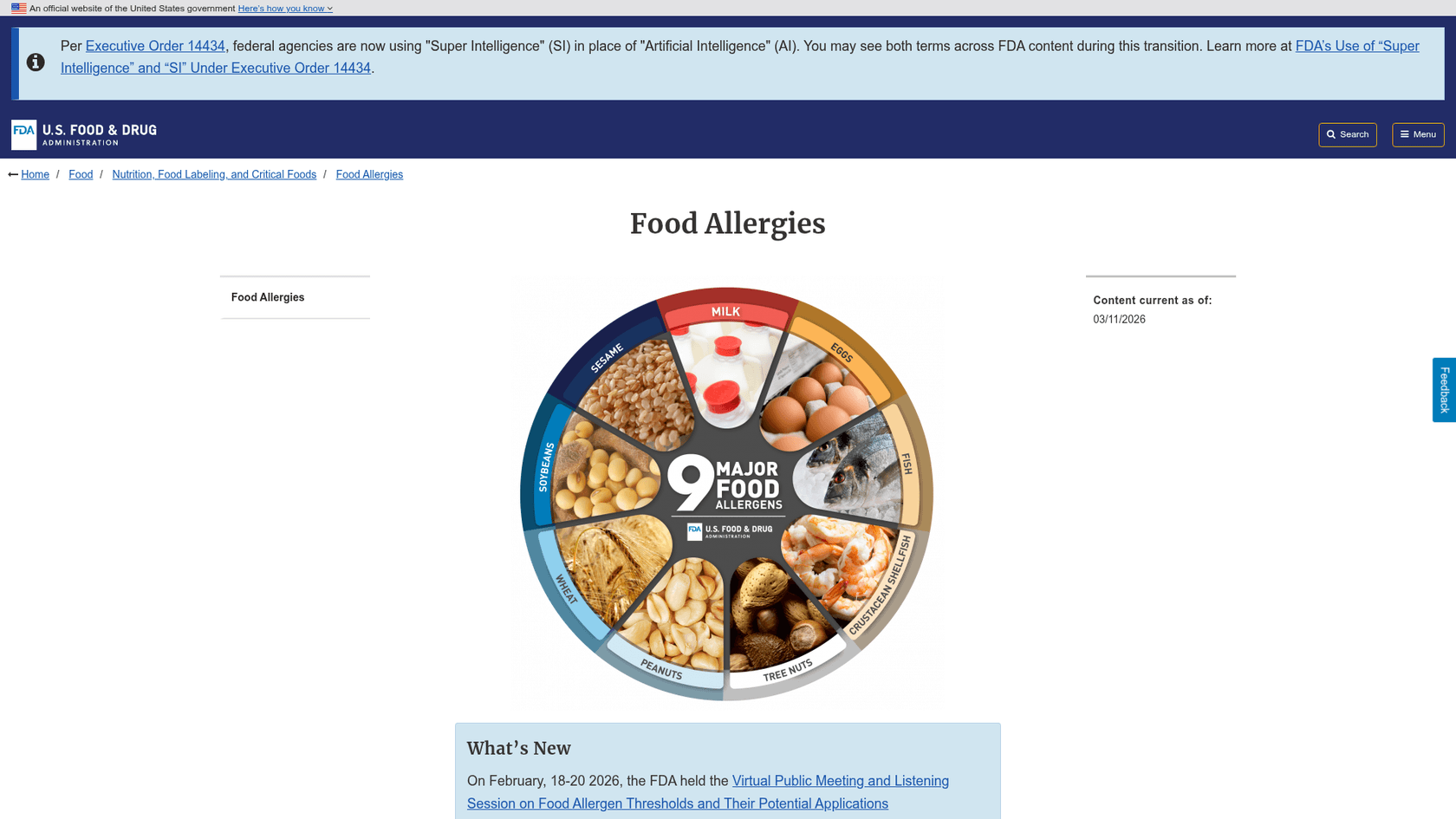
On its food allergies page, the FDA lists nine major food allergens: milk, eggs, fish, crustacean shellfish, tree nuts, peanuts, wheat, soybeans and sesame. Sesame joined the list on January 1, 2023. A label has to name the allergen source, either in parentheses after the ingredient or in a "contains" statement next to the ingredient list. That gives an AI something solid to quote. Three other lines on the same page are why I do not let it go further:
- Advisory statements such as "may contain" or "produced in a facility that also uses" are not required by law. A label with no such line does not prove there is no cross-contact.
- The FDA says it has not established a threshold level for any allergen.
- Beyond the nine, the page says more than 160 foods have been identified to cause allergic reactions, and gluten and some additives are monitored separately.
So the AI's job is narrow. It reads the ingredient list and contains statement for that exact product and quotes them. It does not infer "safe", does not reason about cross-contact, and does not answer for a product it has no sheet for.
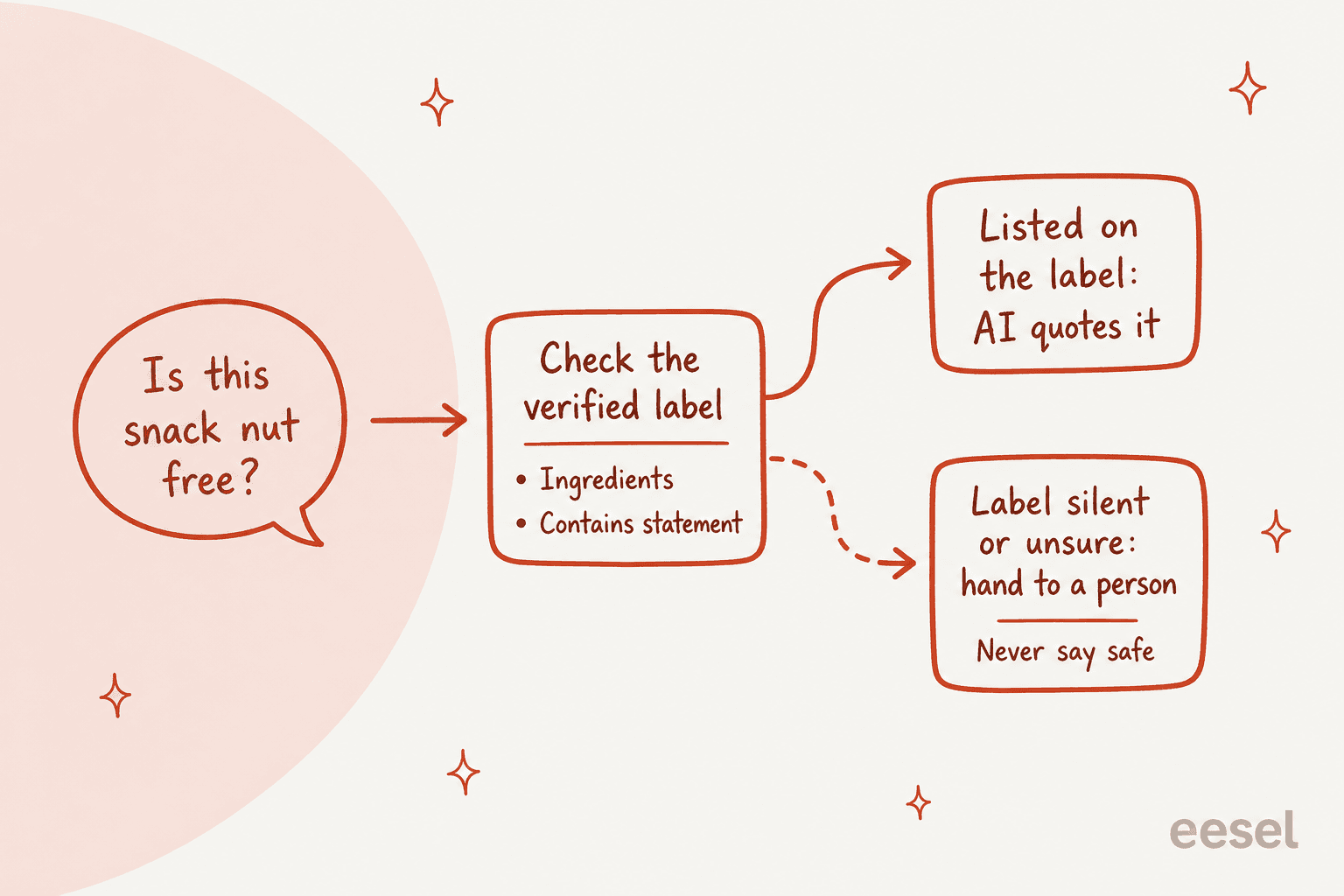
I learned why the data matters the hard way. In an early storefront rollout for a Shopify coffee retailer, the agent named "Dark Roast" when the product was called "Dark Espresso Roast", and it cited a file the owner had already deleted. For a coffee pick that is an embarrassing slip. The same slip on a peanut warning is a safety incident. That is why I now insist on a verified sheet per product, a rule that anything outside it goes to a person, and a test run before anything goes live. For more on product-specific pre-purchase questions, the pattern is the same. If your category touches rules around product recalls, keep a written path for that too.
What about melted, damaged and late orders?
For most food brands, this is the volume. Chilled and frozen boxes get delayed, chocolate melts, glass jars break. The AI is good at the first half of that conversation: asking the right questions and looking up the order. A person should make the call that costs money.
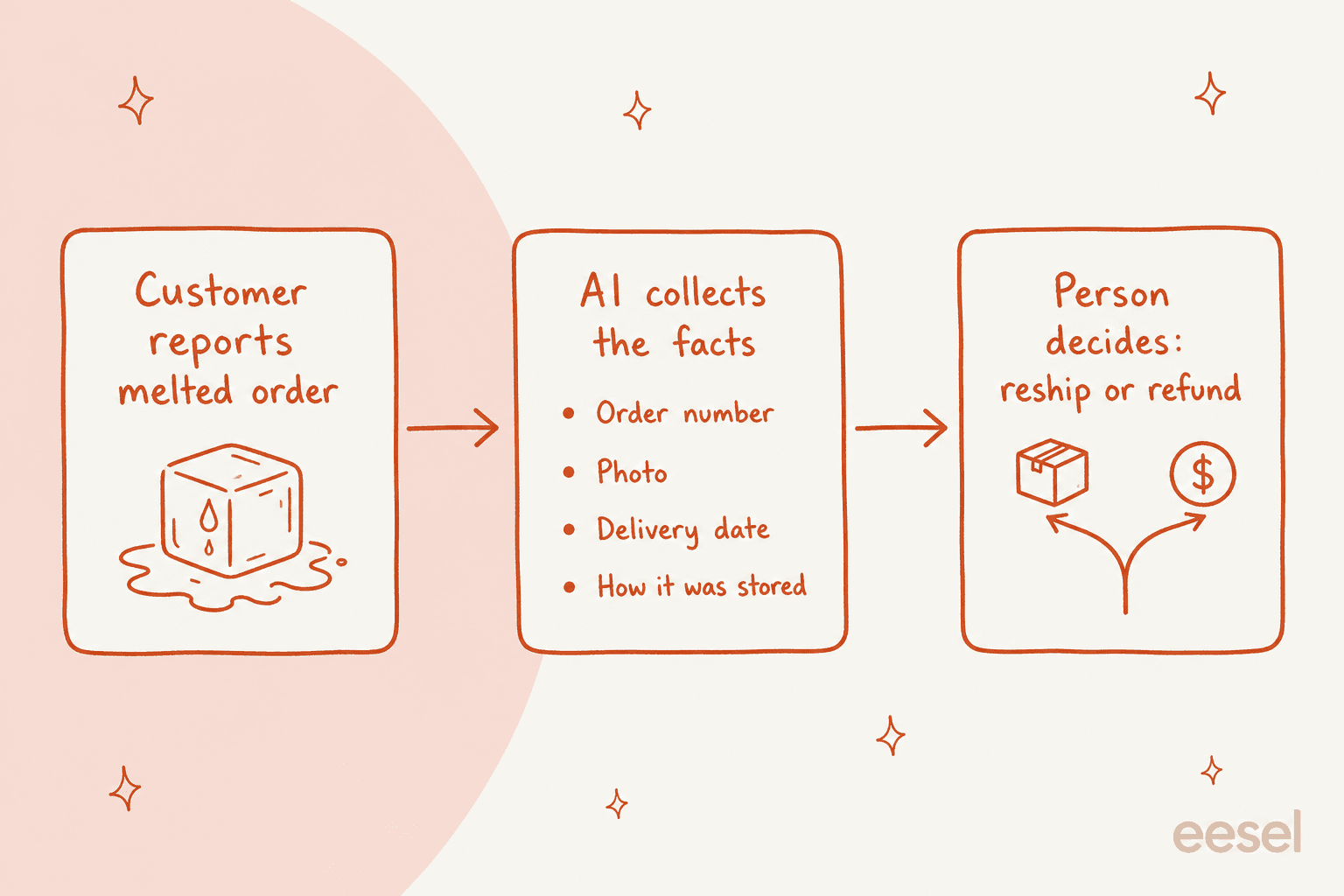
What I would automate, in order of safety:
- Order status. A live look-up through the store and carrier. See AI for order tracking and WISMO automation.
- Proactive delay messages. Tell the customer before they write in, as described in shipping delay notifications.
- Evidence gathering for damage. Order number, photo, delivery date, storage. The same fact-collecting step applies to lost package claims.
- Refund and reship. Your team decides, ideally with a value threshold under which approval is one click.
Perishables also make timing matter. A box that sat on a porch for two days is a different case from one that arrived cold, which is why the AI should ask for the delivery date before anyone offers a refund. Holiday gifting and summer heat shift the mix too, so plan for seasonal spikes and after-hours messages, because a warm-box complaint does not wait for office hours.
Which routine questions are safe to automate?
Everything that lives on a page you control. Brewing and prep steps, storage and shelf life, how to open or reheat, whether an item is vegan or halal when your own sheet says so, and which flavour suits a taste. Treat these as FAQ deflection with a written source behind each answer.
Subscriptions are the other big one for coffee, snacks and sauces. A customer wants to skip, pause or change frequency, and the AI must reach Recharge, Loop or Skio to do it. Gorgias documents skip, pause and cancel actions for those apps, with limits for shoppers who have more than one subscription. See Gorgias with Recharge for how that works, and test a customer who has two active plans before you sign.
Channel matters for these brands as well. Customers may write through WhatsApp or Instagram DMs, so check each tool's channel list before you pick one. If you ship to several countries, check multilingual support too, because label wording and allergen names differ by market.
What do Gorgias, Tidio, Zendesk and eesel offer?
All facts below come from each vendor's own pages as of November 2026. The deciding difference is how each one charges and which controls it gives you over what the AI may say.
| Tool | Pricing signal | What matters for food brands | Worth knowing |
|---|---|---|---|
| Gorgias AI Agent | Starter $40/month, Basic $90, Pro $550 (monthly); $0.90 per automated interaction on Basic and Pro | Shopify depth; actions and brand voice and guardrails not on Starter | Helpdesk and AI on one bill; subscription actions in Recharge, Loop, Skio |
| Tidio Lyro | Starter $33/month billed annually for 50 conversations; Growth from $63 for 100 | Human handoff on every plan; Guidance instructions to steer answers | Lyro and human conversations share one plan limit |
| Zendesk AI agents | Suite Team $55 per agent a month (annual), $1.50 committed or $2.00 pay-as-you-go per resolution | Actions on connected systems | Charged per automated resolution, with no human escalation |
| eesel | From $299 a month for 500 credits, a ticket or chat is one credit | Joins your existing helpdesk; answers from uploaded sheets and links the source | Recharge documented; Loop and Skio not in the docs |
Gorgias: the AI built into the helpdesk
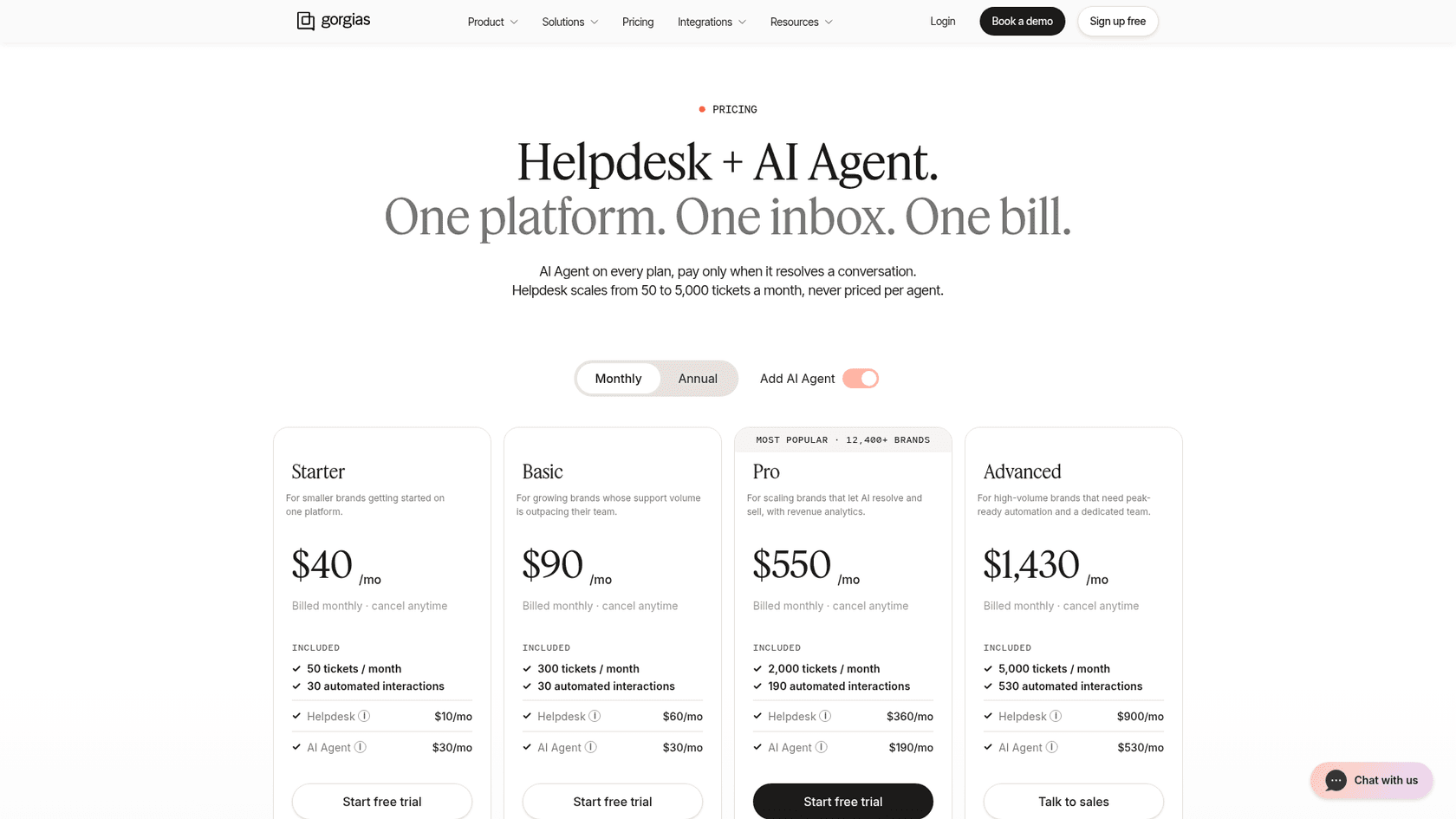
Gorgias prices the helpdesk and the AI together. On the monthly view, Basic is $90 a month for 300 tickets and 30 automated interactions, and Pro is $550 for 2,000 tickets and 190 interactions. Past that, an automated interaction costs $0.90 on Basic and Pro. The comparison table lists actions such as cancel and discount, and brand voice and guardrails, as not included on Starter. If you already run Gorgias, AI Agent actions on Recharge, Loop and Skio are the shortest path to automating skips and cancels.
A G2 reviewer flagged the cost curve:
"The main frustration with Gorgias is the pricing model, which is based on ticket volume rather than a flat monthly fee. As our order volume grows and customer inquiries increase, the cost scales up quickly in ways that can be difficult to predict and budget for."

For a brand with holiday peaks, read Gorgias AI Agent pricing before you commit.
Tidio Lyro: a lighter option for small teams
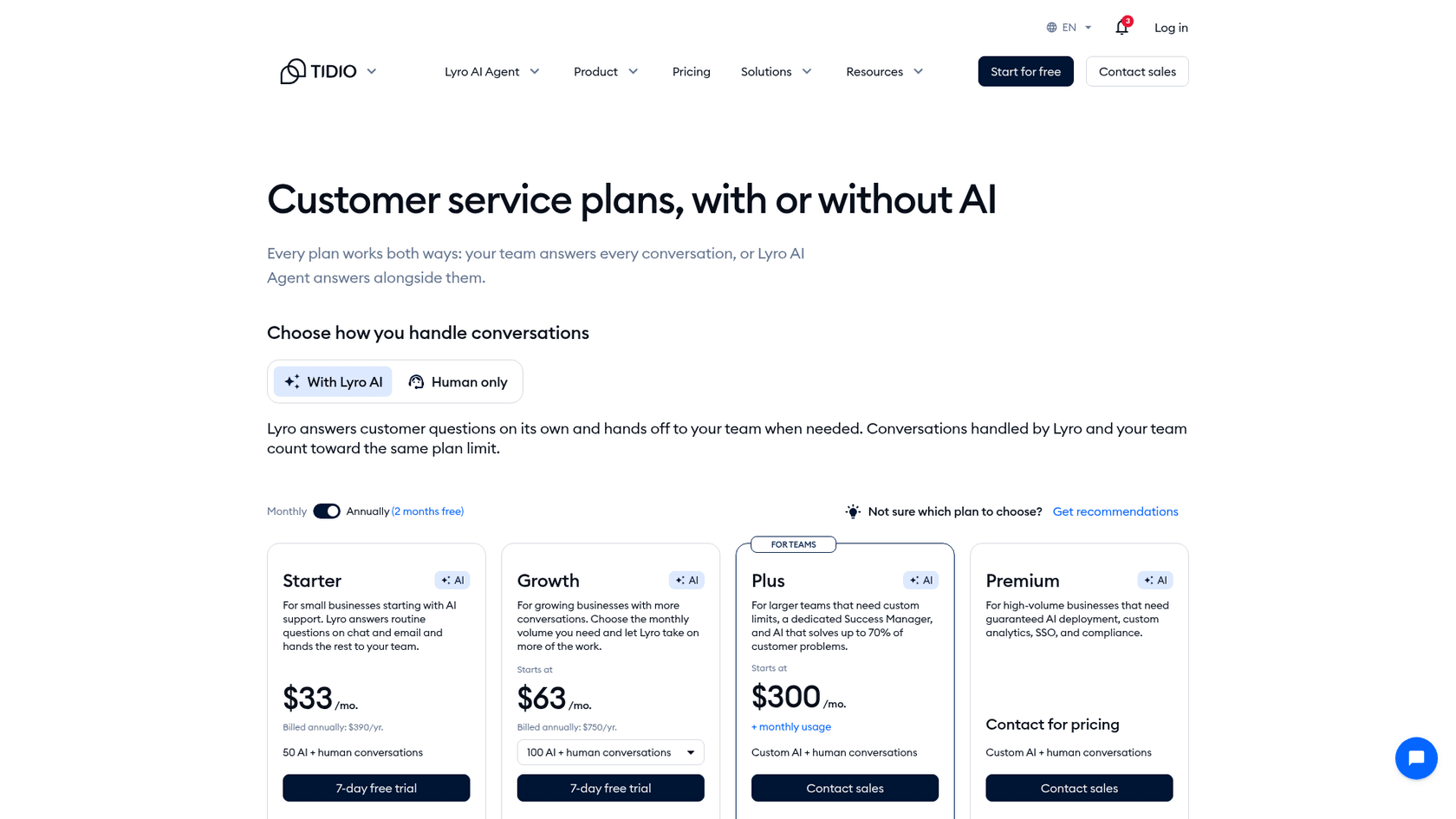
Tidio bundles live chat, ticketing and its Lyro AI Agent. Starter is $33 a month billed annually for 50 AI plus human conversations, and Growth starts at $63 for 100. Its pricing page says Lyro answers on its own and hands off to your team when needed, and that conversations handled by Lyro and by your team count toward the same plan limit. Human handoff is listed as included on every plan. For a small brand with a short product range that can be enough; the thing to test is how Lyro behaves on an allergen question, since it follows the knowledge and Guidance instructions you give it. More in my Lyro pricing breakdown and Gorgias vs Tidio.
Zendesk AI: the pick if you are already on Zendesk
Zendesk's AI agents are billed per automated resolution, meaning a request resolved with no escalation to a human: $1.50 committed or $2.00 pay-as-you-go, on top of Suite Team at $55 per agent a month paid yearly. By that definition, an allergen question your rules hand to a person should not count as an automated resolution, though it is worth confirming with Zendesk before you budget around it. The long version is in my guide to Zendesk AI agents and AI for Zendesk.
Where does eesel fit for a food and beverage brand?
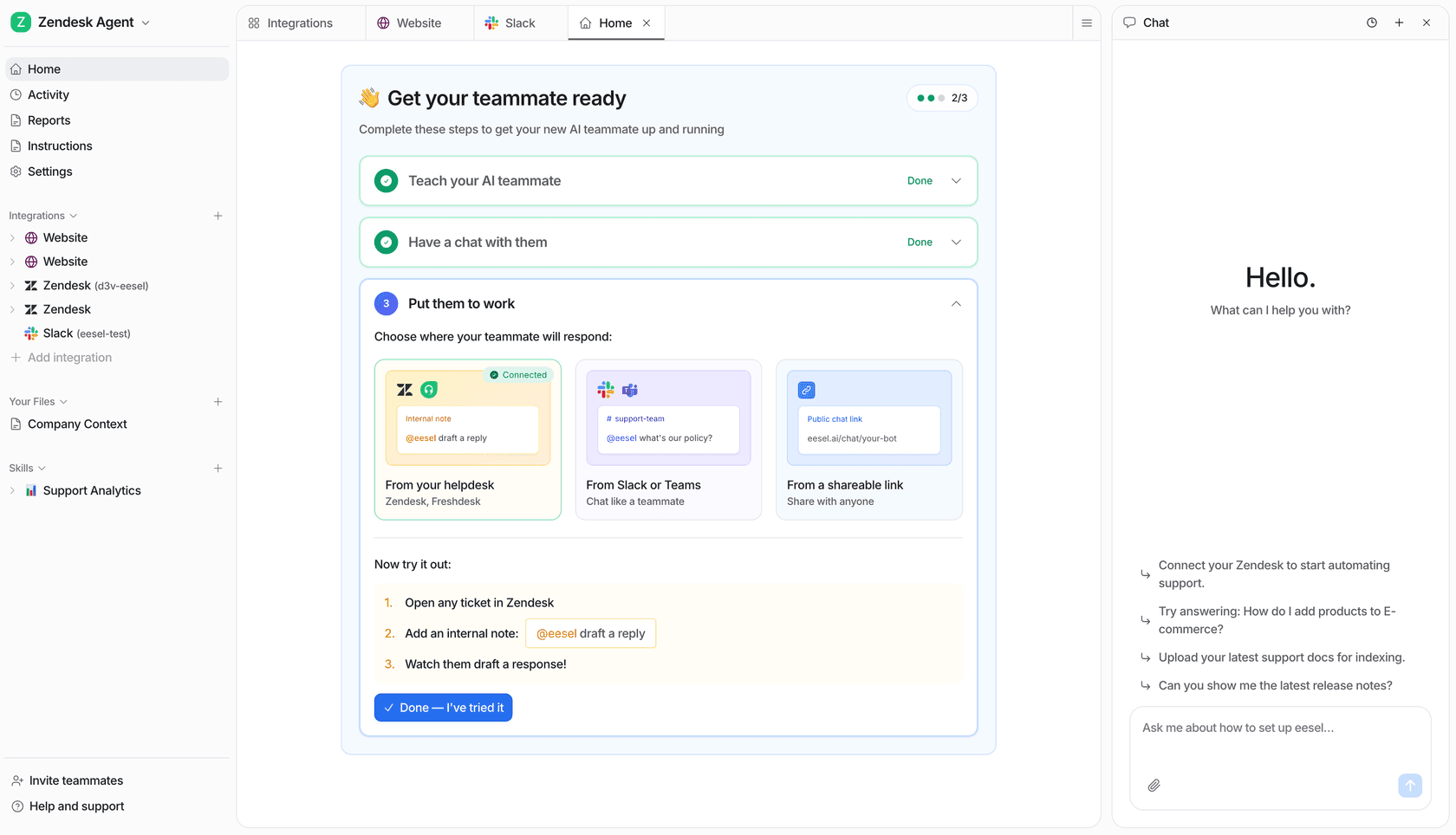
eesel is an AI teammate you hire for a job. For a food or drink brand that job is the AI helpdesk teammate: it joins the helpdesk you already use, such as Gorgias, Zendesk or Freshdesk, and learns from your help center, macros, past tickets and uploaded sheets. It can also look up orders through Shopify. Each action can be set to run on its own, ask first, or stay off, per Actions and Approvals.
I should be plain about the limits. The Recharge docs list skip charge, change frequency or quantity, cancel and address updates, but not pause. Loop and Skio are not in the e-commerce integrations list, so on those apps the subscription step goes to a person. eesel can answer from uploaded files and link the source, but it only knows what you give it, so a missing allergen sheet means a missing answer, not a guess.
eesel has run AI on live support queues for years, so I never roll one out blind. I replay historical tickets through the agent first and read the answers, which is the step I would not skip when a reply can touch someone's health. See simulation testing.
Two published customer stories show the shape of it. Cape Coffee Beans is a specialty coffee retailer in Cape Town running Zendesk and Shopify. In one month eesel ran about 160 scheduled checks on the Zendesk queue, was called into 23 tickets by the team, and did about 120 knowledge searches across tickets, the Shopify catalogue and Google Drive, with 19 product and 5 order look-ups. It answers the team as an internal note, not the customer, and every answer links its source; if the knowledge does not confirm something, it says so and asks the team to check. That is the behaviour I want around an allergen question. Poseidon Animal Health sells gut health supplements for horses from one Gorgias inbox, and a person reads and sends every draft because serving amounts and product choices need someone who knows the product.
Pricing is on the eesel pricing page: a 7-day free trial with 100 credits, then monthly plans from $299 for 500 credits, with extra credits at $0.80. For side-by-sides with helpdesk-native AI, see eesel vs Gorgias AI and eesel vs Zendesk AI.
How do I roll AI out without risking an allergy incident?
The order I would use:
- Write the source sheets first. One verified sheet per product: ingredients, contains statement, any advisory line, storage, brewing or prep steps. If the AI has nothing written to quote, it will guess.
- Write the hard handoffs. "Safe for my allergy", any reaction, a broken seal, illness after eating, a request about a recall. Put them in the instructions as rules.
- Replay old tickets. Run a few hundred real messages through it and read every allergen and damage answer, using a pilot scorecard.
- Start with drafts. Let your team approve for a week, then switch the safe groups to automatic. Set the agent's permissions so refunds stay with people.
- Set a damage threshold. Under a value limit the team approves in a click, above it a person decides.
- Watch every product change. A new recipe or supplier means a new label. Update the sheet the same day.
With the CLI, a coding agent can run the test questions and flag any answer that differs from your sheet, which suits step three. For larger retail partners who ask about vendors, my security review checklist covers what to ask. If you want the helpdesk comparison first, see best AI helpdesk for ecommerce, and for a food business that also runs a kitchen, my page on restaurant customer service covers the dine-in side.
Try eesel for your food and drink inbox
If your messages land in Gorgias, Zendesk or Freshdesk, eesel works like a new support hire: it learns your product sheets, brewing guides and past replies, answers the repeatable questions, and hands allergy questions and spoiled-product claims to your team. Start with the free trial on one mailbox and replay last month's tickets before you go live.
Try eesel free for 7 days, or see the wider options in the AI customer support guide.
Frequently Asked Questions
What is the best AI for food and beverage brands?
If you already run Gorgias on Shopify, start with its built-in AI Agent. If you use another helpdesk, or want one AI across several, an AI helpdesk agent like eesel joins the inbox you have and answers from your own ingredient and allergen sheets.
Can AI answer allergen questions for a food brand?
It can quote your verified label data, such as the ingredient list and the contains statement. It should never say a product is safe for someone's allergy, and it should hand uncertain questions to a person under clear handoff rules. For regulated topics, see AI for regulated industries.
Can AI handle melted, damaged or spoiled food orders?
It can collect the order number, a photo, the delivery date and how the package was stored, then pass the case to a person. Reship and refund calls stay with your team, as in any refund request workflow with refund guardrails.
How much does AI for a food and beverage brand cost?
Gorgias Basic with AI Agent is $90 a month billed monthly, Tidio Starter is $33 a month billed annually, Zendesk charges $1.50 to $2.00 per automated resolution, and eesel is a flat monthly plan from $299 for 500 credits. Compare that with your cost per ticket today.
Can AI skip or cancel a coffee or snack subscription?
Yes, if it is connected to your subscription app. Gorgias documents skip, pause and cancel actions for Recharge, Loop and Skio, and eesel documents skip, frequency change and cancel for Recharge. See AI for subscription box support and cancellation requests with AI.
Does AI work on WhatsApp and Instagram for a food brand?
It can, if the AI you choose supports those channels. Check each vendor's channel list, then compare WhatsApp support for ecommerce and Instagram DM automation.
How do I test AI before it talks to customers with allergies?
Replay a few months of real tickets through it, read every allergen answer, and start with drafts a person approves. A simple pilot scorecard and simulation testing tell you when the safe categories can go automatic.
What should AI never handle for a food and beverage brand?
Reaction reports, requests to confirm a food is safe for an allergy, and anything that could be a product recall signal, such as illness after eating. Write them as hard rules in the instructions and flag them for a person straight away.