


What counts as a payment dispute (and why it's three problems)
A payment dispute is any case where a customer questions a charge, either with you or with the company that processed their payment. In practice it shows up in three different places, and each of them needs its own kind of help, which is easy to forget when you only look at the chargeback part.
- In your inbox, as "why was I charged twice?" or "where is my order?" No dispute exists yet. This is a billing question, and answering it well is the cheapest fix there is.
- As an alert or inquiry, before a formal chargeback. Visa's and Mastercard's pre-dispute programs let you refund and close it, and some networks (mainly Amex and Discover) still run an inquiry phase first.
- As a formal chargeback. The bank pulls the money back, charges a fee, and gives you a deadline to send evidence. Stripe puts that window at 7 to 21 days depending on the card network, and miss it and you lose automatically.
Layer 3 is where the hours go. One Shopify merchant wrote up the evidence list for a single small case:
"Tracking screenshot, order confirmation, refund policy, shipping proof, customer emails, and timeline summary. All for a $42 order that was clearly delivered. By the time I finished uploading everything into stripe, I realized i'd spent more on labor than the dispute itself."

PayPal also adds its own path on top of this, where a buyer opens a dispute in the Resolution Center and has to escalate it to a claim within 20 days under its buyer protection rules or PayPal closes it.
I work on eesel's integrations, so a lot of my week is spent inside Stripe's and Shopify's APIs. The pattern I keep seeing is that teams buy a chargeback tool for layer 3, then the layers 1 and 2 are left to whoever has time that day. The inbox side has its own deep dive in AI for chargeback inquiries; this post looks at the whole chain and where AI pays for itself.
Where AI fits in a payment dispute
Here's the lifecycle, with the money attached to each step.
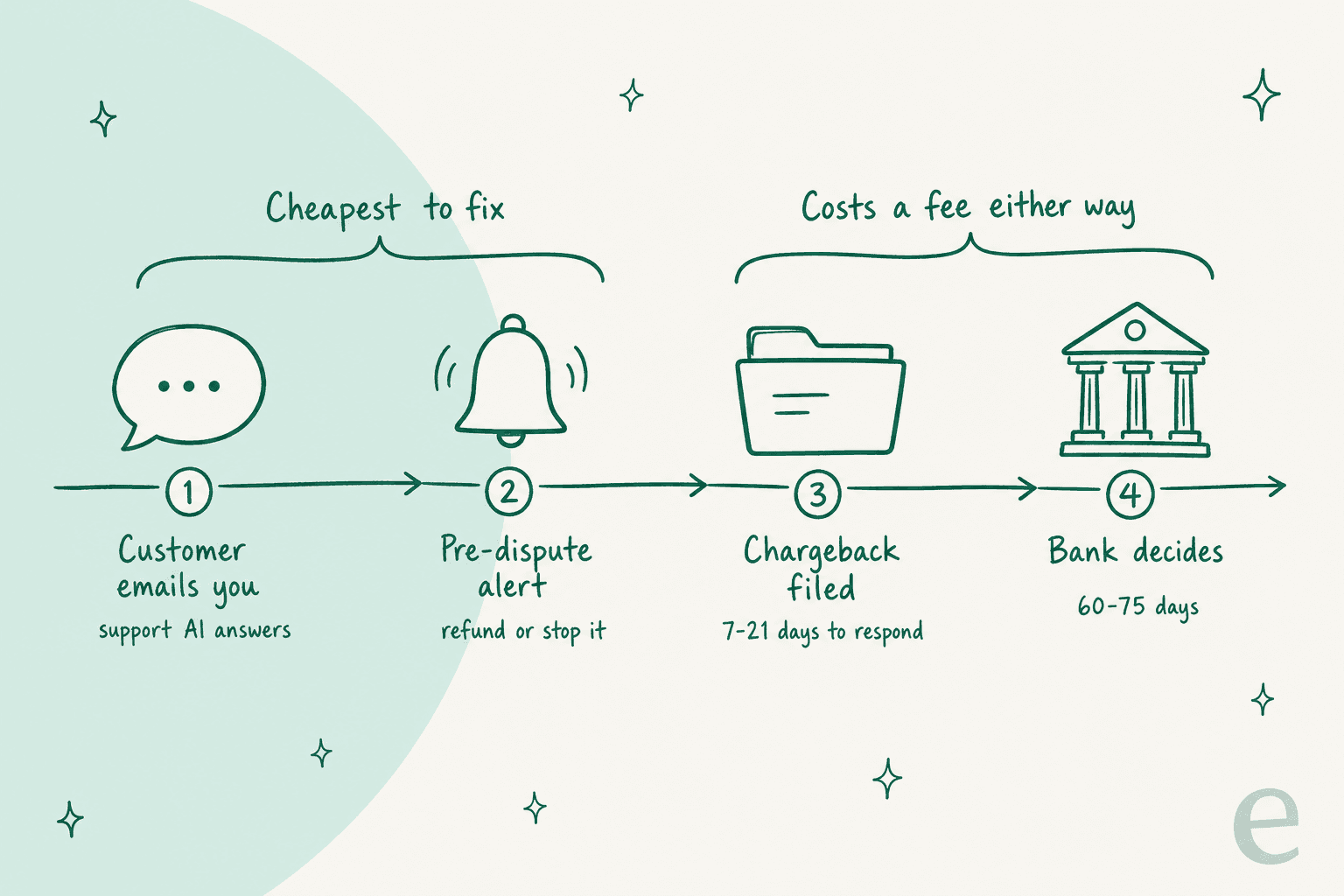
The first two steps are where a dispute is cheapest to fix. Once a chargeback is filed, you have paid a fee no matter what happens next: Stripe charges $15 when you receive a dispute, per its pricing page, and never returns it, plus another $15 if you counter one manually (that one comes back if you win). After you submit evidence, the bank usually takes 60 to 75 days to decide, and the whole process can run two to three months.
So the question isn't "should we use AI for payment disputes?" It's more about which of these steps you want automated, and also how much each one is worth to you in terms of money and time.
| Step | What AI can do | Who usually does it | Typical cost |
|---|---|---|---|
| Customer asks about a charge | Look up the order and payment, explain it, offer a refund within your rules | A support AI in your helpdesk | Your support tool's per-ticket price |
| Pre-dispute alert | Refund automatically by rule so no chargeback is filed | Visa RDR, Verifi CDRN, Ethoca Alerts, or a tool reselling them | $15 (Visa) or $29 (Mastercard) per resolution on Stripe |
| Chargeback filed | Pull evidence, write the response, submit before the deadline | Your processor's built-in tool or a dispute specialist | 20-30% of what's won, plus the processor's dispute fee |
| Bank decides | Nothing; this is the bank's call | The cardholder's bank | n/a |
The number most teams miss: winning doesn't fix your ratio
Card networks watch how many disputes a merchant gets, and they count a dispute when it's filed, not when it's decided. A chargeback you win still counts against you.
- Visa's VAMP (the Visa Acquirer Monitoring Program) replaced Visa's older dispute and fraud programs on April 1, 2025. Its "excessive" threshold dropped to
1.5%globally on April 1, 2026, with a minimum count of1,500, per Adyen's monitoring docs. The ratio adds fraud reports and disputes together and divides by your card-not-present sales. - Mastercard's Excessive Chargeback Program flags merchants at
100-299chargebacks and a1.5-2.99%rate, with a higher tier from300and3%, per Stripe's monitoring-program docs.
What stays out of the count is anything resolved before it becomes a chargeback. Stripe's docs say disputes resolved through Visa's Rapid Dispute Resolution or Mastercard's Ethoca Alerts don't count toward dispute rates, and Shopify now shows merchants two chargeback rates for exactly this reason. The cheapest version of "resolved before it's filed" is a customer who got a straight answer from you and never called the bank.
This changes how I'd spend the budget. An evidence tool earns its fee by winning money back, but it doesn't keep you under 1.5%, and if you're anywhere near a threshold then the money should go earlier in the chain first.
What your processor's AI already does
Before buying anything, it's worth to check what you already pay for. The big ecommerce processors, all three of them, automate some part of the response now.
Stripe Smart Disputes
Smart Disputes is Stripe's AI evidence builder, still labelled "Public preview" in its docs. Stripe describes it as "an AI rules engine" that pulls evidence from Stripe's own data, your transaction data and cardholder data, and tailors it to the dispute reason. If you do nothing, it submits the packet "just before the dispute times out."
The pricing is the part that needs some attention. Smart Disputes charges 30% of the disputed amount on disputes you win, per Stripe pricing, nothing on losses, and Stripe waives the $15 counter fee when Smart Disputes submits the response. The $15 received fee applies either way. It's card disputes only, Stripe doesn't publish a list of supported countries, and "not all disputes qualify for automatic submission."
Stripe's own proof point is GitHub Sponsors, which saw "an average reduction of 20 hours per month spent addressing disputes" on the dispute management page. Stripe is also upfront that the final decision "lies with the issuer."
Merchants who use it tend to like it when it fires, and they also notice how rarely that happens:
"The huge issue we have had with this feature is that it only runs on a small portion of disputes. They waive the new countering fee for using it (in exchange for 30%), so I guess they only do it on disputes they think they will win. The pricing makes a lot of sense for small ticket items, but not if it barely runs on any disputes."
One detail worth knowing: adding a tracking ID lets Stripe pull delivery history and proof of delivery from supported carriers automatically. If your store doesn't pass tracking to Stripe yet, that's the cheapest fix for win rate you can find.
Shopify Payments
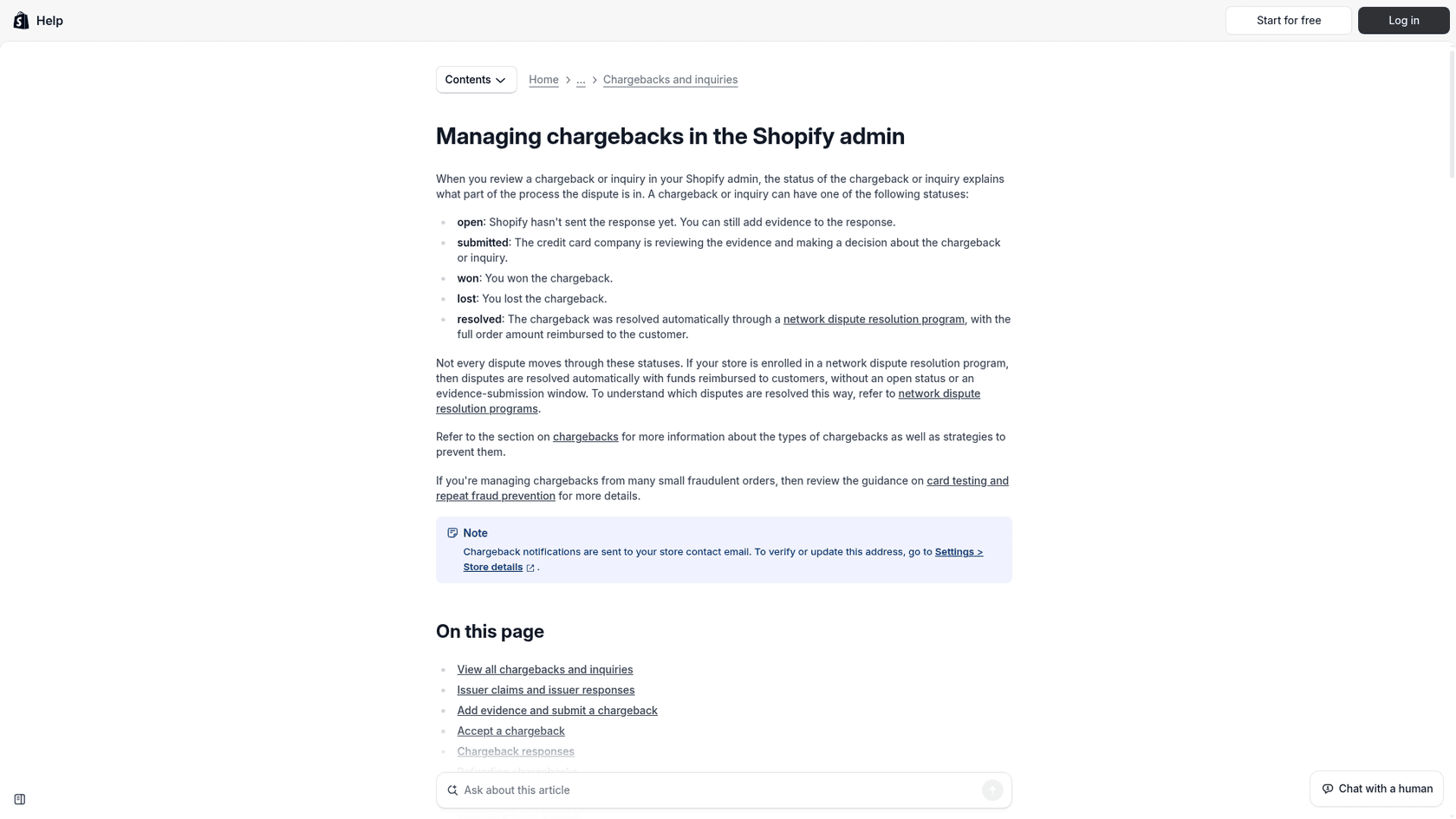
Shopify goes further by default. It collects evidence and submits it on the due date even if you add nothing, and the automatic evidence now includes the customer's IP address, tracking with the carrier's delivery photo for some carriers, past undisputed orders, and the matching store policy. For product-not-received disputes, Shopify adds AI-generated insights to the response, and Sidekick gives guidance on each dispute.
What Shopify says it doesn't have: emails, chat logs and other customer communication. That part is your helpdesk's job, and quite often it's exactly the evidence that wins a "product not received" case.
Shopify Protect covers fraud and unrecognized chargebacks on eligible Shop Pay orders: US merchants, physical goods, shipped with tracking within 7 days. Shopify repays the amount and fee and handles the dispute itself. Non-fraud disputes still go through the normal process. The chargeback fee is $15 in the US, returned if you win.
PayPal
PayPal doesn't describe an AI evidence builder on its pages. Sellers respond in the Resolution Center, and the dispute fee is $15 standard or $30 for high-volume sellers (a dispute ratio of 1.5% or more with over 100 sales in three months). The standard fee is waived when you win; the high-volume one isn't.
| Stripe | Shopify Payments | PayPal | |
|---|---|---|---|
| Builds evidence automatically | Yes (Smart Disputes, eligible card disputes) | Yes, by default | No |
| Submits without you | Yes, just before the deadline | Yes, on the due date | No |
| AI in the response | AI rules engine | AI insights on product-not-received | Not described |
| Extra cost | 30% of won disputes | Included | n/a |
| US dispute fee | $15 received + $15 manual counter | $15, returned on a win | $15 / $30 high volume |
| Missing from its evidence | Your support conversations | Your support conversations | Depends on what you upload |
If you're on one processor and your volume is modest, the built-in tool is the honest first answer. The tools in the next section earn their place when you run several processors or need better win rates on the big orders, and also when you want alerts and evidence managed in one place.
Dedicated AI dispute tools
ChatGPT, asked by a store owner how AI can help with payment disputes, searched for Stripe Smart Disputes, Shopify, Chargeflow and Justt. Those are the names buyers end up seeing, so here's how they compare, going only on what each vendor publishes.
Chargeflow
Chargeflow is the most transparent of the specialists. Its AI docs describe an orchestrator that picks an evidence playbook from the reason code, then hands parts of the case to a transactions agent, a behaviour agent and a delivery agent. A QA agent checks the result for up to three rounds, and "if it still does not pass, a human on the Chargeflow team is alerted rather than a weak case being submitted." I like that design choice a lot, it's the kind of check I'd want too.
Pricing is on the page: 25% per recovered chargeback, $29 per deflected alert, $0.10 per scanned order after the first 1,000, with no contracts or minimums (Chargeflow pricing). The win-rate claims are relative ("up to 80% higher win rates") rather than an absolute average.
Chargeflow sits at 4.7/5 from 278 reviews on G2, and the common trade-off reviewers mention is control, since the process runs mostly on its own:
"One downside is that you have limited control over the dispute strategy and customization of evidence, since the process is mostly automated. Additionally, fees can add up depending on your chargeback volume, and there's not always full visibility into how each case is specifically handled behind the scenes."

If you want to review cases before they go in, the thing to look at is which disputes you hand over; Chargeflow says you have "full control over which chargebacks Chargeflow manages."
The useful detail for support teams: Chargeflow pulls evidence from helpdesks like Gorgias and Zendesk, and its Zendesk integration page says plainly that the helpdesk "supplies support records; Chargeflow uses them as evidence." In other words, the quality of your support conversations is deciding a part of your win rate, whether you plan for it or not.
Justt
Justt aims at mid-market and enterprise merchants. Its AI writes a different response for each dispute and decides which ones are worth fighting. The Justt FAQ says "you only pay when you win a chargeback" but doesn't publish a percentage, and it puts automated win rates at "typically 35-45% vs 15-25% manual." Onboarding takes "3-5 business days after setting up your PSP," and there's an API for pushing your own evidence into each case.
A Justt user on G2 made the point every dispute tool shares:
"The main limitation is that Justt's results are only as good as the data you give it. The biggest gains depend on enrichment, which means the merchant has to do the work of figuring out which data points will matter and building them."
The others worth knowing
- Disputifier is built around Shopify stores and is the only specialist with a fully public price: "20% of recovered revenue", "capped at $250 per recovery", no subscription.
- Chargebacks911 sells a managed service with a "Performance Guarantee" and pricing by ROI analysis or demo.
- Midigator is now sold as Equifax Chargeback Recovery, with demo-only pricing.
| Tool | What it automates | Price model | Published win-rate claim | Best for |
|---|---|---|---|---|
| Stripe Smart Disputes | Evidence + submission on Stripe card disputes | 30% of won disputes | None (GitHub saved 20 hrs/month) | Stripe-only stores |
| Shopify Payments | Evidence + submission on Shopify Payments | Included | None | Shopify-only stores |
| Chargeflow | Evidence, AI responses, alerts, fraud screening | 25% of recovered, $29/alert | "Up to 80% higher" | Multi-processor ecommerce |
| Justt | AI responses, fight-or-accept decisions, alerts | Success-based, rate not public | "35-45% vs 15-25% manual" | Mid-market, enterprise |
| Disputifier | Responses, alerts, fraud screening | 20%, capped at $250 | Guaranteed increase, no number | Shopify merchants |
A fair caveat about all of them is that every win-rate number above comes from the vendor, and each one defines it a bit differently. Run any of these on your own last 90 days of disputes before you believe the uplift.
Pre-dispute alerts and Visa's Compelling Evidence 3.0
For most stores, two network programs do more than any evidence writer will.
Alerts. Visa's Rapid Dispute Resolution lets you set rules (for example, auto-refund fraud claims under $10) so the dispute closes before it's filed. Its manual sibling, CDRN, gives you 72 hours to refund. Mastercard's Ethoca Alerts do the same on Mastercard. These cost $15 per Visa resolution and $29 per Mastercard resolution on Stripe, per its pricing page, and you don't pay the dispute fee on top. You do refund the order.
Compelling Evidence 3.0. For card-absent fraud claims (Visa reason code 10.4), Visa accepts a specific kind of proof: the same card was used before and nobody complained.
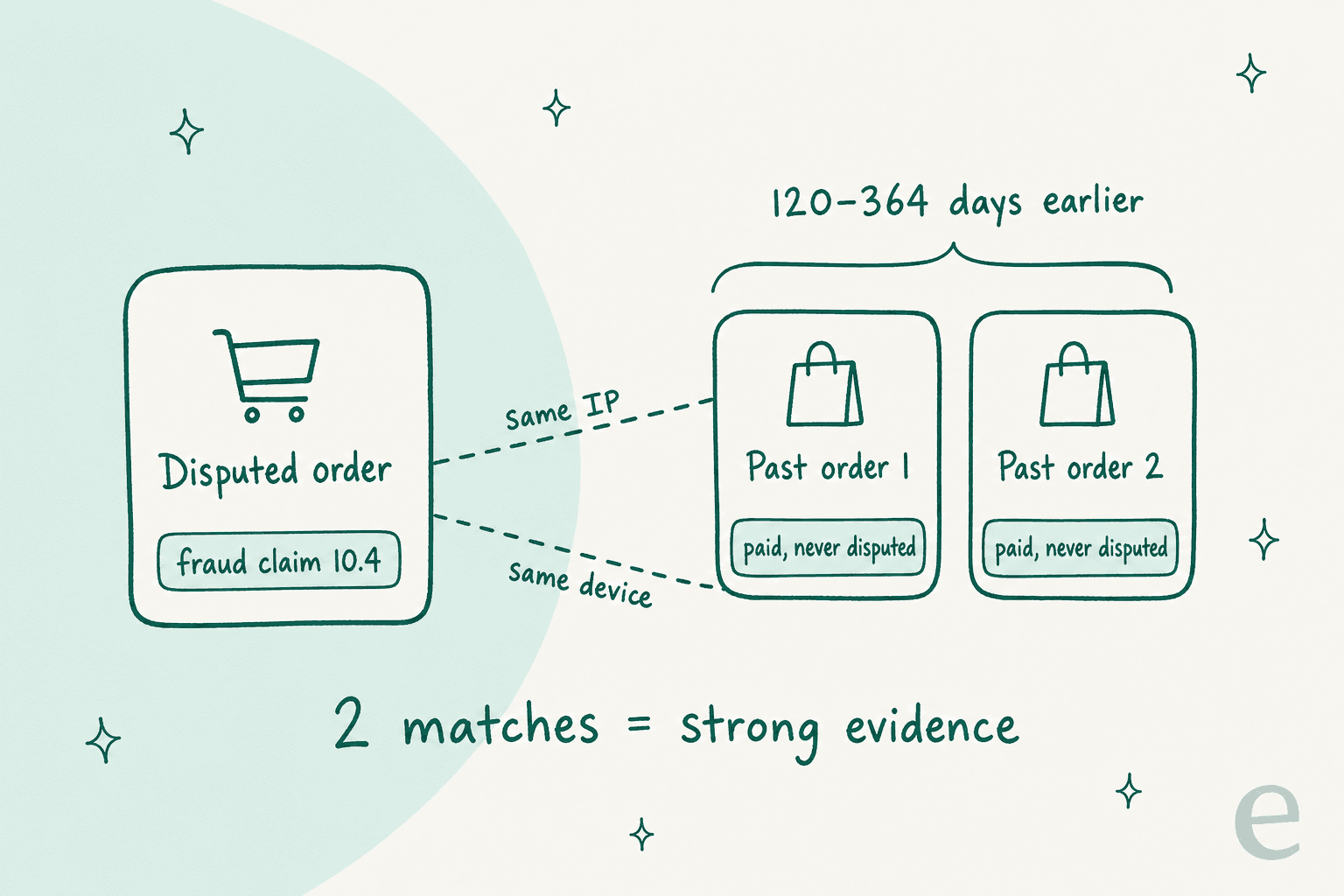
Per Stripe's CE 3.0 docs, you need at least two earlier paid, undisputed transactions on the same card, placed 120-364 days before, matching on two main data points (purchase IP, device) or one main plus one secondary (shipping address, email, account ID). Stripe checks eligibility for you. It can also use the same rule before the dispute is filed: if two prior transactions match on IP plus email or delivery address, the bank must block the dispute, at $15 per block.
The practical takeaway is boring and important: capture IP address, email and product description on every order. It's the data CE 3.0 runs on, and no AI can invent it later.
Should you fight, refund, or let an alert handle it?
This is where most teams end up arguing in Slack. The answer depends on the order value and your realistic win rate, then also on how close you are to a threshold. Plug in your own numbers; the fees are Stripe's US list prices.
With the defaults ($80 order, 30% win rate, Visa), letting Smart Disputes fight is cheapest at about $78 per dispute, and an alert refund costs about $95. That $17 gap is the price of keeping the case off your ratio. On a $15 order the math flips, and the alert or a quick refund is winning on cost as well. That's why Stripe's own example rule for RDR is to auto-resolve fraud disputes under $10.
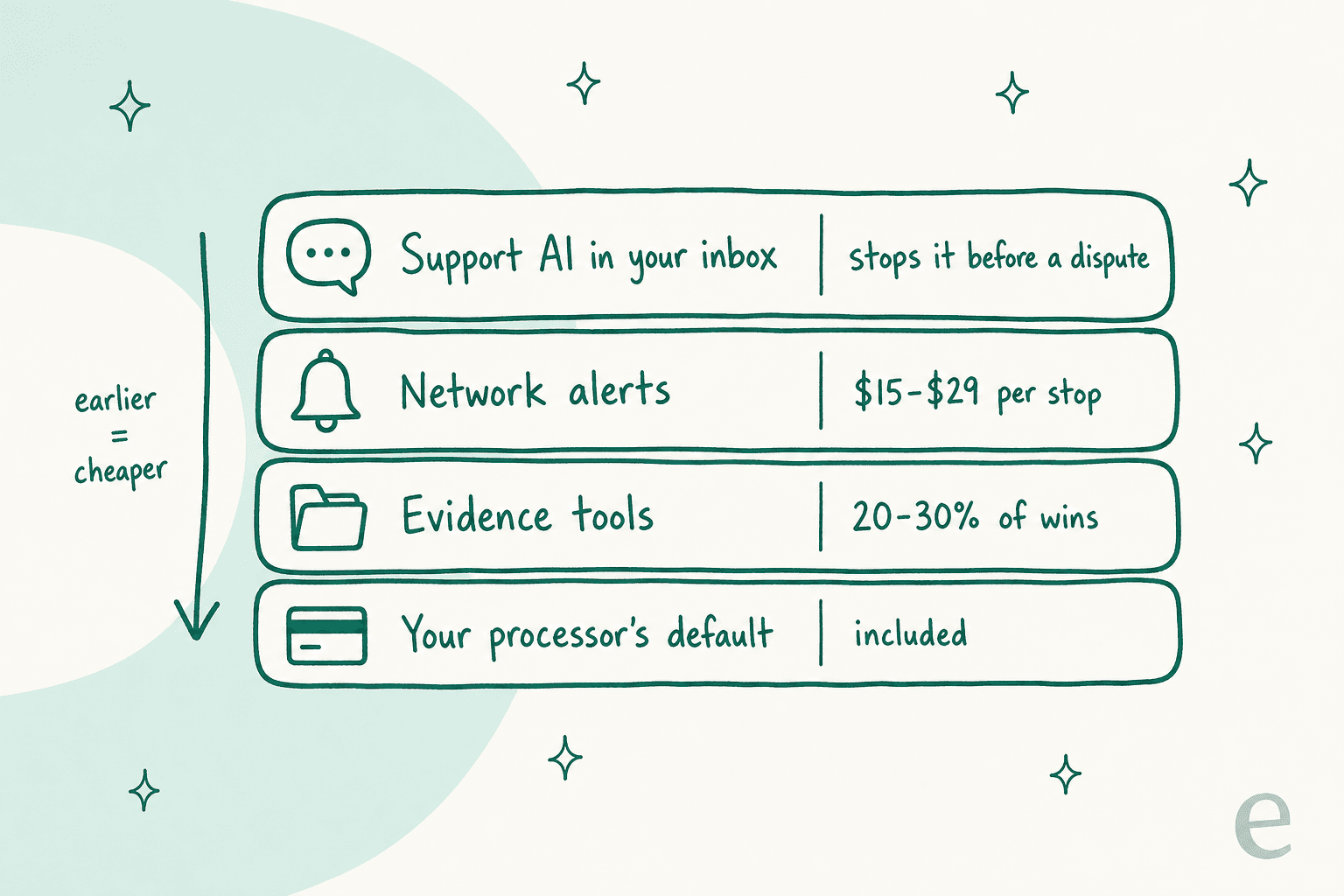
The rule I'd write down for an AI or a junior agent: refund small and fair claims early, let alerts catch fraud claims under a set amount, and fight large orders where you hold tracking with a delivery photo or a CE 3.0 match. Put it in a refund approval matrix so it's applied the same way at 3am as at 3pm.
Where support AI earns its keep
Everything above happens after the customer has decided to complain. The layer that stops the complaint lives in your helpdesk, and it's the one most dispute guides leave out, mostly because the dispute vendors don't sell it.
Most disputes start as an ordinary ticket. A customer doesn't recognize the descriptor on their statement, or a parcel is late, or a subscription renewed and they forgot about it. Proactive support, like a shipping-delay email before they ask, removes some of these entirely. Stripe's own data says about 40% of early fraud warnings become fraud disputes if the merchant doesn't refund. A SaaS founder on Hacker News described the most common version:
"I run a SaaS business, and whilst disputes are rare, I'm pretty sure most of them are from customers who forget to cancel their subscription. Rather than emailing me asking for a refund (which I'll be happy to give), these customers go straight to the dispute process."

Answering those first messages fast, with real data, is tier-1 support work, and it's what a support AI is for.
Here's what that looks like in eesel, the AI helpdesk teammate I work on, when it's connected to Stripe. The customer asked about a charge; the agent found the payment, confirmed the order, and queued the refund for a person to approve.
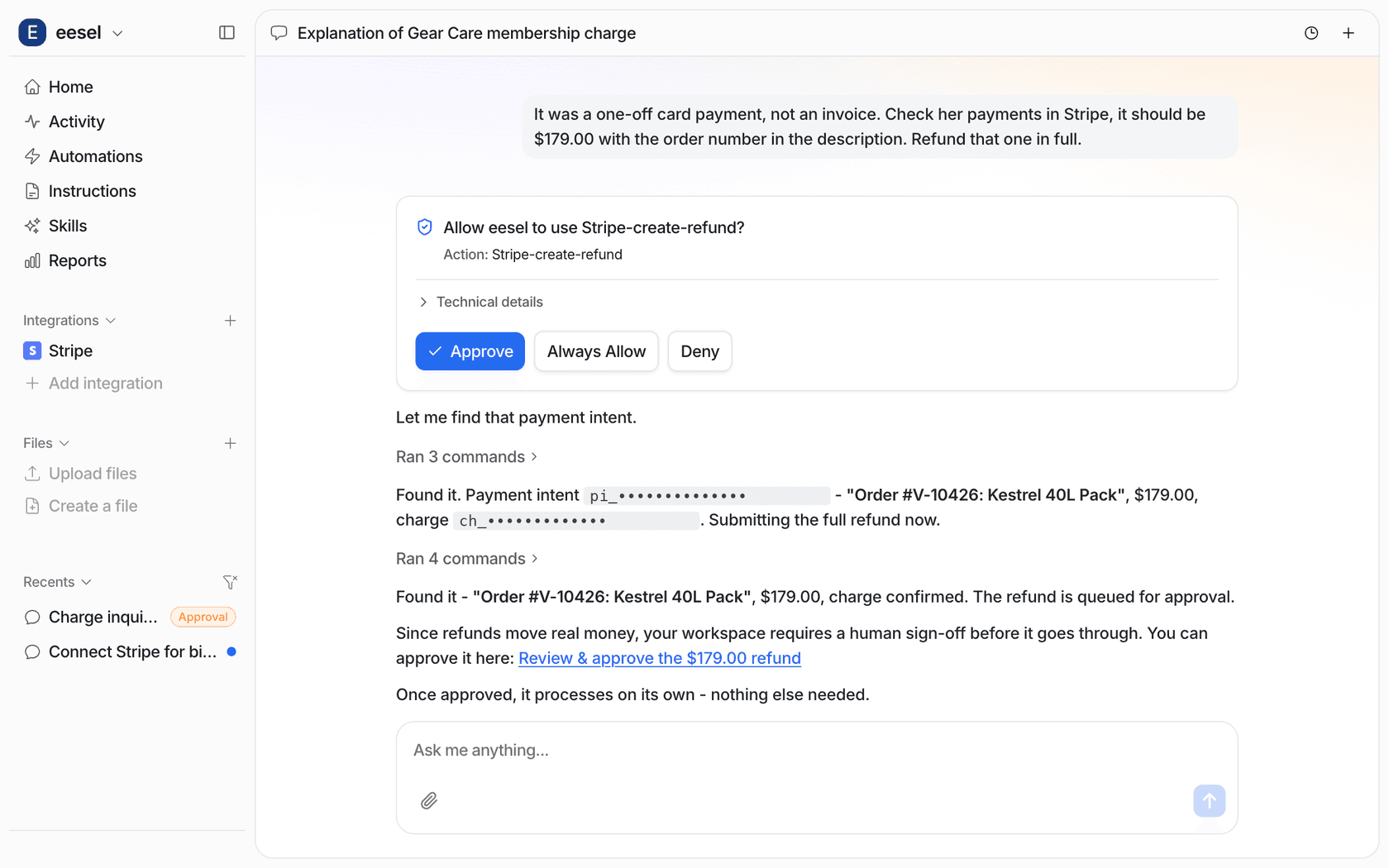
The Stripe integration reads invoices, payments, subscriptions and refunds, and states the amount back before proposing a refund, because refunds can't be undone.
If you want the full walkthrough, there's a guide to automating refunds with AI. Each action can run on its own, wait for approval, or stay off. On Shopify, it looks up orders, tracking and refund history before it writes anything. To be clear about the limit: eesel doesn't submit chargeback evidence to the bank. That stays with Stripe, Shopify or your dispute tool.
What it does well is the part before and around the dispute, and that's where the real customer stories are:
- Question Beauty runs eesel on Gorgias and Shopify. In a month it handled
990tickets, looked up290Shopify orders before answering, and closed280tickets without a person. Refunds, complaints and chargebacks go to a person, with an internal note on "what the customer asked, what it found in Shopify and why a person is needed." - Rúngne, a climbing apparel brand in Norway, handles
2,100Gorgias tickets a month. When money is involved, the agent writes a note with the facts instead of replying. - STIL Classics looked up
230Shopify orders in a month to prepare drafts. "The team reads the draft, processes the refund or replacement it describes if they agree... eesel never sends and never changes an order."
That internal note turns out to be quietly useful later, which is easy to miss. It's the "documented attempt to help the customer" that Chargeflow's Gorgias integration looks for when it builds a response, and the customer communication Shopify says it can't collect on its own.
A CX lead running about 7,000 tickets a month put the requirement better than I could on a sales call:
"I need an AI who is only handling the tickets that it's confident to handle and all the other ones, leave them alone."
That's the right instinct for anything that touches the money. Before switching anything on, I'd run the agent against past tickets with eesel's simulation skill to see how it would have answered, which is a far better test than a demo.
If you're building this out, tagging disputes in your queue, clear escalation rules, and fast order tracking answers do most of the prevention work.
Where you still want a human
There's a fair objection to all of this, and it came up when Stripe announced its 30% fee:
"A credit card dispute is a strong signal from an unhappy customer. And you're going to let it be handled by a robot? That's not smart. If you make it easy for customers to reach a human, and easy for a human to issue refunds, you don't get disputes."
I agree with the second half of that. The answer isn't fewer people, it's making the easy path to a refund faster than the path to the bank, while a person stays on the calls that need judgment. AI for payment disputes is good at gathering facts and following rules. Keep people on these:
- Large or unusual orders. A Mastercard response is capped at 19 pages and you get one submission, with no edits after. Someone should read the case before a big one goes in.
- Anything that looks like a pattern. Ten disputes from one IP range is a fraud problem, not a support problem. That's a job for your fraud rules and, on Stripe, Radar.
- Angry or vulnerable customers. An AI can explain a charge politely. Deciding whether to make an exception for a long-time customer is a human call.
- Policy changes. If your refund policy changes, the evidence your tools submit has to change too. A refund automation setup that still quotes last quarter's policy will lose cases.
The setup I'd recommend for most stores on one processor: turn on the built-in automation (Smart Disputes or Shopify's default), set alert rules for small fraud claims, and put a support AI in front of the inbox with clear approval workflows for refunds. Then add a specialist like Chargeflow or Justt when you outgrow one processor or your average disputed order gets large enough that a few points of win rate pay the fee.
Try eesel for payment-dispute tickets
If disputes are eating your support team's week, the place to start is where they begin, which is the "why was I charged?" email. eesel's AI helpdesk teammate plugs into Gorgias, Zendesk or Freshdesk alongside Shopify, reads the real Shopify order or Stripe payment, answers what it can with the facts, and hands chargebacks to your team with a note that already says what it found. Refunds wait for your approval unless you say otherwise.
It's free to start with 100 credits, and paid plans begin at $299 for 500 credits, where one ticket is one credit. Try eesel on a week of your billing tickets and see what it would have said.