

What is Rep AI?
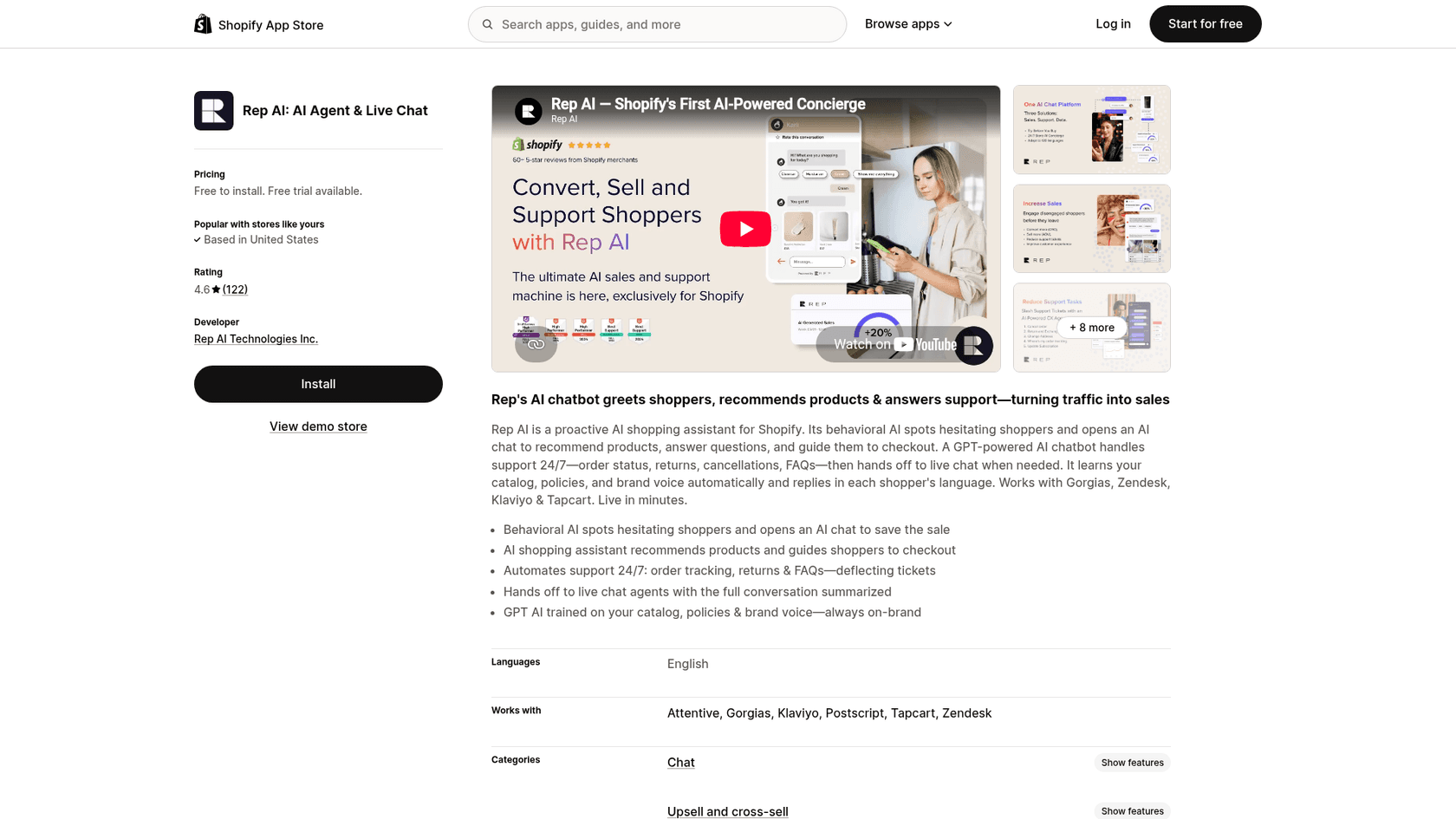
Rep AI is an AI sales and support agent built mainly for Shopify stores. The company behind it, Rep AI Technologies Inc., lists New York as its headquarters on LinkedIn, and its co-founder and CEO is Yoav Oz. The pitch on its homepage is one AI that sells, supports and reports across your website, email, Instagram, Facebook and WhatsApp.
The core of it is a chat widget on your store. Its Shopify listing describes "behavioral AI" that spots hesitating shoppers and opens a chat to recommend products and guide them to checkout, plus a GPT-powered agent that handles order status, returns, cancellations and FAQs and then hands off to a person. Rep's own help center is plain about the engine: "Rep is powered by ChatGPT", trained on your whole site except the blog.
It is Shopify-first in practice too. WooCommerce and Salesforce Commerce Cloud stores get reduced versions of some features, for example a link instead of an in-chat discount code, per its discount code article.
That puts Rep in the conversational commerce camp next to tools like VanChat and Zipchat, rather than in the helpdesk camp with Gorgias. That difference shapes everything below, including the bill.
How Rep AI works
Rep does three jobs: it starts sales conversations, it answers support questions with real order actions, and it gives you a console to correct and steer the AI. I'll take them one at a time.
Selling: proactive chats and product finding
Rep's homepage says it monitors "hundreds of behavioral signals", things like product comparisons, repeated browsing, search queries and exit risk, and opens a conversation when intent shifts. In the chat, shoppers describe what they want in plain words and Rep narrows the catalog, compares products and shows checkout-ready product cards. Its sales skills include upsells after add-to-cart, out-of-stock recommendations and abandoned cart rescue, per the pricing page feature list.
You are not stuck with Rep's triggers. A September 2026 help article explains how to create your own sales skills for any shopper behavior. The same article mentions a detail I liked: a share of sessions is held back for A/B measurement, so proactive skills stay hidden for some shoppers. That holdout is how a vendor can measure lift instead of just counting chats.
A reviewer on the Shopify App Store described the result in a store selling in two languages:
"It answers sizing and product questions in Hebrew and English, jumps in when a shopper hesitates, and it's driven 12% of our assisted sales while cutting repetitive support tickets."

Support: order actions and handoff to people
The Support plan is more than an FAQ bot. It covers order status, returns and exchanges, cancelling and modifying orders, answering emails and editing subscriptions, per the pricing page. These are the where-is-my-order questions that fill most Shopify inboxes, and Rep pulls order data straight from the store, which is the part most generic bots get wrong. (If you are curious how that plumbing works, I covered it in connecting Shopify order data.)
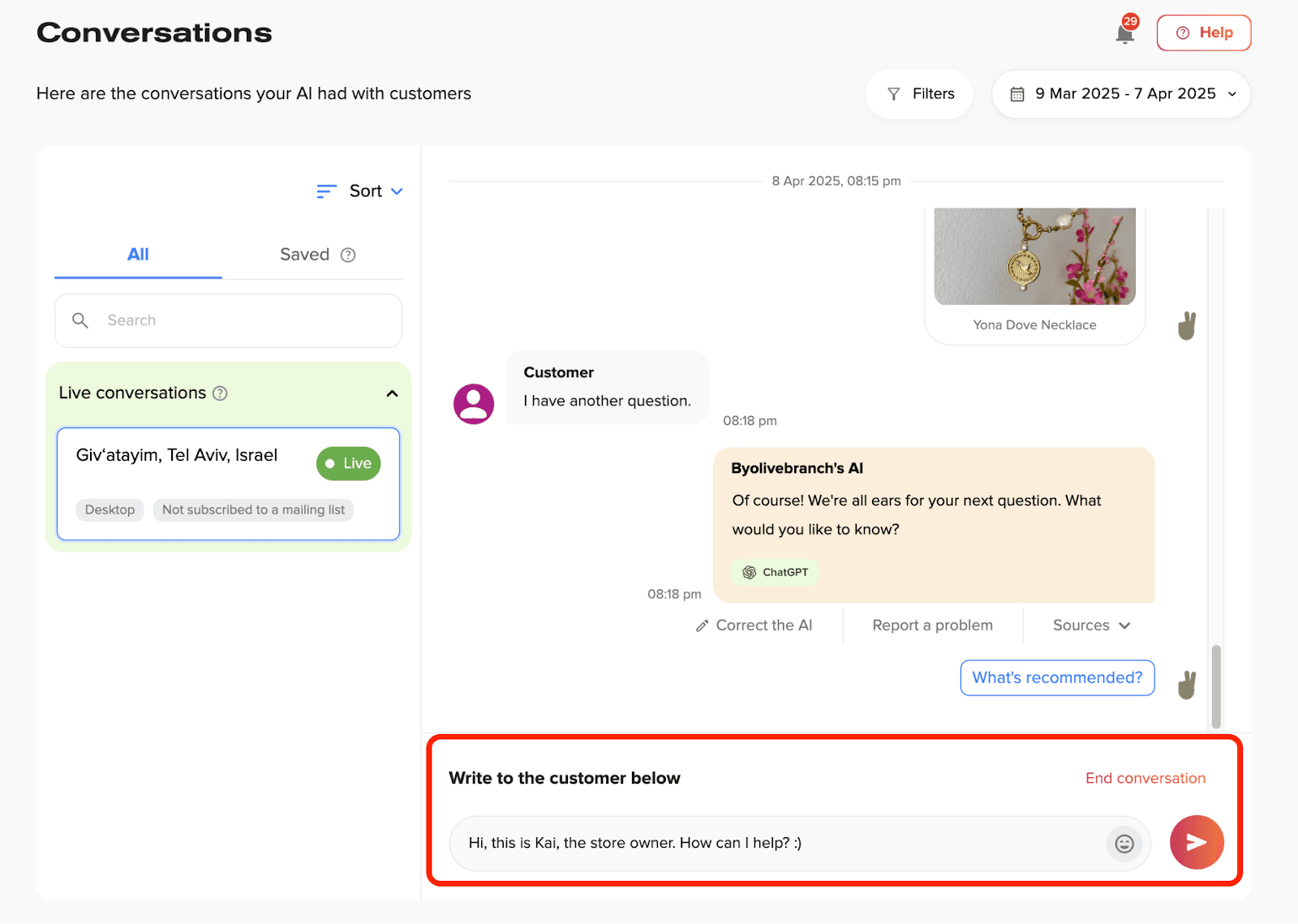
When a shopper needs a person, Rep has two paths. Inside its own console, you can see live conversations and use "Agent Drop In" to type to the shopper directly. If the shopper has already left the site, your reply goes out by email, per the human assistance article.
If you run a helpdesk, the Zendesk integration and the matching Gorgias integration work the same way: the AI collects the shopper's email and name, asks about the issue, and creates a ticket with the conversation attached. That is a clean handoff, and it follows most of the handoff best practices I'd want. What it doesn't do is work the ticket once it lands. From there, it's your team's queue.
Training and correcting the AI
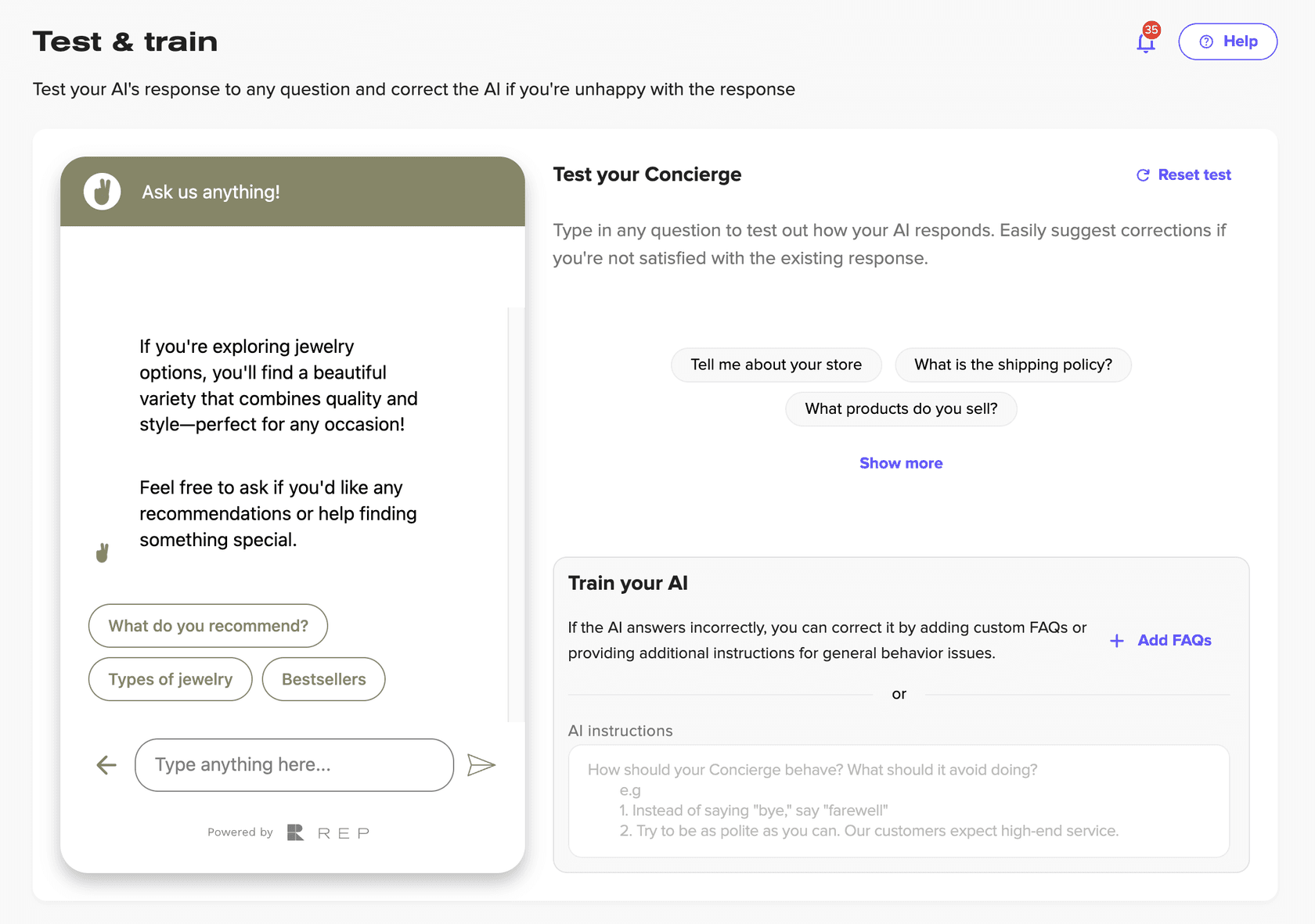
This is the part of Rep that I think gets undersold. The Test & Train page puts a live preview of your widget next to a training panel. You ask a question, see the answer and its sources, and either add a custom FAQ or write general instructions for how the AI should behave.
The other useful screen is Missing Information, a list of shopper questions the AI could not answer, sorted by topic and how often they were asked, with an Answer button that turns each one into an FAQ. One reviewer described exactly that loop:
"I have been monitoring the chats and seeing what information is missing in the product descriptions etc and once changed the responses are changed which is really great!"
From the support side, I'd call this the most important feature in the product. An AI that tells you what it doesn't know is far safer than one that guesses, and guessing is the thing AI hallucinations in support come from.
How Rep AI counts the sales it takes credit for
Every AI sales chat shows you a revenue number, so the question is always how it is counted. Rep's answer, in its attribution article updated in June 2026, is stricter than most.
A sale is linked to a chat only when the shopper buys in the same session. Then Rep's AI rereads the conversation and decides whether it actually helped. Sessions where the shopper only saw a greeting, where the AI could not answer, or where the shopper was handed to your team are filtered out.
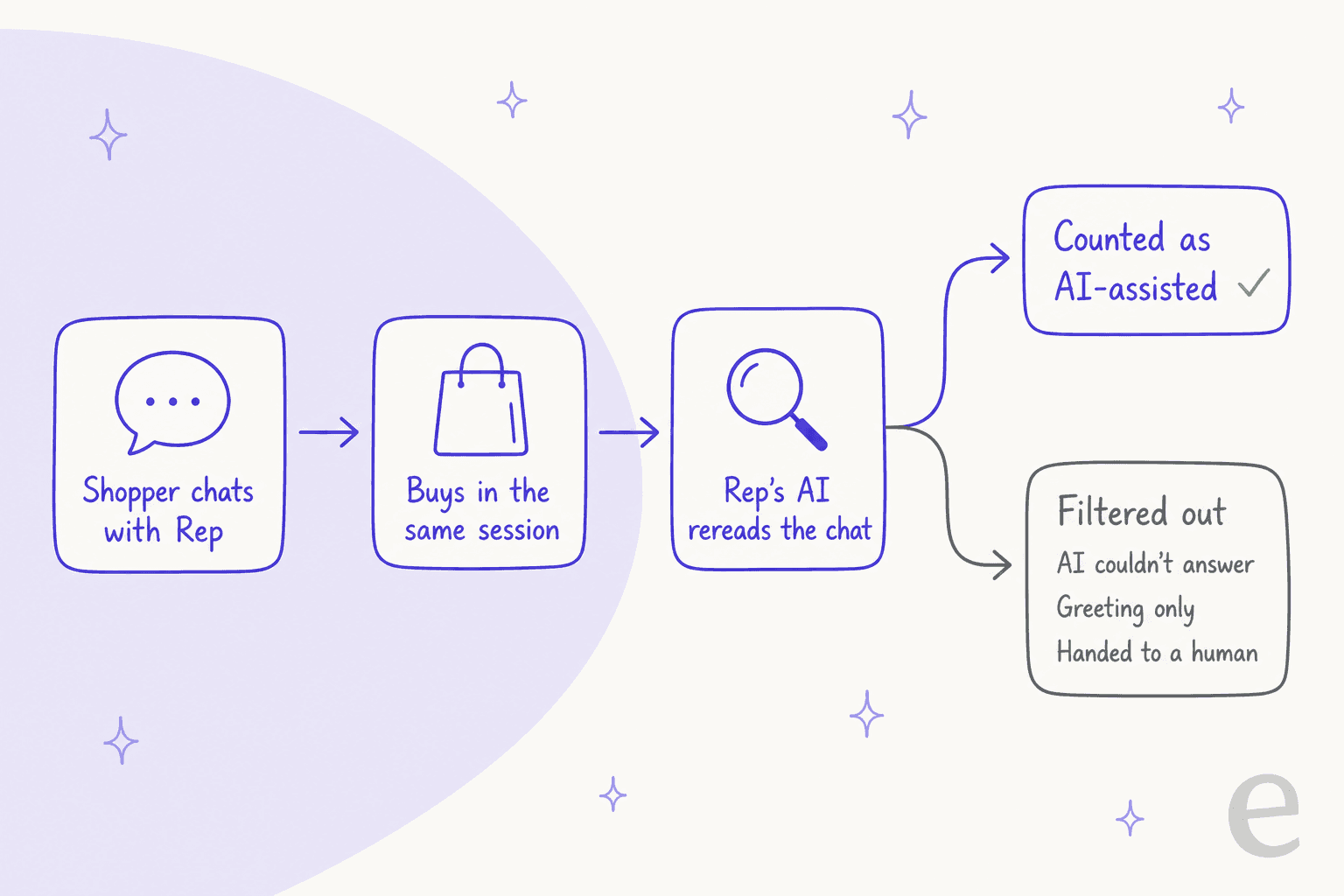
That is a real improvement over "any purchase after a chat counts". Two caveats are worth keeping in mind, though. The judge is still Rep's own AI, and same-session attribution cannot tell you whether the shopper would have bought anyway. The A/B holdout I mentioned above is the better evidence, so ask Rep for holdout results, not just the attributed revenue figure. An older one-star review from August 2024, written before the current rules, shows why merchants check:
"After the trial period, the app counted one sale, but when I checked the details in my backend, it was doubtful that this single sale came through this app."
Rep also advertises a "5x ROI money-back guarantee" on its homepage: "If you don't see the results, we'll refund you." I could not find written terms for it in the help center, so I'd ask how ROI is measured for the guarantee, and over what period, before relying on it.
Rep AI pricing
Here is the thing to understand before anything else: Rep AI's plans are priced by monthly website sessions. Not by chats, not by AI replies, not by resolutions. A store with 80,000 sessions pays the 80,000 price whether Rep talks to 300 shoppers or 3,000.
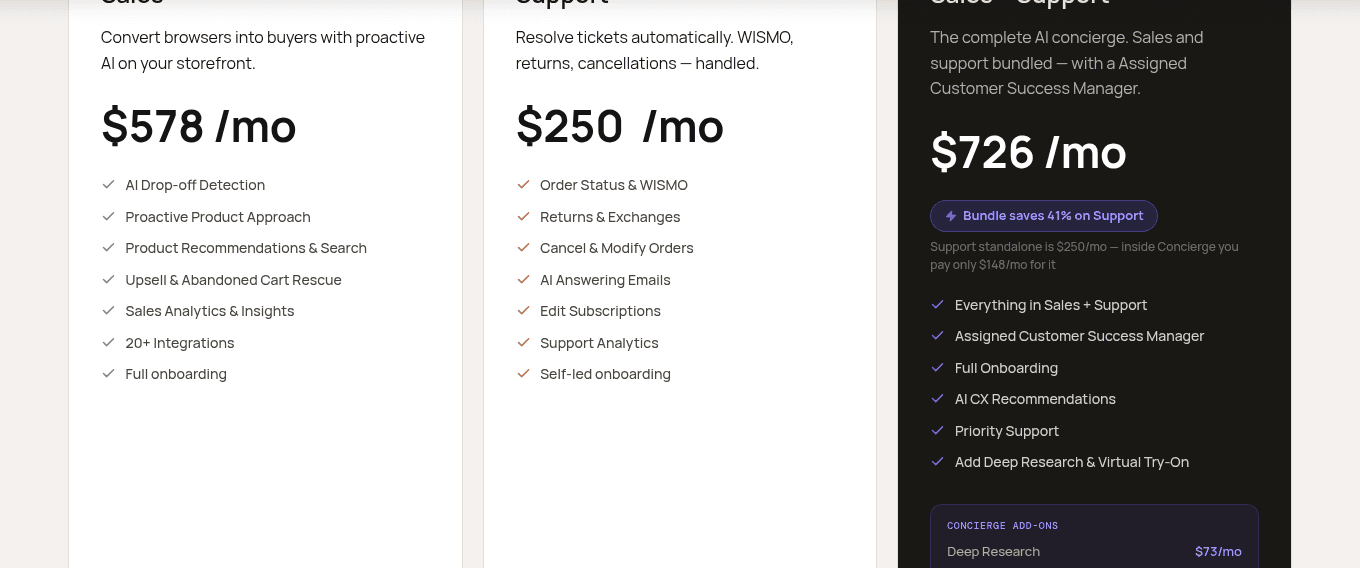
The page opens at 80,000 sessions, which is a lot for a small store. So I pulled the full tier table out of the page itself. Pick your traffic:
How many sessions does your store get a month?
Rep AI prices every plan by website sessions, not chats. Pick your traffic to see the monthly bill.
Sales works out to $4.00 per 1,000 sessions here. Every session past 3K costs $12 per 1,000, capped at $1,000 a month.
Sales works out to $10.40 per 1,000 sessions here. Every session past 10K costs $12 per 1,000, capped at $1,000 a month.
Sales works out to $8.36 per 1,000 sessions here. Every session past 25K costs $12 per 1,000, capped at $1,000 a month.
Sales works out to $7.36 per 1,000 sessions here. Every session past 50K costs $12 per 1,000, capped at $1,000 a month.
Sales works out to $7.22 per 1,000 sessions here. Every session past 80K costs $12 per 1,000, capped at $1,000 a month.
Sales works out to $6.47 per 1,000 sessions here. Every session past 125K costs $12 per 1,000, capped at $1,000 a month.
Sales works out to $5.78 per 1,000 sessions here. Every session past 180K costs $12 per 1,000, capped at $1,000 a month.
Sales works out to $5.42 per 1,000 sessions here. Every session past 250K costs $12 per 1,000, capped at $1,000 a month.
Sales works out to $5.02 per 1,000 sessions here. Every session past 500K costs $12 per 1,000, capped at $1,000 a month.
Monthly prices from the tier table on hellorep.ai/pricing, checked October 22, 2026. Overage rule from Rep AI's billing help article. Concierge bundles Sales and Support. Above 500K sessions, pricing is custom.
Monthly prices for each Rep AI plan at each session tier, from Rep AI's own pricing page.
The key numbers, all from the pricing page and checked October 22, 2026:
| Sessions a month | AI Sales | AI Support | AI Concierge (both) |
|---|---|---|---|
| 3,000 | $12 | Not offered | Not offered |
| 10,000 | $104 | $49 | $130 |
| 25,000 | $209 | $79 | $263 |
| 50,000 | $368 | $149 | $462 |
| 80,000 | $578 | $250 | $726 |
| 125,000 | $809 | $350 | $1,018 |
| 250,000 | $1,355 | $575 | $1,716 |
| 500,000 | $2,510 | $1,075 | $3,157 |
| 500,000+ | Custom (Enterprise) | Custom | Custom |
Yearly billing takes about 20% off, so AI Sales at 10,000 sessions drops to $83 a month. All plans come with a 14-day free trial with no card required, and the product catalog limit on the compare table is 10,000 products. Concierge adds an assigned customer success manager, and Rep's compare table notes that an assigned CSM is included for all plans above 50,000 sessions.
The overage rule, and why it nudges you up a tier
When you pass your plan's sessions, Rep charges $12 per 1,000 extra sessions, capped at $1,000 per billing period, per its billing cycle article. Compare that with what a session costs inside a plan: AI Sales at 50,000 sessions works out to about $7.36 per 1,000. Overage is the most expensive way to buy traffic, so if your traffic is close to a tier line, pick the tier above it. Rep's own annual plans article makes a similar point: yearly plans count traffic across the whole year, which absorbs seasonal spikes.
One one-star review shows what hitting the limit felt like for one store on an annual plan:
"paid for annual subscription - shut me off after 8 months and a certain number of views. I couldn't view billing history or anything in the app."
The other meters
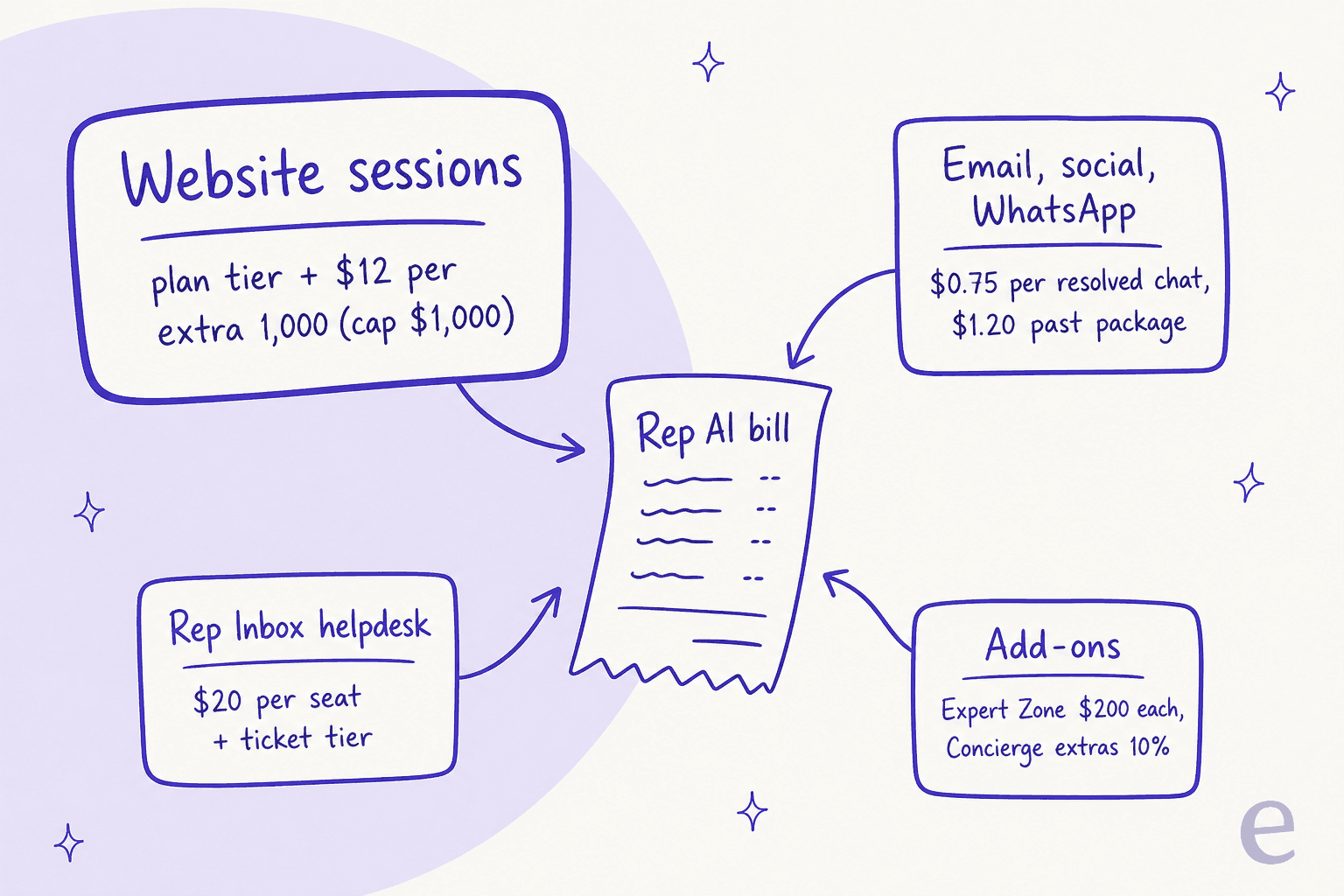
The session plan isn't the whole bill. Rep sells four more things, each priced its own way:
| Add-on | Price | Source |
|---|---|---|
| AI for Email, Social and WhatsApp (beta) | $0.75 per AI-resolved conversation; $1.20 per resolved conversation past your package | Pricing page, overage article |
| AI Helpdesk / Rep Inbox (beta, paying customers only) | $20 per seat a month ($16 on annual) plus a ticket tier: $8 for 50, $45 for 300, $270 for 2,000, $675 for 5,000 tickets | Pricing page, Rep Inbox billing |
| Expert Zone: Flow Studio Builder, Custom Support Policies, Product Finder Customization | $200 each on Sales or Support, included in Concierge | Pricing page |
| Deep Research, Virtual Try-On | 10% of your Concierge price each ($73 at 80,000 sessions) | Pricing page |
The resolution-based channel pricing is fair in one important way: Rep's overage article says you are not charged when the AI escalates, when a teammate takes over, or when it stays silent. That's the right definition. I go into why it matters in deflection vs resolution rate. Note that every Console user counts as a billable Inbox seat, Admins included, once you turn on Rep Inbox.
Where the listing and the site disagree
Rep's prices are mostly consistent across its own pages, but not entirely:
- Starting prices. The homepage pricing cards say AI Sales starts at $99, Concierge at $118 and Support at $49. The pricing page's lowest full tier (10,000 sessions) shows $104, $130 and $49, or $83 and $105 on yearly billing. G2's pricing panel also lists a $99 Starter plan for 10,000 visitors.
- Product limits. The Shopify listing caps products by plan: 100 on the free Pay-as-you-Grow plan, 1,000 on Starter ($104), 2,000 on Basic ($209) and 5,000 on Standard ($368). The pricing page's compare table shows a 10,000-product limit on every plan.
- Plans shown. The listing only shows Sales-skill plans (Starter, Basic, Standard), while the site also sells Support and Concierge. The listing's dollar amounts match the site's Sales prices at 10,000, 25,000 and 50,000 sessions, and its yearly prices ($995, $2,006 and $3,528) match the site's yearly rate too.
- The 25,000 tier. On the pricing page, AI Support at 25,000 sessions shows a yearly price ($99) higher than its monthly price ($79), which looks like a display error.
None of this is a deal-breaker, but confirm your exact plan, product cap and yearly price in the billing screen before you subscribe. For how this compares with tools that price per conversation or per seat, see Gorgias pricing for Shopify and Tidio pricing.
What Shopify merchants say in their Rep AI reviews
Rep AI holds a 4.6 rating from 122 reviews on the Shopify App Store: 115 five-star, one four-star, two three-star and four one-star. On G2 it has 4.9 out of 5 from 66 reviews, all five stars, with G2 listing a typical implementation time of one month. It has a claimed Trustpilot profile with no reviews yet.
How long reviewers had used it
A rating is only as good as the people behind it, so I read all 122 Shopify reviews and sorted them by the "time using the app" Shopify shows on each one.
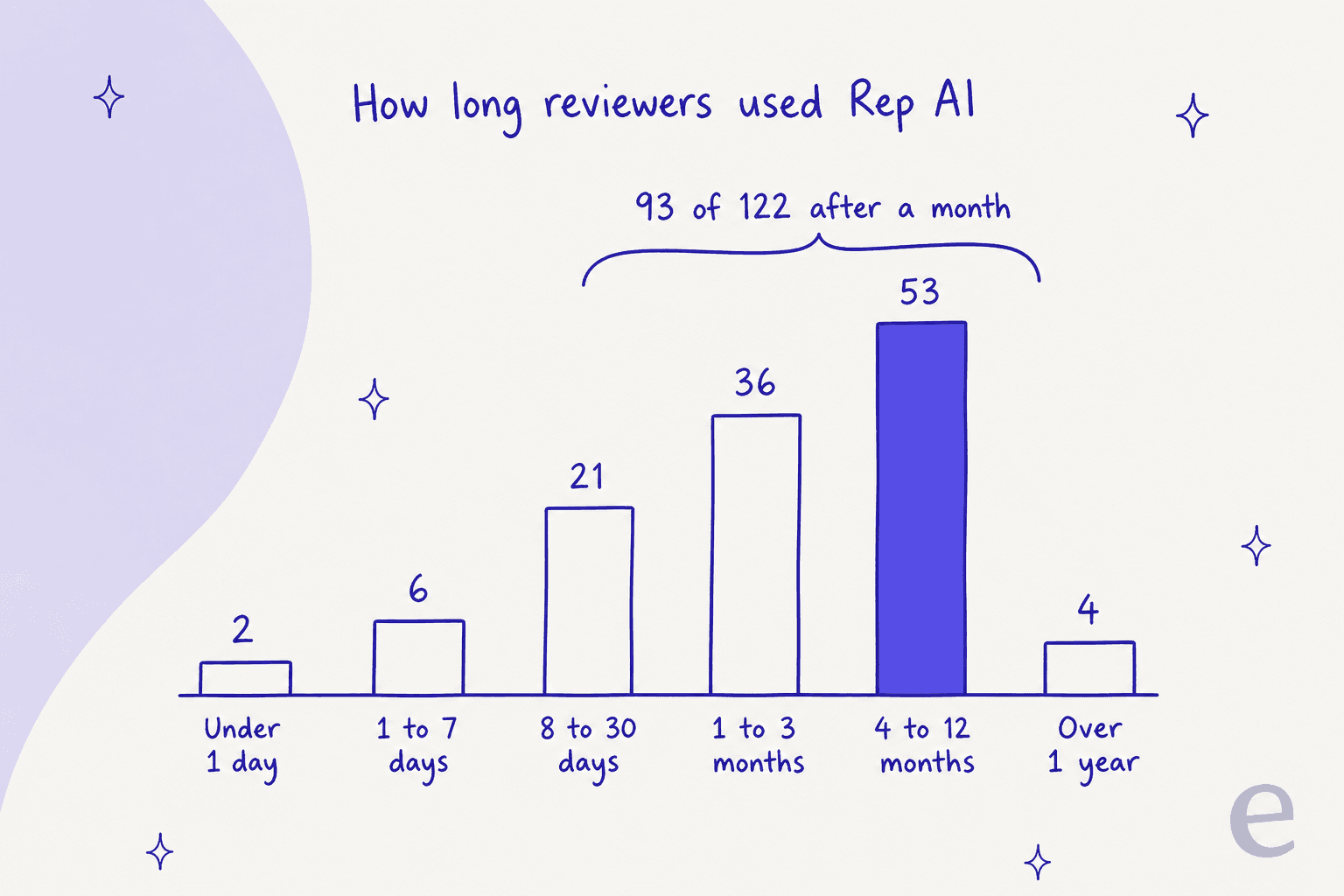
93 of the 122 reviewers had used Rep for a month or more, and 53 for somewhere between four months and about a year. Only eight wrote their review in the first week. That is a stronger base than the install-day reviews many Shopify apps collect, and it lines up with G2's one-month implementation estimate.
The second pattern is how often reviewers name a person. 32 of the 122 reviews mention a Rep team member by name, most often customer success managers Dafi (12 reviews) and Gabriela (8). Rep is a high-touch product. Merchants credit the onboarding calls and the weekly tuning as much as the AI, and one reviewer put it simply:
"Just be sure to use their support to set up the correct communications with visitors to your site."
That is a strength if you want hand-holding. It also means some of what people praise is the service around the AI, which you get on Concierge or above 50,000 sessions, not on a self-serve Support plan with self-led onboarding.
The critical notes
The low ratings are few, but they cluster around the same two themes: answer quality and price. A three-star review from a store with six months on the app is the most useful one I read:
"Lots of confident-sounding answers that often don't actually address the question the customer is asking and lead to circular conversations."
A one-star review from May 2025 said the bot "annoyingly guesses answers and often answers incorrectly", and an August 2024 review said several training sessions were needed and "depending on the size of your shop, it can become a significant monthly expense". On price, reviews pull both ways: one store said the price "kept me from installing it initially" and then called it worth it, while the American Hospital Supply review above ended with "not worth $550 per month for a basic LLM". A July 2026 one-star review said the app still showed on the theme after uninstalling.
Outside the App Store, Reddit mentions are thin, and most threads are vendors pitching their own tools. The clearest user note came from a supplement store owner on r/ecommerce:
"We use rep ai which functions more like a shopping assistant, handling faqs, upselling, and passes the trickier questions to us."

That last line is a fair summary of the product. Rep sells and answers the easy questions, and the trickier ones still come to you.
Rep AI pros and cons
| Pros | Cons |
|---|---|
| Proactive sales triggers, plus custom sales skills you can build yourself | Price follows traffic, so quiet sessions still cost money |
| Real support actions: order status, returns, cancellations, address and subscription changes | Separate meters for channels, helpdesk seats, Expert Zone and Concierge add-ons |
| Same-session, AI-reviewed sale attribution and an A/B holdout | The AI that judges attribution is Rep's own |
| Test & Train and Missing Information screens make gaps visible | Reviews mention confident wrong answers until the AI is trained |
| 4.6 from 122 Shopify reviews, 93 of them after a month or more | Best results lean on CSM help, which is fuller on bigger plans |
| Handoff into Gorgias or Zendesk with the transcript attached | Shopify-first; WooCommerce and Salesforce Commerce get reduced features |
Who Rep AI fits, and who should skip it
Pick Rep AI if you run a Shopify store with steady traffic, a catalog that shoppers need help choosing from (sizes, variants, compatibility), and your main goal is turning browsing into orders. It's also a good fit if you like a vendor that sits down with you weekly. The reviews show that is where Rep shines.
Skip it, or test carefully, if your traffic is high but your chat rate is low, because the session price doesn't care how many people you actually talk to. The same goes if your real pain is a full email and helpdesk queue rather than the storefront. Rep's Inbox and email answering exist, but they are newer, beta add-ons on top of a plan you must already pay for. Stores in regulated categories should also watch what the bot says. A commenter on the same Reddit thread above pointed out that you "can't let a bot make medical claims", which is a reason to lean hard on Rep's AI instructions field.
If you're weighing it against other storefront chat apps, my reviews of Chatty, Willdesk and Siena AI are a good next read, and the full field is in my list of Shopify chatbot apps.
My Rep AI verdict: 4 out of 5
Rep AI is a mature, sales-first AI agent for Shopify. The behavioral triggers, the custom sales skills, the order actions and the training screens all hold up, and a 4.6 rating where most reviewers stuck around for months is hard to fake. I also respect the attribution rule: filtering out greeting-only and handed-off sessions is more honest than most chat apps manage.
I take a point off for the pricing model. Paying by sessions makes Rep cheap for a small, chatty store and expensive for a big store whose visitors mostly browse in silence. Then email, social, helpdesk seats and add-ons each bring a separate meter, and the homepage, pricing page and listing don't quite agree on the starting price. Run the 14-day trial on real traffic, ask for holdout results, and read your chat logs before you trust the revenue chart.
How eesel compares for Shopify support
I'll be straight about where eesel fits, because it is not a like-for-like swap. Rep is built to sell on the storefront. eesel is an AI teammate platform, and the teammate that matters here is the AI helpdesk teammate: it joins the queue you already run in Gorgias, Zendesk or Freshdesk, learns from your past tickets, help center and Shopify store, and answers or drafts replies on the tickets themselves. It can also run a chat bubble on your site.
The reason I lead with the queue is what I hear on calls. An ops lead at a DTC supplements brand doing about 7,000 Gorgias tickets a month told eesel's team that their agents simply couldn't keep up and needed AI to resolve at least half of email volume: order tracking, subscription changes, basic product questions. That's an inbox problem, not a storefront problem. eesel has learned the hard way that a confident AI is not the same as a correct one. In one real-traffic trial on an ecommerce inbox, agents sent only 12% of AI drafts as-is and rewrote the rest into much shorter replies. That's why eesel runs every rollout against your historical tickets before it answers a real customer, and why the Unicorn Snot review above rings true to me.
Here is how that looks with real stores:
- Cape Coffee Beans runs eesel on Zendesk, Shopify and Google Drive. In one month it ran about 160 scheduled checks of the queue, was called into 23 tickets by the team, and ran about 120 knowledge searches across tickets, products and Drive files.
- Nordbutiker sells e-bikes and scooters in four Nordic countries and runs a separate bot for each of four brands, on Zendesk tickets and the website chat bubble.
- SaunaSpace drafts Gorgias replies in its own calm voice: 110 customer conversations and 180 draft replies in a month, answered from 1,550 pages, articles and past tickets.
Pricing works differently too. eesel's pricing is a fixed monthly batch of credits, where one ticket or chat is one credit, handled, not resolved: free with 100 credits, then $299 a month for 500, $499 for 1,000, up to $1,749 for 5,000. Overage at $0.80 a credit is off unless you turn it on. Traffic doesn't count at all. To be fair to Rep, a small store that mainly wants storefront selling pays less with Rep's $104 Sales plan at 10,000 sessions than with eesel's $299 entry plan. eesel earns its place when the job is clearing the Shopify helpdesk queue, and the two can run side by side: Rep on the storefront, eesel on the tickets Rep hands off.
Try eesel on the tickets behind your Shopify chat
If Rep or another storefront chat is already selling for you, the tickets it hands off still need answering. eesel plugs into Gorgias or Zendesk, reads the Shopify order before it replies, and learns from the tickets your team has already solved, so the first draft sounds like you. You can test it on your own past tickets before it ever talks to a customer, with 100 free credits.
Frequently Asked Questions
Is Rep AI worth it? What does an honest Rep AI review conclude?
For a Shopify store with steady traffic that wants an AI chat focused on selling, yes. My Rep AI review gives it 4 out of 5: proactive sales triggers, real support actions like cancellations and address changes, a stricter-than-usual sale attribution rule, and a 4.6 rating from 122 Shopify reviews where 93 reviewers had used it for a month or more. I take a point off because the price follows your traffic, not your chats, and the pricing is spread across several meters. Compare it with other Shopify AI chatbots before you commit.
How much does Rep AI cost?
Rep AI prices by monthly website sessions. On its pricing page, AI Sales is $104 a month at 10,000 sessions, $368 at 50,000 and $578 at 80,000; AI Support is $49, $149 and $250 at the same tiers; and the Concierge bundle is $130, $462 and $726. Extra sessions cost $12 per 1,000, capped at $1,000 a month. For how other tools price, see my Shopify AI pricing breakdown.
Does Rep AI have a free plan?
Sort of. The Shopify App Store listing shows a free-to-install Pay-as-you-Grow plan with 100 free visitors a month and up to 100 products, then $12 per extra 1,000 visitors. Every paid plan also has a 14-day free trial. If you want a free option that answers support tickets, eesel starts with 100 free credits, one per ticket or chat.
What does Rep AI count as a sale?
Rep links an order to a chat only when the shopper buys in the same session, then its AI rereads the conversation and drops the sale if the chat was only a greeting, the AI could not answer, or the shopper was handed to a person. That is stricter than counting every purchase after a chat, but Rep still grades its own work. Run your own before-and-after check, the same way you would judge any Shopify AI chatbot.
Does Rep AI work with Gorgias and Zendesk?
Yes. Rep AI can import help center articles from both and, when a shopper asks for a person, it collects their email and name and opens a ticket in Gorgias or Zendesk. The ticket then lands with your team. If you want AI on the tickets themselves, look at an AI teammate that works inside the helpdesk, like eesel.
Is Rep AI good for customer support, or mostly for sales?
Both, but sales is where it started. The Support plan handles order status, returns, exchanges, cancellations, address changes and subscription edits in the chat, and email, social and WhatsApp answers are a paid add-on at $0.75 per AI-resolved conversation. If your main pain is a full email queue, compare it with the options in my AI for Shopify support roundup.