

What is Zipchat?
Zipchat calls itself an omnichannel AI shopping assistant for ecommerce brands. In plain terms, it is an AI chatbot for ecommerce that sits on your search bar, product pages and chat bubble, and follows the shopper into WhatsApp, Instagram DMs, Messenger and email. The homepage says it is trusted by 2,500+ ecommerce brands.
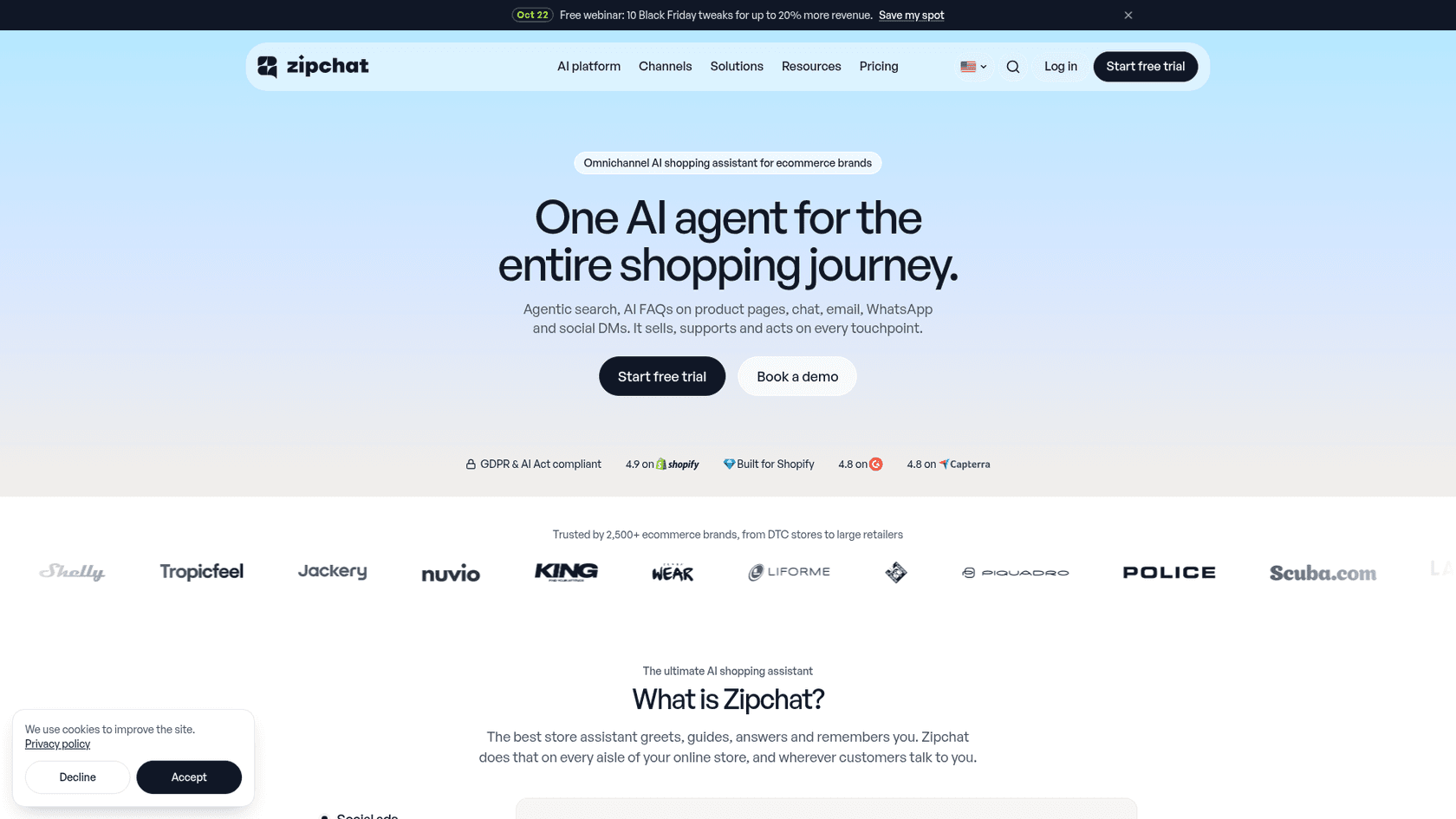
The company is small and founder-led. Its about page names three co-founders, Ruslan Leteyski, Luca Borreani and Carlo Bellati, who previously built CheckoutX and Udroppy, and a team of 18 people, six of them engineers. It is headquartered in Tallinn, Estonia, while the Shopify listing shows the developer as ZIPCHAT INC, based in the United States. The app carries Shopify's Built for Shopify badge.
I work eesel's support queue every day, so I read Zipchat's docs and reviews with one question in mind: what happens on the day the AI cannot answer and a person has to step in? That moment decides whether a chatbot saves your team time or quietly creates a second inbox. I'll come back to it, because it is where most of the honest complaints sit.
How Zipchat works
Zipchat is one AI agent that you train on your store, then switch on per channel. The quickstart docs describe three jobs: sell more, support smarter, and learn from every chat. Setup takes "under 30 minutes" per the pricing FAQ: install the Shopify app, or paste one script on other platforms like WooCommerce, BigCommerce, Magento, Wix or Webflow.
Training: crawl, correct, prompt
Training starts with the knowledge base. Zipchat crawls your site automatically, and you can add single pages, whole sections, PDFs, plain text, a CSV of links or an XML sitemap. The plan sets the ceiling, from 100 pages on Free to unlimited on Scale Plus.
On top of that sit chat corrections: when you fix an answer, Zipchat saves it as a Q&A entry, with an optional expiry date for things like promotions. The docs are refreshingly candid about the limit here. Corrections only load when the AI does an information search, so they won't change how it handles order tracking or escalation. Their rule of thumb is "use corrections when you want to change what Zipchat knows", and prompting when you want to change what it does.
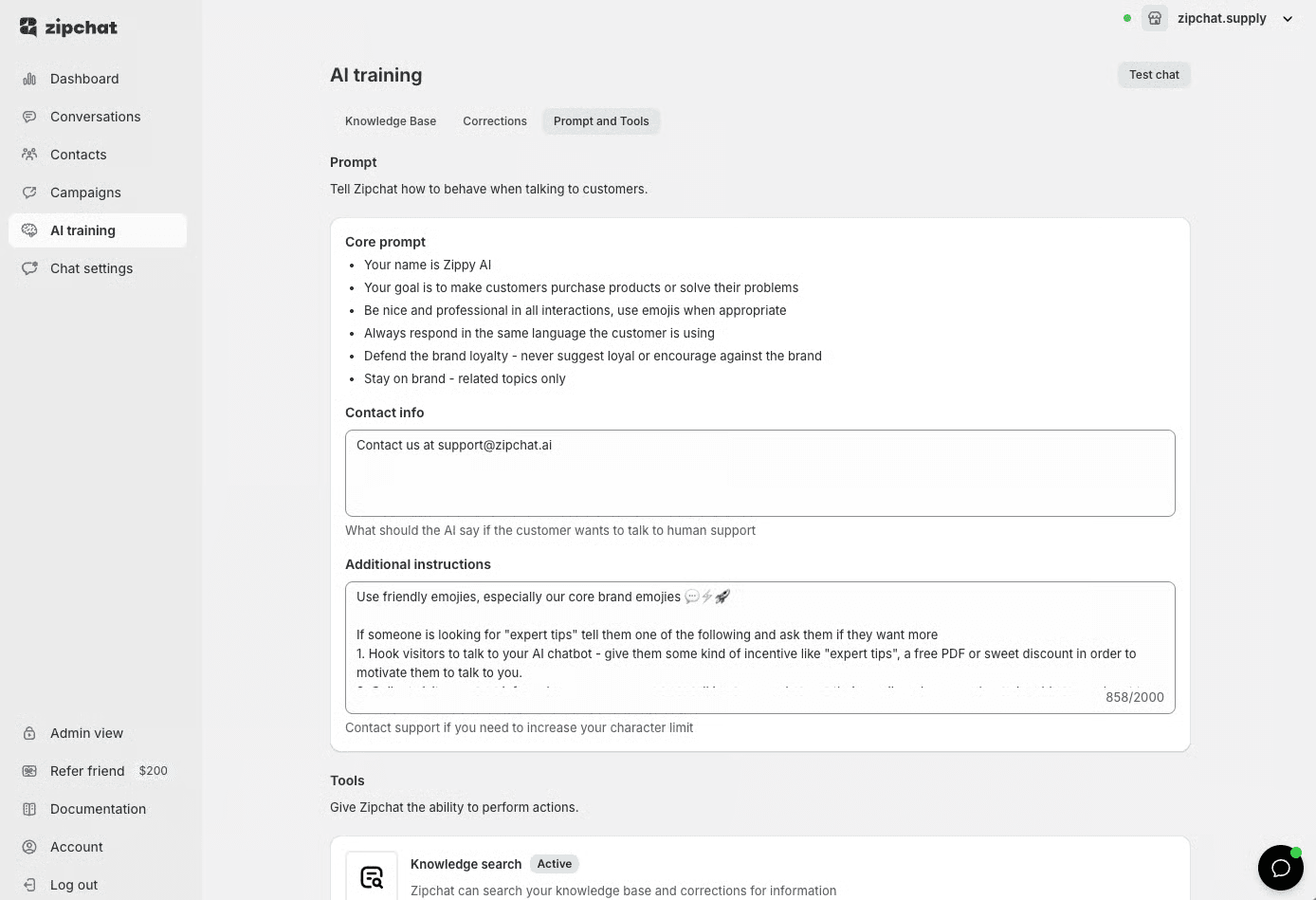
The Prompt and Tools page is where behaviour lives, in four layers: a core prompt shared by all Zipchat bots, a contact info field for human handoff, additional instructions (your "business playbook"), and per-tool instructions. That last layer is useful. You can tell the escalation tool to ask a clarifying question first, or tell the discount tool to only create a code when a shopper says the price is too high.
Tools and Agentic Skills
Out of the box, the agent has five tools: knowledge search, escalate conversation, order lookup (by email and order number from Shopify), create discounts (Shopify only), and skip conversation. That covers the classic WISMO automation job and the "is there a code?" moment.
Agentic Skills extend it into other tools. You install a template from Zipchat's gallery, add your credentials, and test it. The examples on the page are concrete: a two-step return that checks the window and creates the label, a subscription skip, a loyalty points lookup, car parts fitment, store stock checks, opening a Freshdesk ticket, and booking a slot in Cal.com. The page's own comparison table puts it well: without skills, "the AI explains and your team finishes the job".
That's the same split I'd use to judge any AI agent vs a chatbot. Zipchat with skills connected is closer to an agent. Without them, it is a well-trained answer bot.
Channels and the inbox
Every plan includes the chat widget, email, WhatsApp, Instagram and Messenger. Email works by forwarding your support inbox to a Zipchat address, then verifying your own domain so replies don't come from Zipchat's (email setup guide). WhatsApp runs on the WhatsApp Business API, and Zipchat also sells WhatsApp marketing campaigns, which carry Meta's own fees (more on that in pricing).
All conversations land in Zipchat's Conversations tab, where you can watch chats live, see which page a chat started on, track chat-to-sale conversions on Shopify, and fix answers on the spot.
Handing off to a human
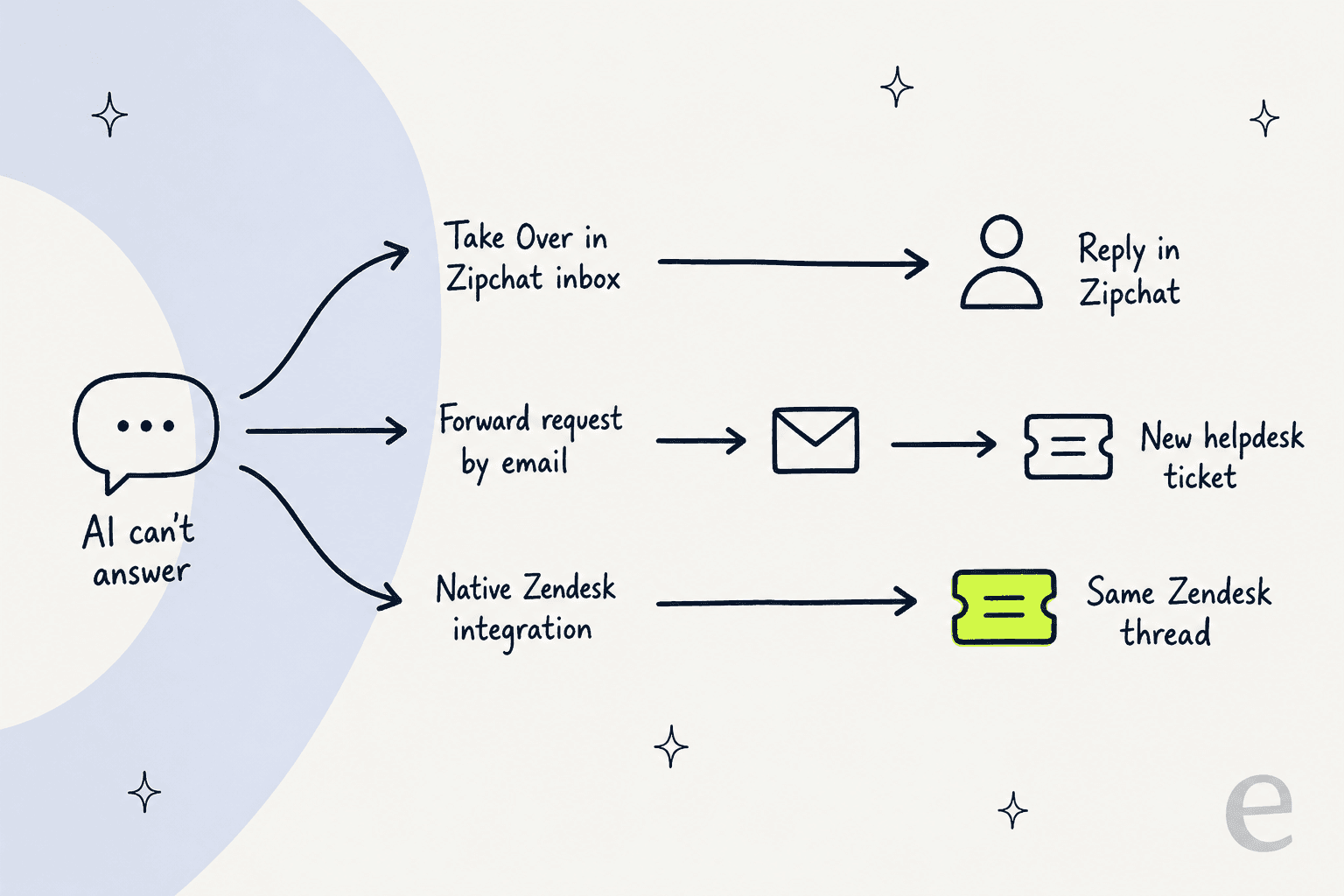
This is the part worth understanding before you install. There are three different ways a person ends up taking over, and they behave differently.
- Take over inside Zipchat. You open the chat, click Take Over, reply on web or WhatsApp, then click Enable AI Replies when you're done (docs).
- Forward request by email. The escalation tool flags the chat in the inbox and can email it to an address you set. If that address is your helpdesk, the chat shows up there "as regular tickets".
- The native Zendesk integration. On Zendesk, Zipchat answers tickets and chats inside your account and hands off "in the same thread", with escalation rules for a human request, a confidence threshold, or set topics. It's included on every plan.
Option three is the clean one. Options one and two are where the complaints in the reviews come from, which I cover below. If you run Zendesk, the integration also means you don't need Zendesk's own AI add-on to get AI in Zendesk, though you'll still want to read up on chatbot escalation design either way.
What Zipchat does well
The praise across reviews is consistent, and most of it lines up with what the docs promise.
A sales-first chat that shows its revenue
Zipchat's dashboard leads with money, not tickets: sales that included a conversation, total orders, chat-to-sale conversion rate, average order value, chats started and replies sent. For an owner who wants to know whether the chatbot pays for itself, that's the right first screen.
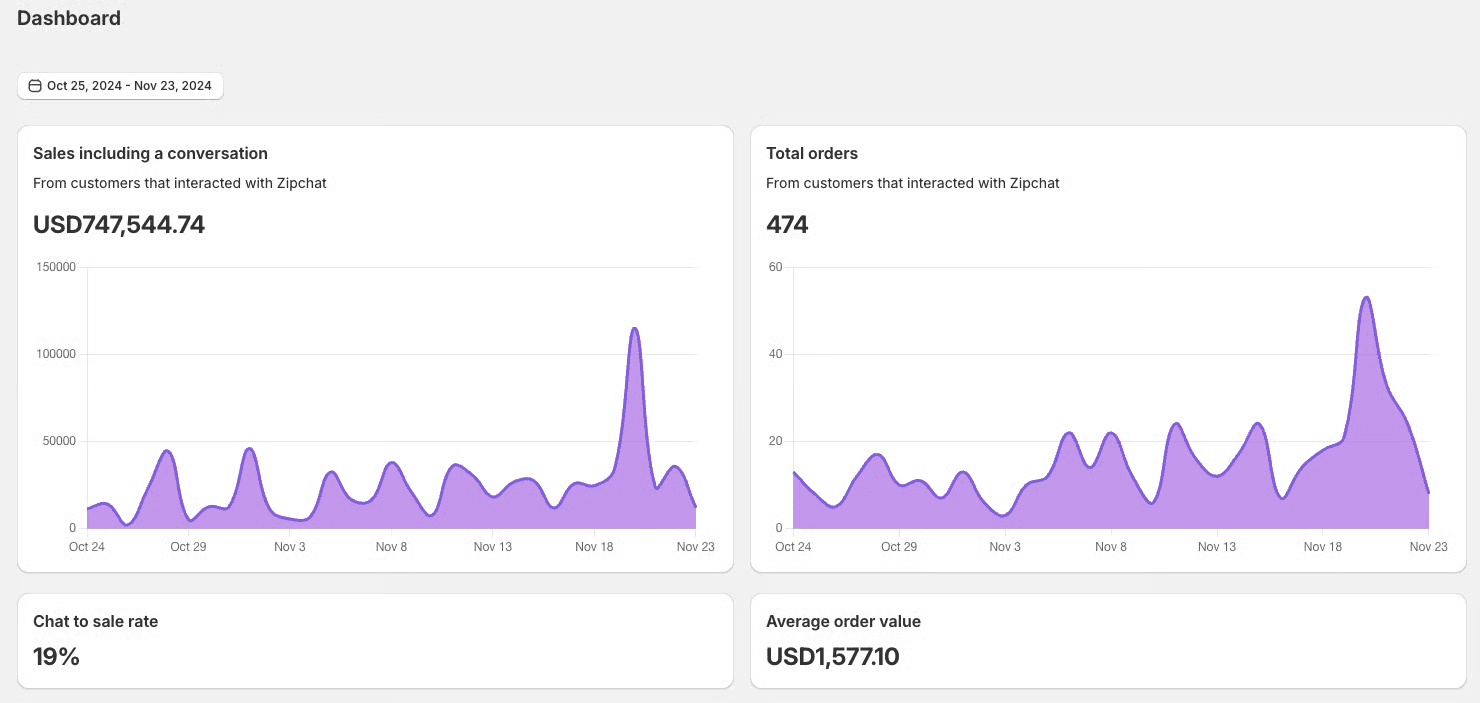
The selling features are the reason most merchants install it: proactive messages on cart value, exit intent or time on page, product recommendations from the catalog, unique discount codes, and answers to the pre-purchase questions that would otherwise send a shopper back to Google. A mid-market automotive reviewer on G2 described the before state well:
"Previously there was no facility for customers to raise product queries without stepping away from the site, therefore impacting on the customer journey and reducing the likelihood of conversion."

Setup is fast, and merchants keep saying so
"Easy setup" is the most repeated phrase in Zipchat reviews. On the Shopify side, Zipchat is a one-click install that crawls the catalog on its own. One G2 reviewer who has run it for two years put it bluntly:
"I've worked with competitors before, and I can say Zipchat AI is the easiest setup I've ever done."
The vendor also includes a free onboarding call on every new plan, and there's a free store preview on the site that shows the agent on your own products before you sign up.
Every channel and every language on every plan
Some chat apps gate WhatsApp or Instagram behind a higher tier. Zipchat doesn't: the plan comparison shows chat, email, WhatsApp, Instagram and Messenger on Starter, along with API access, human escalation, proactive AI and WhatsApp marketing. Language detection is automatic, and Zipchat replies in the shopper's language from the first message, which matters if you sell across Europe like many of its customers do. If that's your main need, my guide to multilingual ecommerce support goes deeper.
Unlimited team members on every plan is a nice touch too. You pay for AI usage, not seats.
Where Zipchat falls short
None of these are dealbreakers on their own. They're the things I'd check in the 7-day trial.
You pay per reply, not per conversation
Zipchat's pricing FAQ defines a reply as "any response the AI sends", and "each outbound AI message counts as one reply". So a shopper who asks about shipping, then sizing, then returns uses three replies in one chat.
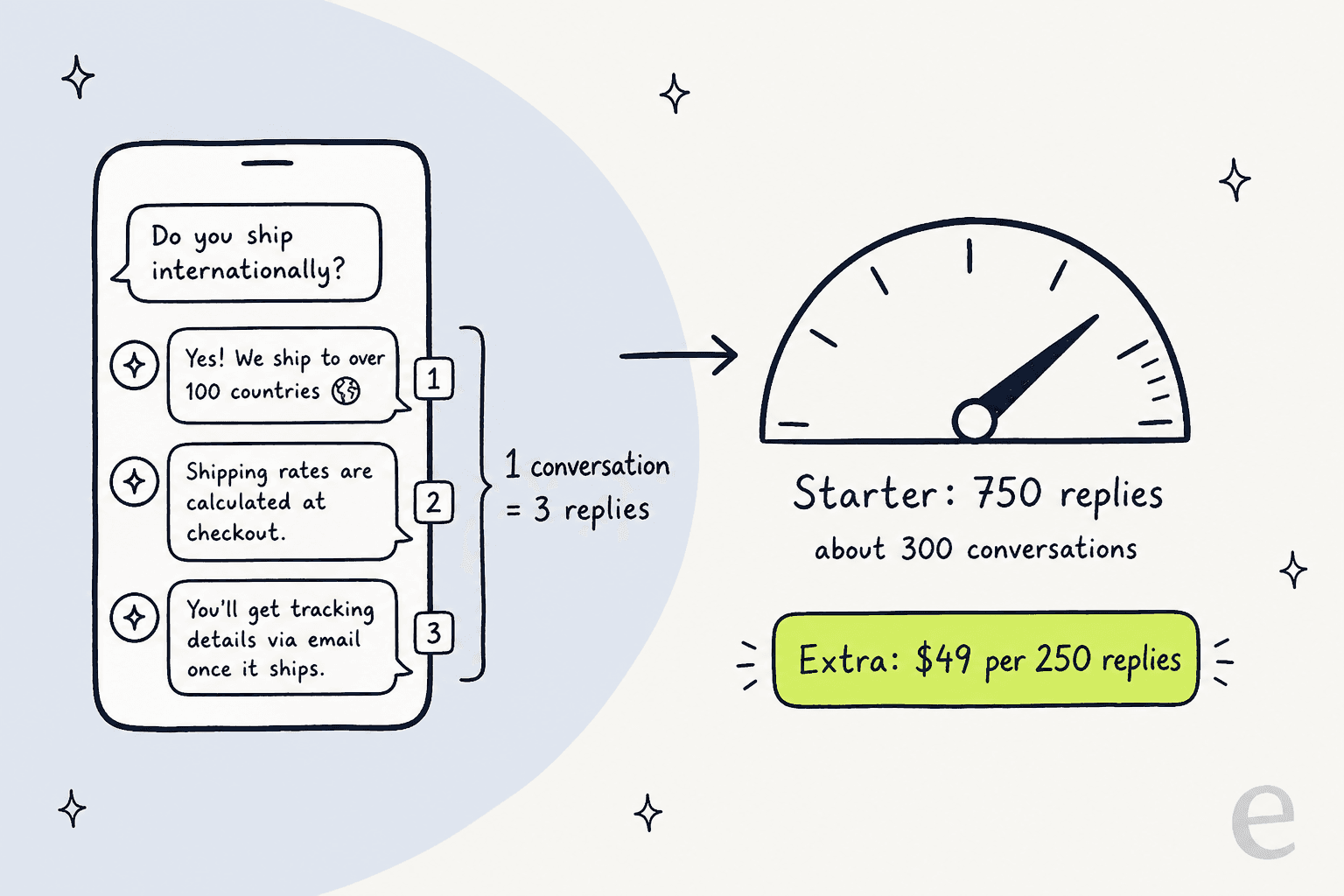
Zipchat is upfront about the ratio. Every plan lists replies and "around" conversations side by side, at roughly 2.3 to 2.5 replies per conversation. The thing to check is whether your chats match that average. A chatty store (sizing, fit, "which one is better for me?") will run longer threads and burn replies faster, and overage is $49 per 250 replies. The vendor itself says "upgrading to the next plan is almost always more cost-effective". Plug your own numbers into the calculator in the pricing section below.
The human handoff can split the conversation
The clearest product complaint across review sites is about following up after the AI hands off. A G2 reviewer gave it 0.5 stars for exactly this:
"No option to reply to customer inquiries that require a human, without creating an entirely new ticket."
A Trustpilot review from September 2026 says the same, adding that the new ticket and the original chat "are not linked in anyway", so the agent has no context (Trustpilot review). A long-time Shopify user who left a 2-star review in November 2025 called Zipchat "siloed", with "no way to export conversation data to help with email or phone handling" (Shopify review).
To be fair, the native Zendesk integration is built to avoid this, and the Backend API now lets you pull conversation data into a CRM. But if you rely on email forwarding into a helpdesk, test a full round trip (chat, escalation, human reply, customer reply) during the trial. This is the same seam I'd test for any tool, as I lay out in my guide to testing AI agents before launch.
It knows your catalog better than your customer
Zipchat learns from your site, uploaded files and corrections. It doesn't learn from your past support tickets, and it knows less about the individual shopper than a helpdesk does. Nick W., a happy 5-star reviewer, still flagged it:
"I'm limited on feeding it customer data. The bot doesn't know if someone is part of a special program, if this is a first-time customer, or what language they speak."
He also mentions uploading PDFs daily because the bot "can't connect to live documents like Google Sheets", and another reviewer asked for pages to be reindexed periodically "to avoid providing obsolete information" (Adelino C., G2). A Shopify reviewer on a niche German store reported customers "put off" by answers despite many corrections (Shopify review). If your products need expert explanation, plan for a longer training phase.
The smaller nit: Emanuele P. found the bot "a little bit too persistent", asking if the customer needs more help after they've said thanks. That's a prompt tweak, but it's also an extra reply on your meter.
Reviews split by site, and the low scores are mostly about email
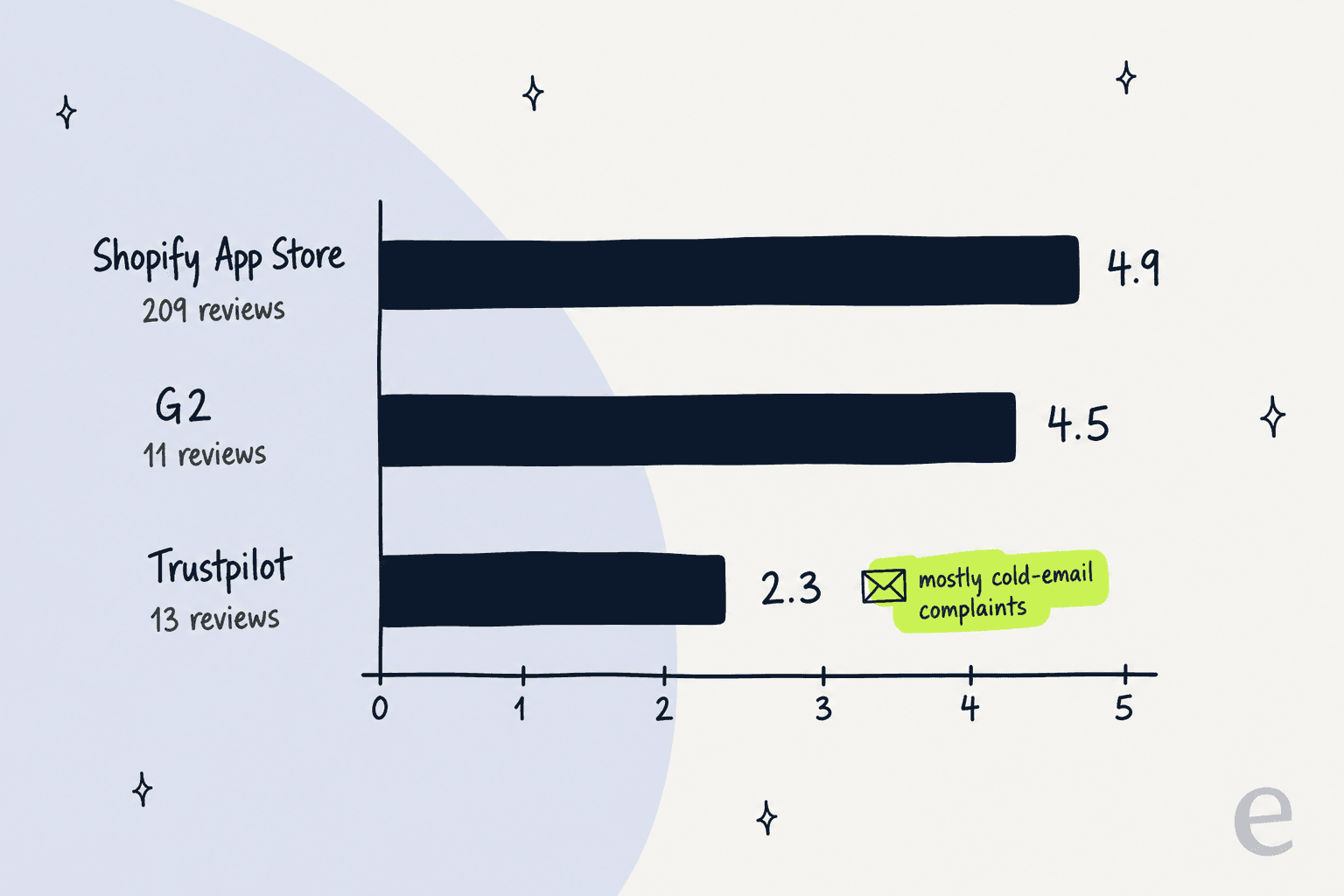
Zipchat's ratings look very different depending on where you check.
The Trustpilot page is unclaimed, and most of its 13 reviews come from store owners complaining about repeated cold sales emails, not about the product. One Shopify reviewer even left a 1-star review over an outreach email (Shopify review). That doesn't tell you much about the chatbot, but it's worth knowing.
The product-related low scores are about vendor support speed. A Shopify reviewer in May 2026 said the team took "more than one week" to respond on a paid account, and a Trustpilot reviewer went back to Tidio after waiting two days (Trustpilot review). Most G2 reviewers say the opposite and praise support, so treat it as a risk to test, not a pattern. Zipchat's own about page promises a reply "within one business day".
Zipchat pricing
Zipchat prices by AI replies per month, with a 7-day free trial on every paid plan and a 30-day money-back guarantee on the first payment. Its pricing page asks for your monthly visitor count to suggest a plan, and shows annual prices by default.
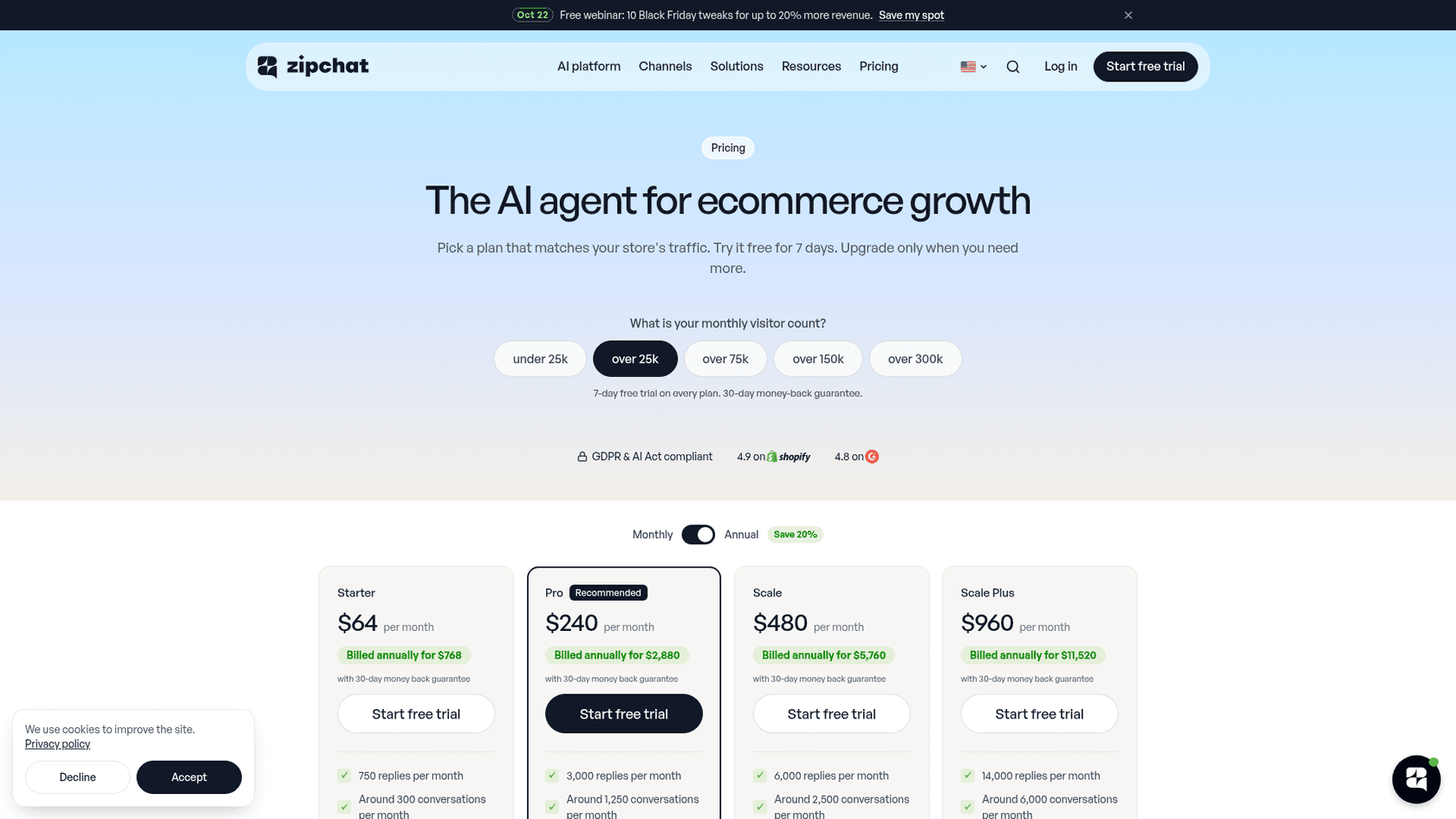
Here's every plan, with monthly prices from the Shopify listing and annual prices from both:
| Plan | Monthly | Annual (per month) | AI replies / month | Conversations (approx.) | Training pages | AI agents | Support |
|---|---|---|---|---|---|---|---|
| Free (Shopify only) | $0 | $0 | 120 | ~50 | 100 | Not listed | Not listed |
| Starter | $80 | $64 ($768/yr) | 750 | ~300 | 1,000 | 1 | Standard |
| Pro | $300 | $240 ($2,880/yr) | 3,000 | ~1,250 | 75,000 | 3 | Priority |
| Scale | $600 | $480 ($5,760/yr) | 6,000 | ~2,500 | 300,000 | 5 | Priority |
| Scale Plus | Not listed | $960 ($11,520/yr) | 14,000 | ~6,000 | Unlimited | 10 | Priority |
| Unlimited | From $2,100 | Quote | Unlimited | Not listed | Not listed | Not listed | Not listed |
A few things the table doesn't show:
- Extra replies cost $49 per 250 on Starter, Pro and Scale, or $49 per 500 on Scale Plus. That is about $0.20 a reply on the lower plans.
- The Unlimited plan is a demo-only quote "starting at $2,100/month", paid monthly with the rate locked for 12 months.
- WhatsApp marketing has a second bill. Zipchat notes Meta charges a fee per marketing conversation started, about $0.02 per chat in the US. My guide to WhatsApp API pricing covers Meta's side.
- Each store needs its own plan. Multi-store pricing is a sales conversation.
- Shopify installs are billed through Shopify, on the same invoice as your other apps, with identical features.
Per conversation, this is cheap for a sales-capable AI. At Zipchat's own ratio, Starter works out to about $0.27 a conversation on monthly billing, and Scale Plus to about $0.16 on annual. Compare that with what most helpdesks charge for AI, for example Zendesk AI pricing or Gorgias AI, and Zipchat looks good on cost.
Try your own numbers. Set your monthly chats and how many AI replies a typical chat takes, and the calculator picks the cheapest Zipchat plan, including overage packs.
If you want a broader view of what this kind of tool should cost, my chatbot ROI guide walks through the math from the other side.
Zipchat pros and cons
| Pros | Cons |
|---|---|
| Fast, no-code setup that crawls your catalog on install | Billed per AI reply, so long chats use more of the plan |
| Every channel on every plan, including WhatsApp and Instagram | Email-forward handoffs can create a separate ticket with no chat context |
| Sales tools built in: discounts, recommendations, proactive chat, cart recovery | Learns from site content and corrections, not from past support tickets |
| Revenue dashboard ties chats to orders and AOV | Limited per-customer context, per a 5-star G2 reviewer |
| Unlimited team members, free onboarding call, 30-day money-back | Some merchants report slow vendor support; cold outreach drags its Trustpilot score |
| Native Zendesk integration with same-thread handoff | Multi-store pricing and Unlimited are quote-only |
Who Zipchat fits, and who it doesn't
Zipchat fits a Shopify or WooCommerce brand that sells products people ask about before buying, like fashion, beauty, outdoor gear or electronics, and wants the chat to close sales, not only deflect questions. It also fits a store without a real helpdesk yet, where Zipchat's inbox is the support inbox.
It's a weaker fit for three kinds of teams:
- A team that already lives in Gorgias, Freshdesk or Richpanel and mostly needs the ticket queue worked. Zipchat can escalate into those tools, but the AI sits outside them.
- A niche or technical catalog where answers depend on expert judgement and past cases, not product pages.
- B2B sellers. One G2 reviewer noted Zipchat "is primarily designed for e-commerce", so B2B setup "can be more complicated" (jacopo p., G2).
The pattern I see among bigger stores is splitting the jobs. One Shopify apparel founder on Reddit listed their stack like this:
"zipchat -- for chat ... richpanel -- for customer support"

That's a sensible setup. The storefront chat sells, and the helpdesk handles refunds, damaged parcels and everything that needs order history. The question is what AI runs on the helpdesk side, which is where my AI helpdesks for Shopify roundup and the best AI for Richpanel guide pick up.
Zipchat or eesel: which one fits?
I'll be honest about the overlap and where it ends. Zipchat is a storefront AI built to sell. eesel is an AI helpdesk teammate: it joins the queue you already run in Gorgias, Zendesk or Freshdesk, reads the Shopify order before it replies, and learns from the replies your team has already sent.
| Zipchat | eesel | |
|---|---|---|
| Main job | Selling and answering on the storefront | Working the support queue in your helpdesk |
| Where the AI runs | Its own widget and inbox, plus a Zendesk integration | Inside Gorgias, Zendesk, Freshdesk and more, plus chat and email |
| Learns from | Site crawl, files, corrections | Past tickets, help center, docs, Shopify data |
| Billing unit | Per AI reply | Per ticket or chat, 1 credit however long |
| Entry price | $80/month for 750 replies | $299/month for 500 credits, free plan with 100 credits |
| Testing before launch | Test chat with your own questions | Simulation on your past tickets |
On pure cost per chat, Zipchat's lower plans come out cheaper than eesel's pricing, and I'd rather say that plainly than bury it. Where eesel earns its price is the work after the first answer: tagging, drafting, order lookups and handoffs inside the helpdesk, with every action on the same ticket your team already uses. Years of running AI on live support queues at eesel taught me that a confident AI can be confidently wrong, which is why every rollout gets tested against past tickets before a customer sees it, as I explain in my guide to training AI on past tickets.
Question Beauty is a good example on a Shopify and Gorgias stack: in a month, eesel handled about 990 tickets across Messenger, email and chat, looked up about 290 Shopify orders before answering, and assigned refunds and complaints to a person with a note attached. If you're deciding between built-in helpdesk AI and an AI layer, that post explains the trade-off.
A store can run both: Zipchat on the storefront for sales, and an AI teammate in the helpdesk for the tickets that follow.
Zipchat alternatives
The right shortlist depends on why Zipchat isn't the fit:
- Tidio if you want live chat plus AI with a larger review base; see my Tidio pricing breakdown and Tidio alternatives.
- Gorgias if you need a full Shopify helpdesk with chat built in, or browse my Gorgias alternatives.
- Re:amaze if you want a helpdesk and chat for several stores in one place.
- Shopify Inbox if you only need free live chat without AI selling.
- Smaller Shopify chat apps like Chatty, Willdesk and MooseDesk if budget is the main constraint.
- Zoko if WhatsApp is your main channel.
For more options, my list of Shopify chatbot apps covers the wider field.
My verdict on Zipchat
4 out of 5. Zipchat is one of the better sales-first chatbots for Shopify. It goes live in an afternoon, covers every channel on every plan, knows the catalog well, and stays cheap per conversation. For a store that wants its chat to sell, I'd start with Starter on monthly billing and watch the reply meter for two weeks before committing to annual.
It loses a point on what happens around the AI. Billing per reply makes long chats cost more, the email-forward handoff can leave your team replying in a fresh ticket without context, and the agent doesn't learn from your past support. Run a full escalation round trip in the trial, and if your team works out of a helpdesk, use the native integration or pair Zipchat with an AI that lives in that helpdesk.
Try eesel
Zipchat gets the shopper to checkout. After the order come the "where is it?", "can I swap the size?" and "it arrived damaged" tickets, and that's where eesel works. It's an AI teammate that joins your Gorgias, Zendesk or Freshdesk queue, checks the Shopify order before it replies, drafts or sends answers in your team's voice, and hands the judgement calls to a person on the same ticket. Rúngne runs three eesel agents on Gorgias for triage, drafts and plain answers, and Question Beauty uses it to answer in the customer's language.
You can Try eesel free with 100 credits, connect your helpdesk and Shopify, and see it work on last month's real tickets before a customer sees a single reply.
Frequently Asked Questions
How much does Zipchat cost?
On the Shopify App Store, Zipchat costs $80 (Starter), $300 (Pro) or $600 (Scale) a month, or $768, $2,880 and $5,760 a year. Its own pricing page adds Scale Plus at $960 a month billed annually and an Unlimited plan from $2,100 a month. Extra replies cost $49 per 250. My guide to chatbot costs puts those numbers in context.
Is Zipchat free?
There is a Free plan on the Shopify listing with 120 AI replies a month, around 50 conversations, and training on 100 pages. Every paid plan comes with a 7-day free trial and a 30-day money-back guarantee. For other free options, see my list of Shopify chatbot apps.
What counts as a reply in Zipchat?
Zipchat counts every outbound AI message as one reply, on any channel. A conversation where the AI answers three times uses three replies, which is why Starter's 750 replies works out to about 300 conversations. If you compare tools, my post on deflection vs resolution explains why billing units matter.
Does Zipchat work with Gorgias or Zendesk?
Zipchat has a native Zendesk integration that answers tickets and chats and hands off in the same thread, and its Shopify listing names Gorgias and Re:amaze as tools it works with. Its built-in Forward Request tool emails escalations, which then arrive as new tickets. If your team lives in Gorgias, my AI for Gorgias guide covers the options.
Is Zipchat good for customer support or mainly for sales?
Zipchat is built sales-first: product recommendations, discounts, cart recovery and revenue tracking. It also handles order status, FAQs and returns with the right skills connected. Teams with a heavy ticket queue often pair a storefront chatbot with a helpdesk AI, as in my AI helpdesks for Shopify roundup.
What do merchants say in Zipchat reviews?
Zipchat holds 4.9 from 209 reviews on Shopify and 4.5 from 11 on G2, with praise for fast setup and product knowledge. The complaints are about the human handoff, limited customer data, slow support for some merchants, and cold sales emails. My Tidio review is a useful comparison point.
What is a good Zipchat alternative for a Shopify store?
Tidio, Gorgias, Re:amaze and Shopify Inbox are the common comparisons. If your support already runs through a helpdesk, eesel adds an AI teammate for Shopify that works the ticket queue and learns from past replies. My list of AI chatbots for Shopify covers more.