

What is Zoko?
Zoko (listed on Shopify as "Zoko WhatsApp Marketing & Chat") connects a Shopify store to the official WhatsApp Business API and gives the team one place to sell, market and support on it. The developer is Bourbon Science Inc., with an address in Buford, Georgia and an office in Bengaluru, and the app went live on the Shopify App Store on December 8, 2020. Zoko's homepage calls itself "a complete WhatsApp platform for Shopify Brands", and that is the right frame: it is a WhatsApp business tool first and a helpdesk second.
| Zoko at a glance | |
|---|---|
| What it is | WhatsApp shared inbox, broadcasts, catalog checkout, flows, AI agents |
| Built for | Shopify brands, installed from the Shopify App Store |
| Rating | 4.9 from 463 reviews: 427 five-star, 19 four, 4 three, 0 two, 13 one |
| Price | From $49.99 a month plus usage, 7-day free trial, no free plan |
| Channels | WhatsApp (chat and calling), Instagram DMs and comments, Facebook Messenger |
| AI agents | Guru (FAQs), Wismo (order tracking), Sello (sales), paid add-ons |
| AI model | Your own OpenAI account, connected by API key |
| Trust | Official Meta Business Partner, ISO 27001:2022, GDPR |
| Works with | Shopify, Judge.me, Razorpay, Google Sheets, API and webhooks |
The homepage also says Zoko AI "can handle 80% of your incoming chats." That is Zoko's own marketing figure, with no method shown, so I would read it as a ceiling to test against, not a forecast for your store.
How Zoko works
Setup is where WhatsApp tools differ most from a normal chat widget, because the WhatsApp Business API sits behind Meta's approval. You install Zoko on Shopify, pick a plan, then connect a phone number as your official WhatsApp API number after a one-time code check. Per Zoko's pricing FAQ, an existing number works too, but you delete the WhatsApp account on it first, and once it is on the API it can't be used in the WhatsApp phone app at the same time. You can reverse that later by removing the API connection.
There are also two billing setups. Per the billing setup guide, the Zoko subscription is approved through Shopify, and Meta's message fees need a payment method in Meta Business Manager, which in turn needs a verified business, per the WhatsApp API payment guide. Reviewers say this is where Zoko's team earns its praise:
"He walked us through Meta Business verification, helped us get our number approved and templates submitted, and patiently answered every question, big or small."

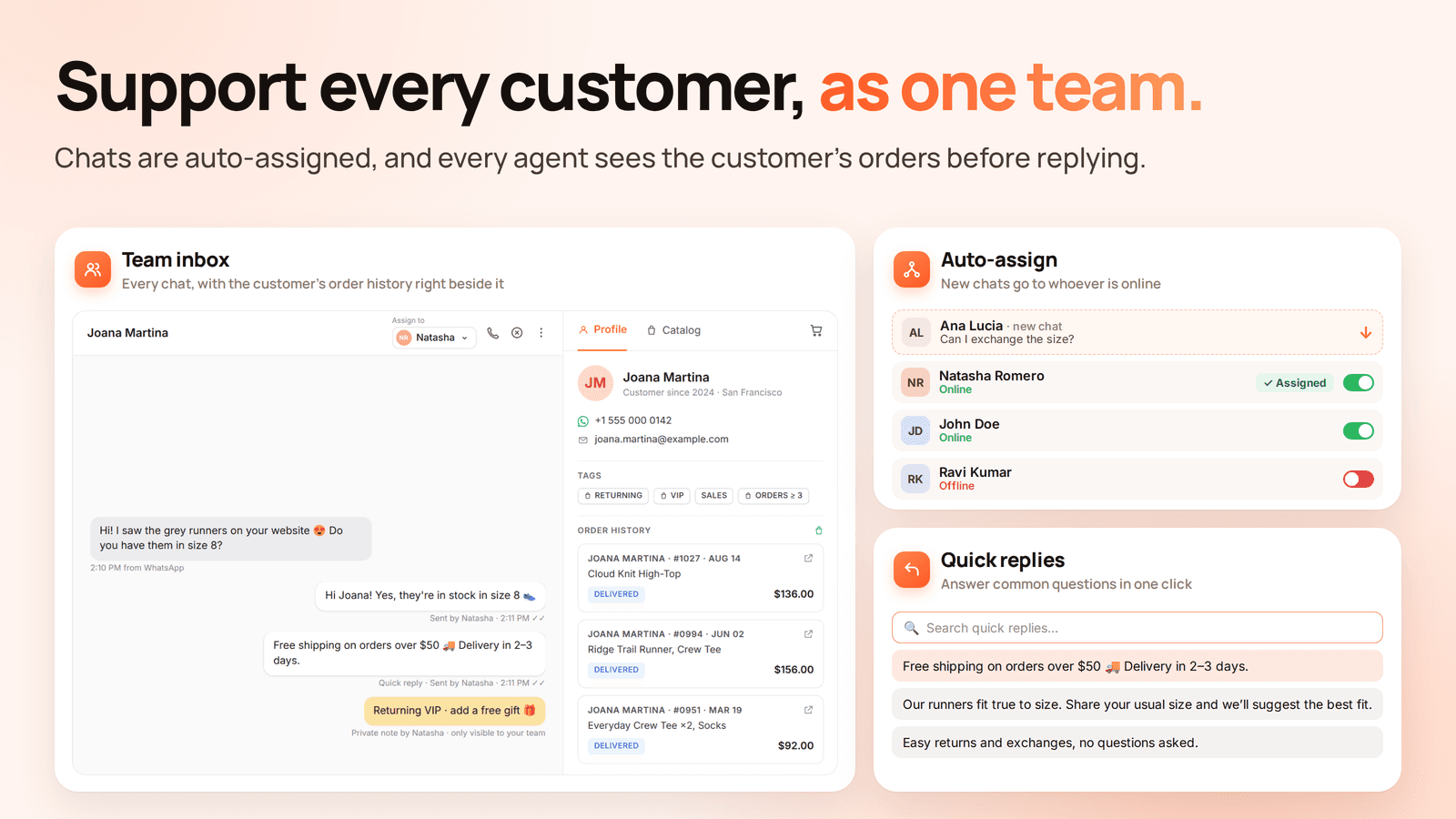
Once live, every agent replies from the same number. Chats are auto-assigned to whoever is online, and each chat shows the customer's Shopify tags and order history beside it. You can build custom inboxes from filters, such as replies to one broadcast going only to the sales team, and set four access levels: Owner, Admin, Salesman and Salesman (Limited), where a limited agent sees only chats assigned to them or their team. Instagram DMs and comments and Facebook Messenger land in the same inbox, and the team can take WhatsApp calls, send voice notes and translate messages in real time.
The WhatsApp rules still apply on top. A free-form reply only goes out inside Meta's 24-hour customer service window, and anything after that needs an approved template. If that is new to you, my explainer on the WhatsApp chatbot rules and the post on Meta's policy changes cover what you can and can't send.
What Zoko does well
Zoko's strengths are the ones that matter when WhatsApp is where your customers already buy, not just where they complain.
Selling inside the chat
Zoko syncs your Shopify catalog to WhatsApp, so an agent can send product cards, build a cart, add a discount code and send a checkout link without the customer leaving the chat. The order then lands in Shopify, marked as created from a WhatsApp chat. Cash on delivery is supported, which explains why so many reviewers run COD confirmation flows.
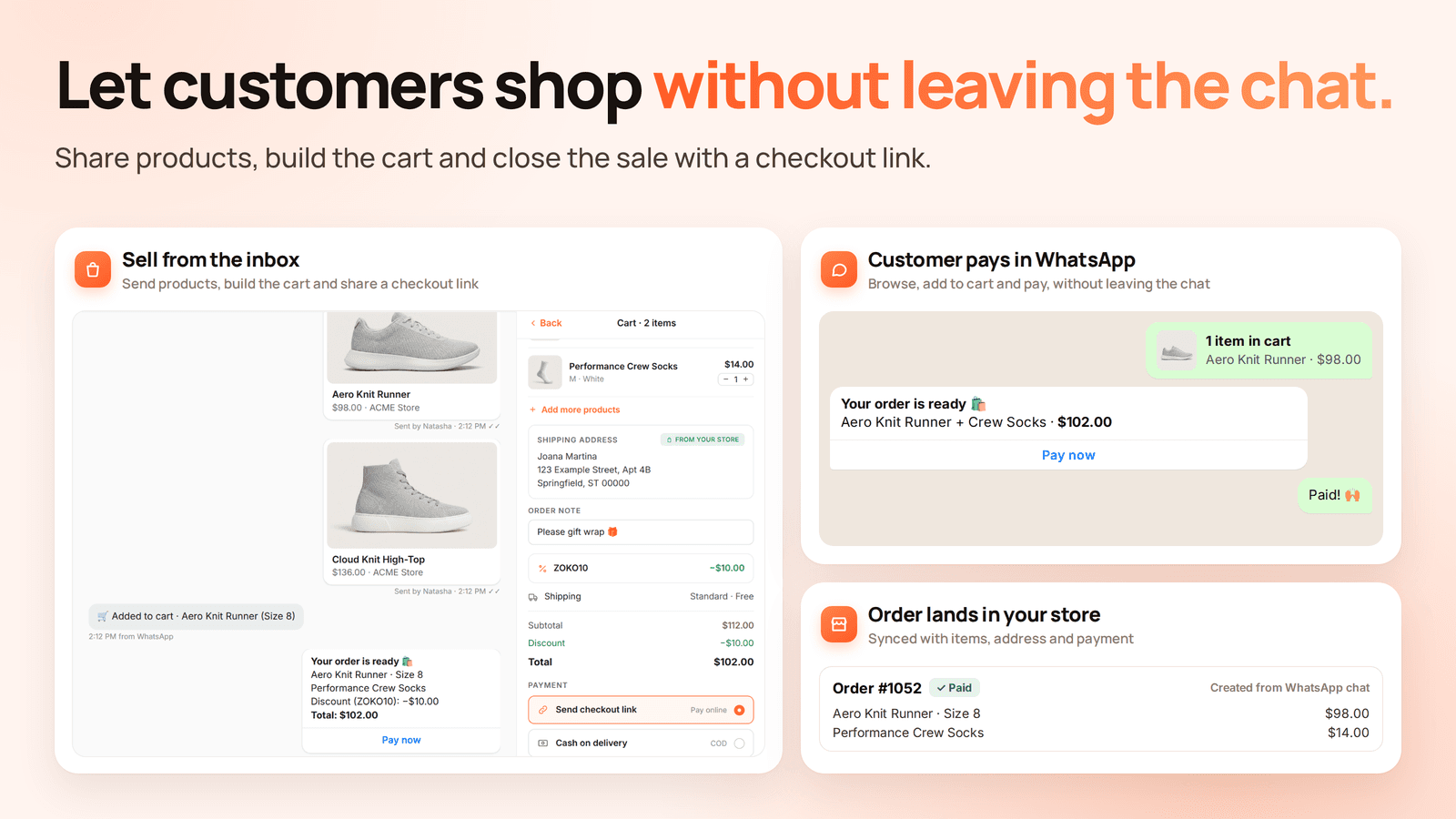
For markets where shoppers expect to ask a question and order in the same thread, that is the feature. It is also the biggest difference between Zoko and a helpdesk with a WhatsApp channel bolted on, like the setup in my Gorgias WhatsApp guide. Zendesk works much the same way, as my Zendesk WhatsApp post shows.
Flows that cover the whole order
Zoko Flows (the builder was called FlowHippo) triggers WhatsApp messages from Shopify events. Per the pricing page, 11 essential flows are free on every plan: abandoned checkout recovery, review collection, COD double confirmation, COD to prepaid, reorder reminders, upsells and order notifications. Custom flows, such as CSAT collection, Judge.me review sync or Instagram auto-replies, are $5.99 a month each, and Zoko lists 64+ ready-made playbooks.
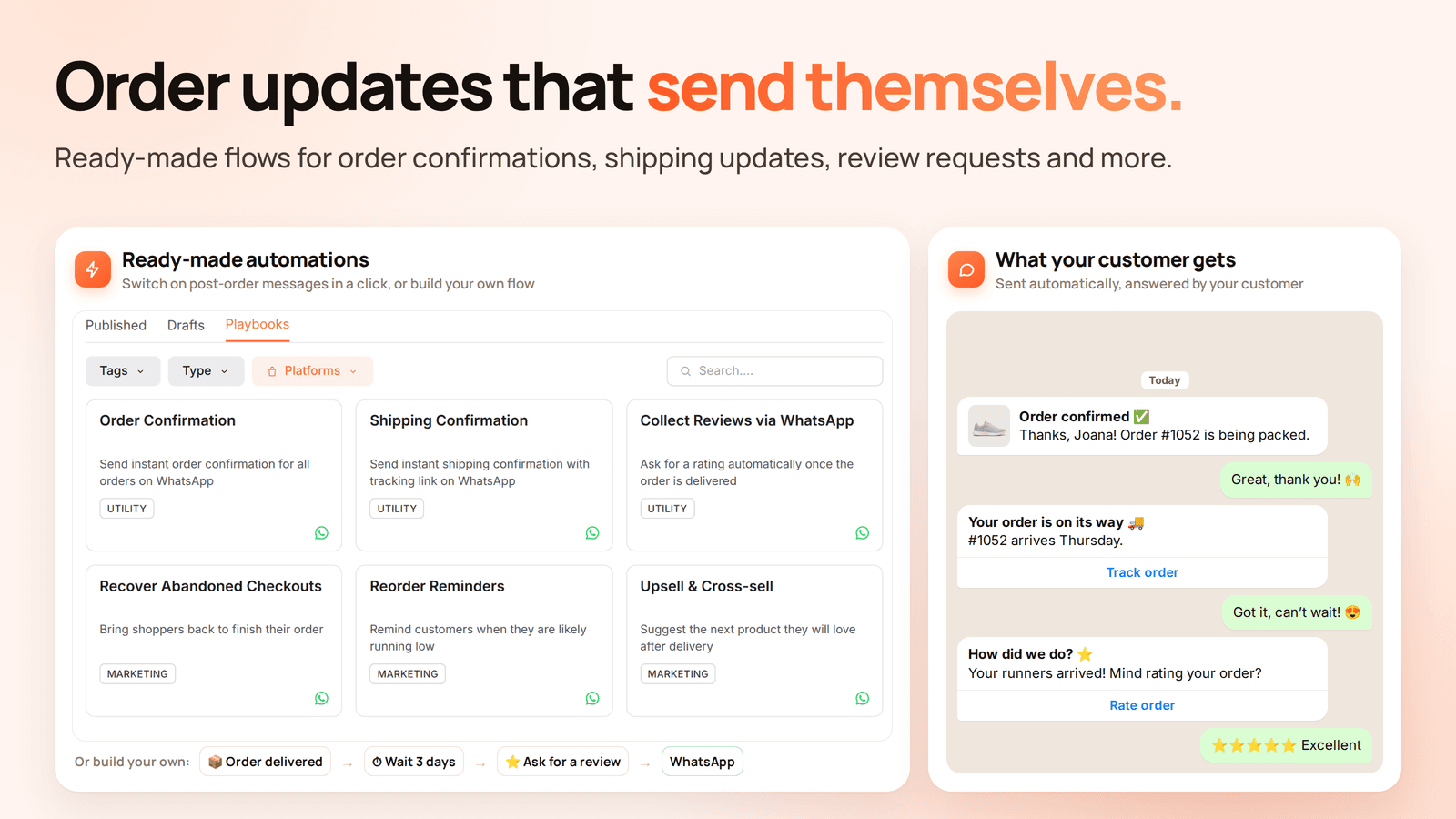
Reviewers who stick with Zoko tend to love this part. One Egyptian store wrote that it replaced several apps:
"We now use it for abandoned checkout recovery, COD order confirmation, transactional WhatsApp updates, delivery notifications, review requests, and customer support."
Order updates also cut the "where is my order?" chats before they start, which my guide to WISMO automation covers in more depth.
Every feature on every plan
Zoko's pricing page is blunt about it: "A store on Starter gets the same Zoko as a store on Max." Broadcasts, the catalog, the chat widget, segments, click-to-WhatsApp ads, pop-ups, analytics and the API and webhooks are all on Starter. Plans differ only by how much volume, how many agents and how many call minutes come included. The catalog, widget and pop-ups carry Zoko branding on every plan.
That is a fair way to price, and it means a small brand isn't locked out of the tools a bigger one uses. It also means the plan name tells you very little about your bill, which I come back to below.
A support team that reviewers name
In the 60 newest Shopify reviews, 23 thank a support rep by name, people like Aaquib, Anand, Bharath, Muzaina and Nishant. Reviewers describe help with Meta verification, building flows, and Google Meet sessions to learn features. One review stood out because it is about a billing problem handled well:
"One of our flows was consuming far more ops steps than we'd budgeted for because of a Google Sheets lookup that had to scan through thousands of rows."
The same reviewer says the team paused the flow, found earlier overcharges on its own and arranged a refund. Good service, and also a reminder that Zoko has several usage meters running at once.
Zoko's AI agents: Guru, Wismo and Sello
Zoko AI is three separate agents, each with its own job and price. Per Zoko's AI pricing guide, each costs $24.99 a month plus usage, and Zoko's estimator applies the first 100 free each month.
| Agent | Job | Price | Learns from |
|---|---|---|---|
| Guru | Answers FAQs | $24.99 a month + $0.09 per resolution | Uploaded files (PDFs), typed text, Q&A pairs, your Shopify catalog |
| Wismo | Answers "where is my order?" | $24.99 a month + $0.09 per resolution | Live Shopify orders |
| Sello | Takes orders in chat | $24.99 a month + 3% of order value | Your WhatsApp catalog and checkout settings |
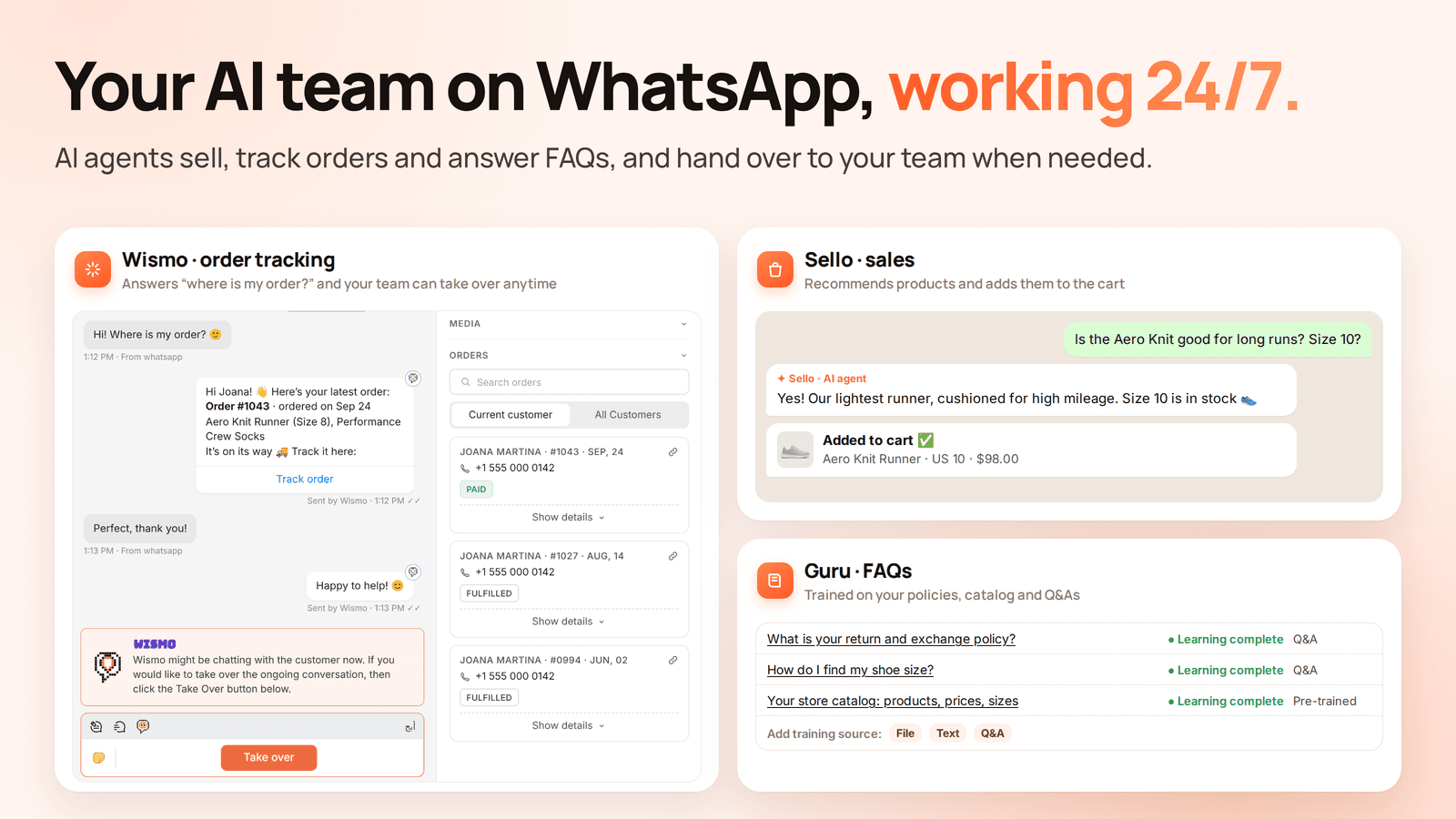
The setup guides fill in the detail. Guru trains on files, text and Q&A pairs, where you add several phrasings of each question, and a Knowledge Gaps view flags unanswered or outdated questions. Wismo replies in the customer's language when ChatGPT supports it and falls back to English, and you can switch it on automatically or trigger it from a keyword or button. Sello walks a customer from product to address, shipping and payment, and "currently supports English language only." When an agent is mid-chat, a person can hit Take over.
The part to know before you budget: you bring your own OpenAI account. Zoko's AI guide says you are "required to connect your own OpenAI account to Zoko," the compute cost is billed to you by OpenAI, separate from Zoko's fees, and if the OpenAI wallet runs dry the bots stop. The ChatGPT integration guide walks through pasting an Organization ID and API secret key, and a red bar in the dashboard means you are out of credits.
Merchant views on the AI split. A Colombian store wrote that "Zoko AI will take some training but once its trained it works great and converts sales efficiently." A Mexican store that left after 10 days felt the opposite:
"There are a few useful functions, but the AI capabilities are extremely limited compared to what the product claims to offer."
Both can be true. An AI agent is as good as what it learns from, and with Guru that is what you upload and type. If you want to know how good it is before customers see it, test it on real past questions, the way my notes on testing an AI agent describe.
Where Zoko falls short
None of these rule Zoko out. They are the things I would check before moving a store's WhatsApp number over.
Three bills, not one
A Zoko month can carry line items from three companies. From Zoko: the plan fee, the per-conversation fee, extra agents, Instagram at $9.99, $5.99 per premium flow, and $24.99 per AI agent plus per-resolution or per-order fees. From Meta: every WhatsApp message your business sends. From OpenAI: the tokens behind each AI reply.
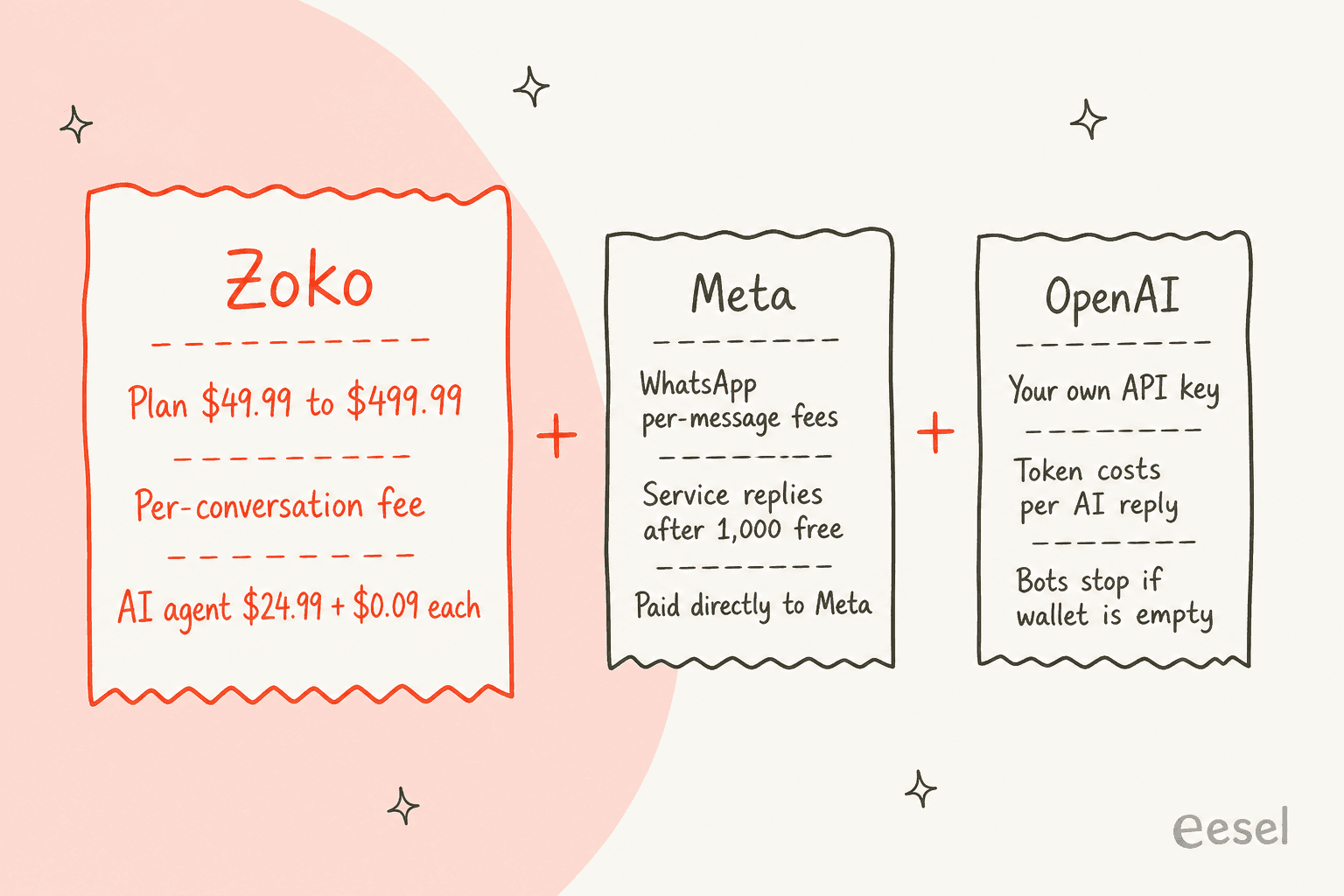
Zoko is open about all of this on its pricing page, and it says plainly that WhatsApp fees are "paid directly to Meta." It is still the most common complaint in the low reviews. One Indian store, after 6 months, wrote that "they have a lot of hidden charges even in free flows, agents and conversation limits," then added a star back because Zoko updated its pricing page. Another, after a year:
"They increased the plan pricing without notice and you have no choice but to accept it. When you downgrade the plan, their conversation charges skyrockets."
That last part is how the Starter plan works: it has no included conversations, so every one carries Zoko's $0.015 fee, while Plus includes 5,000. Meta's side changed too. Per Meta's pricing docs, WhatsApp has charged per delivered message since July 1, 2025, and as of October 1, 2026 service messages are charged after 1,000 free a month per business phone number. For a support-heavy store, the replies your team and your bot send are now metered too. My breakdown of WhatsApp API pricing goes through the categories.
The AI knows what you upload
Guru's training sources are files, text and Q&A pairs, plus the Shopify catalog. In the docs I read, there is no website or help center crawl, no connector for Google Drive or Notion, and no training on your past WhatsApp chats; Knowledge Gaps points out missing answers, and you write them. For a store with a tidy FAQ PDF, that is fine. For a store whose real answers live in two years of agent replies, someone has to turn those into Q&A first.
The Reddit thread most people find when they search for a way out says the same thing in fewer words:
"we made a mistake, this app is too confusing to work with and i had thought we could do more with chatbot features but it's not as advanced as we had wanted"

Billing per resolution also needs one question answered up front: what counts. My explainer on deflection vs resolution rate covers why two vendors' "resolution" can mean different things, and I would ask Zoko how a resolution is counted before switching Guru on for a busy season.
Your WhatsApp number moves to the API
Moving a number to the WhatsApp Business API is a Meta rule, not a Zoko one, but Zoko is where people feel it. The number stops working in the WhatsApp phone app while it is on the API. A 2022 reviewer, writing before several product updates, put the practical advice well:
"Dont sacrifice your current business number for this app because you cannot retrieve it again."
Zoko's FAQ today says you can go back to the phone app by removing the API connection, so "cannot retrieve" is no longer the full picture. I would still start with a fresh number or be ready for the team to stop using the app on that one. Several of the oldest low reviews are about onboarding that stalled on verification; a July 2025 reply from Zoko says Meta onboarding "now happens under 5minutes."
What the low reviews are about
Zoko's ratings are excellent: 92% are five stars, and 58 of the 60 newest reviews gave five. The 17 reviews at 3 stars or below are worth reading as a list of things to check, because they cluster.
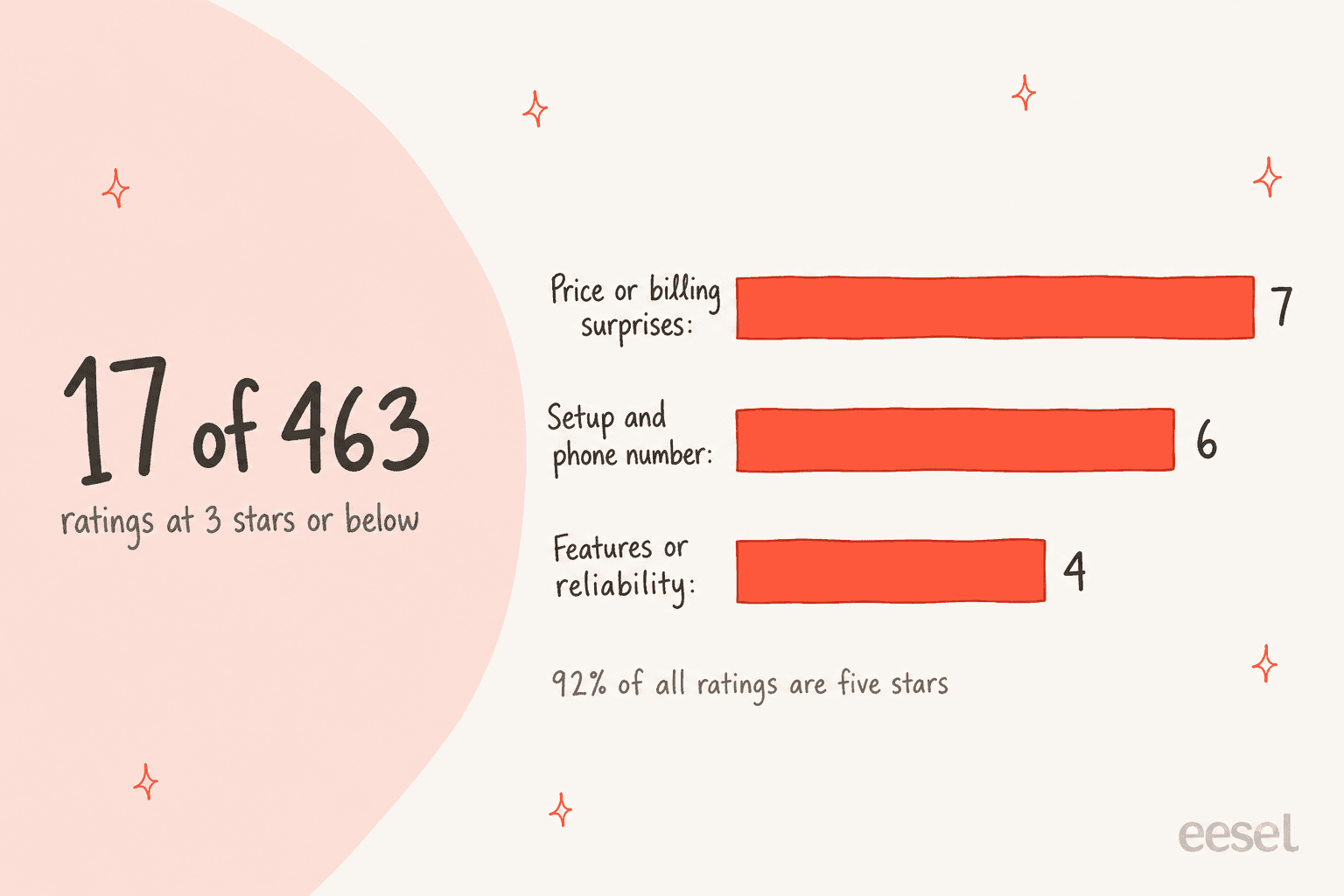
I sorted them myself, so read the split as a rough guide. Billing covers the trial charge, older listings that showed a low "from" price, and conversation fees; setup covers number and verification trouble; reliability covers flows that a year-long customer said "frequently don't work as expected." The positive reviews skew recent and early in the relationship, too: 21 of the 60 newest were written at "3 months using the app," and 33 came from India, Zoko's biggest market.
No email inbox
Zoko's channels are WhatsApp, Instagram and Messenger. I found no email channel on the pricing page, the Shopify listing or the Learning Centre topics, and its homepage pitches "support without tickets." If your support still runs on email, you will keep a helpdesk next to Zoko, and the AI in each one learns separately. My comparison of shared inboxes vs ticketing covers when that split becomes a problem.
Zoko pricing
Zoko has four plans, a 7-day free trial and no contracts, billed in USD through Shopify. The subscription is charged at the start of each period and usage fees after the month ends.
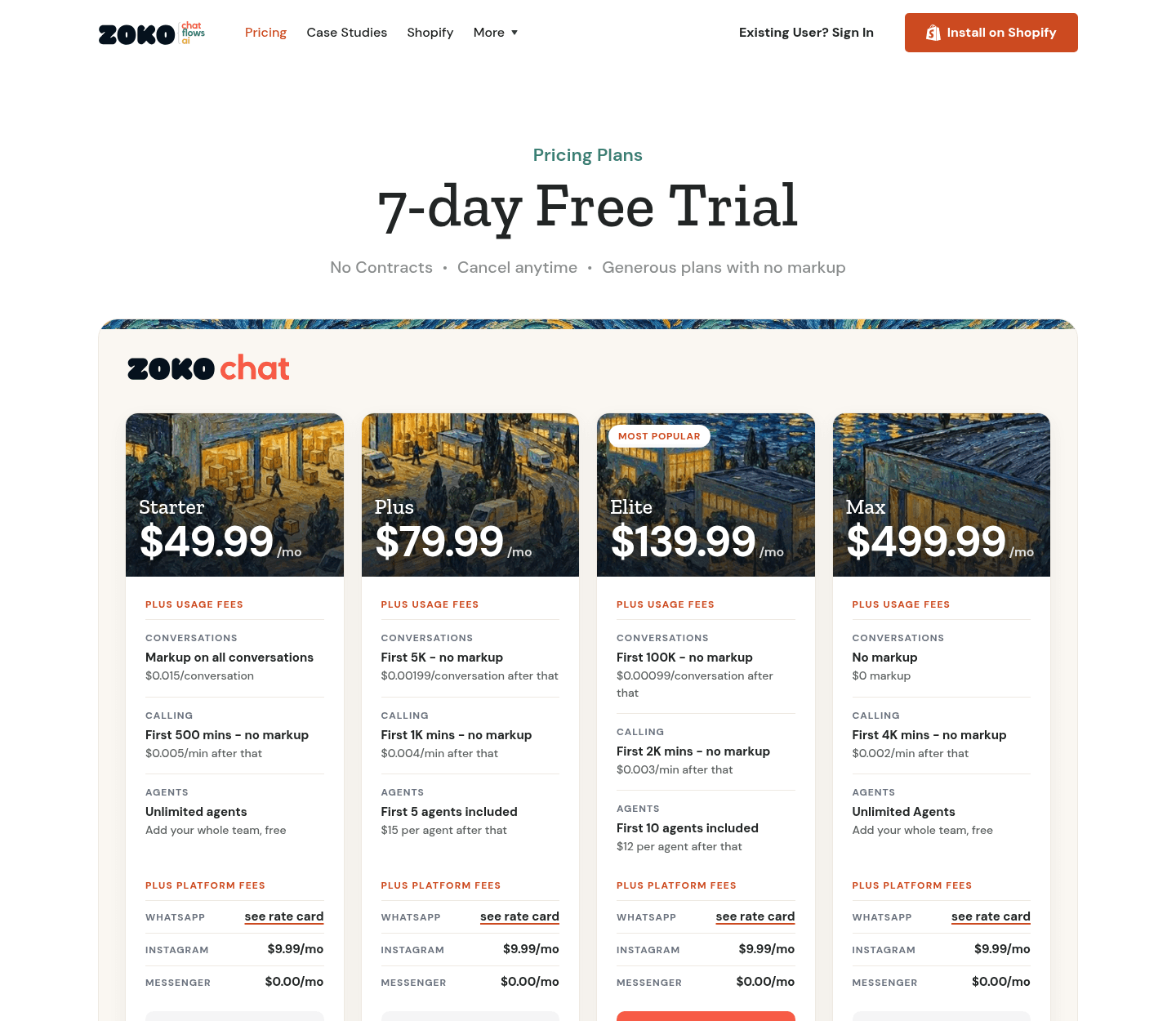
| Starter | Plus | Elite | Max | |
|---|---|---|---|---|
| Price per month | $49.99 | $79.99 | $139.99 | $499.99 |
| Zoko fee per conversation | $0.015 on all | First 5,000 free, then $0.00199 | First 100,000 free, then $0.00099 | No markup listed |
| Agents included | Unlimited | 5, then $15 each | 10, then $12 each | 30, then $9 each |
| No-markup call minutes | 500, then $0.005 | 1,000, then $0.004 | 2,000, then $0.003 | 4,000, then $0.002 |
| Zoko's "best for" range | Up to 2,000 conversations | 2,000 to 35,000 | 35,000 to 465,000 | Above 465,000 |
| WhatsApp messages | Meta's rate card, paid to Meta | Same | Same | Same |
| Instagram / Messenger | $9.99 / $0 | $9.99 / $0 | $9.99 / $0 | $9.99 / $0 |
| Premium flows | $5.99 each a month | Same | Same | Same |
| AI agents | $24.99 each + usage | Same | Same | Same |
Plan details are from Zoko's pricing page on October 21, 2026. A conversation is "a 24-hour session that starts when the first message from your business is delivered," and going over a limit never cuts you off; you pay the per-unit rate. Flows include 500,000 steps a month, then $0.0002 a step. Two notes on conflicts: the Max card says "Unlimited Agents," while the pricing FAQ, the Shopify listing and Zoko's own estimator say 30 agents, then $9 each, which is what I used. And Zoko's calling help article still lists smaller minute allowances than the pricing page.
Here is a quick way to see the Zoko part of your bill. It mirrors the formula Zoko's own estimator uses.
Enter your monthly volume, team size and add-ons to see the Zoko fees on each plan, with the cheapest one highlighted.
A worked example: a store with 3,000 WhatsApp conversations, 3 agents, one custom flow and Guru resolving 600 questions a month pays $155.97 to Zoko on Plus, against $170.97 on Starter, because Starter's $0.015 per conversation adds $45. Then come Meta's fees. Zoko's estimator, which uses Meta's rate card, puts a marketing message to a US or Canada number at $0.025 and a utility message at $0.0034, so 2,000 marketing broadcasts add about $50. Then OpenAI's token costs for 600 AI answers, which depend on the model and the length of each chat. For a store that only answers questions, those three bills are the comparison to make, as my guide to chatbot cost lays out.
Zoko pros and cons
| Pros | Cons |
|---|---|
| Every feature on every plan, from $49.99 | Three bills: Zoko, Meta and your own OpenAI account |
| Catalog, cart and checkout inside WhatsApp | Starter charges $0.015 on every conversation |
| 11 essential flows free, 64+ playbooks | Guru learns from uploads and Q&A, not past chats or your site |
| Instagram and Messenger in the same inbox | Sello is English only |
| 4.9 from 463 reviews, support praised by name | Number can't run in the WhatsApp app while on the API |
| Meta Business Partner, ISO 27001:2022 | No email channel; low reviews cluster on billing |
Zoko or eesel: which one fits?
There is no eesel integration for Zoko, so this is a choice about what you need WhatsApp to do. Zoko is the marketing and selling layer: broadcasts, a catalog, checkout links, flows that fire on every Shopify event. eesel has none of those. eesel is an AI helpdesk teammate: it answers customers, including on WhatsApp, works inside the helpdesk you already run, like Gorgias or Zendesk, and looks up orders in Shopify before it replies.
The difference shows in two places. First, what the AI learns from. eesel reads your help center, docs, website and past tickets, so the answers your team already wrote are the starting point. Cape Coffee Beans, a South African coffee retailer with more than a thousand products, runs eesel on Zendesk, Shopify and Google Drive: every morning it checks the queue for tickets that slipped through, and during the day the team calls it into tickets to find a product, an order or a past reply, with the source linked. Question Beauty's agent tags every ticket, checks the Shopify order before any delivery answer, replies in the customer's language, and hands refunds and complaints to a person with a note.
Second, the bill. eesel is one fixed monthly plan: free to try with 100 credits, then from $299 a month for 500 credits, where one ticket or chat is 1 credit however long it runs, with no separate AI model bill and no per-seat fee. That is more than Zoko's Starter plan for a small store, and I would say so to anyone. If WhatsApp is mostly a sales channel and your questions fit a short FAQ, Zoko's Plus plan with Guru is the better deal. If WhatsApp, email and chat are mostly support, and your best answers live in old replies, the AI helpdesk teammate is the one I would test against last month's real questions.
Zoko alternatives
The right shortlist depends on why Zoko isn't the fit. For another WhatsApp-first platform, start with my respond.io pricing breakdown, the closest like-for-like tool. SleekFlow's pricing is the other one worth reading, and for Instagram-heavy brands my notes on Instagram chatbots help.
If support is the main job, my roundup of the best WhatsApp chatbots compares the field, and the guide to AI WhatsApp support covers ecommerce setups.
For a Shopify helpdesk with WhatsApp as one channel, read the Gorgias pricing guide and my roundup of the best AI helpdesk for Shopify.
For a lighter Shopify chat app, my MooseDesk review covers a free option with unlimited AI replies. The Chatty review covers a usage-based one.
Verdict: 4 out of 5 for WhatsApp-first Shopify brands
Zoko earns 4 out of 5. For a Shopify brand whose customers live on WhatsApp, it does a lot for $49.99 to $139.99 a month: one number for the whole team, a catalog customers can buy from in the chat, 11 free flows that cover the order from cart to review, every feature on every plan, and a support team that walks you through Meta's setup. The 4.9 rating is earned.
It loses a point on cost clarity and on the AI. The real bill is Zoko plus Meta plus your own OpenAI account, Starter charges on every conversation, and since October 1, 2026 Meta meters support replies too. Guru knows what you upload, Sello speaks English only, and per-resolution pricing needs a clear definition before a busy month. If WhatsApp is how you sell and market, install the trial and run your top flows on Plus. If WhatsApp is mostly where customers ask for help, test it against an AI that learns from your past replies first.
Try eesel with your Shopify store
If you like the idea of AI answering your customers on WhatsApp, but you'd rather not write every answer as Q&A or run a separate OpenAI wallet, eesel connects to Shopify and the helpdesk you already use, learns from your past tickets and help center, and checks the order before it replies. Question Beauty's agent sends replies on its own, looks up hundreds of Shopify orders a month and passes refunds to a person with the context attached. Try eesel free with 100 credits and run it on last month's real questions before a customer sees it.
Frequently Asked Questions
How much does Zoko cost?
Zoko's plans are Starter $49.99, Plus $79.99, Elite $139.99 and Max $499.99 a month, per Zoko's pricing page. On top come Zoko's per-conversation fee on Starter, Meta's WhatsApp message fees, Instagram at $9.99, premium flows at $5.99 each and AI agents from $24.99. My guide to WhatsApp API pricing covers Meta's side.
Is Zoko free?
No. Zoko has a 7-day free trial and no free plan, and the cheapest plan is Starter at $49.99 a month. Pre-built essential flows are free on every plan, but WhatsApp messages still carry Meta's fees from day one. If you only need a chat button, compare free options in my list of Shopify chatbot apps.
Does Zoko charge for WhatsApp messages?
Meta charges for WhatsApp messages, and you pay Meta directly through Meta Business Manager. Zoko adds its own fee per conversation on Starter, and above the included volume on the other plans. Since October 1, 2026, Meta also charges support replies after 1,000 free a month per number, which my WhatsApp 2026 updates post explains.
Do Zoko AI agents need an OpenAI account?
Yes. Zoko's help center says you must connect your own OpenAI account with an API key, keep funds in it, and the bots stop when that wallet runs out. That cost is separate from the $24.99 agent fee and the $0.09 per resolution. For an AI that bundles the model cost, see the AI helpdesk teammate.
What does the Zoko AI learn from?
Guru, the FAQ agent, trains on uploaded files such as PDFs, typed text and Q&A pairs, with your Shopify catalog pre-trained. Wismo reads Shopify orders for tracking questions. I found no website crawl or past-chat training in the docs, which matters if your answers live in old replies, as my guide to training AI on past tickets covers.
Can I keep using my WhatsApp number with Zoko?
You can move an existing number, but you first delete the WhatsApp account on it, and once it is on the WhatsApp API it can't run in the WhatsApp phone app at the same time, per Zoko's pricing FAQ. You can move it back later by removing the API connection. My guide to automating WhatsApp support covers the setup choices.
Is Zoko a good Gorgias alternative?
For a WhatsApp-first store, Zoko does more on WhatsApp selling, broadcasts and flows than a helpdesk does. Gorgias is the stronger pick when email, many channels and ticket rules carry most of your support. My Gorgias review covers that side, including how its WhatsApp channel works.