
How we picked these 8
We scraped each vendor's pricing page, feature pages, and help docs on 2026-06-04 and cross-checked against G2, the Shopify App Store, and live Reddit and LinkedIn threads. Then we ran each tool against the same set of buyer questions a Shopify operator usually has: How deep does it actually go into Shopify order data? What does the AI do that a rule-based bot can't? What does a 1,000-ticket month actually cost? Can it sit on an existing helpdesk, or does it force a migration?
We dropped tools that didn't have a real Shopify story (most generic chatbot SaaS), tools that bury pricing behind "contact us" with no public number, and tools with fewer than ~50 verifiable user reviews across G2 and the App Store. We do not cover Intercom or Fin in our roundups.
The 8 best Shopify chatbot apps at a glance
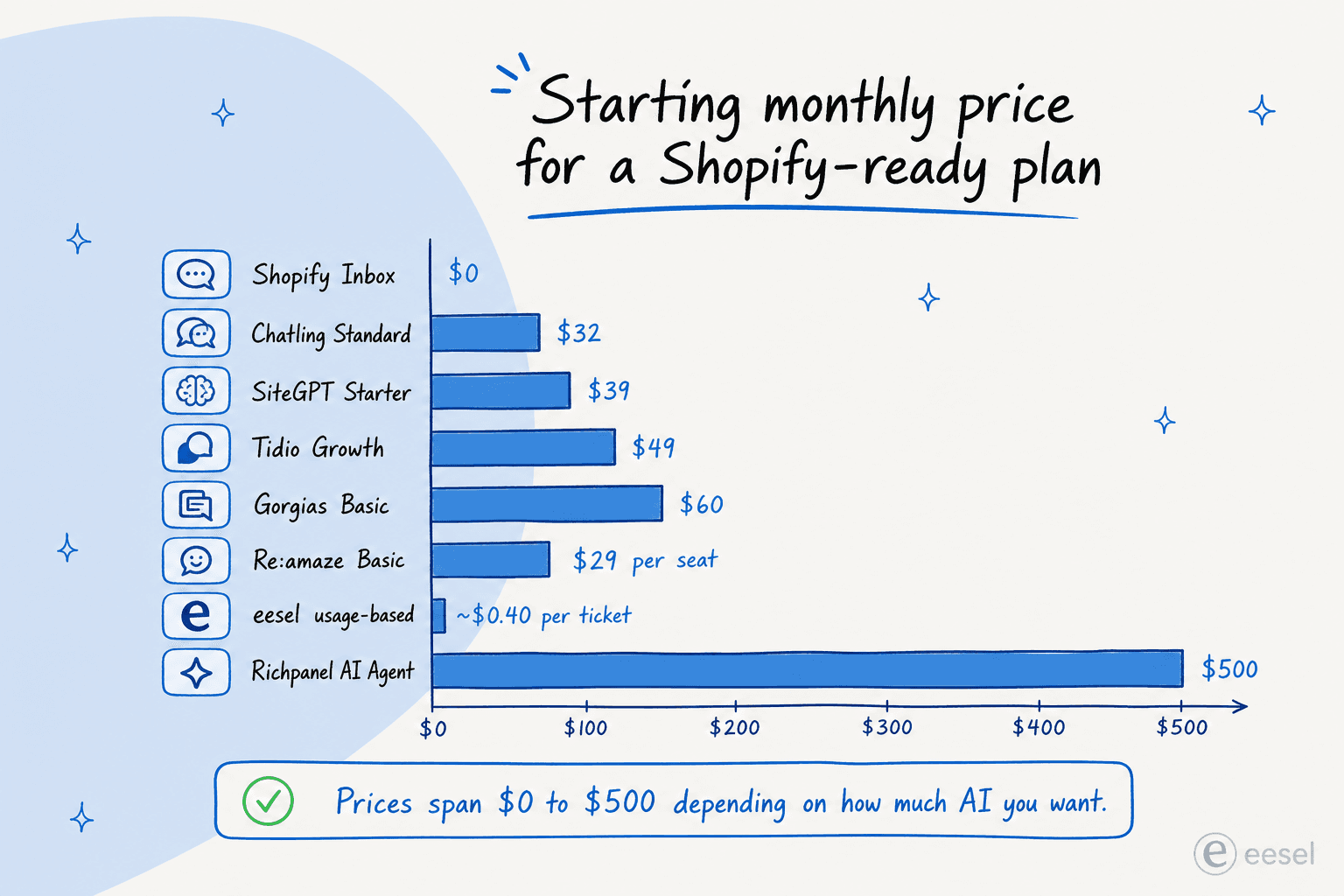
| App | Best for | AI type | Shopify-native depth | Starting price | Rating | Free tier |
|---|---|---|---|---|---|---|
| eesel AI | Stores already on a helpdesk | Autonomous AI agent | Shopify + your helpdesk | $0.40/ticket | New (no public G2 yet) | $50 trial credit |
| Gorgias | Shopify-native helpdesk | AI Agent + Shopping Assistant | Deepest in market | $10/mo (50 tickets) | 4.6/5 on G2 (560+) | 7-day trial |
| Tidio | SMBs wanting AI + chat in one | Lyro (Claude-powered) | Native Shopify actions on Growth+ | $24.17/mo | 4.8/5 on Shopify App Store (1,300+) | Free plan + 7-day trial |
| Shopify Inbox | Free chat on Shopify | Shopify Magic (light) | First-party | Free | 4.7/5 on App Store (5,386) | Always free |
| Re:amaze | Multichannel small teams | AI Agent (Beta) + drafts | Order data in conversations | $29/seat/mo | n/a | 14-day trial |
| Richpanel | AI-first ecommerce ops | 4-role AI team + QA | Shopify, Recharge, Loop, AfterShip | $500/mo + $0.25/conv | n/a | 30-day money-back |
| Chatling | No-code AI chatbot on any store | 28-model AI agent | Webhook to Shopify via API | $32/mo (annual) | 4.7/5 on G2 (71) | Free plan |
| SiteGPT | Website-trained AI on any store | GPT-4.1 / mini | Embed widget; no native Shopify | $39/mo | Small G2 sample (11 reviews) | 7-day trial |
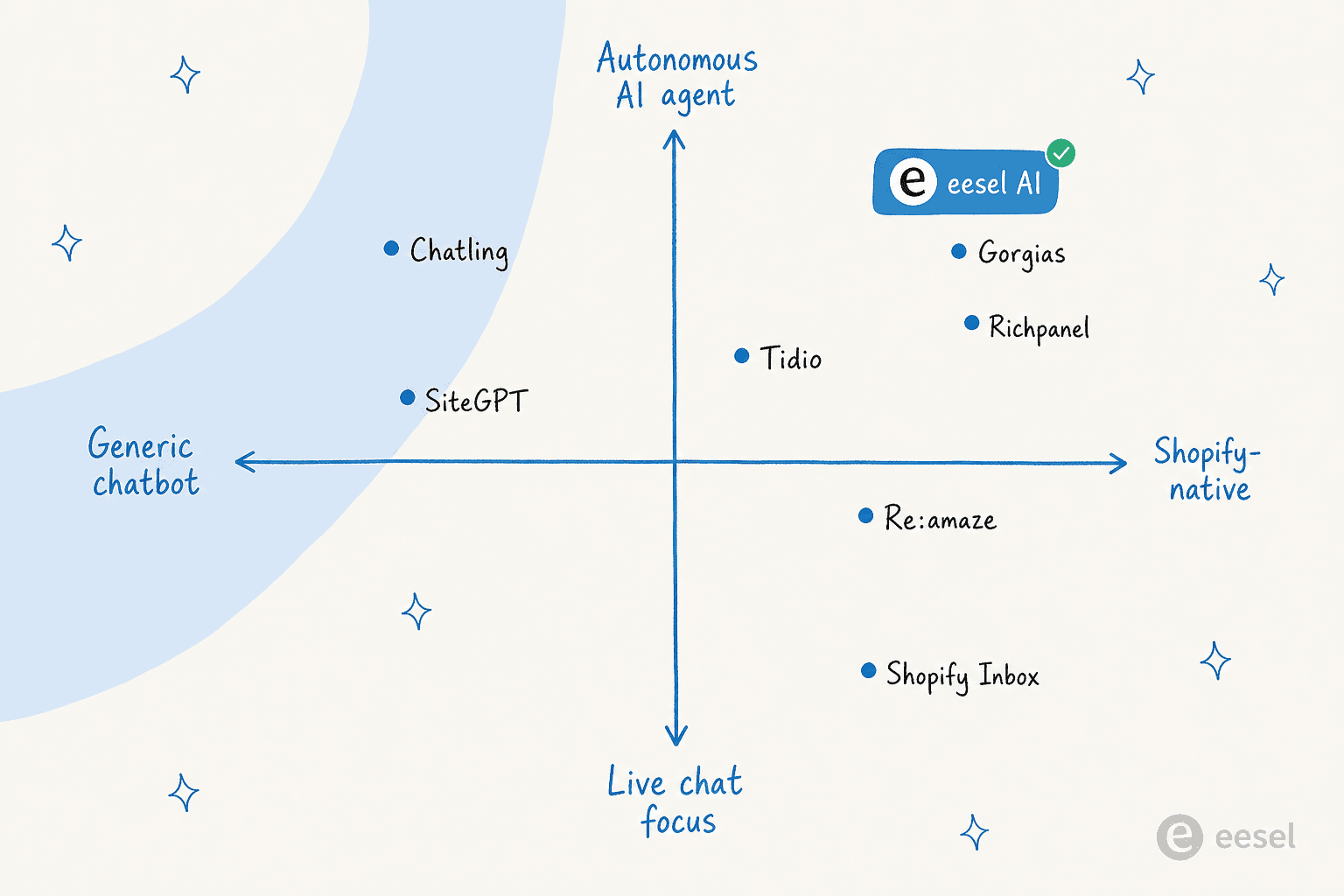
A bit of nuance up front. "Native Shopify depth" matters more than headline AI claims because the failure mode of a Shopify chatbot isn't usually that the model is wrong, it's that it has no idea where your customer's order is. Tools that read Shopify order data, fulfillment status, and subscriptions live (Gorgias, Richpanel, eesel AI, Tidio on Growth+) handle ecommerce edge cases in a way generic chatbots can't.
1. eesel AI
Best for: Shopify stores already running a helpdesk (Zendesk, Freshdesk, Gorgias, Help Scout) that want autonomous AI on top without a migration.
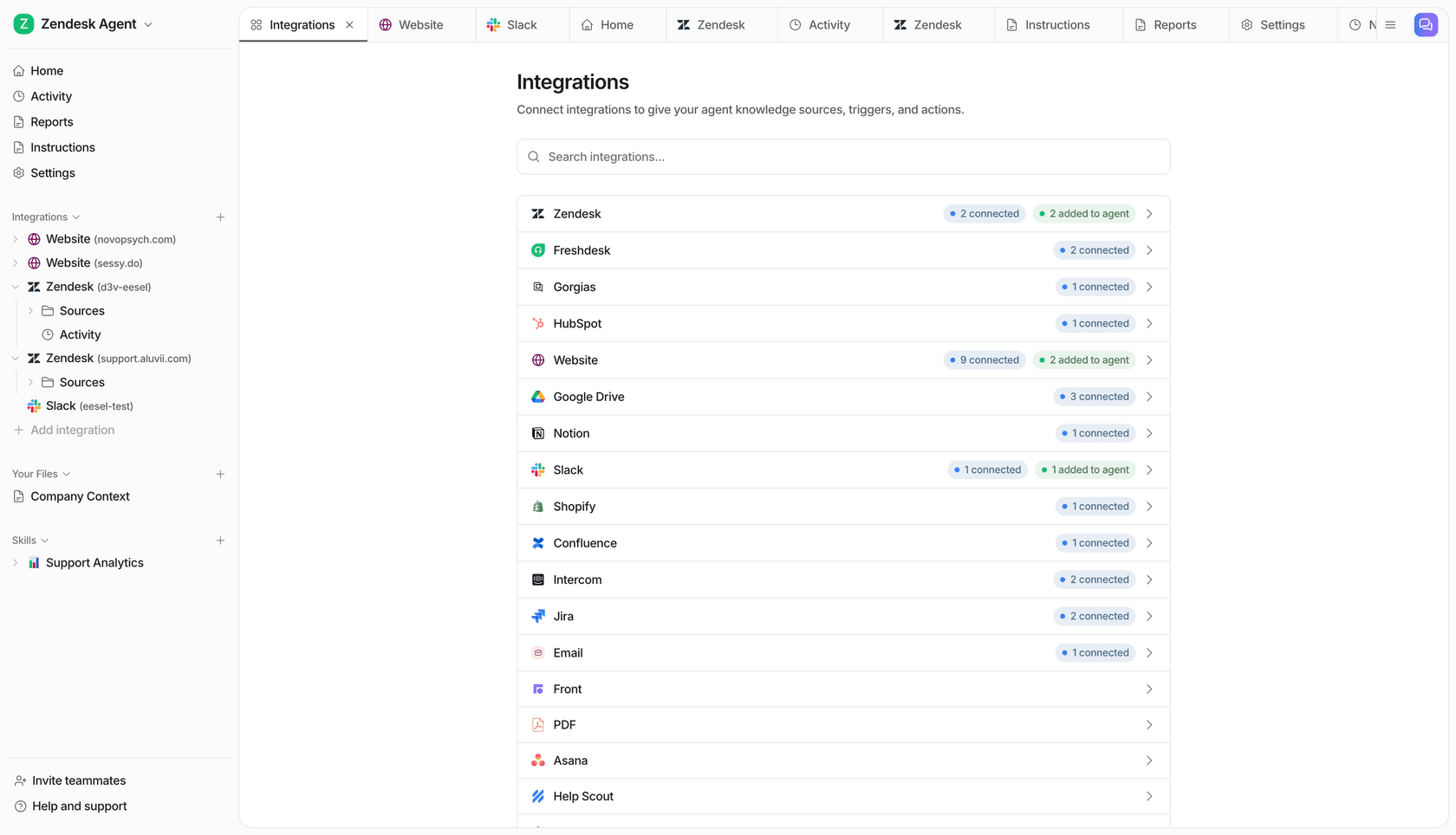
The pitch with eesel AI is contrarian to the rest of this list: most tools here are "rip out your helpdesk and use ours instead." eesel goes the other direction. It connects to your existing helpdesk (Zendesk, Freshdesk, Gorgias, Help Scout, Front), your Shopify store, your knowledge base, and 100+ other apps, and runs an autonomous AI agent across all of them. Your customer-facing chat widget and your helpdesk stay where they are; the AI sits on top.
The model is autonomous tasks, not seats. A "regular task" (one ticket or chat) is $0.40. A simulation mode lets you replay your last 1,000 tickets against the agent before it goes live, so you see deflection rates and edge cases up front instead of discovering them in production.
Pros:
- Doesn't force a helpdesk migration. Keep Zendesk, Gorgias, Freshdesk, or Help Scout, get autonomous AI on top.
- Simulation mode replays historical tickets so you can validate before going live.
- Per-task pricing means a slow month is a cheap month. No seat fees, no platform fee on self-serve.
- Multilingual out of the box; reads tone and brand voice from existing tickets.
Cons:
- It's a layer, not a helpdesk. If you don't have a helpdesk yet, you're not the target buyer (yet).
- Public review base is still small relative to incumbents like Gorgias.
- Heavy task (blog post generation) is priced at $4 each, which sits separately from the support pricing if you want to use the Blog Writer agent too.
Pricing: $0.40 per regular task (ticket or chat), $4.00 per heavy task, free dashboard Q&A. Annual commits over $300/mo get a 25% discount. Enterprise: $1,000/mo platform fee plus usage. Free trial is $50 of credit with no card required. Full breakdown on the eesel pricing page.
Our take: If you've already invested in Zendesk, Gorgias, or another helpdesk and don't want to throw it away, this is the path of least resistance to real AI deflection. The simulation mode is the unlock; nothing else in this list lets you see your deflection rate before paying for it. If you don't have a helpdesk yet, look at Gorgias, Tidio, or Richpanel below first.
2. Gorgias
Best for: Shopify-native ecommerce teams who want one tool that does ticketing, live chat, and AI in one package.
Gorgias is the default answer to "what helpdesk should I run on Shopify?" and the numbers explain why: it powers 40% of the top 1,500 Shopify brands and is Shopify's Premier Partner for CX. The product combines a unified inbox (email, chat, social, SMS, voice) with an AI Agent that splits into two roles: a Shopping Assistant for pre-purchase questions, and a Support Agent for post-purchase work like order tracking, returns, refunds, and subscription edits.
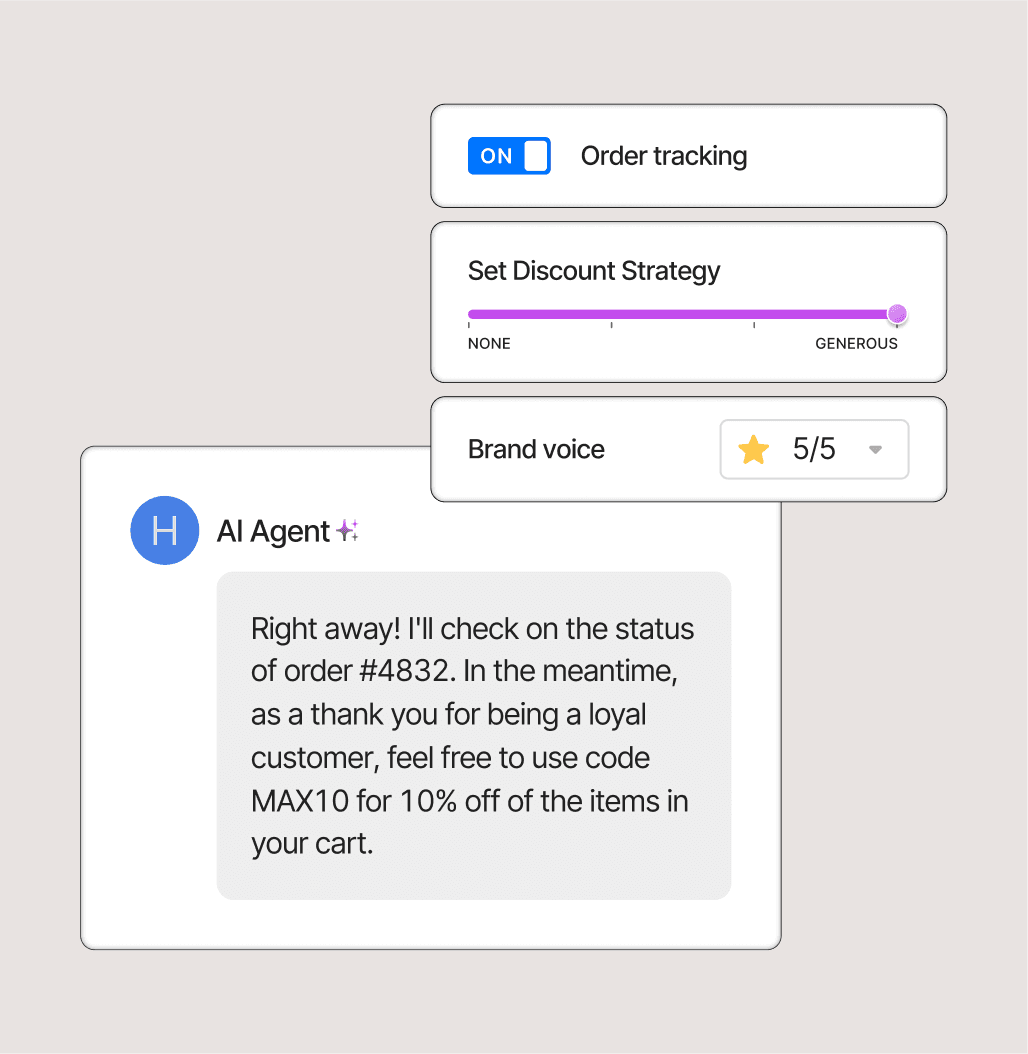
The depth of the Shopify integration is the single biggest reason people pick it. Order history, product catalog, customer profile, fulfillment status, and revenue attribution all surface inside the ticket and chat view, no tab-switching. The chat in checkout feature even prevents cart abandonment by surfacing live chat at the checkout step.
Pricing is the #1 objection. At roughly 3x the cost of Zendesk for similar ticket volumes, small teams frequently question whether Gorgias is worth it. Community rule of thumb: worth it if 40%+ of tickets require direct Shopify actions.
Synthesised from Reddit r/CRM discussions and r/ecommerce threads

Pros:
- Deepest Shopify integration on the market. Multi-store support, native order actions, revenue attribution.
- AI Agent handles order tracking, returns, refunds, subscriptions, and discount code generation end to end.
- Pricing is ticket-volume based with unlimited users on every plan, which suits ecom teams with seasonal swings.
- 4.6/5 on G2 across 560+ reviews is a strong, well-tested baseline.
Cons:
- The cheap-looking $10/mo Starter is 50 tickets; if you do 1,000 tickets/month you're on the $360/mo Pro plan minimum.
- AI Agent is a paid add-on at $0.90–$1.00 per fully resolved conversation, stacked on top of plan cost.
- Per-ticket pricing penalises busy months; one Reddit operator we surfaced noted the cost-to-Zendesk gap as the main reason teams hesitate.
Pricing: Five plans by ticket volume. Starter $10/mo (50 tickets), Basic $60/mo (300), Pro $360/mo (2,000), Advanced $900/mo (5,000), Enterprise custom. AI Agent is $0.90–$1.00 per fully resolved conversation. Annual billing saves up to 16%. Full detail on the Gorgias pricing page.
Our take: If your store is Shopify-only and you want one tool to run support, chat, and AI on top of native order data, Gorgias is the unmissable choice. Skip it if your support volume is low (under 300 tickets/month) or if you're already on another helpdesk you don't want to migrate away from. For alternatives at lower cost, see our Gorgias alternatives roundup.
3. Tidio
Best for: SMB Shopify stores wanting an all-in-one chatbot, live chat, and helpdesk without a per-resolution AI bill.
Tidio is a single-product bundle: AI agent (Lyro), live chat widget, ticketing, and proactive automations (Flows). Lyro is the headline, and it's a notable choice; it runs on Anthropic's Claude rather than ChatGPT and Tidio claims a 67% average resolution rate, which they market as the highest in the customer support AI category. The platform serves 300,000+ businesses including Under Armour, The Body Shop, and Stanley.
On Shopify specifically, Tidio ranks 4.8/5 across 1,300+ App Store reviews and adds native Shopify actions (order tracking, cart recovery, product cards) starting at the Growth plan.

Pros:
- Claude-powered Lyro is one of the few non-OpenAI mainstream support agents, which means different failure modes than the rest of the field.
- 4.8/5 on the Shopify App Store with 1,300+ reviews is the strongest Shopify-native social proof outside of Gorgias.
- 67% resolution claim is backed by a money-back guarantee on the Premium plan if resolution falls below 50%.
- A meaningful free plan exists (50 conversations, 50 lifetime Lyro convos), so you can validate fit before paying.
Cons:
- Three separate usage axes (billable conversations + Lyro AI conversations + Flows visitors) make pricing hard to predict at scale.
- The jump from Growth (from $49.17/mo) to Plus ($749/mo) is a $700 step with no middle plan.
- Lower plans are email-support only; live chat support starts at Plus.
Pricing: Free $0/mo (50 conversations). Starter $24.17/mo. Growth from $49.17/mo (Shopify actions unlocked here). Plus from $749/mo (Lyro Connect, OpenAPI, dedicated CSM). Premium ~$2,999/mo (guaranteed 50% resolution, managed AI, SSO). Lyro AI standalone from $32.50/mo if you want to layer it on a different helpdesk. Full breakdown on the Tidio pricing page.
Our take: If you want an all-in-one chatbot and helpdesk for a small or growing Shopify store, Tidio is the strongest balance of features, integration depth, and pricing. The Claude-based Lyro genuinely behaves differently from OpenAI-based competitors. The pricing model is the only real watchout: model your monthly bill against all three usage axes before signing an annual deal. For more context, see our Tidio alternatives breakdown.
4. Shopify Inbox
Best for: Stores on a tight budget that want a working chat widget today and don't yet need AI deflection.
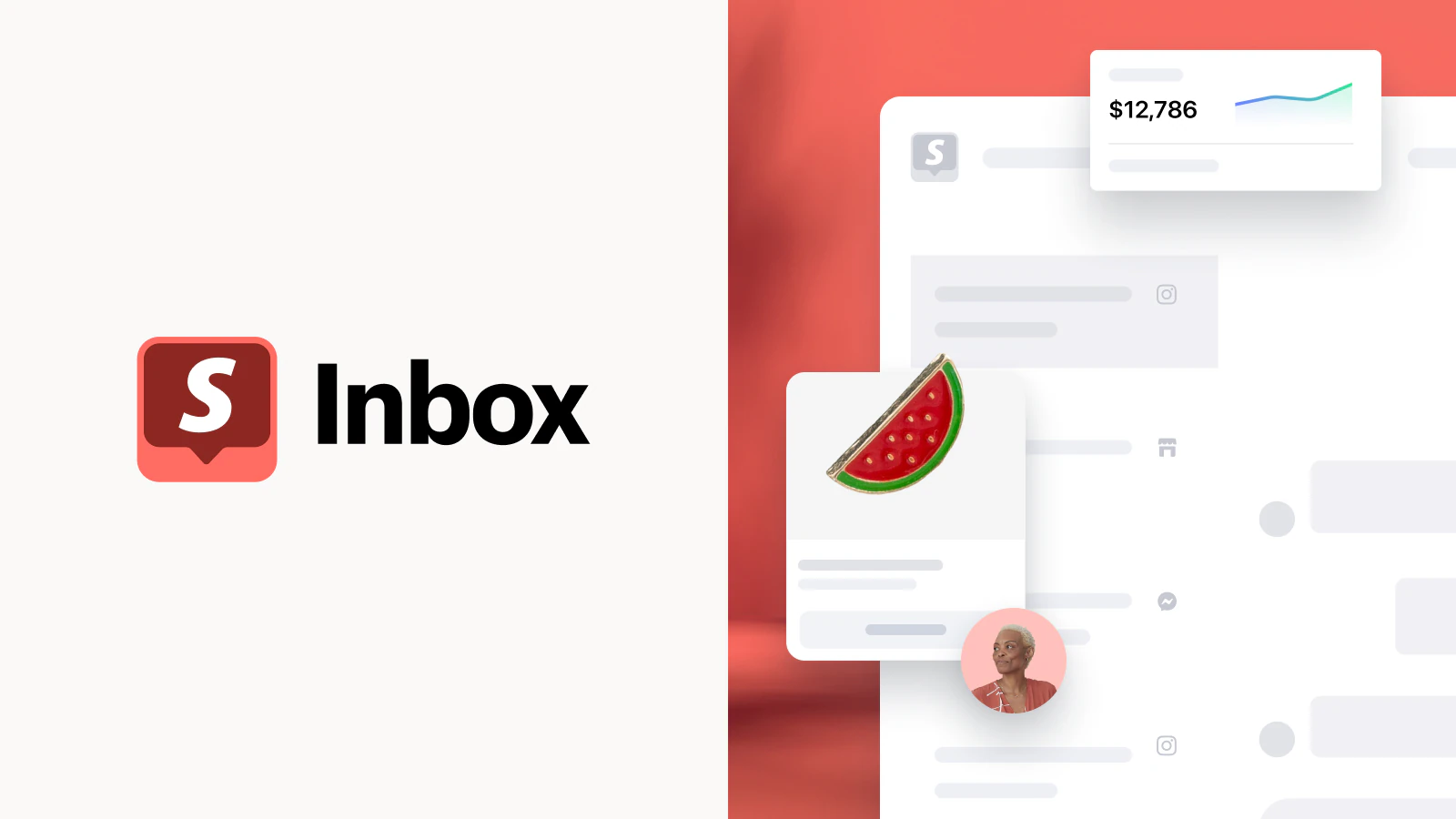
Shopify Inbox is Shopify's own free messaging tool, baked directly into the Shopify admin. It does the things you'd expect from a native product: live chat widget, mobile apps, cart visibility inside the conversation, rich product cards, discount code sharing mid-chat, and AI-suggested replies powered by Shopify Magic.
The standout stat is the 4.7/5 rating across 5,386 App Store reviews, with 80% of those being 5-star. Shopify pitches it as a conversion tool first; the marketing line is that 70% of Inbox conversations are with shoppers in active purchasing decisions.
Pros:
- Free at every scale. No paid tier, no per-conversation fee, no upsell.
- First-party Shopify integration. Cart, order history, browsing data all there.
- Mobile apps for iOS and Android with reliable push notifications.
- 21-language support out of the box.
Cons:
- Shopify Magic AI is light and template-driven. It pulls from website text rather than real conversation history, so reviewers consistently call out generic suggestions.
- No chat history export, no real ticketing, no advanced routing or CRM-level features.
- Power users describe it as "very basic" once volume picks up.
- No native integration with external channels (WhatsApp, Messenger, email outside Shopify).
Pricing: Free. Always. Requires a Shopify subscription, but Inbox itself adds nothing. See the full Shopify Inbox guide for setup, limits, and when to upgrade.
Our take: If your store does under ~200 chats a month and you've never run a helpdesk before, just start with Shopify Inbox. It's free, it works, and you'll learn what your customers actually ask before you spend money on a more powerful tool. The moment you find yourself answering "where is my order" three times an hour, you've outgrown it; check out Tidio or eesel AI for the next step up.
5. Re:amaze
Best for: Small ecommerce or SaaS teams that want a unified inbox covering chat, email, SMS, voice, and social without buying four separate tools.
Re:amaze, owned by GoDaddy since 2021, is the multichannel inbox that bundles in a chat widget and bots without making them paid add-ons. You get live chat, email, social, SMS, VoIP, video calls, push notifications, an AI Agent (in beta), AI reply drafting, conversation summaries, sentiment analysis, and a co-browsing feature (Peek) all in one product.
The Shopify story is more "deep integration via the order context surfacing inside conversations" than a dedicated Shopify-native build like Gorgias. It's a generalist tool that happens to do ecommerce well.
Pros:
- Built-in chatbots (Welcome Bot, Order Bot, custom bots) ship as first-party features, not paid add-ons.
- Starter plan at $59/mo flat is unusual: unlimited team members at low ticket volume, which suits a larger team with light support load.
- Co-browsing (Peek), live video calls, and in-chat video on the Plus plan are uncommon at this price point.
- Honest, customer-driven testimonials: Built Bar reported 5–6x speed gains; Printful scaled from 1 to 30 operators on the same tool.
Cons:
- The "AI Agent" is in beta, and overage past included AI resolutions is $0.85 each on every plan.
- Shopify-specific feature pages are thin (the
/solutions/shopifypage returned generic homepage content during our research). - G2 review data was inaccessible during research, so independent social proof is weaker than for Gorgias or Tidio.
- The flat-rate Starter sounds great until you hit 500 conversations a month; from there it's per-seat pricing.
Pricing: Starter $59/mo flat for unlimited seats, capped at 500 conversations/month. Basic $29/seat/mo (annual: $26.10). Pro $49/seat/mo (annual: $44.10). Plus $69/seat/mo (annual: $62.10). AI Agent overage $0.85/resolution. 14-day free trial, no card. See the Re:amaze pricing page for the full feature matrix.
Our take: Re:amaze is the right pick when you genuinely have customers reaching out across 5+ channels (email, chat, Insta, SMS, voice) and you want them all in one inbox without paying Zendesk Enterprise pricing. If your support is mostly Shopify chat and email, you'll get more native depth from Gorgias.
6. Richpanel
Best for: AI-first ecommerce ops teams ready to commit to autonomous resolution and willing to pay a meaningful base fee for it.
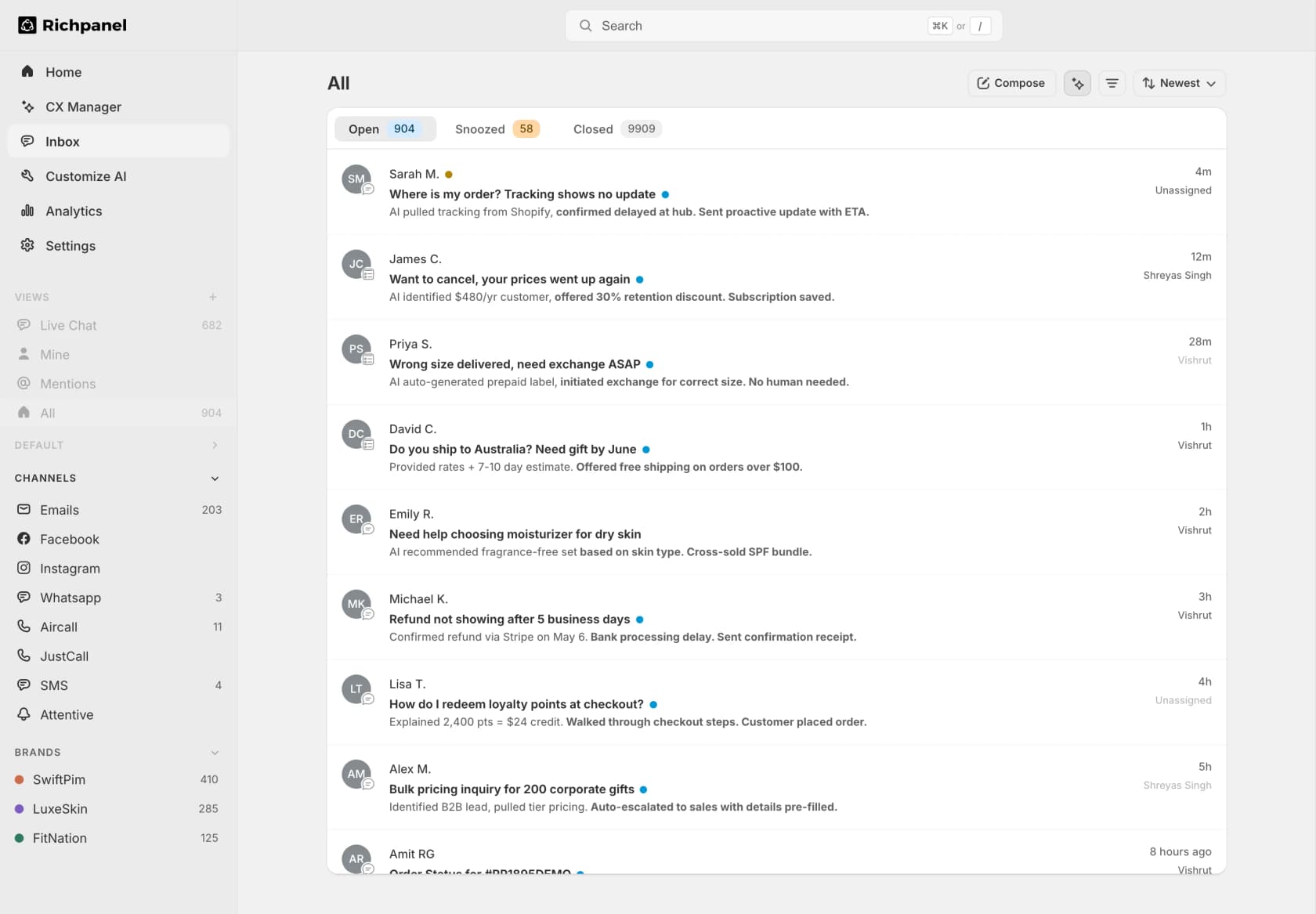
Richpanel is the boldest reframe of the helpdesk category in this list. The product is structured as a team of four AI roles: Frontline AI that resolves tickets end to end, Copilot AI that researches and drafts replies for human agents, QA AI that reviews every reply before it sends, and a CX Manager AI that builds SOPs from your site and assigns work. The marketing line is "hire an AI support team," and the pricing is structured like hiring.
The headline guarantee is the commercial hook: 50% autonomous resolution in 30 days or your money back. The product claims 70–80% resolution at maturity, $0.30 per conversation on AI-handled tickets, and an 8-second first reply across all channels 24/7. Named customers include The Ridge, Jones Road Beauty, and Pela.
Pros:
- 30-day money-back guarantee on AI performance is rare in the category; it's a credible commitment.
- Strong Shopify ecosystem integrations (Recharge, Loop Returns, Loop Subscriptions, AfterShip, Skio, ShipStation) beyond just Shopify itself.
- QA AI reviewing 100% of replies before they go out is a real answer to the hallucination concern most other AI chatbots ignore.
- No feature gating between tiers. Same AI on the $500 plan as on Enterprise.
- SOC 2 Type II, HIPAA via third-party, GDPR, and SAML SSO ship across all plans.
Cons:
- $500/mo base plus $0.25/conversation is the most expensive entry point in this list. Below ~2,000 conversations/month, the ROI math doesn't work.
- Public review data is thin (G2 was JS-gated during research).
- The "hire an AI" framing is divisive; some buyers find it grating, others love it.
- If you need a "try before you buy" trial, the money-back guarantee is the only path; there's no traditional 14-day window.
Pricing: AI Agent (self-serve) $500/month + $0.25/conversation, human seats $100/seat/month. Sample bill: 2 AI agents + 3 human seats = $800/month. Enterprise is custom with volume pricing and human seats included. Full detail on the Richpanel pricing page.
Our take: If you're already over 2,000 conversations a month and you're philosophically ready to bet on autonomous AI (with humans handling exceptions), Richpanel is the cleanest product on that bet. Below that volume, the math doesn't work yet and Tidio or eesel AI will get you to the same place at a tenth of the base cost.
7. Chatling
Best for: Stores that want a no-code AI chatbot they can drop on Shopify without migrating off their existing helpdesk.
Chatling is the lightweight option in this list. It's a no-code chatbot builder where you point it at your website, docs, FAQs, or uploaded files; it trains an AI agent on that content; and you embed it on your store. It deploys across the web widget, WhatsApp, Instagram, and Messenger from a single inbox, and lets you pick from 28 LLMs (OpenAI, Claude, Gemini, Mistral, Grok, DeepSeek) for different blocks or agents.
Chatling has 4.7/5 on G2 across 71 reviews with 81% five-star ratings. It scores 9.5/10 on G2 for "ease of use" and verbatim user reports say they were live in 5–20 minutes. The biggest verbatim complaint is the AI credit system, which varies ~28x by model (GPT-4o mini at 0.5 credits versus GPT-5.5 or Claude Opus 4.8 at 14 credits).
Pros:
- Live in 5–20 minutes for most users; the visual builder is genuinely no-code.
- Free plan exists with 100 AI credits, 2 agents, and visual builder access.
- 28 model choices means you can pick a cheap fast model for FAQs and a stronger one for nuanced replies.
- Omnichannel deployment beyond web (WhatsApp, Instagram, Messenger) is included on the $40/mo Standard plan.
Cons:
- Not Shopify-native. You connect to Shopify via webhook or HTTP request action, not a one-click integration.
- AI credit system is the dominant user complaint; budget for premium-model conversations is easy to burn through.
- Live chat / human handoff is the weakest dimension per checkthat.ai's review aggregation (Route-to-Human score 6.7/10).
- SMB-targeted, not enterprise. A/B testing, RBAC, and accessibility features trail Botpress and similar.
Pricing: Free $0/mo (100 AI credits, 2 agents). Standard $40/mo monthly or $32/mo annual (3,000 credits, WhatsApp/IG/Messenger, all 28 models, API, Zapier). Plus $140/mo monthly or $112/mo annual (15,000 credits, Zendesk/Zoho/HubSpot, daily auto-sync). Annual billing is 20% off; 7-day money-back guarantee. See the Chatling pricing page for AI-credit-per-model details.
Our take: A great fit if you want a working AI chatbot on your Shopify store without changing your helpdesk and you're comfortable wiring a webhook to fetch order data. Skip if you need a deep, native Shopify integration that surfaces order context automatically in every conversation.
8. SiteGPT
Best for: Stores that already write good help docs and want a website-trained AI bot to answer from them, on a small budget.
SiteGPT is the most narrowly scoped tool in this list. You point it at a URL (or sitemap, YouTube channel, Zendesk Help Center, Gitbook, or file uploads), it trains a chatbot specifically on your content, and you embed it on your site. Positioning is "ChatGPT for your product." It supports 95+ languages, escalates to a human via a one-button handoff, and integrates natively with Crisp, Zendesk, and a few other helpdesks.
The product is bootstrapped and founder-built, with a small but genuinely positive review base (~11 G2 reviews). It quietly does what it says it does.
Pros:
- Cheapest paid entry point in the deflection-focused tier: Starter is $39/mo (or about $23/mo annual).
- SOC 2 Type II, GDPR DPA, HIPAA BAA on Enterprise; your data doesn't train upstream models.
- Two model tiers (GPT-4.1 for depth, GPT-4.1-mini for speed and ~10x lower cost per message); you split your monthly quota between them.
- Auto-refresh retraining (monthly, weekly, or daily depending on plan) keeps the bot in sync with your help docs.
Cons:
- Not Shopify-native. The integration story is "embed on your Shopify storefront and train on your docs"; order context isn't there unless you wire it via the API.
- Small public review base (~11 G2 reviews) and a quiet Reddit footprint compared to Tidio or Gorgias.
- Page math is plan-gated (1,000 / 10,000 / 50,000 pages) and the page definition is 2,500 cleaned characters, so larger help centers consume the quota faster than expected.
- Live chat and human handoff are present but not the headline feature.
Pricing: Starter $39/mo (1 chatbot, 4k msgs/mo, 1,000 pages, manual refresh). Growth $79/mo (2 chatbots, 10k msgs, 10,000 pages, integrations + API, monthly auto-refresh). Scale $259/mo (3 chatbots, 40k msgs, 50,000 pages, weekly auto-refresh + daily auto-scan). Enterprise custom. Yearly billing is ~40% off. Add-ons: remove branding $39/mo, extra 5k messages $39/mo. See the SiteGPT pricing page for the full table.
Our take: A clean, focused tool when your support volume is small and your help docs are good. The fit gets thinner as soon as you need real Shopify order context inside conversations; for that, look at eesel AI, Tidio, or Gorgias instead.
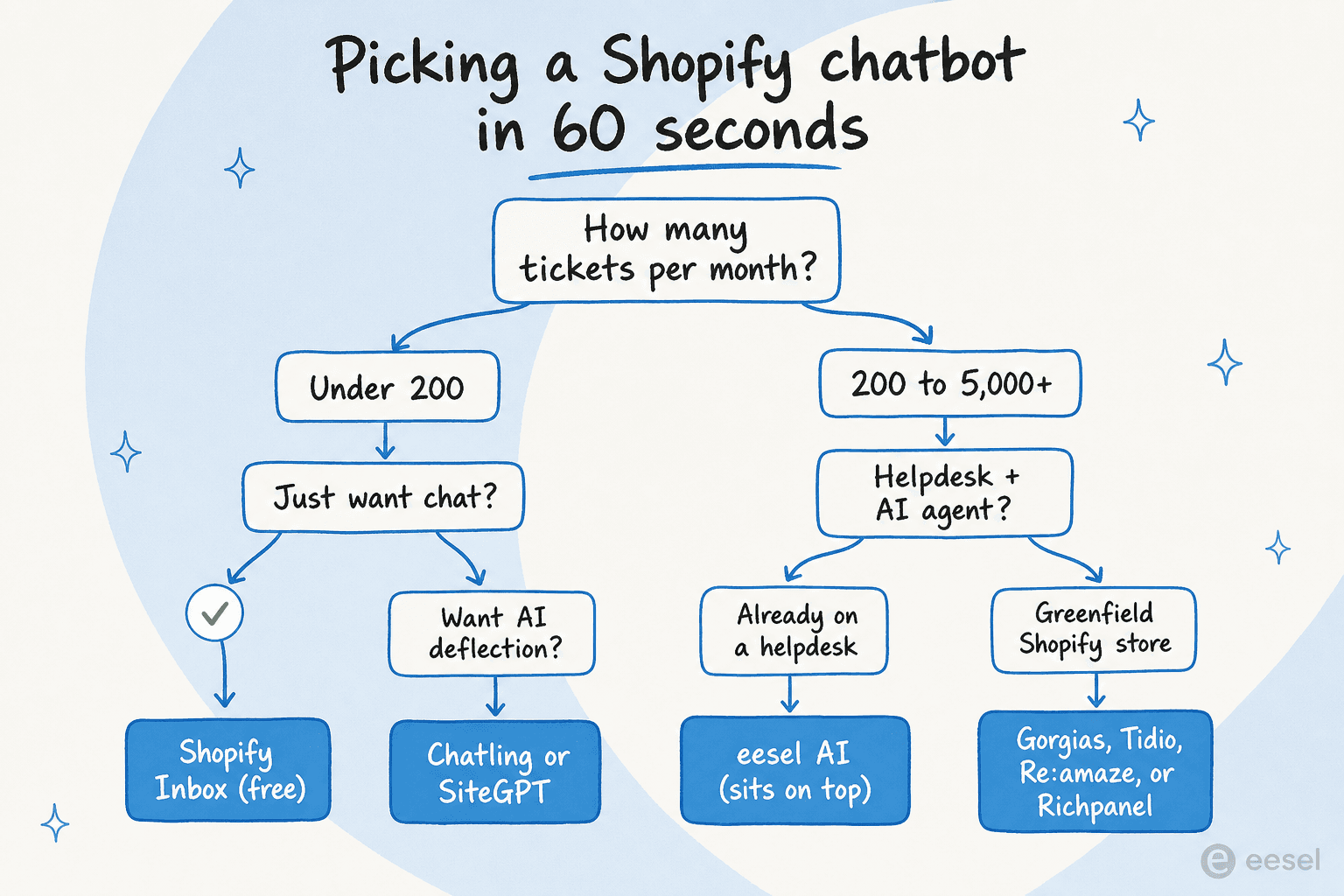
How to pick the right Shopify chatbot in 60 seconds
The whole list collapses into three forks: how big is your support volume, do you already have a helpdesk, and do you want a real AI agent or just a live chat widget.
A worked example of what this costs in practice. We've seen this exact pattern in real buyer conversations: a German online jewelry retailer running roughly 1,000 tickets a month on Zendesk + Shopify ran a final-stage comparison between two AI vendors and a per-resolution pricing model. The per-resolution math punished them on busy months and held them flat on slow months. At 1,000 tickets a month and 80% resolution they were looking at about $792/month; at Black Friday's 4,000 tickets and the same resolution rate, $3,168/month. A flat or per-task model kept the November bill the same as their March bill, which is a different shape of bet entirely.
The takeaway: model your pricing against both your sleepy month and your Black Friday month before you sign. The cheapest sticker price in this list is rarely the cheapest annual bill.
Buyer's checklist before you commit
- Does it actually read Shopify order data live? Not "we integrate with Shopify" on the marketing page, but "the AI can answer where is my order #1234 without an agent." Test it during a trial.
- Can it sit on your existing helpdesk, or does it force a migration? Migration cost is real time and a real risk. If you've already invested in Zendesk or Gorgias, layering AI like eesel AI on top will usually beat a re-platform.
- What does a 1,000-ticket month cost? What does 4,000? Get a worked bill for both. Per-resolution pricing tilts costs against you; flat-rate flattens them.
- How does the AI handle escalation? A clean human handoff (with the conversation context preserved) is the difference between an AI that helps and an AI that buries your team in cleanup.
- What does the agent do when it's not sure? The honest tools give you confidence-based routing, ticket-type exclusion, and a "draft an internal note instead of replying" mode. The dishonest ones auto-reply and apologise later.
- Does the AI training data stay your data? Most reputable tools (Chatling, SiteGPT, eesel, Richpanel) explicitly do not use your data to train upstream models. Read the DPA before signing.
Try eesel
If your store is already on a helpdesk and the migration cost of switching is what's holding you back, eesel AI is the lowest-friction path to autonomous Shopify support. It connects to Zendesk, Freshdesk, Gorgias, Help Scout, Front, your Shopify store, and your knowledge base, and runs an AI agent on top of all of it. The simulation mode replays your last 1,000 tickets against the agent before it goes live, so you see your real deflection rate before you pay for it.
Pricing is $0.40 per regular task with no seat fees, and a free trial runs on $50 of credit with no card required. Start a free eesel trial or read the Shopify integration guide for setup detail.

Frequently asked questions
What is the best Shopify chatbot app for small stores?
For stores with under 200 tickets a month, Shopify Inbox is the cheapest sensible starting point because it's free, native, and surfaces cart data inside the chat. If you want real AI deflection on a budget, Chatling's $32/mo Standard plan adds an AI agent trained on your help docs. For everything else, see our Shopify chatbot tools roundup.
How much does a Shopify chatbot app cost?
Shopify chatbot pricing in 2026 ranges from free (Shopify Inbox) to about $500/mo for a fully autonomous AI helpdesk like Richpanel. Mid-market AI chatbots sit between $32–$360/mo on entry plans, then add per-resolution or per-conversation fees on top. See our Shopify AI pricing guide for the full breakdown.
What does a Shopify chatbot actually do?
A Shopify chatbot is a chat widget that sits on your storefront and answers shopper and customer questions automatically. The good ones do more than reply: they pull live order data, share product cards, send discount codes, and hand off to a human when they hit something they can't solve. See our complete Shopify chatbot guide for the full picture.
Can a Shopify chatbot replace my support agents?
Not entirely, and the honest tools don't claim it. Most AI chatbots aim for 50–70% autonomous resolution on repeat tickets so your team can focus on the messy ones. Richpanel guarantees 50% resolution in 30 days or your money back, and Tidio's Lyro claims a 67% average resolution rate.
Which Shopify chatbot has the best AI?
It depends on your starting point. If you're already on a helpdesk (Zendesk, Freshdesk, Gorgias), eesel AI drops an autonomous agent on top of it without forcing a migration. If you're starting fresh and want a Shopify-native helpdesk with an AI agent baked in, Gorgias and Richpanel are the strongest picks.
Are free Shopify chatbots any good?
Shopify Inbox is genuinely useful at the free tier - 4.7 stars across 5,386 App Store reviews - but it's a chat tool with light AI, not a deflection engine. Chatling and SiteGPT both have free or low-cost trial tiers that include real AI agents trained on your content, which is a step up if deflection is the goal.
How long does it take to set up a Shopify chatbot?
For a basic chat widget like Shopify Inbox, minutes. For an AI agent trained on your knowledge, plan on 1–2 hours to connect data sources and 1–2 weeks to tune behaviour. eesel AI ships with a simulation mode so you can replay past tickets against the agent before it touches a live customer, which collapses the tuning loop dramatically.


Article by
Riellvriany Indriawan
Riell is a designer and writer at eesel AI with about two years of experience researching CX platforms, AI chatbots, and helpdesk software. She combines her design background with a sharp eye for how these tools actually look and feel in practice — making her comparisons unusually visual and user-focused.