


What separates good Shopify AI support from bad
Every tool on this list claims AI. The real dividing line is how deep the Shopify integration goes. A tool that just chats without pulling order history is a generic chatbot in a Shopify costume - it can't actually answer the question "where's my order?" without the customer repeating themselves.
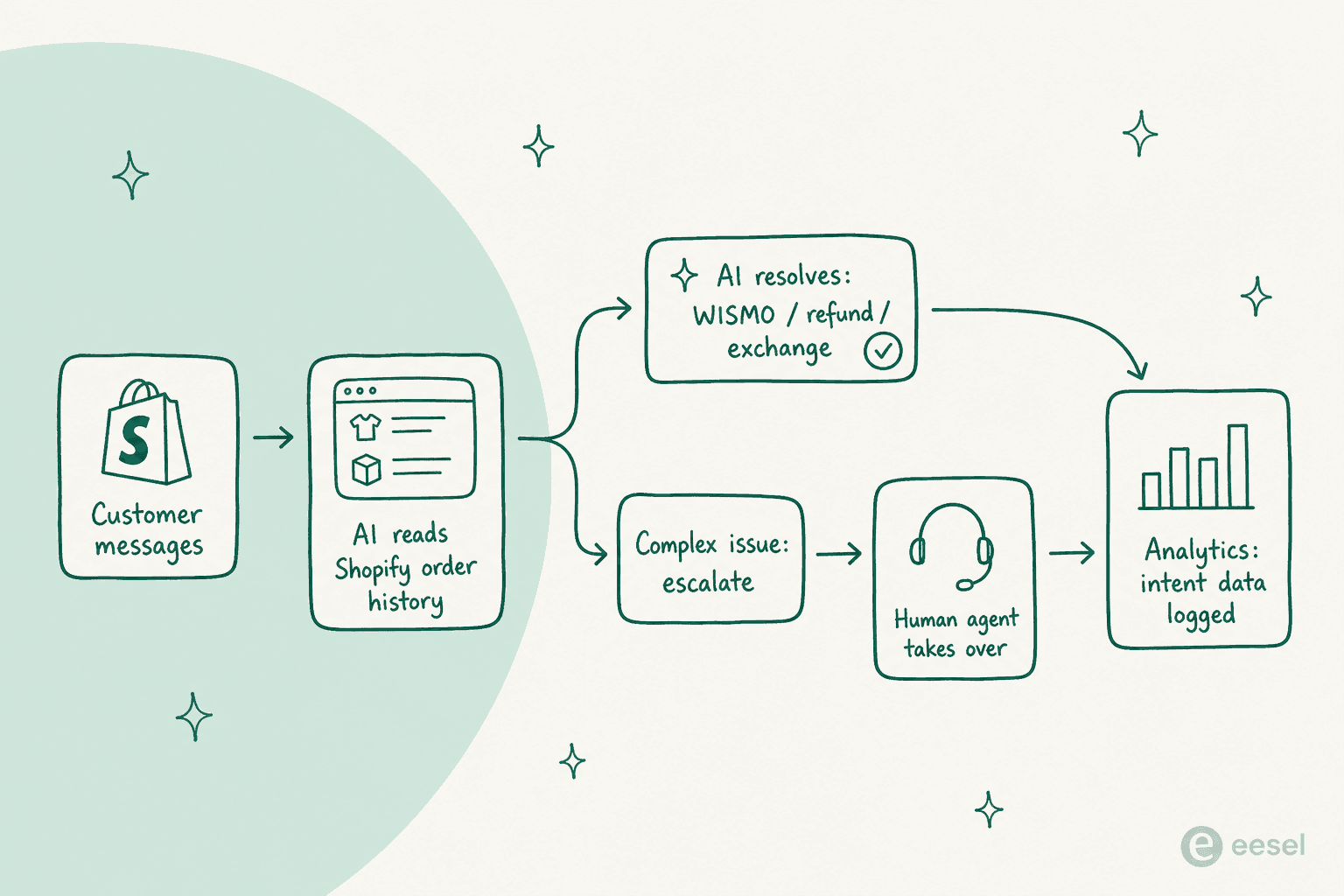
What genuinely useful Shopify AI does:
- Pulls the customer's order history, fulfillment status, and product details in real time
- Resolves WISMO, refund, exchange, and subscription questions without human intervention
- Escalates edge cases with full context already attached
- Learns from past tickets and policies so answers stay on-brand
The tools below all meet that bar to varying degrees. Here's how they stack up.
The 7 best AI tools for Shopify customer support at a glance
| Tool | Best for | AI agent | Shopify-native | Free plan | Starting price | Rating |
|---|---|---|---|---|---|---|
| Gorgias | Deep Shopify integration | Yes | Yes (Premier Partner) | No | $10/mo | 4.6/5 G2 |
| Tidio | Small/growing stores | Yes (Lyro AI) | Yes (Growth+) | Yes (50 convos) | $24.17/mo | 4.8/5 Shopify |
| Richpanel | AI-first mid-market | Yes | Yes | No | $500/mo | 4.7/5 CSAT |
| Re:amaze | Multi-channel + social | Yes (Beta) | Yes | No | $29/seat/mo | N/A |
| Shopify Inbox | Free, built-in basics | Limited (Shopify Magic) | Native | Yes (free) | Free | 4.7/5 App Store |
| Freshdesk | Enterprise helpdesk | Yes (Freddy AI) | Via marketplace | Yes (limited) | $19/agent/mo | N/A |
| eesel | AI on existing helpdesk | Yes | Via integration | $50 trial | $0.40/ticket | N/A |
1. Gorgias - best for Shopify-native support at scale
Best for: Mid-to-large Shopify merchants who want the deepest native integration
Gorgias is Shopify's only Premier Partner for customer experience - that designation exists because 40% of the top 1,500 Shopify brands use it. It is not a generic helpdesk that happens to have a Shopify integration. The two products are genuinely fused: every ticket and live chat session surfaces the customer's full Shopify order history, product catalog context, and purchase signals without any tab-switching.
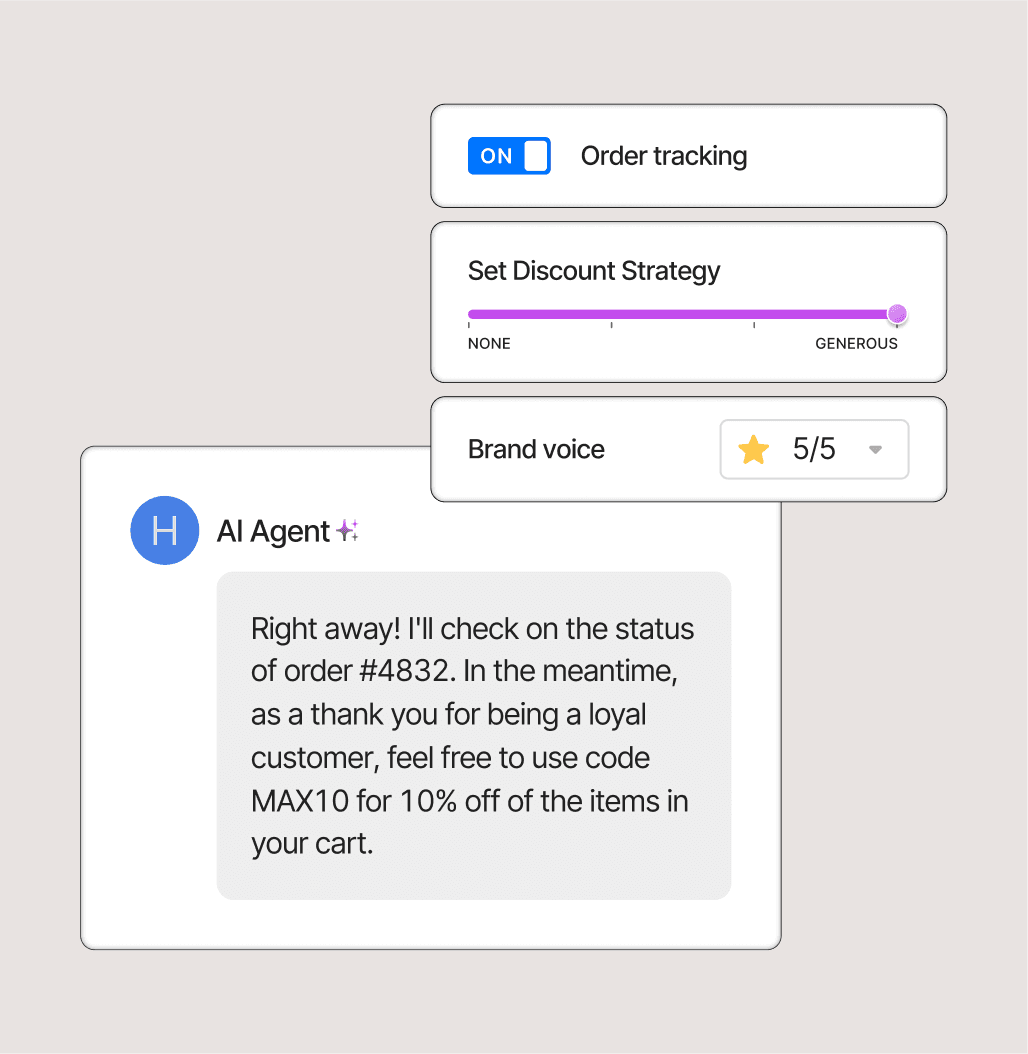
The Gorgias AI Agent runs in two modes. In Shopping Assistant mode it handles pre-purchase questions - "do you have this in size L?" - with live product data. In Support Agent mode it handles post-purchase WISMO, refunds, returns, and subscription edits fully autonomously. Gorgias claims 60% of support can be automated, and Orthofeet hit 56% automation in under two months.
The revenue side is the part competitors don't match. Gorgias tracks which chat conversations convert into purchases and attributes revenue directly. Pepper earned a 19.2x ROI on AI-driven sales; bareMinerals saw 8.83x. The $500M+ in revenue Gorgias claims to have driven via conversations is the benchmark nobody else is publishing.
Pros:
- Deepest Shopify data integration in the market
- AI Agent handles order edits, refunds, and discount codes natively
- Proactive chat campaigns triggered by cart state or URL can double as a sales tool
- Ticket-based pricing (not per-agent) makes costs predictable on growing teams
Cons:
- Gorgias pricing runs roughly 3x Zendesk at comparable volumes - it's only worth it once 40%+ of tickets involve Shopify actions
- AI Agent add-on ($0.90–$1.00 per resolved conversation) sits on top of the base plan; heavy AI usage stacks costs quickly
- Not designed for non-Shopify channels; a hybrid ecommerce setup gets awkward
Pricing:
| Plan | Price | Tickets/month |
|---|---|---|
| Starter | $10/mo | 50 |
| Basic | $60/mo | 300 |
| Pro | $360/mo | 2,000 |
| Advanced | $900/mo | 5,000 |
| Enterprise | Custom | Custom |
AI Agent add-on: $0.90–$1.00 per fully resolved conversation across all plans. Annual billing saves up to 16%.
Our take: Gorgias is the obvious pick if Shopify is your entire world and you're past 300 tickets a month. For stores below that, the $60/month Basic plan is still a reasonable choice if you value the Shopify data depth. If you're using multiple platforms beyond Shopify, look elsewhere.
2. Tidio - best for small and growing Shopify stores
Best for: SMBs and growing Shopify brands that want AI without a big monthly commitment
Tidio takes a different bet from Gorgias: it leads with accessible pricing, a genuine free tier, and Lyro, an AI agent powered by Anthropic's Claude. The Gorgias vs Tidio comparison is one of the most-searched in the Shopify space for a reason - they're aimed at meaningfully different store stages.
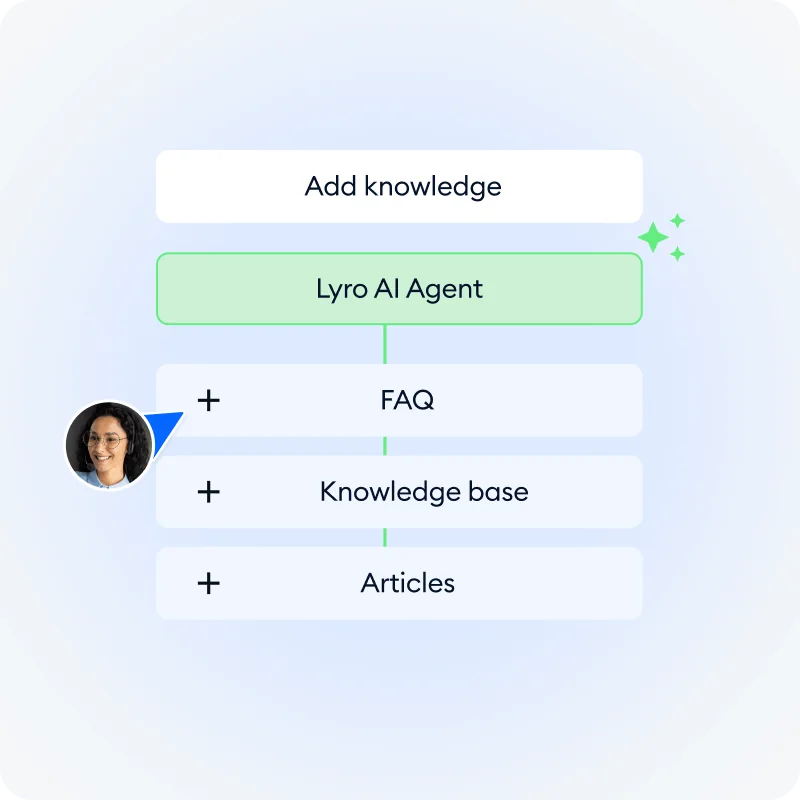
Lyro's standout claim is a 67% average resolution rate - the highest Tidio says they've seen in the market - backed by a money-back guarantee if you don't hit 50%. The resolution rate comes from Lyro staying strictly on customer-provided data: it only answers what it's been trained on, which means it virtually never hallucinates. That guardrail is what makes it trustworthy at scale, even if it limits it compared to tools with richer Shopify action access.
Suitor reduced response time by 97% with Lyro. Bella Sante generated $66K+ in revenue from Lyro-assisted conversations. Those are real numbers from named companies, not generic claims.
Shopify-specific actions (order tracking, cart recovery) require the Growth plan or above. The native Shopify integration is well-rated - 4.8/5 on the Shopify App Store with 1,300+ reviews.
Pros:
- Free plan with 50 Lyro conversations - actually useful for testing
- 67% claimed resolution rate with a money-back guarantee backing it up
- Claude-powered AI stays on-script and doesn't hallucinate outside trained data
- Proactive Flows automations work independently of Lyro for cart recovery and lead capture
Cons:
- Shopify order actions (beyond lookup) require Growth+ at $49.17/mo
- Pricing gets complex fast: per-conversation AND per-Lyro-convo AND per-Flows-visitor charges add up
- The $749/mo jump from Growth to Plus is steep if you need custom integrations or OpenAPI
Pricing:
| Plan | Annual price | Lyro conversations |
|---|---|---|
| Free | $0/mo | 50 (lifetime) |
| Starter | $24.17/mo | 100 |
| Growth | from $49.17/mo | 250–2,000 |
| Plus | from $749/mo | Custom |
| Lyro standalone | from $32.50/mo | Usage-based |
Our take: Tidio is the best entry point for small Shopify stores that want real AI without a big commitment. The free tier is genuinely useful, the Lyro money-back guarantee lowers the risk, and the Claude-backed resolution rate is competitive. Once you hit the Plus wall at $749/mo, re-evaluate whether Gorgias or Richpanel offers better value at that spend.
3. Richpanel - best for AI-first mid-market brands
Best for: Shopify brands with 2,000+ monthly tickets that want a hard automation guarantee
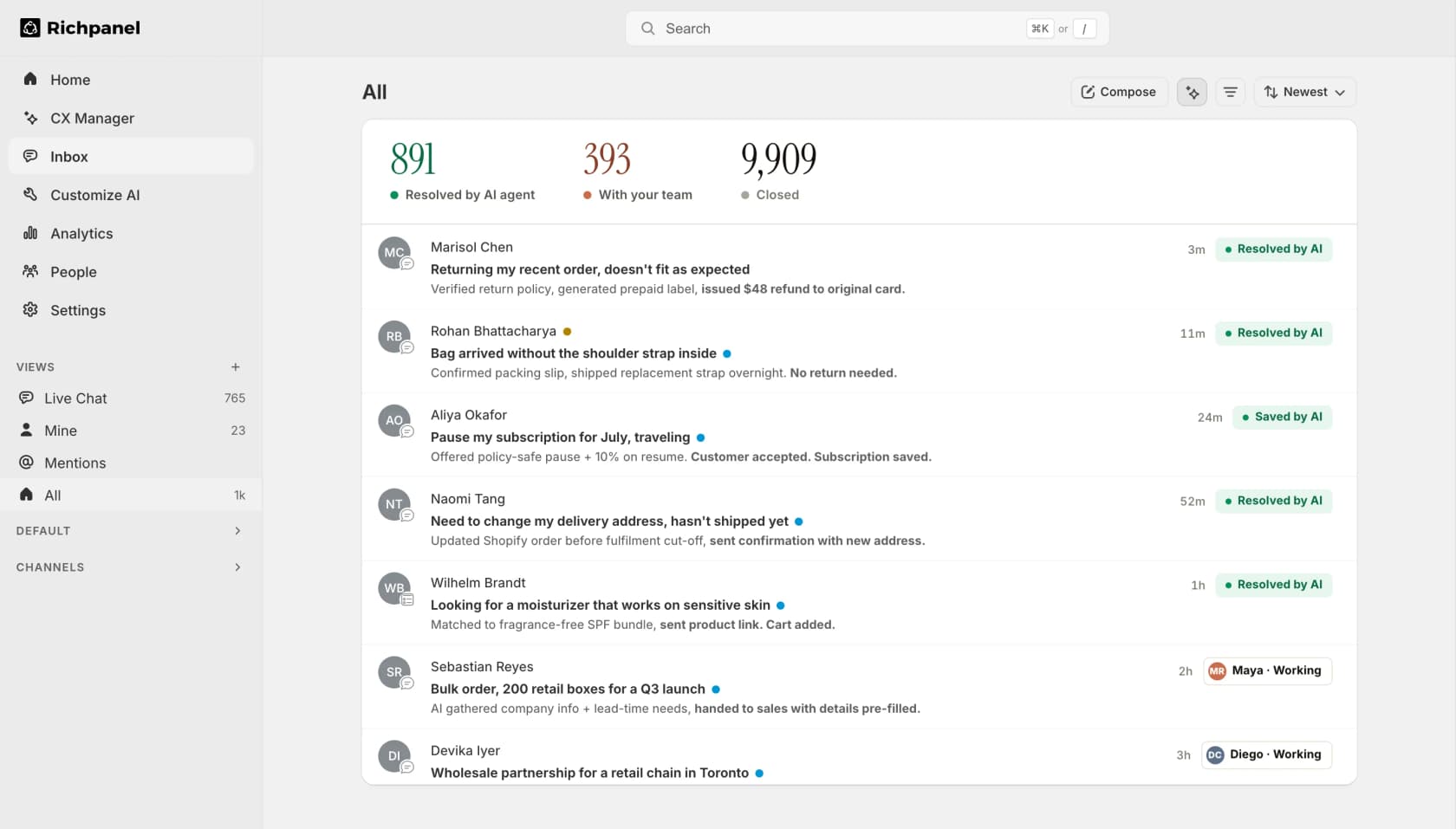
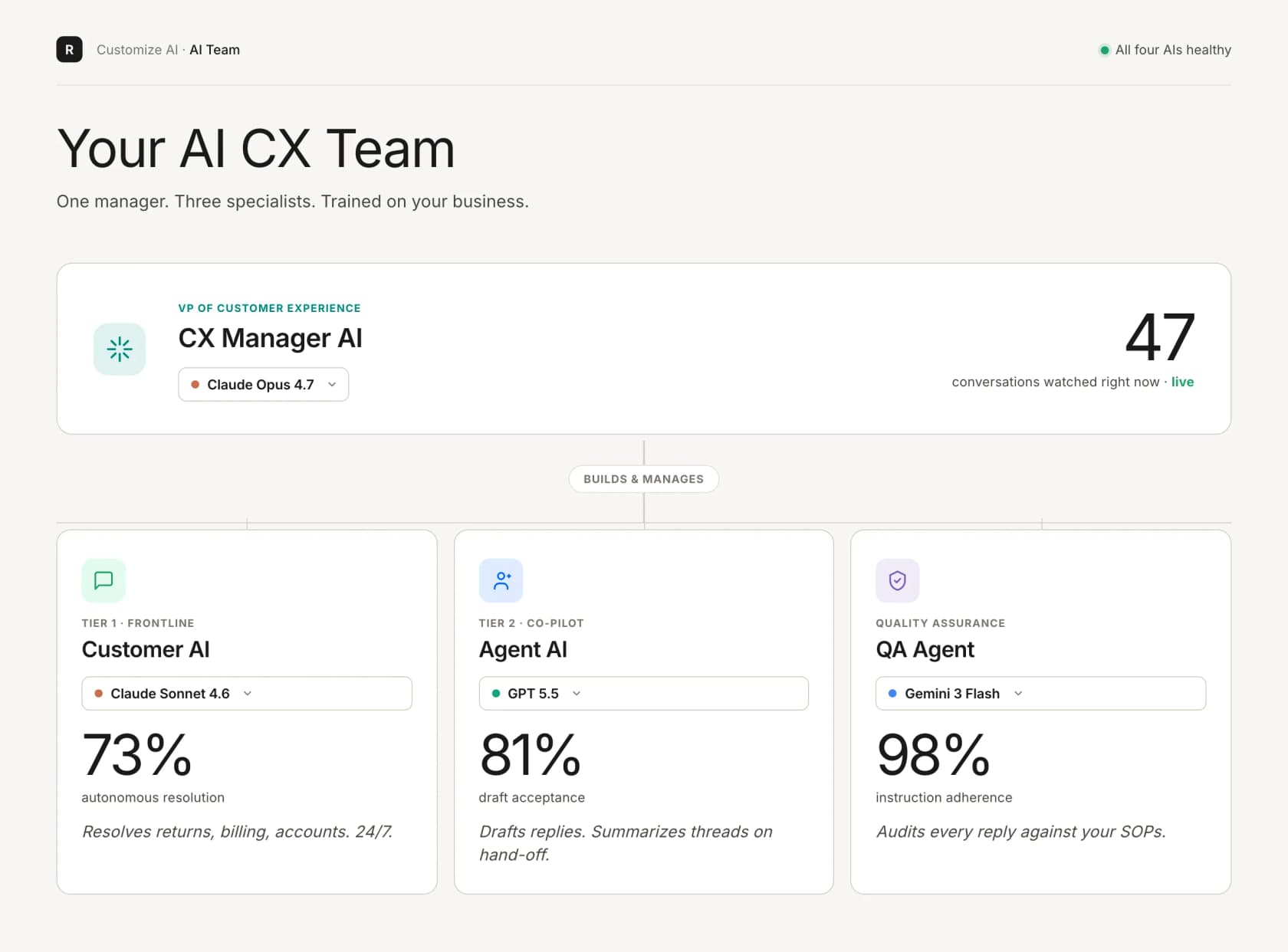
Richpanel was built from the ground up as an AI-native helpdesk for ecommerce. Where Gorgias evolved from a traditional helpdesk to add AI, Richpanel started with a fundamentally different model: instead of one AI, it deploys an entire AI CX team.
The structure is four distinct roles: a Frontline AI that resolves routine issues end-to-end (WISMO, refunds, subscription pauses, address changes), a Copilot AI that assists human agents, a QA AI that reviews 100% of AI responses before they send, and a CX Manager AI that orchestrates everything. Richpanel's core claim is 70–80% autonomous resolution at maturity - backed by a 30-day money-back guarantee of 50% autonomy if you don't hit it.
Real proof: Jones Road Beauty cut from 18 to 10 agents while revenue grew. The Ridge's CSAT went from 88% to 96% after introducing Richpanel AI. Pela maintained 90%+ CSAT throughout their AI rollout.
At ~$0.30 per AI-handled conversation versus an estimated $2–$10 for human-handled tickets, the ROI math is straightforward once you're past 2,000 tickets a month.
Pros:
- 30-day money-back guarantee of 50% autonomous resolution - rare and credible
- QA AI reviews every response before sending, which addresses the hallucination concern directly
- SOC 2 Type II, HIPAA, and GDPR - security-compliant from day one
- Migration tooling to move from Zendesk or Gorgias with tickets, macros, and tags intact
Cons:
- $500/month minimum + per-conversation fees puts it out of reach for stores under 2,000 tickets/month
- No G2 rating data available (JS-gated at research time)
- Four distinct AI roles adds configuration complexity upfront
Pricing:
| Tier | Base | Per AI conversation | Human agents |
|---|---|---|---|
| AI Agent (self-serve) | $500/mo | $0.25 | $100/seat/mo |
| Enterprise | Custom | Volume pricing | Included |
Sample bill: 2 AI agents + 3 human seats = $800/month. ROI breakeven at roughly 2,000 conversations/month.
Our take: Richpanel is the right choice for Shopify brands in the 2,000–20,000 monthly ticket range that are serious about AI-first support and need compliance certifications. The money-back guarantee takes most of the risk off the table. If you're smaller than that, the $500/month floor is hard to justify.
4. Re:amaze - best for multi-channel Shopify support
Best for: Shopify stores that also need social, SMS, and push notification support in one inbox
Re:amaze (now owned by GoDaddy after a 2021 acquisition) fills a specific gap: a helpdesk that unifies email, live chat, social media, SMS, VoIP, and push notifications into one inbox, with ecommerce order data baked in. Most of the tools on this list do one or two of those channels well. Re:amaze tries to do all of them.
Its AI Agent (currently in Beta) handles 24/7 autonomous support trained on your business data. But where Re:amaze genuinely shines is the combination of features most tools charge separately for: proactive Cues that trigger messages based on visitor behavior, a Live Dashboard showing real-time browsing and shopping activity, co-browsing via their Peek feature (Plus plan), and push notification campaigns for re-engagement.
Printful grew from 1 to 30 operators on Re:amaze without switching tools. Built Bar boosted customer service speed by 5–6x. Art of Skin Care went from 1–2 live chat customers per week to 60–80.
The Starter plan at $59/month flat for unlimited seats is unusual and genuinely attractive for larger teams that don't want per-seat costs at lower volumes.
Pros:
- Most comprehensive channel coverage of any tool on this list (email, chat, SMS, VoIP, social, push)
- Flat $59/month Starter plan with unlimited seats - great for larger teams at low volume
- Proactive Cues and Live Dashboard features are first-party, not add-ons
- Sentiment analysis and AI conversation summaries help agents pick up mid-thread
Cons:
- AI Agent is still in Beta - not as mature as Gorgias or Richpanel's AI
- Per-plan AI resolution limits (5/user/mo on Basic, 10 on Pro, 20 on Plus) constrain automation on lower plans
- G2 data was unavailable at research time; community sentiment is harder to validate
Pricing:
| Plan | Monthly | Annual | AI resolutions/user/mo |
|---|---|---|---|
| Starter (flat) | $59 | N/A | 5 (Basic-level features) |
| Basic | $29/seat | $26.10/seat | 5 |
| Pro | $49/seat | $44.10/seat | 10 |
| Plus | $69/seat | $62.10/seat | 20 |
AI Agent overage: $0.85 per resolution. No contracts, 14-day free trial.
Our take: Re:amaze is the right pick if your Shopify store also runs heavy social and SMS channels, and you're tired of paying for three different tools to cover them. The Beta label on the AI Agent is worth watching - for now, lean on it for drafting and summaries rather than full autonomous resolution. Use the flat-rate Starter plan if you have a team of 5+ but moderate ticket volume.
5. Shopify Inbox - best free option
Best for: New or budget-conscious Shopify merchants who want the basics for free
Shopify Inbox is free, native, and rated 4.7/5 across 5,386 reviews on the Shopify App Store. Its primary selling point is that it costs nothing and requires zero setup friction - it's already in your Shopify admin.
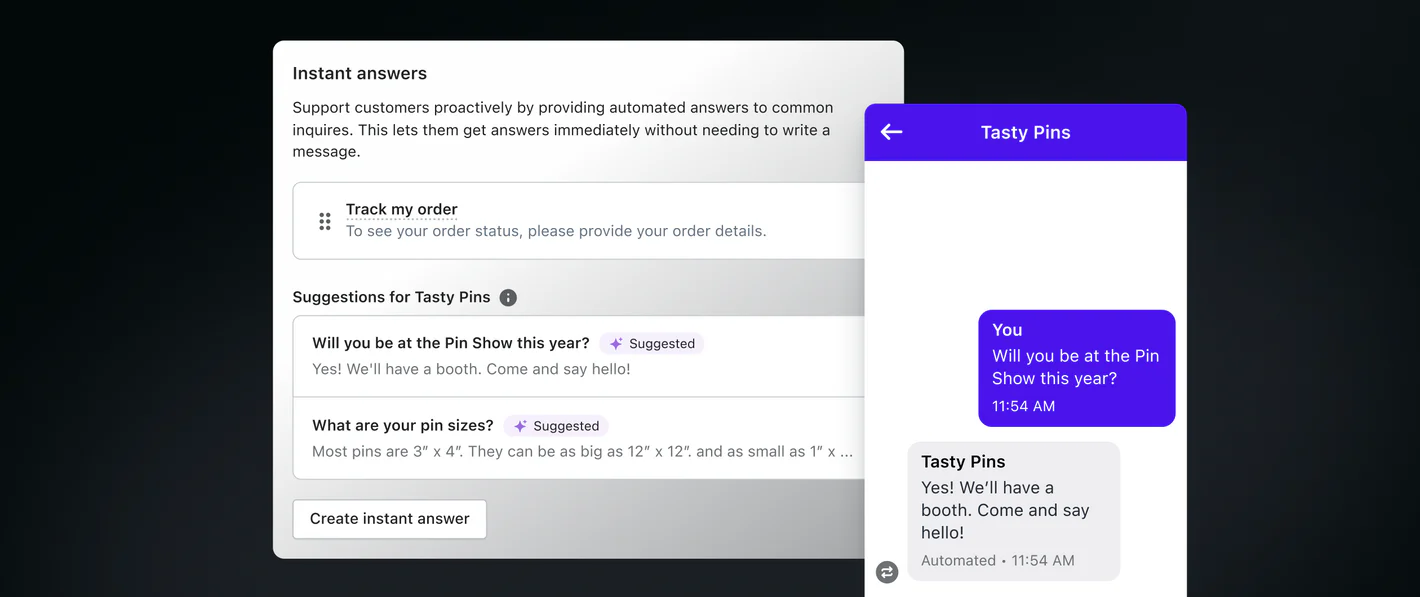
The AI layer, branded Shopify Magic, does two concrete things: it scans your store content to auto-generate FAQ responses that you approve and publish, and it suggests draft replies in live chat that agents can review, edit, and send. Neither is autonomous in the way Gorgias or Richpanel AI is - a human still presses send. But for stores that just want to reduce the blank-stare-at-chat feeling, it works.
70% of Shopify Inbox conversations involve customers in active purchasing decisions, which is where the cart visibility and product link features become genuinely useful. Sharing a discount code mid-conversation to close a hesitating buyer is a conversion lever few store owners use as aggressively as they could.
Pros:
- Genuinely free at any scale - no usage caps or paid tiers
- Cart visibility and product links in chat are first-party and work seamlessly
- No new interface to learn; lives in Shopify admin
- 4.7/5 on Shopify App Store from 5,386 reviews - one of the most-reviewed store tools
Cons:
- AI is assistive, not autonomous - humans still handle every message
- No ticketing system, routing, or SLA features - outgrown quickly past 50 tickets/month
- No chat history export, which limits ability to analyze patterns
- AI instant answers pull from site text, not real conversation history - suggestions can be generic
- Image delivery issues noted by reviewers in May 2026
Pricing: Free. A Shopify subscription is required, but Inbox itself costs nothing extra.
Our take: Use Shopify Inbox when you're just starting, when your volume is under 50 chats a month, or when budget is genuinely the deciding factor. It's not a long-term support strategy - at any real scale, the lack of ticketing and autonomous AI will become painful. But as a first step that costs nothing, it earns its place. Read our full Shopify Inbox guide for setup and upgrade triggers.
6. Freshdesk - best for enterprise Shopify teams
Best for: Larger teams that need a full enterprise helpdesk with Shopify as one of many channels
Freshdesk is a different category from the tools above - it's a full enterprise helpdesk trusted by 74,000+ businesses (Bridgestone, Klarna, PepsiCo, Tata Digital) that happens to have a Shopify integration. If your support team handles channels beyond ecommerce - enterprise accounts, B2B service, IT support - and Shopify is one of several data sources rather than the whole operation, Freshdesk is worth considering.
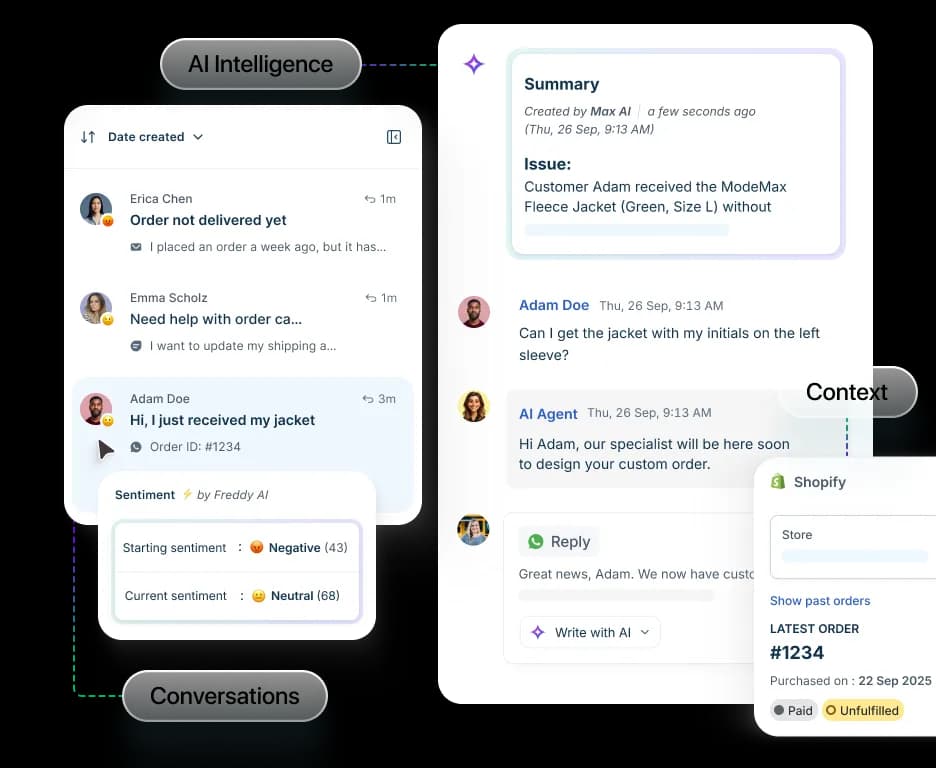
Freddy AI, Freshworks' AI suite, comes in three parts: an AI Agent for autonomous resolution (claiming up to 80% autonomous query resolution), an AI Copilot that assists human agents in real time, and AI Insights that surfaces proactive alerts and CSAT trends for managers. The no-code AI Agent Studio lets you build custom agentic workflows with 50+ prebuilt templates, including Shopify integration hooks.
The honest catch: Freshdesk's Shopify integration via the Freshworks Marketplace has a 3.0/5 star rating from 61 reviews - mixed reception. The integration works, but it doesn't have the native depth of Gorgias's Premier Partner relationship. Freshdesk is better understood as a powerful general helpdesk that connects to Shopify, not a Shopify-first tool.
Pros:
- Full enterprise-grade helpdesk: routing, SLAs, multilingual, omnichannel
- Freddy AI Copilot - in-workspace reply suggestions without context-switching
- Freddy AI Insights surfaces proactive alerts before problems escalate
- 500 free Freddy AI Agent sessions on Pro/Enterprise plans for initial testing
Cons:
- Shopify Marketplace integration rated 3.0/5 - not as native as Gorgias
- Freddy AI Agent sessions beyond the free 500 cost $49/100 sessions - expensive at volume
- Freshdesk Omni (needed for live chat channels) has separate pricing on top
- Overkill for pure-play Shopify stores that just need ecommerce support
Pricing:
| Plan | Annual price | Free AI sessions |
|---|---|---|
| Growth | $19/agent/mo | 500 |
| Pro | $55/agent/mo | 500 |
| Enterprise | $89/agent/mo | 500 |
Freddy AI Agent sessions beyond the free 500: $49 per 100 sessions. Free tier: up to 2 agents free for 6 months.
Our take: Freshdesk makes sense if Shopify is one channel in a multi-brand, multi-channel support operation - not if ecommerce is your whole business. The 3.0/5 Shopify integration rating is a signal: use Gorgias if Shopify is your core. If you're already on Freshdesk and want to dramatically upgrade the AI layer on your Shopify tickets specifically, consider adding eesel on top rather than rebuilding everything.
7. eesel - best for adding AI on top of your existing helpdesk
Best for: Shopify merchants already on Freshdesk or Zendesk who want AI without migrating
Most Shopify AI support comparisons assume you're starting fresh. eesel solves a different problem: you already have Freshdesk, Zendesk, or another helpdesk that your team knows, and switching platforms is not on the table. You just want AI handling the routine tickets.
eesel deploys as an autonomous AI teammate that lives inside the apps your team already uses - Zendesk, Freshdesk, Slack, email - and acts like a support agent you onboarded on their first day. You brief it in plain English ("handle shipping and returns questions; anything over $500 refunds, loop me in"). It reads your existing ticket history, learns your tone and policies, and starts resolving. Smava runs 100,000+ tickets/month through eesel in German. Design.com handles 50,000+ monthly tickets across multiple eesel agents. No prompt engineering required for any of it.
The e-commerce agent specifically handles Shopify order questions, product recommendations, and order inquiries by pulling live data from your Shopify store. This runs at $0.40 per resolved ticket - straightforward usage-based pricing with no seat fees, no monthly minimums, and a $50 free trial to start.
"It feels like a partnership, not a vendor relationship."
-- Jon Miron, Director of Support & Operations, Yellowdig, via eesel.ai
Pros:
- No migration needed - works inside Zendesk, Freshdesk, Slack, email, and more
- Usage-based pricing ($0.40/ticket) with no monthly minimum - low risk to start
- Brief in plain language; no prompt engineering or technical setup
- Free $50 trial with all features unlocked, no credit card required
- Handles 100,000+ tickets/month at companies like Smava and Design.com
Cons:
- Not a standalone helpdesk - requires an existing helpdesk to live inside
- No dedicated chat widget for storefronts (it handles tickets, not proactive chat)
- Usage-based pricing adds up at high volume if you want human-like coverage of every ticket
Pricing:
| Task type | Price |
|---|---|
| Support ticket (regular) | $0.40 each |
| Dashboard Q&A (light) | Free |
| Blog post (heavy) | $4.00 each |
Annual commit of $300+/month saves 25%. Enterprise plan at $1,000/month flat fee adds dedicated support, SSO, and HIPAA compliance.
Our take: eesel is the right pick if you're already invested in Freshdesk or Zendesk and don't want a multi-month migration project. The $0.40/ticket pricing is transparent - 1,000 tickets a month is $400, well below Richpanel's floor. And the $50 free trial means you can test it against your actual ticket queue before committing.
How to choose the right AI for your Shopify store
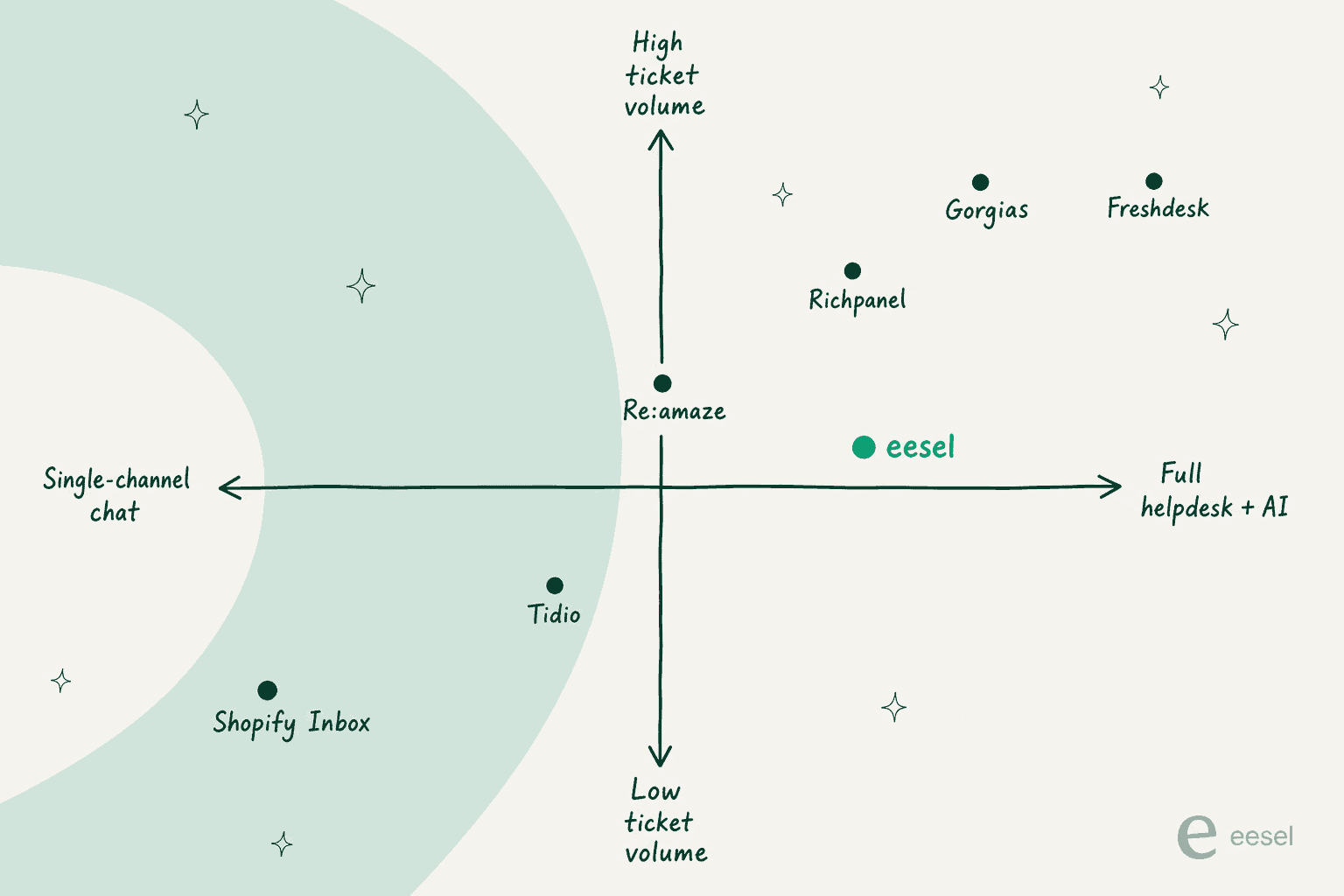
The honest answer is that the right tool depends mostly on two things: where your tickets come from, and whether you already have a helpdesk.
Start here:
- Under 50 tickets/month, budget is the concern: Shopify Inbox is free and already in your admin
- 50–500 tickets/month on Shopify-first: Tidio offers the best entry-level AI with a free tier and money-back guarantee
- 500–5,000 tickets/month on Shopify-first: Gorgias is the default for Shopify-native operations; worth the premium if order actions are 40%+ of your queue
- 2,000+ tickets/month, want maximum AI autonomy: Richpanel with its 30-day guarantee and QA AI layer
- Multi-channel including social and SMS: Re:amaze covers all channels in one inbox
- Already on Freshdesk or Zendesk, don't want to switch: eesel adds AI on top without replacing your existing setup
- Enterprise operation where Shopify is one channel of many: Freshdesk with Freddy AI
The worst decision is picking a tool that requires a full migration when you have years of ticket history in an existing system. If you're on a helpdesk you're comfortable with and you just want the AI layer, that migration cost - in time, training, and context lost - is usually larger than people budget for.
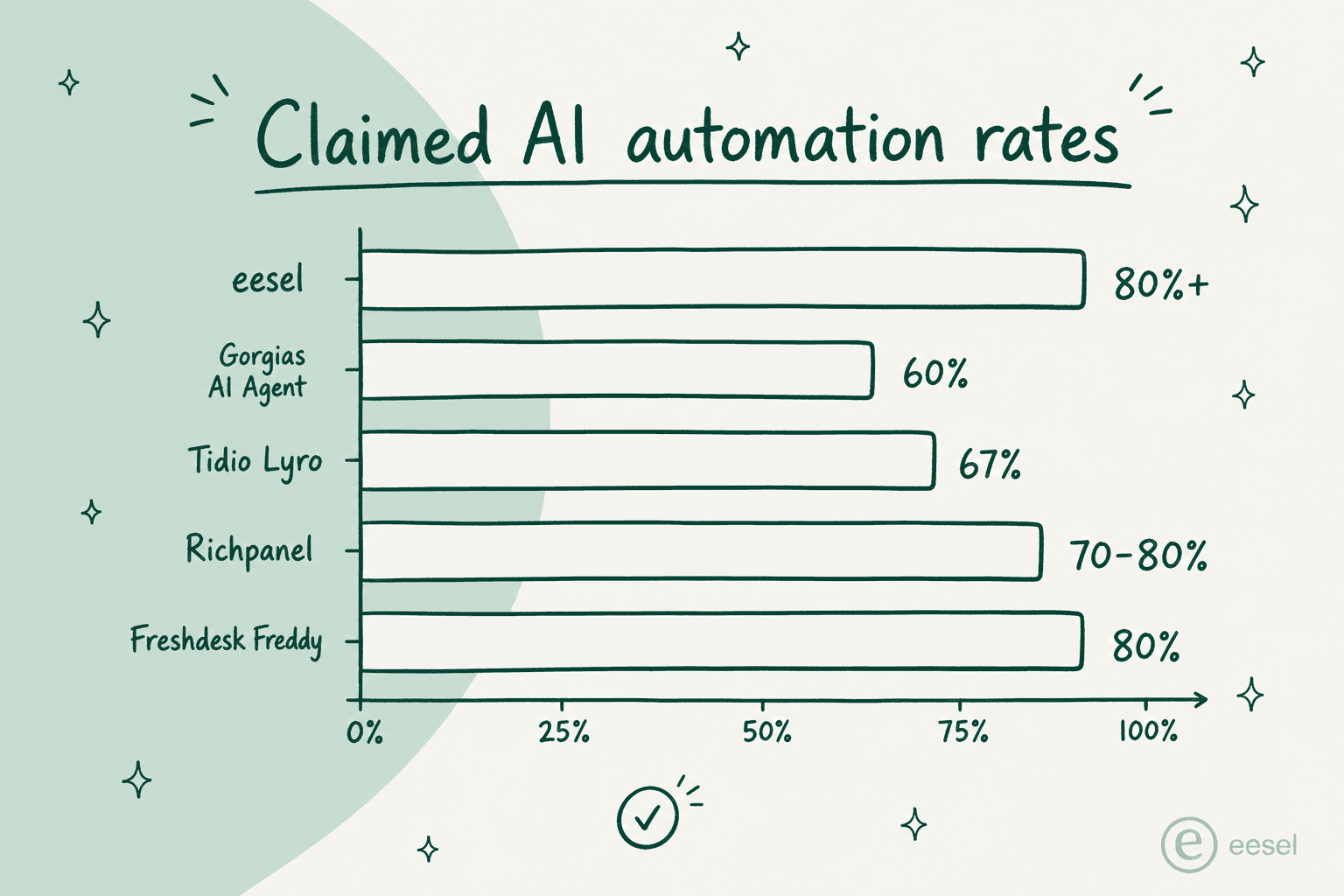
One more thing worth naming: automation rate claims are marketing numbers. The 60–80% figures across every tool assume ideal conditions - a well-documented knowledge base, clear escalation policies, and ticket types that fit the AI's training. Real-world automation rates start lower and improve over months. Budget for a 6–8 week ramp on any serious AI deployment.
Try eesel
If you're already on Freshdesk, Zendesk, or another helpdesk and want to handle Shopify order questions, returns, and WISMO tickets without a migration, eesel is purpose-built for that. The e-commerce AI agent connects to your existing tools and your Shopify store, resolves routine tickets autonomously at $0.40 each, and escalates edge cases with full context attached.
Companies like Smava and Design.com handle 50,000–100,000 tickets per month through eesel. The free $50 trial has all features unlocked and needs no credit card.
Frequently Asked Questions
What is the best AI for Shopify customer support in 2026?
How much does AI customer support cost for a Shopify store?
Can I add AI to my existing Shopify helpdesk without switching tools?
What is the best free AI for Shopify customer support?
What AI can automatically handle Shopify order tracking questions?


Article by
Alicia Kirana Utomo
Kira is a writer at eesel AI with a Computer Science background and over a year of hands-on experience evaluating AI-powered customer service tools. She focuses on breaking down how helpdesk platforms and AI agents actually work so that support teams can make better buying decisions.