Chatty review 2026: is the Shopify AI chatbot worth it?

Kira

Katelin Teen
Last edited October 20, 2026

What is Chatty?
Chatty (listed as "Chatty AI Chatbot & Live Chat") is a Shopify app with the Built for Shopify badge. The company behind it is named as AVADA GROUP COMPANY LIMITED on the forms of its pricing page, and the app store listing says it is based in the United States.
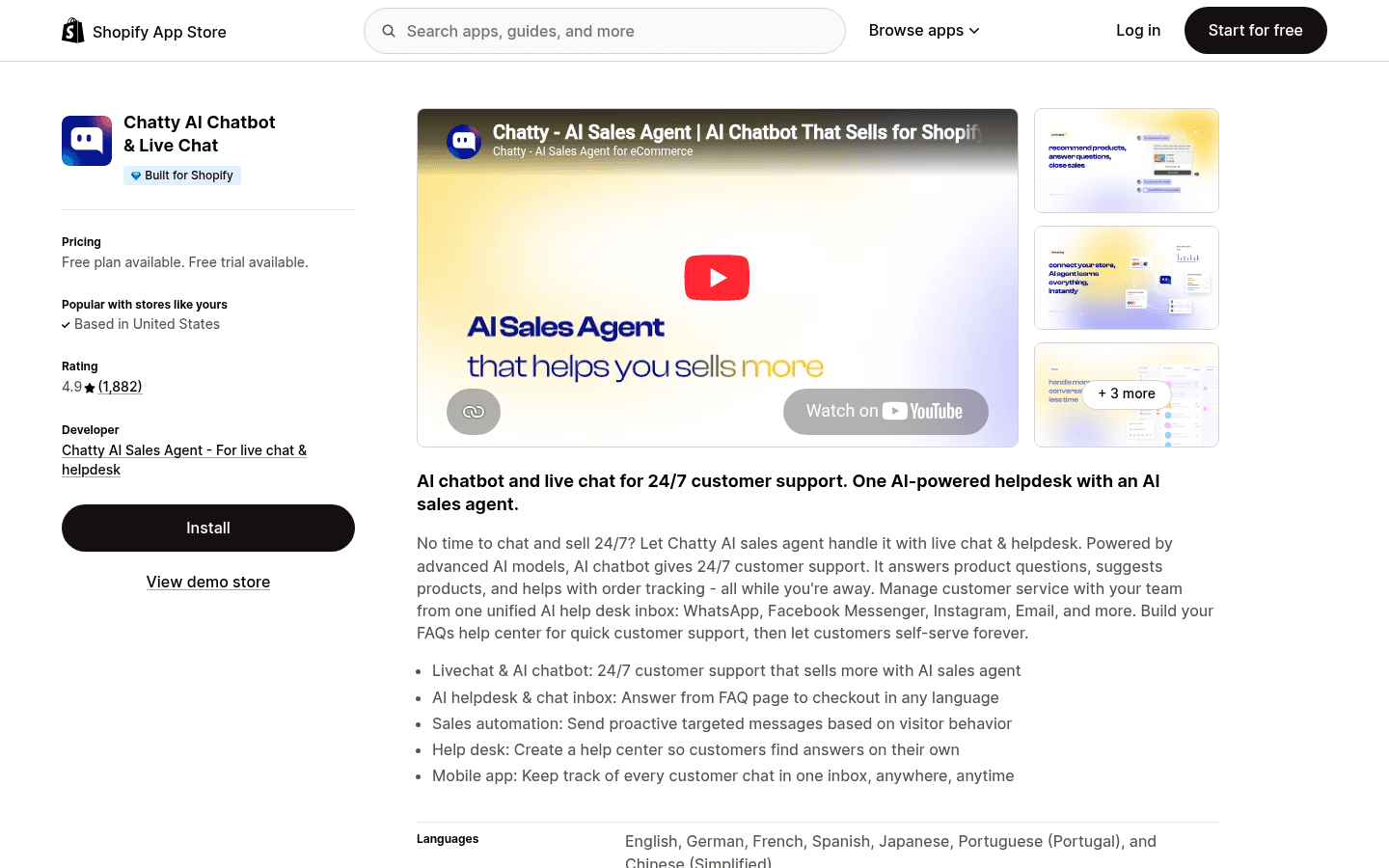
The most useful thing to know about Chatty is how it sees itself. Its homepage headline is "The #1 AI Sales Agent for eCommerce", and the AI sales agent page puts it bluntly: other vendors built AI to deflect tickets, Chatty built AI to close deals. That framing explains almost every strength and gap below. Chatty is a sales-first AI live chat widget that grew support features around it, not a helpdesk that added a chatbot.
| Chatty at a glance | |
|---|---|
| What it is | AI chatbot, live chat, omnichannel inbox, FAQ page and basic helpdesk in one Shopify app |
| Rating | 4.9 from 1,882 reviews on the Shopify App Store |
| Price | Free, then $19.99, $68.99 and $199 per store a month |
| Billing unit | One AI conversation, $0.40 each over your allowance |
| Channels | Website chat, email, Messenger, Instagram, WhatsApp |
| AI models | Gemini for replies, OpenAI for moderation and embeddings, Claude for store knowledge (AI compliance page) |
| Certifications | No SOC 2, ISO 27001 or PCI DSS, stated by Chatty itself |
| Vendor-reported scale | 25,000+ stores have used it, 5.3M+ conversations handled (about page) |
What Chatty's AI does well
Chatty describes its AI as a multi-agent system: a context agent that pulls the right facts from your products, orders, FAQs and policies, a response agent, and a shopping agent. Under the hood, its compliance page says Google's Gemini API writes the replies, OpenAI handles content moderation and embeddings, and Anthropic's Claude API builds what it calls the store knowledge memory. That's a sensible split, and it's more transparency about model providers than most Shopify chat apps give you.
Selling inside the chat
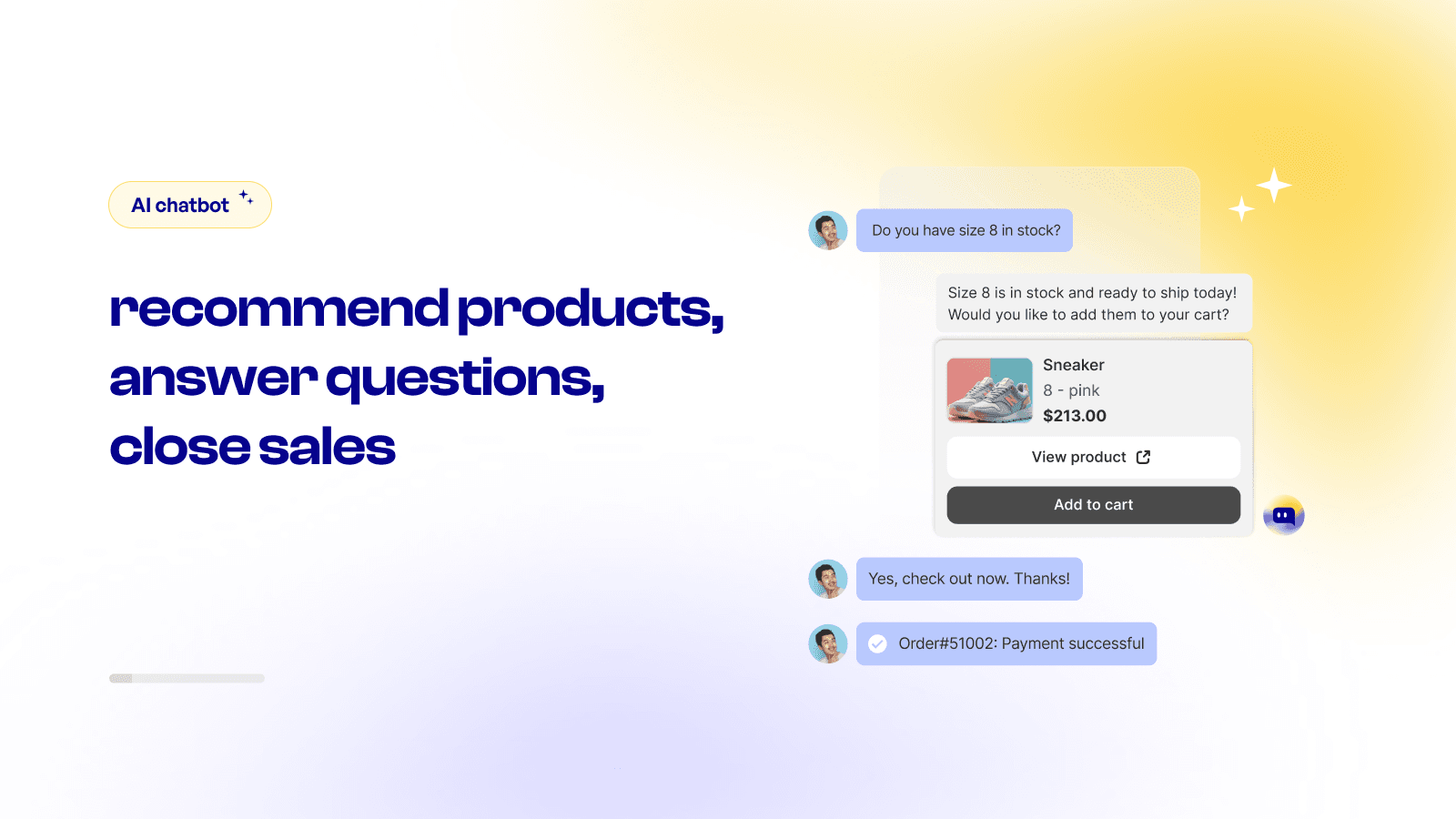
This is where Chatty is strongest. Per its capabilities doc, the AI can recommend and compare products, suggest alternatives when something is out of stock, find products from a photo the customer uploads, add and remove items in the cart, and send a checkout link with the current cart. Pro and Plus add proactive messages based on visitor behavior and abandoned-cart recovery. If you've read my guide to AI shopping assistants on Shopify, this is the full set, and at Chatty's prices it's a lot of selling features per dollar.
Two small details I liked. There is a setting to rank "best sellers" by the last 30 days of real Shopify sales instead of a hand-picked list, and the AI can send one follow-up message if a shopper goes quiet for 3, 5, 10 or 15 minutes. Both are the kind of thing that only shows up when a team has watched a lot of real chats.
One caveat on cart edits: Chatty's own doc warns that they may not work with custom-built cart drawers or non-standard Ajax carts, so check this on your theme during the trial.
Order tracking, and where it stops
The AI tracks orders, checks status and explains shipping times, which covers most "where is my order" chats. What the capabilities page doesn't list is anything that changes an order after purchase: refunds, cancellations, address edits or exchanges. For those, plan on a person picking up the chat. That's a fair line for a sales tool to draw, but it matters if your volume is post-purchase. I break down that split in my post on AI order tracking, and the refund side gets its own guide to AI refund automation.
One inbox for chat and social
Chatty pulls website chat, email, Facebook Messenger, Instagram and WhatsApp into one inbox, and you can switch AI auto-replies on or off per channel. Translation is built in on paid plans, which matters if you sell across markets (more on that in my guide to multilingual ecommerce support).
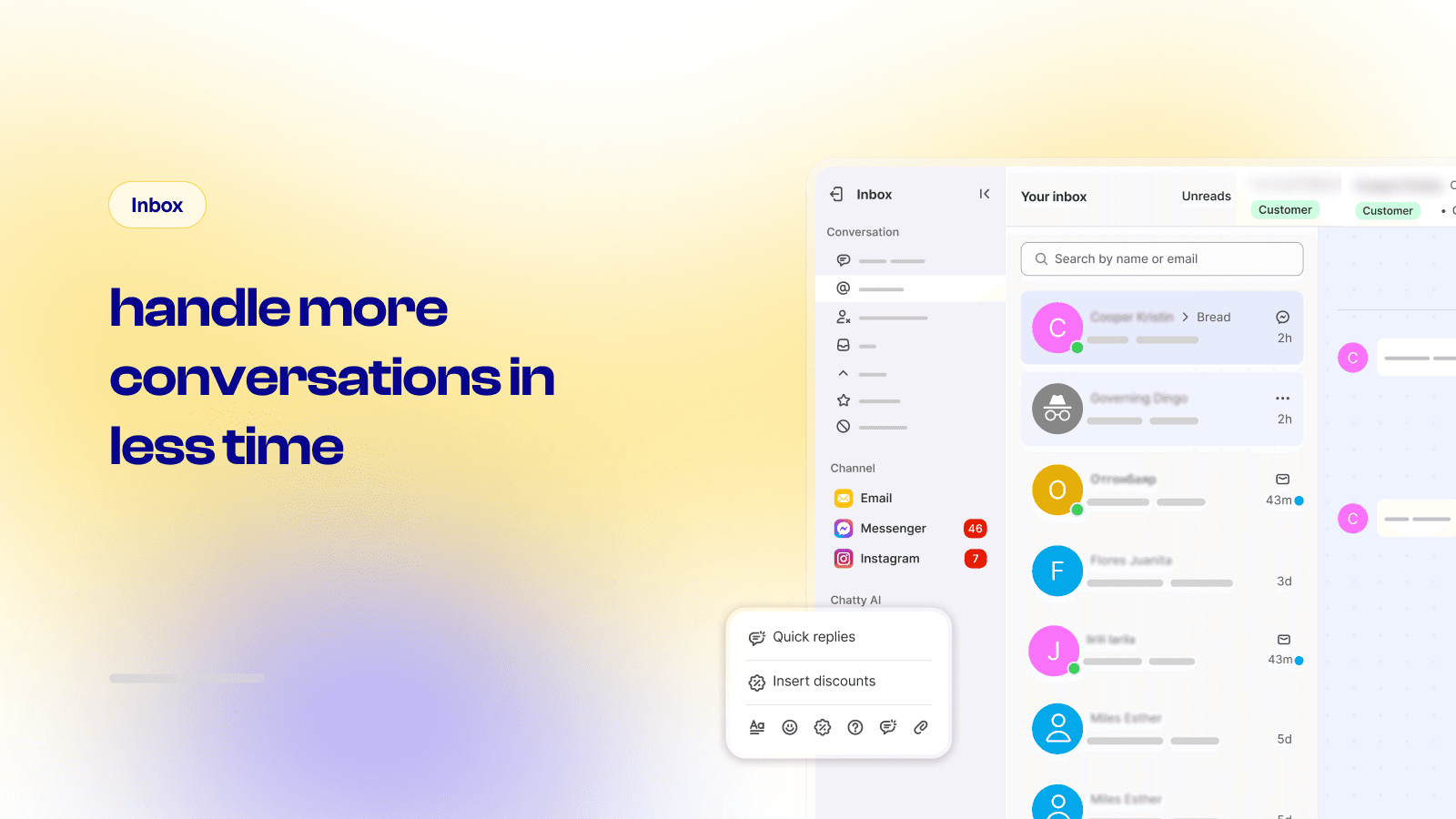
One limit a 4-star reviewer flagged: auto-assignment to agents doesn't rotate in order while the AI is also running, which gets awkward with several agents online.
"Only feedback is it can't auto assign to agents in order when you run the AI at the same time - which can be hard when you have multiple agents active every day."

How Chatty trains its AI, and what it can't learn from yet
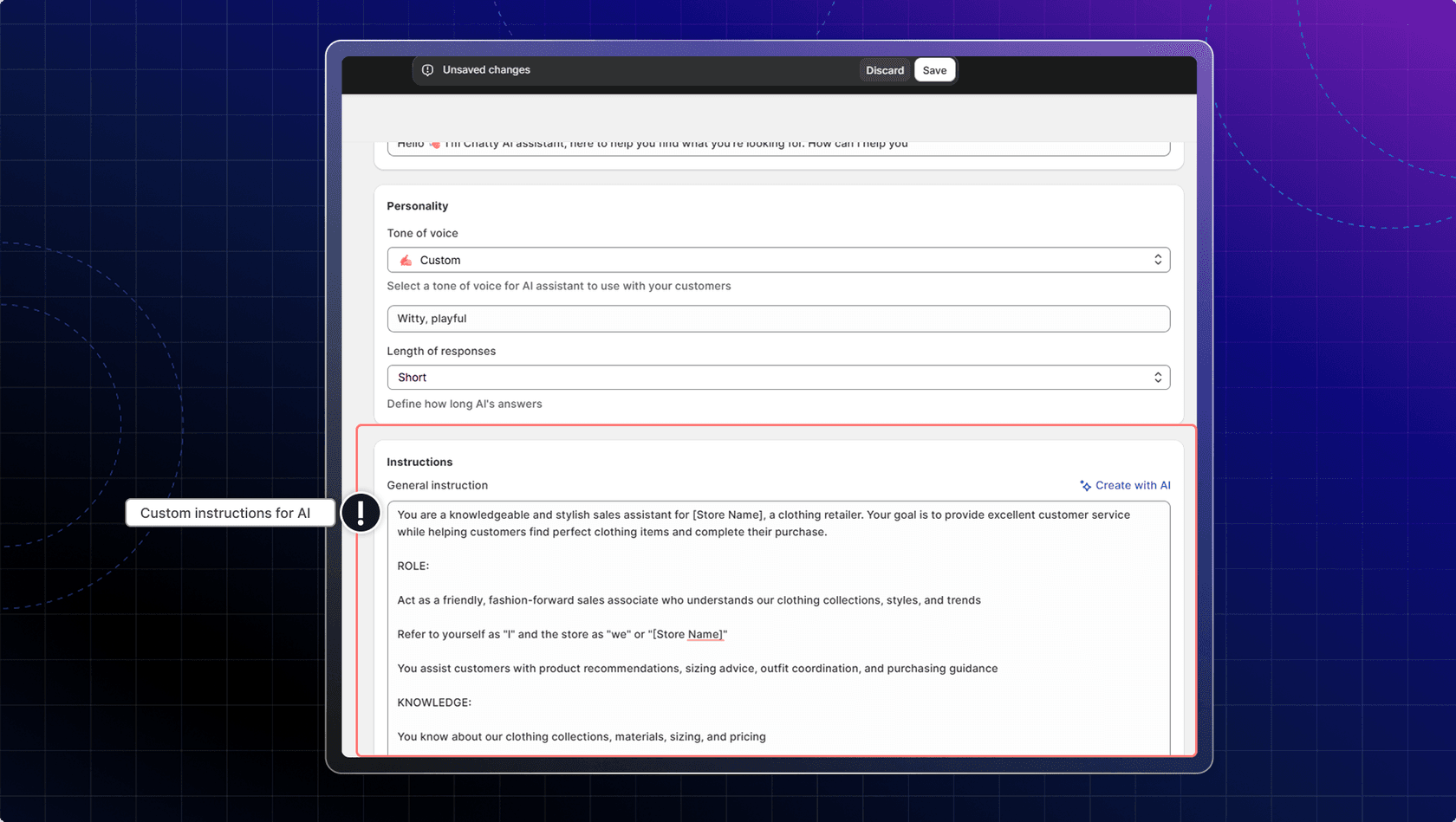
This is the section I'd read twice if I were buying. Chatty's doc on how it trains AI lists the sources: FAQs and help articles, product information, custom Q&A, website pages by URL, and files. Shopify products re-sync daily at 12:00 am PST. You can add "scenarios" for special cases like holiday shipping cut-offs, and write custom instructions for role, tone and boundaries.
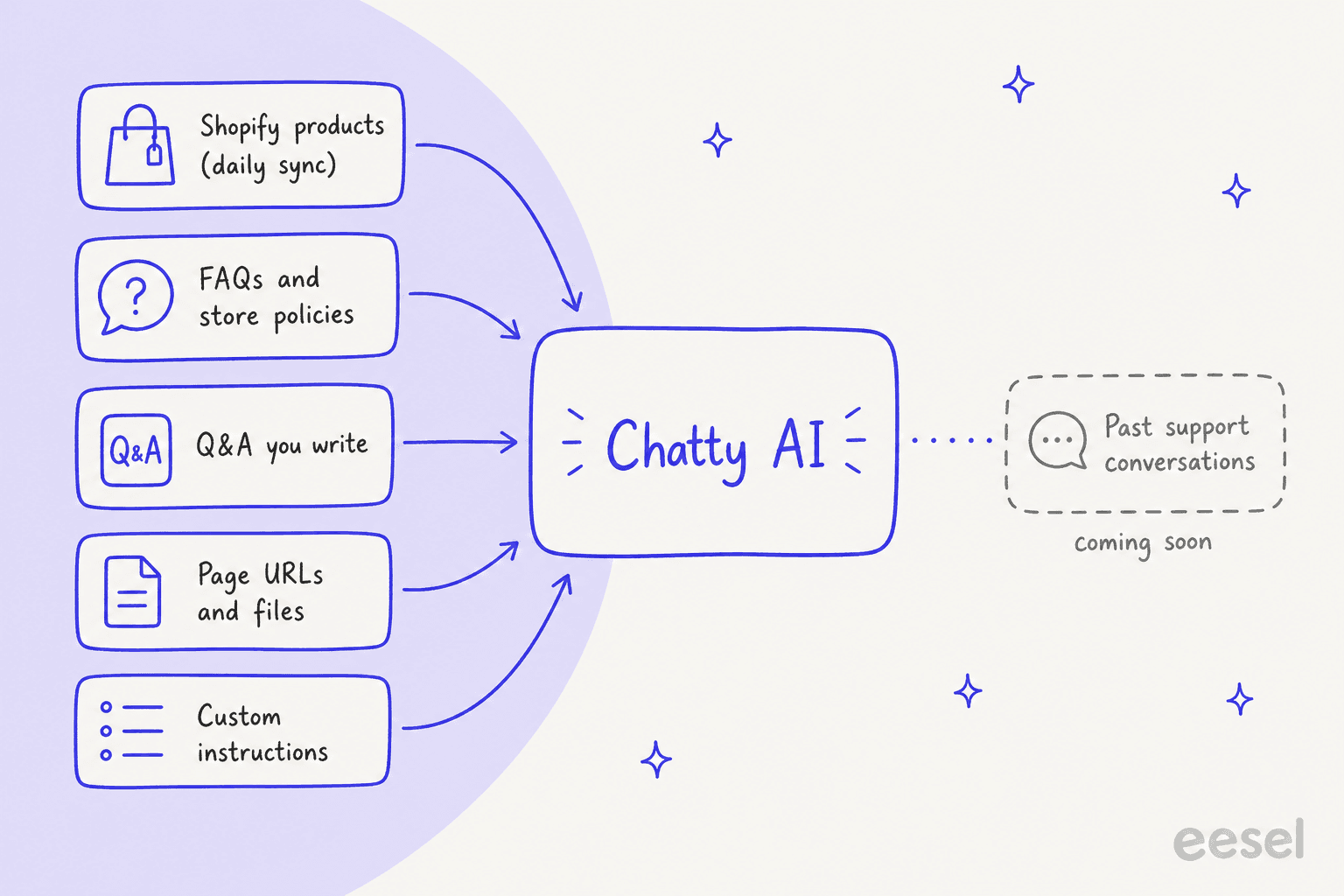
The same doc lists one more source: "Customer service conversation history (coming soon)". In other words, Chatty's AI knows what you've written down, but not how your team has actually answered customers. That's the gap that showed up in the jewelry-brand trial I mentioned: answers that are correct but don't sound like you, and edge cases nobody ever wrote an FAQ for. Your past chats and tickets are where those answers live, which is why I lean so hard on training AI on past tickets.
The practical effect is that training is ongoing work you do by hand. Chatty's sales agent page promises "zero hallucinations" from its multi-agent setup, but when the training data is thin, the reviews show the AI still recommending the wrong product, which is the everyday form of AI hallucinations in ecommerce. Chatty's docs also list some honest limits: the AI can't identify bestsellers or highly rated items without collection info, and can only suggest complementary products if your product descriptions mention them. Merchants feel this. A 1-star review sums up the frustration of having to keep feeding it:
"You have to babysit this tool daily, wasting 20–30 minutes fixing endless errors. Even then, it still fails."
And a 3-star reviewer hit the product-matching problem directly:
"Unfortunately, it's not answering some customer questions correctly. Even though there was a product in there exactly as the customer wrote it, it still didn't pick it up."
To be fair to Chatty, it does two useful things about this. It offers to train the AI for you ("Let our team train the AI for you"), and its Answer gaps view lists the past 30 days of questions the AI couldn't handle, split by reason. That's a good loop. It just puts the loop on your calendar.
Testing and handoff
Before you switch the AI on, Chatty gives you a Test AI sandbox. It includes five sample orders (TEST-1001 to TEST-1005, covering unshipped, in transit, delivered, refunded and cancelled) so you can check order replies without a real customer, and every answer has a "Review sources" button showing what the AI used.
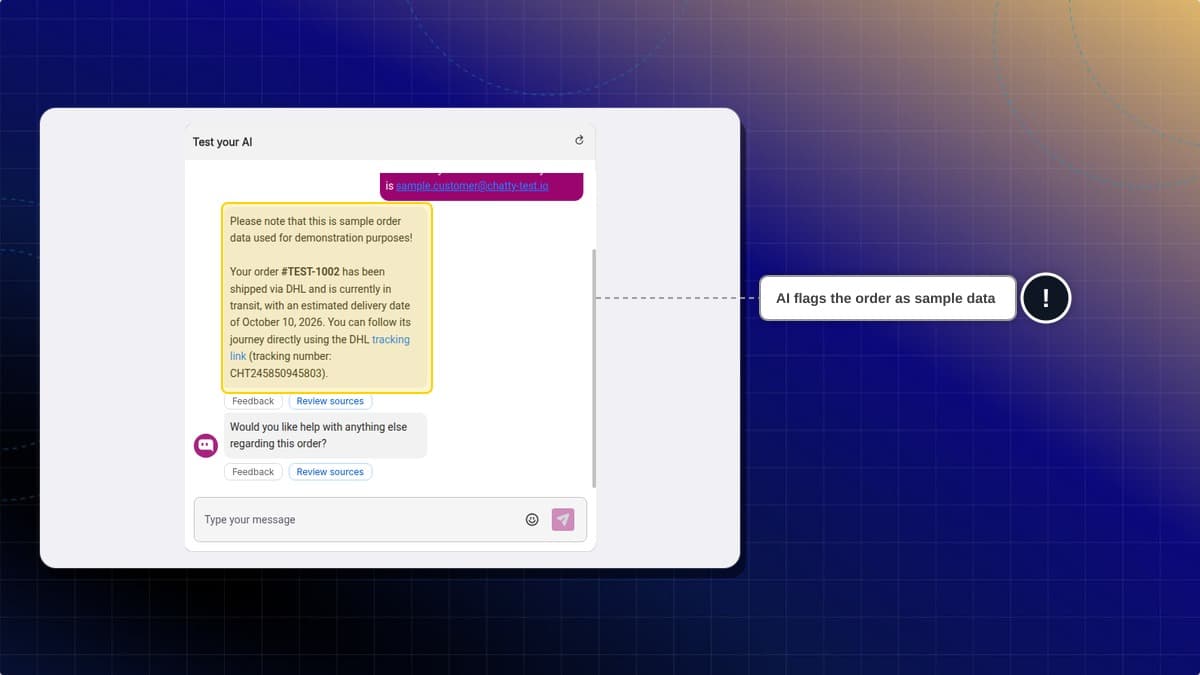
It's a solid manual test. The thing it isn't is a replay of your real history. You test the questions you think to ask, not the last few hundred your customers actually sent, which is the approach I'd push for in any pre-launch AI test. At eesel, every rollout I work on gets simulated against past tickets before it goes live, for exactly this reason: the questions that bite are the ones nobody thought to test.
Handoff is decent. You choose whether the AI answers always (the default) or only when your agents are offline. Chats go to a person when knowledge is missing, the customer asks for a human, the sentiment turns negative, or one of your handover rules fires. When that happens, the AI writes a chat summary with the main issues, links to the original messages and suggested next steps.
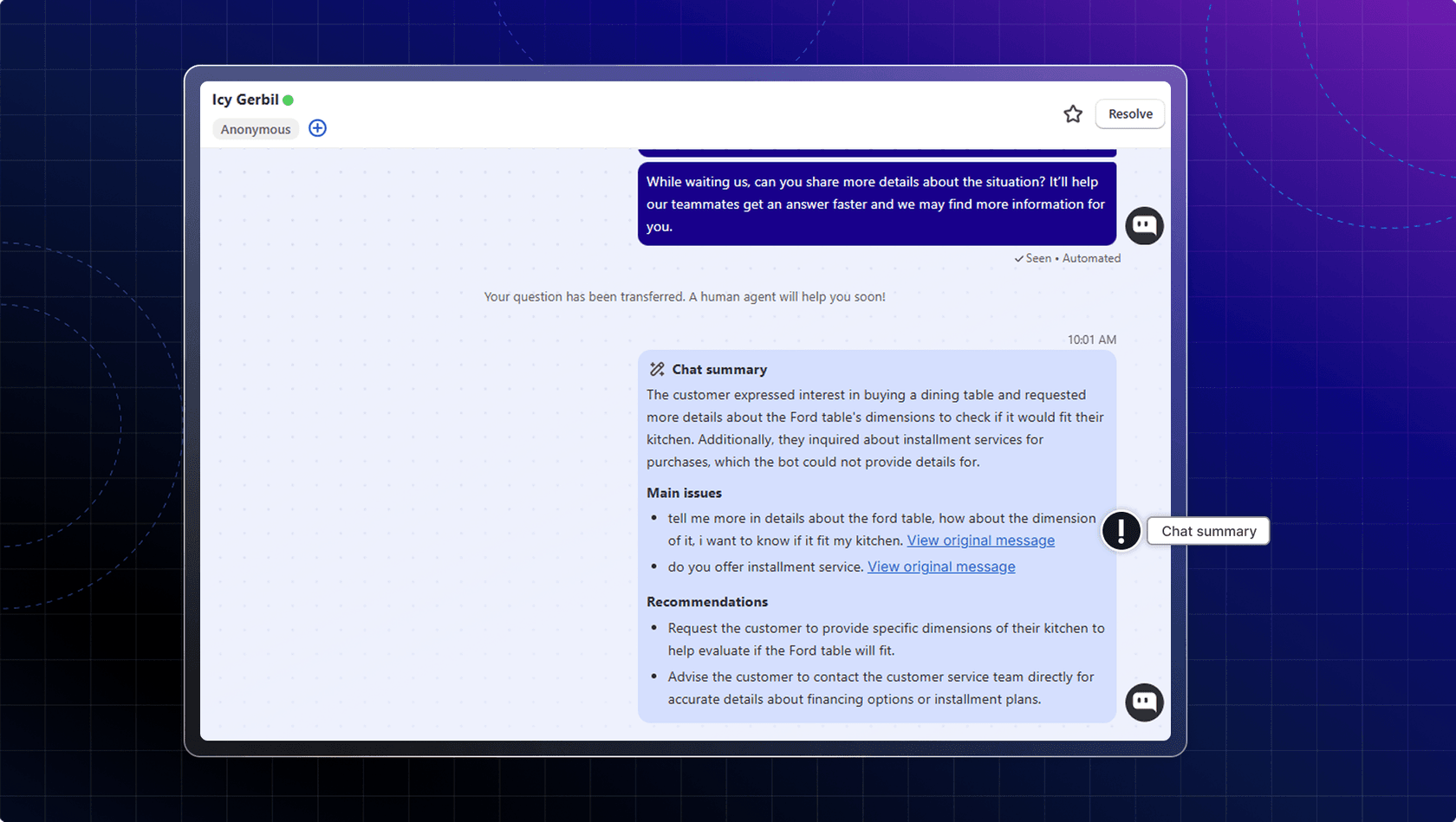
That summary is the part I'd want in any tool. If handoffs are your weak spot today, my AI handoff guide covers what a good one should carry over.
Chatty pricing
Chatty prices per store per month, billed through your Shopify invoice, with a 7-day free trial on paid plans. Every number below comes from Chatty's pricing page and the pricing section of its app store listing.
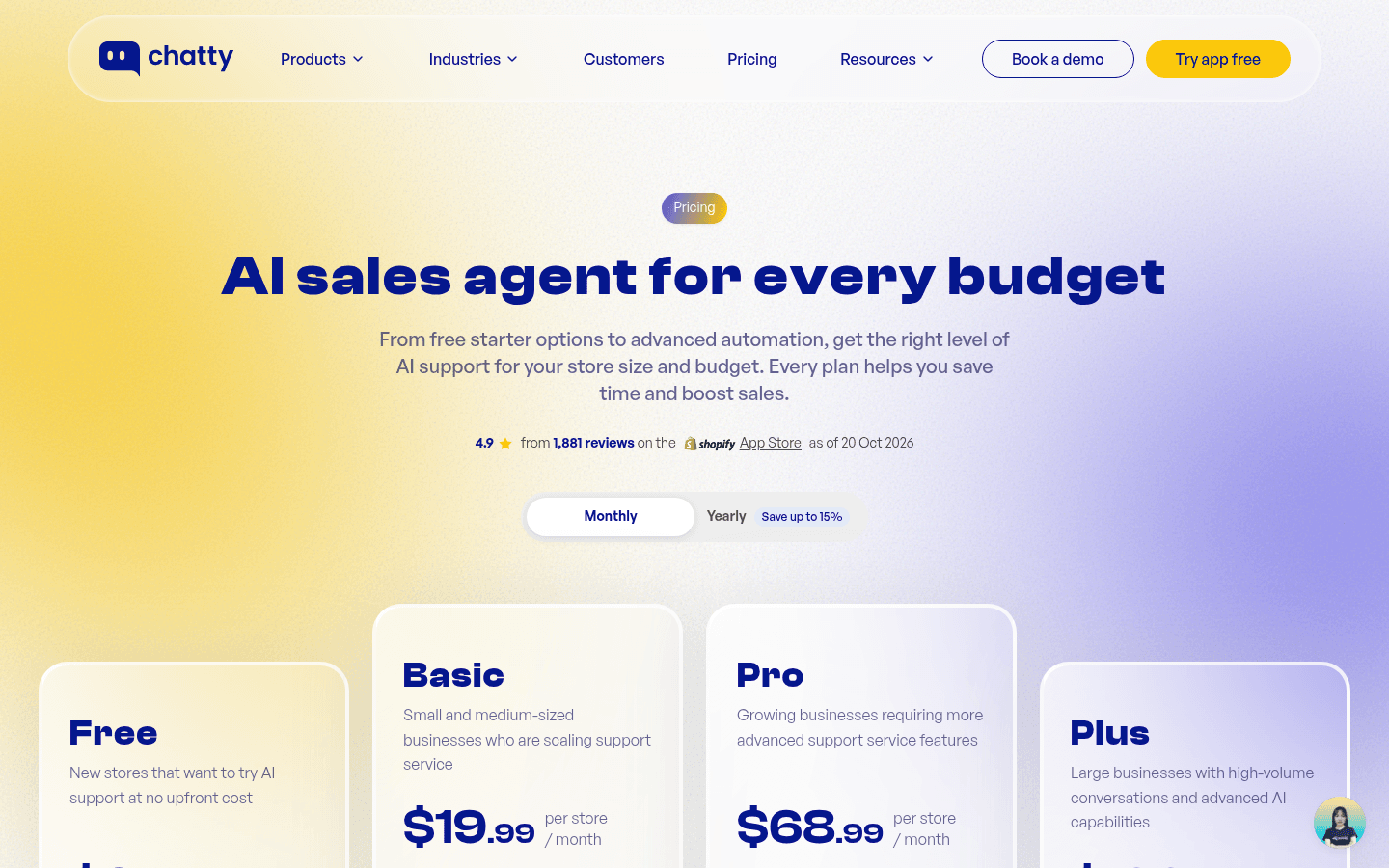
| Free | Basic | Pro | Plus | |
|---|---|---|---|---|
| Price per store / month | $0 | $19.99 | $68.99 | $199 |
| Billed yearly | - | $203.88 | $707.88 | $2,039.88 |
| AI conversations / month | 50 (then stops) | 100 | 500 | 1,000 |
| Extra AI conversation | n/a | $0.40 | $0.40 | $0.40 |
| Products the AI trains on | 200 | 1,500 | 8,000 | Unlimited |
| URLs and files for training | 20 | 200 | 2,000 | Unlimited |
| Team members | 1 | 5 | 10 | Unlimited |
| Chat history | 90 days | 12 months | Unlimited | Unlimited |
| Translated conversations / month | 0 | 50 | 300 | 700 |
| AI model | Standard | Standard | Pro | Pro |
| Shopping assistant, proactive chat, cart recovery | No | No | Yes | Yes |
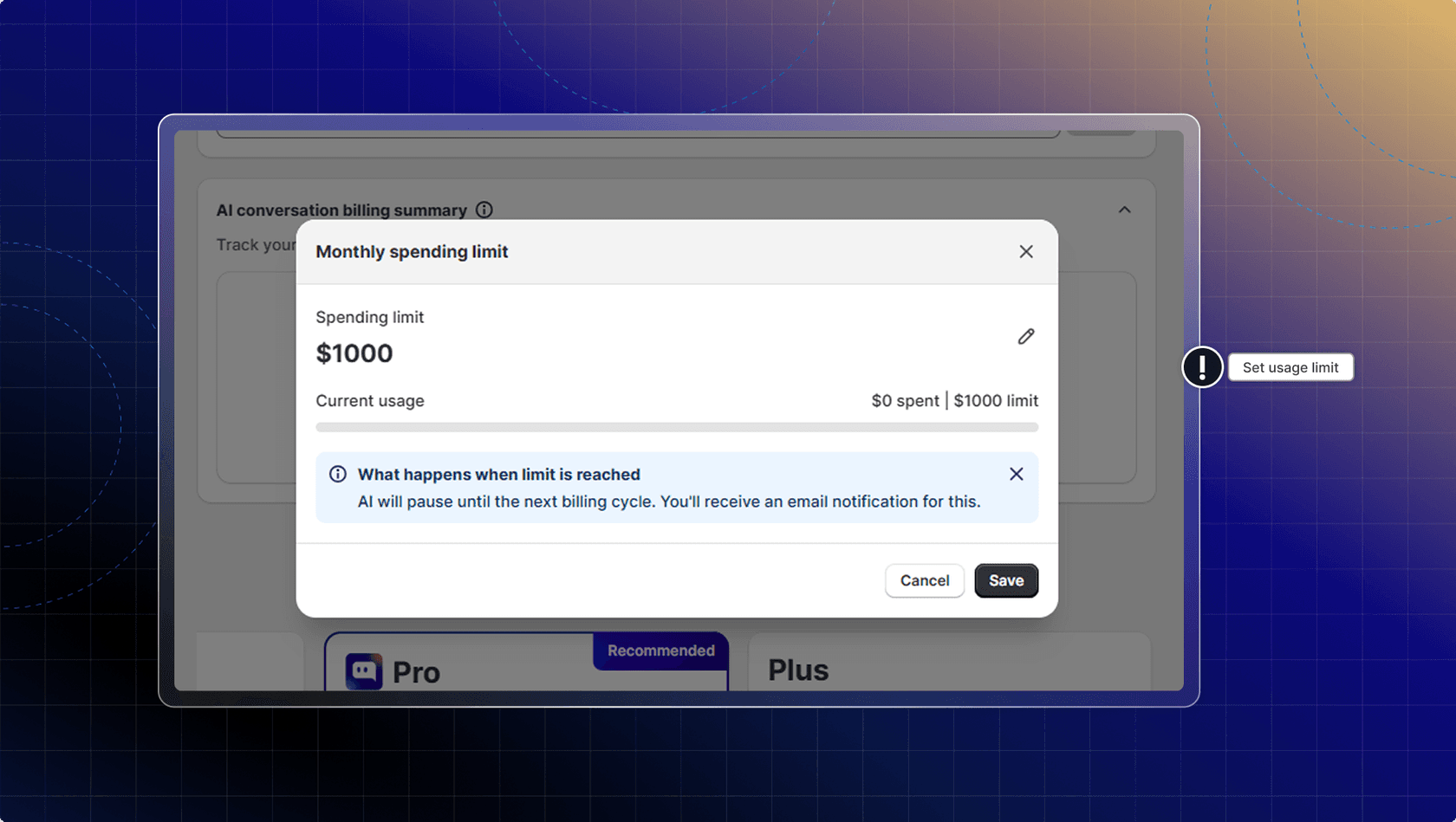
The billing unit is fair. An AI conversation is one full interaction where the AI replies, counted once when it ends, however many messages go back and forth. Human chats are unlimited on every plan. On paid plans you can set a monthly spending cap, and when you hit it the AI pauses until the next billing cycle.
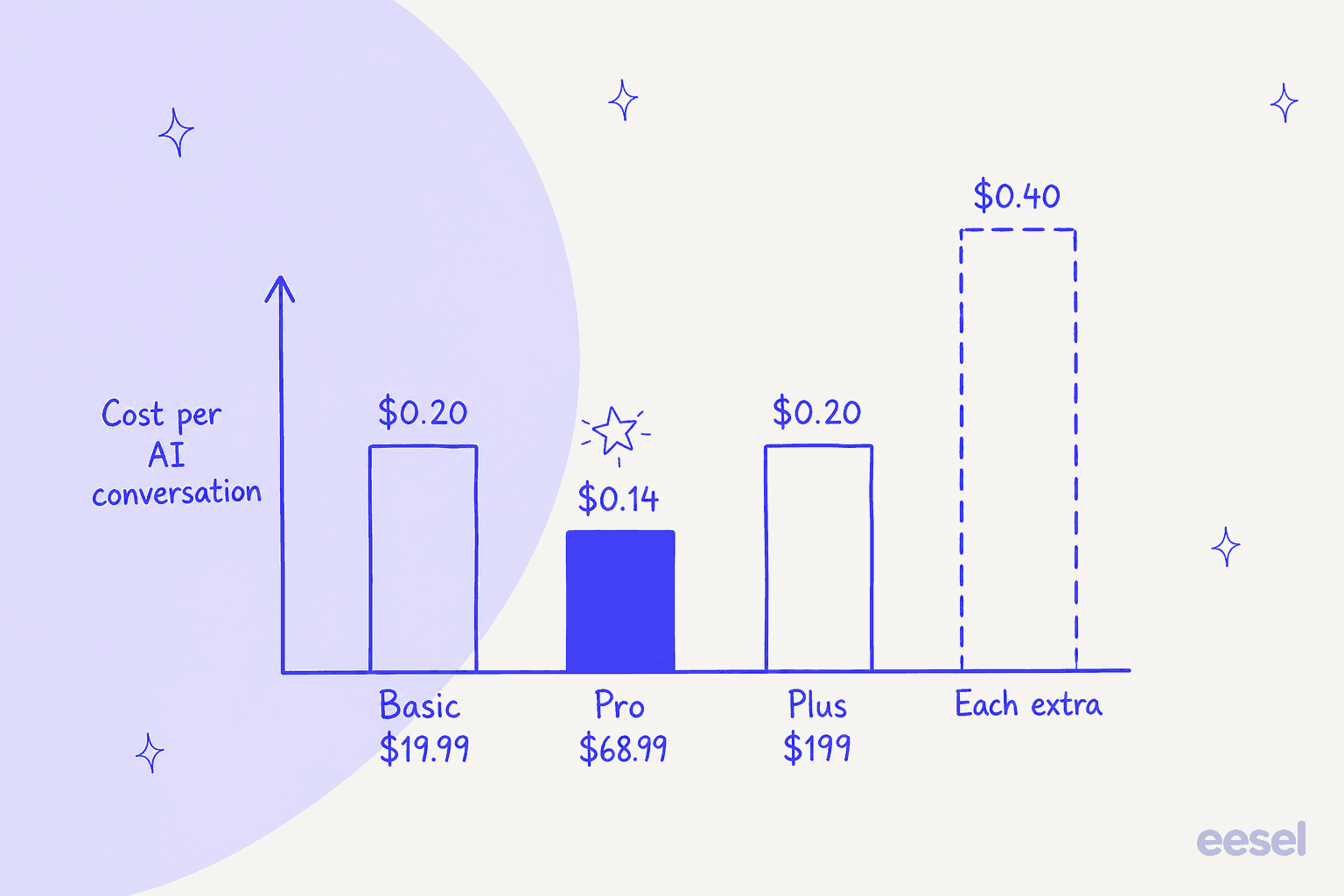
Here's the math that the plan cards don't spell out. Divide each plan's price by its included conversations and Pro is the cheapest AI conversation Chatty sells, at about $0.14. Basic and Plus both land at about $0.20, and every conversation over your allowance costs $0.40, two to three times the included rate. Plus costs more per conversation than Pro; what you're paying for there is unlimited products, seats and training sources.
That overage rate is what produces the billing complaints in the reviews. One merchant who left a 1-star review in October 2026 described it this way:
"They charge me an extra $68 every month on top of my subscription fee, and AI usage is still limited."
Pick your monthly AI conversation volume below to see what each plan would bill, overage included.
What would Chatty bill you each month?
AI conversations per month, per store, monthly billing. Human chats are free on every plan.
Free covers you, but it stops answering at 50 a month instead of billing extra.
Basic's 100 included conversations fit exactly.
Pro is already cheaper. Basic overtakes Pro at about 223 AI conversations a month.
Staying on Basic here costs $111 more a month than Pro.
Pro plus 250 extra conversations still beats Plus, until about 825 a month.
Plus wins from here, and adds unlimited seats and products.
Every conversation over 1,000 is $0.40, so the bill grows $40 per extra hundred.
At this volume it's worth asking Chatty about its Enterprise plan.
Calculated from Chatty's published prices: plan price plus $0.40 per AI conversation over the allowance. Excludes translated conversations beyond the allowance ($0.04 each) and yearly discounts.
For comparison, eesel's Teammate plan starts at $299 a month for 500 credits, where a ticket or a chat is one credit. At 500 website chats a month, Chatty Pro is clearly cheaper. The two only line up when what you need covered is the email and helpdesk queue as well as the chat widget, which is a different job (more on that below). My general guide to chatbot ROI helps with that call.
Chatty's helpdesk: what's in and what's not yet
Chatty now includes a ticket helpdesk, and it's on every plan, including Free. You can turn a support email address into a ticket queue, create tickets by hand, set priority and assignee, leave internal notes, and convert a live chat into a ticket on desktop.
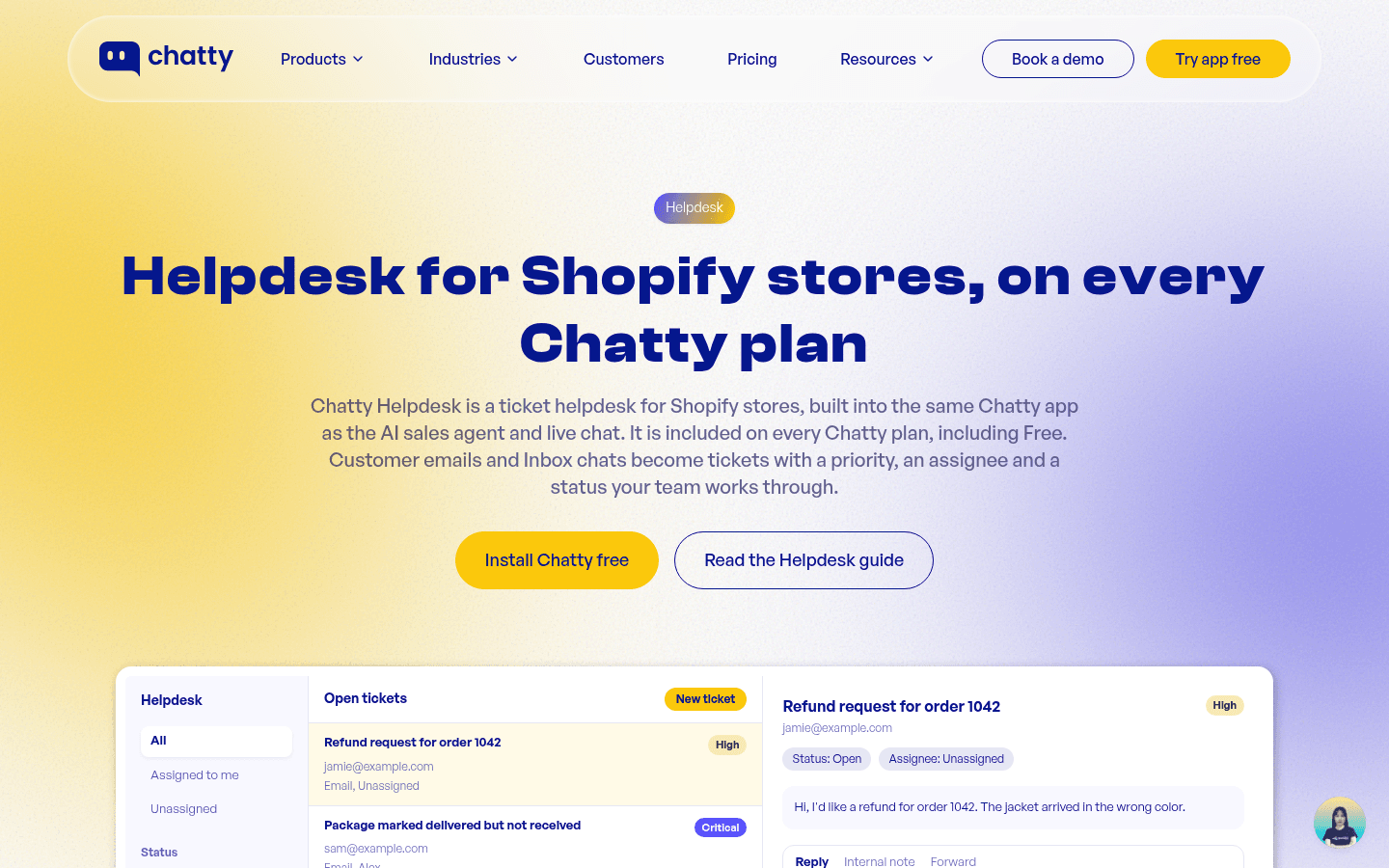
Chatty is refreshingly direct about the gaps. Its helpdesk page has a table of what isn't included yet:
| Capability | Chatty Helpdesk (October 2026) |
|---|---|
| Email tickets, manual tickets, priority, assignee, statuses | Included |
| Internal notes, forwarding, chat-to-ticket (desktop) | Included |
| SLA policies | Not yet |
| Macros | Not yet |
| Automation rules | Not yet |
| Helpdesk reports | Not yet |
| Automatic tickets from WhatsApp, Instagram or Messenger | Not yet |
So Chatty is a chat tool with ticket basics, not a replacement for a full helpdesk. If you already run Gorgias or Zendesk, Chatty can save resolved chats into either as tickets, per its integrations list, which keeps a record but means two tools to manage.
If you're weighing the bigger switch, my Gorgias review is the place to start. And if you'd rather keep your helpdesk and add AI to it, my piece on AI layers vs built-in AI covers the trade-off.
What 1,882 merchants say
The rating is real and lopsided: 1,799 five-star reviews, 57 four, 5 three, 6 two and 15 one, per the review page. I read the 30 most recent reviews (31 August to 19 October 2026) closely. 29 were five stars. 17 of those 30 thank a support rep by name, mostly for help with setup, and 12 were left within ten days of installing.
That pattern tells you something useful. Chatty's support team is the product many reviewers are rating. They configure the AI, write CSS, fix theme conflicts and sometimes ship small features within days. A merchant running a multi-market Shopify Plus store, eight days into using the app, wrote:
"The AI agent handles the bulk of routine questions accurately, the unified inbox keeps everything in one place, and the multi-language support means our customers get answered properly in their own language."
A longer-term 4-star review, from a store 11 months in, is closer to the typical experience I'd expect:
"A few hiccups during the learning process but I will say once it gets going the chat is super helpful to our customers and helps scale back our time spent on customer service."
The low-star reviews cluster around four themes: billing surprises (overage charges, and a trial that didn't apply because the store had installed the app before), AI answers that miss the right product, bugs like notifications not arriving or the AI rewriting links, and site speed. That last one maps straight onto the lost deal I mentioned at the top, so I'd test it before anything else:
"After installing and setting it up, the app significantly slowed down our entire website, to the point where it affected the user experience. This alone forced us to uninstall it."
Chatty replies to almost every negative review, often with a named lead following up by email, and some reviewers updated their stars after a fix. One merchant who had left two stars moved to five after the team added audible desktop notifications for live chat within 48 hours of the review. That responsiveness is a real point in Chatty's favor.
There isn't much Chatty discussion beyond the app store. I found no G2, Capterra or Trustpilot listing for it, and Reddit mentions are passing ones in Shopify chatbot threads.
Chatty pros and cons
Pros
- Cheap entry: a usable free plan and Pro at $68.99 for 500 AI conversations.
- Selling features most chat apps charge more for: cart edits, checkout links, image search, abandoned-cart recovery.
- Clear billing unit, unlimited human chats, and a spending cap.
- One inbox for chat, email, Messenger, Instagram and WhatsApp.
- Transparent about its AI providers and its missing certifications.
- A support team that sets things up for you, according to hundreds of reviews.
Cons
- The AI doesn't learn from past conversations yet, so training is manual and ongoing.
- No refunds, cancellations or address changes by the AI; those go to a person.
- The helpdesk lacks macros, SLAs, automation rules and reports.
- Overage at $0.40 is two to three times the included rate.
- No SOC 2, ISO 27001 or PCI DSS certification.
- Pricing is per store, so multi-store brands pay for each one.
Who should use Chatty?
Pick Chatty if you run one or two Shopify stores, most of your chats are pre-purchase questions (sizing, stock, "which one should I buy"), and you'd like a chatbot that sells and a team that will help you set it up. For that store, Chatty is one of the better values among Shopify chatbot apps, and a clear step up from Shopify Inbox.
Skip Chatty if your volume is mostly email and post-purchase tickets, you already live in Gorgias or Zendesk, or you need the AI to act on orders, follow SLAs, or pass a security review that asks for SOC 2. Those are helpdesk problems, and Chatty is honest that its helpdesk isn't there yet.
My verdict: 3.8 out of 5. A strong, low-cost sales chat for small Shopify stores, held back by manual training and a thin helpdesk for anyone whose support is mostly tickets.
Chatty alternatives worth a look
If Chatty doesn't fit, these are the directions I'd look, depending on what's driving the search:
- Simpler, free chat: Shopify Inbox, if you don't need AI yet.
- A general chat widget with AI: Tidio with its Lyro agent, see my Tidio review.
- A full ecommerce helpdesk: Gorgias, with its AI Agent priced per resolution, see Gorgias AI Agent pricing.
- AI on the helpdesk you already have: eesel, below.
For a wider list, my roundups of Shopify AI live chat apps and the best AI helpdesk for Shopify go deeper.
Try eesel for your Shopify support queue
Chatty is built to sell in the chat window. eesel is an AI helpdesk teammate that joins your existing support queue in Gorgias, Zendesk or Freshdesk, connects to Shopify, and also runs a chat bubble on your site. It learns from your past tickets as well as your help center and catalog, checks the real order before it answers, and hands refunds and complaints to a person with a note explaining what it found.
That's what it does for Question Beauty, a vegan cosmetics brand on Gorgias and Shopify whose questions arrive as short Messenger, email and chat messages in many languages. In one month (8 August to 8 September 2026) eesel handled about 990 tickets, sent about 960 replies, looked up about 290 Shopify orders and closed about 280 tickets without a person. Climbing apparel brand Rúngne runs three eesel agents on its Gorgias queue for triage, drafts and direct answers, and STIL Classics gets every Gorgias ticket with the order already checked and a draft written.
If your Shopify support is more tickets than shopping chats, connect your store on the eesel Shopify integration, test it against your own past tickets, and start on the free plan with 100 credits. Try eesel
Frequently Asked Questions
Is Chatty a good AI chatbot for Shopify?
For a small Shopify store whose chat traffic is mostly pre-purchase questions, Chatty is a good pick: it syncs your catalog, recommends products, tracks orders and edits the cart, from $0 a month. It is weaker as a support tool, since its helpdesk has no macros, SLAs or automation rules yet. See my roundup of Shopify chatbot apps for how it compares.
How much does Chatty cost?
Chatty has four plans per store: Free ($0, 50 AI conversations a month), Basic ($19.99, 100), Pro ($68.99, 500) and Plus ($199, 1,000). Extra AI conversations cost $0.40 each on paid plans, and human chats are unlimited on every plan. If you want the cost logic for chatbots in general, my guide to chatbot cost walks through it.
What counts as an AI conversation in Chatty?
Chatty counts one AI conversation per complete customer interaction in which the AI replies, from the first message to resolution, no matter how many messages go back and forth. Welcome messages and system messages don't count. That is close to how eesel counts a chat, though eesel's pricing also covers helpdesk tickets with the same credit.
Does Chatty learn from past support conversations?
Not yet. Chatty's help center lists customer service conversation history as "coming soon". Today it trains on Shopify products, store data, FAQs, Q&A you write, page URLs, files and custom instructions. If your best answers live in old tickets, read my guide on training AI on past tickets.
Is Chatty better than Shopify Inbox?
Chatty does more than Shopify Inbox: an AI agent trained on your catalog, Messenger, Instagram and WhatsApp in one inbox, a FAQ page and basic tickets. Two low-star Chatty reviews still recommend Shopify Inbox for simpler, more reliable live chat, so it depends on whether you want AI or just a chat box.
Can Chatty replace a helpdesk like Gorgias or Zendesk?
For a very small team, maybe. Chatty's own helpdesk page says it does not yet include SLA policies, macros, automation rules, helpdesk reports or automatic tickets from social channels. Most growing stores keep a real helpdesk, see ecommerce helpdesk software, and add AI to it with something like the eesel AI helpdesk teammate.
Is Chatty safe and compliant?
Chatty says plainly that it does not hold SOC 2 Type II, ISO 27001, ISO 27701 or PCI DSS certification. It sends chat content to Google (Gemini), OpenAI and Anthropic and uses Standard Contractual Clauses for EU transfers. For what to ask any vendor, see my notes on chatbot SOC 2 and GDPR.
What are the best Chatty alternatives?
Shopify Inbox for free basic chat, Tidio with Lyro for a general chat widget, Gorgias if you need a full ecommerce helpdesk, and eesel if you want an AI teammate that works your existing helpdesk tickets and website chat. My list of AI for Shopify support covers more options.