AiTrillion pricing in 2026: every plan, and what a contact costs

Kurnia Kharisma

Katelin Teen
Last edited October 6, 2026
Why I care how a Shopify app defines "active"
I'm a software engineer at eesel and I've spent the last couple of years writing about search intent for support tooling, which mostly means watching what buyers type into Google right before they churn. "AiTrillion pricing" is one of those queries. Nobody searches it while they're happy.
eesel has been putting AI agents on live support queues for years now, and I sit close enough to the sales calls to have watched the same thing happen repeatedly: the product wins, and then the billing page loses. One that stuck with me was a US swimwear brand running on Gorgias, 151 docs connected, who ran twelve test chats that all went well. The agent performed. Then they opened the billing page and filed two cancellation requests inside the hour. Nothing about the AI had changed. They just couldn't map the meter onto their own numbers.
That's exactly the risk with a contact-priced suite. AiTrillion's rate card is clear and cheap. Its unit is the part that takes reading twice.
Every AiTrillion plan in 2026
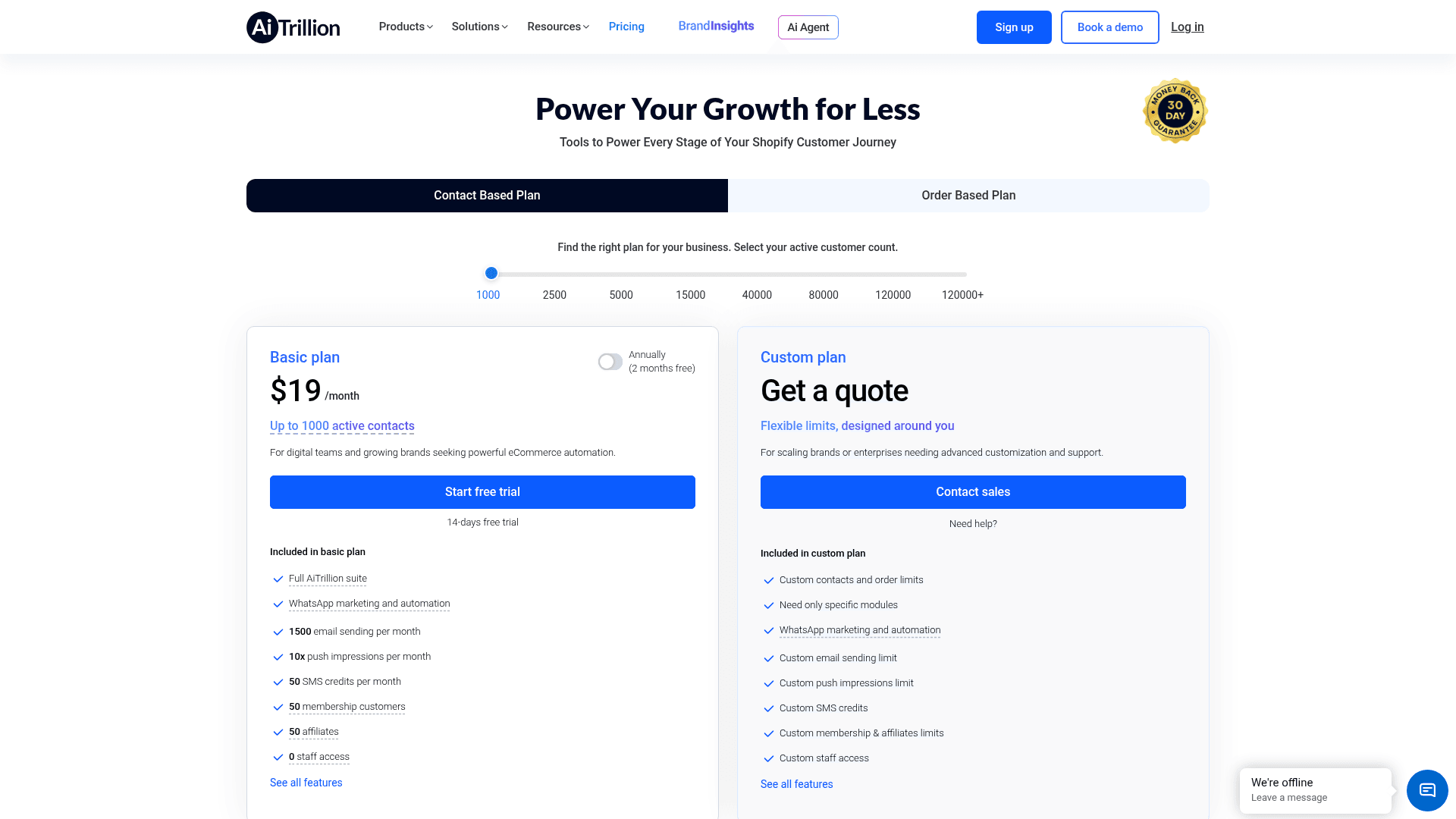
AiTrillion runs two parallel pricing models, and the pricing page puts them behind a toggle: a contact-based plan and an order-based plan. The contact-based ladder is the one that's fully published, so that's the one worth reading carefully.
Every price below is the monthly rate, with the effective monthly rate on annual billing next to it. Annual is straightforwardly two months free, so it's 10/12 of the monthly figure across the whole ladder.
Overage follows the same split: the pricing page lists $10 per extra 1,000 contacts on monthly billing and $120 per extra 1,000 per year on annual.
| Plan | Monthly | Annual (per mo) | Active contacts | Emails / mo | SMS credits | Membership customers | Affiliates | Staff seats |
|---|---|---|---|---|---|---|---|---|
| Starter | $9 | $8 | 500 | 1,500 | 50 | 50 | 50 | 0 |
| Basic | $19 | $16 | 1,000 | 1,500 | 50 | 50 | 50 | 0 |
| Growth | $49 | $41 | 2,500 | 7,500 | 50 | 250 | 250 | 1 |
| Professional | $99 | $82 | 5,000 | 15,000 | 100 | 500 | 500 | 2 |
| Advance | $199 | $166 | 15,000 | 60,000 | 500 | 1,000 | 1,000 | 4 |
| Enterprise | $399 | $333 | 40,000 | 200,000 | 1,000 | 5,000 | 5,000 | 8 |
| Enterprise Plus | $699 | $583 | 80,000 | 400,000 | 5,000 | 8,000 | 8,000 | 15 |
| Enterprise Super Plus | $999 | $833 | 120,000 | 600,000 | 10,000 | 16,000 | 16,000 | 30 |
| Custom | Quote | Quote | Custom | Custom | Custom | Custom | Custom | Custom |
Three things jump out of that table.
Starter to Basic doubles the price and changes exactly one number. $9 buys 500 contacts, $19 buys 1,000, and every other allowance is identical: same 1,500 emails, same 50 SMS credits, same 50 membership customers, same 50 affiliates, same zero staff seats. You are paying $10 a month purely for list headroom.
Staff access is zero until $49. Starter and Basic both ship 0 staff access, which AiTrillion's own tooltip defines as additional users beyond the main admin. So if two people at your store need to log in and manage campaigns, the entry price isn't $9 or $19, it's the $49 Growth plan. That's a real jump for a small team, and it's the kind of gate that also shows up in Freshdesk's free plan discussions.
SMS credits barely move for three tiers. 50 credits on Starter, 50 on Basic, 50 on Growth, then 100 on Professional. Given a US SMS costs one credit, the $49 plan buys you fifty text messages a month. SMS is effectively a paid add-on at every tier below Advance, which matters if texting is part of your ecommerce customer service plan rather than a nice-to-have.
There's also one allowance that isn't a number at all. Web push impressions are listed as "10x per month" on every single tier, from Starter to Enterprise Super Plus. It's a multiplier, presumably against your contact count, but the pricing page doesn't say against what. Worth asking.
What actually makes a contact "active"
This is the heart of AiTrillion pricing, and it's answered plainly in the pricing FAQ, to AiTrillion's credit.
When you first connect Shopify, every imported contact lands inactive by default, and you manually activate the ones you want to reach. Good design. But AiTrillion also lists five actions that will auto-activate a pre-existing imported contact whether you picked them or not.
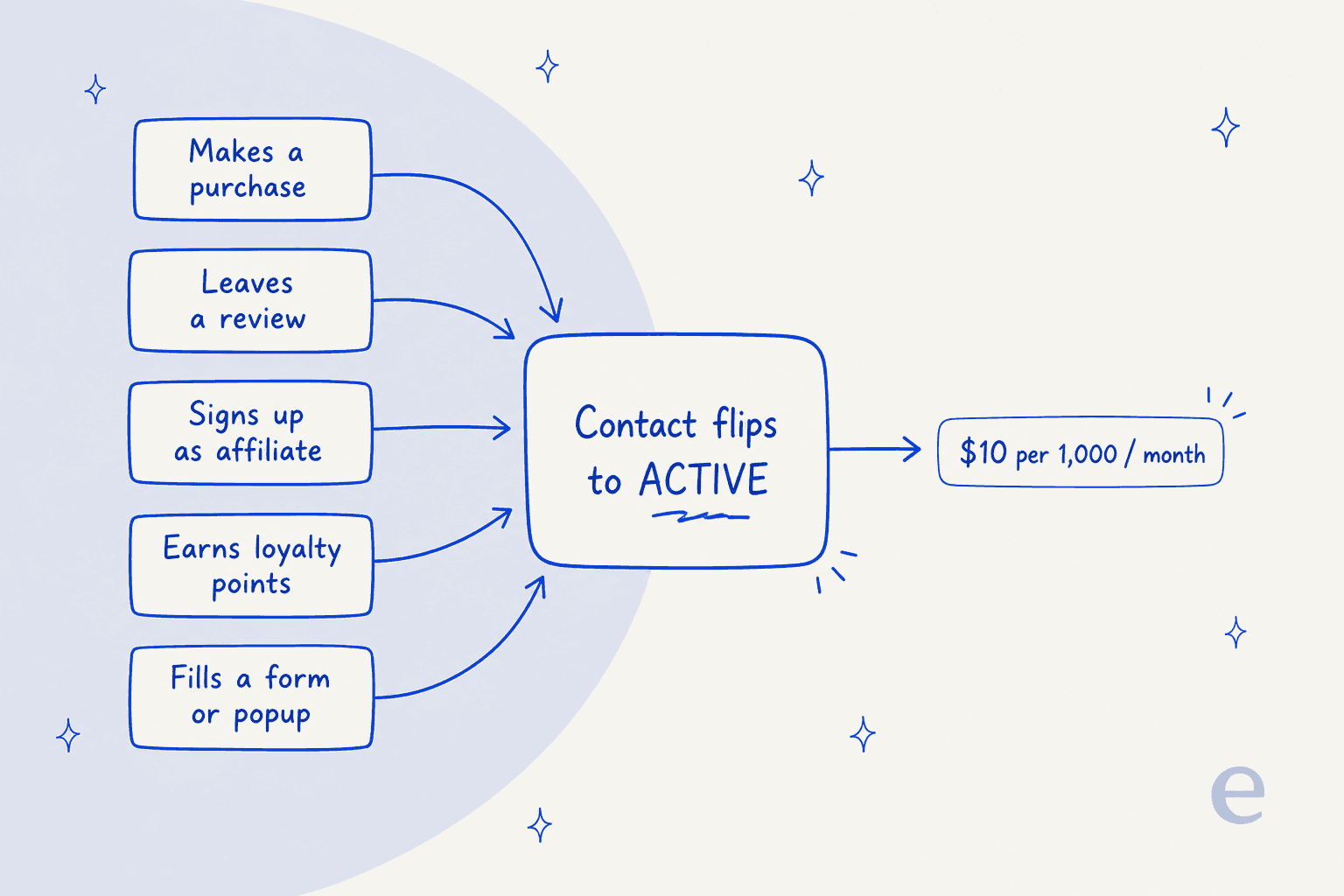
Look at that fifth trigger. Filling out a form or popup activates a contact. AiTrillion sells you the form builder and the smart popups, both bundled in every tier. So the module that grows your list is the same module that grows your bill, and it fires on an action your visitor takes, not one you choose.
Four of those five triggers are things I'd happily pay for, because a purchase or a loyalty redemption is a real buyer. The popup one is different in kind. A visitor who enters an email for a 10% discount code and never returns is, by this definition, an active contact you're paying $10 per thousand to hold.
At least one merchant says the gap between buyers and billables got wide:
"We are being charged for 3.5 times the number of customers who actually purchased from us. I have no idea who the others are, presumably abandoned carts, bots, or similar contacts. AiTrillion classifies them as 'active customers' and charges the higher fees without warning."

The same reviewer reports their subscription auto-upgraded twice without their input. That's the overage mechanic doing its job, and it's the single most important thing to model before you sign up. This is the same class of problem that hits any usage-metered tool, and it's why I push so hard on knowing your unit before you commit, whether that's contacts here or interactions in Zendesk AI resolution pricing.
To be fair to AiTrillion: they publish the definition, they publish the triggers, and they publish the overage rate. Plenty of vendors publish none of the three. The issue isn't concealment, it's that the unit doesn't match the mental model most merchants walk in with.
Model your own bill
Here's the arithmetic that matters. Put in the number of customers who actually buy from you in a month, then set how much bigger your active-contact count runs than your buyer count. The 3.5x mark is the figure from that G2 review.
The gap that opens up between those two cards is the whole reason this post exists. Same store, same revenue, same number of humans buying things, and a materially different bill depending on how your popups perform. That's a very different risk profile from tools where the cost per ticket is the unit, and it changes how you design an AI support workflow around it.
The order-based plan, and its cliff
The second toggle on the pricing page is order-based billing, where your charge tracks total monthly orders instead of contacts. For a lot of stores that is the better mental model, because orders are a number every merchant already watches anyway.
The published detail is thinner here, but two facts are stated outright. If you exceed your monthly order limit and don't manually upgrade, $20 is charged automatically for every additional 50 orders. And once you pass 500 orders a month, AiTrillion recommends contacting sales about a contact-based, enterprise, or custom plan instead.
The 500-order ceiling is the interesting bit. Quietly, it tells you order-based pricing was designed for stores doing under about 17 orders a day. Past that you're back on the contact ladder, or in a quote. If your store is already through that threshold, the order toggle is a dead end and you should read the contact table as the real rate card.
Where SMS and WhatsApp actually get billed
Neither channel sits fully inside the plan price, and each one is metered in its own currency.
SMS runs on credits, and one message costs a different number of credits depending on where it lands. The published table:
| Country | Credits per SMS | Lowest cost per SMS |
|---|---|---|
| United States | 1 | $0.01027 |
| South Africa | 2 | $0.01530 |
| Canada | 2 | $0.02009 |
| Australia | 3 | $0.03081 |
| United Kingdom | 4 | $0.04201 |
| Malaysia | 7 | $0.07307 |
| Vietnam | 12 | $0.12218 |
The "lowest cost" column is the floor, not the rate, since AiTrillion states the per-credit price varies with how many credits you buy. Carrier fees are included, which is a nice touch. But note what the credit multipliers do to the bundled allowance: the 100 credits on the $99 Professional plan are 100 US messages or 25 UK ones.
WhatsApp isn't in the plan price at all. It's charged by message category, Marketing, Utility, or Authentication, following Meta's own template pricing structure, and the rate card lives in a linked PDF in INR and USD rather than on the page. If WhatsApp is a real channel for you, that PDF is required reading before you compare totals against anything else. Metered messaging like this is standard now, and I walked through the same pattern for AI WhatsApp support.
The AI agent: included everywhere, capped nowhere
AiTrillion's AI agent is real, and the product page is specific about what it does: FAQs, order status, shipping, returns and refund automation, loyalty balance lookups, membership questions, in-chat product recommendations, and review collection, with handoff to a human when needed. It's trained on store data plus help docs, and there's a live demo you can poke at without signing up.
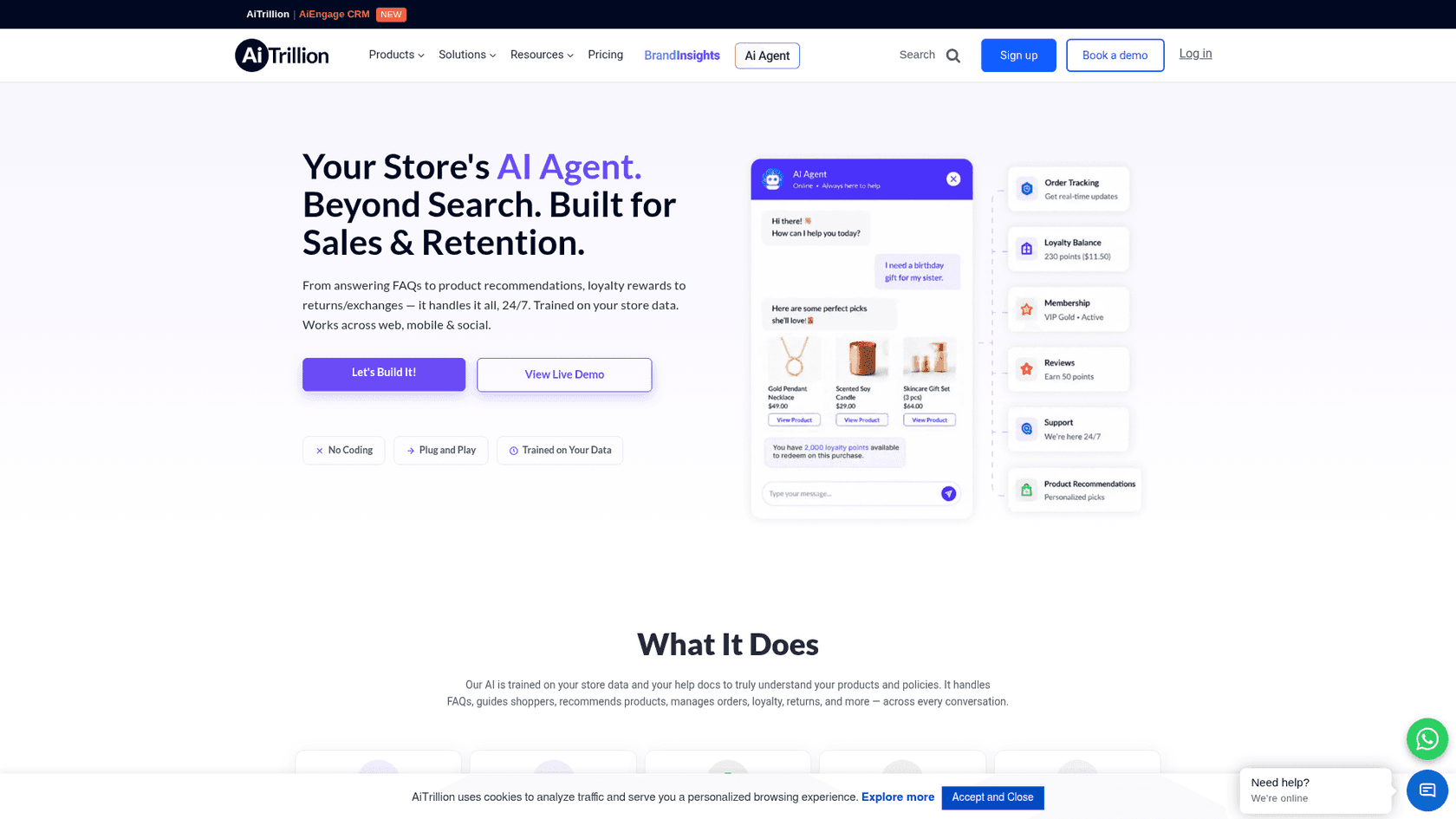
It's also listed as included on every plan, right down to the $9 Starter tier. For a store that wants a competent AI chatbot for orders or an AI shopping assistant without a separate subscription, that's a strong offer at that price.
Here's the gap. Every other allowance in the suite carries a hard published number. The AI agent carries none.
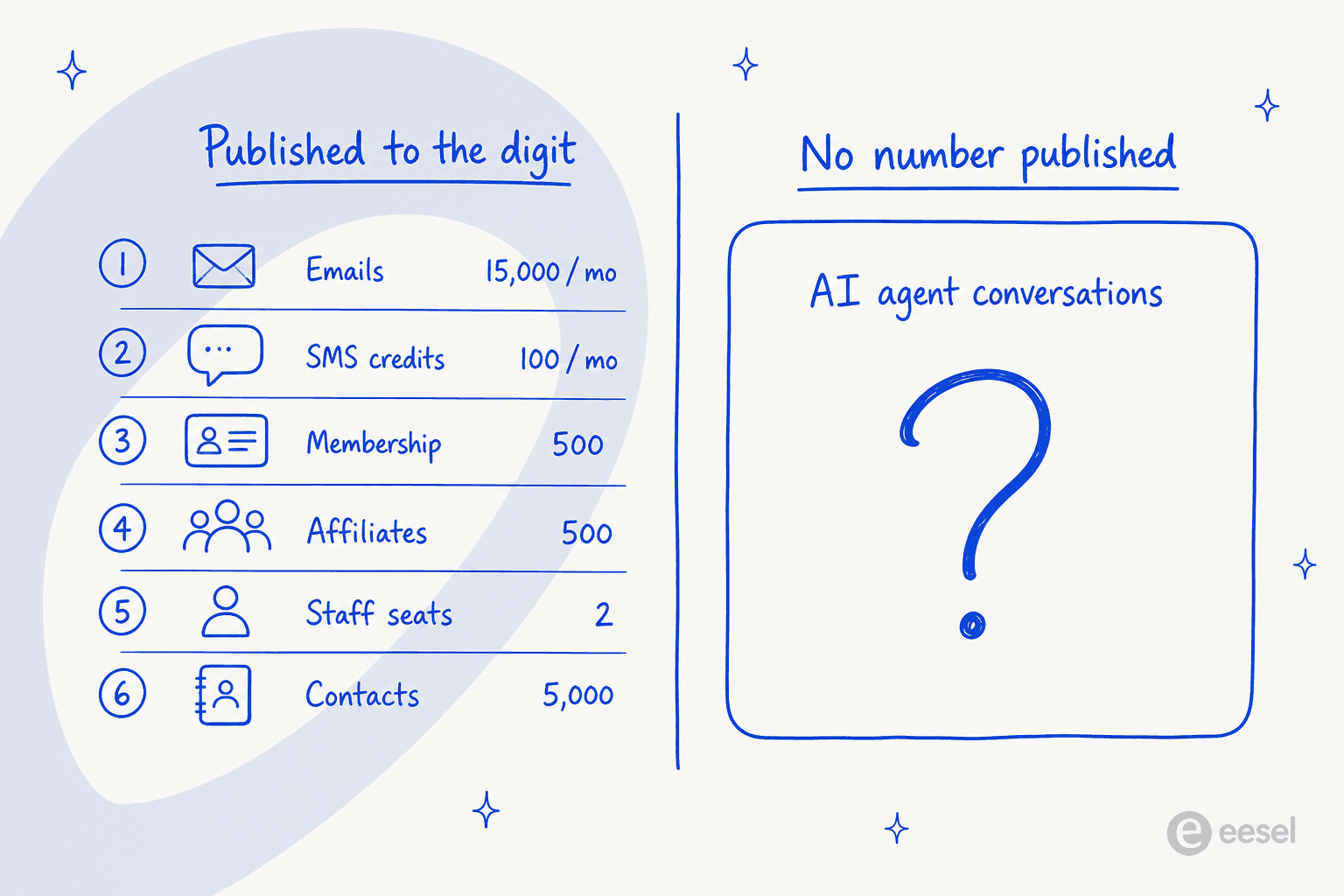
I'm not claiming there's a hidden charge. There may be no cap at all, which would be a great deal. The point is narrower: for a buyer evaluating this as AI for Shopify support, the single number that determines whether it works at your volume is the one number the rate card doesn't state. Email sends are specified. SMS credits are specified. Affiliate seats are specified. AI conversations are a feature bullet.
If you're comparing AiTrillion against tools where the automation number is the price, like Gorgias AI or Zendesk's resolution rate, you're comparing two different kinds of document. Ask for the cap in writing on your call.
The other thing the pricing page doesn't mention is testing. There's no reference to running the agent against your historical tickets or chats before it goes live on your storefront. I've watched enough confident-sounding bots quietly give wrong answers that a dry run over real past conversations is now non-negotiable for me, which is why an AI chatbot answers wrong is one of the most-read things on the eesel blog. A 14-day trial on live traffic is a different risk than a simulation on last quarter's tickets.
What the plan price doesn't cover
Running the pricing page and the review sites side by side, five costs sit outside the monthly figure.
- Staff seats below $49. Starter and Basic are single-admin plans. Two logins means Growth.
- SMS above the bundled credits. Additional email, SMS, and push are bought as separate blocks from the billing section inside the app.
- WhatsApp messages. Priced per message by category, outside the plan.
- Paid setup and migration. AiTrillion says Starter, Growth, and Enterprise sellers get customer-success migration help, notably not Basic, Professional, Advance, or the two top Enterprise tiers. Separately, one G2 reviewer describes buying a paid setup service for around €500.
- Overage on whichever meter you picked. $10 per 1,000 contacts, or $20 per 50 orders.
None of that is unusual for a Shopify app. It just means the $19 on the card is a floor, and the practical entry point for a store with two staff and any SMS ambition is closer to $49 to $99. That's still cheap against a stack of separate Shopify AI apps, which is the whole pitch. Merchants weighing that trade usually shortlist from the top Shopify AI apps first.
Does the all-in-one math actually work out?
AiTrillion's headline claim is that it replaces 11+ apps, and the customer reviews mostly back the consolidation story. Its ratings are strong: 4.8/5 across 97 reviews on G2 with 88% at five stars, and 4.9/5 across 77 reviews on Capterra, with customer service scored 4.9. Ninety of those 97 G2 reviews come from businesses of 50 people or fewer, so the small-store fit is well evidenced.
But the most useful review I read was from a happy customer, not an unhappy one:
"I was able to ditch 3 other apps, that although I didn't save money, it was very close and now i no longer need to Frankenstein those apps, especially when they all 3 need integration."
So: a five-star review saying the cost saving was roughly a wash, and the real win was integration overhead. Honest, and probably the right way to think about it. If you're buying AiTrillion to cut your app bill, run the numbers on your specific stack. If you're buying it to stop wiring five tools together, the case is stronger and doesn't depend on the arithmetic.
Two recurring cons are worth pricing in as time rather than money. Setup complexity is the top dislike on G2, with seven reviewers naming a steep learning curve, mostly around migrating an existing loyalty program. And support coverage is uneven by timezone. AiTrillion states a 24-hour turnaround with limited support on weekends and holidays, and reviewers confirm the shape of that:
"Support not available on weekends when assistance are required."
A merchant in a US timezone should read that as a real constraint during a Black Friday incident, not a nitpick. It's the same gap that makes people look hard at support coverage in ecommerce helpdesks generally.
Who AiTrillion pricing works for
It's a good buy if: you're a Shopify store under a few thousand active contacts, you want loyalty plus reviews plus email plus popups from one vendor, and you'd rather manage one integration than six. At $9 to $99 a month with the AI agent bundled, nothing else among the best Shopify chatbots is priced this aggressively, and the review base backs up the small-store fit. The 14-day trial plus a 30-day money-back guarantee lowers the cost of finding out.
Look harder if: your list grows much faster than your customer base, because the contact meter is the thing that will bite. Model it with the calculator above at 2x before you commit. Also look harder if your team is more than one person and you were budgeting the $19 plan, or if SMS is a primary channel and you'd be buying credit blocks every month.
It's the wrong shape if what you actually need is a support tool. AiTrillion is a marketing and retention suite that has an AI agent attached, not a helpdesk. There's no ticketing backbone, the AI's capacity isn't specified, and there's no published way to test it against your own history first. Those aren't flaws in what AiTrillion set out to build, they're just a different product category, and buyers searching for Shopify customer support tooling end up on this pricing page a lot.
Where eesel fits
If the thing that bothers you about the table above is that your support bill scales with how well your marketing performs, that's the specific problem eesel was built around.
eesel working with Shopify order data inside a live conversation.
eesel is an AI agent for your existing helpdesk rather than a suite you migrate onto. It reads your knowledge base and your past tickets, plugs into your Shopify stack plus Gorgias, Zendesk, Freshdesk or Front, and the meter is tickets it resolves. Not contacts. Not popup signups.
And before it touches a live customer, you simulate it on your historical tickets so you can see the resolution rate on your own data instead of hoping. The pricing is a published fixed monthly plan from $299 for 500 credits, and you can start free with 100 credits.
Keep AiTrillion for loyalty and email if that's working. Put a real support agent behind the tickets it wasn't built to close.
Sources
Primary:
- AiTrillion pricing (contact-based and order-based tiers, active-contact definition, activation triggers, overage rates, SMS credit table, pricing FAQ, migration support, payment methods, support turnaround) accessed 24 August 2026
- AiTrillion AI Agent (agent capabilities, training sources, channel coverage, handoff) accessed 24 August 2026
- AiTrillion live agent demo
Community:
- AiTrillion reviews on G2 (4.8/5, 97 reviews; billing, support-coverage and learning-curve quotes)
- AiTrillion reviews on Capterra (4.9/5, 77 reviews)
Frequently Asked Questions
How much does AiTrillion cost per month?
What is an active contact in AiTrillion's pricing?
Does AiTrillion have a free plan or free trial?
What is AiTrillion's overage charge if I go over my plan?
Is the AiTrillion AI agent included in the price?
How much do AiTrillion SMS and WhatsApp messages cost?
Is AiTrillion pricing good value for a small Shopify store?
What are the best AiTrillion alternatives for support?



Article by
Kurnia Kharisma
Kurnia is a software engineer and writer at eesel AI with two years of SEO experience, writing about AI tools, helpdesk software, and customer support. He pairs a developer's understanding of how these products are built with search-driven research into what actually ranks and resonates with the people searching for them.