
Running a Shopify store is a grind. You want to give every shopper instant, helpful answers, but you can’t be online 24/7. While you're asleep, a customer in a different time zone might be wondering if that shirt comes in a blue. By the time you wake up, they’ve already bought it from a competitor.
For years, live chat was the go-to solution, but it doesn't scale without a bigger team. Now, AI shopping assistants are starting to fill that gap. And no, these aren't the clunky, rule-based chatbots from a few years ago. Think of them less as FAQ machines and more as smart, digital sales agents that guide customers, answer tricky questions, and help you make sales around the clock.
This guide will walk you through what a real AI shopping assistant is, the key features to look for, the common traps to avoid, and how some of the most popular tools stack up.
What is a Shopify AI shopping assistant?
A Shopify AI shopping assistant is a tool that uses artificial intelligence, like Natural Language Processing (NLP), to create personalized, conversational shopping experiences that help you sell more.
It’s easy to mix them up with traditional chatbots, but they’re built for completely different jobs. A traditional chatbot is mostly for reactive support. It waits for a question and then tries to find a pre-written answer. An AI shopping assistant, on the other hand, is built to proactively help you sell more. It understands what a customer is looking for, anticipates their needs, and guides them from just browsing to actually checking out.
This infographic from our Shopify AI shopping assistant guide provides a simple way to tell them apart:
| Feature | Traditional chatbot | AI shopping assistant |
|---|---|---|
| Interaction style | Follows pre-set scripts and keyword triggers. | Engages in natural, human-like conversations. |
| Primary goal | Reactive support (answering FAQs). | Proactive sales (recommending products, upselling). |
| Personalization | Generic, one-size-des responses. | Tailors recommendations based on user behavior and questions. |
| Learning ability | Static: requires manual updates to scripts. | Learns and improves from every interaction. |
Key features of a Shopify AI shopping assistant
Just because an app calls itself an "AI chatbot" doesn't mean it’s a real shopping assistant. The best ones have features that feel like having a really good salesperson right there in the store with your customer.
Personalized product recommendations
This is a big one. A good assistant looks at a shopper's real-time questions ("Do you have vegan leather bags?") and browsing history to suggest products they'll actually want to buy. It’s smarter than just matching keywords; it understands what the customer is really looking for, which helps you increase your Average Order Value (AOV) by showing people exactly what they want, when they want it.
24/7 conversational sales and support
The most obvious benefit is being available around the clock. This is non-negotiable for capturing international sales or serving night-owl shoppers. Modern AI can do more than just answer "Where is my order?"; it can guide a confused shopper who doesn't know which product category to look in or what size would be the best fit, keeping them from leaving your site.
Proactive upselling and cross-selling
A good salesperson knows the perfect time to suggest a complementary item. A great AI shopping assistant does, too. It can intelligently recommend accessories that go with a product in the cart or even create personalized product bundles on the spot. For instance, if a customer adds a dress to their cart, the AI might suggest a matching belt and earrings, turning a single purchase into a whole outfit.
Cart abandonment reduction
How many sales are lost because a customer has one last-minute question? An intelligent assistant can tell when a shopper is hesitating, maybe they’ve been stuck on the checkout page for a minute or are flipping between tabs, and can jump in to help. A simple message like, "Hey, I noticed you're looking at our shipping options. We offer free two-day shipping on all orders over $50!" can be all it takes to close the sale.
Common implementation challenges
Let's be honest, many store owners are skeptical about AI. We've all seen Reddit threads filled with complaints about bots giving wrong answers or creating frustrating loops. These issues are real, but they usually come from using outdated or poorly integrated tools.
I'm worried that adding an AI assistant will hurt conversion because people hate talking to bots

Inaccurate or "hallucinated" answers
Nothing kills a sale faster than an AI giving wrong information. Early chatbots would often "hallucinate" or just make things up when they didn't know an answer, telling a customer a product was in stock when it wasn't or inventing a return policy. This happens when the AI isn't properly trained on your store's real-time, accurate data. It breaks customer trust in a second and can lead to lost sales and chargebacks.
i tried an AI assistant and it was terrible, gave wrong product info constantly so i turned it off
Creating disconnected data silos
Another huge headache is when your storefront chatbot is a completely separate system from your support help desk (like Zendesk or Gorgias) and your Shopify admin. A customer might ask the bot for their order status, but the bot can't see it. The bot then tells the customer to email support, where an agent has to ask for the order number all over again. This creates a clunky, repetitive experience that annoys everyone.
A robotic and impersonal experience
If a chatbot's responses feel cold, generic, and totally off-brand, it can make your store feel impersonal. A true shopping assistant should be customizable to match your brand's unique voice, whether you're fun and casual or high-end and professional.
All these problems point to one thing: you need an AI that connects deeply with your entire ecommerce setup. Modern platforms like eesel AI are built to do just that. By plugging directly into your Shopify catalog, help desk history, and knowledge bases, the AI can make sure every answer is accurate and based on your store's actual data. No more guesswork or hallucinations.
A practical comparison of popular tools
The Shopify App Store is filled with options, but they fall into a few distinct categories. Here’s a look at some popular tools, breaking down their features, pricing, and where they might fall short.
Standalone storefront assistants
These apps are designed to add a sales-focused chatbot directly to your Shopify store. They're often easy to set up but can operate in a silo.
1. AskTimmy AI Chat Bot + ChatGPT
-
Best for: Stores that rely on visual product discovery and want to encourage bundling.
-
Pricing: AskTimmy has a free plan with 250 lifetime replies. Paid plans begin with the Starter plan at $24/month, which includes 1,000 AI replies per month.
-
Key features: It offers unique sales tools like an advanced photo search (customers can upload an image to find similar products) and the ability to create product bundles directly in the chat. It also supports over 95 languages, making it great for international stores.
-
Limitation: AskTimmy is a customer-facing tool that lives on your storefront. It doesn't integrate into your team's help desk. This means that when a conversation needs a human, the context doesn't carry over smoothly, and your agents are left managing two separate systems.
2. Tidio - Live chat & AI chatbot
-
Best for: Small teams looking for a single tool to manage live chat and basic AI automation without using a separate, dedicated help desk.
-
Pricing: Tidio offers a free plan with 50 live chat conversations. To get more AI and automation features, paid plans start at $29/month.
-
Key features: Tidio is a well-established player with over 1,100 reviews. It combines live chat, rule-based automations called "Flows," and an AI agent named "Lyro" into a single dashboard.
-
Limitation: Tidio's all-in-one approach becomes a problem if you already use a dedicated help desk. While Tidio can create tickets in platforms like Zendesk, it doesn't operate within them. This creates a disconnected workflow where your support team has to jump between Tidio and their main helpdesk to resolve issues, creating the exact data silos you want to avoid.
3. AI Shopping Assistant by RVS MEDIA
-
Best for: Merchants who are willing to experiment with a new and relatively simple AI chatbot.
-
Pricing: Plans start at $30/month, which includes training on up to 200 products.
-
Key features: This is a straightforward AI chatbot that promises to integrate with your store data for product recommendations and answers.
-
Limitation: At the time of writing, this app has zero reviews on the Shopify App Store. Every app has to start somewhere, but the lack of feedback makes it tough to know how it performs in the real world or what kind of support you can expect. It also seems to be another storefront-only tool without deep help desk integrations.
The helpdesk-first approach
Some platforms build AI directly into a full-scale helpdesk, which is powerful and ensures a unified experience for the entire team.
4. Gorgias: Helpdesk, chat & FAQ
-
Best for: High-volume Shopify stores that want a comprehensive, mature, and trusted platform to manage all support channels in one place.
-
Pricing: Gorgias offers tiered plans to match different team sizes. The Basic plan is $50/month and includes 300 tickets. Their AI Agent add-on provides impressive automation capabilities directly within the ticket flow at a predictable per-resolution cost.
-
Consideration: As a mature and reliable platform, Gorgias provides a world-class, comprehensive ecosystem that is perfectly suited for growing ecommerce brands. It is a robust solution for teams looking for a complete, enterprise-grade foundation. For those who want to maintain their current help desk while adding specialized automation, complementary tools like eesel AI can work right alongside your existing setup.
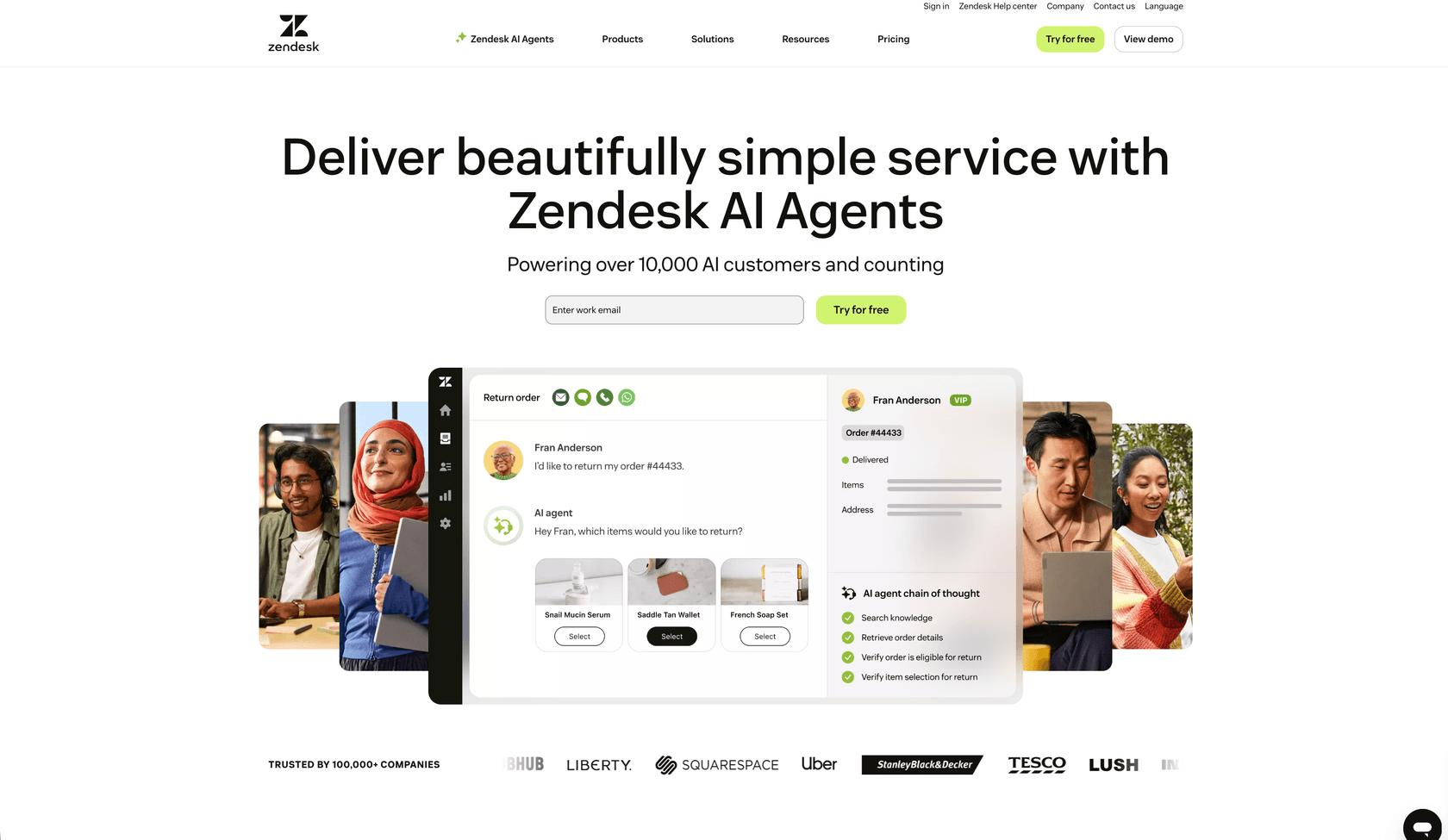
5. Zendesk
-
Best for: Enterprise-level businesses that need a comprehensive, mature, and highly scalable service solution.
-
Pricing: Zendesk offers tiered plans to match different team sizes. The "Suite Team" plan, which includes foundational AI features, starts at $55 per agent per month when billed annually.
-
Consideration: As a mature and reliable platform, Zendesk offers a world-class, comprehensive ecosystem. Its powerful native AI features are perfectly integrated into its robust platform, making it the gold standard for businesses that want a complete, enterprise-grade foundation that grows alongside them.
The missing piece: A unified AI for customers and agents
So you're left with a clear choice: do you pick a storefront chatbot, or do you commit to a comprehensive helpdesk setup?
Often, there is a disconnect where the AI on your website doesn't know a customer's support history, and your support agents in the help desk don't have the context from the bot's conversation.
This is the exact gap a unified platform like eesel AI fills. It gives you both a customer-facing AI Chatbot for your Shopify store and an AI Agent that works inside the help desk you already use, like Zendesk or Gorgias. This setup means the AI can handle initial questions on your site with its deep Shopify connection. Then, if an issue needs a human touch, your agent gets the full conversation context and AI-powered tools to solve it fast, all without ever leaving their helpdesk.
Moving from a simple chatbot to a true shopping assistant
A real AI shopping assistant can be a huge asset for your store, but only if it's accurate and plays well with the tools you already use. The goal isn't just to stick another chat widget on your site. It’s about creating a smooth, smart experience for your customers and your own team.
The right tool should connect to your key data sources from day one, cutting down on manual work instead of creating more of it. When you bring your storefront engagement and your backend support together, you can finally deliver the kind of fast, accurate, and personalized experience that turns browsers into buyers and buyers into loyal fans.
Ready to deploy an AI assistant that truly understands your products, customers, and agents? eesel AI connects to your Shopify store, help desk, and internal docs in minutes to automate support and drive sales with unparalleled accuracy. Book a demo or start your free trial today.
Frequently asked questions
What's the core distinction emphasized in this Shopify AI shopping assistant guide between an AI shopping assistant and a traditional chatbot?
This guide highlights that an AI shopping assistant proactively drives sales through natural conversation and personalized recommendations. In contrast, a traditional chatbot is primarily for reactive support, following pre-set scripts to answer FAQs. AI learns and improves, while traditional chatbots are static.
Which key features should I prioritize when looking for a solution, based on this Shopify AI shopping assistant guide?
This guide suggests prioritizing personalized product recommendations, 24/7 conversational sales and support, proactive upselling and cross-selling, and cart abandonment reduction. These features aim to enhance the customer journey and increase your store's average order value.
How does this Shopify AI shopping assistant guide suggest avoiding common implementation challenges like inaccurate AI answers or data silos?
The guide recommends using an AI that connects deeply with your entire ecommerce setup, including your Shopify catalog, help desk history, and knowledge bases. This integration ensures accurate responses and prevents disconnected data, providing a seamless customer and agent experience.
Does this Shopify AI shopping assistant guide offer advice on choosing an AI solution that integrates well with my existing help desk like Zendesk or Gorgias?
Yes, the guide points out the benefits of a unified platform like eesel AI. It provides an AI Chatbot for your storefront and an AI Agent that works within your existing help desk, ensuring seamless context transfer and reducing agent workload without requiring a full system migration.
What are some practical considerations when comparing the tools mentioned in this Shopify AI shopping assistant guide?
When comparing tools, consider if they are standalone storefront assistants or full helpdesk replacements. Evaluate integration capabilities with your existing support systems, pricing models (per reply, per agent, per ticket), and whether they address data silos versus creating them.
What defines a "true" AI shopping assistant as opposed to a basic chatbot, according to this Shopify AI shopping assistant guide?
A true AI shopping assistant goes beyond simple FAQs, actively guiding customers, understanding their needs, and proactively making sales. It learns from interactions, offers personalized recommendations, and integrates deeply with your store's data to provide accurate and relevant assistance around the clock.