
Why ecommerce support is its own problem
Generic helpdesk software treats every ticket the same. Ecommerce support doesn't work that way. A shopper asking "where is my order?" needs a live tracking number pulled from your store, a customer wanting to cancel needs the AI to actually touch the order, and a pre-sale "does this run small?" question is really a sales conversation in disguise. Around 70% of Shopify Inbox conversations happen with customers who are mid-purchase decision, which means support and revenue are the same queue.
So the bar for "good" AI customer service software here is higher than answering FAQs. It needs to read order data, take actions safely, and know when to hand off to a human, which is what separates a real agent from a basic AI customer service chatbot. That's the lens I used for every tool below.
A quick note on how I tested: I worked through each platform's live product, help docs, and pricing pages, and pulled real user sentiment from G2, Reddit, and Shopify's own app store. Where I quote a customer or a number, there's a link to the source. I didn't run any of these in production for months, so I'm honest about where my read is based on hands-on use versus documented behaviour.
What to look for before you pick
Before the list, here's the shortlist of dimensions that actually separate these tools. Most "best of" posts stop at price and a star rating, but for an online store these are the ones that decide whether the AI earns its keep:
- How deep the order integration goes. Can the AI just read order status, or can it act (refund, cancel, edit address)? That gap is the difference between a chatbot and an agent.
- How the AI is billed. Per resolution, per conversation, per seat, or flat. This decides your bill during a sales spike.
- Whether it replaces or layers onto your stack. Switching helpdesks mid-season is brutal. Some tools let you keep yours.
- Realistic automation rate. Vendors love "up to 80%". What matters is what your store hits after the docs are cleaned up.
- Channels and self-service. AI live chat, email, social, WhatsApp, plus a knowledge base the AI can learn from.
Here's roughly where the eight tools land on the two dimensions that matter most, how Shopify-native they are and who they're built for:
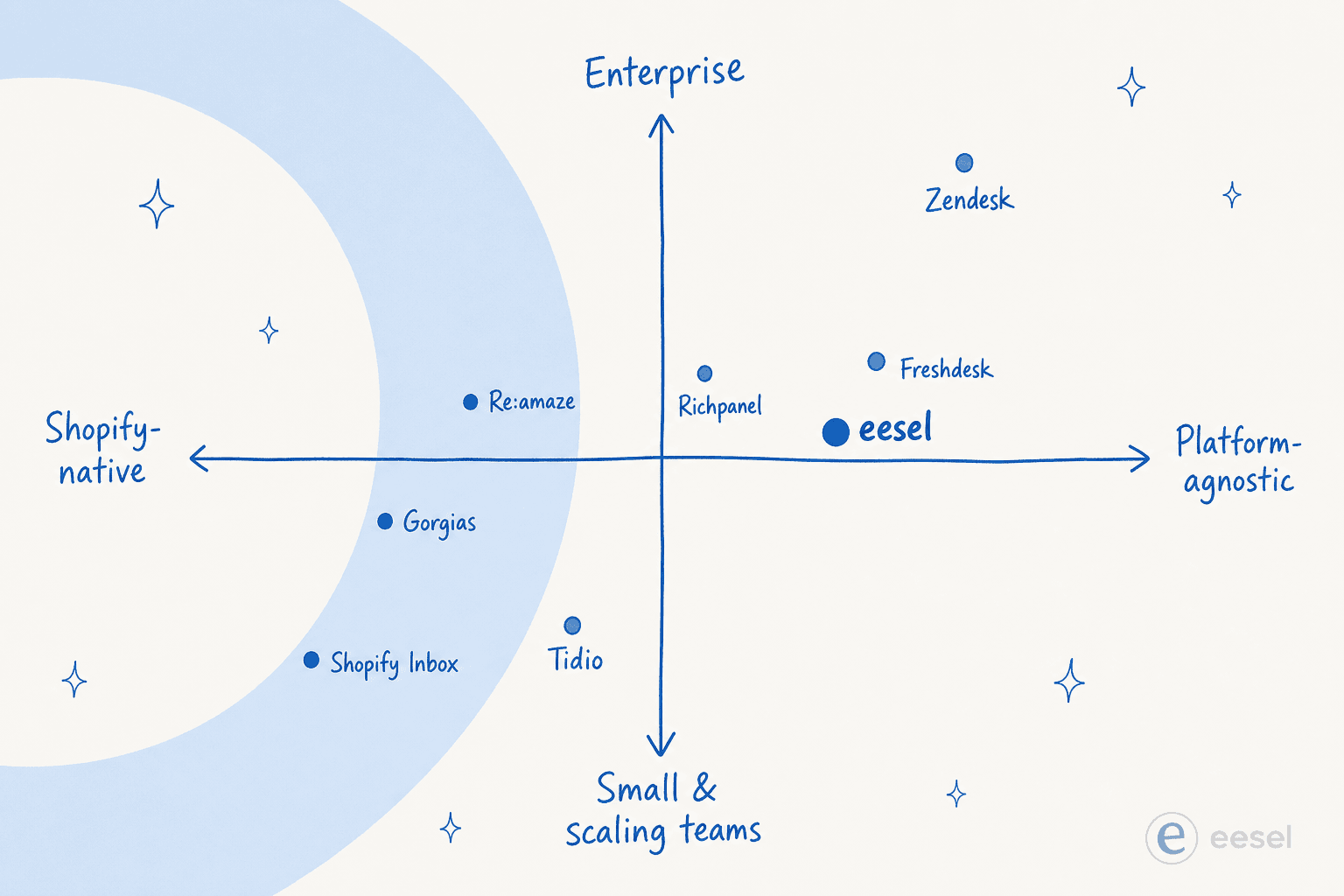
The best AI customer service software for ecommerce at a glance
| Tool | Best for | How the AI is billed | Entry price | Native Shopify order actions | Free option |
|---|---|---|---|---|---|
| eesel AI | Adding AI to your existing helpdesk | Credit plans, 1 credit per ticket, no seats | From $299/mo (500 credits), no platform fee | Via Shopify + your helpdesk | 100 free credits |
| Gorgias | Deep Shopify order actions | $0.90–$1.00 per resolved conversation | $10/mo (50 tickets) | Deepest, fully native | 7-day trial |
| Zendesk | Enterprise scale and omnichannel | Per automated resolution (~$1.20–$1.50 over commit) | $19/agent/mo | Via Copilot actions | 14-day trial |
| Freshdesk | Teams already on Freshworks | Per AI Agent session ($49 per 100) | $19/agent/mo | Via free Shopify app | Free for 1–2 agents (6 mo) |
| Tidio | SMB live chat plus AI on a budget | Per Lyro conversation (~$0.50) | $0 free / $24.17/mo | Native actions (Growth+) | Free plan (50 convos) |
| Re:amaze | Multi-channel small teams | $0.85 per AI resolution | $29/seat/mo or $59 flat | Order data in conversations | 14-day trial |
| Richpanel | AI-first resolution guarantee | $0.25–$0.30 per conversation | $500/mo + $0.25/convo | Native plus Recharge, Loop | 30-day money-back |
| Shopify Inbox | Free native chat on Shopify | Free (Shopify Magic) | Free | Native (cart, orders) | Free, always |
1. eesel AI: best for adding AI to the helpdesk you already use

Most tools on this list ask you to move your support onto their platform. eesel AI takes the opposite bet: it drops an autonomous AI teammate into the helpdesk you already run, whether that's Zendesk, Freshdesk, Gorgias, your email, or Shopify directly. For an ecommerce team that's spent a year configuring macros, tags, and routing, not having to rip that up is the whole pitch.
The framing eesel uses is that you're hiring a teammate, not buying a chatbot. You brief it in plain language ("handle order-status questions, but loop me in on anything over $500 in refunds"), it learns from your past tickets and help docs, and it drafts or fully resolves tickets inside the tool your agents already open every morning. For ecommerce specifically, it connects to Shopify to pull order data and take actions, which is the piece a generic knowledge-base bot can't do.
Here's eesel working directly inside Shopify:
What I like most is that you can roll it out on a slice of your volume first, route 200 of your 1,000 monthly tickets to it, watch what it does, then widen the gate. That's a far less terrifying way to adopt AI than flipping a switch on every conversation.
One ecommerce operator put the "keep your stack" appeal plainly:
"Finally, AI software that suits our needs. Easy to connect to Shopify, easy to prompt, and it learns from our articles. We're using it as a copilot for our Zendesk agents, with AI live chat next."
Mateusz Golda, Director, Tulipy (multi-brand gardening ecommerce), via G2

Features
- Works inside Zendesk, Freshdesk, Gorgias, email, Slack, and Shopify, no platform migration.
- Trains on past tickets, help center articles, Google Docs, and macros so it sounds like your brand on day one.
- Takes Shopify actions (order lookup, tracking, refund workflows) rather than just answering text.
- A simulation mode that replays your historical tickets so you can see the resolution rate before going live.
- Confidence-based handover so low-certainty tickets quietly go to a human instead of getting a guessed answer.
Pros
- The only pick here that doesn't make you switch helpdesks.
- Fixed monthly credit pricing that doesn't spike during a sales rush.
- Genuinely fast to onboard because it learns from history you already have.
Cons
- It's an AI layer, not a full helpdesk, so you do need an underlying tool (which is the point, but worth saying).
- The newest brand on this list compared to Zendesk or Gorgias, so it has fewer years of public reviews.
Pricing: One fixed monthly price on the Teammate plan, from $299/month for 500 credits ($499/month for 1,000, $999/month for 2,500). 1 credit covers one ticket or chat, with no per-seat fees and no platform fee. The free plan gives you 100 credits. Pay a year upfront and get two months free, and SSO is an add-on. HIPAA is available on request.
Our take: Pick eesel if you already have a helpdesk you like and your real problem is "we're drowning in repetitive tickets," not "we need a new platform." It's also the safest choice if seasonal spikes make per-conversation pricing scary, since a fixed monthly price is the same in March and November.
2. Gorgias: best for deep Shopify order actions
Gorgias was built for ecommerce from day one, and it shows (our full Gorgias review goes deeper). It's Shopify's only Premier Partner for CX, powers around 40% of the top Shopify brands, and the consistent verdict across Reddit and G2 is that no other tool pulls Shopify order data into the ticket view as cleanly. Order history, product catalogue, and customer context sit right there in every conversation, and the AI Agent can fully resolve order tracking, returns, refunds, and subscription edits without an agent touching it.
If your support is really order operations (cancel this, change that address, where's my parcel), Gorgias is the tool that does the most without custom work. Its Shopify integration even supports chat-in-checkout to catch customers before they abandon a cart. There's a reason competitors benchmark themselves against it, and why it anchors most Shopify AI apps to automate support lists.
The catch is cost. Gorgias runs roughly 3x the price of Zendesk for similar ticket volumes, and pricing is the number-one objection in the community. The rule of thumb that keeps coming up: it's worth it if 40% or more of your tickets need a direct Shopify action. Below that, you're paying for depth you won't use. In our own customer data, one ecommerce brand running Gorgias and Shopify was handling about 700 tickets a week at roughly $1.07 per ticket, solid economics, but only because their volume was high enough to justify it.
Features
- Deepest native Shopify integration on the market, including chat-in-checkout and revenue attribution.
- AI Agent with separate pre-purchase (Shopping Assistant) and post-purchase (Support) modes.
- Chat campaigns that fire proactive messages and discount codes based on cart state or URL.
- Unlimited users on every plan (you pay for tickets, not seats).
Pros
- Unmatched for Shopify-native order actions.
- Strong 4.6/5 across 560+ G2 reviews.
- Built specifically for the revenue-plus-support overlap that defines ecommerce.
Cons
- Expensive relative to general helpdesks, and the AI Agent add-on stacks on top.
- The AI add-on bills per resolved conversation, so heavy automation raises your bill.
Pricing: Five plans billed by ticket volume, from $10/month (Starter, 50 tickets) to $900/month (Advanced, 5,000 tickets), with Enterprise custom. The AI Agent is an add-on at $0.90–$1.00 per resolved conversation. Our full Gorgias pricing breakdown has the gotchas.
Our take: If you're a Shopify brand where 40%+ of tickets need real order actions, Gorgias is worth the premium and it's my top native pick. If you're below that threshold, or the per-conversation AI bill makes you nervous, look at Gorgias alternatives before committing.
3. Zendesk: best for enterprise scale and omnichannel
Zendesk is the heavyweight, now positioning itself as "the Resolution Platform". For a large ecommerce operation juggling email, messaging, voice, and social across regions, it's hard to beat on breadth: 1,800+ marketplace apps, 80+ languages, and a named 2025 Gartner Magic Quadrant Leader spot. Its AI Agents (the old Answer Bot and Ultimate.ai lineage) and Copilot for human agents cover both customer-facing automation and agent assistance, and Copilot can take actions across Shopify, Jira, and Slack.
It's genuinely powerful, but two things temper my enthusiasm for ecommerce specifically. First, the AI only resolves well on top of a clean, comprehensive knowledge base, teams without one see around 20% automation in month one, climbing toward 70% only after sustained doc cleanup. Second, the billing. Zendesk meters AI by "automated resolution", and third-party teardowns triangulate $1.20–$1.50 per resolution over your commit, with no hard spend cap. The only overage control is to pause AI entirely. For a store with unpredictable seasonal volume, that's a real risk worth modelling in our Zendesk AI pricing guide.
Features
- Omnichannel ticketing across email, messaging, voice, and social at enterprise scale.
- AI Agents plus Copilot, with intelligent triage and AutoQA across 100% of tickets.
- Huge app marketplace, including third-party AI agents that plug in if the native one underwhelms.
Pros
- The most mature, broadest platform here.
- Strong reporting and routing for large, multi-region teams.
- 4.3/5 across 6,837 G2 reviews, a deep track record.
Cons
- Per-resolution billing with no cap is the dominant 2026 complaint.
- AI configuration is repeatedly described as burdensome and needing technical help.
- Overkill (and overpriced) for small Shopify stores.
Pricing: Suite plans run from $19/agent/month (Support Team) to $115/agent/month (Suite Professional), with Enterprise plus Copilot at contact-sales. Copilot is a $50/agent/month add-on below Enterprise. AI resolutions are metered separately. See our Zendesk live chat pricing notes too.
Our take: Choose Zendesk if you're a large operation that needs omnichannel depth and has the team to maintain the knowledge base and AI config. If you mostly want the resolution engine without the platform overhead, this is exactly the case where layering eesel onto Zendesk gets you the AI without the per-resolution surprise, and it's worth scanning the Zendesk AI alternatives too.
4. Freshdesk: best for teams already in the Freshworks world
Freshdesk is the friendly, well-priced alternative to Zendesk, used by 74,000+ businesses. Its AI suite, Freddy, splits into an AI Agent for autonomous resolution, an AI Copilot for agents, and AI Insights for leadership. Freshworks claims Freddy resolves up to 80% of queries and that the Agent ships with 50+ prebuilt agentic workflows plus a no-code studio, with integrations for Shopify, Stripe, and PayPal.
For ecommerce, the Shopify app shows order, payment, and shipping details inside Freshdesk and lets agents cancel orders or process refunds without leaving the tool. That's solid, although it's worth flagging the Shopify app sits at a modest 3.0/5 across 61 reviews, so the integration is functional rather than best-in-class. Freddy AI Agent sessions are also consumption-based, which can climb at scale. If you want chat in the mix, see our Freshdesk live chat guide.
Features
- Freddy AI Agent, Copilot, and Insights across one platform.
- No-code AI Agent Studio with 50+ prebuilt workflows.
- Generous free tier and the lowest enterprise price of the big helpdesks.
Pros
- Excellent value, especially the 6-month free tier for 1–2 agents.
- Easy setup and fast time-to-value, a recurring theme in reviews.
- Strong omnichannel unification for the price.
Cons
- The Shopify integration is decent but not deep, and reviews are mixed.
- Freddy AI Agent sessions bill per 100, so heavy use adds up.
Pricing: Growth $19/agent/month, Pro $55, Enterprise $89, all billed annually. Freddy AI Agent gives 500 free sessions on Pro/Enterprise, then $49 per 100 sessions; Copilot is a per-agent add-on. (Freshdesk Omni, which adds chat and messaging, is priced separately.)
Our take: Freshdesk is the smart budget pick if you want a full helpdesk with built-in AI and aren't tied to Shopify-native depth. If you've already standardised on Freshworks, Freddy is the path of least resistance, just watch the session-based AI costs as volume grows. If Freddy underwhelms, the Freshdesk AI alternatives are worth a look.
5. Tidio: best for small teams that want live chat plus AI on a budget
Tidio is the SMB-friendly all-in-one: live chat, ticketing, automation Flows, and an AI agent called Lyro, all in one tidy product. Lyro is powered by Anthropic's Claude rather than ChatGPT, and Tidio claims a 67% average resolution rate, which it markets as the highest in the category, even backing it with a money-back guarantee if you fall under 50%. It's trusted by 300,000+ businesses and scores 4.8/5 across 1,300+ reviews on the Shopify App Store, which keeps it on most best Shopify chatbot apps shortlists.
What makes Tidio a good ecommerce starter is that it does the proactive sales bits (abandoned cart Flows, product recommendations) alongside support, and Lyro is praised for staying grounded in your own data rather than hallucinating. The thing to watch is pricing complexity: you can end up paying per billable conversation and per Lyro conversation and per Flows visitor, and the jump from the Growth plan to Plus is a steep $749/month. Our Tidio live chat overview digs into the plans, and the Gorgias vs Tidio comparison is worth a read if you're weighing the two.
Features
- Lyro AI agent (Claude-powered) with a documented resolution-rate guarantee.
- Live chat, ticketing, and visual no-code Flows in one tool.
- Native Shopify actions (order tracking, cart recovery) on Growth and up.
Pros
- A genuine free plan and a low entry price for AI.
- Strong Shopify App Store standing and an easy, no-code setup.
- The money-back resolution guarantee is a rare, confidence-signalling move.
Cons
- Layered usage-based pricing gets hard to predict at scale.
- The Growth-to-Plus jump is a big cliff for growing teams.
Pricing: Free plan (50 Lyro conversations lifetime), Starter $24.17/month, Growth from $49.17/month, Plus from $749/month, Premium at contact-sales. Lyro is also sold standalone from $32.50/month to layer onto an existing helpdesk.
Our take: Tidio is the best entry point for a small store that wants chat and AI without enterprise pricing. Just map out your expected conversation volume first, because the usage-based layers can surprise you as you grow.
6. Re:amaze: best for multi-channel small teams
Re:amaze (owned by GoDaddy) is a tidy support-and-engagement platform that pulls email, live chat, social, SMS, VoIP, and video into one shared inbox. Where it stands out for ecommerce is that the engagement extras, chatbots, proactive Cues, a real-time Live Dashboard of who's browsing, and co-browsing, ship as first-party features rather than paid add-ons. Order data surfaces inside conversations, and there's an AI Agent (in beta) for autonomous responses plus AI reply drafting and summaries.
The standout is its pricing quirk: the $59/month flat Starter plan lets unlimited team members use core features, which is genuinely attractive for a larger team with low ticket volume, a combination most per-seat tools punish. The trade-off is that Re:amaze is a smaller player, the AI Agent is newer and less proven, and review data is thinner than the big names.
Features
- Unified inbox across email, chat, social, SMS, VoIP, and video.
- Built-in chatbots, proactive Cues, and a live browsing dashboard.
- AI Agent (beta), AI reply drafting, summaries, and sentiment analysis.
Pros
- The $59 flat Starter plan is unusually team-friendly.
- Lots of engagement tooling included rather than upsold.
- Strong reported speed gains (one brand cited 5–6x faster service).
Cons
- AI Agent is still in beta and less battle-tested.
- Smaller ecosystem and fewer public reviews than Gorgias or Zendesk.
Pricing: Starter $59/month flat (unlimited seats, 500 conversations), Basic $29/seat, Pro $49/seat, Plus $69/seat, with AI resolutions billed at $0.85 each over the included allowance.
Our take: Re:amaze is a smart fit for a multi-channel small team that wants lots of people in the inbox without per-seat pain. If autonomous AI is your main reason for buying, though, the beta status means I'd test it hard before relying on it.
7. Richpanel: best for an AI-first resolution guarantee
Richpanel has gone all-in on "hire an AI support team". Instead of selling software, it frames the purchase as hiring four AI roles: Frontline AI (resolves tickets end to end), Copilot AI (assists humans), QA AI (reviews every reply before it sends), and CX Manager AI (builds SOPs and orchestrates the rest). It serves 2,000+ brands including The Ridge and Jones Road Beauty, and the headline commercial hook is a guarantee of 50% autonomous resolution in 30 days or your money back.
For ecommerce, the QA AI layer is the interesting bit, it reviews 100% of replies before they go out, which is Richpanel's direct answer to the "what if it hallucinates?" fear. The economics are aggressive too: roughly $0.25–$0.30 per AI-handled conversation versus the $2–$10 a human ticket costs. The flip side is the entry point, $500/month minimum for the self-serve AI plan, which prices out the smallest stores, and the public review trail is thinner than the incumbents.
Features
- A four-part AI team, including QA AI that checks every reply.
- Unified inbox plus migration tooling to import from Zendesk or Gorgias.
- SOC 2 Type II, HIPAA, and GDPR coverage out of the box.
Pros
- The 30-day resolution guarantee de-risks the purchase.
- QA-on-every-reply is a genuinely good answer to accuracy worries.
- Reported CSAT gains after AI (The Ridge went 88% to 96%).
Cons
- $500/month floor is steep for small stores.
- Newer, AI-first positioning means less independent review data.
Pricing: Self-serve AI Agent plan at $500/month plus $0.25 per conversation and $100/seat/month for humans (a sample bill of 2 AI agents and 3 human seats lands around $800/month). Enterprise is custom with volume pricing. A 30-day money-back guarantee anchors the offer.
Our take: Richpanel suits a mid-sized brand that's ready to go AI-first and wants a contractual resolution guarantee to lean on. If $500/month is more than your ticket volume justifies, a credit-based tool like eesel gets you autonomous resolution from $299/month, with no per-seat fees.
8. Shopify Inbox: best free, native chat on Shopify
Shopify Inbox is the free, native messaging tool baked into the Shopify admin, and for a brand-new or small store it's a perfectly reasonable starting point. It's a live chat widget with cart visibility, product links, discount-code sharing mid-chat, and some Shopify Magic AI: instant FAQ answers and suggested replies your team reviews before sending. It carries a strong 4.7/5 across 5,386 app store reviews and costs nothing on top of your Shopify plan.
Be clear-eyed about what it isn't, though. Power users consistently call it "very basic", there's no chat history export, no real ticketing or routing, and the Shopify Magic suggestions pull from website text rather than past conversations, so they read generic. It's a conversion-focused chat tool, not a support automation platform, so it sits near the bottom of any live chat software for ecommerce ranking on AI depth. For more depth, our complete guide to Shopify Inbox covers when to upgrade, and Shopify Sidekick is the broader AI assistant Shopify is building out.
Features
- Free live chat with cart visibility and in-chat product and discount cards.
- Shopify Magic instant answers and suggested replies.
- Automated order-status updates to cut "where's my order?" volume.
Pros
- Completely free, with zero setup beyond your Shopify store.
- Cart and order context is native and genuinely useful for closing sales.
- Reliable across desktop and mobile apps.
Cons
- No ticketing, routing, or chat export; thin for any real support workload.
- AI suggestions are generic because they don't learn from conversation history.
Pricing: Free for all Shopify merchants. You just need a Shopify subscription.
Our take: Start here if you're a small or new store and want zero-cost chat that converts browsers. The moment your volume outgrows manual replies, graduate to a tool with real AI resolution, and the good news is most of the others on this list layer cleanly on top of Shopify.
How AI support tools actually bill you (and why it matters)
This is the section I wish more "best of" lists included, because the billing unit quietly decides your annual cost more than the headline price does. There are three broad models:
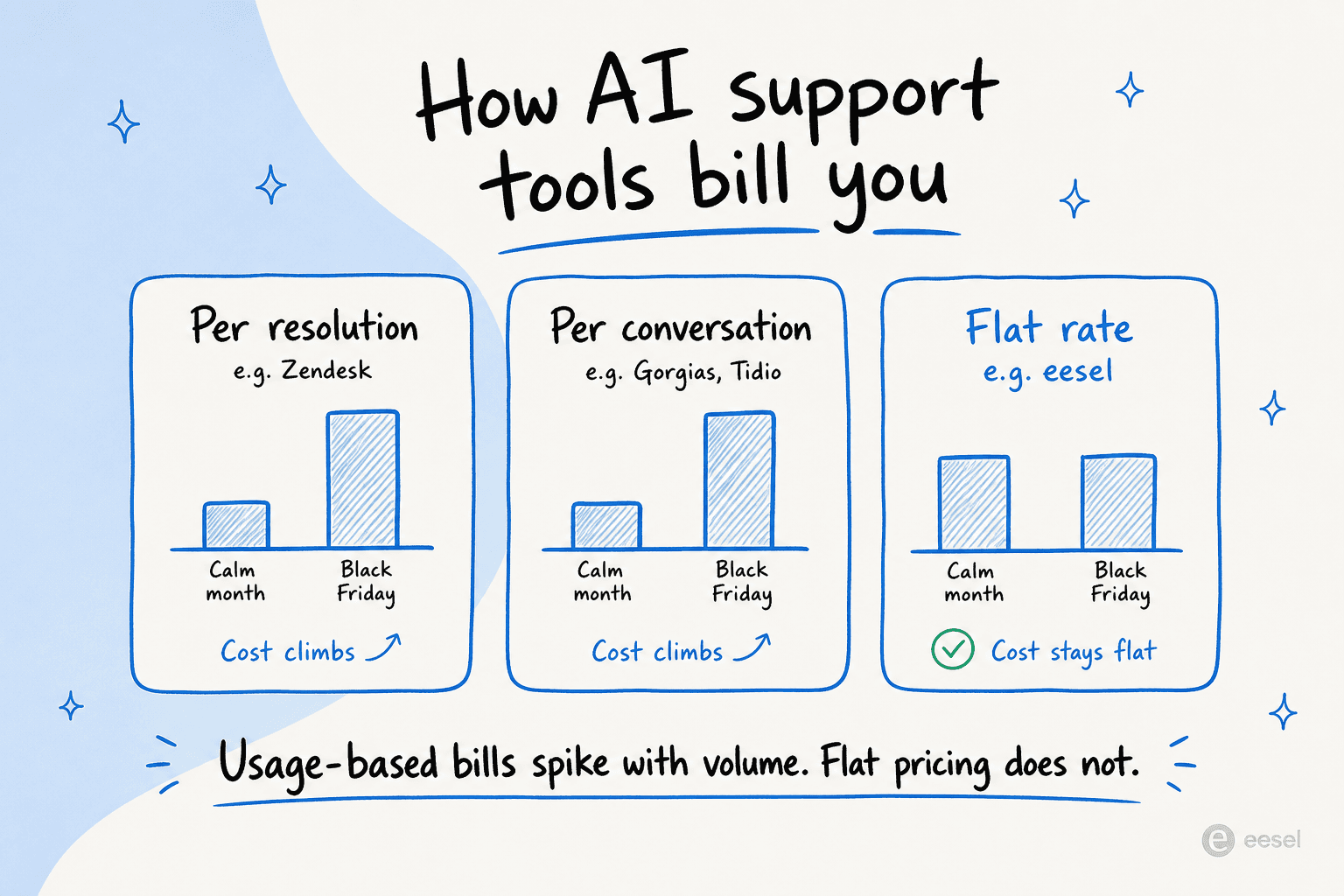
- Per resolution (Zendesk): you pay each time the AI fully solves a ticket. Sounds fair, but it quietly penalises you for better automation, the more the AI succeeds, the more you owe, and there's often no cap.
- Per conversation (Gorgias, Tidio, Re:amaze, Richpanel): you pay for any chat the AI handles. Same dynamic, scaled by volume.
- Flat monthly credits (eesel): one fixed monthly price for a set number of tickets or chats regardless of resolution rate, so your cost is predictable.
Here's where it bites. Run the numbers on a store doing 1,000 tickets a month at 80% automation: on a per-resolution model that's roughly $792/month. Now hit Black Friday and spike to 4,000 tickets at the same 80%, and the same model jumps to around $3,168/month. Your busiest, most stressful month is also your most expensive, exactly when margins are tightest. A flat monthly credit plan (on eesel, 1,000 tickets fits the $499 plan and a 4,000-ticket month fits the $1,899 plan for 5,000 credits, with no resolution-rate penalty) keeps the surprises out.
None of this means metered pricing is bad, for steady volume it's fine. But if your store is seasonal, model your peak month before you sign, not your average one. Our guide to reducing support tickets with AI and our notes on deflection rate both feed into getting that forecast right, and the customer service KPIs you should track alongside it.
Which one should you pick?
After all eight, the honest answer is that the "best" tool depends on one or two questions about your store. Here's the decision I'd actually walk through:
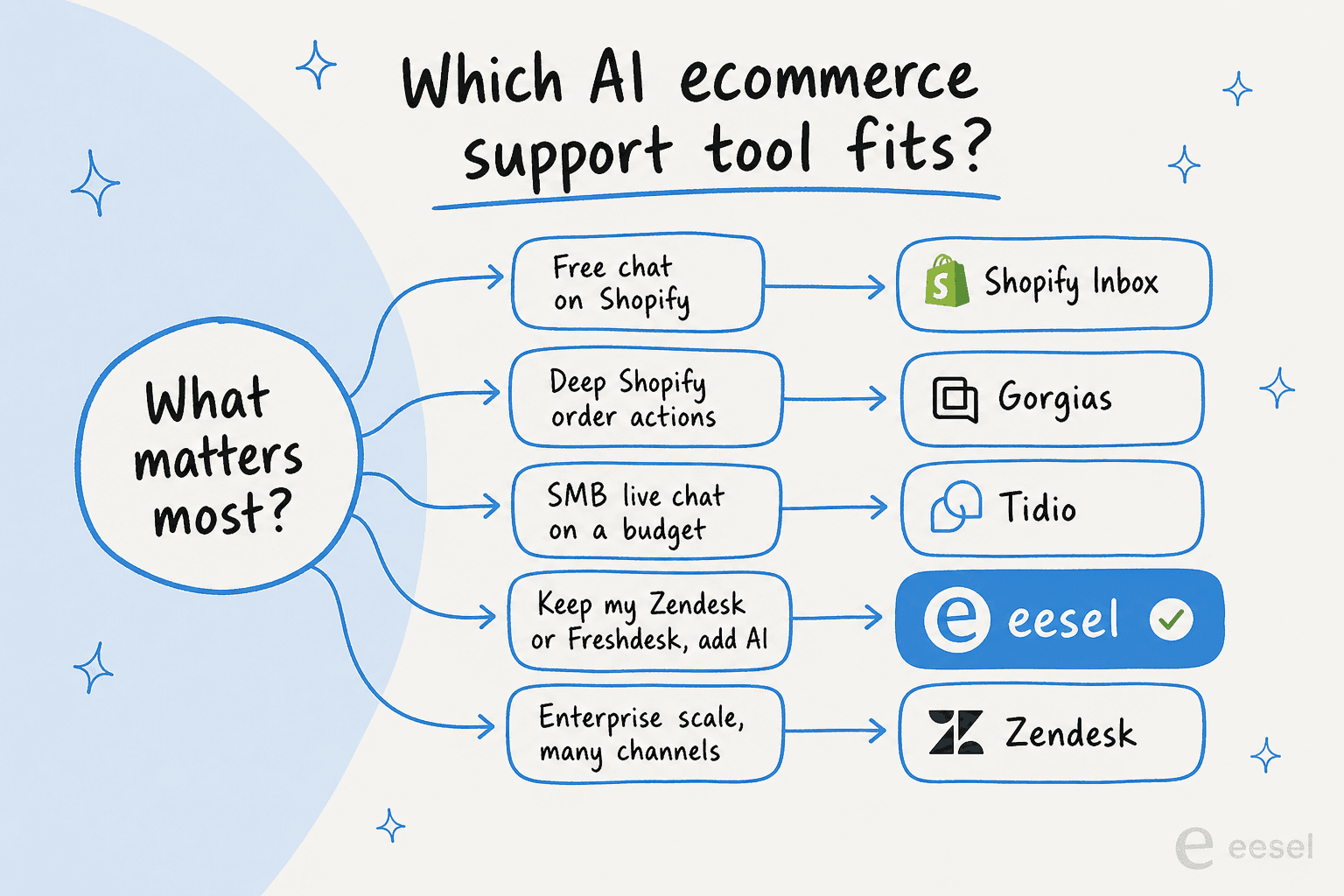
- You're tiny or just starting: Shopify Inbox (free) or Tidio's free plan.
- You're a Shopify store and 40%+ of tickets need order actions: Gorgias.
- You want chat plus AI cheaply as you grow: Tidio.
- You're enterprise with many channels and a team to run it: Zendesk or Freshdesk.
- You want a contractual resolution guarantee and you're AI-first: Richpanel.
- You already have a helpdesk and just need AI on top of it: eesel AI.
That last case is more common than the others combined, most teams I talk to don't want a new platform, they want their current one to stop drowning them. If that's you, the move is to add AI without the migration. For a broader field, our roundups of the best customer service AI and Shopify customer service apps go wider, and companies using AI for customer service shows what real deployments look like.
Try eesel AI on your ecommerce support
If your store already runs on Zendesk, Freshdesk, Gorgias, or Shopify and you just want the repetitive tickets to handle themselves, eesel AI is built for exactly that. It drops an autonomous AI teammate into the helpdesk you already use, learns your brand voice from past tickets and help docs, and connects to Shopify to answer order questions and take action, no migration, no per-seat fees.
The differentiator worth calling out: you can simulate eesel on your historical tickets to see the real resolution rate before you go live, then roll it out on a slice of volume and widen the gate as you trust it. With a fixed monthly credit plan, your bill stays predictable even when Black Friday doesn't. You can start with 100 free credits, no card required.
Frequently Asked Questions
What is the best AI customer service software for ecommerce in 2026?
How much does AI customer service software cost for an online store?
Is there free AI customer service software for ecommerce?
Do I need to replace my Shopify helpdesk to add AI customer service software?
What's the difference between per-resolution and per-conversation AI pricing?
How much of my ecommerce support can AI actually automate?


Article by
Kira
Kira is a writer at eesel AI with a Computer Science background and over a year of hands-on experience evaluating AI-powered customer service tools. She focuses on breaking down how helpdesk platforms and AI agents actually work so that support teams can make better buying decisions.