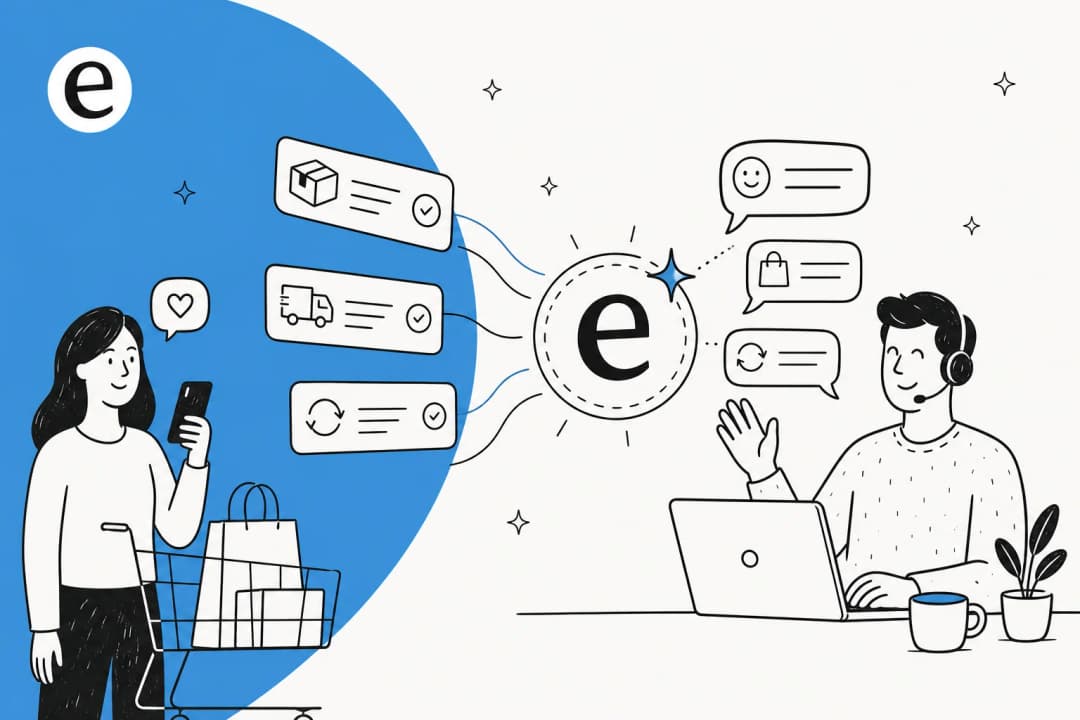
If you run an online store, you already know the feeling. It's 9 AM and your support queue's already full of the same question, asked ten different ways: "Where's my order?"
WISMO tickets (Where Is My Order) eat up 30-40% of most ecommerce support teams' time. Returns, refunds, and pre-purchase questions about sizing or availability fill up the rest. Traditional helpdesks weren't built for this. They treat a shipping question the same as a technical bug report, forcing your agents to hunt through tabs and screens just to answer something that should take seconds. It's frustrating for everyone.
AI helpdesks built for ecommerce solve this problem. These platforms understand orders, inventory, and shipping. They can look up a tracking number, process a return, or recommend a product size without human intervention.
We've tested and compared the 7 best AI helpdesks for ecommerce in 2026. Whether you're drowning in tickets or just want to give your team their time back, one of these platforms will fit your needs. For teams that don't want to migrate, eesel AI layers on top of your existing helpdesk.
What makes an AI helpdesk right for ecommerce?
Ecommerce support differs from other industries. A SaaS company's support team deals with technical issues and feature questions. An ecommerce team deals with anxious customers wondering if their package'll arrive before a birthday, or frustrated shoppers who ordered the wrong size.
Here's what actually matters for ecommerce AI helpdesks:
-
Deep store integration. The AI needs to pull real-time order data, inventory levels, and shipping status. Without this, it's just guessing.
-
WISMO automation. "Where's my order?" is the most common question. The best platforms handle this completely autonomously.
-
Returns and refund handling. Processing returns shouldn't require a human until there's an edge case.
-
Pre-purchase support. Shoppers ask about sizing, fit, availability, and recommendations before buying. Good AI can convert these conversations into sales.
-
Multichannel coverage. Email, live chat, Instagram DMs, WhatsApp. Customers reach out everywhere.
There's also the migration problem. Most stores already have a helpdesk. Switching is painful: data migration, retraining agents, workflow rebuilds. Some AI solutions require you to rip everything out and start over. Others, like eesel AI, layer on top of what you already use.
Quick comparison: 7 AI helpdesks at a glance
| Platform | Best for | Starting price | Key AI feature | Setup time | Shopify depth |
|---|---|---|---|---|---|
| eesel AI | Adding AI without migration | $299/mo | Simulation mode on past tickets | Minutes | Deep |
| Gorgias | Shopify-native stores | $60/mo | Pre + post-purchase AI agents | Easy | Native |
| Zendesk | Enterprise scale | $55/agent/mo | Pre-trained AI across sectors | Weeks | Via apps |
| DigitalGenius | Complex workflows | Custom | Real actions (refunds, warranties) | 1-2 days | Deep |
| Freshdesk | Budget-conscious SMBs | Free, then $18/agent/mo | Freddy AI assistant | Days | Via apps |
| Yuma.ai | Fast Shopify setup | Custom | Fact Snippets for accuracy | Hours | Primary focus |
| Zowie | High-volume enterprises | Custom | Hallucination-free engine | 3-5x faster | Deep |
The 7 best AI helpdesks for ecommerce
1. eesel AI
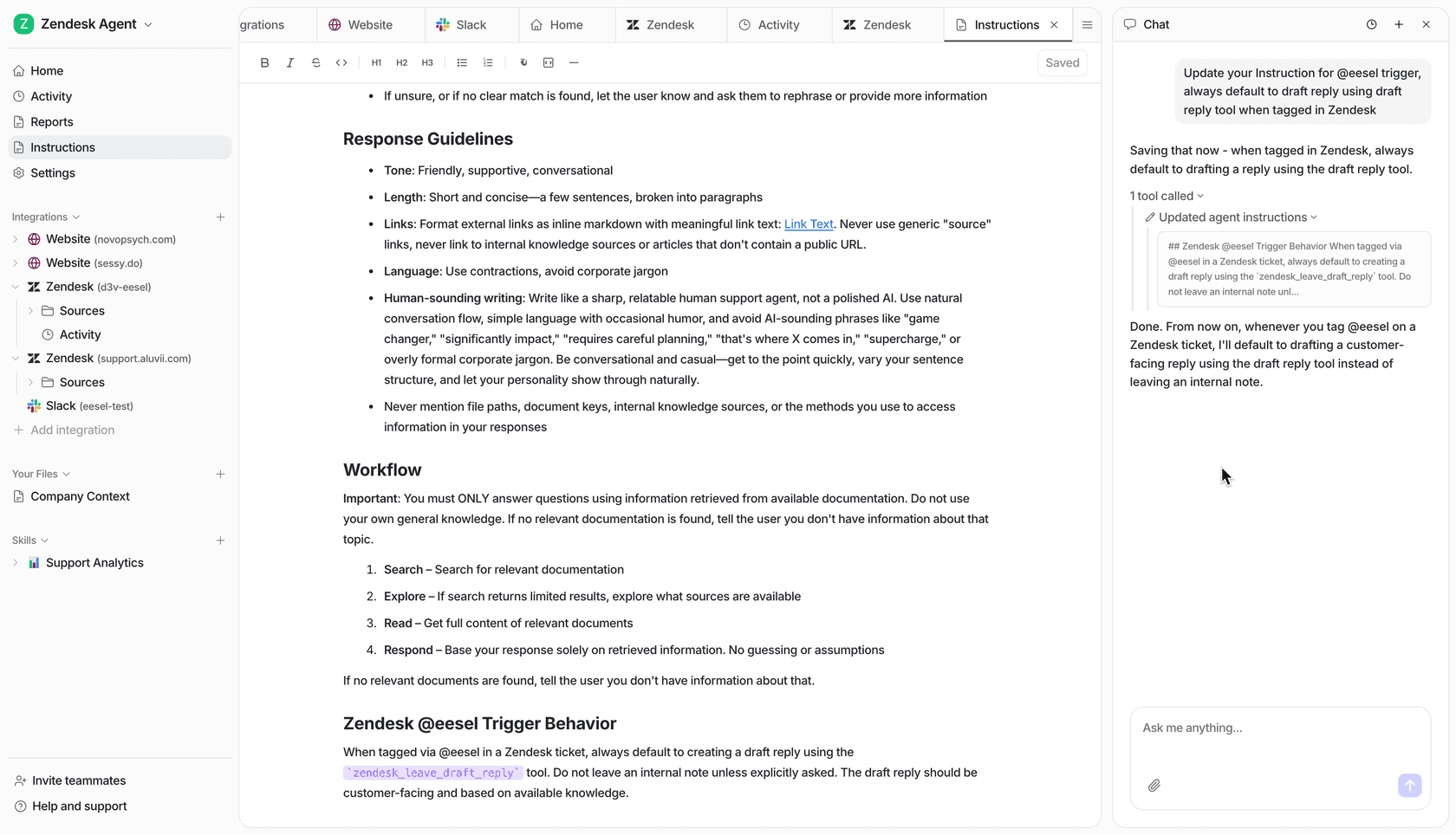
Here's the problem with most AI helpdesks: they want you to switch everything. New platform, new workflows, weeks of migration. For a busy ecommerce team, that's a non-starter.
eesel AI takes a different approach. It's an AI layer that sits on top of your existing helpdesk (Zendesk, Gorgias, Freshdesk, and others). You connect it in minutes, it learns from your past tickets and help center, and starts helping immediately. No migration, no disruption.
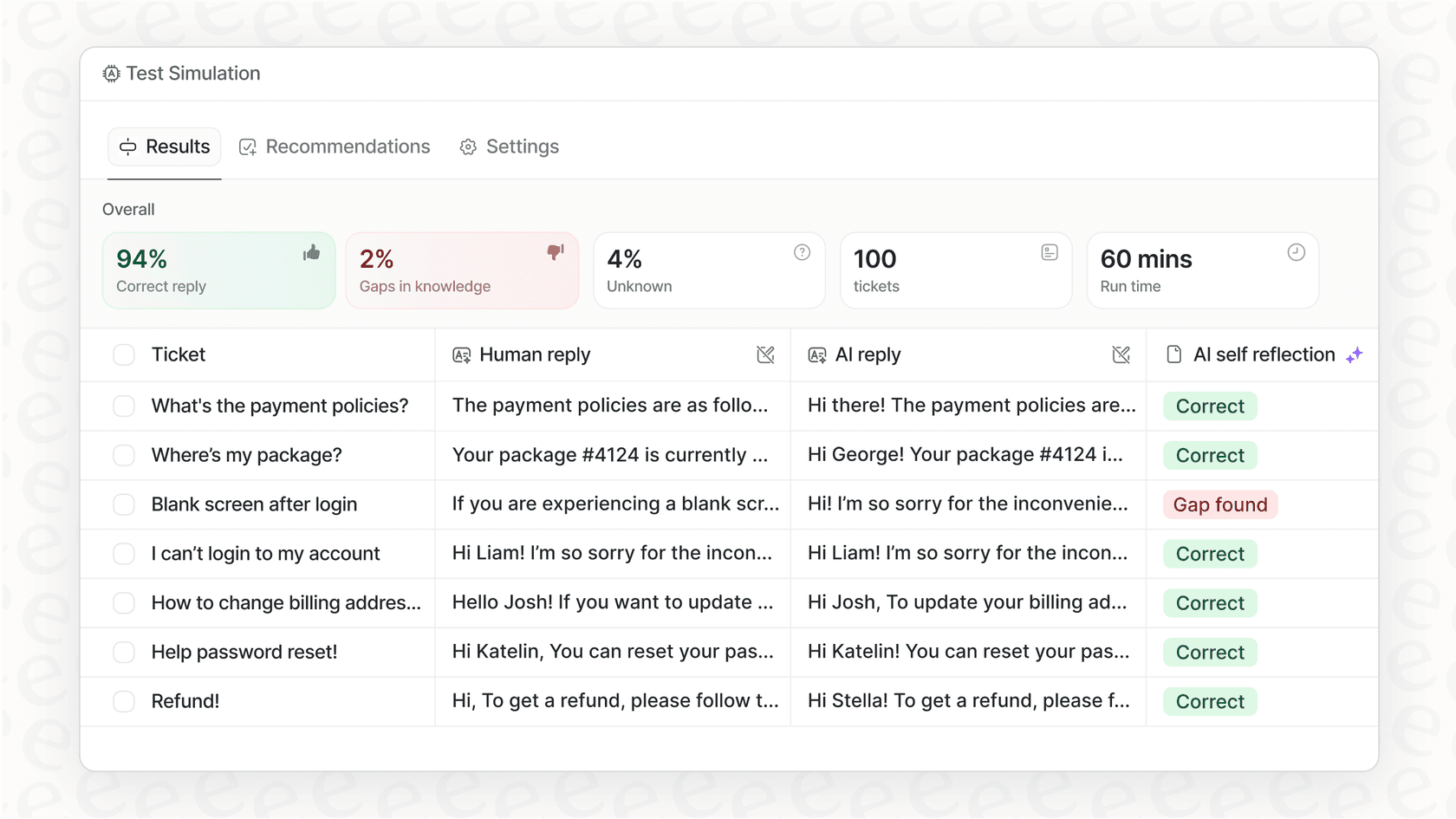
The standout feature is simulation mode. Before the AI ever talks to a real customer, you can run it against thousands of your past tickets. You'll see exactly how it would've responded, what percentage it could've resolved, and what your cost savings would look like. It's a risk-free way to prove value before going live.
Key features:
- One-click helpdesk connection
- Trains automatically on past tickets, macros, and connected docs (Confluence, Google Docs, Notion)
- AI Agent for autonomous resolution, AI Copilot for draft suggestions, AI Triage for auto-tagging and routing
- Plain-English escalation rules ("Always escalate billing disputes to a human")
- Deep Shopify integration for order lookups, refunds, and returns
Pricing:
| Plan | Monthly price | Annual price | What's included |
|---|---|---|---|
| Team | $299/mo | $239/mo | 3 bots, 1,000 interactions, Copilot, Slack |
| Business | $799/mo | $639/mo | Unlimited bots, 3,000 interactions, AI Actions, EU data residency |
| Custom | Contact sales | Custom | Unlimited everything, multi-agent orchestration |
Pros: No migration required, minutes to setup, risk-free simulation, transparent flat pricing
Cons: Requires an existing helpdesk (not a standalone solution)
Best for: Teams happy with their current helpdesk but wanting powerful AI capabilities without the pain of switching
2. Gorgias
Gorgias has built its entire brand around ecommerce, and it shows. With over 16,000 Shopify merchants using the platform, it's arguably the most Shopify-native helpdesk available.
The platform splits its AI into two agents: a Shopping Assistant for pre-purchase questions and a Support Agent for post-purchase issues. This separation makes sense. Someone asking about sizing needs different handling than someone requesting a refund.
Gorgias claims to automate 60% or more of common support tasks like returns, subscriptions, and order tracking. That's substantial time savings for busy teams. The deep Shopify integration means customer data, order history, and inventory levels're instantly available in every conversation.
Key features:
- Native Shopify, Magento, and BigCommerce integration
- AI Agent for pre-purchase (Shopping Assistant) and post-purchase (Support Agent)
- Unified inbox for email, chat, social, and SMS
- Real-time order data from Shopify and Stripe
- Intent detection for automatic routing
Pricing:
Starts at $60/mo for basic ticketing. Advanced AI and automation features are available in higher tiers. Pricing scales with ticket volume.
Pros: Purpose-built for ecommerce, deep Shopify connection, unified multichannel inbox, extensive macros and rules
Cons: Gets expensive at scale, complex rules can be tricky to set up, lacks some basic notification features
Best for: Shopify stores wanting an all-in-one helpdesk and AI solution without cobbling together multiple tools
3. Zendesk
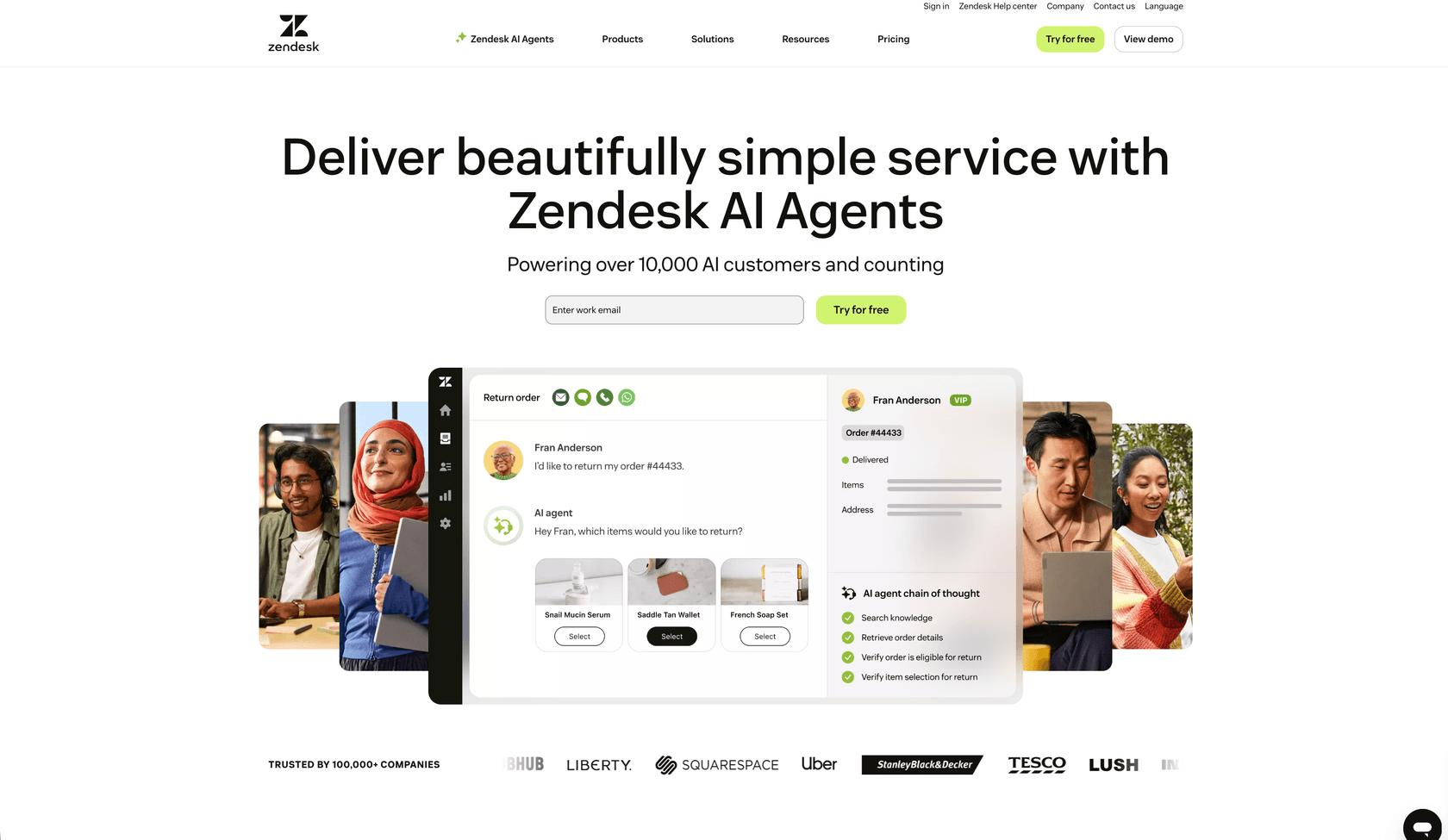
Zendesk is the established leader in customer service software. With over 200,000 companies using the platform, it's the safe, proven choice for enterprises that can't afford to get this wrong.
The platform's AI capabilities come from both internal development and the acquisition of Ultimate.ai. Zendesk AI Agents are pre-trained across multiple sectors including retail, financial services, insurance, and travel. You can also add custom intents for your specific business needs.
Zendesk excels at scale and ecosystem. The app marketplace has over 1,000 integrations. The platform includes quality assurance tools, workforce management, and advanced analytics that smaller platforms can't match.
Key features:
- Pre-trained AI across multiple industries
- Custom intent creation
- Omnichannel support (chat, email, voice)
- Massive app marketplace
- Built-in QA and workforce management
Pricing:
| Plan | Monthly price | Key features |
|---|---|---|
| Suite Team | $55/agent/mo | Basic tools, ticketing, messaging |
| Suite Growth | $89/agent/mo | Automation, multilingual support |
| Suite Professional | $115/agent/mo | Analytics, smart routing |
| Suite Enterprise | Custom | Premium support, custom roles |
AI add-on: $50/agent/mo additional
Pros: Proven at enterprise scale, highly customizable, extensive integration ecosystem, comprehensive feature set
Cons: Per-agent pricing adds up quickly, complex setup and configuration, requires training to use effectively
Best for: Large enterprises with complex workflows, multiple brands, or strict compliance requirements
4. DigitalGenius
DigitalGenius has been doing ecommerce AI since 2019, before ChatGPT existed. That experience shows in their approach: they combine LLM agents with structured workflows they call "Genius Flows."
The key differentiator is actionability. Most AI helpdesks can tell a customer how to return an item. DigitalGenius can actually process the return, issue the refund, and create the shipping label. This extends to warranty claims, replacement orders, and carrier escalation for lost packages. That's real automation, not just chat.
The platform offers five products: Care AI for post-purchase support, Purchase AI for recommendations, Proactive AI for outbound alerts, Voice AI for phone calls, and Insights AI for analytics.
Key features:
- Genius Flows: out-of-box workflows for WISMO, returns, and common requests
- Hybrid AI: LLM agents plus structured workflows for reliability
- Real actions: refunds, warranties, replacements without human intervention
- Deep integrations: Shopify, BigCommerce, WooCommerce, Magento, Salesforce
- Free custom integrations for new platforms
Pricing:
Custom pricing (contact sales). Enterprise-focused.
Pros: Deep ecommerce expertise since 2019, handles complex workflows end-to-end, can take real actions not just provide answers, free custom integrations
Cons: Pricing not transparent, may be overkill for smaller stores, enterprise sales process
Best for: Mid-market to enterprise ecommerce brands with complex support needs and high ticket volumes
5. Freshdesk
Freshdesk is the pragmatic choice for smaller teams that need solid AI capabilities without enterprise complexity or pricing. It's part of the Freshworks ecosystem, which means it plays nicely with their CRM and other tools.
The platform includes Freddy AI, which assists with ticket routing, response suggestions, and automation. While not as advanced as some competitors, it covers the basics well: automatic categorization, priority setting, and agent assistance. It's a solid starting point.
The free plan (up to 10 agents) is genuinely useful, not just a teaser. For growing teams, the Growth plan at $15/agent/mo (annual) offers solid value.
Key features:
- Freddy AI assistant for routing and suggestions
- Omnichannel support (email, chat, phone, social, WhatsApp)
- Workflow automation and rules
- Knowledge base and self-service portal
- Team collaboration tools
Pricing:
| Plan | Monthly price | Annual price | Key features |
|---|---|---|---|
| Free | $0 | $0 | Limited features, up to 10 agents |
| Growth | $18/agent/mo | $15/agent/mo | Automation, custom fields, SLAs |
| Pro | $59/agent/mo | $49/agent/mo | Advanced AI, custom roles |
| Enterprise | $95/agent/mo | $79/agent/mo | Sandbox, advanced security |
Pros: Free plan available, affordable entry point, easy setup, good feature set for the price
Cons: AI capabilities less advanced than competitors, per-agent pricing still applies, not purpose-built for ecommerce
Best for: Small to mid-size businesses on a budget who want AI assistance without breaking the bank
6. Yuma.ai
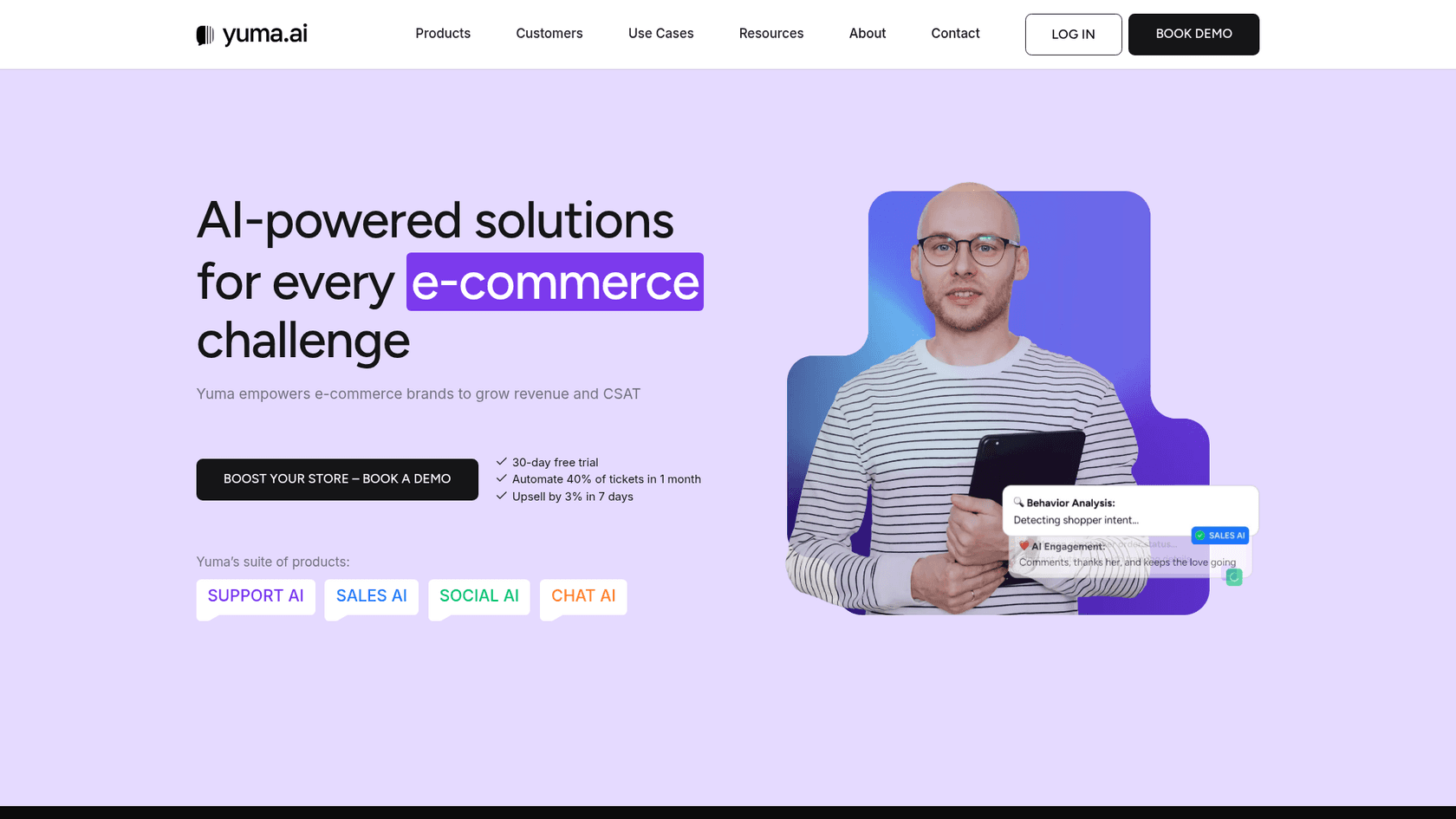
Yuma.ai started in 2022 as a support app for Gorgias, then expanded into a full platform. That heritage shows: it understands ecommerce workflows and integrates tightly with Shopify, Gorgias, and Zendesk. For teams already using those platforms, setup is straightforward.
The platform's standout feature is Fact Snippets. Instead of generating responses from scratch, Yuma can insert verified information verbatim into replies. This reduces hallucinations and keeps messaging consistent with your policies.
Yuma offers four products: Support AI, Sales AI, Social AI, and Chat AI. The company targets 60%+ true automation rates and emphasizes quick setup.
Key features:
- Fact Snippets for accurate, consistent responses
- Auto-Pilots that follow your standard operating procedures
- Support, Sales, Social, and Chat AI modules
- Quick setup process
- Shopify, Gorgias, and Zendesk integrations
Pricing:
Custom pricing (contact sales). Tailored to ecommerce volume.
Pros: Fast setup, Fact Snippets improve accuracy, good for Shopify stores, consistent messaging
Cons: Limited ecommerce platform support (mainly Shopify), pricing not transparent, newer platform with less track record
Best for: Shopify brands using Gorgias or Zendesk who want fast implementation and consistent AI responses
7. Zowie
Zowie is built for enterprises that can't afford AI hallucinations. Their proprietary "deterministic decision engine" promises accurate, consistent outcomes every time. No unpredictable responses, no made-up answers.
The platform goes live 3-5x faster than traditional AI vendors, according to their claims. They assign a dedicated technical account manager to handle deployment.
Beyond support, Zowie includes revenue optimization features. The AI can identify upsell opportunities and drive conversions within service conversations. Their customer list includes Decathlon, Monos, and Booksy.
Key features:
- Deterministic decision engine (hallucination-free)
- End-to-end workflow automation including returns and refunds
- Multichannel: chat, email, voice, SMS
- Revenue optimization and sales capabilities
- SOC 2 Type II certified
Pricing:
Per-conversation pricing (contact for quote). Enterprise-focused.
Pros: Guaranteed accuracy with deterministic engine, fast deployment with dedicated support, handles complex workflows reliably, enterprise security certifications
Cons: Enterprise-focused with opaque pricing, may be excessive for smaller teams, requires sales process
Best for: High-volume enterprises that need reliable autonomous resolution and can't risk AI mistakes
How to choose the right AI helpdesk for your store
Let's make this simple. The right choice depends on your situation:
Do you like your current helpdesk? Don't switch. Add eesel AI on top and get powerful AI without the migration headache.
Are you on Shopify and need an all-in-one? Gorgias is purpose-built for Shopify stores and handles both pre-purchase and post-purchase support.
Are you an enterprise with complex needs? Zendesk or DigitalGenius offer the scale and customization you need. Zendesk for breadth, DigitalGenius for deep ecommerce actions.
Are you budget-conscious or just starting? Freshdesk has a genuinely free plan and affordable paid tiers.
Do you need guaranteed accuracy? Zowie's deterministic engine eliminates hallucinations entirely.
Do you need to go live fast? Yuma.ai and eesel AI both offer setup in hours, not weeks.
Consider your ticket volume too. Per-agent pricing (Zendesk, Freshdesk) scales linearly with team size. Flat pricing (eesel AI) or per-conversation pricing (Zowie, DigitalGenius) might save money as you grow.
Upgrade your ecommerce support with AI today
AI helpdesks have moved from "nice to have" to essential for competitive ecommerce. The stores winning at customer service aren't hiring more agents. They're using AI to handle routine questions instantly while their human team focuses on complex issues and building relationships.
The key is choosing a platform that fits your current setup and growth plans. If you're happy with your helpdesk but want AI capabilities, we built eesel AI specifically for you. No migration, no disruption, no months-long implementation. Just connect your helpdesk, run the simulation on your past tickets, and start saving hours every day.
Ready to see what AI can do for your support team? Try eesel AI free or book a demo to see it work on your actual tickets.