


Why Shopify stores start looking past Gorgias
Let me be fair to Gorgias first, because it earned its place. It is an ecommerce-native helpdesk built around a deep Shopify integration: order data, refunds, cancellations, and subscriptions all live right inside the ticket, and it unifies email, chat, SMS, and social into one inbox. Gorgias says it powers support for 40% of Shopify brands, and that is not marketing fluff, the product really is shaped for Shopify.
So why the search for an alternative? I spend my days mapping what Shopify merchants actually type into Google to what these tools actually do under the hood, and the gap shows up in one place over and over: pricing that punishes you for growing, not for hiring.
Here is the thing I keep coming back to. At eesel, we have spent the last few years putting AI agents on live support queues, and one pattern from our own sales calls has stuck with me. A Shopify merchant ran a Gorgias trial, watched the AI agent handle twelve test chats well, was impressed, and then opened the billing page. The next message was, more or less, "please cancel my subscription." The product worked. The pricing model is what lost them.
That is the visceral version. The structural version is the billing unit. Gorgias bills per ticket, and its AI Agent is a separate metered charge of $0.90-$1.00 per resolved conversation, where each AI resolution also counts as a billable helpdesk ticket. So a resolution can get counted twice. As one Shopify merchant put it on Reddit:
"The downside is that costs can rise as you scale even if many enquiries are simple or repetitive. For a small team it might feel like you are paying too much for features you don't use."

To put real numbers on it: an eesel cost analysis of a typical store handling 1,000 tickets a month at an 80% resolution rate landed at roughly $792/month on per-resolution pricing. Scale that to a 4,000-ticket Black Friday and it jumps to about $3,168/month, even though a flat-rate model for the same volume stays fixed. (Worth asking any vendor: does your "resolution rate" count auto-closed spam? In that same analysis, 22% of the inbox was spam.)
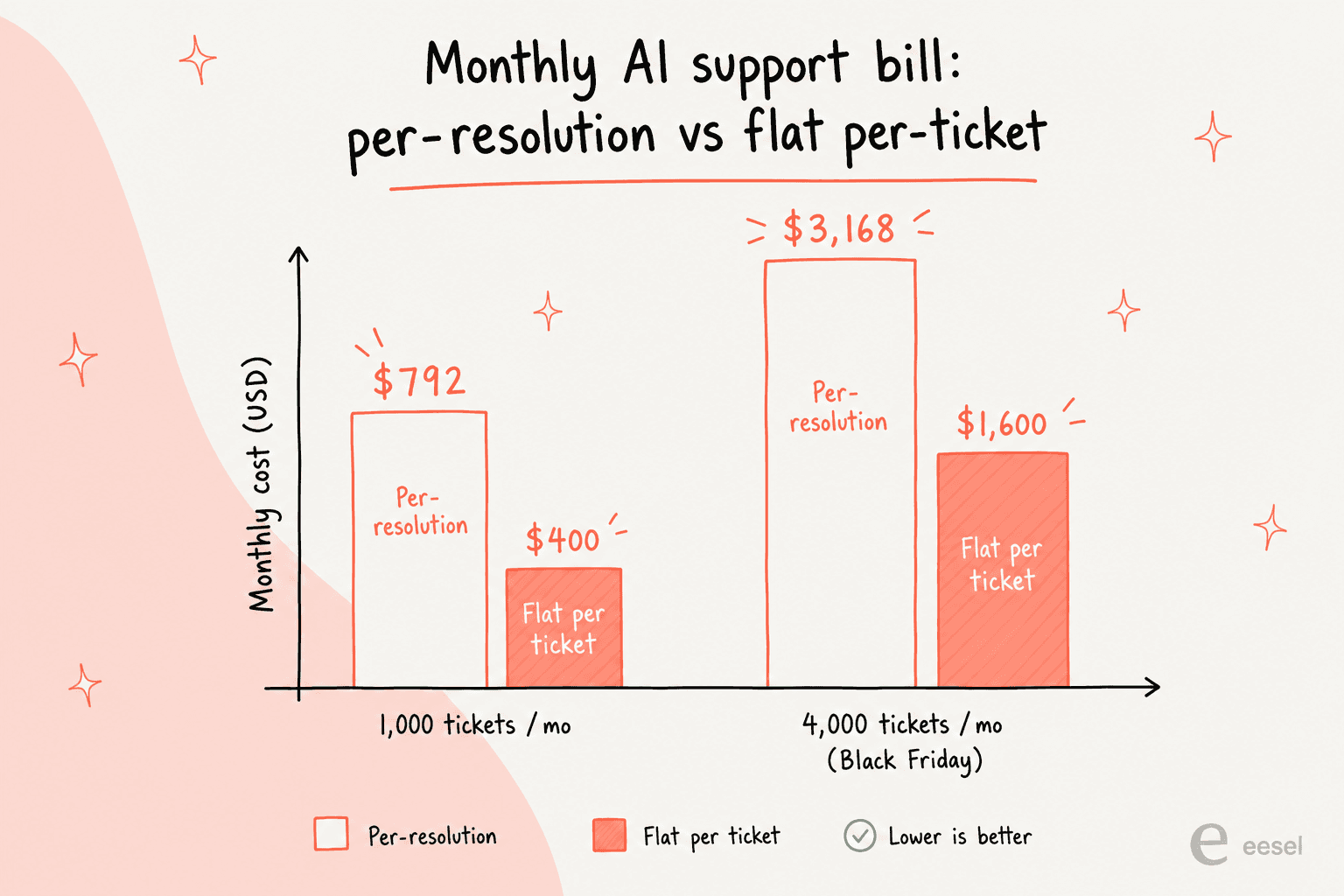
None of this makes Gorgias a bad product. It makes it a product whose pricing model rewards low volume and punishes the seasonal spikes that ecommerce lives on. If that is the wall you have hit, here is where to look next.
How I picked these (and what to actually compare)
A quick note on method, so the verdicts below have a basis. I worked from each vendor's own pricing and docs, real Shopify App Store and Reddit feedback, and our own experience running AI agents on live ecommerce queues. I am writing in eesel's voice, so I will be upfront when eesel is the answer, and equally upfront about where another tool fits your store better.
The single most important thing to compare is the billable unit, because it is where the surprise hides. These four words look interchangeable and absolutely are not:
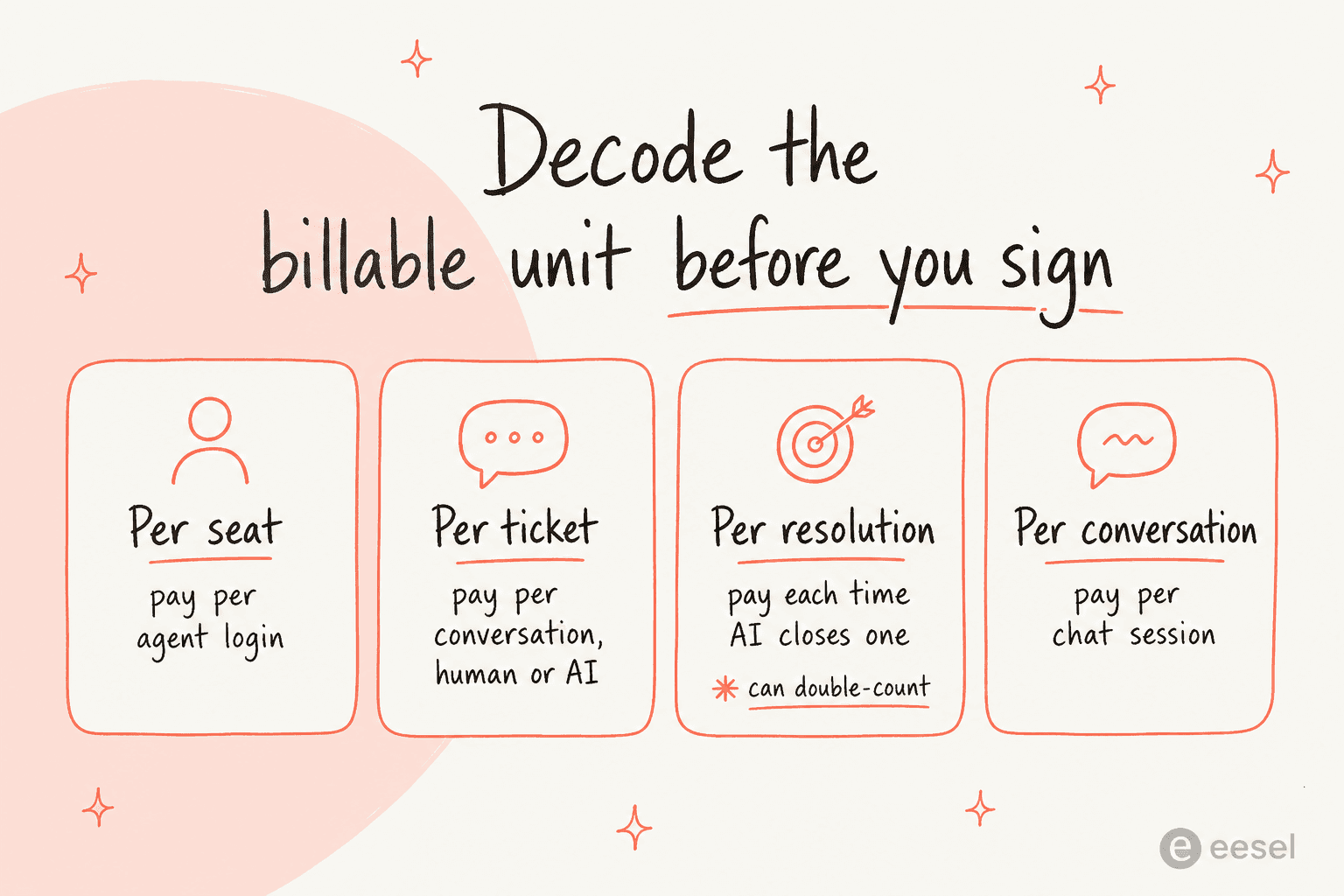
- Per seat: you pay per agent login. Predictable, but you pay even when agents are idle.
- Per ticket: you pay per conversation, whether a human or the AI handles it. Scales with volume.
- Per resolution: you pay every time the AI closes a conversation. Sounds fair, but it means a higher deflection rate costs you more, and some tools double-count the resolution as a ticket too.
- Per conversation: you pay per chat session. Multi-turn chats can rack up fast.
The second thing to compare is Shopify depth, can the AI actually look up an order and process a refund, or does it just answer FAQs? And the third is whether you can test the AI against your real history before you commit. With that lens, here is the lineup.
The best Gorgias alternatives for Shopify at a glance
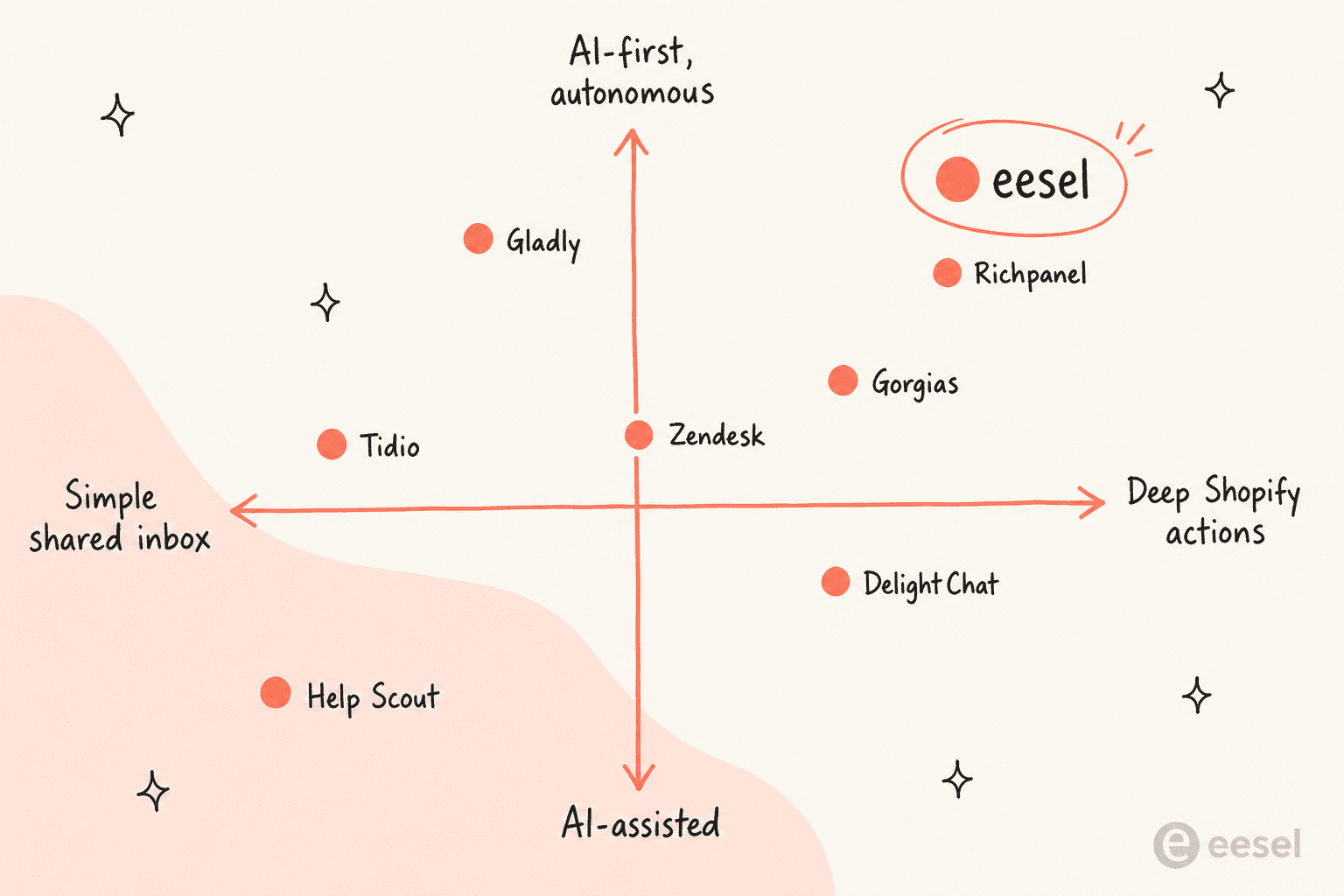
| Tool | Best for | AI billing model | Starting price | Shopify actions | Free trial |
|---|---|---|---|---|---|
| eesel AI | Flat-rate AI on your existing helpdesk | Flat per ticket ($0.40), no per-resolution fee | Pay-as-you-go, no platform fee | Yes (orders, lookups, actions) | $50 free usage |
| Re:amaze | Multi-channel chat at a flat seat price | Bundled resolutions/seat, then $0.85 each | $29/seat/mo | Order context in ticket | 14 days |
| Richpanel | An AI "support team" with a guarantee | $0.25 per conversation | $500/mo base + seats | Yes (returns, subscriptions) | Demo / Shopify trial |
| Gladly | Premium, high-LTV retail brands | $1.50 per AI resolution | ~$120/seat/mo (Shopify) | Yes (orders, returns) | 30-day Shopify trial |
| Zendesk | Mature, do-everything platform | ~$1.20-$1.50 per resolution | $19/agent/mo (no AI) | Via app marketplace | 14 days |
| Help Scout | Simple shared inbox, small teams | $0.75 per resolution | $25/user/mo | Limited (no native actions) | Free plan |
| Tidio | Live chat + AI bot for SMBs | ~$0.50 per Lyro conversation | $24.17/mo | Order tracking, cart recovery | 7 days |
| DelightChat | WhatsApp-first D2C brands | AI assist add-on (token-based) | $29/mo | Yes (view/modify orders) | 14 days |
Prices are starting points pulled from each vendor's pricing page; model your real volume before committing. Now the detail.
1. eesel AI
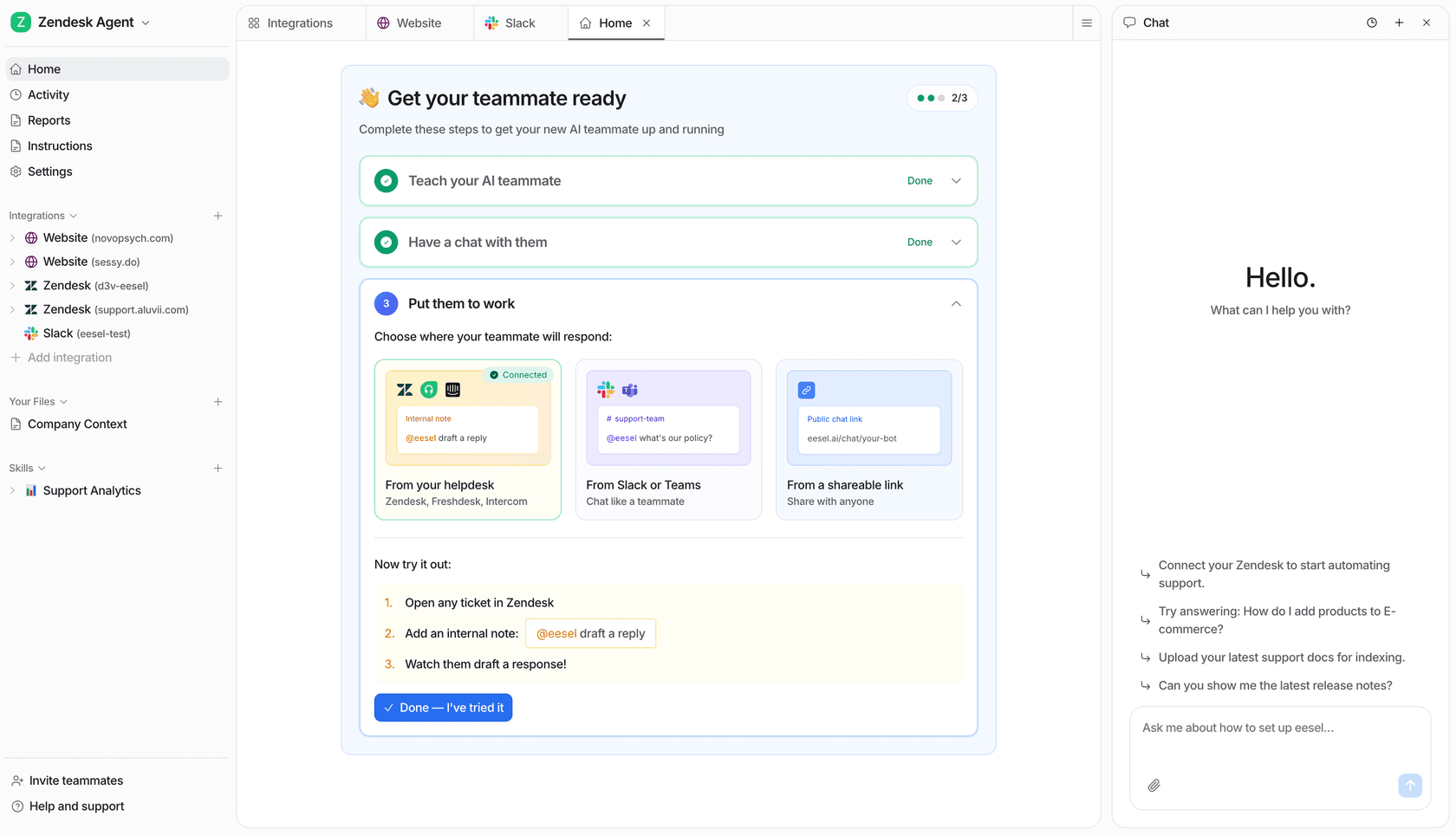
Best for: Shopify stores that want real AI deflection without per-resolution billing, layered on top of the helpdesk they already use.
I will start with us, and then earn it. eesel AI is an AI teammate that plugs into your existing stack, Gorgias, Shopify, Zendesk, Front, email, and learns from your past tickets and help docs on day one. Instead of forcing you to rip out your helpdesk, it sits on top of it and starts drafting and resolving tier-1 tickets (WISMO, returns, order edits) inside the inbox your team already lives in.
The reason it leads a Gorgias-alternatives list is the billing model. eesel charges a flat $0.40 per ticket, with no per-resolution fee, no per-seat fee, and no platform minimum. A high-deflection month does not spike the bill, which is the exact opposite of the trap merchants describe with per-resolution pricing.
There is a real story behind why we built it this way. An ops lead at a DTC supplements brand running about 7,000 Gorgias tickets a month told us their team simply couldn't keep up, and they were clear about what they needed: "I need an AI who is only handling the tickets that it's confident to handle, and all the other ones, leave them alone." That is why eesel uses confidence-based routing, low-confidence tickets get drafted for a human instead of getting a risky auto-reply.
Pros:
- Flat $0.40 per ticket, no per-resolution charge and no per-seat fee, so deflection never costs you more.
- Simulation mode runs the AI against your past tickets so you can see coverage and gaps before it goes live, no blind launch.
- Works on top of your current helpdesk and 100+ integrations (Gorgias, Shopify, Zendesk, Freshdesk), so there is no migration project.
Cons:
- It is an AI layer, not a full replacement helpdesk UI, if you want one tool to be your inbox and your AI, a native helpdesk may suit better.
- Usage-based pricing means very spiky volume needs a quick model to forecast (the pricing page and a simulation make this easy, but it is a step).
- Newer brand than the incumbents on this list, so it shows up less in legacy "best helpdesk" roundups.
Pricing: Pay-as-you-go at $0.40 per ticket (one ticket or one chat session = one task, regardless of message count). A free trial gives you $50 of usage with no credit card. Annual commitments of $300/month or more get 25% off, and there is a $1,000/month Enterprise tier for SSO, HIPAA, and a dedicated engineer. You are never billed for tickets your humans handle.
For proof it works in the wild: Kim Simpson at Gridwise told us "in the first month, eesel is resolving 73% of our tier-1 requests," with results showing up during the 7-day trial.
Verdict: If your reason for leaving Gorgias is the bill, this is the most direct fix, you keep your helpdesk and swap the expensive AI for a flat-rate one. Skip it only if you specifically want a brand-new all-in-one inbox rather than an AI layer on your current one.
2. Re:amaze
Best for: Small-to-mid Shopify teams that want live chat, chatbots, and proactive messaging bundled at a flat per-seat price.
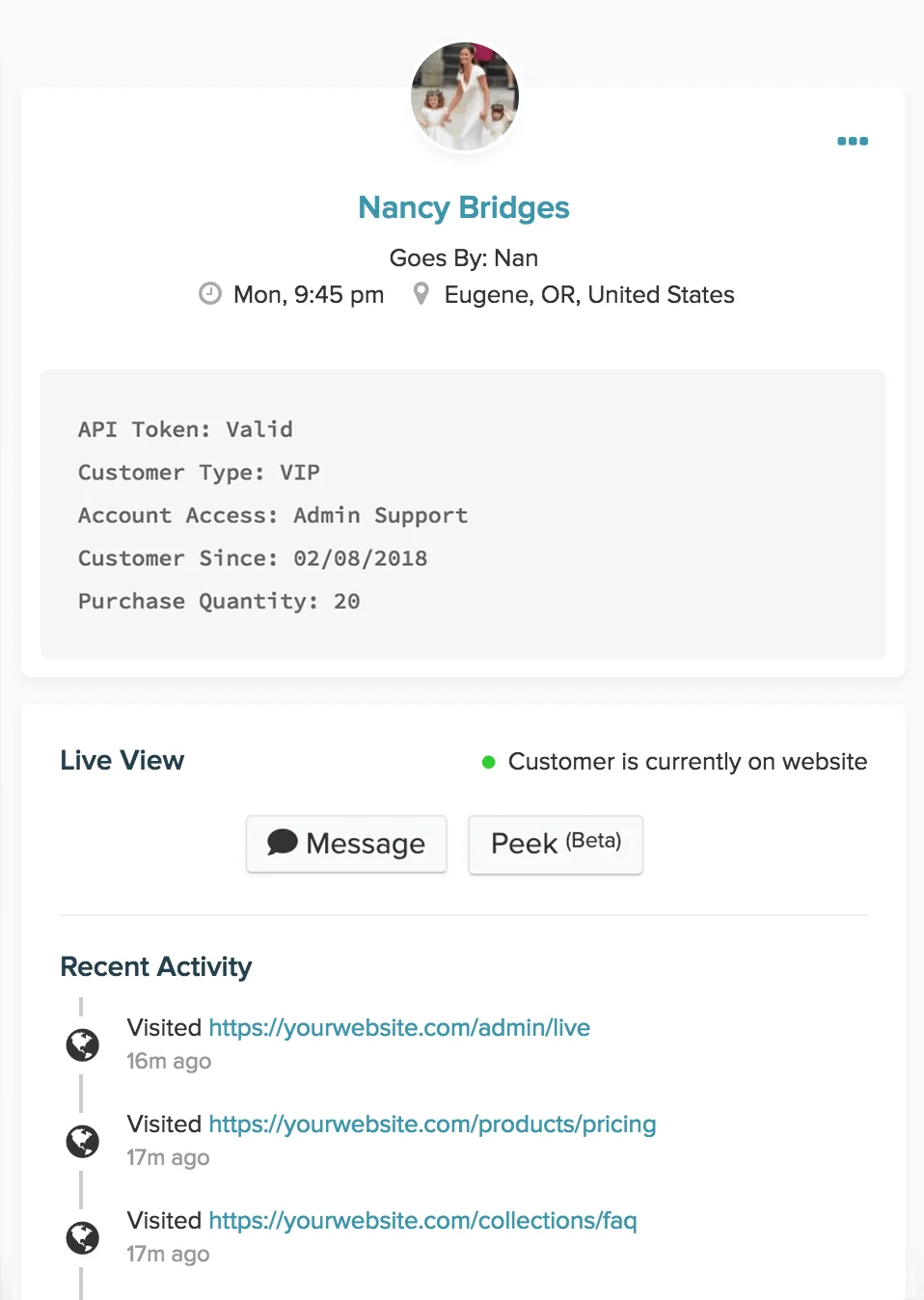
Re:amaze (owned by GoDaddy since 2021) is a unified support inbox for ecommerce and SaaS, email, chat, social, SMS, even VoIP and video, with an unusually useful Live Dashboard that shows what a shopper is browsing right now so you can reach out mid-purchase. Order context lives inside the conversation, so agents can see order history without leaving the thread.
Pros:
- Order details surface right in the conversation, strong native ecommerce fit for Shopify stores.
- Real-time Live View plus one-click "Peek" co-browsing makes proactive outreach easy.
- Team-friendly entry price: a $59 flat Starter tier covers unlimited seats (capped at 500 conversations), good for low-volume stores with many casual responders.
Cons:
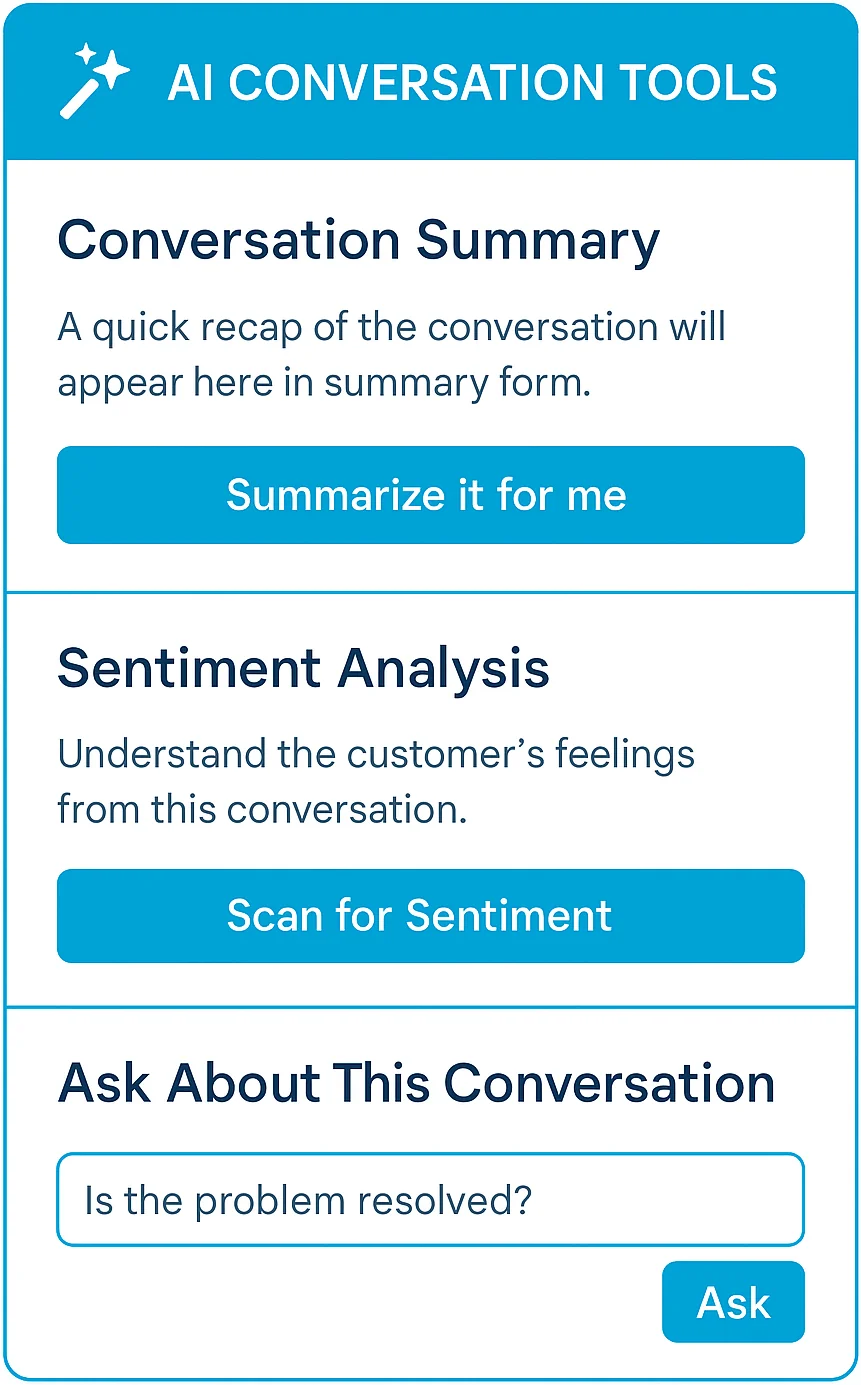
- The AI is metered and stingy, only 5/10/20 AI resolutions per user per month before $0.85 each kicks in, so heavy automation gets pricey.
- The AI Agent is still labelled Beta and feels like a bolt-on rather than an autonomous resolver.
- The best engagement features (Peek, video, departments, CSAT) are locked to the higher $69 Plus tier.
Pricing: Basic $29/seat/mo, Pro $49, Plus $69 (most popular), or the $59 flat Starter (unlimited seats, 500-conversation cap). Billing is per member except for the flat Starter. 10% off annual, 14-day trial, no credit card.
Verdict: Pick Re:amaze if you want chat plus proactive engagement and order context at an affordable seat price. Skip it if AI deflection volume is your priority, its metered Beta AI undercuts the value against an AI-first agent.
3. Richpanel
Best for: Shopify merchants who want to "hire" an AI support team that resolves order, return, and refund tickets end-to-end, with a money-back resolution guarantee.
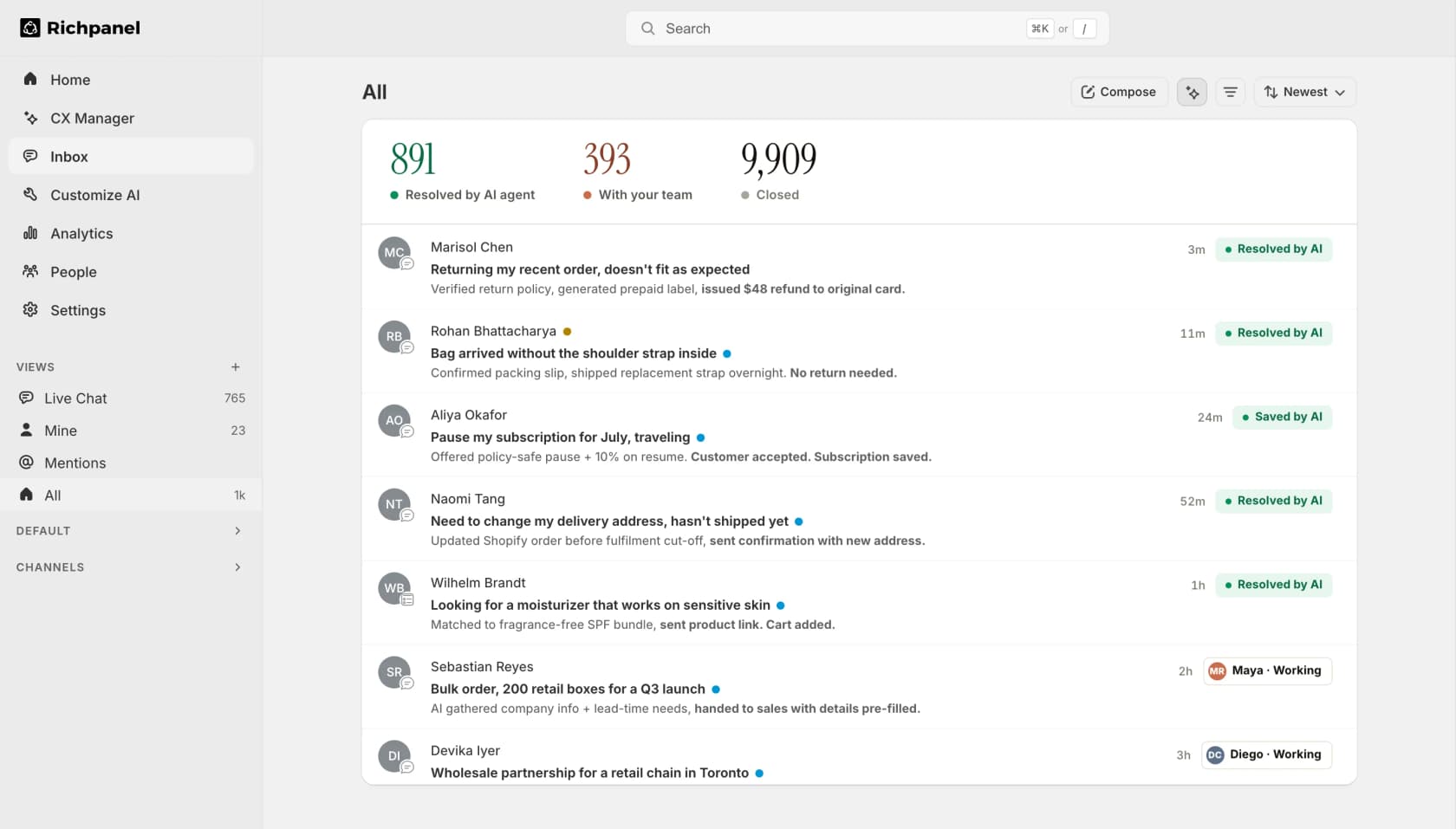
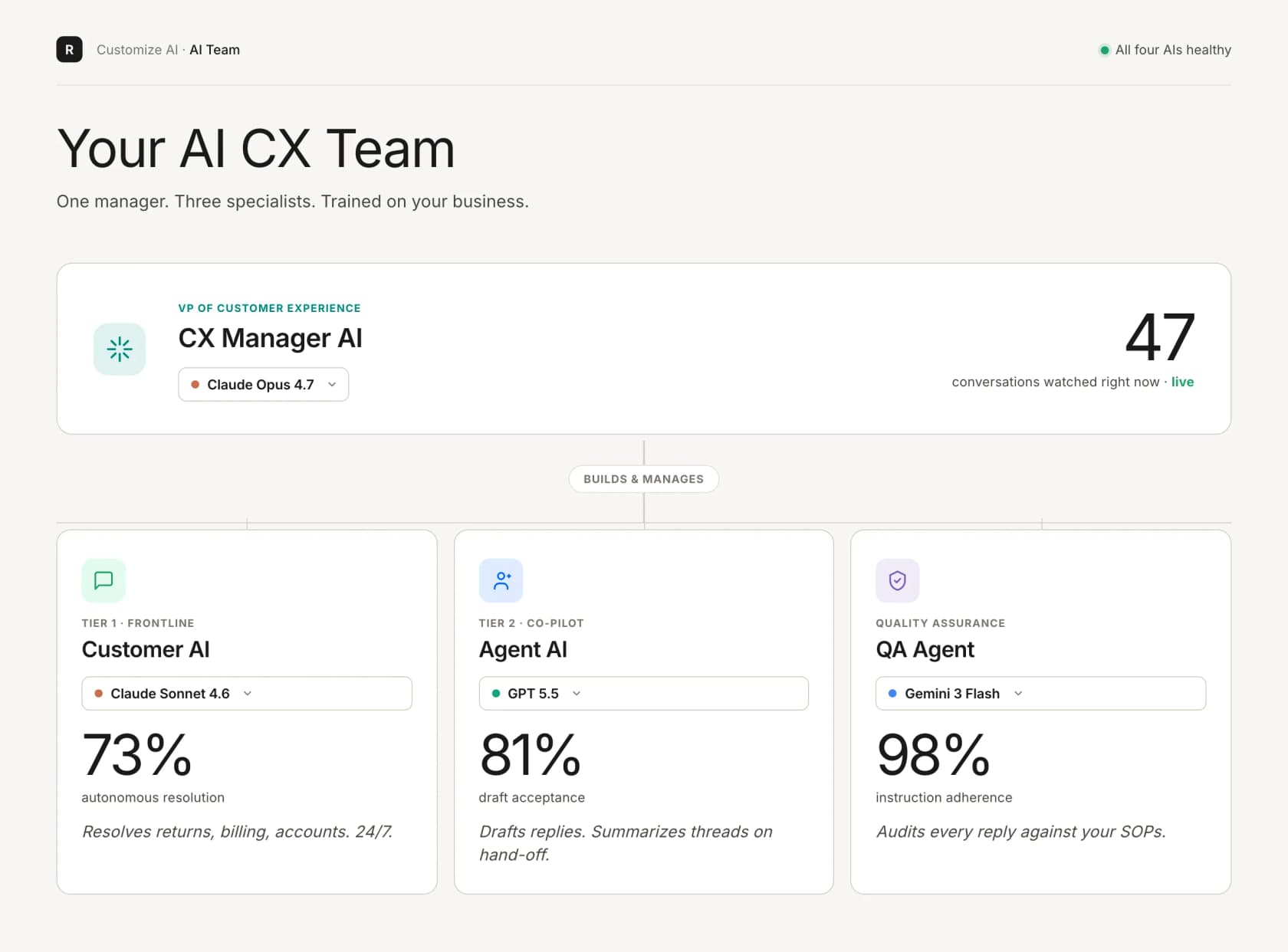
Richpanel reframes the whole purchase: instead of "a helpdesk with an AI feature," it sells you a team of AI roles (a frontline agent, a copilot, a QA reviewer, and a manager) that handle routine ecommerce support while humans take the exceptions. It is properly Shopify-native, with deep integrations into Shopify, Recharge, Loop Returns, and AfterShip so the AI executes real actions, not just chat.
Pros:
- Deep Shopify-stack integrations let the AI process refunds, address changes, and subscription saves, not just answer questions.
- A rare resolution guarantee: 50% autonomous resolution in 30 days or your money back, which de-risks the switch.
- Zero-downtime migration from Gorgias or Zendesk via API, your team keeps answering on the old system while everything moves over in parallel.
Cons:
- High floor: a $500/month base plus $0.25 per conversation means ROI only really kicks in above roughly 2,000 conversations a month.
- I could not find verifiable third-party reviews, the proof points are all vendor-supplied case studies, so go in with healthy skepticism.
- The "hire AI employees" framing and four-role roster add conceptual overhead if you just want simple deflection.
Pricing: The self-serve AI Agent plan is $500/month base + $0.25 per conversation + $100 per human seat. A sample bill of two AI agents plus three seats lands around $800/month. Enterprise pricing is custom for multi-brand stores.
Verdict: A properly Shopify-native AI helpdesk with a guarantee most rivals won't offer, but the $500/month floor means it earns its keep only above a couple thousand tickets a month. Below that, a flat per-ticket tool is cheaper.
4. Gladly
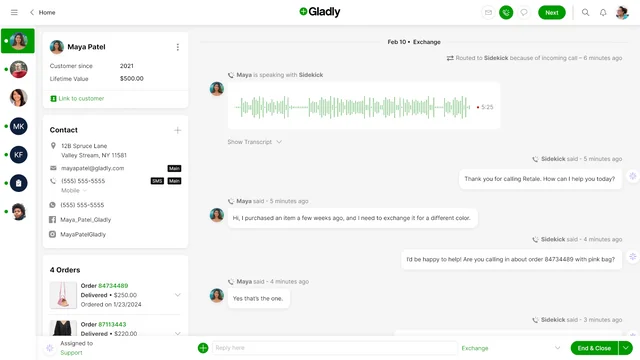
Best for: Premium, high-LTV B2C retail and DTC brands (apparel, beauty, travel) that sell on relationships, not budget-conscious small Shopify stores.
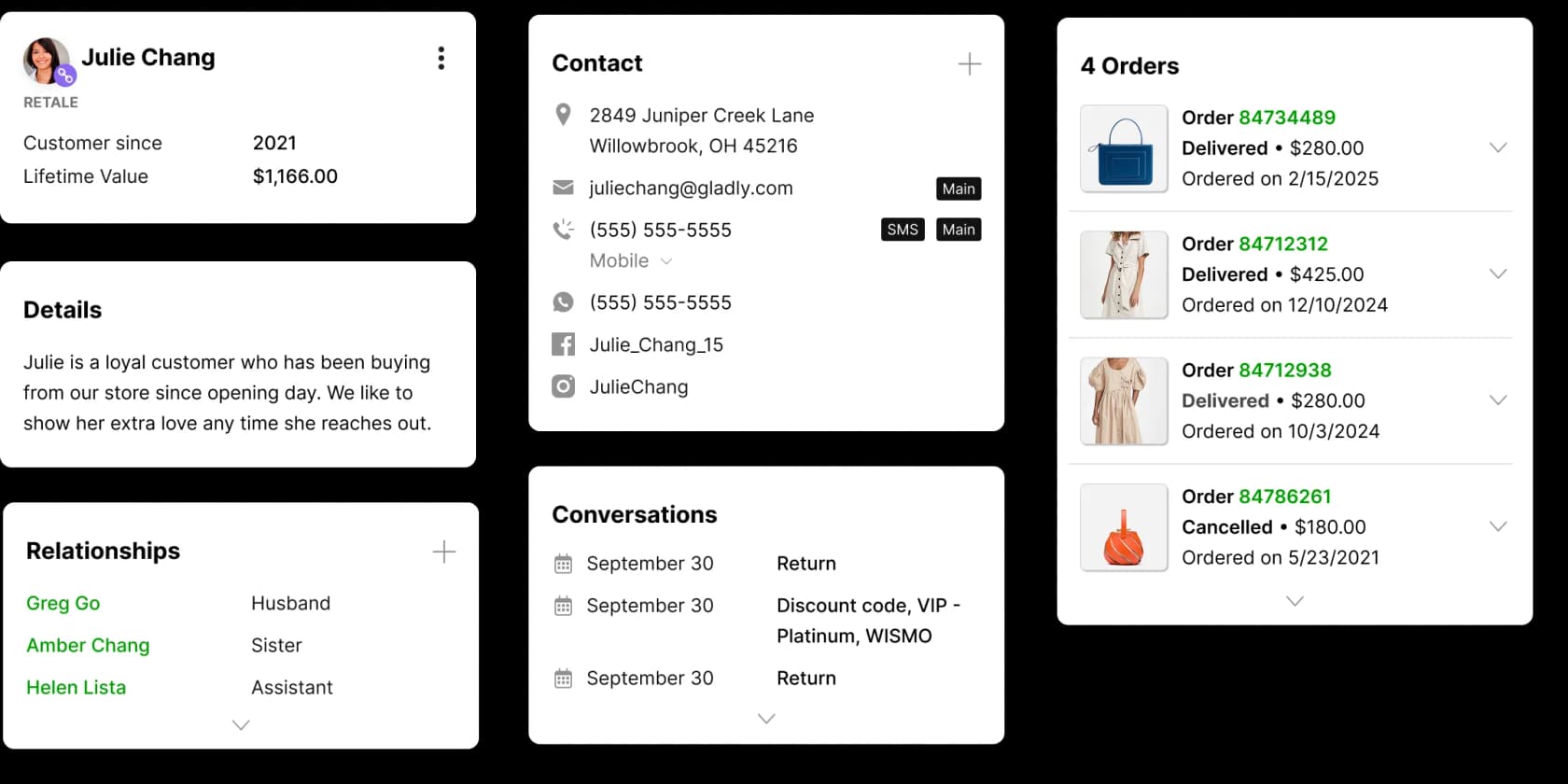
Gladly takes a deliberately different stance: "people, not tickets." Instead of discrete tickets, every customer gets one continuous, lifelong conversation across chat, voice, email, SMS, and social, all under a single 360-degree profile. Its roster skews premium, TUMI, Ulta, UGG, Crate & Barrel, and its Sidekick AI takes real actions like cancelling orders and processing returns, including on voice.
Pros:
- The unified customer view kills duplicate threads, every channel sits under one profile with full context.
- Sidekick takes real actions (returns, exchanges, price adjustments) and resolves on voice, not just text.
- Strong sentiment: 4.7/5 on G2 across 1,100+ reviews, praised for ease of use.
Cons:
- Expensive and rigid for small stores, the platform tiers carry seat minimums (10 seats and up).
- Segmented reporting is the top complaint, key metrics often need manual Excel pulls.
- A dense UI and steep learning curve mean it is overkill for a lean Shopify team.
Pricing: Gladly doesn't publish platform pricing (it is demo-only), but its Shopify listing exposes a pay-as-you-go option: a free 30-day trial (100 AI interactions), then a $250/month spending cap at $1.50 per AI resolution, $0.25 per AI assist, and $120 per seat. As one G2 reviewer put it bluntly: "to be quite frank, gladly is very expensive. The per-user cost may be very expensive to a mid-sized company and they lack a flexible plan." (G2)
Verdict: A best-in-class experience for premium retail brands that can stomach enterprise pricing. For a typical scrappy Shopify store, the seat minimums and per-resolution billing make it the wrong fit.
5. Zendesk
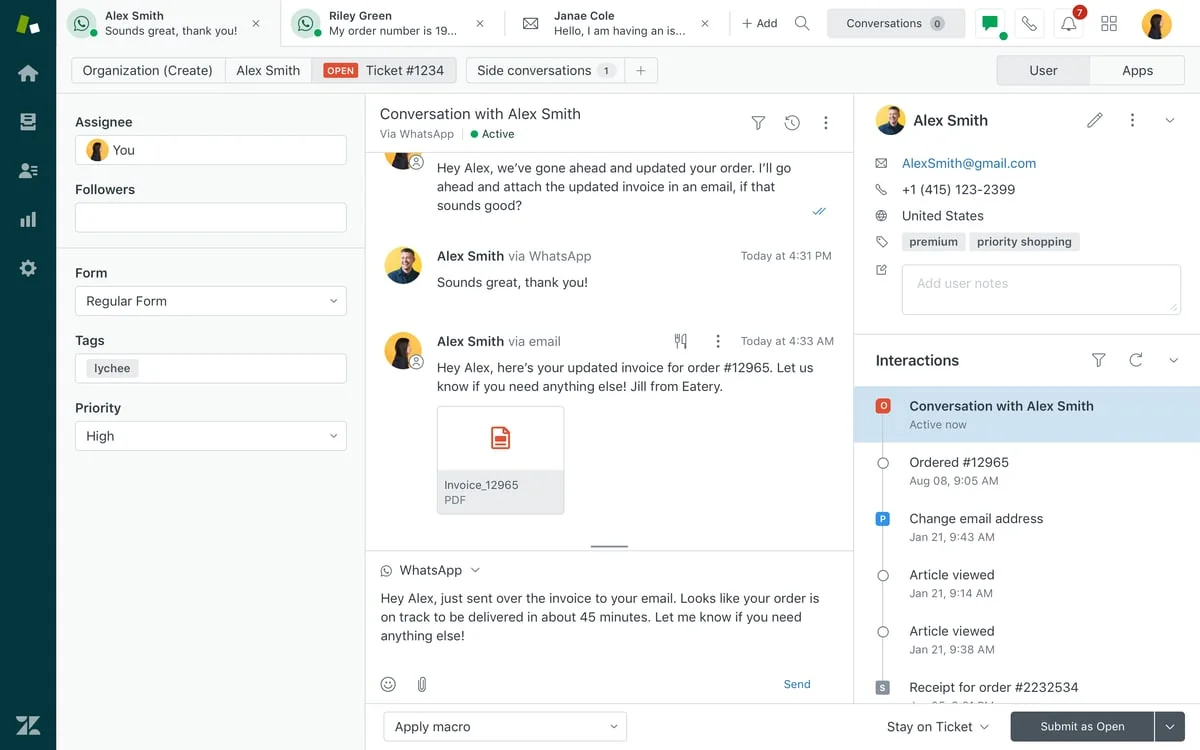
Best for: Enterprise and scaling teams (including Shopify merchants) that want a mature, omnichannel platform with a huge integration marketplace, and can absorb a layered bill.
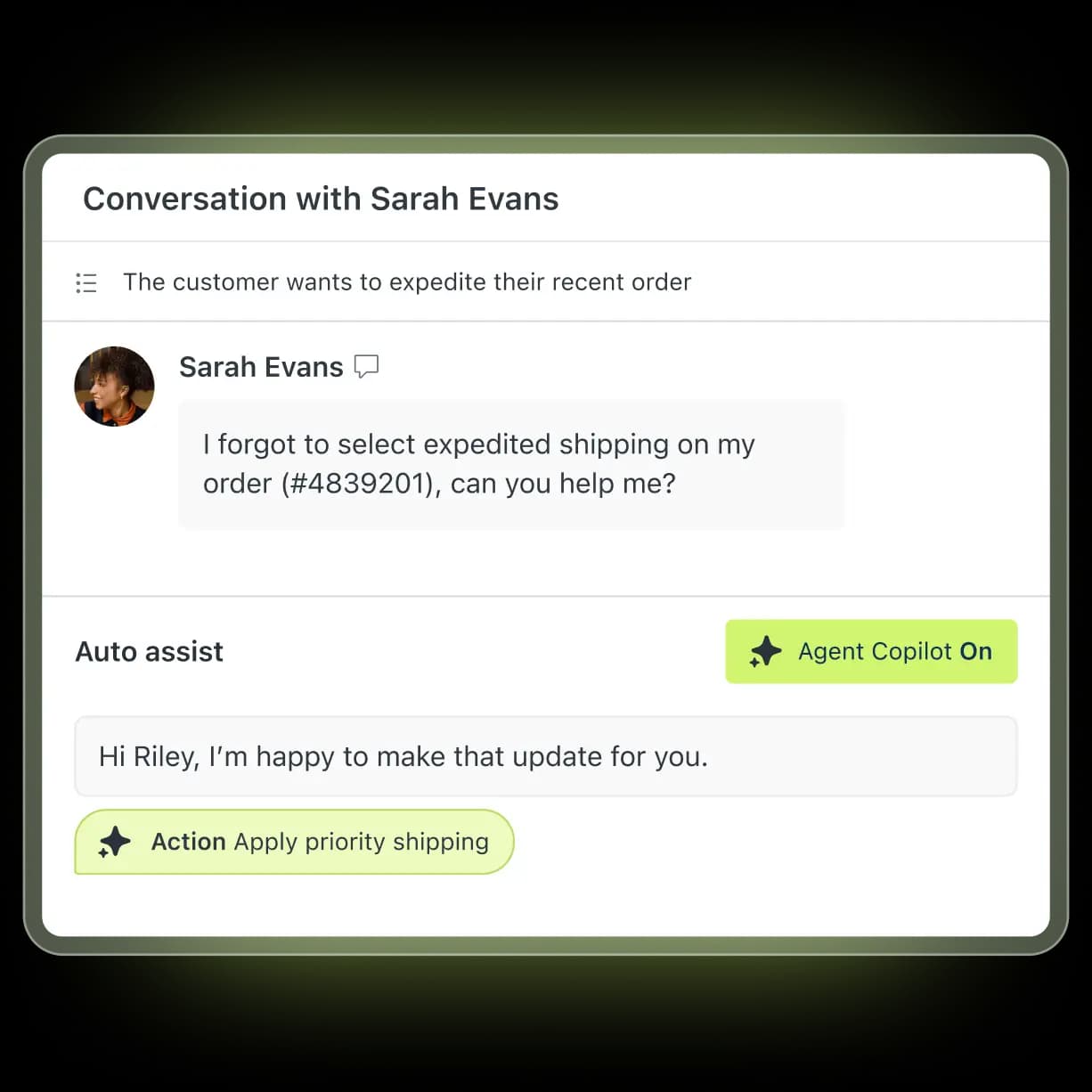
Zendesk is the incumbent's incumbent, mature, reliable omnichannel ticketing with a 1,800+ app marketplace that includes a solid Shopify integration. Its AI suite is deep: autonomous AI Agents (now Forethought-powered), a per-role Copilot, and AutoQA that scores 100% of interactions. If you are scaling past what an ecommerce-only tool can handle, this is the safe, capable choice.
Pros:
- Mature, reliable omnichannel ticketing with the deepest app marketplace on this list.
- A deep, capable AI suite (AI Agents, Copilot, AutoQA) with up to 80% automation claimed.
- Broadly liked core product, 4.3/5 on G2 across nearly 7,000 reviews.
Cons:
- Expensive, and it scales the wrong way: bills climb faster than headcount, with a well-earned "nickel and dime" reputation.
- Steep learning curve, configuring add-ons "could feel like a full-time job."
- AI is billed per Automated Resolution on top of seats, and the definition of "resolution" is disputed (abandoned chats can count).
As one Zendesk admin vented on Reddit:
"Their pricing isn't transparent at all. Even if you spend a million dollars a year, they will still nickel and dime the shit out of you because it's their model... I would never suggest any company get stuck in the zendesk pricing trap."
Pricing: Support Team $19/agent/mo (no AI), Suite Team $55, Suite Professional $115, Enterprise custom. Add-ons (Copilot, WEM, Contact Center) are $50/agent/mo each. AI Agents are billed per Automated Resolution, community math puts it around $1.20-$1.50 with a plan and $2 without one. This is exactly the spot where eesel works well as the AI layer on Zendesk at a flat rate.
Verdict: The mature, do-everything choice, buy it for the omnichannel depth and marketplace, but go in clear-eyed: the per-resolution AI billing and add-on creep mean the real bill is rarely the sticker price.
6. Help Scout
Best for: Small, relationship-driven Shopify teams that want a clean, email-like shared inbox they can learn in under an hour.
Help Scout is the friendliest shared inbox in its class. It pairs an email-like inbox with a Docs knowledge base, the Beacon widget, and live chat, and it is deliberately not enterprise ticketing. New agents are productive in under an hour, which is its single most-praised trait. For a lean store that just wants tidy, human-feeling support, it is lovely.
Pros:
- The cleanest, most intuitive inbox here, new agents get going fast.
- Strong small-team fit (~4.4/5 G2, ~4.6/5 Capterra), rated above Zendesk for ease of use.
- A unified product (inbox, Docs, Beacon, Messages) with 100+ integrations.
Cons:
- Thin on ecommerce-specific depth, no native order or refund actions like Gorgias.
- Lighter AI: AI Answers "can't take actions or learn from past tickets," and bills $0.75 per resolution on top of seats.
- A 2025 pricing flip (per-seat → per-interaction → reverted) burned a lot of goodwill.
That last point came up sharply in the community:
"HelpScout changed back to user-based pricing. Guess too many people cancelled including me... Helpscout lost all trust with this flip-flopping on pricing."
Pricing: Free for up to 5 users, then Standard $25/user/mo, Plus $45, and Pro $75 (10-user minimum). AI Answers is a usage-based add-on at $0.75 per resolution. The pricing model reverted to per-seat in late 2025.
Verdict: The best simple shared inbox for a small team that lives in email. But ecommerce-action depth and AI muscle thin out fast, so pair it with an AI layer if deflection matters. See our Gorgias vs Help Scout comparison for the head-to-head.
7. Tidio
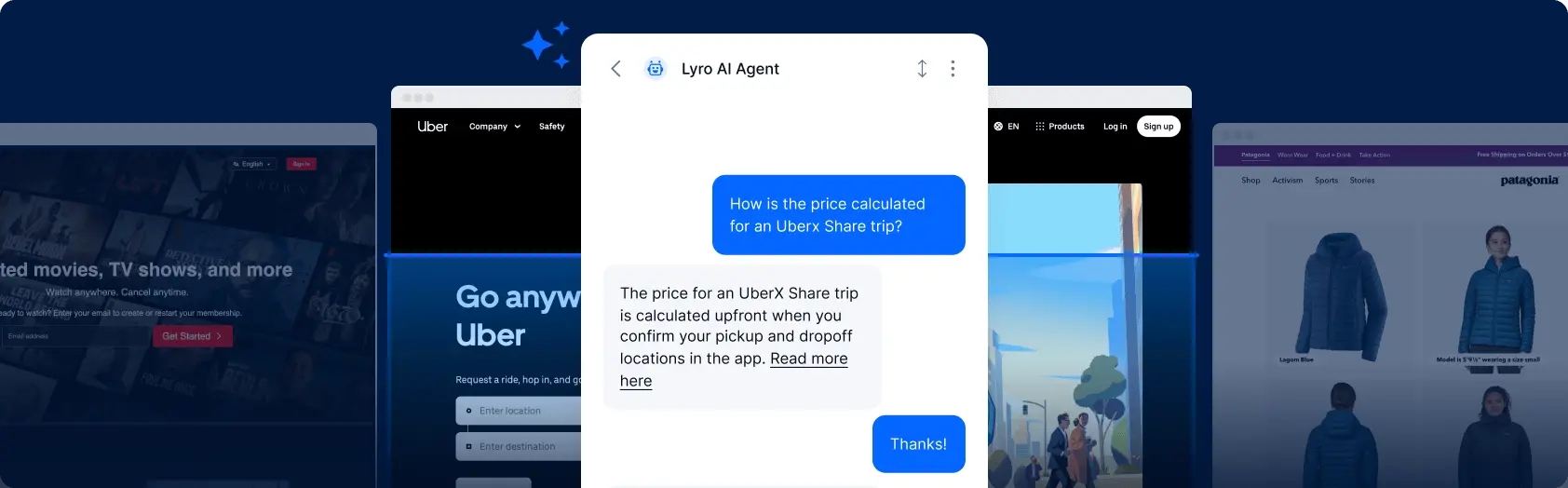
Best for: SMB and mid-market Shopify stores that want live chat plus an AI chatbot in one affordable, beginner-friendly suite.
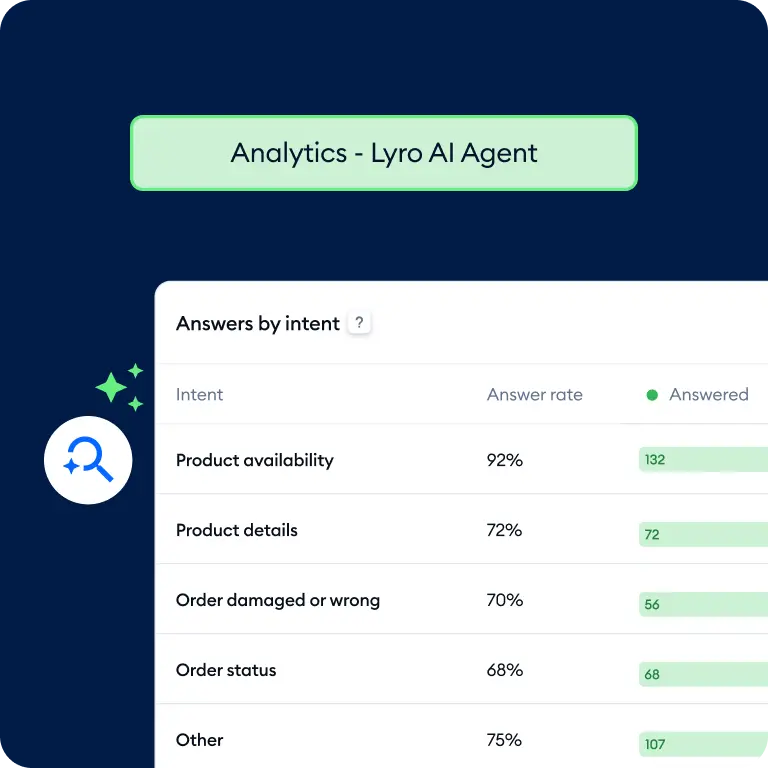
Tidio bundles live chat, a help desk, no-code Flows automation, and its Lyro AI agent into one SMB-focused platform. Lyro runs on Anthropic's Claude, grounds answers in your own content, and claims a 67% resolution rate, backed by a money-back guarantee if it can't hit 50%. Setup is fast, the widget and FAQ bot can be live within an hour, and the free tier is unusually generous.
Pros:
- Fast, low-friction setup, no engineering needed, with a 4.8/5 across 1,300+ Shopify App Store reviews.
- Lyro grounds answers in your own content with low hallucination, and handles order-tracking and cart-recovery actions on higher tiers.
- A free tier that is actually usable to get started.
Cons:
- Confusing usage pricing across three separate billable axes (billable conversations + Lyro conversations + Flows visitors); the "free tier as a trap" complaint recurs.
- A steep jump from Growth to the $749/month Plus tier.
- A clunky UI that even long-time users find hard to navigate.
The pricing confusion is a real theme:
"Just had a conversation with tidio, their pricing is so off and hidden, 'free tier' is just a trap... tidio is a NO-GO for me"
Pricing: Free ($0, 50 billable conversations, 50 lifetime Lyro conversations), Starter $24.17/mo, Growth from $49.17, Plus from $749, Premium custom (~$2,999). Lyro is billed per resolved conversation, around $0.50 each on paid plans. For more, see our Tidio AI features guide and Tidio alternatives.
Verdict: The most beginner-friendly AI-plus-live-chat combo for small Shopify stores. Just budget carefully, the three-axis usage pricing gets murky fast as you scale.
8. DelightChat
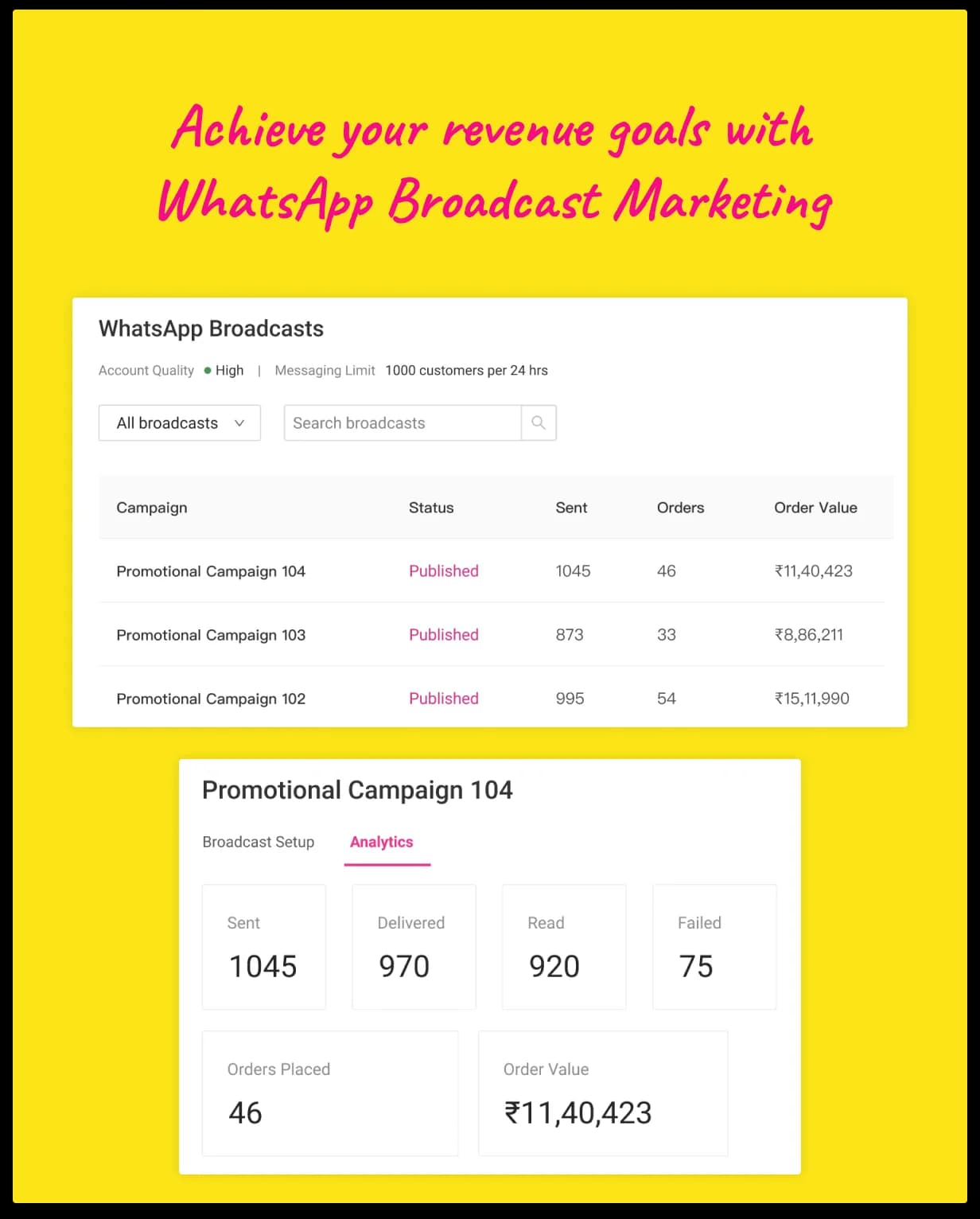
Best for: Shopify and D2C brands that run support and marketing primarily over WhatsApp, Instagram, and other modern messaging channels.
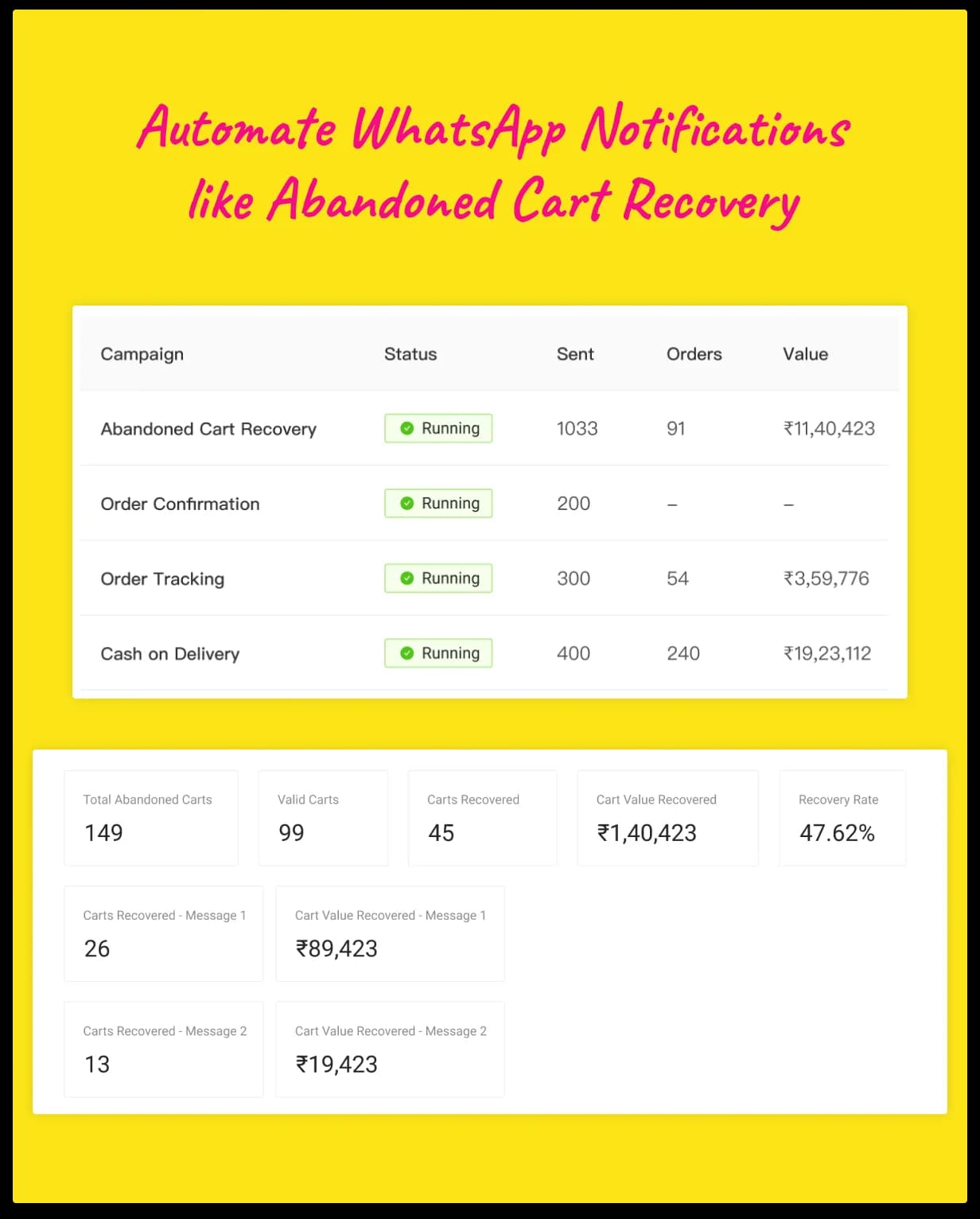
DelightChat is purpose-built for ecommerce brands living on WhatsApp. It is two products in one: an omnichannel support inbox (WhatsApp, Email, Live Chat, Instagram, Messenger) and a WhatsApp marketing suite (broadcasts, abandoned-cart recovery, order notifications, COD verification). It uses the official WhatsApp Business API with no markup on Meta's conversation fees, and its Shopify integration lets agents view and modify orders inside tickets.
Pros:
- WhatsApp-first with official Business API, free Green Tick, and no markup on Meta fees.
- Support inbox plus a marketing suite in one tool, useful for D2C brands driving revenue over chat.
- Deep Shopify integration (view/modify orders, Shopify Flow triggers), 4.8/5 across ~217 Shopify reviews.
Cons:
- No autonomous AI resolution agent, the AI is Draft/Rewrite assist only, and a paid add-on.
- Thin independent review footprint outside the Shopify App Store.
- Headline ROI claims (26x, 7.1x) are vendor-stated and unverified.
A representative Shopify review:
"The WhatsApp integration works smoothly, and the automation capabilities allow us to manage order updates and customer communication efficiently."

Pricing: Startup $29/mo (500 tickets, 2,500 contacts), Scale $99 (2,000 tickets), Growth $299 (6,000 tickets), all plus Meta's WhatsApp fees. A ticket is counted only when a human replies. The AI Assistant add-on gives 10K free tokens/mo, then $2 per 100K tokens.
Verdict: The sharpest WhatsApp-marketing-plus-support combo for Shopify D2C brands. Pick it for the channel fit, not for autonomous deflection, its AI is assistive, not AI-first.
How to switch without the chaos
Picking the tool is the easy part. The thing that actually stops teams is the fear of a messy migration, losing ticket history, breaking automations, launching a bot that confidently gives wrong answers to real customers. A few things make it painless:
- Don't rip and replace if you don't have to. If your only real problem with Gorgias is the AI bill, the lowest-risk move is to keep Gorgias as your inbox and put a flat-rate AI layer on top. That is exactly what eesel does, no migration project, no retraining your team on a new UI.
- Simulate before you go live. Any AI you trust with customers should be testable against your real past tickets first. eesel's simulation mode shows you, on your actual history, what it would have resolved and where it would have stumbled, so launch day isn't a leap of faith.
- Roll out gradually. Start with the AI drafting for humans, then let it auto-resolve the narrow categories it is confident on, then widen. Confidence-based routing means the rest stays with your team.
For more on the broader category, our roundups of the best AI helpdesk software and best AI for Shopify customer support go deeper, and best customer service AI covers the wider field.
Try eesel for your Shopify store
If you came here because Gorgias works but the bill doesn't, eesel AI is the most direct fix. It plugs into Gorgias, Shopify, and your help center in minutes, learns from your past tickets on day one, and resolves tier-1 conversations at a flat $0.40 per ticket, no per-resolution charge, no per-seat fee. You can simulate it on your real history before going live, so you know exactly what it will resolve before a single customer sees it.
The one differentiator I would underline: because there is no per-resolution fee, a great deflection month makes your bill better, not worse, which is the opposite of almost everything else on this list. You can try eesel free, with $50 of usage and no credit card.
Frequently Asked Questions
What is the best Gorgias alternative for a small Shopify store?
Why do Shopify merchants switch away from Gorgias?
Which Gorgias alternative has the deepest Shopify integration?
How much does an AI support agent cost for Shopify?



Article by
Kurnia Kharisma Agung Samiadjie
Kurnia is a software engineer and writer at eesel AI with two years of SEO experience, writing about AI tools, helpdesk software, and customer support. He pairs a developer's understanding of how these products are built with search-driven research into what actually ranks and resonates with the people searching for them.