


Why teams look for Gorgias alternatives
Gorgias's ecommerce helpdesk is legitimately good - 40% of the top 1,500 Shopify brands use it, and its Shopify data integration remains the deepest in the market. But three friction points push teams to look elsewhere:
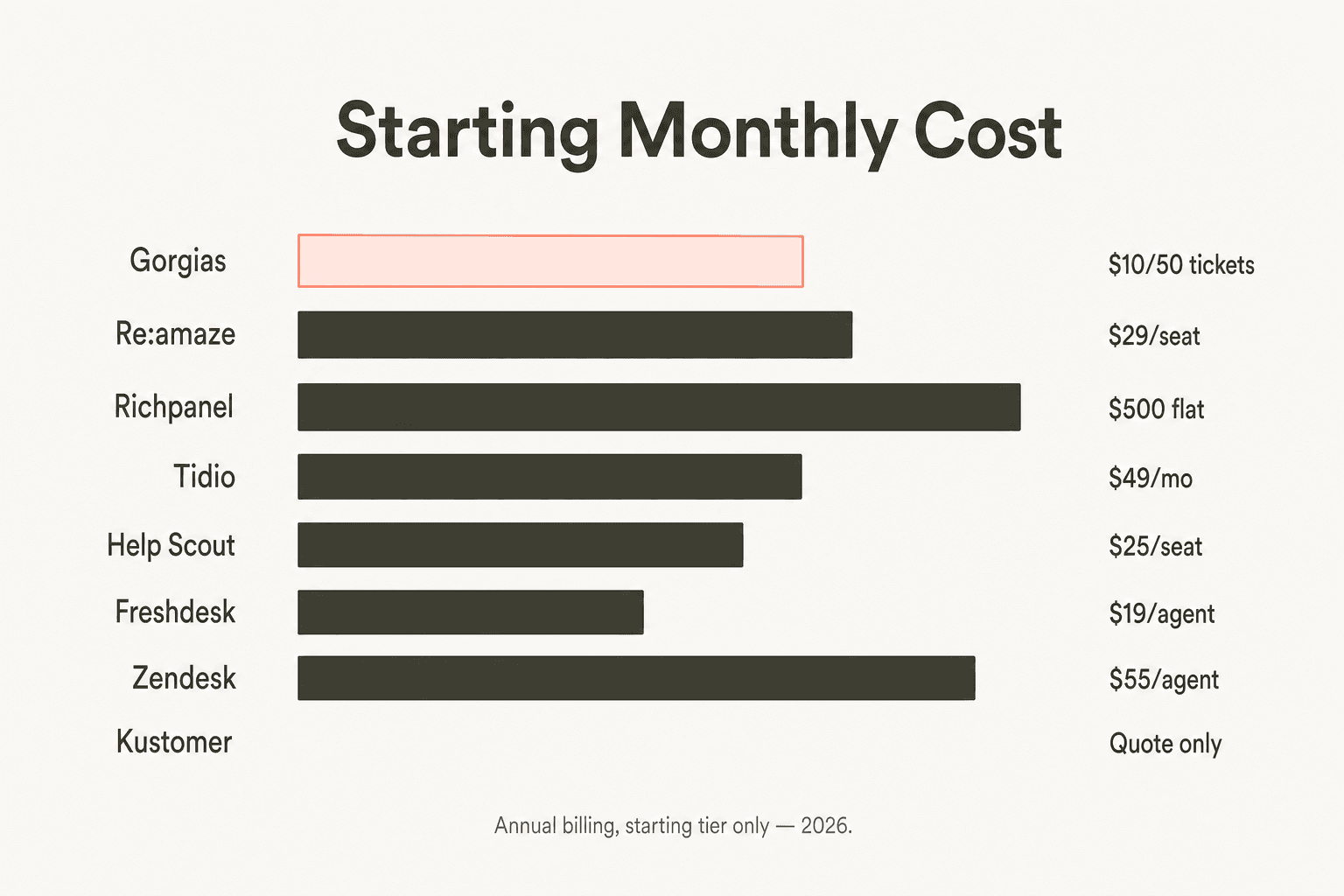
1. Ticket-volume pricing. Gorgias prices by monthly ticket count, not by seat. That's fine for lean teams - $10/month for 50 tickets is a bargain. But it punishes growth: the Pro plan is $360/month for 2,000 tickets, Advanced is $900/month for 5,000. A flash sale that doubles your ticket volume for two weeks still costs you the higher plan for the full month. The Gorgias ticket limit is a well-documented frustration point.
2. AI is a separately billed add-on. The Gorgias AI agent resolves orders, tracks packages, and handles returns - but it costs $0.90–$1.00 per fully resolved conversation on top of your base plan. Brands aiming for 60% automation see that per-conversation cost compound fast. The community rule of thumb is: Gorgias AI is worth it once you're processing 500+ AI-resolved conversations per month and the cost is clearly offset by agent time saved.
3. It's built for Shopify first. If you run WooCommerce, BigCommerce, or a multi-platform stack, or if your support volume spans non-ecommerce channels like B2B email, Gorgias's Shopify-first architecture starts to feel like a constraint. Alternatives like Freshdesk and Zendesk were built for broader use cases.
None of this means Gorgias is bad. It means it's optimized for a specific type of team. If you're outside that profile, the alternatives below are better fits.
The 8 best Gorgias alternatives in 2026
1. Re:amaze - best for Shopify teams wanting Gorgias-like depth at a lower cost

Re:amaze is the alternative that sits closest to Gorgias in its feature set - unified inbox, native live chat, proactive Cues, real-time visitor dashboard, chatbots, and co-browsing - while charging per seat rather than per ticket. Owned by GoDaddy since 2021, it targets small-to-mid ecommerce and SaaS teams and covers email, chat, SMS, social, VoIP, and push notifications from a single workspace.
The pricing model flips Gorgias's logic: Re:amaze charges $29–$69 per seat per month, not per ticket. That means a 3-agent team processing 5,000 tickets/month pays $87–$207 versus Gorgias's $900 at the same volume. The Starter plan is genuinely unusual - $59 flat/month for unlimited seats, capped at 500 conversations - which makes it one of the cheapest full-featured setups for small teams.
AI sits inside the platform as an add-on: Re:amaze AI Agent (Beta) handles 24/7 autonomous replies, with an overage charge of $0.85 per AI-resolved conversation beyond each plan's included allocation (5–20 resolutions per user per month on paid tiers). That's slightly cheaper than Gorgias's $0.90–$1.00, though neither publishes a claimed resolution rate.
The main trade-off versus Gorgias is Shopify depth. Re:amaze surfaces order data inside conversations and supports native order actions on the Growth plan and above, but reviewers consistently rate Gorgias's Shopify integration as deeper and more real-time. Re:amaze also doesn't have Gorgias's revenue attribution tracking or chat campaign conversion data.
Read the full Re:amaze automation guide to understand what its workflow engine can do before committing.
Pricing: Starter $59 flat/mo (500 convos), Basic $29/seat/mo, Pro $49/seat/mo, Plus $69/seat/mo. AI overage: $0.85/resolution. 14-day free trial, no credit card.
Verdict: Re:amaze is the best direct Gorgias swap if per-ticket pricing is your main objection and you want a comparable feature surface at a lower predictable cost.
2. Richpanel - best for AI-first ecommerce brands with high ticket volume
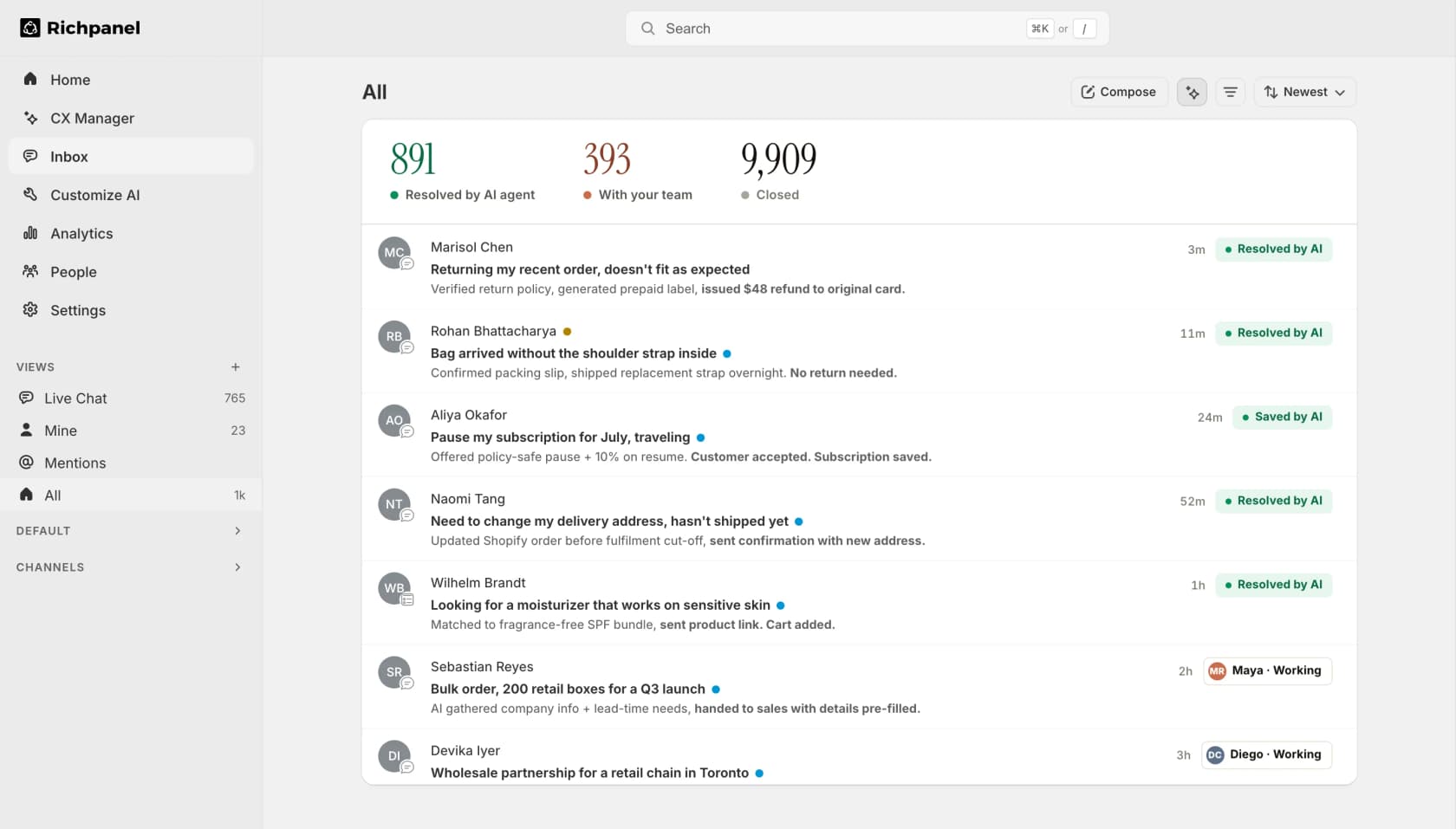
Richpanel is the most aggressively AI-native alternative on this list. Where Gorgias treats AI as a feature add-on, Richpanel frames the entire product as an AI team you hire - a Frontline AI for customer-facing resolution, a Copilot AI for human agent assist, a QA AI that reviews 100% of conversations before they send, and a CX Manager AI that writes SOPs, routes work, and monitors performance.
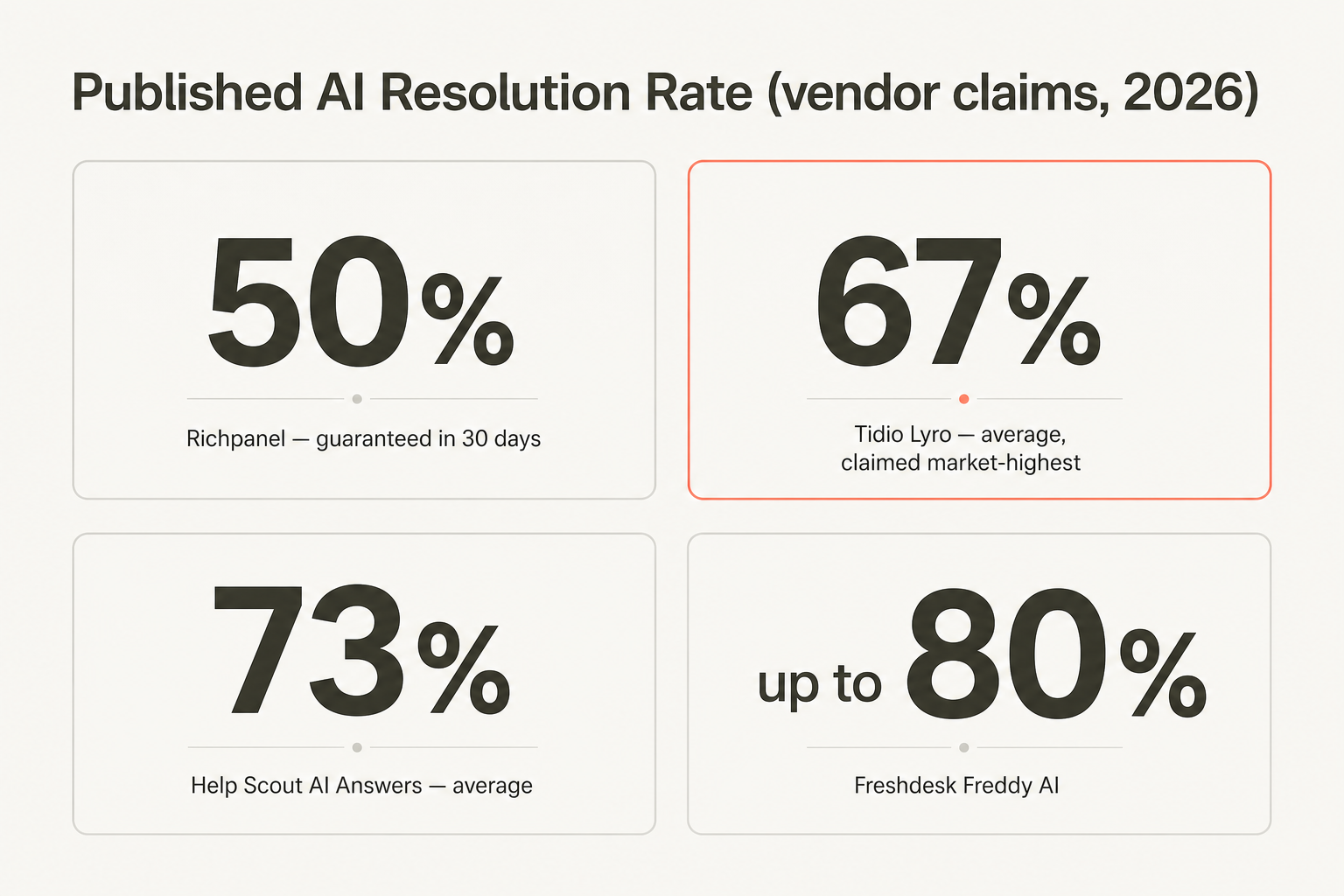
Richpanel guarantees 50% autonomous ticket resolution within 30 days, or a full refund. The company claims 70–80% autonomous resolution at maturity. Verified outcomes include The Ridge going from 88% to 96% CSAT after deploying Richpanel AI, and Jones Road Beauty reducing from 18 to 10 support agents while revenue grew through a peak BFCM season.
The pricing model is flat: $500/month base plus $0.25 per AI-handled conversation ($100/seat/month for human agents). That per-conversation rate is the cheapest on this list for AI resolution. For a team handling 2,000 AI-resolved conversations per month, the total AI cost is $500 - versus $1,800–$2,000 on Gorgias's AI add-on at the same volume.
Richpanel also ships the most thorough migration tooling of any alternative here: it imports tickets, macros, tags, custom fields, routing rules, and internal notes from Gorgias and Zendesk via API. Karta Ventures cited zero migration issues when moving three brands.
The catch is the $500/month floor - that's a high minimum for small teams with low volume. Richpanel's ROI breakeven is roughly 2,000+ conversations per month or 3+ agents. Below that, the flat cost stings.
Pricing: $500/month base + $0.25/conversation (AI), $100/seat (human agents). 30-day money-back guarantee.
Verdict: The strongest option for ecommerce brands that want maximum AI automation and are willing to pay a flat base rate for the certainty of a resolution guarantee.
3. Tidio - best for SMB DTC brands that want live chat and AI on a budget
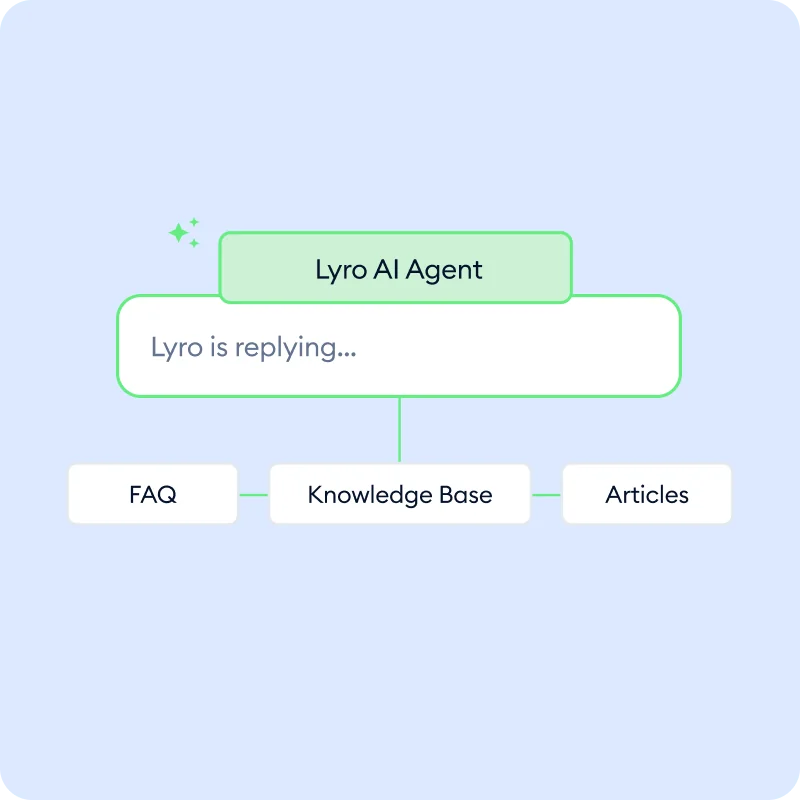
Tidio is the friendly version of this list. Over 300,000 businesses use it, 4.8/5 on the Shopify App Store from 1,300+ reviews, and the entry price starts at $24.17/month - a fraction of Gorgias's base cost. Its flagship AI is Lyro, powered by Anthropic's Claude rather than OpenAI's models, which Tidio says grounds answers more reliably in customer-provided data and reduces hallucinations.
Tidio claims Lyro achieves a 67% average resolution rate - the highest published figure for any AI customer support tool. Bella Sante attributed $66K+ in revenue directly to Lyro, and Gecko Hospitality reported 90% of repetitive tasks automated. The money-back guarantee on Premium tier (if Lyro doesn't hit 50% resolution) echoes Richpanel's guarantee model and signals real confidence in the number.
The platform combines live chat, a ticketing inbox, proactive automation (Flows), and Lyro AI in one tool. The Tidio pricing structure has four tiers: Free (50 Lyro conversations lifetime), Starter ($24.17/mo), Growth (from $49.17/mo with Shopify order actions and advanced analytics), and Plus ($749/mo). That jump from Growth to Plus is steep - teams that scale past Growth quickly feel the ceiling.
Lyro conversation pricing: $0.50 per conversation on paid plans, which sits between Richpanel's $0.25 and Gorgias's $0.90–$1.00. The Tidio AI features include Lyro Smart Actions for backend task automation (order tracking, lead qualification), Lyro Guidance for brand voice and escalation rules, and Lyro Connect for layering Lyro on top of Zendesk or Salesforce (Plus tier only).
For teams comparing Tidio and Gorgias head-to-head, see our Gorgias vs Tidio breakdown. The short version: Gorgias wins on Shopify data depth; Tidio wins on budget and AI resolution confidence.
Pricing: Free tier available; Starter $24.17/mo; Growth from $49.17/mo; Plus from $749/mo. Lyro: $0.50/conversation on paid plans. 7-day free trial.
Verdict: Best alternative for budget-constrained SMB DTC brands that want live chat plus a genuinely capable AI agent, without the infrastructure complexity of enterprise tools.
4. Help Scout - best for relationship-driven DTC brands that live in email

Help Scout is built on a different philosophy than Gorgias. Where Gorgias optimizes support as a revenue channel with chat campaigns, product recommendations, and sales attribution, Help Scout is built for the idea that support is a relationship. Its tagline - "Businesses that run on relationships run support on Help Scout" - positions it squarely against transactional helpdesk thinking.
The product centers on a clean shared inbox that new agents learn in under an hour, a Docs knowledge base that cuts email volume roughly 30%, and an embeddable Beacon widget. AI features include AI Answers (autonomous customer-facing agent resolving 73% of interactions on average) and Inbox Assistant (drafts, summaries, tone adjustments, and translation for human agents).
12,000+ companies use Help Scout, and 80% of customers stay after four years - a retention metric that signals genuine stickiness. Help Scout pricing: $25/user/month (Standard), $45 (Plus), $75 (Pro, min 10 users). The AI Answers add-on is $0.75 per resolution - higher than Richpanel or Tidio but bundled with a 3-month free trial.
The community's loudest complaint is well-documented: Help Scout went through a pricing-model change from per-seat to per-interaction pricing in 2025 that triggered significant customer churn, then reversed course. The Gorgias vs Help Scout comparison surfaces this pricing whiplash as the main trust concern for prospective buyers. It was fixed, but the episode damaged confidence in the platform's pricing stability.
Also worth noting: Help Scout's Shopify integration is functional but not deep. There's no native order management inside tickets - you'll need a third-party integration for that. If Shopify order actions inside the inbox are a hard requirement, Re:amaze or Richpanel serve you better.
Pricing: Free tier (up to 5 users); Standard $25/user/mo; Plus $45/user/mo; Pro $75/user/mo. AI Answers: $0.75/resolution. 3-month AI trial included.
Verdict: Best choice for DTC brands that prioritize human, email-like support quality over Shopify order automation. Not the right call if deep Shopify actions are critical.
5. Freshdesk - best for multi-channel teams growing beyond Shopify
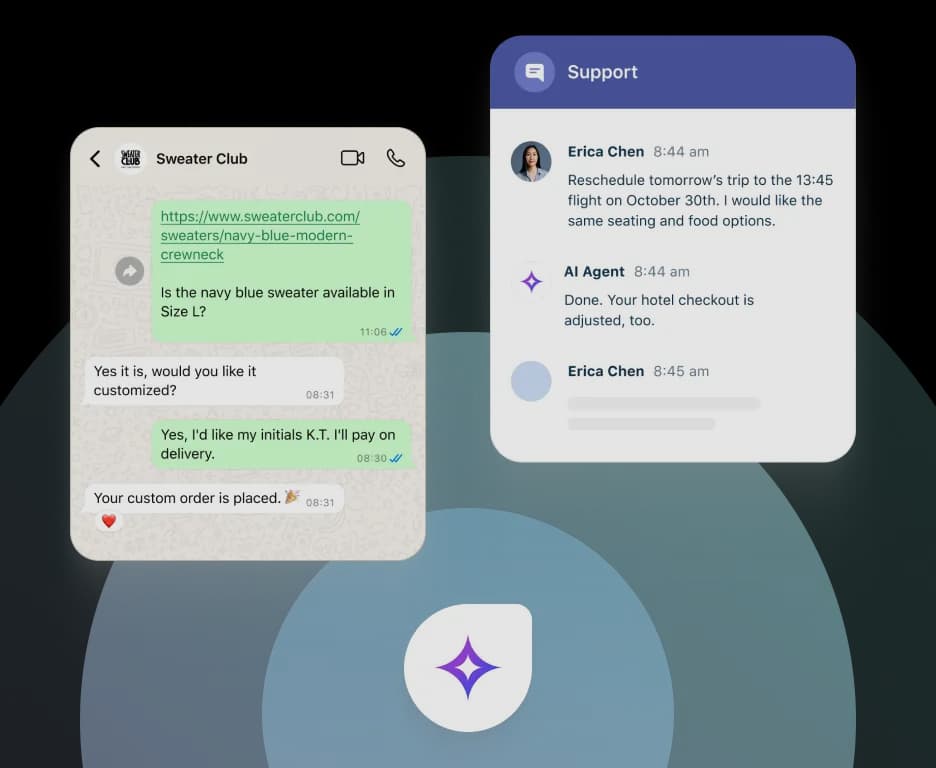
Freshdesk is the broadest-reach option on this list. 74,000+ businesses use it, including Bridgestone, Tata Digital, Klarna, PepsiCo, and Forbes - a roster that signals enterprise credibility even if the brand is known for its SMB entry point. Unlike Gorgias, Freshdesk wasn't built for ecommerce: it covers email, chat, phone (Freshcaller add-on), social, messaging apps, and self-service under one roof, for any industry.
Freddy AI is Freshdesk's flagship differentiator: Freddy AI Agent claims up to 80% autonomous query resolution with 50+ prebuilt agentic workflows, a no-code AI Agent Studio, and native Shopify, Stripe, and PayPal integrations. Freddy AI Copilot handles agent-side assistance (reply suggestions, summaries, live translation). Freddy AI Insights surfaces proactive alerts, root cause analysis, and CSAT trend tracking.
The Freshdesk AI pricing model: Growth $19/agent/mo, Pro $55/agent/mo, Enterprise $89/agent/mo. Freddy AI Agent sessions: 500 free sessions on Pro/Enterprise (one-time), then $49 per 100 additional sessions - a session is one unique customer-to-AI interaction within a 72-hour window. That per-session rate of ~$0.49 is comparable to Tidio's $0.50/Lyro conversation.
The Shopify caveat: Freshdesk's Shopify integration has a 3.0/5 rating from 61 reviews on the Shopify App Store - mixed enough to flag. Merchants report it surfaces order data inside tickets but isn't as seamless as Gorgias or Re:amaze for taking direct order actions. The Freshdesk alternatives list covers this gap in detail.
Pricing: Growth $19/agent/mo; Pro $55/agent/mo; Enterprise $89/agent/mo. Freddy AI: 500 free sessions then $49/100 sessions. 14-day free trial (Enterprise).
Verdict: Best option for multi-channel teams that need helpdesk breadth beyond Shopify, especially teams with mixed ecommerce and B2B or IT support use cases.
6. Zendesk - best for enterprise ecommerce with the deepest integration catalog
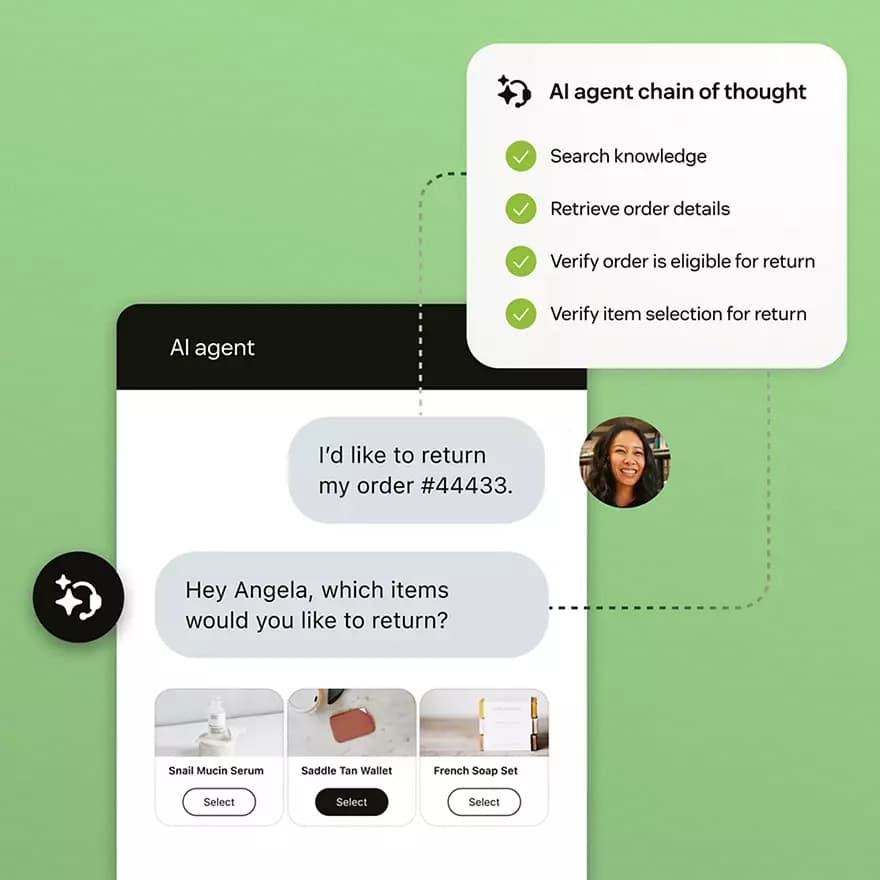
Zendesk is the 800-pound gorilla of this list: 6,837 G2 reviews at 4.3/5, a 1,817-app marketplace (253 in AI and Bots alone), and a 2025 Gartner Magic Quadrant Leader position. If your team needs the widest possible integration ecosystem, the most battle-tested ticketing infrastructure, or multi-region enterprise compliance certifications, Zendesk is the benchmark.
The AI suite includes AI Agents (advanced Ultimate.ai-derived agents with generative procedures, scripted dialogues, authorized actions, and Shopify-level API integrations), Copilot (Auto Assist + Admin Copilot + Intelligent Triage), and AutoQA across 100% of conversations. Advanced AI Agents support voice (in early access) and 80+ languages.
The pricing reality is sharp: Suite plans run $55–$115/agent/month, and Copilot adds $50/agent/month on lower tiers. AI billing moved in May 2026 to a "Verified Resolution" model - only conversations the AI resolves and an LLM confirms are billed against your allowance, with overages at $1.20–$1.50 per verified resolution. The total bill at $115/agent + $50 Copilot + AR overages can easily 2–3x the base subscription for AI-heavy teams.
Zendesk also surfaced a self-inflicted credibility problem: at ProductLab Conference 2025, only ~10% of AI agents built in the prior six months were still in use - an abandonment signal. Reddit reviewers are consistently critical of the per-resolution billing model, with the most-cited comment calling ARs "a rip off and a rushed product to get into the AI hype." For Zendesk Shopify plugin setup, the plugins work but lack the native depth of Gorgias's Premier Partner integration.
Pricing: Suite Team $55/agent/mo; Suite Professional $115/agent/mo; Copilot $50/agent add-on. AI overages ~$1.20–$1.50 per Verified Resolution. 14-day trial.
Verdict: Best for enterprise ecommerce teams that need the widest integration catalog and have the budget to absorb the complex per-resolution billing model. Overkill for most SMB DTC brands.
7. Kustomer - best for high-volume DTC/retail brands that need CRM-level customer context
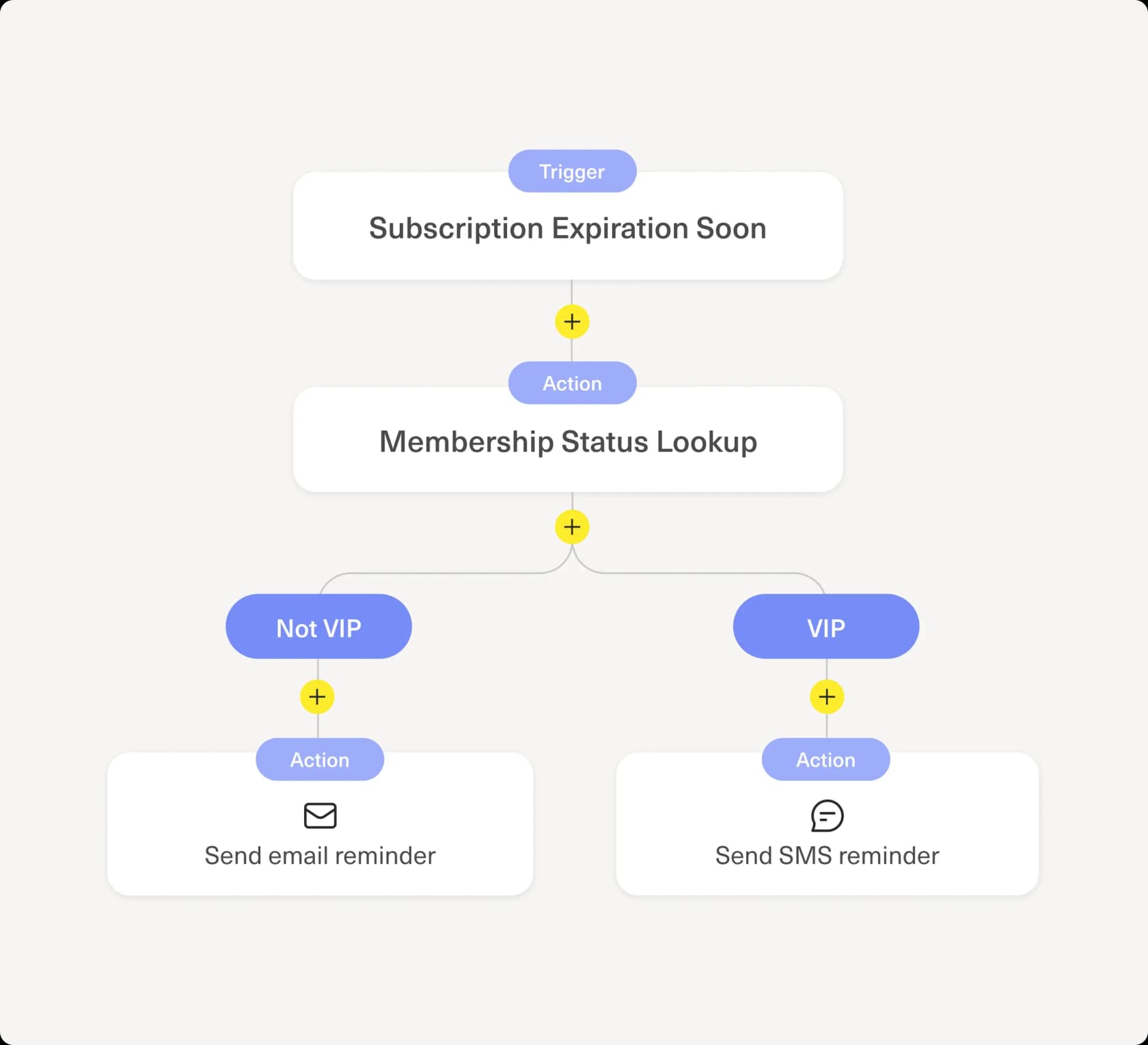
Kustomer's core insight is that Gorgias and Zendesk are ticket-centric: every conversation starts fresh. Kustomer is customer-centric: every interaction is tied to a complete customer record covering order history, loyalty tier, churn risk score, and the full conversation timeline. The positioning - "the only CX platform where AI runs on context, not guesswork" - is a direct shot at ticket-oriented competitors.
The AI suite has four named products: Concierge (customer-facing autonomous AI across chat, email, SMS, WhatsApp), Envoy (agent-side copilot), Architect (no-code AI builder with native Model Context Protocol support), and Data Explorer (conversational analytics). The customer roster skews B2C retail at scale: Turo, Everlane, Kin, Rappi, Skims, Vuori, loveholidays, sweetgreen. Vuori reports 70% of all chat conversations fully automated using Kustomer AI.
The Kustomer pricing is quote-only - no published tier prices. Third-party research triangulates ~$89/seat/month (Enterprise) or ~$139/seat (Ultimate), annual-only, 8-seat minimum, with AI agent-side AI billed separately at ~$40/user/month and customer-facing AI at ~$0.60/engaged conversation. That 8-seat floor and annual-only requirement makes Kustomer a non-starter for most small brands.
Kustomer reviews on G2 average 4.4/5 across 555 reviews - the homepage claims "5.0 from 500+ reviews" which is cherry-picked marketing, not the aggregate. The sharpest G2 complaints: voice channel described as "incredibly buggy" with dropped calls and poor routing, complex UI that overwhelms new users, and perceived product stagnation on API updates. For a Gorgias vs Kustomer comparison, the verdict usually goes: Gorgias if you need native Shopify depth, Kustomer if you need unified customer records at B2C scale.
Pricing: Quote-only. Estimated ~$89–$139/seat/mo (annual), 8-seat minimum. AI: ~$0.60/engaged conversation + ~$40/user/mo for agent AI.
Verdict: Best for high-volume DTC and retail brands with complex customer profiles who need a true CRM-meets-helpdesk. Not suitable for small teams or budget-sensitive brands.
8. eesel AI - best for teams that want to keep their helpdesk and add AI on top

Every alternative on this list requires migrating your entire support stack. eesel AI is built on a different assumption: that the helpdesk you already use is probably fine, and the only thing missing is a capable AI layer on top of it.
eesel works as an overlay - it connects to your existing tools (Zendesk, Freshdesk, Gorgias, Shopify, Slack, and 100+ others), ingests your knowledge base and ticket history, and starts auto-answering and routing tickets without you switching platforms. When the AI is confident, it resolves. When it's not, it escalates to a human - and critically, it only bills for tasks it actually handles.
eesel charges $0.40 per task, with no seat fees and no platform fee on self-serve plans. There's no per-seat floor, no annual commitment required, and no migration project. For a team on Gorgias that's spending $0.90–$1.00 per AI-resolved conversation, switching the AI layer to eesel while keeping Gorgias as the helpdesk cuts the AI unit cost by more than half.
The pitch isn't to replace Gorgias - it's to add the AI capability Gorgias charges extra for, at a lower per-task rate, while keeping everything else in place. Teams use eesel for ticket auto-response, draft generation, FAQ deflection, and Shopify order lookups via the existing helpdesk's Shopify integration.
The trade-off is scope: eesel AI is the AI layer, not the full helpdesk platform. It doesn't replace the inbox management, reporting, routing, or SLA features of a full helpdesk. If those features are where your current platform is failing you, eesel alone won't fix that - you need a platform switch. But if the helpdesk works and the AI doesn't, eesel is the surgical upgrade.
Pricing: $0.40/task. No seat fees, no platform fee (self-serve). 14-day free trial.
Verdict: Best alternative for teams that aren't dissatisfied with their current helpdesk but want AI resolution without migrating and without paying Gorgias's AI add-on rate.
Summary comparison table {#summary-table}
| Tool | Best for | Starting price | AI per-unit cost | Free trial | Shopify depth | G2 rating |
|---|---|---|---|---|---|---|
| Re:amaze | Gorgias-like depth, lower seat cost | $29/seat/mo | $0.85/resolution | 14 days | Good (order actions Growth+) | 4.4/5 |
| Richpanel | AI-first, high-volume brands | $500/mo flat | $0.25/conversation | 30-day money-back | Strong (native) | N/A (reviews limited) |
| Tidio | SMB DTC, live chat + AI | $24.17/mo | $0.50/Lyro convo | 7 days | Good (Growth+ native actions) | 4.7/5 |
| Help Scout | Email-first, relationship-driven | $25/user/mo | $0.75/resolution | 3-mo AI trial | Limited | ~4.4/5 |
| Freshdesk | Multi-channel, growing teams | $19/agent/mo | ~$0.49/session | 14 days | Mixed (3.0/5 Shopify app) | 4.4/5 |
| Zendesk | Enterprise, deepest integrations | $55/agent/mo | ~$1.20–$1.50/AR | 14 days | Via Shopify plugins | 4.3/5 |
| Kustomer | High-volume B2C, CRM-level context | ~$89/seat/mo (quoted) | ~$0.60/convo | Contact sales | Via integration | 4.4/5 |
| eesel AI | Add AI to any existing helpdesk | $0.40/task | Included in task price | 14 days | Via existing integration | - |
How to choose the right Gorgias alternative {#how-to-choose}
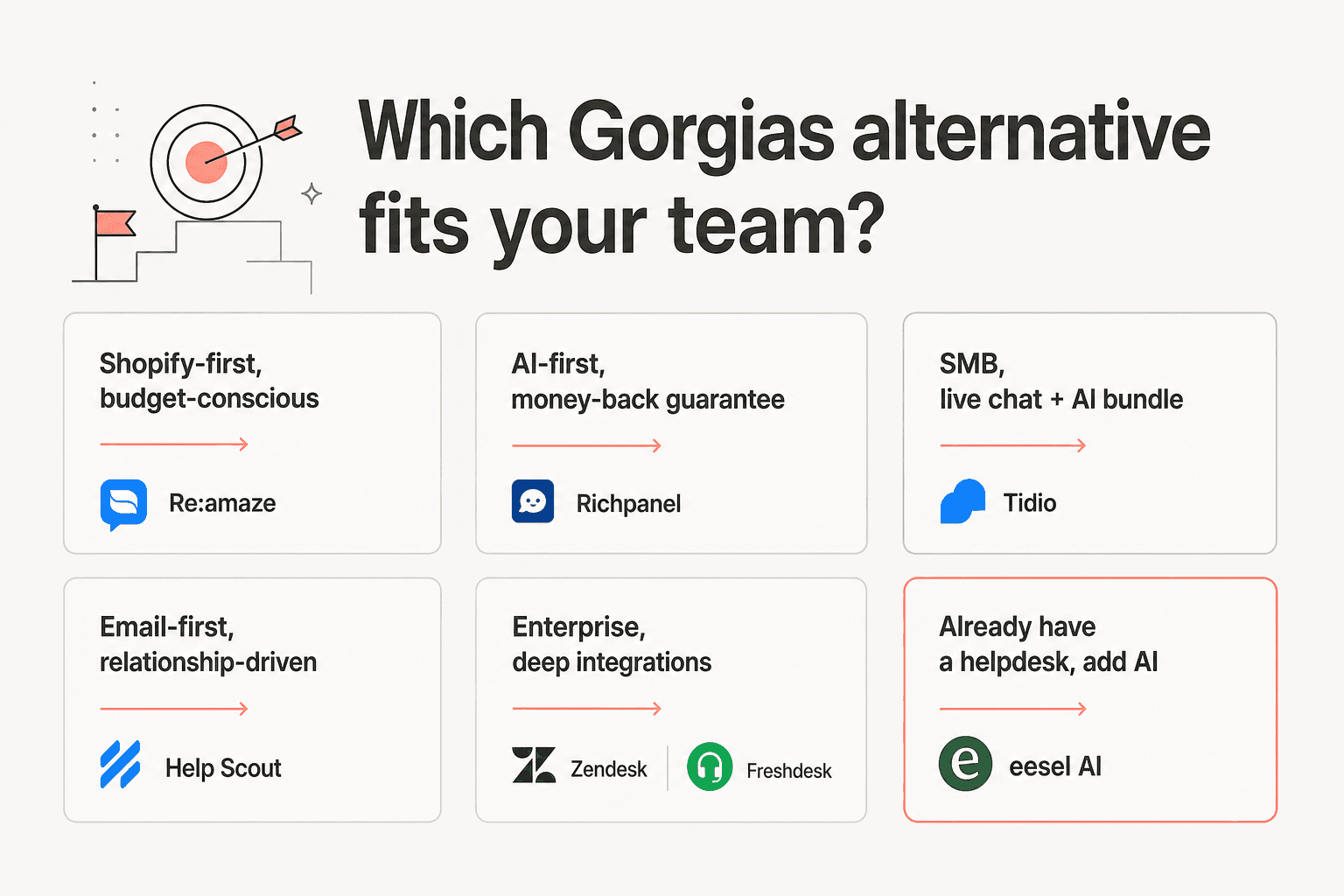
If your pain point is Gorgias's ticket-volume pricing → Re:amaze is the closest feature equivalent on a seat-based model. Run the math: if your per-seat Re:amaze cost comes out lower than Gorgias's per-ticket Pro or Advanced plan, it's a clean swap.
If you want maximum AI automation with a resolution guarantee → Richpanel. The $500/month floor is high, but the 30-day money-back guarantee and $0.25/conversation AI rate make it financially testable. Realistic for brands processing 2,000+ tickets/month.
If budget is tight and you're SMB → Tidio. The 67% Lyro resolution rate, $49.17/month Growth entry, and 4.8/5 Shopify App Store rating make it the most accessible pick. The $749/month jump to Plus will eventually hit you if you scale, but there's a lot of room before then.
If your brand leads with email relationships, not sales chat → Help Scout. The email-like inbox, fast onboarding, and 73% AI resolution average make it the friendliest option for teams that find Gorgias's sales-channel framing a bad fit. Watch the pricing history before committing.
If you're beyond Shopify-only → Freshdesk or Zendesk. Freshdesk for the combination of broad channel coverage and lower per-agent entry price; Zendesk for enterprise compliance, the 1,817-app marketplace, and teams already deep in its ecosystem.
If you have complex customer data at B2C scale → Kustomer. The CRM-first data model, the 70% automation rate at Vuori, and the four-product AI suite are hard to match if your support tickets require customer context that a ticket-centric tool can't surface. The 8-seat minimum and quote-only pricing mean this is only worth evaluating for teams with the budget for it.
If you don't want to switch helpdesks → eesel AI. Add AI resolution to whatever you currently run, at $0.40 per task, without migrating tickets, training agents on a new UI, or taking on an integration project.
Try eesel AI with your existing helpdesk
If you're reading this because Gorgias's AI add-on costs more than you want to pay, eesel AI is worth a look before committing to a full platform migration.
eesel connects to Gorgias, Zendesk, Freshdesk, and 100+ other platforms, ingests your knowledge base, and starts resolving tickets at $0.40 per task - no seat fees, no annual contract, no migration required. Teams use it to handle order status questions, FAQ deflection, draft generation, and escalation routing on top of the helpdesk they already have.
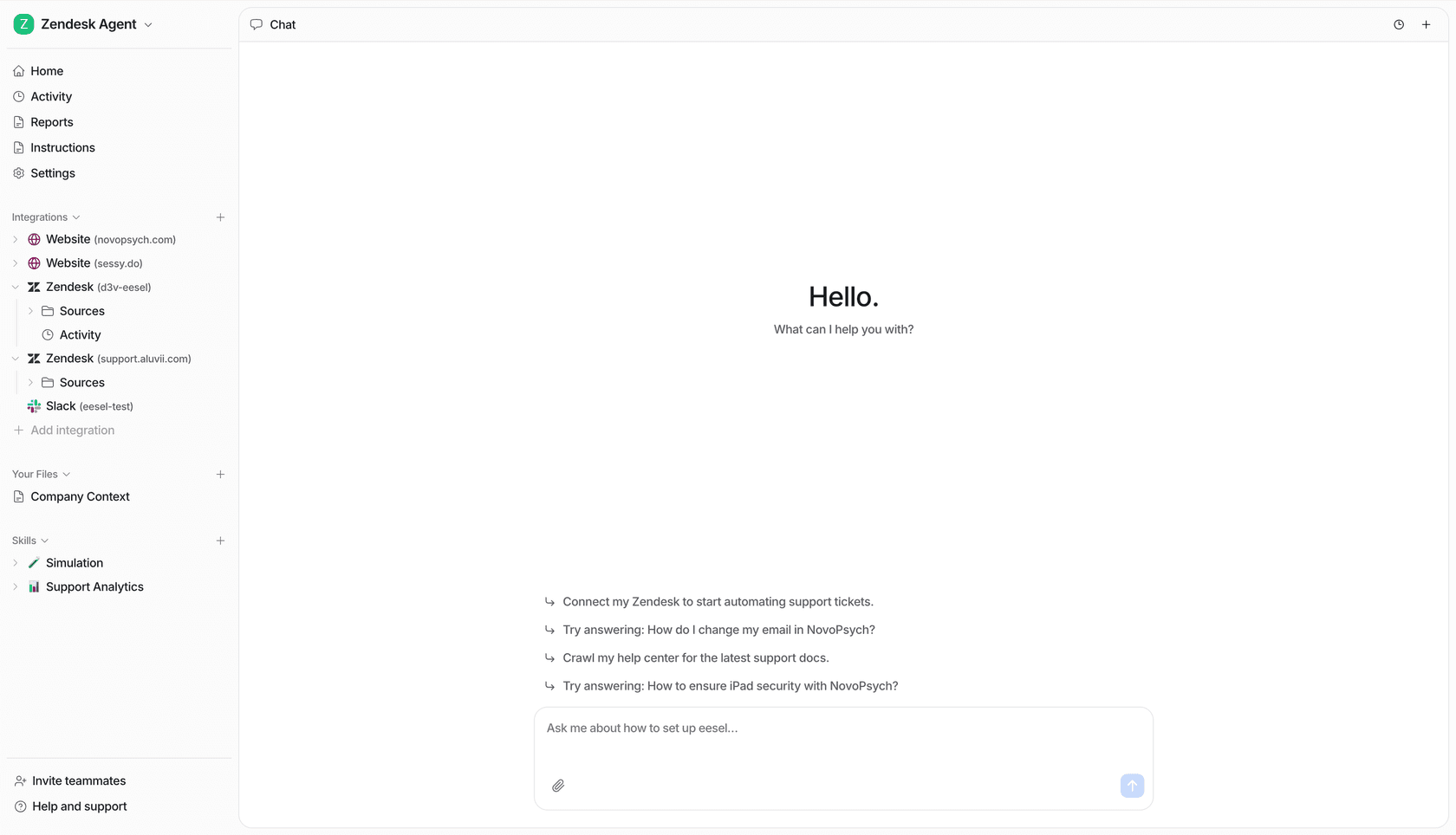
Try eesel free for 14 days - no credit card required.
Frequently Asked Questions
What is the best Gorgias alternative for Shopify brands?
Is there a cheaper Gorgias alternative?
Can I migrate from Gorgias without losing data?
Does Gorgias have an AI agent - and is it included in the price?
What if I don't want to switch helpdesks - can I just add AI to Gorgias?
Which Gorgias alternative handles Shopify orders best?


Article by
Riellvriany Indriawan
Riell is a designer and writer at eesel AI with about two years of experience researching CX platforms, AI chatbots, and helpdesk software. She combines her design background with a sharp eye for how these tools actually look and feel in practice — making her comparisons unusually visual and user-focused.