B2B support teams are facing a familiar dilemma: ticket volumes keep climbing while budgets stay flat. The difference between keeping customers happy and watching them churn often comes down to how quickly you can resolve their issues.
AI helpdesks have moved from experimental to essential. The best ones don't just deflect tickets they actually solve problems. They learn your business, understand your customers, and handle routine requests without human intervention. That leaves your team free to tackle the complex issues that actually need their expertise.
This guide compares seven leading AI helpdesk platforms built for B2B support. We'll look at what each does well, where they fall short, and how their pricing actually works (no "contact sales" hand-waving). Whether you're looking to augment your current help desk or replace it entirely, you'll find a clear path forward.
What is an AI helpdesk?
An AI helpdesk is support software that uses artificial intelligence to understand, route, and resolve customer requests. Unlike traditional ticketing systems that simply organize conversations, AI helpdesks actively participate in them.
The core capabilities break down into three categories:
- AI agents handle tickets autonomously from start to finish, resolving issues without human involvement
- AI copilots draft replies for human agents to review, edit, and send
- Intelligent routing analyzes incoming requests and sends them to the right team or person automatically
B2B support differs from B2C in ways that matter for AI. You need account-level context not just ticket-level plus SLA tracking, the ability to handle multiple contacts from the same company, and deep integration with your CRM and product data. The AI can't just answer questions it needs to understand the relationship behind them.
How we evaluated these platforms
We looked at five criteria that matter most for B2B teams:
- Autonomous resolution rate: Does the AI actually solve problems, or just redirect them?
- B2B-specific features: Account context, SLA management, multi-contact handling
- Integration depth: Can it see and act on data from your CRM, order systems, and product?
- Pricing transparency: Can you calculate costs without talking to sales?
- Setup time: How long from signup to handling real tickets?
These seven platforms represent different approaches: some are enterprise suites, others are mid-market focused, and a few specialize in specific industries. Together they cover the landscape of what's actually available in 2026.
Quick comparison
| Platform | Starting price | AI resolution | Best for | Key differentiator |
|---|---|---|---|---|
| eesel AI | $299/mo | Up to 81% | Teams wanting AI as a teammate | Learns your business in minutes, progressive rollout |
| Zendesk | $19/agent/mo | Up to 80% | Large enterprises | Mature ecosystem, extensive marketplace |
| Freshdesk | $19/agent/mo | Up to 80% | Growing mid-market teams | Fast setup, practical AI features |
| Intercom | $29/seat/mo | 65% | SaaS and product-led companies | Strong in-app messaging |
| Kustomer | Custom | Not stated | Teams wanting CRM + support unified | Unified customer timeline |
| HubSpot Service Hub | $9/seat/mo | 65%+ | Companies using HubSpot CRM | Connects support to revenue |
| Gorgias | $10/mo | 60% | Ecommerce brands | Deep Shopify integration |
1. eesel AI
The AI teammate that learns your business and levels up from drafts to full autonomy
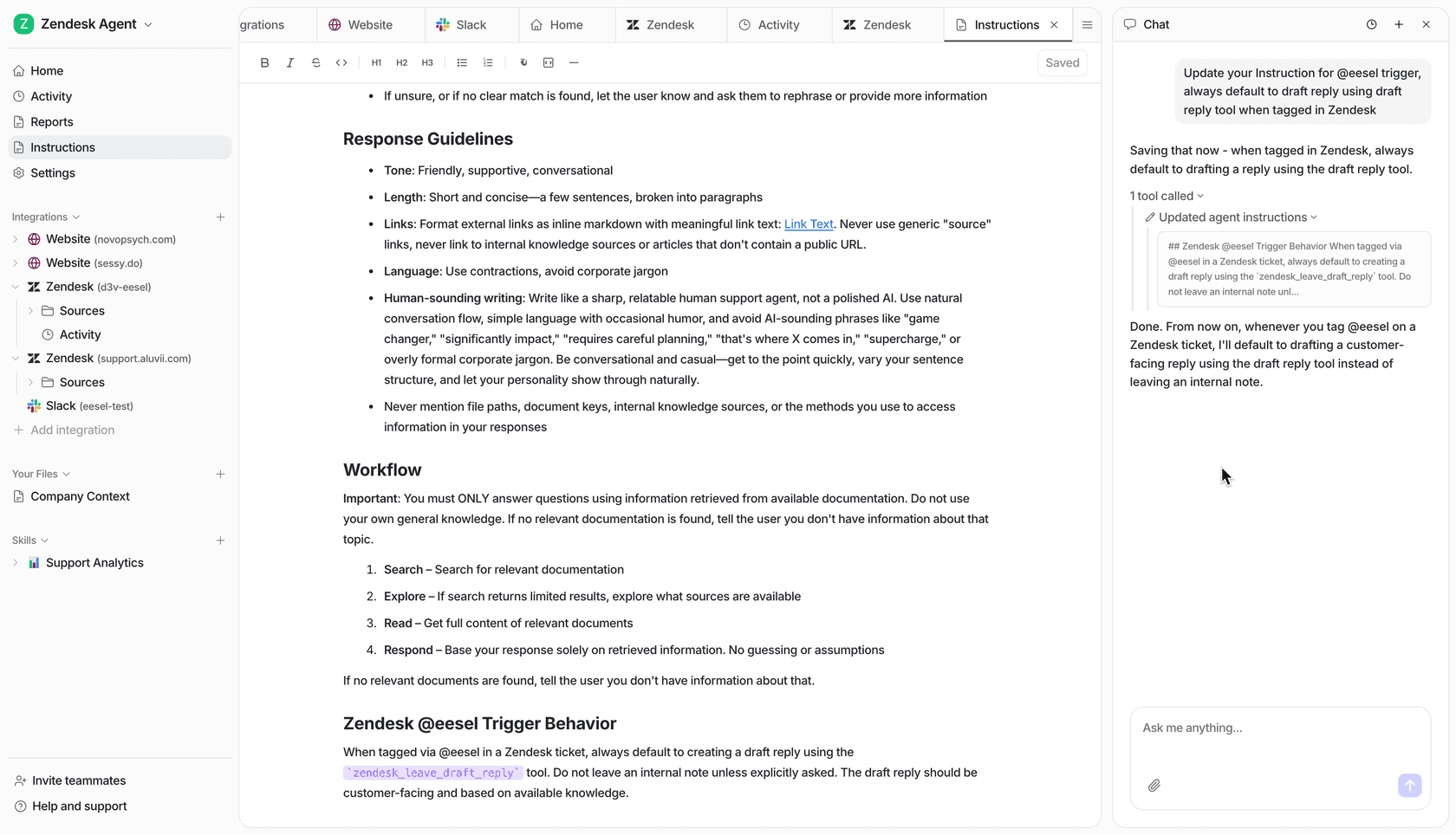
Most AI helpdesks position themselves as tools you configure. eesel AI takes a different approach: you hire it like a new team member. It learns your business from existing data, starts with guidance, and levels up to autonomy based on actual performance.
Here's how it works. You connect eesel to your existing help desk (Zendesk, Freshdesk, Intercom, Gorgias, or others). It immediately reads your past tickets, help center articles, macros, and any connected docs like Confluence or Notion. Within minutes, eesel understands your tone, policies, and common issues. There's no manual training, no uploading documents, and no configuration wizards.
The AI Agent handles frontline tickets autonomously, achieving up to 81% resolution rates in mature deployments. The AI Copilot drafts replies for agents to review before sending. You choose where to start: maybe eesel drafts responses for human review first, or handles only specific ticket types during business hours. As performance proves itself, you expand the scope.
Eesel connects to 100+ integrations including help desks, knowledge sources, and internal tools.
What makes this approach different is control through plain English. You define escalation rules naturally: "If the refund request is over 30 days, politely decline and offer store credit" or "Always escalate billing disputes to a human." No code, no decision trees.
Before going live, you can run simulations on thousands of past tickets to see exactly how eesel would respond. Measure resolution rates, identify gaps, tune instructions. Only deploy when you're confident.
Pricing:
| Plan | Monthly | Annual | Key features |
|---|---|---|---|
| Team | $299 | $239/mo | 3 bots, 1,000 interactions, Copilot, Slack |
| Business | $799 | $639/mo | Unlimited bots, 3,000 interactions, AI Agent, MS Teams |
| Custom | Contact sales | Contact sales | Unlimited interactions, multi-agent orchestration |
Best for: B2B companies that want AI to feel like a team member, not a black box. Teams that value testing before deploying and controlling the pace of automation.
See eesel AI pricing for detailed plan information.
Pros: Fastest setup in the category, learns from existing data, transparent flat-fee pricing, teammate mental model that matches how AI actually works
Cons: Not a standalone helpdesk (requires existing Zendesk, Freshdesk, Intercom, etc.)
2. Zendesk
Enterprise helpdesk with embedded AI for high-volume teams
Zendesk has been the default choice for enterprise support for years, and their AI integration has matured significantly. If you're already standardized on Zendesk, their AI features are the natural next step.
The platform offers AI agents that can resolve up to 80% of requests autonomously, though you'll need the Advanced AI add-on for the full capability. AI copilot provides contextual assistance with suggested replies. Intelligent routing directs tickets based on intent, sentiment, language, and agent skills.
The strength here is the ecosystem. With 1,800+ apps in the marketplace, you can connect almost anything. The platform handles omnichannel support across email, messaging, voice, and social. For enterprises needing extensive customization and proven scale, Zendesk delivers.
The trade-off is complexity. Pricing has multiple tiers and add-ons that can surprise you. AI features often cost extra beyond base plans. As your team grows, costs scale linearly with headcount.
Pricing:
| Plan | Annual | Monthly | Key features |
|---|---|---|---|
| Support Team | $19/agent | $25/agent | Email/ticketing, basic automations |
| Suite Team | $55/agent | $69/agent | + AI agents (Essential), messaging, help center |
| Suite Professional | $115/agent | $149/agent | + Copilot, skills-based routing, SLA management |
| Suite Enterprise | $169/agent | $219/agent | + Sandbox, custom roles, up to 300 help centers |
AI add-ons: Advanced AI Agents (contact sales), Copilot ($50/agent/mo), automated resolutions ($1.50-$2.00 each)
Best for: Large enterprises already using Zendesk, teams needing extensive customization, organizations requiring HIPAA compliance
Pros: Mature ecosystem, extensive marketplace, proven at scale, comprehensive feature set
Cons: Complex pricing, AI features cost extra, gets expensive as team grows
3. Freshdesk
Practical AI for mid-market teams seeking fast time-to-value
Freshdesk (part of Freshworks) offers a balanced approach: structured ticketing with practical AI that doesn't require a PhD to implement. Their Freddy AI handles up to 80% of support queries autonomously.
The Freddy AI Copilot helps agents write responses, summarizes tickets, and suggests solutions. The AI Agent Studio lets you build custom AI agents without code. Sentiment analysis prioritizes tickets from dissatisfied customers so they get attention faster.
Setup is straightforward, which matters if you're moving from email-based support to a proper help desk for the first time. The 1,000+ integrations cover most tools B2B teams use. Omnichannel support spans email, phone, chat, and social.
The catch is that AI capabilities require add-ons they're not included in base pricing. You'll need to factor that into cost calculations. Some users also report mobile app reliability issues.
Pricing:
| Plan | Annual price | Key features |
|---|---|---|
| Free | $0 | Up to 2 agents, basic ticketing, knowledge base |
| Growth | $19/agent/mo | Automation, reporting |
| Pro | $55/agent/mo | Custom portals, advanced ticketing |
| Enterprise | $89/agent/mo | Audit logs, approval workflows, advanced security |
Freddy AI Agent and Copilot: Additional cost (not included in base pricing)
Best for: Growing teams wanting structured ticketing with practical AI, organizations moving from email to help desk software
Pros: Easy setup, good value for mid-market, 1,000+ integrations, solid tier-1/tier-2 automation
Cons: AI requires add-ons, mobile app issues reported, limited product support in lower tiers
4. Intercom
Conversational AI for SaaS and product-led companies
Intercom built its reputation on messaging-first support, and their Fin AI Agent extends that to autonomous resolution. With 65% resolution rates, it's particularly strong for SaaS companies where in-app support matters.
Fin AI Agent handles customer questions across every channel. The AI copilot (available as an add-on) assists agents in the inbox. Workflow automation uses a visual builder for custom flows. The real strength is in-product messaging: you can engage users contextually based on what they're doing in your app.
Setup is fast (under an hour on existing help desks). You can customize tone and answer length to match your brand. The AI can take actions on external systems, not just provide information.
The pricing model can surprise you. Beyond per-seat costs, Fin AI charges $0.99 per resolution. For high-volume teams, that adds up quickly. The pricing structure gets complex when you factor in all the components.
Pricing:
| Plan | Annual price | Key features |
|---|---|---|
| Essential | $29/seat/mo | Basic help desk, shared inbox, live chat |
| Advanced | $85/seat/mo | + Workflow automation, multilingual help center |
| Expert | $132/seat/mo | + SSO, SLA features, multiple help centers |
Fin AI Agent: $0.99 per resolution Copilot add-on: $29/agent/mo
Best for: SaaS companies with in-app support needs, product-led growth companies, teams wanting proactive engagement
Pros: Strong in-product messaging, good for onboarding flows, fast implementation, customizable tone
Cons: Usage-based pricing can surprise, costs scale quickly with volume, complex pricing structure
5. Kustomer
CRM-native AI with unified customer timeline
Kustomer takes a different approach: instead of bolting AI onto a help desk, they built support around a CRM core. Every interaction feeds into a unified customer timeline, giving agents (and AI) complete context.
The AI Agent Team Assistant handles automated routing and response suggestions. The AI Knowledge Base Assistant generates articles from resolved tickets automatically. The AI Workflow Assistant automates repetitive tasks. Everything ties back to the customer record, including purchase history and past interactions.
This works best if you're already committed to the Kustomer ecosystem. The unified data model is powerful, but switching costs are high if you're coming from another platform.
The main limitation is pricing transparency there's no public pricing. You'll need to contact sales for any tier. The platform is also chat-focused with no voice support, which may not work for all B2B use cases.
Pricing:
| Plan | Pricing | Notes |
|---|---|---|
| All plans | Contact sales | No public pricing tiers |
Best for: Teams wanting CRM and support deeply unified, organizations already using Kustomer, teams needing rich customer context
Pros: Deep customer context, strong automation capabilities, unified timeline view
Cons: Pricing not transparent, chat-only (no voice), best fit for existing Kustomer customers
6. HubSpot Service Hub
Unified support, sales, and marketing with Breeze AI
Service Hub makes the most sense if you're already using HubSpot for sales or marketing. It connects support activity directly to revenue data, which is valuable for B2B teams where customer success and expansion matter.
Breeze Customer Agent resolves 65%+ of conversations automatically. The platform includes knowledge base, customer success workspace for health scores, and SLA customization. Ticket resolution is 39% faster after implementation according to their data, with 28% more tickets closed.
The unified data model is the real advantage. Support agents can see sales history, marketing engagement, and product usage. For revenue-aligned support teams, this context is invaluable.
The pricing has some gotchas. Big jumps between tiers. Mandatory onboarding fees ($1,500 for Professional, $3,500 for Enterprise). Annual contracts lock you in once committed.
Pricing:
| Plan | Price | Key features |
|---|---|---|
| Free | $0 | Up to 2 users, basic ticketing |
| Starter | $9/seat/mo (annual) | Simple automation, multiple pipelines |
| Professional | $90/seat/mo (annual) | AI features, knowledge base, 3,000 credits |
| Enterprise | $150/seat/mo (annual) | Skill-based routing, advanced analytics |
Required onboarding: Professional ($1,500), Enterprise ($3,500) Breeze Customer Agent: 100 HubSpot Credits per conversation
Best for: Companies already using HubSpot for sales/marketing, growing companies needing unified customer data, revenue-aligned support teams
Pros: Unified customer data, connects support to revenue, integrates with existing HubSpot workflows
Cons: Big pricing jumps between tiers, mandatory onboarding fees, annual contract lock-in
7. Gorgias
Ecommerce-focused AI with deep Shopify integration
Gorgias is purpose-built for online stores, and that specialization makes it powerful for ecommerce B2B (think wholesale, B2B marketplaces, or retail operations). Over 15,000 brands use it for Shopify and ecommerce support.
The AI Agent resolves up to 60% of tickets across email, chat, and other channels. The Shopping Assistant provides AI-powered product recommendations. Order management lets you update orders directly within the help desk. Voice of Customer analyzes conversations for feedback and trends.
The deep Shopify integration is the standout feature. The AI understands orders, inventory, and shipping. It can track revenue impact from support interactions. For ecommerce brands, this alignment between support and sales is valuable.
The limitation is scope outside retail and ecommerce, Gorgias is less compelling. The pricing model (ticket-based + per-resolution AI) can get expensive at high volume.
Pricing:
| Plan | Monthly | Tickets/month | AI Agent price |
|---|---|---|---|
| Starter | $10 | 50 | $1.00 per resolution |
| Basic | $50 | 300 | $0.90 per resolution (60 included) |
| Pro | $300 | 2,000 | $0.90 per resolution (600 included) |
| Advanced | $750 | 5,000 | $0.90 per resolution (2,500 included) |
| Enterprise | Custom | Custom | Custom |
Best for: Ecommerce brands on Shopify/BigCommerce, online stores needing order-aware support, teams wanting to turn support into sales
Pros: Deep commerce integration, revenue tracking, fast setup for stores, order-aware AI
Cons: Limited outside retail, expensive at high volume, less ideal for SaaS or traditional B2B
Key features to look for in a B2B AI helpdesk
When evaluating options, focus on these five areas:
Autonomous resolution vs. deflection: Some tools claim AI capabilities but only deflect tickets routing them elsewhere without resolving the issue. True autonomous resolution means the AI solves the problem and closes the ticket. Ask for specific resolution rates and how they're measured.
Integration depth: B2B support requires context from CRM, order systems, product usage, and account history. The AI needs to both see this data and take actions on it updating records, processing refunds, and creating tickets in other systems.
Progressive deployment: Can you start with AI drafting responses for human review, then expand to autonomous handling based on performance? This matters for building trust and catching issues before customers see them.
Pricing model: Per-agent pricing scales with headcount. Per-resolution pricing scales with volume. Flat-fee pricing is predictable but may have limits. Match the model to your growth trajectory.
B2B-specific capabilities: Account-level context (not just ticket-level), SLA tracking and management, handling multiple contacts from the same company, and custom fields that map to your business logic.
Making the right choice for your team
The best AI helpdesk for your B2B team depends on three factors:
Your current tech stack: If you're deeply invested in HubSpot, Zendesk, or Freshdesk, the AI features from your existing vendor may be the path of least resistance. The integration is already there.
Your growth trajectory: Per-agent pricing gets expensive as you scale. Per-resolution pricing is variable. Flat-fee models like eesel AI give you predictability. Calculate costs at your current size and 2x your current size.
Your risk tolerance: Some platforms let you simulate AI performance on past tickets before going live. Others require full commitment. If you're cautious about AI making mistakes with customers, look for platforms with robust testing and gradual rollout options.
One practical approach is to start with a platform that lets you test before deploying. Run your last 1,000 tickets through the AI. See how it would've performed. Tune the instructions. Only then go live with real customers.
Start with an AI teammate, not another tool
The best AI helpdesk doesn't feel like software you installed. It feels like a team member you hired one that learns fast, works 24/7, and never forgets your policies.
That's the core difference between traditional AI tools and the teammate approach. You don't configure eesel AI with workflows and decision trees. You hire it, train it on your existing data, and level it up from drafts to full autonomy based on actual performance.
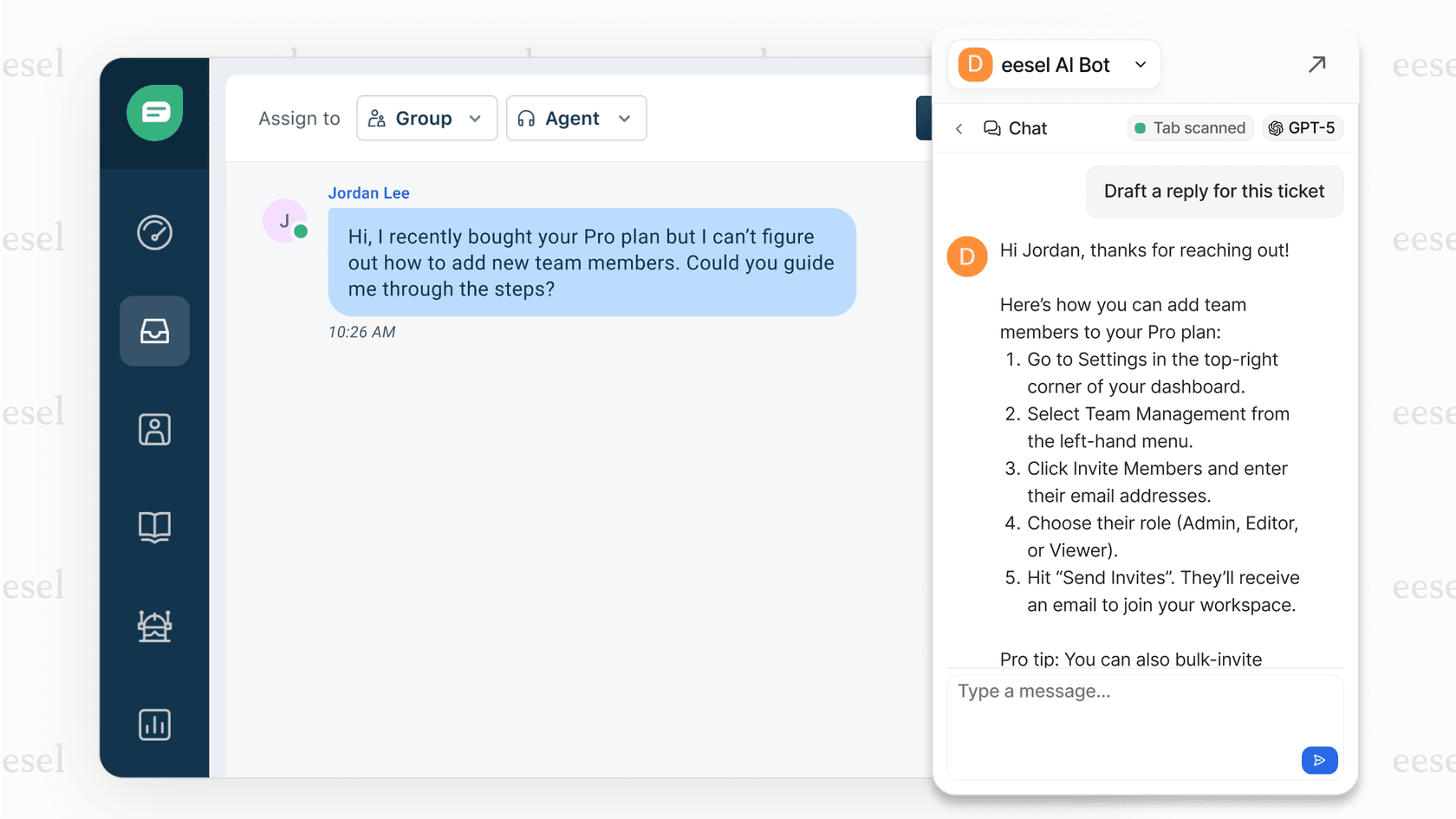
The results speak for themselves: up to 81% autonomous resolution, payback periods under two months, and millions in saved support costs across customers. But more importantly, you maintain control. You see how eesel performs before it's customer-facing. You decide when to expand its scope. You define escalation rules in plain English.
If you're evaluating AI helpdesks for your B2B team, start with a platform that lets you test before you commit. See how eesel performs on your past tickets no credit card required, results in minutes.