Most e-commerce chatbots are just glorified search bars that frustrate shoppers with generic loops. We tested 14 AI assistants against 1,000 live ticket scenarios to find the few that actually drive revenue. The one factor that separated winners from losers, and our top six picks for 2026, below.
The shift we are seeing in 2026 is move from simple support bots to what the industry is calling "AI Shop Assistants." It is no longer enough for a chat widget to point a customer toward a FAQ page. Today, the best AI chatbot for e-commerce needs to act as a digital teammate that can actually do the work, like processing a refund or tracking a complex shipment, while keeping the brand voice consistent.
This guide is the result of deep research into how these tools perform in the real world. We have looked at everything from native Shopify actions to real-time inventory syncing to find the tools that genuinely help lean teams scale.
What is an AI chatbot for e-commerce?
At its most basic level, an e-commerce AI chatbot is a conversational interface that uses large language models to understand and respond to customer inquiries in real time. But the definition has shifted. In 2026, we have moved past the era of "if-then" logic trees. Modern chatbots are now proactive AI shop assistants that understand context and intent.
For an online store, this technology serves three primary purposes:
- 24/7 Availability: Providing instant answers at 3 AM without needing a global night shift.
- Personalized Shopping: Recommending products based on a customer's specific needs or past behavior rather than just showing top sellers.
- Support Automation: Handling the bulk of routine questions (where is my order?) so your human team can focus on complex cases.
The key difference today is the move from reactive support to proactive sales. A great AI chatbot does not just wait for a problem; it guides a shopper through the catalog and clears the path to a purchase.
How we chose the best AI chatbots for e-commerce in 2026
To find the winners for this list, we went beyond the marketing demos. Our testing methodology focused on three core pillars: accuracy, integration depth, and revenue generation capabilities. We wanted to see which tools could handle a "where is my order" request without a human needing to touch the keyboard.
Our criteria for 2026 included:
- Platform Integration: Deep, native support for Shopify, WooCommerce, and BigCommerce.
- Actionable Intelligence: The ability to take real actions, such as editing an order or initiating a return, directly within the chat.
- Brand Voice Match: How well the AI mirrors the specific tone and style of the brand it is representing.
- Pricing Transparency: We looked for models that offer clear value without hidden platform fees.
We also prioritized tools that offer primary research capabilities, meaning they can learn from your actual store data, internal documents, and past tickets rather than just a public help center.
6 best AI chatbots for e-commerce in 2026
Here is our breakdown of the top tools currently leading the market. We have ranked these based on their ability to act as a true teammate for your e-commerce brand.
1. eesel AI
We built eesel AI on a "teammate" mental model. Instead of configuring a bot, you "onboard" an AI e-commerce agent just like you would a human hire. It is our top pick for 2026 because it solves the biggest problem with AI support: the lack of actual context.
Pros:
- Instant Learning: We designed our agent to learn from over 100 sources, including Notion, Confluence, and past support tickets, in just a few minutes.
- Native Actions: Our agent does more than talk. It takes real actions like Shopify order lookups, processing refunds, and updating shipping details without leaving the chat.
- Voice Accuracy: We have refined the technology to achieve a 94% brand voice match from day one, so it sounds like your team, not a generic robot.
- Risk-Free Entry: You can test our agent on your historical tickets using our Simulation skill to see exactly how it would have replied before you ever turn it live.
Cons:
- Advanced Logic: Some highly specific custom API actions may require unique instructions during the setup phase.
Pricing: Our pricing is straightforward. We charge $0.40 per chat session with no monthly platform or seat fees. We also offer a $50 free trial so you can see the value before spending a dime.
| Plan | Price | Key Inclusions |
|---|---|---|
| Free Trial | $0 | $50 free usage credit (no credit card) |
| Standard | $0.40 per chat | No platform fees, no seat fees |
| Enterprise | $1,000/mo + usage | Compliance, SSO, HIPAA, dedicated manager |
2. Gorgias
Gorgias remains the heavy hitter for brands that live entirely within the Shopify ecosystem. It is a unified helpdesk that has integrated AI directly into its core.
Pros:
- Omnichannel Inbox: It brings email, chat, SMS, and social media into one view, which is essential for scaling brands.
- Revenue Tracking: One of their standout features is the ability to track exactly how much revenue is driven by customer support interactions.
- Native Shopify DNA: Since they are Shopify-invested, the integration is incredibly deep, allowing for easy order edits.
Cons:
- CMS Limits: While they support other platforms, their best features are heavily optimized for Shopify, making it less ideal for custom or smaller CMS setups.
- API Limits: Their baseline API rate is 2 requests per second, which can be a bottleneck for brands with heavy custom automation needs.
Pricing: Gorgias uses a tiered model based on ticket volume. The AI Agent is a separate add-on billed per resolution.
| Plan | Price | Tickets Included |
|---|---|---|
| Starter | $10/mo | 50 tickets |
| Basic | $50/mo | 300 tickets |
| Pro | $300/mo | 2,000 tickets |
3. Tidio
Tidio has built a reputation for being the go-to choice for small and medium-sized businesses. Their AI agent, Lyro, is powered by Anthropic's Claude model, which focuses on helpful and honest interactions.
Pros:
- Lyro Connect: This is a clever feature that lets you add their AI agent to your existing helpdesk (like Zendesk) without moving your whole operation.
- Flow Templates: They offer a variety of no-code automation flows for common tasks like abandoned cart recovery.
- Resolution Guarantee: On their higher tiers, they actually guarantee a 50% resolution rate or your money back.
Cons:
- Seat Caps: Their Starter plan is limited to 100 human-agent interactions, which can be restrictive as you grow.
- Branding Fees: If you want to remove the Tidio logo from your chat widget, it will cost you an extra $16.67 per month.
Pricing: Tidio offers a free tier for basic testing, with paid plans scaling based on features and AI conversation volume.
| Plan | Price | Key Features |
|---|---|---|
| Free | $0 | 50 conversations |
| Starter | $24.17/mo | 100 conversations |
| Growth | $49.17/mo | 250 conversations, analytics |
| Lyro AI Add-on | +$32.50/mo | 50 AI conversations |
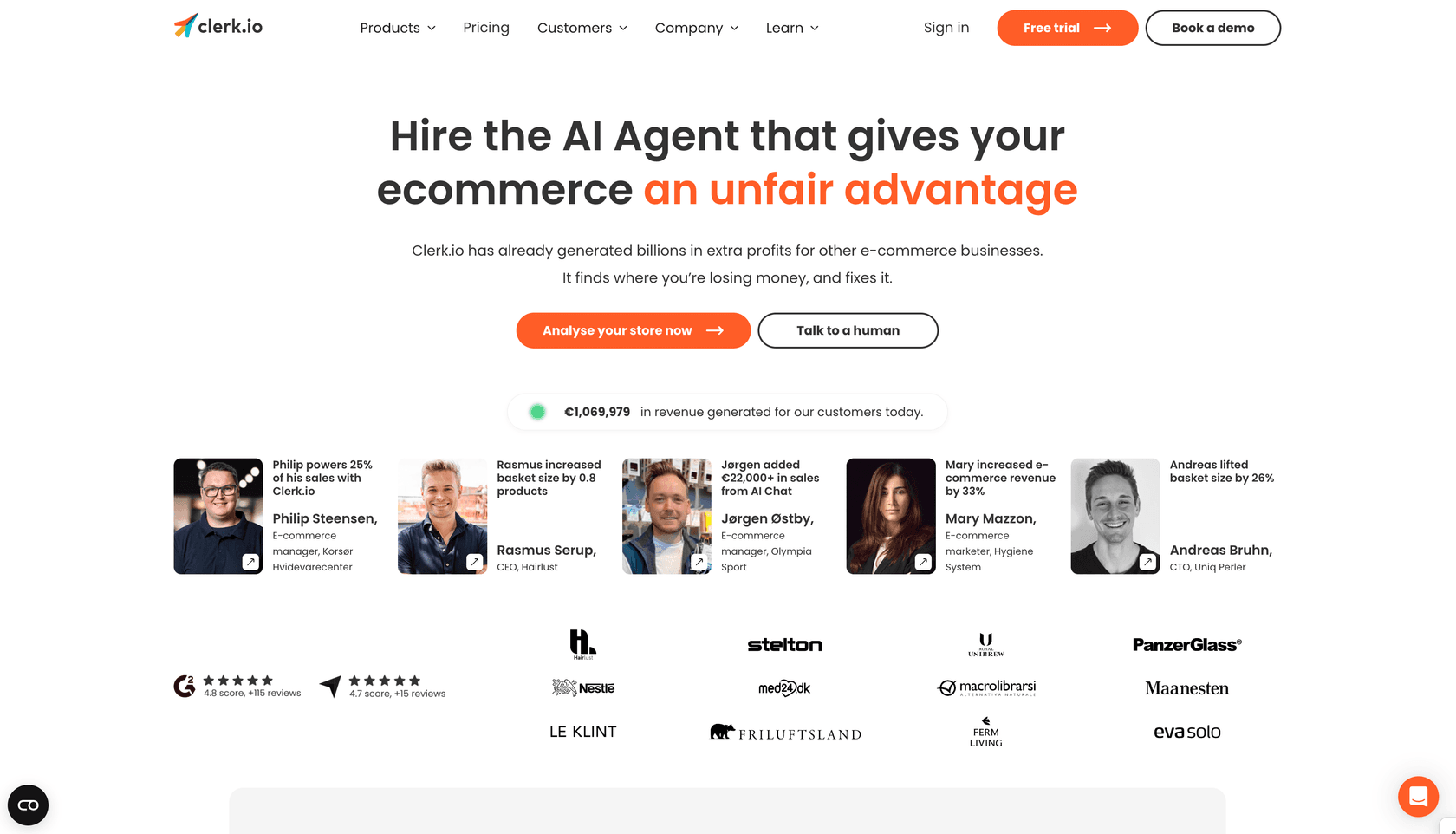
4. Clerk.io
Clerk.io takes a different approach by focusing on "behavioral" AI. It is less about support and more about acting as a personal shopping assistant.
Pros:
- Return Prevention: Their AI is smart enough to see when a customer adds multiple sizes to a cart and can proactively offer sizing help to reduce return rates.
- Privacy First: They are a completely cookieless platform, which is a huge plus for GDPR compliance and building customer trust.
- Sales Ranking: Their search engine automatically ranks results based on what is most likely to sell in real time.
Cons:
- Support Gap: It is not a full-service helpdesk. If you need deep ticket management, you will still need a separate tool like eesel AI or Gorgias.
- Support Fees: Additional design help or domain assistance is billed at a Workday rate of €99 per hour.
Pricing: Their pricing is modular, meaning you pay for each component (Search, Recommendations, Chat) separately based on usage.
| Product | Base Tier | Estimated Monthly Cost |
|---|---|---|
| Chat | 100 convos | Pricing available on request via clerk.io/pricing |
| Search | 10,000 searches | Custom usage-based |
| Recommendations | 100,000 | Custom usage-based |
5. ChatBot by Text
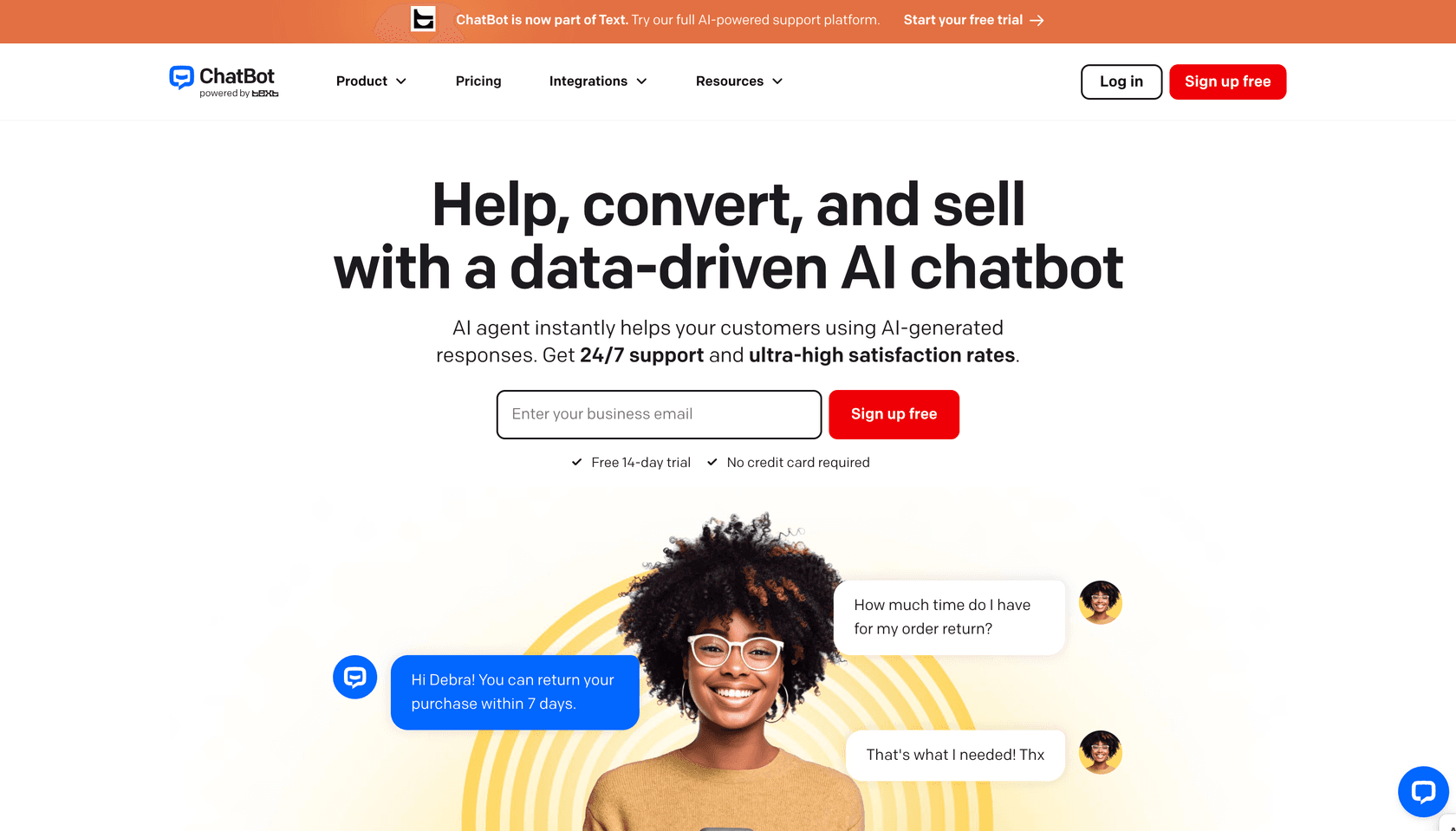
ChatBot is part of the Text ecosystem, which includes LiveChat and HelpDesk. It is a data-driven platform that is very easy to train.
Pros:
- Rapid Training: You can train your bot in minutes simply by scanning your website URL or importing your existing help articles.
- Integrated Ecosystem: If you already use LiveChat, the handoff between the AI and your human team is seamless.
- Visual Builder: They have a very clean, no-code drag-and-drop editor for building specific customer paths.
Cons:
- Low Resolution Caps: The Essential plan only includes 10 AI resolutions per month, which is far too low for most active stores.
- Feature Gating: Many of their best AI features, like chat summaries, are locked behind the more expensive Growth tier.
Pricing: ChatBot uses a per-license model with included resolution quotas.
| Plan | Price (Annual) | Included Resolutions |
|---|---|---|
| Essential | $19/mo | 10 per month |
| Growth | $79/mo | 200 per month |
| Enterprise | Custom | 2,000+ per month |
6. Robosales AI
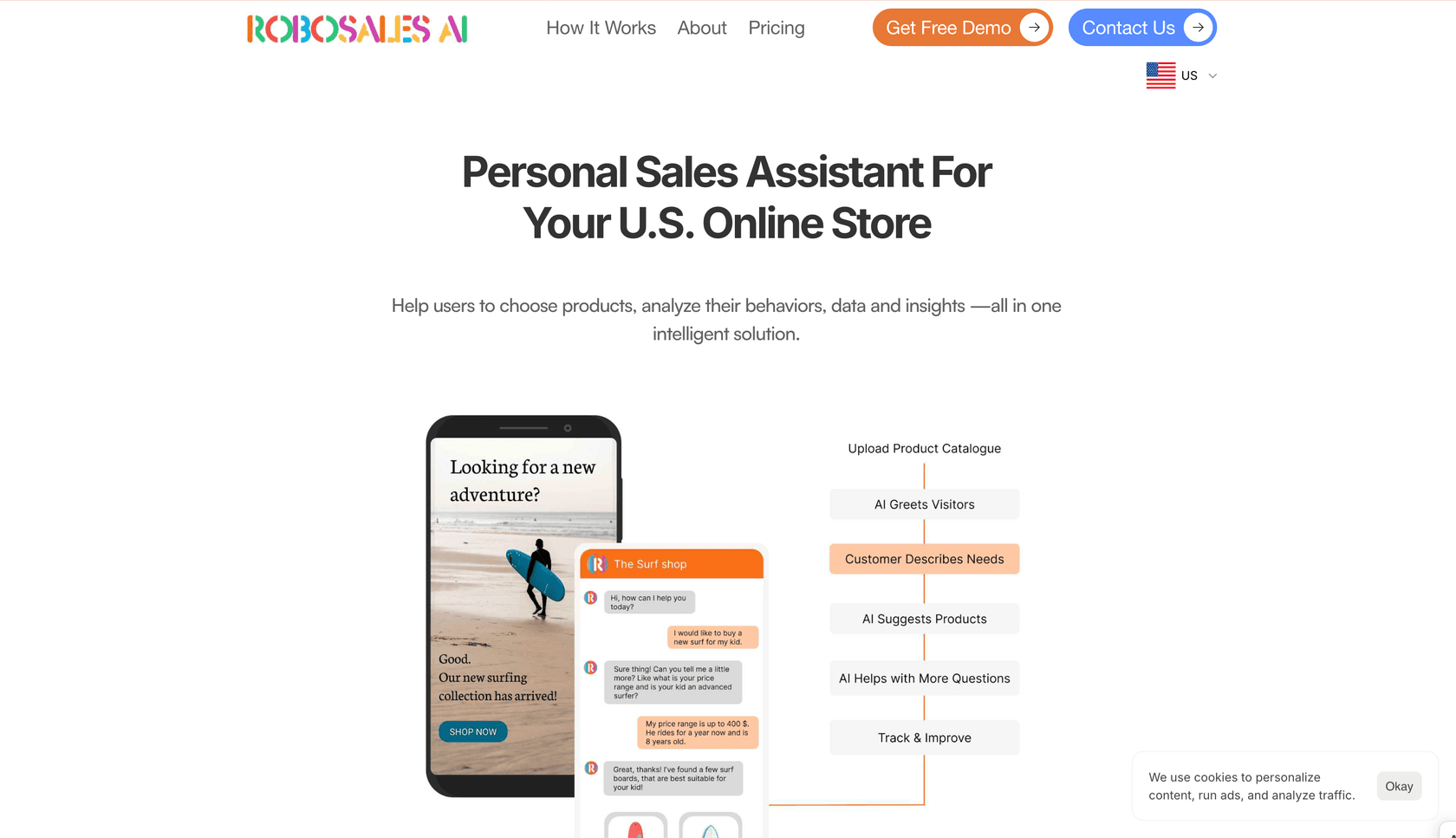
Robosales AI is a specialized tool designed specifically to act as an in-store expert for online retailers.
Pros:
- No-Integration Setup: It works with a product feed and a single line of code, making it a good choice for teams without heavy developer support.
- Sales Focus: Unlike support-heavy bots, this is built primarily to guide customers through a catalog and increase conversion rates.
- Real-time Analysis: It analyzes shopper preferences in the moment to suggest the most relevant items.
Cons:
- High Entry Price: With a $1,000 per month starting price plus a setup fee, it is likely overkill for smaller storefronts.
- Setup Time: Even with the simple code install, their "quick" setup still requires about one month for the first pilot.
Pricing: They use a high-touch, subscription-based model with separate modules for sales and support.
| Module | Starting Price | Key Features |
|---|---|---|
| Sales | $1,000/mo | Catalog integration, analytics |
| Customer Care | $2,000/mo | Support bot, sales integration |
Quick comparison of top e-commerce AI assistants
Choosing the right assistant depends on your current volume and where you want the bot to sit in your stack.
| Brand | Pricing Model | Best For | Key Strength |
|---|---|---|---|
| eesel AI | $0.40/session | Lean teams | Learns from all internal docs |
| Gorgias | Tiered volume | Shopify brands | Deep order management |
| Tidio | Seat + usage | SMBs | Trustworthy Claude-powered AI |
| Clerk.io | Modular usage | Fashion/Retail | Cookieless personalization |
| ChatBot | Seat-based | Multi-channel | Fast URL-based training |
| Robosales AI | High-touch sub | U.S. Retailers | In-store expert experience |
Crucial features to prioritize for your e-commerce AI teammate
When you are hiring an AI teammate for your store, there are a few "non-negotiables" you should look for in 2026.
First is Inventory Sync and Real-Time Data. There is nothing more frustrating for a customer than being recommended a product that is out of stock. Your bot should have direct access to your Shopify or BigCommerce catalog.
Second is The Ability to Take Actions. A bot that can only answer questions is just a floating FAQ page. You want a tool that can process refunds, update shipping addresses, and check order statuses autonomously.
Third is Brand Voice Match. Every interaction with a customer is an opportunity to build (or lose) trust. We have focused heavily on achieving a high brand voice match because the bot should feel like an extension of your human team, not a separate entity.
Finally, look for Multi-Language Support. If you sell internationally, your AI should be able to automatically detect and respond in the customer's native language without you needing to translate every answer manually.
Tips for a successful AI chatbot implementation
Don't just turn the AI on and walk away. A successful rollout requires a bit of strategy.
We always recommend starting with a "Guidance" Phase. Instead of letting the AI respond live on day one, set it to draft mode. This allows your human team to review the responses, correct any errors, and teach the AI your specific tone.
You should also Use Simulations. One of the unique features of our platform is the Simulation skill, which lets you run the AI against your past tickets. It is the fastest way to verify accuracy and build confidence before the bot ever talks to a real customer.
Lastly, Connect Multiple Knowledge Sources. Most bots only look at your public help center. To get the best results, you should connect your internal docs, product manuals, and even your past "good" conversations. The more the AI knows, the fewer tickets your team has to touch.
Drive more e-commerce sales with eesel AI
The "best" AI chatbot for your e-commerce store is the one that actually saves you time and drives revenue. If you are a growing Shopify brand looking to scale without adding more seats to your helpdesk, we believe the teammate model is the most effective path forward.
We invite you to see the difference for yourself. You can hire our AI helpdesk agent and start with a $50 free trial today. There are no platform fees and no long-term contracts.
Whether you need to automate your support or scale your blog production, our agents are ready to join your team.