

I run a support queue, so here's how I read this category
I'm on eesel's customer support team, which means I spend my days in the same queue you're trying to automate: the order that didn't arrive, the refund that's "still processing," the customer who changed their mind about the shipping address ten minutes after checkout. So I read AI support tools the way an agent does, by asking what they actually take off my plate, not by how slick the demo looks.
That frontline view matters because eesel has spent the last few years putting AI agents on live ecommerce queues, and the patterns repeat. One DTC supplements brand we spoke with was running about 7,000 tickets a month on Gorgias plus Shopify and told us, plainly, that their team simply couldn't keep up and needed to auto-resolve at least half of email volume. Another multi-brand operator was handling 500-plus tickets a day, and when we looked at what those tickets actually were, it was the same three things over and over: refunds, unsubscribes, and order tracking. The repetitive, order-data-driven stuff is exactly where AI earns its keep, and it's why ecommerce is one of the strongest fits for support automation there is.
Here's the scar, though, because it shapes how I evaluate every tool below. We've watched a confident-sounding bot tell a customer "yes, we support that" for a product that wasn't in the catalog, simply because a help article said "we support all models." That's why I now care less about a tool's headline resolution rate and more about whether it knows when to shut up and pass the ticket to a human. Keep that in mind as you read.
A quick note on one name you won't see: I've left Intercom and Fin out of this roundup.
How I picked, and what actually matters for ecommerce
I tested and researched each tool against the things that actually move the needle for an online store, not a generic SaaS support desk:
- Order-data actions, not just answers. Can the AI look up an order, process a refund, edit a subscription, or change an address inside the conversation? Answering "here's our return policy" is table stakes. Doing the return is the point.
- Confidence-based routing. Does the AI only auto-reply when it's sure, and silently escalate the rest? This is the difference between automation you trust and a liability.
- How it bills. Per-resolution, per-conversation, per-ticket, or per-seat. This is the number that surprises people on the invoice.
- Setup and time to value. Does it train on your past tickets and your help center, or do you start from a blank slate?
- Whether you have to switch helpdesks to get the AI at all.
For the wider picture beyond ecommerce, our roundup of the best customer service AI covers general-purpose platforms, and the ecommerce helpdesk guide goes deep on the inboxes themselves.
The two paths, before the list
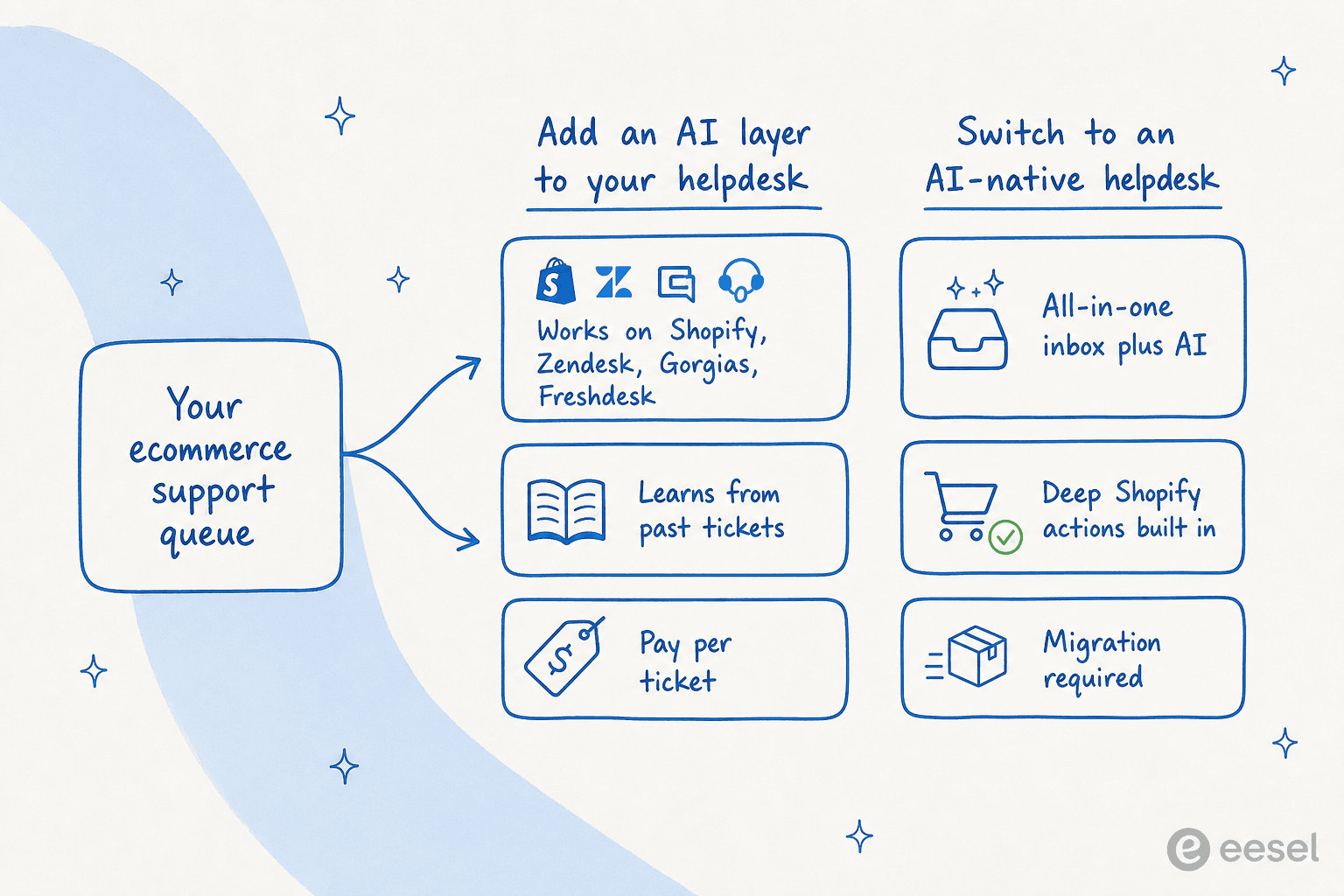
Almost every tool here falls into one of two camps. On the left are AI layers that sit on top of your current helpdesk: you keep your Shopify setup and your existing inbox, and add automation without a migration. On the right are AI-native helpdesks that want to replace your inbox entirely, with the AI baked in. Knowing which path you're on cuts the shortlist in half before you've watched a single demo.
The 8 best AI tools for ecommerce customer support
Here's the quick comparison, then the detail on each.
| Tool | Best for | How AI is billed | Entry price | Shopify-native | Confidence routing | Channels |
|---|---|---|---|---|---|---|
| eesel AI | Adding AI to your existing helpdesk | Flat $0.40 / ticket | $0 trial, then usage | Via integration | Yes | Helpdesk, chat, email, Slack |
| Gorgias | All-in-one Shopify-native platform | $0.90–$1.00 / resolution | $10/mo helpdesk | Native | Configurable | Email, chat, SMS, social, voice |
| Gladly | High-LTV consumer brands | ~$1.50 / resolution | Demo-gated | Via integration | Yes | Chat, voice, email, SMS, social |
| Richpanel | AI-first DTC with a guarantee | $0.25 / conversation | $500/mo + seats | Native | Yes (QA layer) | Email, chat, social, SMS, voice |
| Re:amaze | Budget all-in-one for small teams | $0.85 / resolution | $29/seat/mo | Yes | Beta | Email, chat, SMS, social, video |
| Tidio | Small Shopify stores led by live chat | $0.50 / conversation | $0 free tier | Yes (Growth+) | Yes | Chat, email, social |
| Zendesk | Large omnichannel operations | Per automated resolution | $19/agent/mo | Via app | Yes | Omnichannel, voice |
| Freshdesk | Teams in the Freshworks ecosystem | $49 / 100 sessions | $0 for 6 months | Via app | Yes | Email, chat, phone, social |
1. eesel AI
Best for: teams who want to keep their current helpdesk and add AI on top of it.
I'll be upfront that this is the tool I work with, so read the verdict with that in mind, but the reason it leads my list is specific: it's the only option here that doesn't ask you to switch anything. eesel AI plugs into the helpdesk you already run, whether that's Zendesk, Gorgias, Freshdesk, or Front, pulls in your Shopify order data, and learns from your past tickets and help center on day one.
The part that matters most for ecommerce is what it does with that context. It resolves the WISMO, refund-status, and address-change tickets that dominate an online store's volume, taking real actions rather than just quoting policy. And it leads with the thing my scar story is about: confidence-based routing, so the agent only answers what it's sure of and quietly leaves the rest for a human. Before you go live, you can simulate the agent against your past tickets to see exactly what it would have resolved and where it would have stayed quiet, broken down by topic. In one real-traffic trial on an ecommerce inbox, that simulation surfaced 93% triage accuracy and 100% spam detection before a single live reply went out.
Pros:
- No migration. Works on top of 100+ integrations including Shopify, WooCommerce, and the major helpdesks.
- Trains on your resolved tickets, so it sounds like your team, not a generic FAQ bot.
- Flat $0.40 per ticket, with no per-seat fees and a spend cap you set yourself.
- Simulation mode lets you prove ROI before going live, which is rare in this category.
Cons:
- It's an AI layer, not a full helpdesk, so if you don't have an inbox yet you'll still need one (email-only setups are a gap).
- SOC 2 is in progress rather than certified, which can matter for regulated buyers.
Pricing: Free until you've used $50, no credit card. After that it's usage-based at $0.40 per ticket with no platform fee. A store doing 1,000 AI-handled tickets a month pays around $400, and you're never charged for tickets your humans handle.
Our take: If you already have a helpdesk and a Shopify store, this is the lowest-friction way to get real automation live this week. Pick something else only if you're shopping for a brand-new inbox at the same time.
2. Gorgias
Best for: Shopify brands that want their helpdesk and AI in one Shopify-native platform.
Gorgias is the helpdesk built specifically for online retail, and it's earned its reputation. It claims to power customer conversations for 40% of Shopify brands, and its AI Agent is pre-trained on over a billion ecommerce conversations, so it handles returns, order edits, subscription changes, and even conversational upsells natively. Orders and customer data live inside the ticket view with no syncing, which is the thing no general-purpose helpdesk does as cleanly.
The community sentiment is remarkably consistent on both its strength and its catch. As one Reddit user with a decade in ecommerce put it:
"I've been around ecommerce for 10+ years and this is honestly how I'd choose: 40%+ tickets need Shopify actions → I'd lean Gorgias. Mostly conversational support → Zendesk is fine."

Pros:
- The deepest native Shopify integration of any helpdesk, full stop.
- Fully omnichannel: email, chat, SMS, WhatsApp, Instagram, Facebook, and TikTok in one inbox.
- Ticket-based pricing rather than per-seat, so adding agents doesn't inflate the bill.
Cons:
- Pricing creep is the universal complaint. The AI Agent is a separate per-resolution charge on top of the helpdesk ticket, and small teams routinely flag it as roughly 3x Zendesk for similar volume.
- Each AI resolution also counts as a billable helpdesk ticket, so you're metered twice.
Pricing: Helpdesk plans run from $10/mo (Starter, 50 tickets) up to $750/mo (Advanced, 5,000 tickets), with the AI Agent billed separately at $0.90 per resolution on annual plans, $1.00 on monthly. We break the full math down in our Gorgias AI pricing guide.
Our take: If 40% or more of your tickets need a Shopify action, Gorgias is worth the premium and the obvious pick. Just go in with eyes open about the per-resolution meter, because we've literally watched a trial user run twelve flawless test chats, hit the billing page, and immediately demand to cancel out of pure sticker shock.
3. Gladly
Best for: premium, high-touch consumer brands where the customer relationship is the product.
Gladly takes a deliberately different stance: it organizes support around people, not tickets, so each customer is one continuous lifelong conversation instead of a stack of disconnected threads. Its AI agent, Sidekick, resolves end to end and takes real actions like cancellations and exchanges across chat, voice, email, SMS, and social. The customer roster tells you who it's for: TUMI, UGG, Nordstrom, Crate & Barrel, and HOKA. It holds a 4.7 out of 5 from over 1,100 G2 reviews and claims 76% of conversations fully resolved by AI.
Pros:
- The unified customer profile is the thing reviewers love most; customers never repeat themselves across channels.
- Strong on voice, which most ecommerce-AI tools treat as an afterthought.
- Conversation-first model fits brands that see support as a revenue and loyalty channel.
Cons:
- Expensive, and consistently flagged as such. There's no published platform pricing; it's demo-gated.
- The most-cited gripe in reviews is fragmented reporting that needs manual exports.
- A real learning curve compared to lighter tools.
Pricing: The core platform is sales-gated. The only public, self-serve rates are on its Shopify App Store listing: roughly $1.50 per AI resolution, $0.25 per AI assist, and $120/mo per seat. As one ecommerce operator summed it up:
"Gladly works well if you really want a conversation-first experience though it's usually on the pricier side."
Our take: If you're a premium brand where lifetime value justifies the spend and voice matters, Gladly is a strong, differentiated choice. Smaller or more price-sensitive stores will find the per-resolution rate hard to stomach.
4. Richpanel
Best for: DTC brands that want an AI-first helpdesk and a money-back guarantee to de-risk it.
Richpanel leans hardest into the AI-native idea, pitching the purchase as "hiring an AI support team" rather than buying software. It pairs a full helpdesk with four AI roles: Frontline AI resolves tickets, Copilot AI assists agents, QA AI reviews 100% of replies before they send, and a CX Manager AI builds SOPs and orchestrates the rest. That QA layer is its direct answer to the hallucination worry, and it's a smart one.
The commercial hook is unusually concrete: a 50% autonomous resolution guarantee in 30 days or your money back, with 70 to 80% claimed at maturity. Named customers like Jones Road Beauty and The Ridge cite zero Black Friday backlog and CSAT holding or climbing after the AI went in.
Pros:
- The QA AI reviewing every reply is a real, differentiated safety layer.
- Strong, named security posture: SOC 2 Type II, HIPAA, GDPR, 99.9% uptime.
- Migration tooling imports tickets, macros, and rules from Zendesk or Gorgias.
Cons:
- It's a full platform switch, so you're replacing your inbox, not augmenting it.
- The $500/mo floor makes it a poor fit for very small stores.
- No verifiable third-party review volume yet; most proof is vendor testimonials.
Pricing: The self-serve AI Agent plan is $500/mo plus $0.25 per conversation and $100/seat/mo. A sample bill of 2 AI agents plus 3 human seats lands around $800/mo, with breakeven cited around 3 agents or ~2,000 conversations a month.
Our take: If you're committed to going AI-first and want a contractual guarantee to back it, Richpanel is one of the boldest options here. The 30-day guarantee really does lower the risk of the bet. Just know you're switching helpdesks to make it.
5. Re:amaze
Best for: small ecommerce teams that want an affordable all-in-one inbox with AI included.
Re:amaze (owned by GoDaddy) is the value pick. It bundles email, live chat, social, SMS, VoIP, and video into one shared inbox, and ships chatbots, proactive Cues, a real-time customer activity dashboard, and co-browsing as first-party features rather than paid add-ons. Order data surfaces inside conversations, and its AI Agent (currently in beta) aims for 24/7 autonomous answers trained on your business data.
The standout is an unusual pricing option, the $59/month flat Starter plan that lets unlimited team members use it for up to 500 conversations, which is rare in a per-seat world.
Pros:
- Excellent value, especially the flat-rate Starter tier for low-volume teams.
- A lot of engagement tooling (Cues, Live Dashboard, Peek co-browsing) bundled in.
- Customer testimonials cite real speed gains, like one brand going from a handful of chats a week to 60 to 80.
Cons:
- The AI Agent is still beta, so it's less proven than Gorgias's or Gladly's.
- AI resolutions are capped per user per month, then $0.85 each, which complicates the math.
- Less Shopify-deep than Gorgias for complex order actions.
Pricing: Plans run $29 to $69 per seat/month (or the $59 flat Starter), with AI resolutions at $0.85 each beyond the included monthly allotment. A 14-day free trial, no card required.
Our take: For a small store that wants one affordable tool to do everything and isn't ready to pay enterprise per-resolution rates, Re:amaze is the sensible, budget-friendly choice. Just treat the AI Agent as promising-but-young.
6. Tidio
Best for: small Shopify stores whose support starts with the live chat widget.
Tidio is the live-chat-led option, and its AI agent Lyro is its headline. Lyro is powered by Anthropic's Claude and claims a 67% average resolution rate, which Tidio backs with a money-back guarantee if you don't clear 50%. It's used by over 300,000 businesses, scores 4.8 on the Shopify App Store, and is praised in reviews for being installable in minutes with no engineering help. For a small store, that low barrier to entry is the whole appeal. If live chat is your main channel, it sits alongside the other AI live chat tools worth a look.
Pros:
- Free tier to start, and famously easy setup.
- Lyro is grounded in your data and praised for staying on-script rather than hallucinating.
- Native Shopify actions (order tracking, cart recovery) on Growth and up.
Cons:
- Layered usage pricing (billable conversations plus Lyro conversations plus Flows visitors) gets hard to predict at scale.
- The jump from Growth to the $749/mo Plus plan is steep.
- Lower plans are email-support only.
Pricing: Free plan (50 Lyro conversations), paid plans from ~$24.17/mo, and standalone Lyro AI from $32.50/mo to layer onto an existing helpdesk. Lyro conversations are about $0.50 each on paid plans.
Our take: For a small Shopify store that leads with chat and wants AI live today without a project, Tidio is a great entry point. Bigger operations will likely outgrow the conversation-based pricing.
7. Zendesk
Best for: large or omnichannel operations that have outgrown an ecommerce-only tool.
Zendesk isn't ecommerce-specific, but plenty of large stores run on it, and its AI resolution platform is serious: 22,000-plus AI customers, claims of up to 80% automation, and a recently folded-in Forethought engine for self-improving agents. It connects to Shopify via marketplace apps rather than natively, which is exactly the trade-off the Reddit crowd debates.
Pros:
- Mature, deeply configurable, and battle-tested at scale.
- Best-in-class reporting, QA, and workforce management.
- Huge app marketplace (1,800+ integrations).
Cons:
- Not Shopify-native; order actions need apps or custom work.
- The pricing model is layered and easy to under-estimate (seat price, then separate per-resolution AI, then $50/agent add-ons).
- Heavier to configure than a purpose-built ecommerce tool.
Pricing: Seats run $19 to $115/agent/month, with AI billed separately per automated resolution on top, plus $50/agent/mo add-ons like Copilot. The entry $19 plan includes no AI at all. Worth noting: in our own demo calls, more than one ecommerce operator told us they'd tried native Zendesk AI and found it "expensive and inadequate," which is often what sends people looking for an AI layer to add on top.
Our take: If you're already on Zendesk and operate at scale, keep it and add an AI layer rather than ripping it out. If you're a Shopify-first brand starting fresh, a native tool will get you there faster.
8. Freshdesk
Best for: teams already in the Freshworks ecosystem, or bootstrapped stores wanting a long free runway.
Freshdesk is the generalist with a properly useful free tier. Its Freddy AI Agent offers 50-plus prebuilt agentic workflows and claims up to 80% resolutions, surfaced inside a unified Command Center. It integrates with Shopify, Stripe, and PayPal via its marketplace. The real hook for small stores is the free plan for up to 2 agents for 6 months, which is a rare on-ramp. For more options here, see our Freshdesk AI free alternatives roundup.
Pros:
- Generous 6-month free tier; no credit card.
- Top-rated for usability on G2 and TrustRadius.
- A mature platform that scales well beyond ecommerce.
Cons:
- Like Zendesk, not Shopify-native; order actions lean on integrations.
- Freddy AI is consumption-priced and gets pricey for high volume.
- The AI story is newer than its ticketing pedigree.
Pricing: Paid plans are $19 (Growth), $55 (Pro), and $89 (Enterprise) per agent/month, with the Freddy Email AI Agent including the first 500 sessions then $49 per 100 sessions.
Our take: If you're already a Freshworks shop or want the longest free runway to start, Freshdesk is a solid, friendly choice. One email-security team we spoke with tested Freddy AI and ended up finding a dedicated AI layer more precise, so if accuracy is your priority, pair Freshdesk with a specialist agent rather than relying on Freddy alone.
How AI actually fits an ecommerce support queue
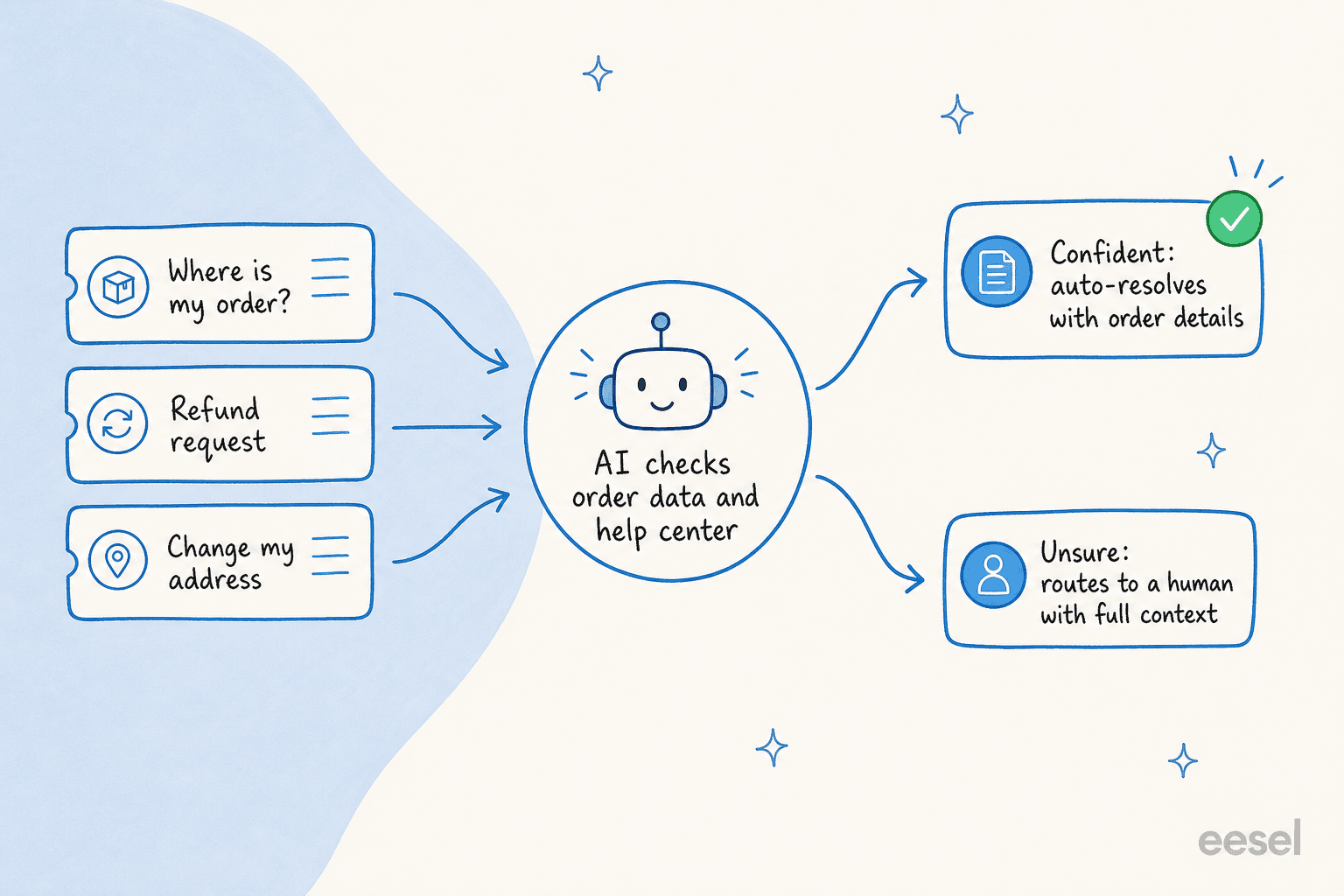
Once you've picked a tool, the mental model is the same regardless of brand. The incoming queue is dominated by a few repetitive, order-data-driven intents: where is my order, refund status, change my address, cancel my subscription. A well-set-up agent connects to your Shopify or WooCommerce store, checks the live order data and your help center, and resolves the ones it's confident about, with the real action taken inside the conversation.
The tickets it isn't sure about, the angry edge cases, the one-off "my package was left in the rain and the product is a gift for tomorrow," get routed to a human with the full context attached. That confidence split is the whole game. A CX lead at a DTC supplements brand we spoke with, running 7,000 tickets a month, said it better than I can: the AI will never answer 100% of the questions, so what he needed was an AI that only handles the tickets it's confident about and leaves all the others alone. Because if it guesses and answers "sorry, I don't know," he can't realistically go back through 7,000 tickets to check whether it got them right.
Any tool that auto-replies "sorry, I don't know" to a customer instead of escalating is creating more work, not less. That's the bar.
The pricing trap nobody warns you about
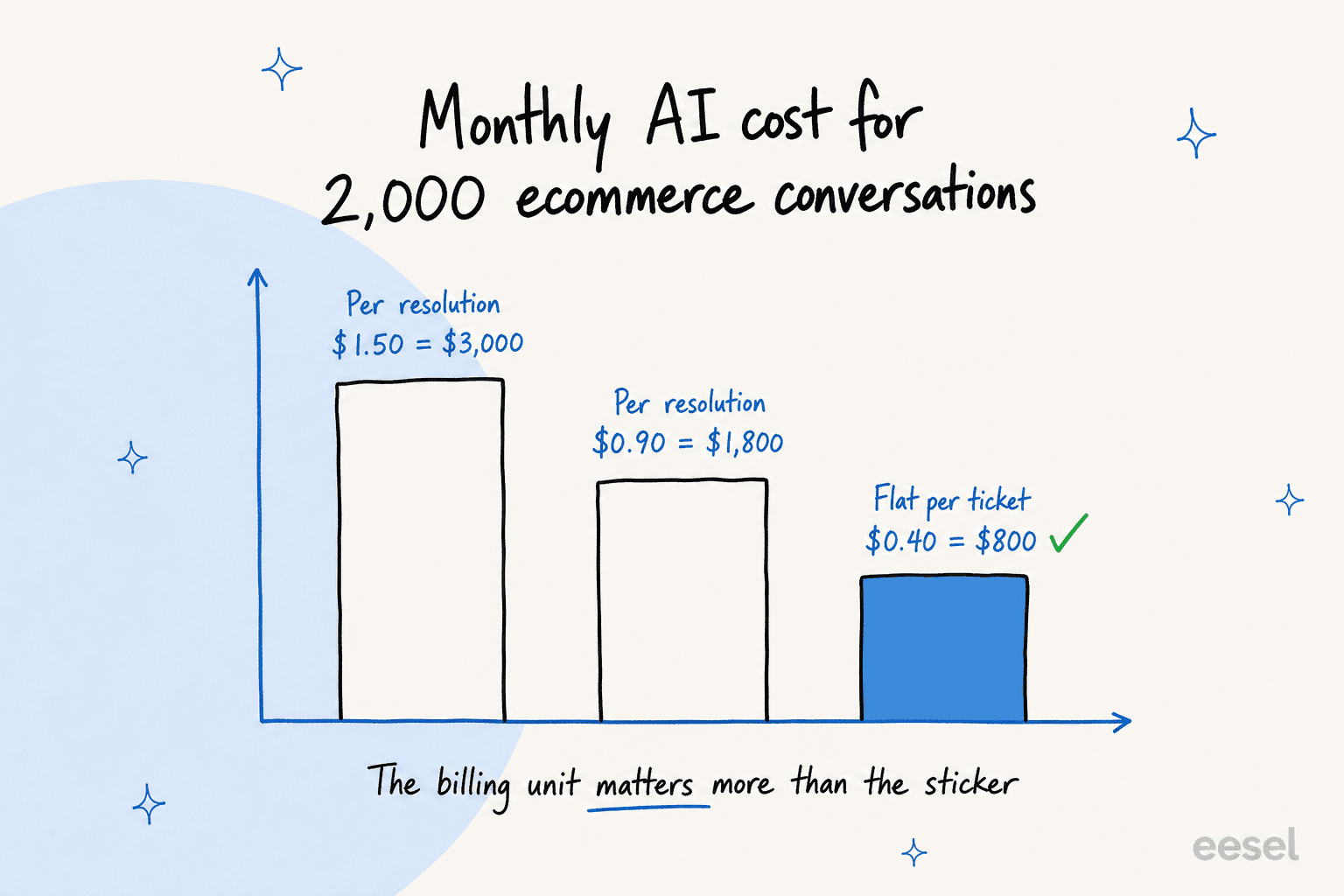
Here's the thing I most want you to take away, because it's where the real money hides. The sticker price barely matters. The billing unit is what determines your actual invoice, and the differences are enormous.
Per-resolution pricing (Gorgias at ~$0.90, Gladly at ~$1.50) sounds fair until you notice it punishes you twice. It scales with volume, so a Black Friday spike multiplies your bill, and it scales with success, so the better your AI gets at resolving tickets, the more you pay. We ran this exact analysis for a German jewelry brand doing about 1,000 tickets a month: at a per-resolution rate, a normal month was manageable, but a 4,000-ticket Black Friday week would have pushed the AI bill past $3,000. Flat per-ticket or per-conversation pricing keeps November's bill identical to March's.
One more trick from that analysis: ask any per-resolution vendor whether their quoted "resolution rate" counts auto-closing spam. For that brand, 22% of the inbox was spam, and counting spam "resolutions" can quietly inflate both the headline rate and the bill. It's the kind of detail that doesn't show up in a demo.
This is exactly why eesel's flat $0.40 per ticket model exists, and why I'd push any growing store to model their peak month, not their average one, before signing.
Try eesel for your ecommerce support
If you've already got a helpdesk and a Shopify store, eesel AI is the fastest way to put real automation on your queue without a migration. It plugs into the inbox you already use, learns from your past tickets so it sounds like your team, and resolves the WISMO and refund tickets that eat your day, while quietly escalating anything it isn't sure about.
The differentiator that matters for an online store: you can simulate the agent against your historical tickets before it ever touches a customer, so you see exactly what it would resolve and what it would pass on, by topic. Pair that with flat $0.40-per-ticket pricing and a spend cap you control, and you can prove the ROI on your own data, in a free trial, this week. Try eesel free, no credit card required.
Frequently asked questions
What is the best AI for ecommerce customer support?
How much does AI customer service for an ecommerce store cost?
Can AI handle WISMO and refund tickets on its own?
How do I stop an AI support agent from giving wrong answers to customers?



Article by
Riellvriany Indriawan
Riell is a designer and writer at eesel AI with about two years of experience researching CX platforms, AI chatbots, and helpdesk software. She combines her design background with a sharp eye for how these tools actually look and feel in practice — making her comparisons unusually visual and user-focused.