

Why I'm comfortable making these calls
I work on the team at eesel, and we have spent the last three-plus years putting AI agents on live support queues, across thousands of real ecommerce tickets and customer rollouts. That means I have watched what actually happens after the demo: the confident-sounding bot that quietly gives a wrong refund answer, the "70% automation" claim that evaporates on a real Black Friday queue. One thing that stuck with me was a CX lead at a DTC supplements brand running ~7,000 tickets a month on Gorgias, who tried a cheap $0.10-per-resolution AI tool and walked away calling it "too simple" and just "a front end for prompting templates." That gap, between a bot that demos well and one that holds up on a real ecommerce queue, is the thing this list is built around.
My day job is also reading what people actually search for when they outgrow a tool, so I have paid attention to why "Help Scout alternatives" is such a busy query for online stores specifically. Let me start there.
Why ecommerce teams look past Help Scout
First, the fair part: Help Scout is very good. The shared inbox is clean, new agents learn it in under an hour, and 12,000+ companies run support on it for a reason. If your support is mostly email and you value a human, low-clutter feel, Help Scout is hard to beat. We even have a full Help Scout review if you want the deep version.
But ecommerce support has a different shape, and two pains show up over and over.
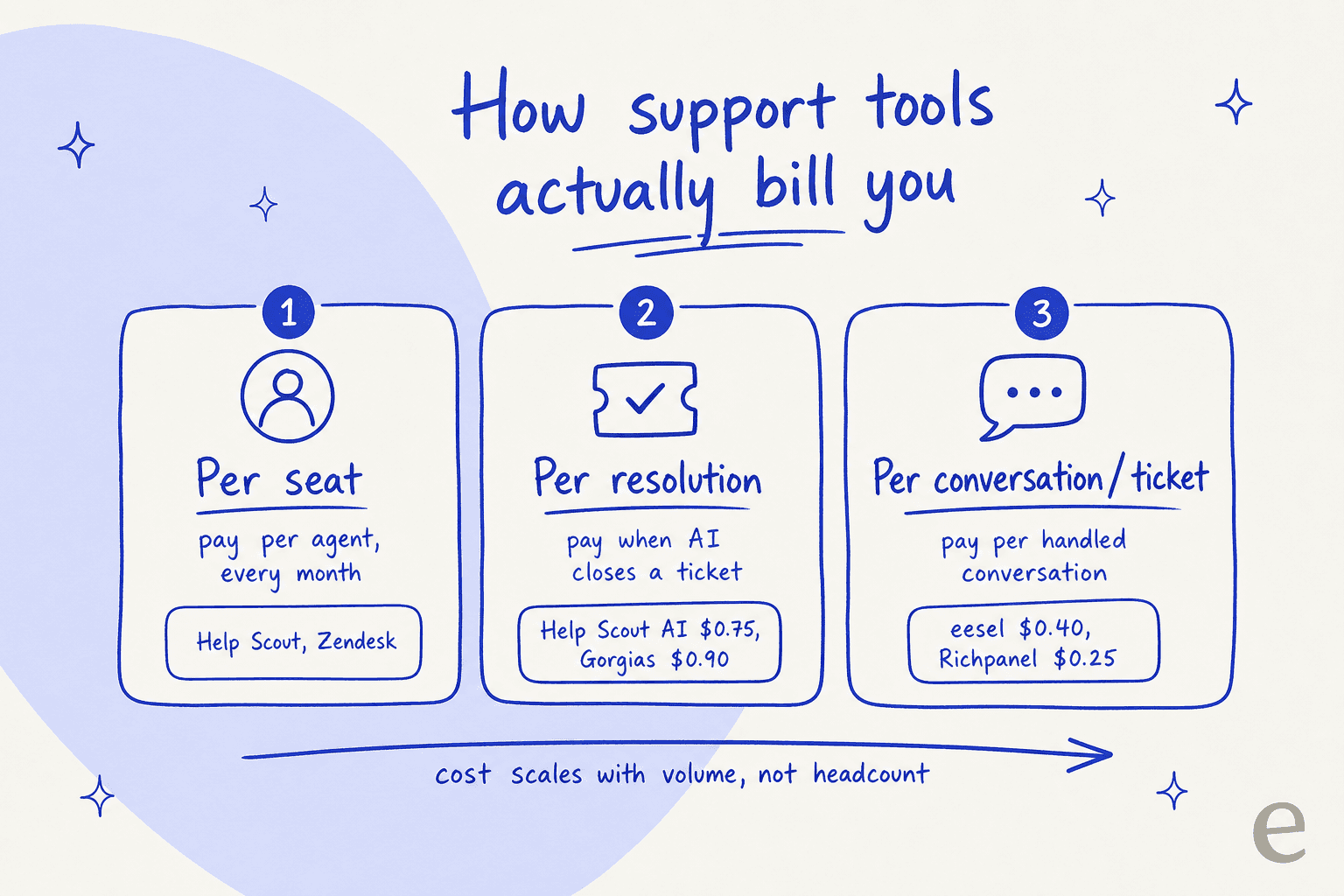
Pain one: the AI bill scales faster than you expect. Help Scout's AI Answers agent is a usage add-on at $0.75 per resolution, stacked on top of the $25-$75 seat price. At 1,000 resolutions a month that is an extra ~$750 before you have paid for a single seat. Worse, the pricing itself has been a moving target. Help Scout flipped from per-seat to per-customer-interaction billing in 2025, triggered a wave of churn, then reverted. The trust damage is the most quotable thing in the whole community dataset:
"HelpScout changed back to user-based pricing. Guess too many people cancelled including me... Helpscout lost all trust with this flip-flopping on pricing."
r/SaaS, on Help Scout's pricing reversal

Pain two: it is not commerce-native. Help Scout surfaces customer context, but it does not natively cancel an order, process a return, edit a subscription, or generate a discount inside the conversation the way a Shopify-built tool does. For an ecommerce team, those actions are most of the job. That is the line that separates a general helpdesk from an ecommerce one, and it is worth picturing before you shop:
Here is what the Help Scout marketing site leads with today, for reference:
If neither pain bites you, honestly, stay on Help Scout. If one of them does, here is where to go. (For the broader, non-ecommerce version of this list, we also keep a general Help Scout alternatives roundup.)
How I picked these (and how to choose)
Every tool below is a real, current product I could research down to its pricing page and UI. I weighted four things that matter specifically for ecommerce:
- Commerce depth: can it take real Shopify/BigCommerce actions (refunds, order edits, subscriptions) inside the conversation, or just read order data?
- AI pricing model: per seat, per resolution, or per conversation? The unit decides whether your bill tracks your team size or your ticket volume.
- Real automation, not demo automation: does the AI hold up on a messy queue, with guardrails against wrong answers?
- Total cost at your size: the sticker price and the bill at 2,000 tickets/month are very different numbers.
A quick way to place the field: the more your support is "answer questions," the further left you can sit; the more it is "do things to orders," the further right you need to be. And the more volume you want handled without hiring, the higher up you go.
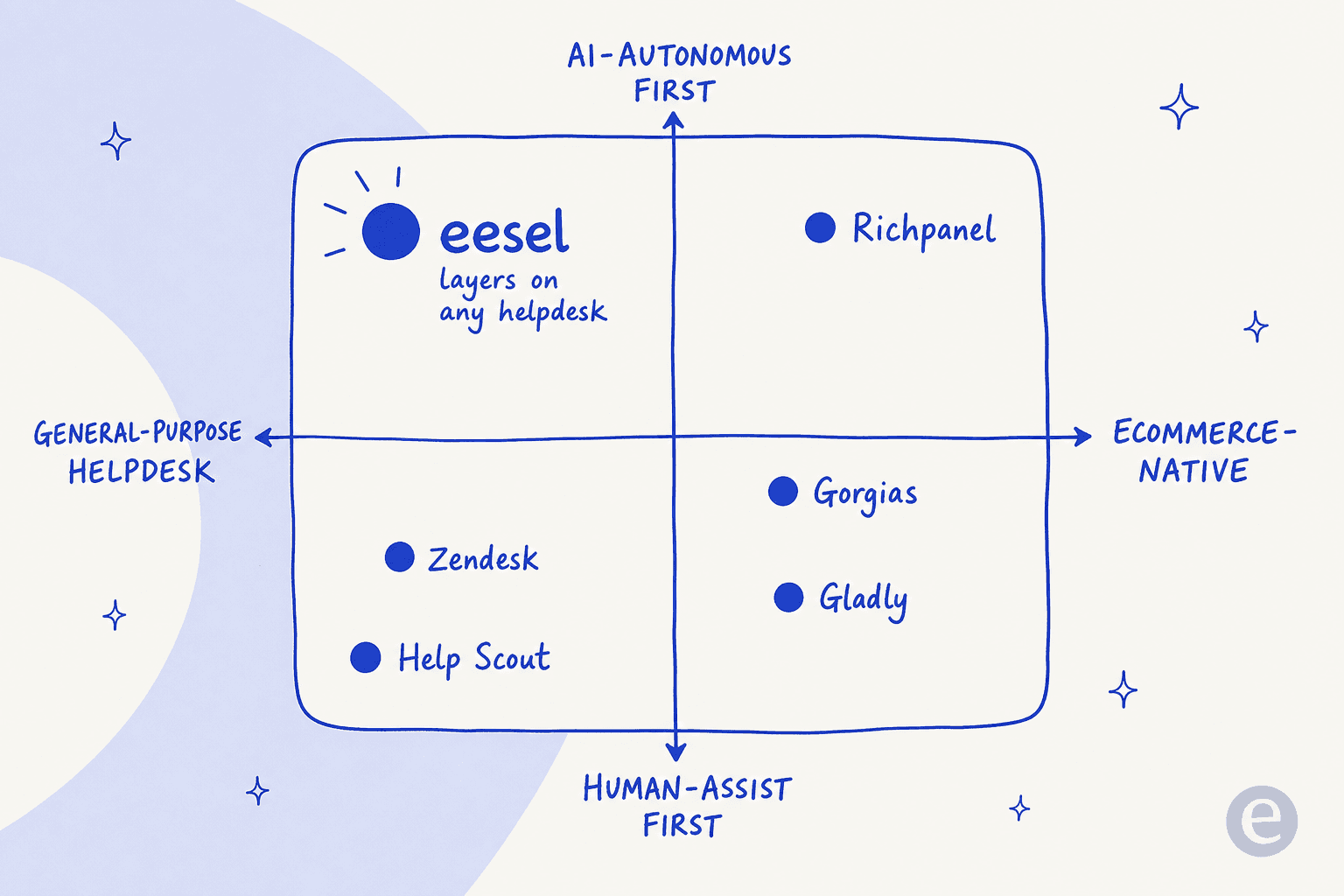
Here is the whole list at a glance before we go tool by tool.
| Tool | Best for | Starting price | AI pricing | Shopify-native actions | Channels | Free option | G2 rating |
|---|---|---|---|---|---|---|---|
| eesel AI | Adding AI to your existing helpdesk | $0.40 / ticket (no seat fee) | Per ticket / conversation | Via Shopify + helpdesk integrations | Helpdesk, chat, Slack, email | $50 free usage trial | New, not yet rated |
| Gorgias | Shopify-native helpdesk | $10/mo (50 tickets) | $0.90 / resolution | Yes, deep native | Email, chat, SMS, social, voice | 7-day trial | 4.6/5 |
| Richpanel | Guaranteed AI deflection | $500/mo + $0.25/convo | Per conversation | Yes, native | Email, chat, social, voice, Amazon | 30-day guarantee | 4.7/5 (CSAT) |
| Re:amaze | Multi-store value | $29/seat/mo | $0.85 / resolution | Yes, order data in-thread | Email, chat, SMS, VoIP, social | 14-day trial | 4.5/5 |
| Gladly | High-touch premium DTC | Demo-gated (~$180+/seat) | $1.50 / resolution | Yes, real actions | Voice, chat, email, SMS, social | Shopify free trial | 4.7/5 |
| Zendesk | Scaling enterprise stores | $19/agent/mo | Per automated resolution | Via app marketplace | Omnichannel + voice | 14-day trial | 4.3/5 |
| Freshdesk | Free-tier all-rounder | Free, then $19/agent/mo | $49 / 100 sessions | Via marketplace app | Email, chat, phone, social | Free (1-2 agents) | 4.4/5 |
| Tidio | Small Shopify stores | Free, then $24.17/mo | $0.50 / conversation | Yes (Growth+) | Chat, email, social | Free plan | 4.6/5 |
Now the detail.
1. eesel AI: best for adding AI to the helpdesk you already have

Best for: teams who like their current inbox (Help Scout included) and want automation without ripping it out.
Full disclosure, this is us, so read the next two sections with that in mind, the criticisms included. The reason eesel AI sits at the top of an ecommerce list is that it solves the Help Scout problem without forcing a migration. Instead of being a new helpdesk, eesel is an AI agent that plugs into the one you have, learns from your past tickets and help docs on day one, and starts drafting or auto-resolving the repetitive stuff.
Standout features. It connects to Shopify, Gorgias, Zendesk, Freshdesk and, yes, Help Scout, pulling order data and triggering actions through those integrations. The part ecommerce teams care about most is the simulation mode: before anything goes live, it runs against your historical tickets so you can see exactly what it would have resolved, find the gaps, and fix them. That is the antidote to the "confident bot gives a wrong answer" fear, paired with confidence-based routing that keeps low-certainty tickets as drafts rather than live replies.
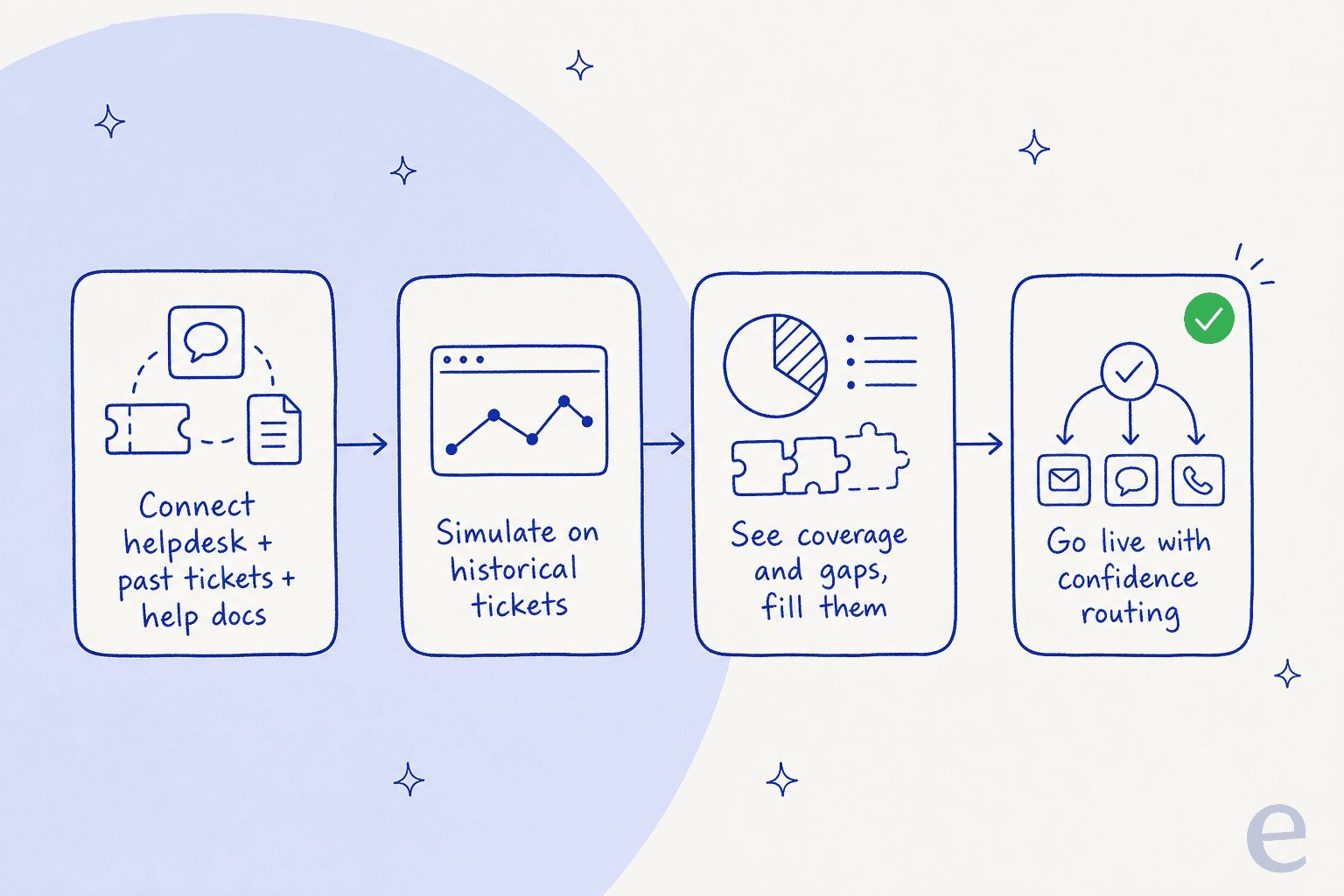
This is the trust-and-control point that, in my experience, decides most ecommerce AI deals. As one DTC supplements CX lead put it to us, the goal is "an AI who is only handling the tickets that it's confident to handle, and all the other ones, leave them alone." That is the design.
Pros:
- No migration, no per-seat fees. Pricing is $0.40 per ticket, so your bill tracks volume, not headcount.
- Learns from solved tickets, not just help-center articles, so answers match how your team actually replies.
- Simulation gives you a real number before you commit.
Cons:
- It is an AI layer, not a full helpdesk, so you still need an inbox underneath it.
- It is the newest tool here, so there is no long G2 history yet (the proof is in named rollouts instead).
- The brand-new ecommerce-specific ecommerce agent role is younger than the core helpdesk agent.
Pricing. Pay-as-you-go from $0.40 per ticket, no platform or seat fee, with a free trial that includes $50 of usage and no credit card. There is a 25% discount for annual commitments above $300/month, and a $1,000/month Enterprise tier that adds SSO, HIPAA, and a dedicated engineer.
Verdict: the proof is real. On a 7-day trial, eesel resolved 73% of tier-1 requests for Gridwise in the first month, and Smava runs a fully automated agent handling 100,000+ tickets a month. If your inbox is fine and the bots are the problem, this is the lowest-friction fix. If you need a brand-new ecommerce helpdesk from scratch, keep reading.
2. Gorgias: best Shopify-native helpdesk
Best for: Shopify and BigCommerce brands who want the helpdesk to take order actions natively.
If Help Scout's weakness is commerce depth, Gorgias is the direct answer. It is built for ecommerce, claims to power 40% of Shopify brands, and its biggest advantage is that orders, customers, and store data live inside the helpdesk with a one-click install and no syncing. An agent (or the Gorgias AI agent) can cancel an order, issue a refund, edit a subscription, or generate a discount without leaving the ticket.
Standout features. The AI Agent is pre-trained on a billion-plus ecommerce conversations and handles pre- and post-sale questions, returns, and even conversational upsells. The omnichannel inbox covers email, chat, SMS, WhatsApp, Instagram, and TikTok, and the 300+ integrations cover the ecommerce stack (Klaviyo, Recharge, Loop, Yotpo).
Pros:
- The deepest native Shopify actions of anything on this list.
- Ticket-based pricing (not per-seat), so adding agents does not balloon the bill.
- Revenue attribution, so you can see support driving sales.
Cons:
- It is roughly 3x Zendesk for similar ticket volumes; the community rule of thumb is it pays off once 40%+ of tickets need direct Shopify actions.
- The AI Agent is a separate $0.90-per-resolution add-on, and each AI interaction also counts as a billable ticket.
- Reporting and setup have a steeper curve than Help Scout's.
Pricing. Four tiers: Starter from $10/mo (50 tickets), Basic $50 (300), Pro $300 (2,000), Advanced $750 (5,000), plus custom Enterprise. The AI Agent is $0.90 per resolved conversation on annual plans ($1.00 monthly).
Verdict: if you are Shopify-first and your tickets are mostly order actions, Gorgias is the natural Help Scout replacement, and it is excellent at it. If most of your volume is questions you could answer from docs, you may be paying ecommerce prices for general support. Worth reading our Gorgias vs Help Scout comparison and the best Gorgias alternatives if you are torn.
3. Richpanel: best for guaranteed AI deflection
Best for: brands who want an AI-first helpdesk and a contractual deflection number.
Richpanel has gone all-in on "hire an AI support team," and its headline hook is unusually concrete: 50% autonomous resolution guaranteed in 30 days, or your money back. For an ecommerce lead who has been burned by vague automation promises, a refund-backed number is a strong pitch.
Standout features. It splits AI into roles: Frontline AI resolves order tracking, returns, and cancellations end to end; QA AI reviews 100% of replies before they send (its answer to the hallucination worry); and CX Manager AI builds SOPs from your site and policies. The unified inbox covers email, chat, social, voice (via Aircall), and Amazon, and it imports tickets and macros from Zendesk or Gorgias for migration.
Pros:
- The 30-day money-back guarantee really lowers the risk of trying it.
- Conversation-based pricing at ~$0.25 each is among the cheapest per-resolution costs here.
- SOC 2 Type II, HIPAA, and 99.9% uptime are real, named certifications, not hand-waving.
Cons:
- The $500/month base is a meaningful floor for a small store; ROI breakeven is roughly 3 agents or ~2,000 conversations/month.
- It is a younger, smaller platform (~2,000 brands) with limited public G2 history.
- You are committing to a full helpdesk switch, not an add-on.
Pricing. Self-serve AI Agent plan is $500/month plus $0.25 per conversation and $100 per human seat; a sample bill of 2 AI agents and 3 human seats lands at ~$800/month. Enterprise is custom.
Verdict: if you want AI-first and you like the accountability of a guarantee, Richpanel is one of the most honest pitches in the category. Just run the math on the $500 floor against your current volume before you switch. Reported results are good (The Ridge took CSAT from 88% to 96%), but they assume you are at the volume where the base fee makes sense.
4. Re:amaze: best multichannel value for multi-store brands
Best for: teams running several stores who want lots of channels without a per-seat shock.
Re:amaze (owned by GoDaddy since 2021) is the value play. It bundles channels that other tools charge extra for, email, live chat, SMS, VoIP, video calls, and push, plus chatbots, proactive Cues, and a real-time live dashboard, all as first-party features. Order data surfaces inside conversations, and Pro tiers support unlimited brands.
Standout features. The proactive engagement tools (Cues triggered by visitor behavior, the Peek co-browsing screen-share) are unusually deep for the price. The unusual $59 flat Starter plan lets unlimited team members use core features, which is rare and useful for larger, lower-volume teams.
Pros:
- Excellent channel coverage and proactive tools for the money.
- Multi-brand support on Pro and up suits agencies and store portfolios.
- The flat Starter plan is unusually team-friendly at low volume.
Cons:
- The AI Agent is still labeled Beta, so it is less mature than Gorgias's or eesel's.
- Per-plan AI resolution allowances are stingy (5-20 per user/month before overages).
- Public third-party review depth is thinner than the bigger names.
Pricing. Starter $59 flat/mo (500 conversations), Basic $29/seat, Pro $49/seat, Plus $69/seat (annual rates are ~10% lower). AI Agent overage is $0.85 per resolution on all plans.
Verdict: for a multi-store brand that wants breadth of channels at a sane price, Re:amaze is a strong, underrated Help Scout alternative. If autonomous AI resolution is your main goal, the Beta agent means you will likely pair it with something more proven. Our Re:amaze automation guide has more on the workflow side.
5. Gladly: best for high-touch premium DTC
Best for: premium retail and DTC brands where the relationship, not the ticket, is the product.
Gladly is the opposite philosophy to a ticketing tool: it models a single lifelong conversation per customer instead of discrete tickets, and explicitly sells itself as "built for LTV" rather than deflection. The customer roster tells you the fit, TUMI, UGG, Crate & Barrel, HOKA, Nordstrom. If your brand competes on premium service, this is the most on-brand option here.
Standout features. The unified 360-degree customer profile means customers never repeat themselves across chat, voice, email, SMS, and social. Its Sidekick AI takes real actions (cancel, return, price adjustment), and it earns a strong 4.7/5 from 1,112 reviews on G2.
"The single continuous conversation under one customer profile eliminates duplicate threads and preserves full context."
paraphrased theme from Gladly reviews on G2

Pros:
- The best unified-customer-view model on this list for relationship-led brands.
- Genuine omnichannel including strong voice support.
- Takes real actions, not just answers.
Cons:
- Price is the consistent complaint; it is the most expensive option here and platform pricing is demo-gated.
- Reporting is fragmented (the #1 review gripe), often needing manual exports.
- Overkill for a store whose support is mostly order-status questions.
Pricing. Gladly does not publish full platform pricing (Hero packages land around $180-$210 per seat/month in third-party sources). The only self-serve option is the Shopify App plan: a free install trial, then a $250/mo cap with $1.50 per AI resolution, $0.25 per AI assist, and $120 per seat/month.
Verdict: if you are a premium brand and service is the differentiator, Gladly is worth the spend, and few tools match its customer-centric model. If you are cost-sensitive or volume-driven, it is the wrong end of the market. See best Gladly alternatives and our Gladly pricing breakdown for the full picture.
6. Zendesk: best for scaling enterprise stores
Best for: larger ecommerce operations that need depth, governance, and a huge integration marketplace.
Zendesk is the enterprise default, and it earns that with sheer breadth: 22,000+ service teams, a 1,800+ app marketplace, and a 2025 Gartner Magic Quadrant Leader placement. It is not ecommerce-native like Gorgias, but with the right apps it scales further than anything else here.
Standout features. The "Resolution Platform" combines AI agents (now Forethought-powered), omnichannel messaging, voice, QA across 100% of interactions, and workforce management. For a big store, the governance and routing depth is the draw.
Pros:
- The most complete platform and the deepest integration ecosystem.
- Strong analytics, QA, and enterprise controls.
- Scales from mid-market to truly large operations.
Cons:
- The pricing model is layered and easy to under-estimate: seat price, plus per-resolution AI, plus $50/agent add-ons (Copilot, WEM, Contact Center).
- The entry $19 plan includes no AI at all; AI starts at the $55 Suite tier.
- Heavier to set up and run than a focused ecommerce tool.
Pricing. Support Team $19/agent/mo, Suite Team $55, Suite Professional $115, Enterprise custom. AI agents are billed separately per automated resolution (the per-unit price is sales-gated). A common move is to keep Zendesk and add a cheaper AI layer; that is exactly what our Zendesk vs Help Scout readers tend to do.
Verdict: if you are scaling past the point where a lightweight tool copes, Zendesk is the safe, powerful choice, just budget for the full stack, not the headline seat price. Many teams pair it with an AI layer to control the per-resolution AI cost.
7. Freshdesk: best free-tier all-rounder
Best for: bootstrapped or early stores that want a real free tier and room to grow.
Freshdesk (from Freshworks) is the balanced all-rounder, trusted by 74,000+ businesses and built around a "Command Center" agent workspace. Its ecommerce hook is the actually-free tier: $0 for 1-2 agents for six months, which is a soft on-ramp Help Scout's free plan does not match for a growing team.
Standout features. The 2025/2026 story is Freddy AI, with 50+ prebuilt agentic workflows and a no-code AI Agent Studio. The omnichannel coverage and marketplace connectors (Shopify, Stripe, PayPal) handle the ecommerce basics.
Pros:
- A useful free or cheap entry point for small teams.
- Mature, well-rounded ticketing with strong automation.
- Freddy AI is a real agentic layer, not a bolt-on.
Cons:
- Not ecommerce-native; Shopify actions go through marketplace apps, not core.
- Freddy's Email AI Agent is consumption-priced ($49 per 100 sessions after the free 500), which adds up at volume.
- The "Omni" SKU you may actually want is pricier than base Freshdesk.
Pricing. Free (1-2 agents, 6 months), then Growth $19, Pro $55, Enterprise $89 per agent/month (annual). Freddy AI Email Agent includes the first 500 sessions, then $49 per 100 sessions.
Verdict: for an early store that wants a real helpdesk without a big upfront bill, Freshdesk is the safe all-rounder, and the free tier makes it easy to try. If you need deep Shopify actions, it will feel general. Our Freshdesk vs Help Scout comparison and best Freshdesk Shopify apps lists go deeper.
8. Tidio: best for small Shopify stores
Best for: small and mid-market stores that want live chat plus a solid AI agent, fast.
Tidio is the friendliest on-ramp here. It combines live chat, a help desk, and an AI agent (Lyro) into one product, and it leans hard into ease of setup, no engineering required. A nice detail for accuracy nerds: Lyro is powered by Anthropic's Claude, and Tidio claims a 67% average resolution rate.
Standout features. Lyro learns from FAQ uploads and website scraping, with guardrails that keep it on your own data (a frequent praise point versus hallucination-prone bots). Native Shopify actions (order tracking, cart recovery) arrive on Growth+, and it scores 4.8/5 on the Shopify App Store across 1,300+ reviews.
Pros:
- Fastest, most beginner-friendly setup on this list.
- Lyro's Claude-grounded answers are well-reviewed for staying on script.
- Affordable entry with a real free plan.
Cons:
- Pricing gets complex fast: you pay per billable conversation and per Lyro conversation and per Flows visitor.
- The jump from Growth to Plus ($749/mo) is steep.
- It is built for SMB scale; very high-volume brands outgrow it.
Pricing. Free plan, Starter $24.17/mo, Growth from $49.17, Plus from $749, Premium (contact sales, ~$2,999/mo). Lyro AI standalone from $32.50/mo or $0.50 per conversation, with a money-back guarantee if resolution stays under 50%.
Verdict: for a small Shopify store that wants chat plus credible AI without a project plan, Tidio is the easy yes. Watch the layered usage pricing as you scale. See Tidio AI pricing and best Tidio alternatives for where it tops out.
Try eesel for Help Scout and your ecommerce stack
Here is the thing most of this list misses: switching helpdesks is expensive and risky, and you might not need to. If Help Scout's inbox works for your team and the AI is the real gap, eesel AI drops an AI agent on top of it (and on top of Shopify, Gorgias, Zendesk, or Freshdesk) without a migration.
It learns from your past tickets and Docs on day one, you simulate it against your historical tickets to see the real resolution rate before going live, and you pay $0.40 per ticket with no per-seat fee. It works like a new hire that already knows your help center, and it is free to try with $50 of usage and no credit card. If you want the layer instead of the rip-and-replace, start here.
Frequently Asked Questions
What is the best Help Scout alternative for ecommerce?
Why do ecommerce teams switch away from Help Scout?
How much does Help Scout cost compared to the alternatives?
Can I add AI to Help Scout instead of replacing it?
Which Help Scout alternative is best for a small Shopify store?


Article by
Kurnia Kharisma Agung Samiadjie
Kurnia is a software engineer and writer at eesel AI with two years of SEO experience, writing about AI tools, helpdesk software, and customer support. He pairs a developer's understanding of how these products are built with search-driven research into what actually ranks and resonates with the people searching for them.