

Why teams leave Help Scout in 2026
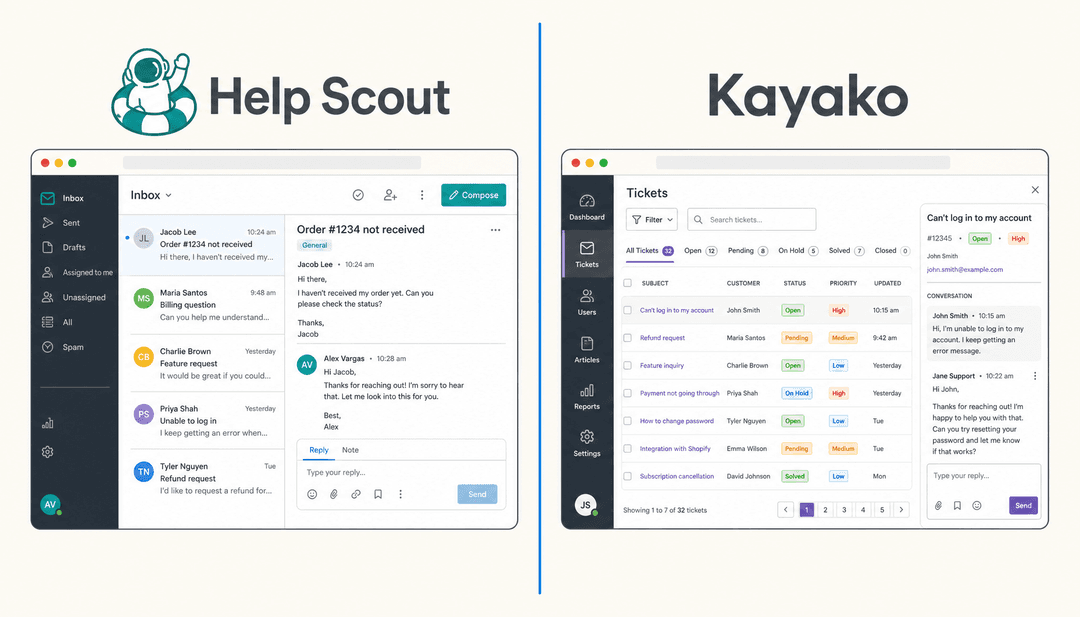
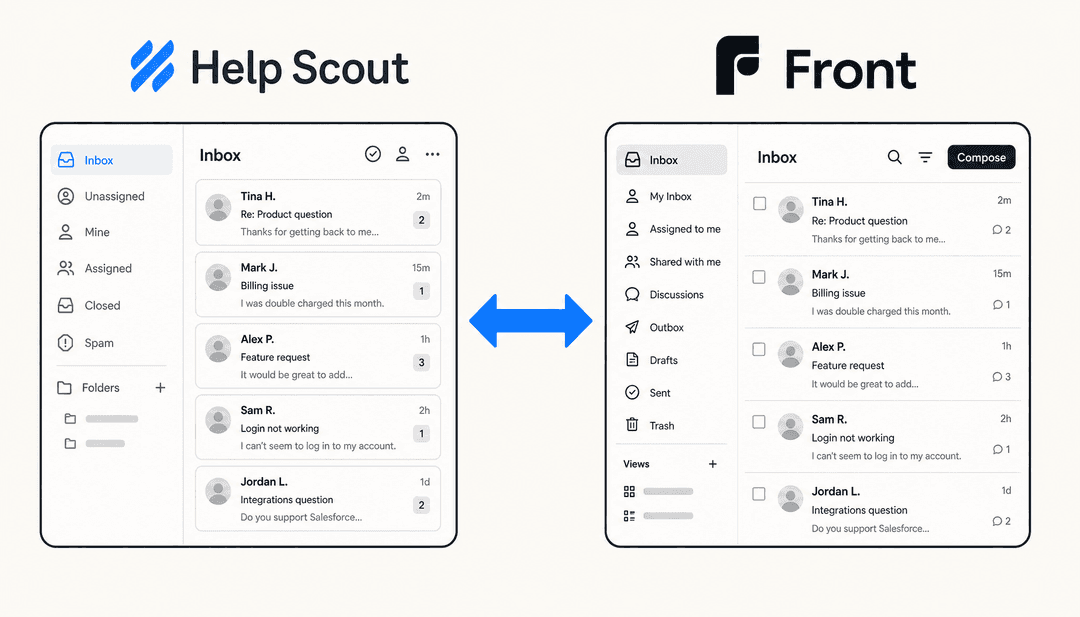
We like Help Scout. We integrate with it. The reasons people leave aren't about the product being bad - they're about it being a particular shape: a beautifully simple, email-first inbox that starts to creak when your team gets bigger or your AI bill gets visible.
Three patterns come up almost every time we talk to switchers:
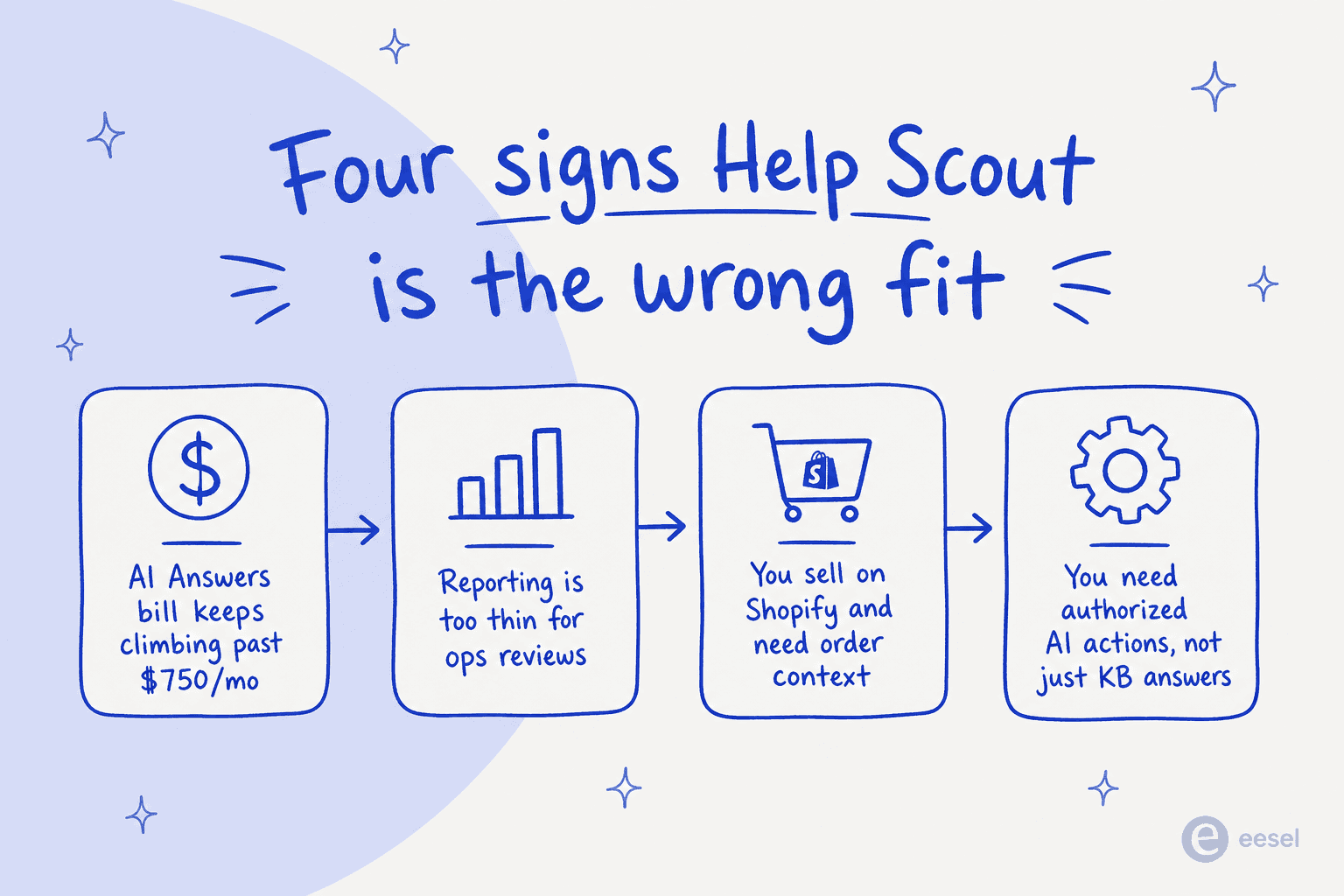
- AI Answers is the silent cost shock. The chatbot add-on is $0.75 per resolution on top of seat pricing. At 1,000 resolutions a month - pretty normal for a 10-agent team - that's an extra $750 over the seat bill. Reviewers on G2 specifically flag this as a "hidden scaling cost." We agree.
- Reporting depth is thin. Help Scout's own docs describe reports as "a handful," and aggregated G2 complaints lead with "Lack of Features. Users complain about the lack of advanced features in Help Scout, which limits customization." If your weekly ops review needs custom metrics, you'll outgrow it.
- Pricing-model whiplash. In late 2025 Help Scout briefly moved from per-seat to per-interaction pricing, then reverted after community pushback. One r/CustomerSuccess thread summed up the feeling - "lost all trust with this flip-flopping on pricing." - and the FreeScout self-hosted exodus accelerated.
The good news: there are real Help Scout alternatives at every shape and budget in 2026. The not-so-good news: the AI-pricing problem doesn't go away by switching - it just changes name. We talk about that under each item.
How we picked these nine
We used the same shortlist most buying teams arrive at: incumbents (Zendesk, Freshdesk), the collaborative-inbox peer (Front), the verticals (Gorgias for Shopify, HubSpot for CRM-first teams), the value plays (Zoho Desk, Tidio), and the AI-overlay pattern that's increasingly the answer for teams who don't want a migration (eesel - that's us). We deliberately left out Intercom because it doesn't fit the Help Scout pattern in our experience.
For the original eight tools we opened the product, captured a real screenshot, checked current pricing on the vendor's page, and pulled community sentiment from G2, Capterra, Reddit, and LinkedIn. Featurebase was added on 16 September 2026 using its product information and current pricing. Numbers come from primary sources; quotes are linked back to where they came from.
Quick comparison: 9 Help Scout alternatives at a glance
| Tool | Best for | Starting price | AI billing | Free tier | SOC 2 / HIPAA | Integrations | SLA |
|---|---|---|---|---|---|---|---|
| eesel | AI on top of your existing helpdesk | From $299/mo (500 credits) | 1 credit per ticket or chat, optional capped overage | 100 free credits, no card | SOC 2 Type II / HIPAA on request | 100+ (Help Scout, Zendesk, Freshdesk, Front, Gorgias, Slack, Shopify…) | 99.9% |
| Zendesk | Enterprise CX scale | $19/agent (Support Team), $55 Suite Team | ~$1.20–$1.50 per resolution above commit | None | SOC 2 Type II / HIPAA | 1,817+ marketplace apps | 99.95% (Enterprise) |
| Freshdesk | SMB upgrade with bundled AI | $19/agent (Growth) | $49 / 100 Freddy AI sessions | 1–2 agents free for 6 months | SOC 2 Type II / HIPAA | 1,000+ Freshworks Marketplace | 99.9% (Enterprise) |
| Featurebase | SaaS support connected to product feedback | $29/seat/mo | $0.49 per successful resolution | Free, 1 seat | SOC 2 Type II / no HIPAA claim | Slack, HubSpot, Jira, Linear, Salesforce and more | Not publicly listed |
| Front | Cross-team operations | Quote-only (Pro plans start ~$59/seat historically) | Front AI included by plan | 7-day trial | SOC 2 Type II / HIPAA | 160+ | 99.9% |
| Gorgias | Shopify DTC | $10/mo (Starter, 50 tickets) | $0.90–$1.00 / resolved AI conversation | 7-day trial | SOC 2 Type II / HIPAA | 100+ Shopify-heavy | 99.9% |
| HubSpot Service Hub | HubSpot-native CRM teams | $7/seat (Starter, annual) | $0.45 / Customer Agent resolution (Pro+) | Free up to 2 users | SOC 2 Type II / GDPR / HIPAA via add-on | 6,000+ partners / 2,000+ apps | 99.95% (Enterprise) |
| Zoho Desk | Low-cost generalist | $7/agent (Express) | Zia included; ChatGPT BYO key | Free Forever (3 users) | SOC 2 / GDPR / HIPAA / ISO 27001 | 360+ apps | 99.9% (paid plans) |
| Tidio | Small-team chat-first | $24.17/mo (Starter) | $0.50 / Lyro conversation | Free (50 convos) | SOC 2 / GDPR | 120+ | Custom on Premium |
Annual rates shown; full pricing detail in each item below.
1. eesel - best for AI on top of the helpdesk you already use

Full disclosure: this is us. If you'd rather skim past the founder favourite, jump to Zendesk below - we won't take it personally.
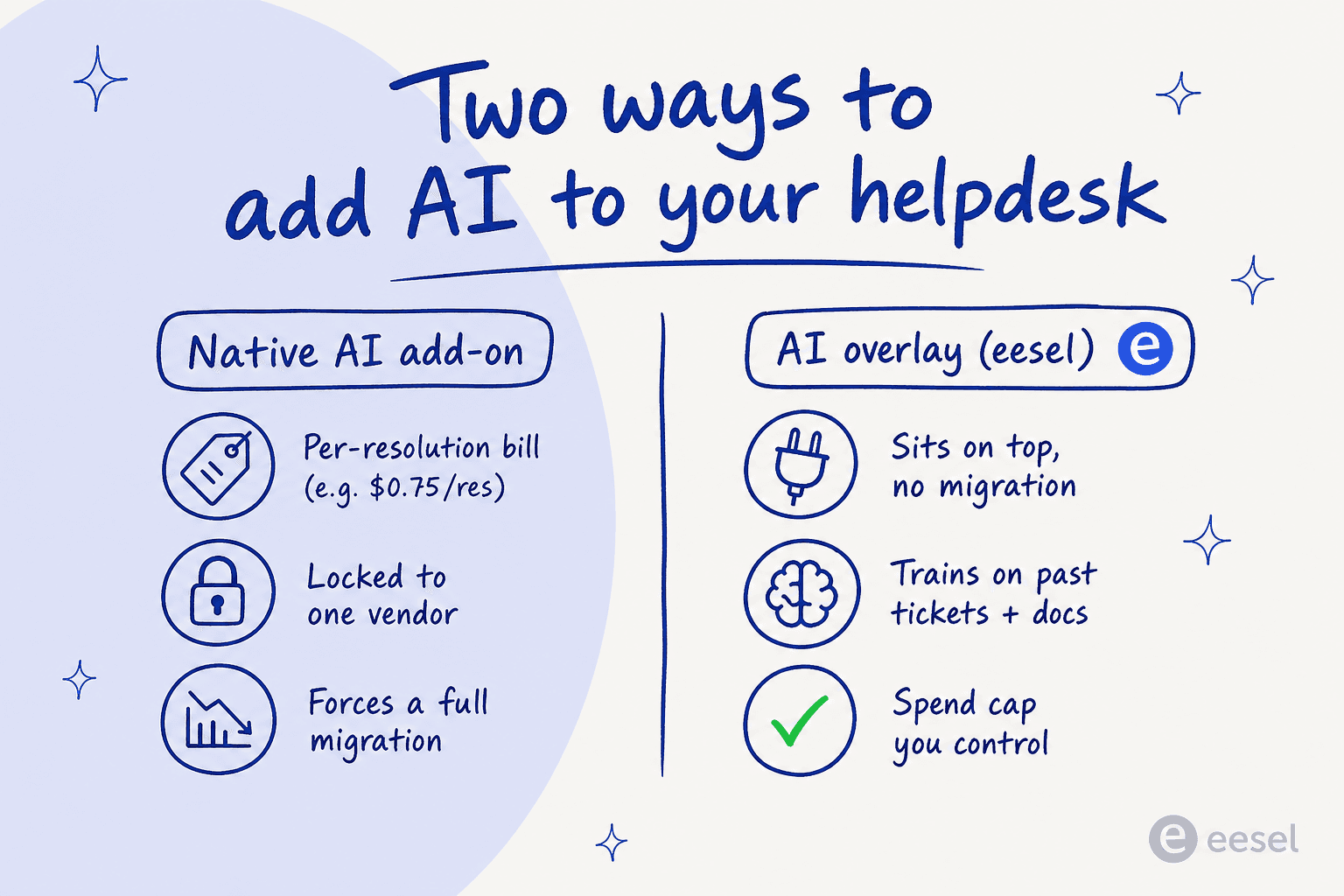
eesel is an AI teammate platform that runs inside the helpdesk you already use - including Help Scout, Zendesk, Freshdesk, Front, Gorgias and 100+ others. The pitch is simple: instead of migrating to a new helpdesk to get a better AI, point eesel at your existing one and let it train on your past tickets, docs, and macros.
Most of the Help Scout switchers we talk to don't actually want to leave Help Scout's inbox - they want better AI, predictable pricing, and reporting that doesn't read like a 2014 dashboard. eesel pulls those three jobs out of the helpdesk decision entirely.
Features
- Helpdesk Agent - resolves support tickets autonomously inside your existing inbox; drafts replies for human review or sends them, depending on the confidence routing you set.
- Internal-note triage - leaves a suggested reply, tags, and a recommended assignee as an internal note so agents skim instead of read.
- Training on past tickets - the single most-requested capability in our customer dossier; learns tone, escalation rules, and product specifics from your own history, not generic LLM training data.
- Authorized actions - looks up Shopify orders, refunds, edits subscriptions, opens Jira tickets, drops Slack threads. Not just KB Q&A.
- Dashboard chat - conversational config; you brief eesel the way you'd brief a new hire.
Pros
- Sits on top of Help Scout - no migration, no seat-count change, no IT lift.
- One fixed monthly price with optional capped overage; no $0.75-per-resolution drift.
- Trained on your tickets, not just your docs. Tone matches your team.
- Authorized actions, which Help Scout AI Answers can't do.
Cons
- Doesn't replace your inbox - if you actually want a new helpdesk, you still need to pick one from the rest of this list.
- Younger company than Zendesk or Freshdesk; expect a more modern, less crowded admin UI rather than a 10-year-old marketplace.
Pricing
| Plan | Cost |
|---|---|
| Free plan | 100 credits, no card |
| 500 credits / month | $299/mo |
| 1,000 credits / month | $499/mo |
| 2,500 credits / month | $999/mo |
| 5,000 credits / month | $1,899/mo |
| Blog post | $4.00 each |
| Pay a year upfront | Two months free |
1 credit covers one ticket or chat, however long. Every integration, channel and seat is included.
Full breakdown on the eesel pricing page.
Verdict: If your real problem with Help Scout is the AI bill or the AI's lack of actions, eesel is the lowest-friction answer in this list - you keep the inbox your team likes and bolt on the AI you wanted. If you actually need a new helpdesk too, treat the next seven items as your shortlist.
2. Zendesk - best for enterprise CX teams ready to standardize
Zendesk repositioned itself in 2025 as "the Resolution Platform" - ticketing core plus an AI layer covering customer-facing autonomous agents, agent-side copilot, intelligent triage, and AutoQA. It's a big, opinionated platform with a 1,800-strong marketplace - and it's overkill for most Help Scout-sized teams. But if you're crossing into mid-market or enterprise, this is where most Help Scout outgrowers land.
Features
- AI Agents (Essential and Advanced) - Essential is the bundled KB-Q&A tier; Advanced is the Ultimate.ai-derived agent with dialogues, generative procedures, authorized actions and API integrations.
- Copilot / Auto Assist - proactive AI for human agents; drafts replies, executes approved actions across Shopify, Jira, Slack.
- Intelligent Triage - auto-classify every ticket by intent, entity, sentiment and language.
- Admin Copilot + AutoQA - admin workflow optimisation; AI QA across 100% of interactions rather than the historical ~2% manual sample.
- Marketplace - 1,817 apps, ~253 in the "AI and Bots" category; eesel, Ada, Forethought (now Zendesk-owned) all live there.
Pros
- Genuinely best-in-class at scale; named 2025 Gartner Magic Quadrant Leader for CRM Customer Engagement Center.
- The largest integrations marketplace of any tool in this list.
- Powerful reporting (Explore) once you set it up.
- 80+ languages at native fluency for AI Agents.
Cons
- AI billing is the dominant 2026 complaint. Per-resolution overage charges run $1.20–$1.50 above commit, with no graceful cap below "pause AI entirely." One Reddit user, quoted in r/Zendesk, described automated-resolution billing as "a rip off, and it's a rushed product to get into the AI hype."
- The free Essentials tier "doesn't feel like AI at all" - a routing layer with the word AI on the box, per multiple r/Zendesk threads.
- Admin-side configuration of Copilot, AI Agents and Triage is consistently described in G2 reviews as "burdensome" and requiring engineering help.
- At ProductLab Conference 2025, Zendesk's own poll showed only ~10% of AI agents built in the prior six months were still in use - pointing to abandonment rather than adoption.
Pricing
| Plan | Price (per agent/mo, annual) |
|---|---|
| Support Team | $19 |
| Suite Team | $55 |
| Suite Professional | $115 |
| Suite Enterprise + Copilot | Contact sales |
| Copilot add-on (sub-Enterprise) | $50/agent/mo |
| Workforce Engagement Bundle | $50/agent/mo |
AI billing on top: automated resolutions metered per agent/mo with discounted "committed usage" packs. The May 2026 three-tier resolution model only bills Verified Resolutions - Assisted Escalation and Contained Resolution are free, which is a real improvement over the older "silence for 72 hours = billable" rule.
Full breakdown in our Zendesk pricing guide and the Resolution Platform overview.
Verdict: Pick Zendesk if you're crossing the 50-agent mark and want one platform to standardize on. Skip it if Help Scout's pricing already feels rich - Zendesk's stacked AI add-ons easily 2–3x the base subscription.
3. Freshdesk - best for SMB teams that want bundled Freddy AI
Freshdesk, part of Freshworks, is the natural like-for-like upgrade from Help Scout. It runs a per-agent seat model close to Help Scout's, but bundles a real AI Agent (Freddy AI Agent) with 500 free sessions on Pro and Enterprise - a more honest "AI included" pitch than Help Scout's per-resolution add-on.
It's the closest cheap-and-cheerful match for teams who like Help Scout's lightness but need more workflow muscle.
Features
- Ticketing + omnichannel - email, chat, messaging, phone (Freshcaller add-on), social - under one inbox.
- Freddy AI Agent - autonomous AI for customer-facing resolution; Freshworks claims up to 80% of queries resolved without human handoff.
- Freddy AI Copilot - reply suggestions, summaries, live translation inside the agent workspace.
- Freddy AI Insights - proactive alerts, root-cause analysis, CSAT trends, SLA breach detection.
- Self-service portal + AI-deflection - knowledge base with AI-powered deflection on top.
Pros
- 500 free Freddy AI sessions on Pro/Enterprise - actually usable AI without immediate metered billing.
- Fast time-to-value; one Hired customer quote on the homepage frames it as "deployed on multiple teams with no pushback."
- Strong omnichannel unification, especially for Freshdesk Omni buyers.
- Cheaper than Zendesk at every comparable tier - see our pricing breakdown.
Cons
- Per-session billing creeps in fast. Beyond the 500 free sessions, Freddy AI Agent is $49 per 100 sessions - at 2,000 sessions/mo that's an extra $735.
- The Shopify integration is only 3.0/5 with 61 reviews on the Freshworks Marketplace - fine for casual users, weak for serious DTC.
- G2 sentiment is mixed-to-skeptical on AI quality; the recurring critique is that bad inputs (messy KB) yield generic outputs.
Pricing
| Plan | Price (annual) | Key adds |
|---|---|---|
| Growth | $19/agent/mo | Ticketing, shared inbox, customer portal, 500 Email AI Agent sessions |
| Pro (most popular) | $55/agent/mo | Custom objects, advanced routing/reporting, 5,000 collaborators |
| Enterprise | $89/agent/mo | Audit logs, approval workflows, skills-based routing, advanced security |
| Freddy AI Copilot add-on | Per agent | No day passes |
Full mechanics in our Freshdesk pricing guide.
Verdict: Pick Freshdesk if you want the like-for-like upgrade from Help Scout and want an AI bundle that doesn't lead with per-resolution math. Skip it if you'll burn through 500 Freddy sessions in a fortnight - at that point eesel's fixed monthly price wins.
4. Featurebase – best for SaaS teams that want support and product feedback in one place
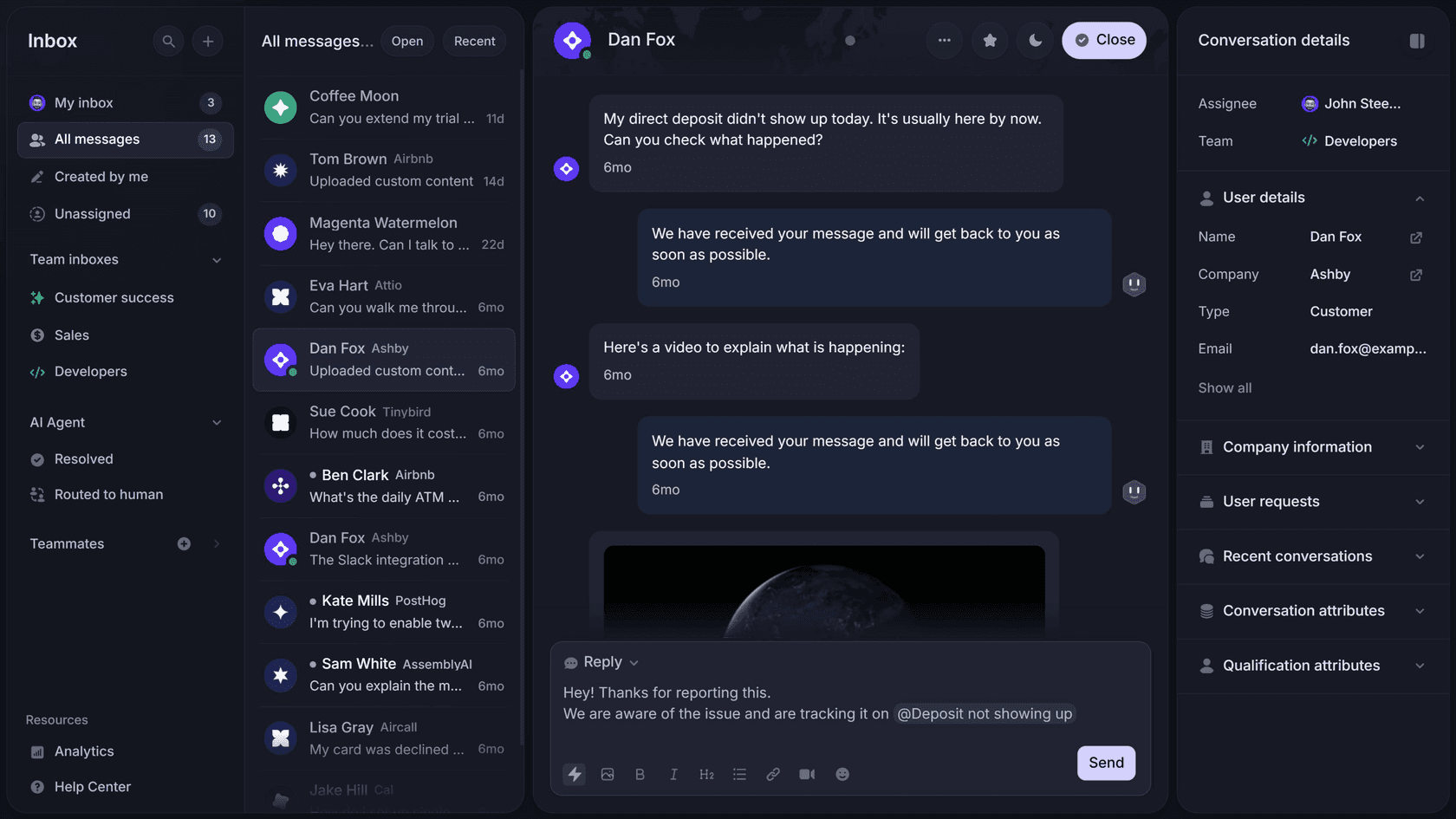
Featurebase is the product-led Help Scout alternative. It combines a shared support inbox, live chat, email ticketing, Fibi AI, a knowledge base, feedback boards, surveys, public roadmaps, and changelogs. The difference is what happens after a support conversation: recurring issues can feed directly into product prioritization, and customers can be notified when their requested improvements ship.
For SaaS teams currently paying for Help Scout alongside separate feedback, roadmap, survey, and changelog tools, Featurebase can replace several subscriptions at once. It is less compelling for voice-heavy support operations or companies that only want a simple email inbox.
Features
- Unified inbox – manages live chat and email conversations with assignments, internal notes, custom views, and mobile apps.
- Fibi AI Agent – answers customers from your help center and other workspace content, classifies conversations, and hands edge cases to teammates.
- AI Copilot – drafts replies, summarizes conversations, and assists human agents inside the inbox.
- Workflows and SLAs – automate routing, tagging, prioritization, and repetitive support processes.
- Product feedback suite – connects support conversations with feedback boards, voting, surveys, roadmaps, and changelogs.
- Help center – provides self-service content that also acts as a knowledge source for Fibi.
Pros
- Replaces Help Scout plus separate feedback, roadmap, survey, and changelog tools.
- Fibi costs $0.49 per successful resolution versus Help Scout AI Answers at $0.75.
- A conversation is charged at most once, even when Fibi answers multiple questions.
- Free plan includes one seat, live chat, ticketing, and unlimited conversations.
- SOC 2 Type II certified and GDPR compliant.
Cons
- The free plan does not include Fibi and is limited to one full seat.
- No native voice channel for call-center-style support.
- Workflows, SLAs, and multilingual support require Professional.
- Smaller integration ecosystem than Help Scout, Freshdesk, or Zendesk.
Pricing
| Plan | Price per seat/month, annual | Key additions |
|---|---|---|
| Free | $0 | 1 seat, live chat, ticketing, mobile app |
| Growth | $29 | Fibi, email support, Copilot, custom domains, integrations |
| Professional | $59 | Workflows, SLAs, segmentation, multilingual support, 20 Lite seats |
| Enterprise | $99 | Multi-brand support, SSO, custom roles, 50 Lite seats |
Fibi costs $0.49 per successful resolution on paid plans. Unlimited Copilot usage costs an additional $19 per agent per month, although every teammate can use it in up to 10 conversations monthly for free.
Verdict: Pick Featurebase if you run a SaaS product and want support conversations to inform what your product team builds next. It is cheaper than Help Scout on AI resolutions and broader as a customer-feedback platform, but Help Scout remains the cleaner choice for teams that only need a polished, email-first shared inbox.
5. Front - best for cross-team, operations-heavy support
Front is the peer most often shortlisted next to Help Scout - same email-like inbox philosophy, but built for cross-departmental customer operations. Their homepage line is sharp: "AI for simple support is everywhere. Complex customer operations demand Front." That's a polite way of saying "FAQ chatbots aren't the job."
It's the one Help Scout alternative where the angle is actually different - collaboration and operations, not ticketing or AI deflection.
Features
- Front AI - Front's flagship AI layer; claims "up to 70% of requests resolved with AI, not just the low-hanging fruit" on the homepage.
- Shared visibility across teams - one view across CS, ops, and account management.
- Tagging automation - flexible automated tagging praised by Supacolor for "surfacing the biggest pain points and inefficiencies across the business."
- Comments / internal collaboration - leave comments on emails, loop teams in without losing things in Slack.
- 160+ integrations - Salesforce, HubSpot, Shopify, Asana, Jira, etc.
Pros
- Best-in-class for collaborative, cross-team work - "After switching from Zendesk, we saw our productivity improve by 40% in our member support team," said Branch's CTO Joe Emison on Front's homepage.
- Multiple G2 Winter 2026 badges for Mid-Market and Enterprise.
- AI explicitly built for complex requests, not just FAQ deflection.
Cons
- Higher floor than Help Scout - Front doesn't publish self-serve pricing; expect a sales conversation.
- Less self-service knowledge-base depth than Zendesk or Freshdesk.
- The Front AI launch is recent enough that customer reviews don't yet have the depth Zendesk's AI Agents do.
Pricing
Front doesn't list pricing on its homepage. Historical public reference points and reseller pages put the paid plans at:
| Plan | Approx. price (per seat/mo, annual) |
|---|---|
| Starter | ~$19 |
| Growth | ~$59 |
| Scale | ~$99 |
| Premier | Contact sales |
Front AI is included by plan tier rather than billed per resolution - a meaningfully different shape from the per-resolution norm. Caveat: Front updates pricing without notice, so check the current page before quoting numbers in a procurement deck.
Verdict: Pick Front if your support work spans multiple teams (logistics, account management, finance) and the bottleneck is coordination, not deflection. Skip it if you're a small straight-up support team - you'll pay for collaboration features you don't use.
6. Gorgias - best for Shopify-first DTC where chat is a revenue channel
Gorgias is the Shopify-native helpdesk: Shopify's only Premier Partner for CX, used by 40% of the top 1,500 Shopify brands. If your business runs on Shopify and your support agents are constantly tab-switching to pull order data, this is the alternative.
We've written more about Gorgias than any other tool on this list - see Gorgias plans comparison, the AI pricing teardown, and the best alternatives post.
Features
- Native Shopify data inside every ticket - order history, product catalog, customer profile, refunds, cancellations - no tab-switching. The deepest commerce integration in this list.
- AI Agent + automation - two modes, Shopping Assistant (pre-purchase) and Support Agent (post-purchase); OpenAI partnership; handles order tracking, returns, subscription edits.
- Chat campaigns - proactive messages triggered by URL, behaviour, or cart state; discount-code delivery via chat.
- Chat in checkout - prevents abandonment by handing the buyer a real agent (or AI) at the highest-intent moment.
- Live chat widget with AI-powered responses out of the box.
Pros
- "Shopify-native" is the #1 reason buyers pick it - consistently across Reddit, G2 and LinkedIn.
- Revenue claims that actually land: Orthofeet hit 56% automation in under 2 months; Pepper AI reported 19.2x ROI on AI-driven sales; bareMinerals reported 8.83x.
- 4.6/5 on G2 across 560+ reviews - the highest in this list except for Tidio.
Cons
- Pricing is the #1 objection. At roughly 3x the cost of Zendesk for similar ticket volumes, small teams frequently question whether Gorgias is worth it. Community rule of thumb: worth it if 40%+ of tickets need direct Shopify actions.
- AI Agent at $0.90–$1.00 per resolved conversation stacks on top of the ticket-volume plan.
- Not the right shape for non-commerce teams - the product's whole point is order data.
Pricing
| Plan | Monthly | Tickets/mo |
|---|---|---|
| Starter | $10 | 50 |
| Basic | $60 | 300 |
| Pro (recommended) | $360 | 2,000 |
| Advanced | $900 | 5,000 |
| Enterprise | Custom | Custom |
AI Agent add-on is $0.90–$1.00 per fully resolved conversation across both email and chat. Annual billing saves up to 16%.
Verdict: Pick Gorgias if your business is Shopify-first and chat is a real revenue surface, not just deflection. Skip it if you're under 300 tickets/mo or run a generalist support team - the per-ticket plan model gets expensive fast.
7. HubSpot Service Hub - best for teams already on HubSpot CRM
HubSpot Service Hub only makes sense if you're already in (or seriously considering) the HubSpot ecosystem. It shares one customer view with Marketing Hub, Sales Hub, and Smart CRM - so for teams running revenue and support on the same record, the lock-in is a feature.
The 14 April 2026 move to outcome-based Breeze Customer Agent pricing - pay only when the task is resolved - is the most buyer-friendly AI pricing move in this list.
Features
- Breeze Assistant / Copilot - in-app conversational assistant that summarizes ticket threads, drafts replies, surfaces prior context; included in every edition including Free.
- Breeze Customer Agent - autonomous AI support agent across chat, email, voice and social; uses only approved, cited content; performs actions like password reset and booking.
- Knowledge Base Agent (Beta) - auto-converts resolved interactions into self-service articles.
- Data / Intelligence (Data Agent + Data Enrichment) - answers from CRM data and the web; auto-fills contact/company records.
Pros
- Outcome-based AI billing at $0.45 per resolved conversation - the cheapest per-resolution rate in this list.
- Breeze Customer Agent reports "already resolves 65% of conversations and cuts resolution time by 39%, across more than 8,000 customers" per April 2026 company news.
- Free tier covers up to 2 users - useful for early-stage teams.
Cons
- Pricing is the loudest complaint by far. Long-tenured customers on r/hubspot report costs roughly doubling; the marketing-contact model penalises growth; the Starter→Pro jump has been quoted as high as $17,500/year.
- Breeze AI-credit billing causes "bill shock" - surprise usage charges, no spend cap below recent utilisation, and upgrades that can't be downgraded until renewal.
- Quality is mixed-to-skeptical. The recurring r/CustomerSuccess critique: "every time I use HubSpot AI I'm disappointed" - with the measured take that weakness is poor CRM-data context, not the model.
- The Customer Agent is Pro/Enterprise only - the cheap tiers don't get it.
Pricing
| Tier | Annual (per seat/mo) | Included credits | Onboarding |
|---|---|---|---|
| Free | $0 (up to 2 users) | - | - |
| Starter | $7 | 500 | - |
| Professional | $90 | 3,000 | $1,500 |
| Enterprise | $150 | 5,000 | $3,500 |
Breeze Customer Agent is 50 credits per resolved conversation = $0.45/resolution at the official $9/1,000-credit rate. Available on Professional/Enterprise only.
Verdict: Pick HubSpot Service Hub if HubSpot CRM is already the source of truth in your business. Skip it if you're not on HubSpot - there's no good reason to migrate into the ecosystem just for the service module.
8. Zoho Desk - best low-cost generalist for Zoho-ecosystem teams
Zoho Desk is the "almost everything Zendesk does at half the cost" pick. Reddit reviewers say this almost verbatim - see this 2023 thread that still gets cited as the canonical Zendesk-alternative framing. It's part of the broader Zoho suite with native integration to Zoho's CRM and 360+ apps.
Features
- Zia AI - Zoho's in-house LLM spanning self-service chatbots, in-ticket agent assist, and admin automation.
- Zia auto-tagging, sentiment, field predictions - Enterprise-tier triage features.
- Blueprint automation - drag-and-drop process automation enforcing step-by-step resolution.
- Omnichannel inbox - email, social (X/Facebook/Instagram), instant messaging (WhatsApp, Telegram, Messenger, LINE), live chat, telephony, community forum, branded help centre.
- ChatGPT integration - BYO-API-key alternate generative backend, available from Standard tier up.
Pros
- Genuinely cheap - Express at $7/agent/mo, with a Free Forever plan for 3 users.
- Gartner Peer Insights 4.5/5 from 2,403 ratings; Software Advice 4.5/5 from 2,213+ reviews.
- Blueprint automation is consistently called "a game changer" in G2 reviews.
Cons
- Zia is widely seen as underwhelming. Reddit users call it "a trainwreck of unhelpful responses" and "so poor that I'm hesitant to use any 'ai' that is branded as Zia" - G2 shows only 27 reviews for Zoho Zia at 4.0/5.
- Advanced AI features (Answer Bot, sentiment analysis, reply suggestions) are gated to Enterprise at $40/agent/mo, "pricing out the SMB segment that represents Zoho's core market."
- Steep learning curve and cluttered UI - 112 tagged "learning curve" mentions on G2, Ease-of-Setup sits at 7.8/10.
- Zia can't reach data in Google Docs, Confluence, or Slack out of the box, pushing several teams to bolt ChatGPT, MCP, or n8n on top.
Pricing
| Plan | Annual | Monthly | User limit |
|---|---|---|---|
| Free Forever | $0 | $0 | 3 users |
| Express | $7 /agent/mo | $9 | 5 users |
| Standard | $14 /agent/mo | $20 | Unlimited |
| Professional (most popular) | $23 /agent/mo | $35 | Unlimited |
| Enterprise | $40 /agent/mo | $50 | Unlimited |
Light agents are $6/light agent/mo; additional departments (Enterprise only) $6/department/mo annually.
Verdict: Pick Zoho Desk if you're already in the Zoho ecosystem and value-for-money is the real lever. Skip Zia and bring your own AI if AI quality matters - Zoho Desk is the inbox here, not the AI.
9. Tidio - best small-team chat-first alternative
Tidio is the small-team chat-first pick - and the only tool in this list whose AI runs on Anthropic's Claude rather than OpenAI. Their tagline ("more automation, less 'I hate your support'") and their Lyro AI agent are pitched specifically at SMBs and DTC brands who want one tool for live chat, ticketing, and AI deflection.
Features
- Lyro AI Agent - claimed 67% average resolution rate, the highest in the customer-support AI category per Tidio's own marketing.
- Lyro Smart Actions - backend task automation (order updates, lead qualification); supports MCP.
- Lyro Connect - adds Lyro as an AI layer on top of Zendesk or Salesforce (Plus/Premium only).
- Flows - no-code visual builder for proactive chat automations.
- Native Shopify actions on Growth+ - order tracking, cart recovery.
Pros
- 4.8/5 on the Shopify App Store with 1,300+ reviews - the highest Shopify-store rating of any tool on this list.
- AI runs on Claude rather than ChatGPT - different model behaviour worth noting if you care about that.
- Money-back guarantee on Premium if resolution rate is under 50% - rare among AI-helpdesk vendors.
Cons
- Usage-based pricing gets complex. You pay per billable conversation, per Lyro conversation, and per Flows visitor - three meters running at once.
- The $749/mo jump from Growth to Plus is a real step up that catches teams off guard.
- Smaller marketplace than Zendesk or Freshdesk; you'll do more integration work for niche tools.
Pricing
| Plan | Annual | Billable convos |
|---|---|---|
| Free | $0 | 50 |
| Starter | $24.17/mo | 100 |
| Growth | from $49.17/mo | 250–2,000 |
| Plus | from $749/mo | Custom |
| Premium | Contact sales (~$2,999/mo) | Custom |
| Lyro AI (standalone) | from $32.50/mo | - |
| Flows (standalone) | from $24.17/mo | - |
7-day free trial on all paid plans, no credit card.
Verdict: Pick Tidio if you're a small DTC team and chat is your primary channel. Skip it if you need a deep ticketing structure or you're past 2,000 conversations/mo - the meter-on-meter pricing will sting.
How to actually pick
The bias in posts like this is to treat all nine tools as comparable. They're not. Map your real switching trigger first:
- It's AI cost. Pick something with a real cap - eesel (fixed monthly price + optional capped overage), HubSpot Service Hub (outcome-based at $0.45/resolution), or Tidio (per-conversation with money-back guarantee).
- It's reporting depth. Lean enterprise: Zendesk Suite Professional or Freshdesk Pro+.
- It's Shopify-shaped tickets. Gorgias if you can afford it; Tidio if you can't; eesel on top if you want both Shopify actions and the helpdesk you already have.
- It's collaboration across teams, not deflection. Front, no question.
- You're already in HubSpot CRM. Service Hub.
- You're already in Zoho. Zoho Desk, and replace Zia with ChatGPT-via-BYO-key.
- You don't actually want to leave Help Scout. Layer eesel on top - keep the inbox your team likes, swap out the AI and reporting layer for something with a fixed monthly price and trained on your tickets.
Try eesel
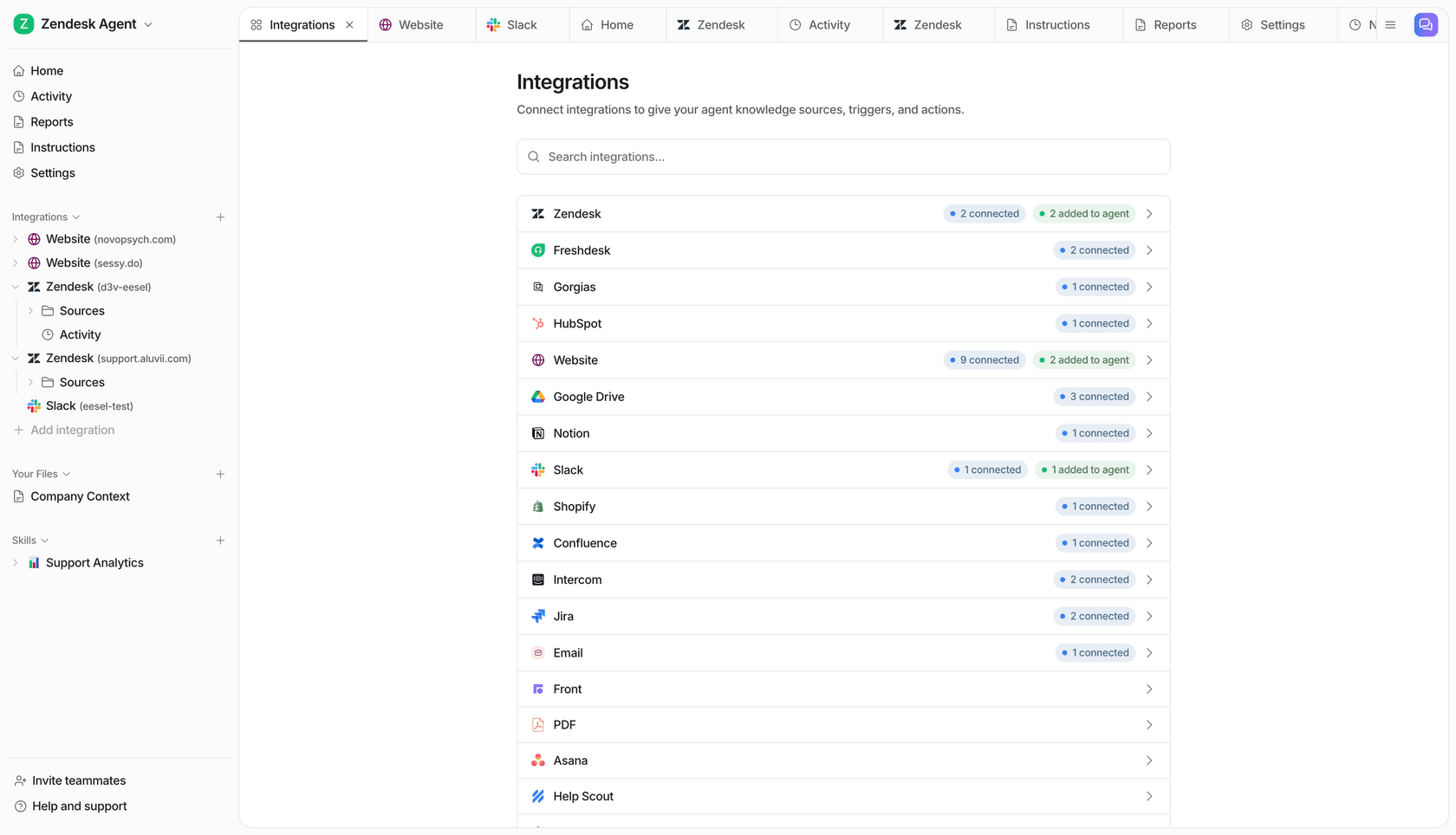
If you got this far, here's the offer most Help Scout switchers don't realise exists. eesel connects to Help Scout and 100+ other tools, trains on your past tickets and docs, and runs autonomous support inside your existing inbox on one fixed monthly price, from $299 for 500 credits, with optional overage capped at a limit you set. No migration, no engineering project, no seat change.
You can try it on a real Slack channel or helpdesk inbox in a few minutes - there's a free plan with 100 credits and no credit card. If it sounds too good to be true, the worst case is a refund and a slightly smarter Slack workspace. Start at eesel.ai or skim the integrations list to see if your stack is already covered.
Frequently asked questions
Why do teams look for Help Scout alternatives in the first place?
What is the best free Help Scout alternative for small teams?
How does Help Scout AI Answers pricing compare to other Help Scout alternatives?
Are there any Help Scout alternatives built specifically for Shopify and DTC?
Can I keep Help Scout and just add a better AI layer?
Which Help Scout alternatives have HIPAA and SOC 2 compliance built in?
How do I choose the right Help Scout alternative for a growing support team?


Article by
Kira
Kira is a writer at eesel AI with a Computer Science background and over a year of hands-on experience evaluating AI-powered customer service tools. She focuses on breaking down how helpdesk platforms and AI agents actually work so that support teams can make better buying decisions.