What I actually mean by a "Siena AI alternative"
Quick context, because "AI customer service" now covers about forty different things. Siena bills itself as "The AI CX operating system for consumer brands": an intelligence layer running multiple agents (support, shopping, reviews, QA, voice-of-customer) that sits on top of your existing helpdesk rather than replacing it, and it's pitched squarely at DTC ecommerce.
So a fair alternative is a tool that does at least one of those jobs well: resolve real support tickets autonomously, take ecommerce actions like refunds and order tracking, and ideally plug into the helpdesk you already run. I've deliberately included a couple of full helpdesks (Gorgias, Richpanel) and a couple of pure agent layers (eesel, Decagon), because depending on your setup, the right answer might be either.
One housekeeping note on how I evaluated these. For Siena and the tools we don't run day to day, I'm working from their own docs, pricing pages, and public reviews, not from a year of living inside each product. Where I can show you the actual UI, I have.
Why teams look past Siena AI in the first place
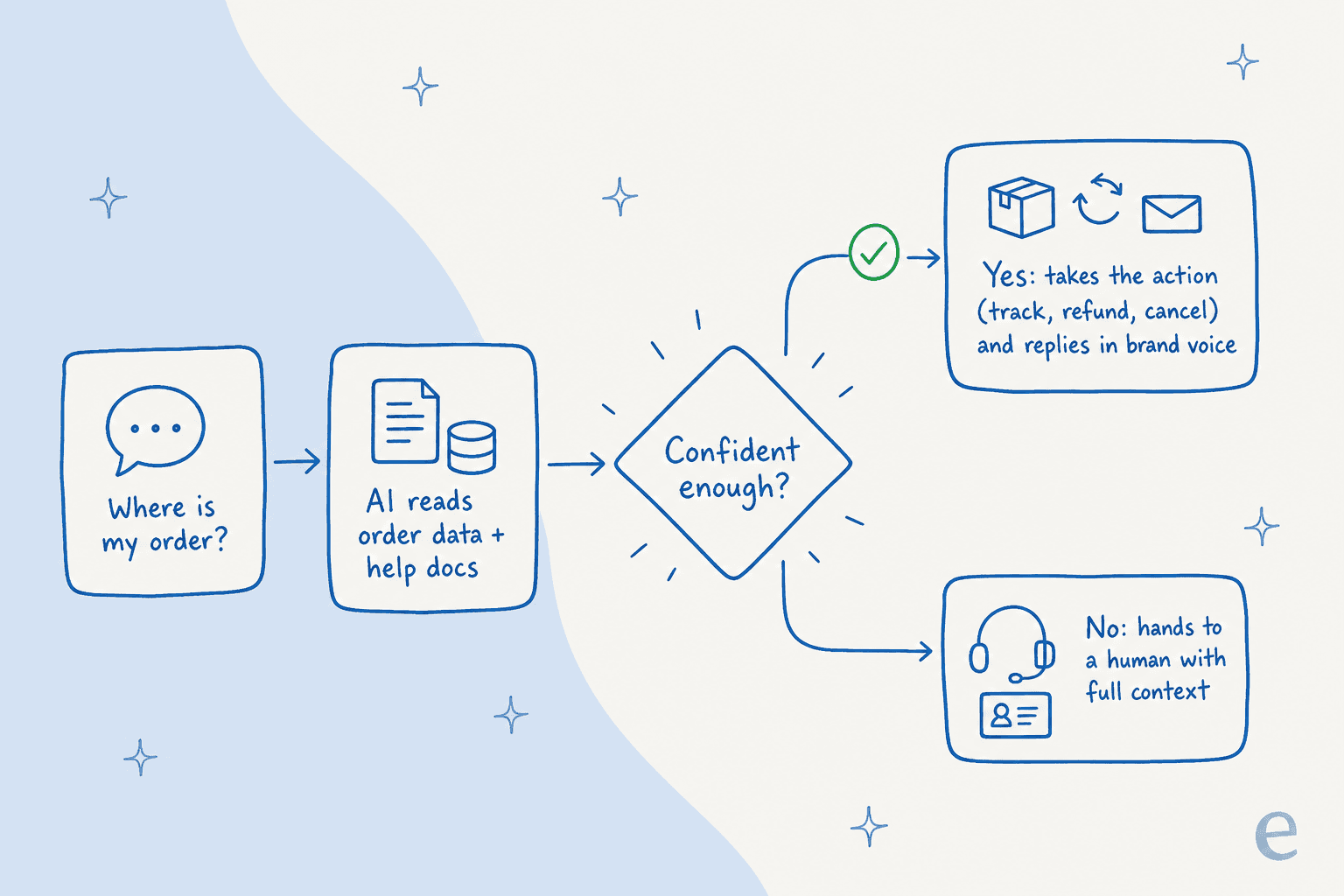
I'll start with the thing I know best. Across thousands of real rollouts, the single hardest part of putting an AI agent live isn't whether it can answer, it's whether it knows when not to. We've watched confident-sounding bots quietly hand customers wrong answers, which is exactly why every eesel rollout now gets simulated against historical tickets before it touches a live queue.
That instinct came straight from buyers. On one sales call, an ops lead at a DTC supplements brand running about 7,000 Gorgias tickets a month put the worry better than I could:
"The AI will never be able to answer 100% of the questions, but if it tries and just answers 'sorry I don't know this,' I cannot go and check all my 7,000 tickets to see if the AI actually made a good answer. I need an AI who is only handling the tickets that it's confident to handle, and all the other ones, leave them alone."
That's the lens I'd judge any Siena alternative through. And it maps neatly onto the three reasons I see brands shopping around:
The commercial model is a commitment. The Siena pricing page discloses a $750/month platform fee, a $0.90-per-automated-ticket pack, and an unpriced implementation tier, with the real number behind a demo form. For a smaller store, paying a $750 floor before you've seen a single resolution is a hard ask.
Escalation is the recurring gripe. Siena's G2 profile sits at a strong 4.8 out of 5, but the most pointed complaint in the reviews is about routing: the agent sometimes keeps responding after a human handoff, or closes an out-of-scope ticket instead of passing it on. One reviewer summed it up as "good 93% of the time, really bad the other 7%."
It's ecommerce-only by design. That focus is a strength if you're a DTC brand and a mismatch if you're a SaaS or B2B support team. Plenty of the best agents are happy to work outside the Shopify world.
The 7 best Siena AI alternatives at a glance
Here's the whole field in one table before I get into each one. The columns I'd actually decide on: how the AI is billed, whether there's a platform fee on top, and whether it bolts onto your current helpdesk or replaces it.
| Tool | Best for | AI pricing | Platform / base fee | Sits on your helpdesk? | Free trial | Standout proof |
|---|---|---|---|---|---|---|
| eesel AI | Any helpdesk, pay per resolution | $0.40 / ticket | None (Enterprise $1k/mo optional) | Yes, 100+ tools | $50 free, no card | Smava: 100k+ tickets/mo automated |
| Siena AI | DTC "CX operating system" | $0.90 / automated ticket | $750 / mo | Yes | No, demo only | G2 4.8/5 (28 reviews) |
| Gorgias | Shopify stores, all-in-one | $0.90 / resolution (annual) | $10–$750 / mo helpdesk | It is the helpdesk | Yes | Powers 40% of Shopify brands |
| Yuma AI | High-volume Shopify automation | ~$0.74 / resolved ticket (est.) | from $850 / mo (Shopify) | Yes | 30 days | EvryJewels: 89% automation |
| Richpanel | DTC wanting an AI helpdesk + guarantee | $0.25 / conversation | $500 / mo + $100 / seat | It is the helpdesk | 30-day guarantee | The Ridge: CSAT 88% to 96% |
| Gladly | Premium retail and voice brands | $1.50 / AI resolution (Shopify) | Contact sales | It is the platform | Free to install (Shopify) | G2 4.7/5 (1,112 reviews) |
| Kustomer | High-volume B2C on a CRM timeline | ~$0.60 / conversation (3rd-party) | ~$89–$139 / seat, 8-seat min | It is the platform | No easy self-serve | 600+ companies |
| Decagon | Enterprise replacing a brittle bot | Custom, volume-based | Sales-led | Fronts or replaces | No | Duolingo: 80% deflection |
A note on those numbers: Siena's, Gorgias's, Richpanel's, and eesel's rates are vendor-published. Yuma's and Kustomer's per-ticket figures are estimates (Yuma's own, and a third-party teardown for Kustomer), so treat them as directional. I'll flag the soft spots as I go.
How the monthly cost actually shakes out
Per-ticket rates are easy to wave away until you do the multiplication. Here's a like-for-like at 2,000 AI-handled tickets a month, counting each tool's platform or base fee plus its per-ticket AI rate.
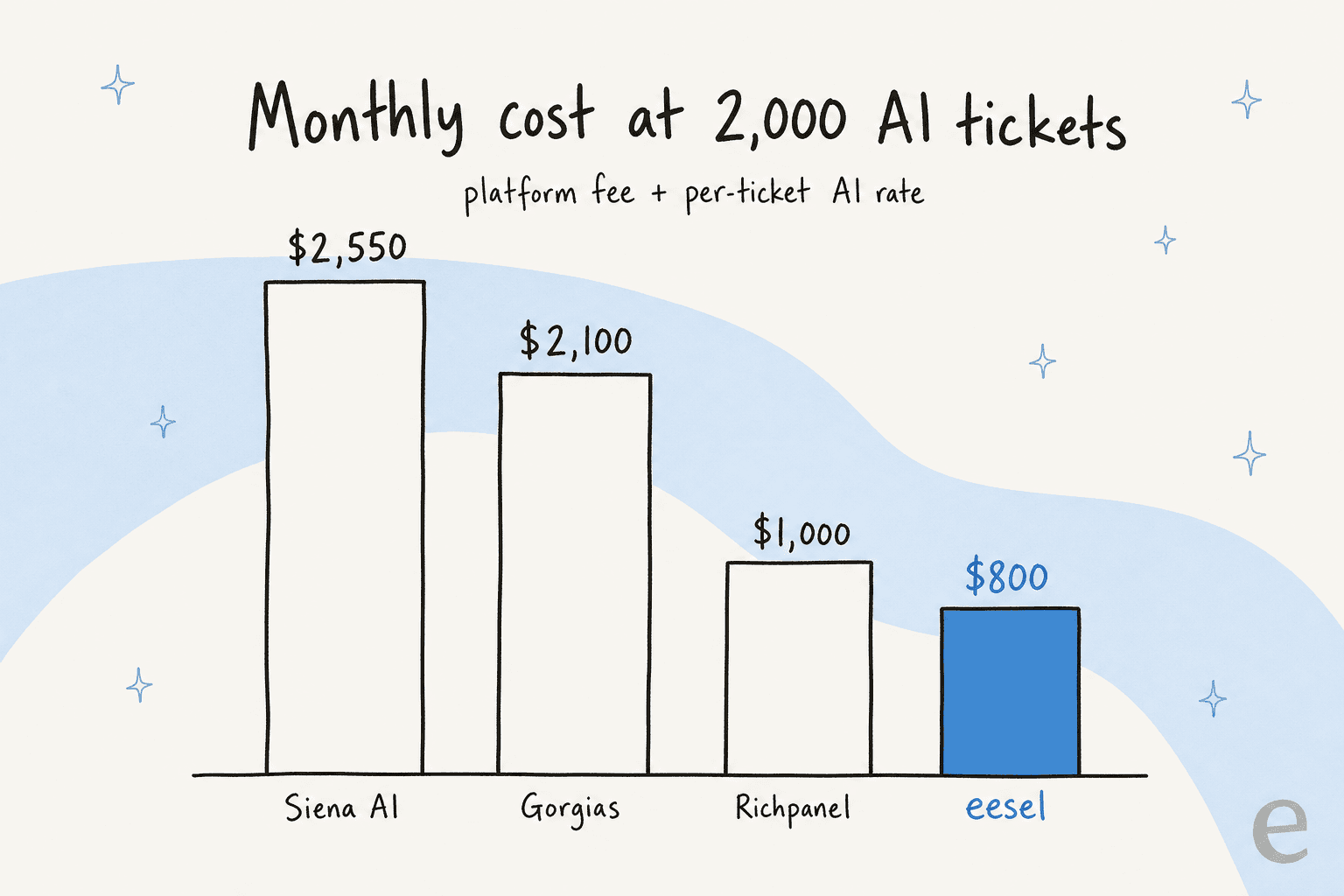
The platform fee is what does the damage. Siena's $750 floor plus $0.90 a ticket lands it near the top; eesel's no-floor, $0.40-a-ticket model comes in lowest because you're only ever paying for resolutions. Plug in your own volume below, since the crossover point moves a lot with ticket count.
1. eesel AI
Best for: teams that want to add an AI agent to the helpdesk they already run, and only pay for what it actually resolves.
I'll be upfront that this is us, so weigh it accordingly. eesel AI is an AI agent that lives inside your existing tools and learns from your past tickets, help docs, and macros on day one, then drafts, triages, escalates, and takes actions. The thing that separates it from Siena is less about resolution quality and more about how you get to live, and what you pay.
Standout features. Two are worth calling out for anyone coming from Siena. First, simulation mode: before you go live, eesel replays the agent over thousands of your historical tickets and shows you exactly what it would have resolved, by theme, so you can find gaps and fix them before a customer is involved. Second, confidence-based routing, which is the direct answer to that supplements ops lead's worry: low-confidence tickets get drafted or escalated, not auto-sent. It connects to 100+ tools across Zendesk, Freshdesk, Gorgias, and Front, handles 80+ languages, and the ecommerce agent takes Shopify actions like order lookups and refunds.

Pros. No platform fee and no per-seat charge: you pay $0.40 per resolved ticket, full stop. You can start on your own ticket history with $50 of free usage and no credit card, and roll out gradually by routing only a slice of volume. Smava runs a fully automated Zendesk agent on 100,000+ German-language tickets a month, and Gridwise's eesel rollout resolved 73% of tier-1 requests in the first month.
Cons. It isn't a Shopify-native helpdesk with a built-in storefront upsell agent, so a brand that wants shopping recommendations baked into the same tool will find Siena or Gorgias more purpose-built. eesel is the agent layer, not the inbox.
Pricing. Pure usage: $0.40 per ticket, $4 per blog draft if you also use the content writer, with an optional $1,000/month Enterprise tier for SSO, HIPAA, and a dedicated engineer. Full numbers on the pricing page.
Our take: if your priority is keeping your helpdesk and not committing to a platform fee before you've seen results, eesel is the most natural Siena swap on this list. If you specifically want an all-in-one ecommerce suite, read on.
2. Gorgias
Best for: Shopify stores that want the helpdesk and the AI in a single, deeply integrated tool.
Gorgias is the ecommerce helpdesk most DTC brands already know, and it claims to power customer conversations for 40% of Shopify brands. Where Siena layers on top of your helpdesk, Gorgias is the helpdesk, with its AI Agent built in and pre-trained on a billion-plus ecommerce conversations.
Standout features. The native Shopify connection is the whole point: orders, customers, and store data live inside the ticket view with no syncing, and the AI Agent can cancel, discount, edit orders, and recommend products in-conversation. It unifies email, chat, SMS, WhatsApp, Instagram, and TikTok into one inbox.
Pros. If you're already on Shopify, nothing pulls store data in as cleanly. Orthofeet hit 56% automation in under two months, and BareMinerals reports an 8.83x ROI on AI-driven sales. It's a mature, well-reviewed product with a real ecosystem.
Cons. Pricing is the common objection: the helpdesk runs roughly 3x a generic tool at similar ticket volumes, and the AI Agent is a separate $0.90-per-resolution add-on on annual plans, where each AI interaction also counts as a billable ticket. It only makes sense once a big chunk of your tickets need direct Shopify actions. If you'd rather not switch helpdesks, see my Gorgias alternatives for Shopify breakdown.
Pricing. Helpdesk tiers from $10/mo (Starter) up to $750/mo (Advanced), plus the AI Agent at $0.90 per resolved conversation annually ($1.00 monthly). Details on the Gorgias pricing page.
Our take: the strongest all-in-one if you're Shopify-first and don't mind that the AI and helpdesk are billed separately. If you already like your helpdesk, an agent layer like eesel will be cheaper and less disruptive.
3. Yuma AI
Best for: high-volume Shopify brands that want end-to-end resolution and an outcome-based bill.
Yuma is the most direct head-to-head with Siena: another AI agent layered on your helpdesk (Gorgias, Zendesk, Kustomer, Gladly), built for ecommerce, that resolves WISMO, returns, refunds, and subscription edits by taking real actions. It's a Y Combinator W23 company that raised $5M in 2024.
Standout features. Its Support AI ships with 100+ ready-made actions and runs 15-20 quality checks per reply, and the "Ask Yuma" assistant builds automations from your SOP docs. The headline claim is up to 89% of conversations resolved autonomously.
Pros. Genuinely strong at scale: the flagship EvryJewels case study cites 89% automation and 150k+ tickets a month. Reviewers on its G2 page (4.8/5) repeatedly praise the human team and the continuous-improvement loop as much as the AI.
Cons. The performance-based model rewards volume and punishes small stores: a recurring G2 note is that it's only cost-effective at significant scale. And real-world automation lands closer to 30-50% fully resolved after genuine setup work, below the 89% headline. Pricing is murky, too, which I get into next.
Pricing. Outcome-based with no public rate card; the Shopify App Store listing shows plans from $850/month, and Yuma's own comparison pages estimate roughly $0.74 per resolved ticket (treat that as a vendor estimate, not a quote).
Our take: a serious Siena rival for large DTC brands, and arguably the closest like-for-like. Smaller stores will feel the high floor, the same way they do with Siena.
4. Richpanel
Best for: DTC teams that want an AI-native helpdesk and a money-back resolution guarantee.
Richpanel is an AI-native helpdesk that frames the purchase as "hiring an AI support team": a Frontline AI that resolves tickets, a Copilot for agents, and a QA AI that reviews every reply before it sends. It serves 2,000+ brands including The Ridge and Jones Road Beauty.
Standout features. The QA AI layer is the interesting bit, since it grades 100% of conversations and surfaces policy gaps, which is a direct answer to the "is the AI sending good answers?" worry. It's a full unified inbox (email, chat, social, SMS, voice) with migration tooling to import from Zendesk or Gorgias.
Pros. The cheapest per-conversation AI rate on this list at $0.25, and a 50% resolution guarantee in 30 days or your money back. The Ridge took CSAT from 88% to 96% after switching, and Jones Road went from 18 agents to 10 while revenue grew.
Cons. Independent review data is thin (the G2 page is JS-gated, so I couldn't verify a community score), and like Gorgias it's a full helpdesk, so adopting it means a migration, not a bolt-on. The $100-per-seat human pricing adds up if you have a big team.
Pricing. $500/month base plus $0.25 per AI conversation and $100 per human seat; a sample bill of 2 AI agents and 3 seats lands at $800/month. See the Richpanel pricing page.
Our take: the best value if you want an AI-first helpdesk (not just an agent) and the guarantee gives you a cheap way to test the resolution claim.
5. Gladly
Best for: premium retail and consumer brands that lead with voice and a lifelong customer view.
Gladly takes a different angle: instead of tickets, it models one continuous, lifelong conversation per customer, and its pitch is "the only AI built for LTV." Its AI agent, Sidekick, resolves issues and takes real actions across chat, voice, email, SMS, and social. The customer roster (TUMI, UGG, Crate & Barrel, Nordstrom) tells you the target.
Standout features. The 360-degree customer profile is the real differentiator, so customers never repeat themselves across channels, and Sidekick on Voice handles natural phone support, which most tools on this list don't. Gladly claims 76% of conversations fully resolved by AI.
Pros. Among the best-reviewed here, at 4.7/5 from 1,112 G2 reviews, with channel breadth (especially voice) and the unified profile drawing consistent praise. If you're a premium brand where every interaction is part of the relationship, the model fits.
Cons. The two most consistent complaints are price (it skews expensive and per-seat, less friendly to small teams) and reporting (fragmented, with manual exports for key metrics). There's a learning curve, too. For a deeper look at the numbers, I wrote up Gladly pricing separately.
Pricing. Core platform is contact-sales; the only public self-serve pricing is the Shopify App Store plan at $1.50 per AI Resolution, $0.25 per AI Assist, and $120/month per seat.
Our take: the pick for premium, voice-heavy retail brands. For most small-to-mid DTC stores it's heavier and pricier than they need.
6. Kustomer
Best for: high-volume B2C operations that want AI running on a full CRM-style customer timeline.
Kustomer is a CX platform built around a customer-centric data model, where every interaction ties to a complete record (orders, loyalty tier, churn risk). Its native AI suite (Concierge for customers, Envoy for agents, Architect for building) runs on that timeline. The roster skews high-volume B2C: Skims, Vuori, Rappi, sweetgreen.
Standout features. Concierge handles end-to-end self-service across chat, email, SMS, and WhatsApp from the full 360-degree timeline, and Architect is a no-code builder with native Model Context Protocol support so agents act on live Kustomer data. Vuori reportedly runs 70% of chat fully automated.
Pros. The unified timeline is genuinely useful for complex, repeat-customer support, and reviewers like the workflow flexibility and the agent copilot.
Cons. It's the heaviest commitment here. Pricing is quote-only, but third-party teardowns put it around $89-$139 per seat with an 8-seat minimum and AI metered separately on top, so there's no easy self-serve trial. Reviewers also flag a buggy voice channel and a complex UI. Worth noting the homepage advertises a "5.0 from 500+ G2 reviews" while the actual G2 aggregate is 4.4/5, so take the marketing figure with a grain of salt.
Pricing. Contact-sales only; expect a per-seat platform fee with an 8-seat floor plus separately billed AI (roughly $0.60 per engaged conversation per competitor research).
Our take: a fit for larger B2C teams that want a CRM and CX platform in one, but the seat minimum and quote-only AI pricing make it the opposite of Siena's (or eesel's) try-before-you-commit model.
7. Decagon
Best for: enterprises replacing a brittle vendor bot with one agent across every channel.
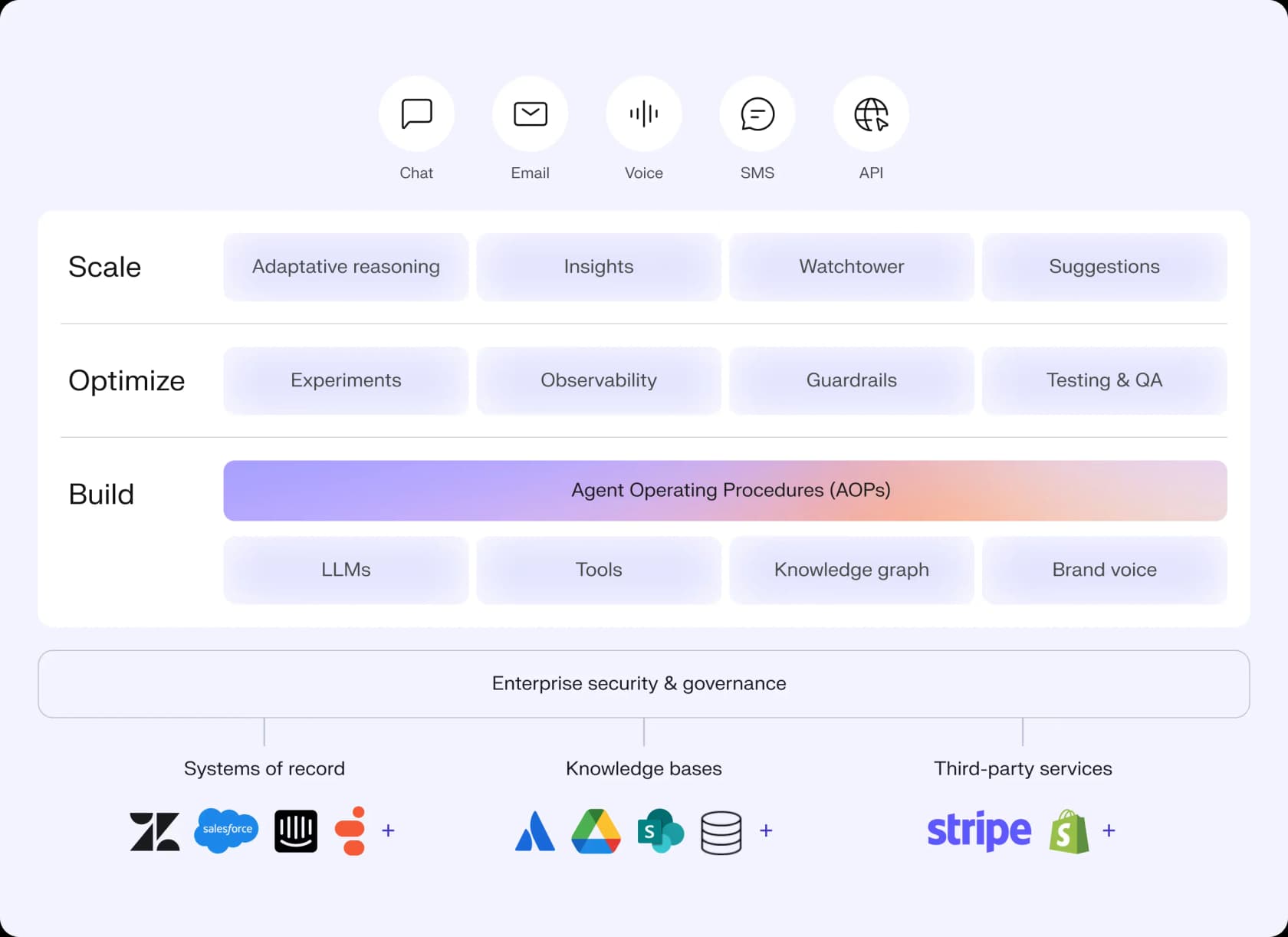
Decagon is the enterprise heavyweight: an AI-native agent platform built around Agent Operating Procedures, natural-language instructions that compile into executable code, deployed across chat, voice, email, SMS, and custom API surfaces from one runtime. It's well-capitalised (a reported ~$1.5B valuation) and its logos (Duolingo, Chime, Hertz, Figma) are not DTC-store names.
Standout features. The AOP authoring model lets CX operators write agent logic in plain language while engineers keep guardrails and versioning, and Decagon runs the same agent natively across voice and chat. Duolingo reports 80% deflection after replacing a previous vendor, and ClassPass cites a 95% cost reduction.
Pros. If you're a large enterprise frustrated by maintaining a flow-builder bot, this is the category leader at omnichannel parity and authoring flexibility, with serious observability and QA tooling.
Cons. It's overkill (and likely over-budget) for a typical ecommerce brand. Pricing is fully sales-led and volume-bracketed, with no free tier or self-serve trial. The demo form's "monthly support tickets" dropdown starts at <9,999 and goes to 250,000+, which tells you the ICP.
Pricing. Custom annual contracts bracketed by ticket volume; no public list price.
Our take: the right call if you're enterprise and replacing a bot, not a Shopify store comparing it to Siena. For most readers here it's a tier above what you need.
So which Siena AI alternative should you pick?
Step back from the feature lists and it sorts cleanly along two axes: how ecommerce-specialised the tool is, and whether it's self-serve or sales-led. Here's roughly where they land.
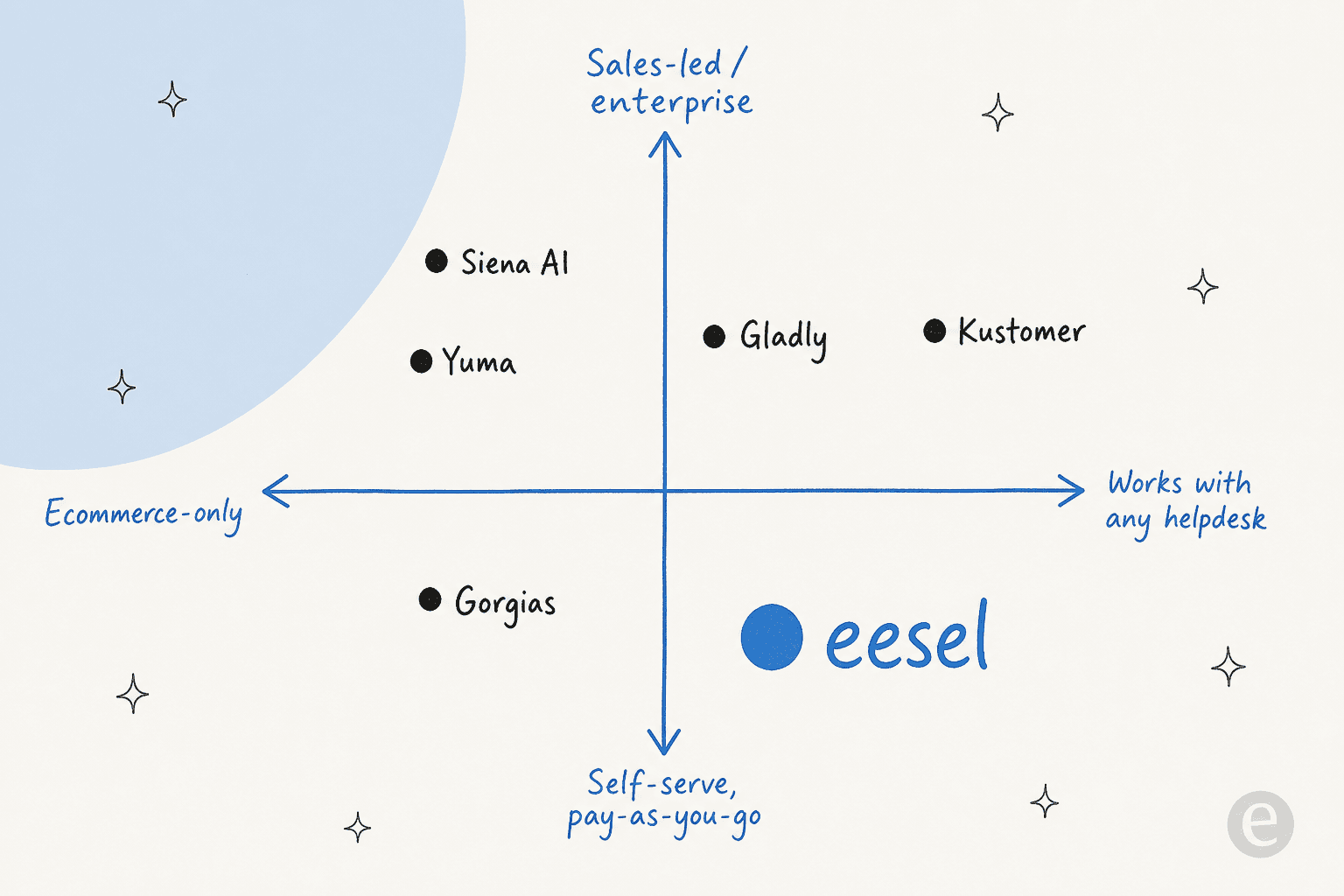
To make it a decision rather than a vibe:
- You're on Shopify and want one tool for everything: Gorgias.
- You're a large DTC brand chasing maximum end-to-end automation: Yuma, or Richpanel if you want an AI-first helpdesk with a guarantee.
- You're a premium, voice-led retail brand: Gladly.
- You're a big B2C enterprise: Kustomer, or Decagon if you're replacing a bot across many channels.
- You want to keep your current helpdesk and only pay for resolutions: eesel AI.
The honest summary: Siena is a good product that's expensive to start with and only worth it if you're committed to the DTC-suite model. For everyone else, one of these fits better and costs less to find out.
Try eesel AI on your own tickets
If the part of Siena that appeals to you is "an AI agent that resolves real tickets and takes ecommerce actions," but the $750 platform fee and demo-gated pricing don't, eesel AI is built for exactly that gap. It plugs into the helpdesk you already run, learns from your past tickets and help docs on day one, and you can simulate it on your real ticket history to see the resolution rate before going live, then pay $0.40 per ticket with no platform fee and no per-seat charge.
You can Try eesel with $50 of free usage, no credit card and no sales call, and route a slice of your volume to see what it resolves this week.
Frequently asked questions
How much does Siena AI cost compared to the alternatives?
Are there Siena AI alternatives that work without switching helpdesks?
Do Siena AI alternatives handle ecommerce actions like refunds and order tracking?
Can these AI agents avoid sending wrong answers to customers?


Article by
Kurnia Kharisma Agung Samiadjie
Kurnia is a software engineer and writer at eesel AI with two years of SEO experience, writing about AI tools, helpdesk software, and customer support. He pairs a developer's understanding of how these products are built with search-driven research into what actually ranks and resonates with the people searching for them.