
Why people leave CoSupport AI
Let me be fair to CoSupport first, because it's a real product, not a punching bag. It's been building this since 2020, it's bootstrapped, and its whole pitch is accuracy: a USPTO-patented multi-model setup (granted January 2024) that answers only from your company data, with a headline 99% accuracy claim. The named-customer numbers are concrete, too. Dental SaaS Remedico reports the agent resolving roughly 74% of tickets and saving about $9,300 a month, and SupportYourApp says it handles around 80% of incoming requests. When CoSupport works, people clearly like it.
So the problem isn't the engine. It's the buying-and-onboarding experience, and it bites hardest at the small-to-mid end of the market.
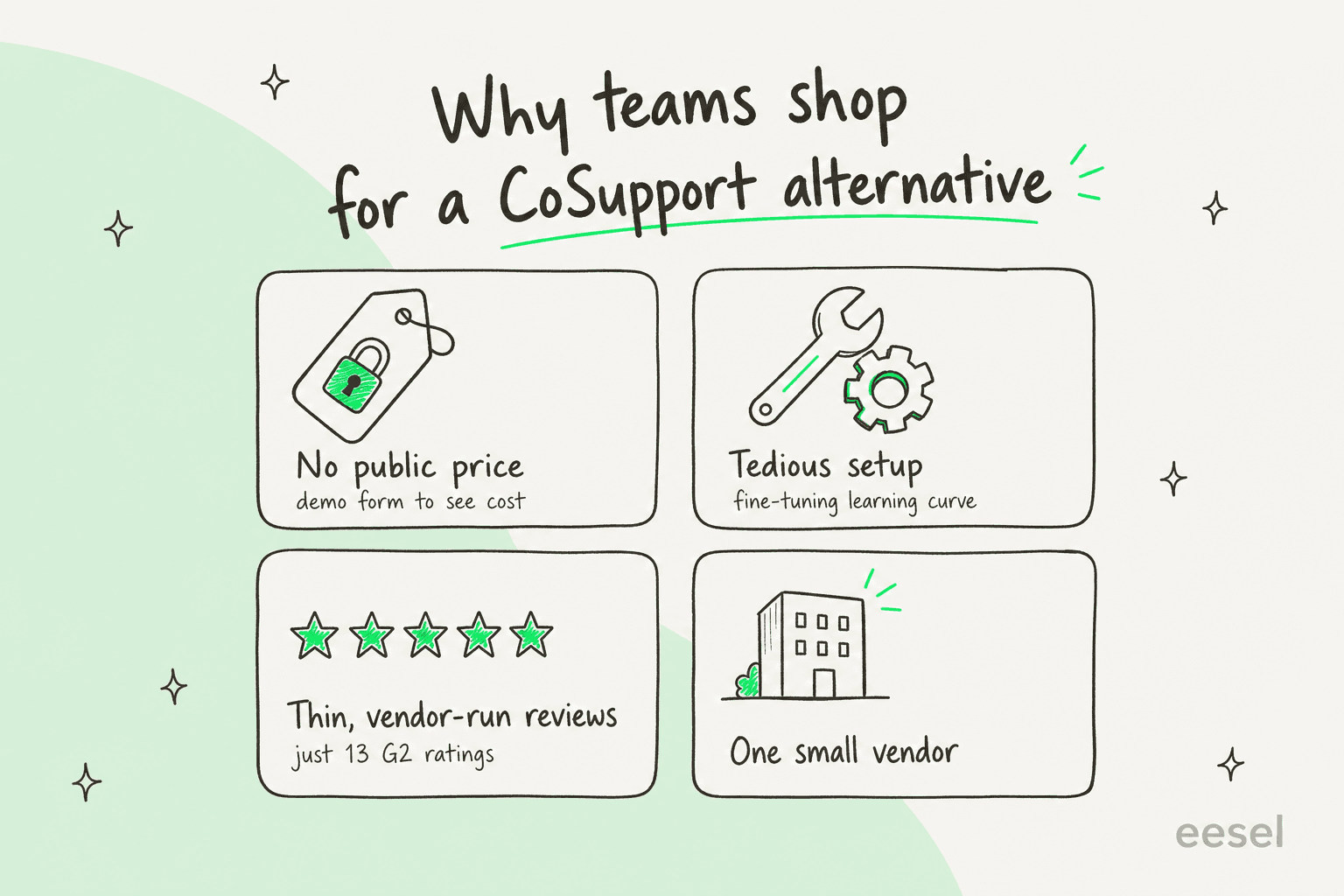
The first wall is pricing. CoSupport lists three billing models, server-based (from $99/month), resolution-based (from $0.19 per solved ticket), and response-based (from $0.04 per reply), but the real cost is a one-time setup fee plus a monthly subscription, both quoted behind a demo form. There's no self-serve checkout. Worse, the numbers don't even agree across the site: the customer-facing pages cite $0.59 per solved ticket and $0.10 per reply, while the live pricing page and the review sites cite $0.19 and $0.04. Two different price sheets, live at the same time, is not what you want when you're trying to forecast a bill.
The second wall is setup. CoSupport markets itself as live "in days," but its own reviewers tell a more mixed story. The recurring G2 complaint tags are Difficult Setup, Integration Difficulty, and Learning Curve, the time-consuming fine-tuning at the start before the accuracy pays off. If you're a five-person team without an ML person to babysit the tuning, that ramp matters.
And the third, quieter wall: there isn't much independent signal to lean on. CoSupport's ratings are excellent but tiny, G2 4.9/5 across just 13 reviews and Capterra 5.0/5 across 10, on a vendor-managed profile. That's not a knock on the product, but a 99% accuracy claim is a lot easier to trust when more than two dozen strangers have stress-tested it in public.
How I ranked these CoSupport alternatives
I wasn't hunting for the longest feature list. For someone leaving CoSupport, four questions decide the whole thing:
- Can I see the price myself? Published, self-serve pricing beats a gated quote when you want to compare options in an afternoon.
- How fast can I actually get live? CoSupport's slow ramp is half the reason people shop around, so setup speed is weighted heavily here.
- Do I have to re-platform? Some tools replace your helpdesk; others sit on top of it. Keeping your stack is usually the cheaper, faster road.
- Can I test it safely? Simulation against your own past tickets is the line between a confident rollout and a public mistake, and the honest answer to CoSupport's accuracy pitch.
Sentiment comes from G2, Capterra, Trustpilot, and Reddit, never marketing copy. Here's how the nine land on the two axes a CoSupport shopper cares about most: how visible the pricing is, and who the tool is really for.
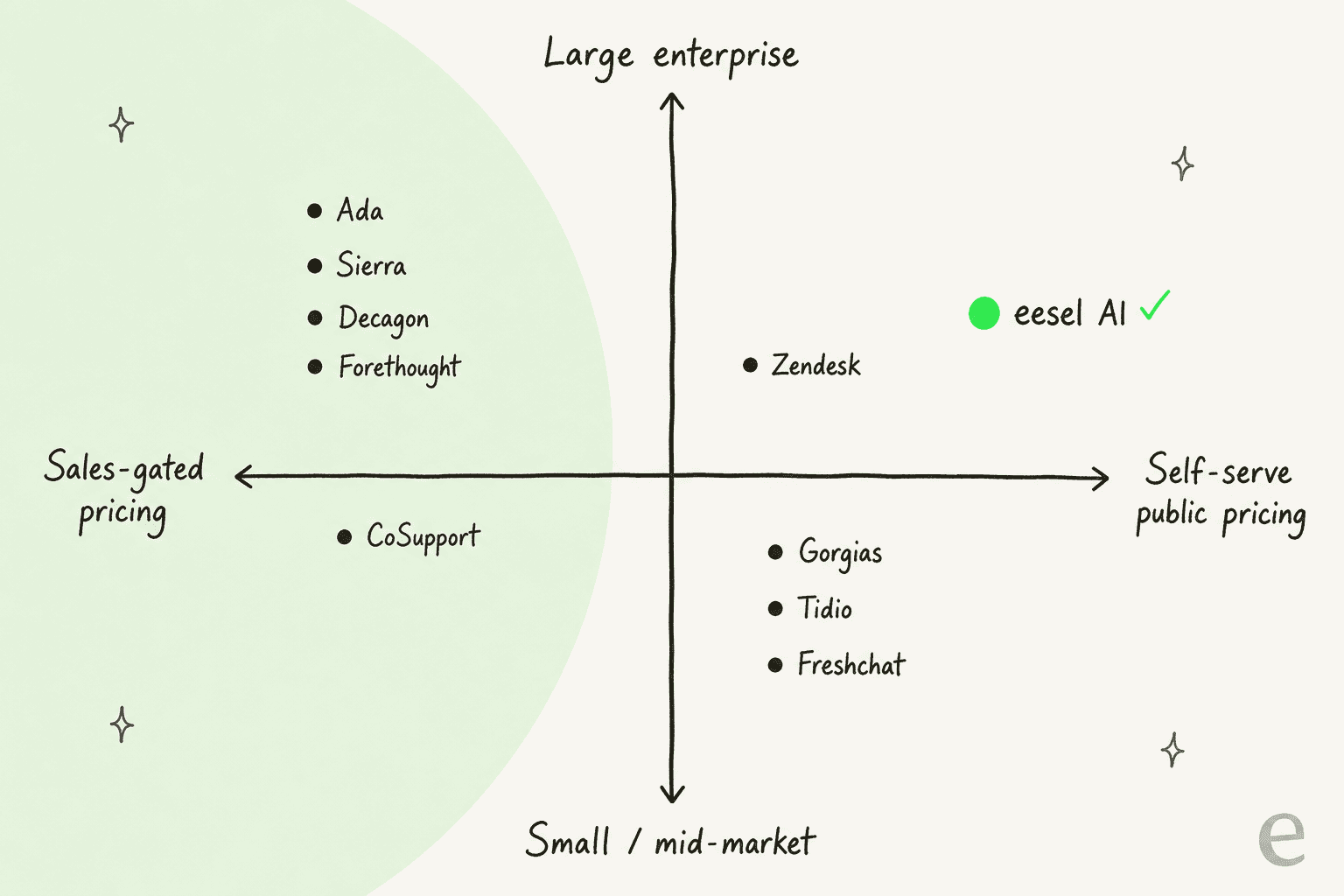
The best CoSupport AI alternatives at a glance
| Tool | Best for | Starting price | AI billing model | Omnichannel | Free trial | G2 rating |
|---|---|---|---|---|---|---|
| eesel AI | Self-serve AI on your existing helpdesk | $0.40 / ticket | Per ticket handled | Helpdesk, chat, email, Slack | Yes ($50 free, no card) | New entrant |
| Gorgias | Shopify and ecommerce brands | $10 / mo | $0.90 / resolution | Email, chat, SMS, social | Yes (7-day) | 4.6 (560+) |
| Tidio | SMB self-serve, Claude-powered | $0 | Usage (per conversation) | Chat, email, social | Yes | 4.8 Capterra (200+) |
| Freshchat | Free multi-agent live chat | $0 (10 agents) | Per AI session | Chat, email, social, SMS | Yes | 4.4 (499) |
| Zendesk | Mature all-in-one suite + AI | $19 / agent / mo | Per automated resolution | Chat, email, voice, social | Yes | 4.3 (6,964) |
| Ada | Large enterprise omnichannel | Contact sales | Per resolution (usage) | Chat, email, voice, social | No | 4.3 (~207) |
| Sierra | Outcomes-based enterprise pricing | Contact sales | Per resolved outcome | Chat, voice, SMS, email | No | Not listed |
| Decagon | AI-native mid-market to enterprise | Contact sales | Usage (annual) | Chat, voice, email, SMS, API | No | Not listed |
| Forethought | Agentic AI on your existing helpdesk | Contact sales | Platform + outcome | Chat, email, voice, SMS, Slack | No (POV) | (166 reviews) |
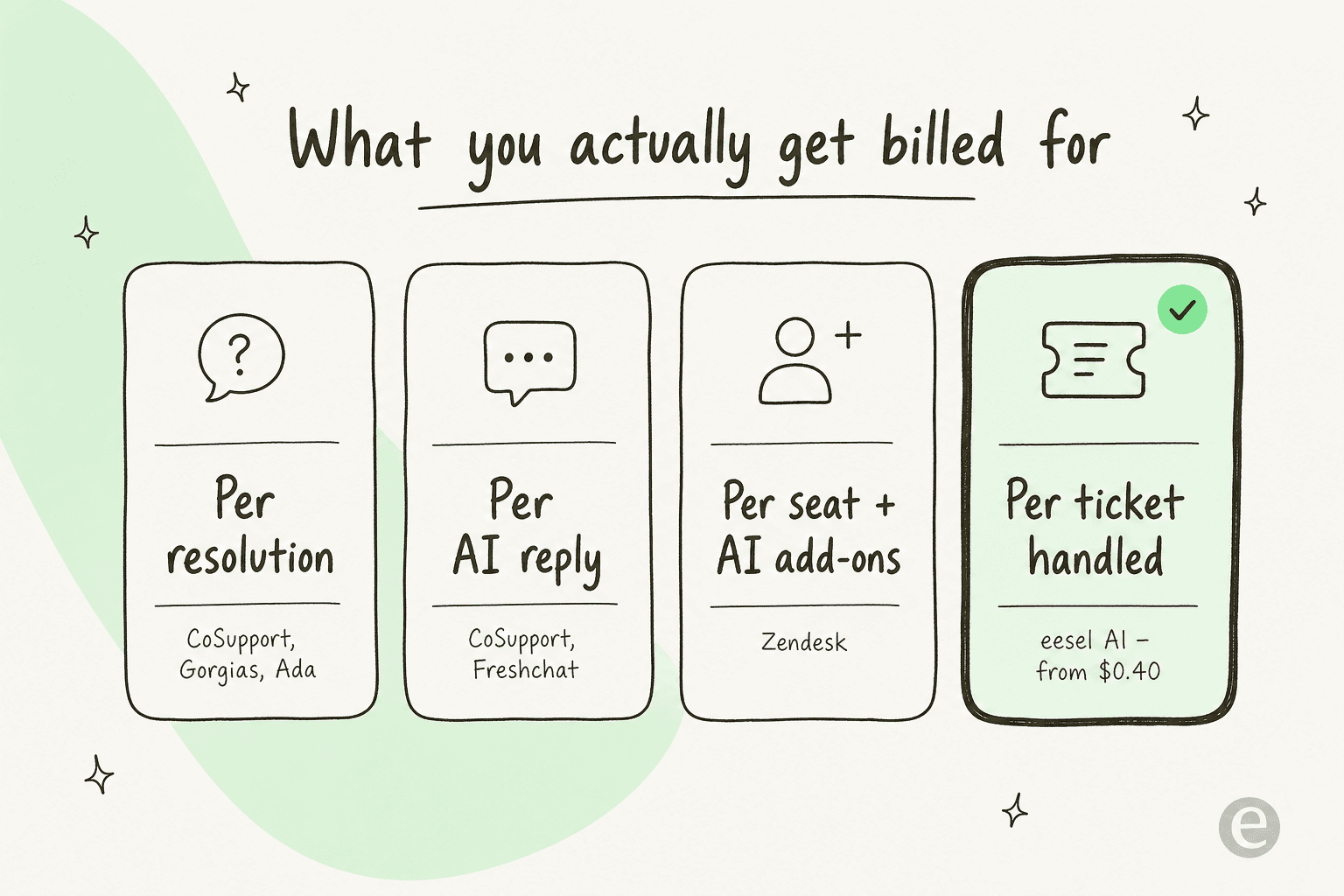
The single most important column there is the billing model, because that's where the real cost gap hides. CoSupport actually sits in two of these buckets at once (per resolution and per reply), which is part of why its pricing is so hard to read. Here's the same idea as a map:
If you'd rather not read all nine, this little filter narrows it down to the ones worth your time.
Now, the detail on each, ranked by how cleanly they answer a specific need.
1. eesel AI
Best for: teams that want a self-serve AI agent on top of the helpdesk they already run, live in minutes and billed only for the tickets it handles.
I'll name my bias up front: I'm on the team at eesel AI. It takes the top slot here because it answers the exact two things that push people off CoSupport. CoSupport makes you book a call to learn the price and budget for a fine-tuning ramp; eesel does the reverse. It connects to your existing helpdesk, trains on your past tickets and help docs in a few minutes, and starts drafting and resolving without a migration, a sales call, or a multi-week setup project.
The part I'd flag is the testing, because that's the honest answer to CoSupport's accuracy pitch. The scariest failure mode with any AI agent is the confident wrong answer, and eesel runs a simulation against your historical tickets before it touches a live customer, so you see the resolution rate and the exact replies first. One CX lead I heard from runs about 7,000 tickets a month and put it plainly: "I need an AI who is only handling the tickets that it's confident to handle, and all the other ones, leave them alone." A simulation plus a confidence threshold is how you get exactly that, no patent required.
Pricing: usage-based, from $0.40 per ticket, no per-seat fees and no minimum on self-serve. A "ticket" is one whole conversation regardless of message count, there's $50 of free usage with no card, and you only pay for tickets the AI handles, so a partial rollout of 200 of your 1,000 monthly tickets runs about $80. Enterprise adds SSO, HIPAA, and a BAA for a flat platform fee plus usage.
Our take: if the reason you're leaving CoSupport is "I just want to see the price and start without a setup project," this is the most direct answer on the list. Pick it to keep your helpdesk and pay per result; look elsewhere if native voice is non-negotiable.
2. Gorgias
Best for: Shopify and ecommerce brands that want a commerce-native helpdesk and an AI agent that can take real order actions.
If most of your tickets are "where's my order" and "I need a refund," Gorgias is purpose-built for that. It's Shopify-native, unifies email, chat, SMS, and social, and its AI Agent (trained on a billion-plus conversations via an OpenAI partnership) handles returns, order edits, and product recommendations instead of just deflecting FAQs.
For this ranking, what matters is that Gorgias is fully self-serve with published pricing, which already beats CoSupport on transparency. A Reddit ecommerce veteran framed the fit well:
"40%+ tickets need Shopify actions → I'd lean Gorgias. Mostly conversational support → Zendesk is fine."
Pricing: self-serve and ticket-based. Starter is $10/mo (50 tickets), Basic $50/mo, Pro $300/mo, Advanced $750/mo, Enterprise custom. The AI Agent is a usage add-on at $0.90 per resolved conversation (annual), with a 7-day free trial and no card.
Our take: the obvious pick for a Shopify brand, and a refreshing one on pricing after CoSupport's demo gate. Skip it if you're not ecommerce or if voice is a hard requirement; the best Gorgias alternatives cover the non-Shopify case.
3. Tidio
Best for: SMB and ecommerce teams that want a self-serve, Claude-powered AI agent with a usable free tier.
Tidio is the SMB-friendly, transparent option. Its Lyro AI agent runs on Anthropic's Claude, claims a 67% average resolution rate, and sets up with no engineering. For a small team that found CoSupport's tuning too heavy, it's about as easy to start as this category gets.
The irony is that Tidio, far more transparent than CoSupport on day one, draws a similar complaint as it scales: pricing that's hard to forecast. It bills across three separate axes (billable conversations, Lyro AI conversations, Flows visitors), and one Reddit user vented that "their pricing is so off and hidden, 'free tier' is just a trap... they need to be more transparent."
Pricing: usage-based and annual. Free is $0 (50 billable conversations, 50 Lyro conversations one-time); Starter $24.17/mo; Growth from $49.17/mo; Plus from $749/mo; Premium is contact-sales. Standalone Lyro bolts onto any help desk from $32.50/mo.
Our take: the best self-serve pick for a small team that wants strong AI without a sales call. Just watch the usage meters as you grow, and weigh the Tidio alternatives if the multi-axis billing worries you.
4. Freshchat
Best for: small teams that want a free, multi-agent live-chat tool with a clear upgrade path into a full suite.
Freshchat, part of the Freshworks family, is the friendliest entry point here. Its free tier covers up to 10 agents, which is unusually generous, and the unified inbox across website chat, email, and social gets steady praise. It funnels naturally into Freshdesk Omni as you grow.
Where it wobbles is the AI. The Freddy AI bot is the weak spot, and reviewers say so directly. One Capterra reviewer in banking summed it up: "The AI capabilities feel basic and outdated." If you're leaving CoSupport because you want strong, accurate AI, test that hard before committing.
Pricing: per agent, billed annually. Free is $0 (10 agents, website chat and email only); Growth is $19/agent and adds WhatsApp, Messenger, Instagram, and SMS; Pro is $49/agent; Enterprise is $79/agent. The Freddy AI bot is billed per session: 500 free once, then $49 per 100 sessions (roughly $0.49 each).
Our take: a strong, low-risk start for a small, price-sensitive team. Don't pick it for the AI alone; compare the best AI chatbots for support if automation is your priority.
5. Zendesk
Best for: teams that want a mature, all-in-one helpdesk with AI baked in and can absorb a layered bill.
Zendesk is the safe enterprise standard, and its AI agents (now powered by Forethought under the hood) live inside the broadest ecosystem in support, with 1,800+ marketplace apps and deep omnichannel across chat, email, voice, and social. For one vendor that does everything, it's hard to argue with the maturity.
The catch for a CoSupport shopper is that you'd be trading one opaque AI bill for another. Zendesk charges per Automated Resolution, and the exact per-resolution dollar isn't published; it's allowance-based and sales-gated. The community is wary. As one Zendesk admin on Reddit put it:
"From what I can see in regards to this new 'Automated Resolution' pricing model, we'll be paying about $1.50 ~ $1.20 per resolution. And what Zendesk counts as a resolution can be ... subjective... If you have 500 AR per week, the bill blows out to be $650, where there wasn't a charge before."
Pricing: per agent, billed annually. Support Team is $19/agent (no AI); Suite Team is $55/agent and adds AI agents; Suite Professional is $115/agent; Enterprise and Copilot are sales-gated. AI add-ons like Copilot run $50/agent/mo, and AI usage is billed per automated resolution on top.
Our take: the right pick if you want a do-everything platform and the AI is a bonus. The wrong pick if escaping opaque, layered AI pricing is the whole point; read the Zendesk AI alternatives first.
6. Ada
Best for: large enterprises (think 300k+ annual conversations) that want a standalone AI agent layer over an existing helpdesk.
Ada is one of the most direct CoSupport rivals on the accuracy-and-automation story, just aimed far up-market: a Toronto-based "Agentic Customer Experience" platform that sits on top of Zendesk, Salesforce, or Freshworks rather than owning ticketing itself. It's fully omnichannel (voice, email, chat, WhatsApp, SMS, Instagram, in-app), runs multiple LLMs, and has the strongest AI-specific compliance posture here, including AIUC-1 and zero data retention.
The honest problem for a CoSupport shopper: Ada is even less self-serve. Its pricing page is a qualification form gated at "at least 300,000 annual customer service conversations." There's no public price, no trial, and reported contracts run from roughly $30,000/year into the six figures. A former customer on Reddit was blunt: "Used to work for a company paying ~300k+ for Ada.cx, it's expensive."
Pricing: contact sales only, usage/per-resolution on annual enterprise contracts. Ada's own materials use an illustrative "$1.50 per resolution."
Our take: a serious choice if you're a large enterprise with voice needs and a procurement process. A poor fit if the whole reason you're here is to escape sales-gated pricing; the Ada alternatives cover the lighter-weight options.
7. Sierra
Best for: large consumer brands and regulated enterprises that want outcomes-based pricing and the deepest compliance.
Sierra, founded by Bret Taylor and Clay Bavor, is the prestige option. Its Agent SDK and no-code Agent Studio cover broad omnichannel (chat, voice, SMS, WhatsApp, email, even ChatGPT) from one agent, and its compliance is exceptional, with SOC 2, ISO 27001, ISO 42001, HIPAA, GDPR, and EU AI Act coverage. Its "Ghostwriter," an agent that builds agents from your SOPs and transcripts, is a clever idea.
Sierra prices on outcomes, "only pay for the value Sierra delivers," charged per resolved outcome and negotiated per customer. That sounds appealing, but it means no self-serve, no free tier, a multi-week statement of work, and a bill that moves with outcomes, which is hard to forecast in a spreadsheet.
Pricing: contact sales only, outcomes-based (per resolved conversation, completed transaction, or retention save). No published rate.
Our take: a credible enterprise rival to CoSupport if you're a large brand and outcomes pricing appeals. Overkill, and over-opaque, for everyone else; the Decagon vs Sierra breakdown is worth a read.
8. Decagon
Best for: AI-native mid-market and enterprise CX teams that want one agent across chat, voice, email, SMS, and API, authored in plain language.
Decagon is one of the buzziest AI-native platforms, and its wedge is interesting: Agent Operating Procedures, natural-language agent logic that compiles to executable code, pitched against the old SDK and decision-tree approach. It offers true omnichannel parity from one runtime plus persistent user memory, which is a strong story.
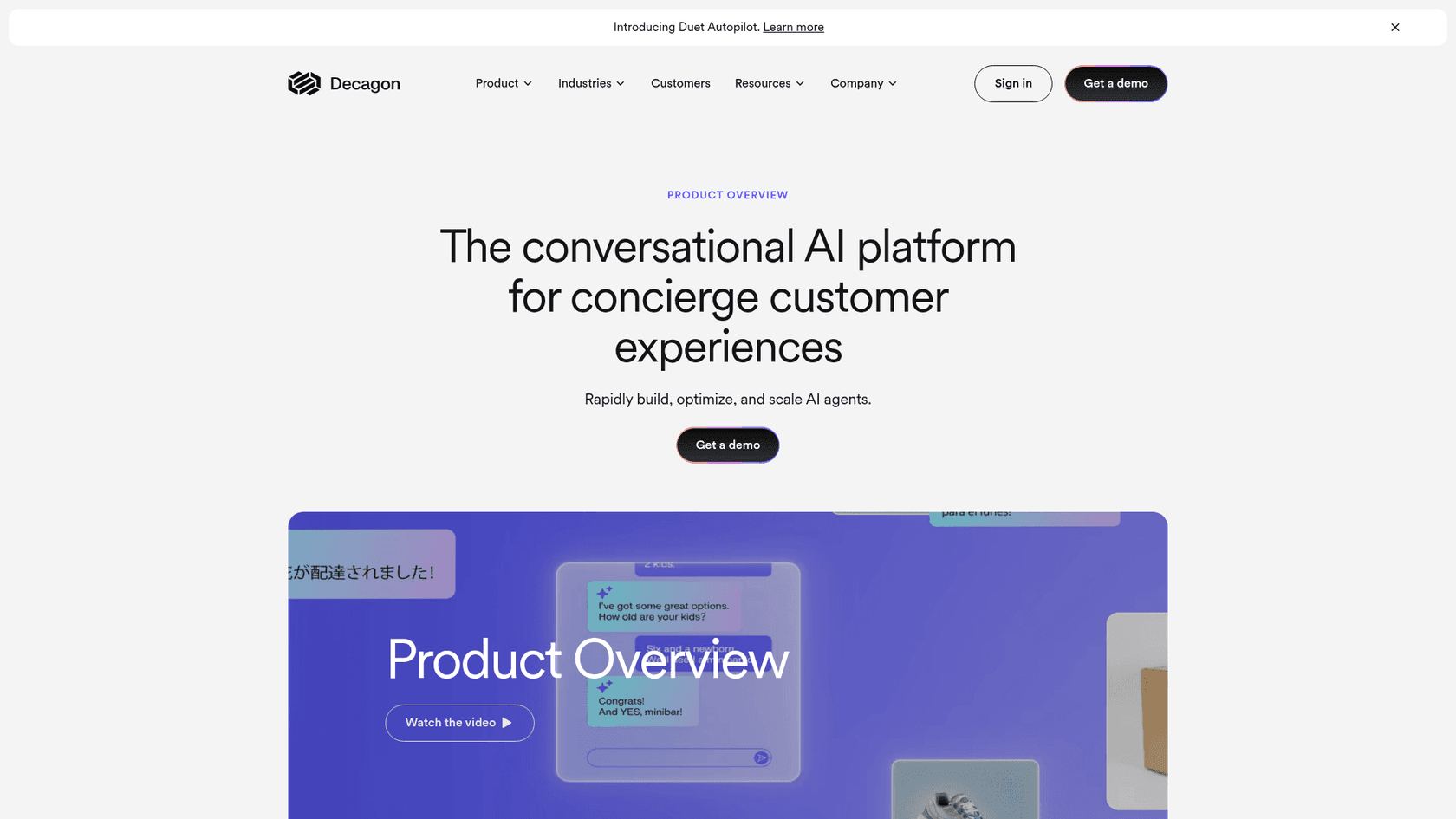
On the dimension a CoSupport shopper cares about, though, it's familiar territory. decagon.ai/pricing 404s, every CTA routes to a demo request, there's no free tier or trial, and the volume tiers start at a "less than 9,999 monthly tickets" bracket that hints at where the floor sits. It's a sales-led, annual enterprise motion.
Pricing: contact sales only, usage-based on annual contracts, tiered by monthly ticket volume. No public figure; the Decagon pricing breakdown covers what's known.
Our take: worth a demo if you're mid-market-plus and want the newest agent architecture. Not the answer if transparent, try-before-you-buy pricing is the goal; see the Decagon alternatives.
9. Forethought
Best for: mid-market and enterprise support orgs that want agentic AI on top of their existing helpdesk without switching stacks.
Forethought is helpdesk-agnostic by design: a multi-agent system (Discover, Solve, Triage, Assist, Agent QA) that layers onto Salesforce Service Cloud, older Zendesk, and others, adding agentic action-taking across chat, email, voice, SMS, and Slack. If you want to keep your current helpdesk and bolt on smarter automation, that's the pitch, and it's the closest in spirit to what CoSupport does as an overlay.
Reviewers who've deployed it like the results. One G2 reviewer wrote that "Forethought's chat widget is a valuable tool that allows our Customer Support team to proactively solve over 70% of inbound support cases." The friction, predictably, is pricing: every tier is "Get a Quote," and the model is explicitly platform-access fees plus outcome-based cost, with no free trial (just a "Proof of Value").
Pricing: contact sales only, no public numbers. Tiers are Team, Professional, and Enterprise, all quote-based, plus add-ons.
Our take: a strong choice if you're committed to your helpdesk and want agentic AI bolted on. Same pricing-opacity caveat as CoSupport and the rest of the enterprise set; compare the best Forethought competitors before signing.
So which one should you pick?
After ranking all nine, the honest summary is that they sort into three camps, and your reason for leaving CoSupport tells you which camp you're in.
If you want to see a price and start today, you're in the self-serve camp: eesel AI, Gorgias, Tidio, and Freshchat all publish their numbers. If you need full omnichannel with native voice, you're looking at the enterprise heavyweights, Ada, Sierra, and Decagon, but you should know you're signing up for the same contact-sales motion (and then some) you're trying to leave. And if your real frustration was the slow, fine-tuning-heavy setup, the tools that train on your existing tickets fast, eesel, Gorgias, Tidio, are the shortest road back to live.
The one thing I'd refuse to skip, whichever you choose, is testing the AI against your own tickets before it talks to a customer. That's the difference between a quiet, confident rollout and a public apology, and it's the fairest way to check any vendor's accuracy claim, CoSupport's included.
Try eesel AI
If you got this far because CoSupport's price was a black box and its setup looked like a project, that's the exact gap eesel AI was built to close. It's an AI agent that plugs into the helpdesk you already run, Zendesk, Freshdesk, Gorgias, Front, and more, trains on your past tickets and help docs in a few minutes, and resolves tier-1 conversations without a migration, a demo call, or a fine-tuning ramp.

The two things a CoSupport shopper wants most are baked in: transparent pricing (from $0.40 per ticket, no seat fees, no minimum) and a simulation mode that runs the agent against your real historical tickets before it talks to a customer. You see the resolution rate up front, start with a slice of your volume, and scale when you trust it. It's free to try with $50 of usage and no credit card.
Try eesel or book a demo to see it run on your own tickets.
Frequently Asked Questions
What is the best CoSupport AI alternative in 2026?
How much does CoSupport AI cost?
What is the best CoSupport alternative for a small team?
Which CoSupport AI alternative has the most transparent pricing?
How do I test a CoSupport AI alternative before going live?


Article by
Kurnia Kharisma Agung Samiadjie
Kurnia is a software engineer and writer at eesel AI with two years of SEO experience, writing about AI tools, helpdesk software, and customer support. He pairs a developer's understanding of how these products are built with search-driven research into what actually ranks and resonates with the people searching for them.