Why teams leave Sendbird AI in the first place
Before the list, it's worth being fair to Sendbird. It's a real platform handling 7 billion conversations every month, with SOC 2 Type II, HIPAA, ISO 27001, and GDPR coverage, fast deployment in "days, not weeks," and a simulation environment to test agents before launch. Long-tenure customers like it. One G2 reviewer wrote that "the pricing stays the same for 8 years, which is a big help for us."
The friction shows up somewhere specific: at the buying stage, and at the small-to-mid end of the market.
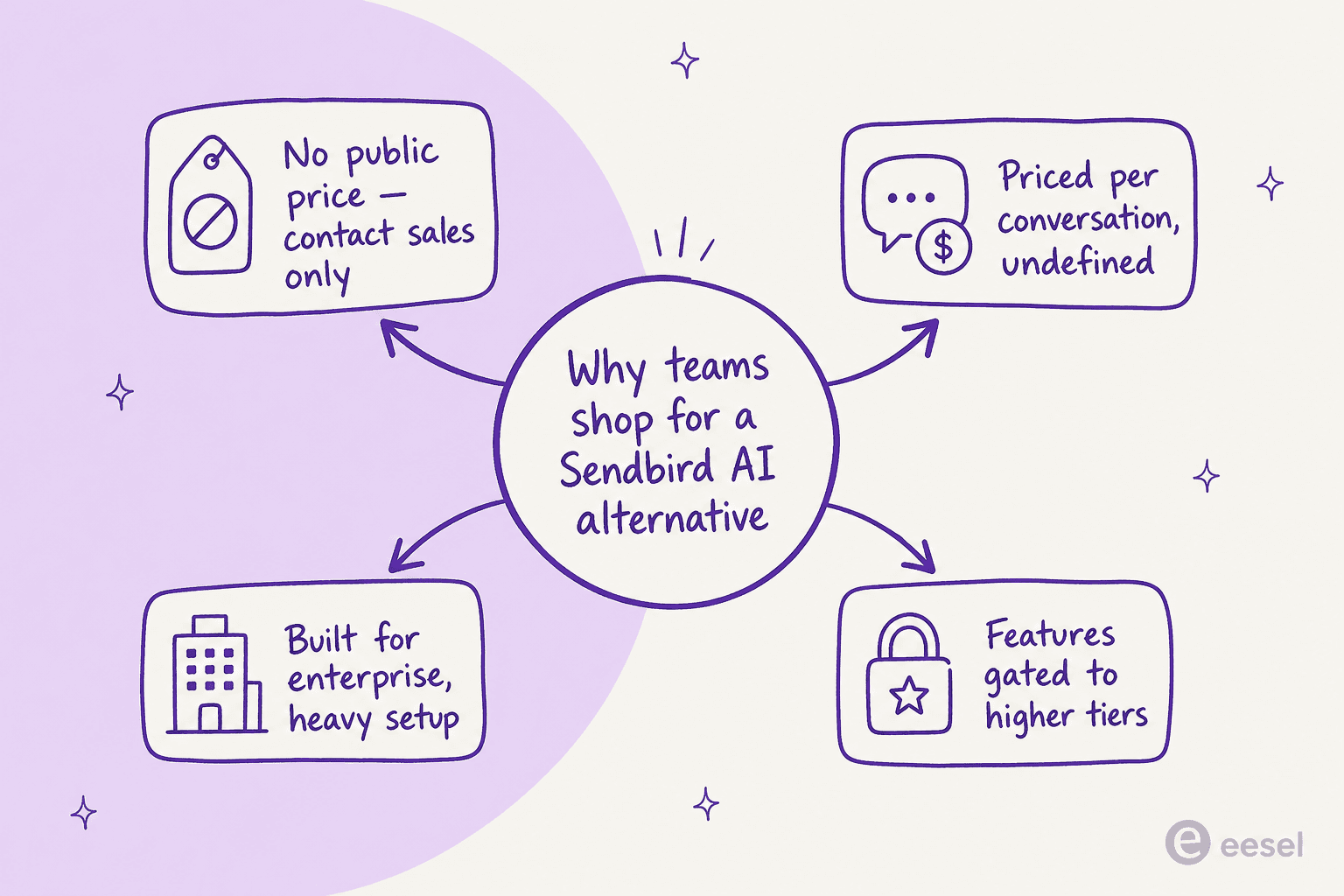
Sendbird is upfront that it prices the AI Agent per conversation, a model it defends at length against per-resolution pricing. The problem isn't the model, it's that there's no published dollar figure, no tier list, and no operational definition of "conversation." Both sendbird.com/pricing and delight.ai/pricing 404 into a contact-sales form. Only Sendbird Chat has a self-serve, MAU-based price.
That opacity compounds with what reviewers describe. On Capterra, the lowest sub-score is Value for Money, and several reviewers say Sendbird gives "different prices to different customers." On G2, cost-related tags (Expensive, Cost, Cost Limitations) outnumber every other complaint, and advanced features are gated into higher tiers, so your bill scales with the feature set you need, not just usage. None of this matters much to a Fortune 500 with a procurement team. It matters a lot if you're a startup where, as one Capterra reviewer put it, "every dollar counts."
If that's the itch, here's where to scratch it.
How I picked these Sendbird alternatives
I wasn't chasing "the most AI features." For a team leaving Sendbird, the decisions that actually bite are narrower:
- Can I see the price? Self-serve, published pricing beats a sales-gated quote when you're trying to compare options in an afternoon.
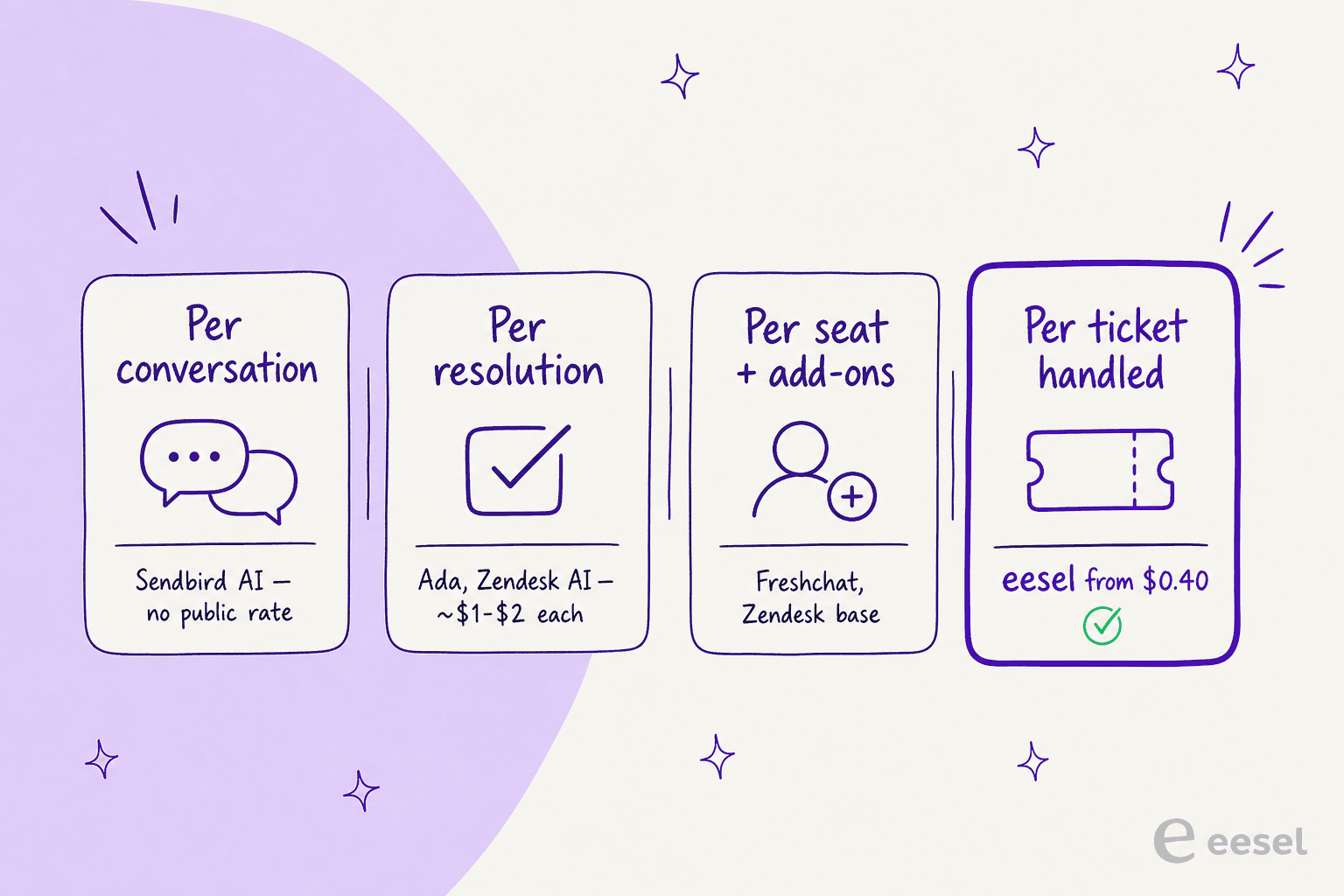
- What's the billable unit? Per conversation, per resolution, per seat, and per ticket are very different bills at scale. I called out each one.
- Do I have to re-platform? Some of these replace your helpdesk; others sit on top of it. Keeping your stack is usually cheaper.
- Can I test it before it talks to a customer? Simulation against your own historical tickets is the difference between a confident rollout and a public mistake.
- Real user sentiment, pulled from G2, Capterra, Trustpilot, and Reddit, not marketing copy.
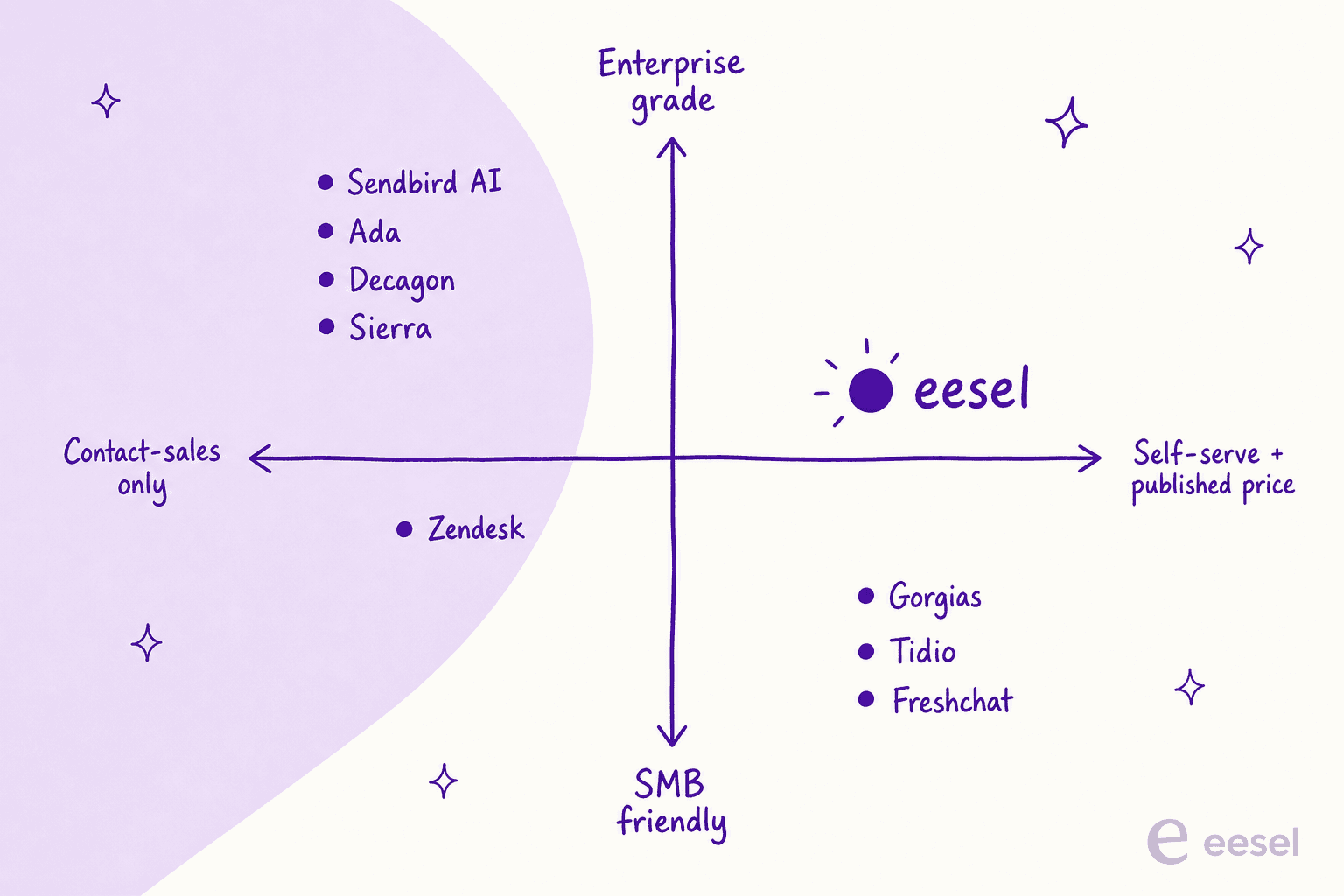
Here's how the nine shake out on the two axes a Sendbird leaver cares about most: how transparent the pricing is, and who the tool is really built for.
The 9 best Sendbird AI alternatives at a glance
| Tool | Best for | Starting price | AI billing model | Omnichannel | Free trial | G2 rating |
|---|---|---|---|---|---|---|
| eesel AI | Self-serve AI on your existing helpdesk | $0.40 / ticket | Per ticket handled | Helpdesk, chat, email, Slack | Yes ($50 free, no card) | New entrant |
| Zendesk | Mature all-in-one helpdesk + AI | $19 / agent / mo | Per automated resolution | Chat, email, voice, social | Yes | 4.3 (6,964) |
| Freshchat | Free multi-agent live chat | $0 (10 agents) | Per AI session | Chat, email, social, SMS | Yes | 4.4 (499) |
| Gorgias | Shopify and ecommerce brands | $10 / mo | $0.90 / resolution | Email, chat, SMS, social | Yes (7-day) | 4.6 (560+) |
| Ada | Large enterprise omnichannel | Contact sales | Per resolution (usage) | Chat, email, voice, social | No | 4.3 (~207) |
| Decagon | AI-native mid-market to enterprise | Contact sales | Usage (annual) | Chat, voice, email, SMS, API | No | Not listed |
| Sierra | Consumer brands wanting outcomes pricing | Contact sales | Per resolved outcome | Chat, voice, SMS, email | No | Not listed |
| Forethought | Agentic AI on top of your helpdesk | Contact sales | Platform + outcome | Chat, email, voice, SMS, Slack | No (POV) | (166 reviews) |
| Tidio | SMB self-serve, Claude-powered | $0 | Usage (per conversation) | Chat, email, social | Yes | 4.8 Capterra (200+) |
A quick map of the billable units, because this is where the real cost differences hide:
Now, the detail on each.
1. eesel AI
Best for: teams that want a self-serve AI agent on top of the helpdesk they already use, billed only for the tickets it handles.
I'll get my bias out of the way first: I work on eesel AI. But it earns the top slot here for a reason that's specific to the Sendbird problem. Sendbird makes you book a call to learn the price and, for the full platform, re-platform onto its stack. eesel does the opposite: it connects to your existing helpdesk, trains on your past tickets and help docs on day one, and starts drafting and resolving without a migration or a sales call.
The part I'd actually flag to a Sendbird leaver is the testing. The biggest risk with any AI agent is the confident wrong answer, and eesel runs a simulation against your historical tickets before it ever touches a live customer, so you see the resolution rate and the exact replies first. One CX lead I heard from runs about 7,000 tickets a month and put the fear plainly: "I need an AI who is only handling the tickets that it's confident to handle, and all the other ones, leave them alone." Simulation plus a confidence threshold is how you get there.
Pricing: usage-based, from $0.40 per ticket, with no per-seat fees, no platform fee, and no minimum on the self-serve plan. A "ticket" is one whole conversation no matter how many messages. There's $50 of free usage with no card, and you only pay for tickets the AI handles, so a partial rollout of 200 of your 1,000 monthly tickets costs about $80. Enterprise adds SSO, HIPAA, and a BAA for a flat $1,000/month platform fee plus usage.
Strengths: transparent, predictable per-ticket pricing; 100+ integrations and 80+ languages out of the box; simulation mode; gradual autonomy. Smava runs a fully automated Zendesk agent on 100,000+ German-language tickets a month, and Gridwise resolved 73% of tier-1 requests in the first month.
Where it falls short: eesel is focused on text channels (helpdesk, chat, email, Slack) and resolving tier-1 well, not on native phone support, so if voice is your primary channel, Ada or Decagon fit that brief better. It's also a newer name than Zendesk or Freshworks, so it carries less of a multi-thousand-review track record.
My take: if your reason for leaving Sendbird is "I just want to see the price and start," this is the most direct answer on the list. Pick it when you want to keep your helpdesk and pay per result; look elsewhere if voice is non-negotiable.
2. Zendesk
Best for: teams that want a mature, all-in-one helpdesk with AI baked in and can absorb a layered bill.
Zendesk is the safe enterprise standard, and its AI agents (now powered by Forethought under the hood) sit inside the broadest ecosystem in support, with 1,800+ marketplace apps and deep omnichannel across chat, email, voice, and social. If you want one vendor for everything, it's hard to argue with the maturity.
The catch for a Sendbird leaver is that you're trading one opaque AI bill for another. Zendesk charges per Automated Resolution, and the exact per-resolution dollar isn't published, it's allowance-based and sales-gated. The community is wary of it. As one Zendesk admin on Reddit put it:
"From what I can see in regards to this new 'Automated Resolution' pricing model, we'll be paying about $1.50 ~ $1.20 per resolution. And what Zendesk counts as a resolution can be ... subjective... If you have 500 AR per week, the bill blows out to be $650, where there wasn't a charge before."
Pricing: per agent, billed annually. Support Team is $19/agent (no AI); Suite Team is $55/agent and adds AI agents; Suite Professional is $115/agent; Enterprise and Copilot are sales-gated. AI add-ons like Copilot run $50/agent/mo on top, and AI usage is billed per automated resolution separately.
Strengths: mature core ticketing, the widest integration ecosystem, strong omnichannel including voice, and a brand procurement teams already trust. G2 rating of 4.3 from 6,964 reviews.
Where it falls short: the bill is the opposite of simple, with seat fees, per-resolution AI, and per-agent add-ons stacking up, and the "AR" model is widely distrusted as unpredictable. If transparency is why you left Sendbird, read the Zendesk AI alternatives before you sign.
My take: the right pick if you want a do-everything platform and the AI is a bonus. The wrong pick if you specifically wanted to escape opaque, layered AI pricing.
3. Freshchat
Best for: small teams that want a free, multi-agent live-chat tool with an upgrade path into a full suite.
Freshchat, part of the Freshworks family, is the friendliest entry point on this list. Its free tier covers up to 10 agents, which is unusually generous, and the unified inbox across website chat, email, and social gets consistent praise. It funnels naturally into Freshdesk Omni as you grow.
Where it wobbles is the AI itself. The Freddy AI bot is the weak spot, and reviewers say so directly. One Capterra reviewer in banking summed it up: "The AI capabilities feel basic and outdated." For a team leaving Sendbird because it wants better AI, that's the thing to test hard.
Pricing: per agent, billed annually. Free is $0 (up to 10 agents, website chat and email only); Growth is $19/agent and adds WhatsApp, Messenger, Instagram, and SMS; Pro is $49/agent; Enterprise is $79/agent. The Freddy AI Agent bot is billed per session, with 500 free sessions once, then $49 per 100 sessions (roughly $0.49 each).
Strengths: a real free tier, a well-liked multi-channel inbox, and the safety of the Freshworks brand and roadmap. G2 sits at 4.4 from 499 reviews.
Where it falls short: social channels are paywalled off the free tier, and the AI bot is the recurring complaint, described as basic even after training.
My take: a strong, low-risk starting point for a small team, especially if you're price-sensitive. Just don't pick it for the AI alone, weigh the best Freshchat AI options if automation is your priority.
4. Gorgias
Best for: Shopify and ecommerce brands that want a commerce-native helpdesk and an AI agent that can take order actions.
If your support is mostly "where's my order" and "I want a refund," Gorgias is built for exactly that. It's Shopify-native, unifies email, chat, SMS, and social, and its AI Agent (trained on a billion-plus conversations via an OpenAI partnership) handles returns, order edits, and product recommendations rather than just deflecting FAQs.
Crucially for this list, Gorgias is fully self-serve with published pricing, which already puts it ahead of Sendbird on transparency. A Reddit ecommerce veteran framed the fit well: "40%+ tickets need Shopify actions → I'd lean Gorgias. Mostly conversational support → Zendesk is fine."
Pricing: self-serve, ticket-based. Starter is $10/mo (50 tickets), Basic $50/mo, Pro $300/mo, Advanced $750/mo, Enterprise custom. The AI Agent is a usage add-on at $0.90 per resolved conversation (annual), with a 7-day free trial and no card required.
Strengths: transparent per-resolution AI pricing, deep Shopify actions, and the easiest enterprise-grade tool here to actually evaluate. G2 rating of 4.6 from 560+ reviews.
Where it falls short: it's heavily ecommerce-bound, the AI Agent is email and chat only (no voice/SMS omnichannel a Sendbird buyer may expect), and the community notes it can run expensive at scale. Compare Gorgias alternatives if you're not Shopify-centric.
My take: the obvious pick for a Shopify brand, and a refreshing one on pricing. Skip it if you're not ecommerce or if voice matters.
5. Ada
Best for: large enterprises (think 300k+ annual conversations) that want a standalone, multi-LLM AI agent layer over an existing helpdesk.
Ada is one of the most direct Sendbird AI rivals: a Toronto-based "Agentic Customer Experience" platform that sits on top of Zendesk, Salesforce, or Freshworks rather than owning ticketing itself. It's fully omnichannel (voice, email, chat, WhatsApp, SMS, Instagram, in-app), runs multiple LLMs, and has the strongest AI-specific compliance posture here, including AIUC-1 and zero data retention.
Here's the honest problem for a Sendbird refugee: Ada is the opposite of self-serve and transparent. Its pricing page is a qualification form gated at "at least 300,000 annual customer service conversations." There's no public price, no trial, and reported contracts run from roughly $30,000/year into the six figures. A former customer on Reddit was blunt: "Used to work for a company paying ~300k+ for Ada.cx, it's expensive."
Pricing: contact sales only, usage/per-resolution model on annual enterprise contracts. Ada's own materials use an illustrative "$1.50 per resolution."
Strengths: true omnichannel including voice, multi-LLM orchestration, and best-in-class AI compliance. G2 sits around 4.3.
Where it falls short: no public price, no trial, a 300k-conversation floor, and setup that's a project rather than a plug-in. If you left Sendbird for transparency, Ada doesn't solve that, see Ada alternatives.
My take: a serious choice if you're a large enterprise with voice needs and a procurement process. A poor fit if the whole reason you're here is to escape sales-gated pricing.
6. Decagon
Best for: AI-native mid-market and enterprise CX teams that want one agent across chat, voice, email, SMS, and API, authored in plain language.
Decagon is one of the buzziest AI-native platforms, and its wedge is interesting: Agent Operating Procedures, natural-language agent logic that compiles to executable code, pitched against the old SDK and decision-tree approach. It offers true omnichannel parity from one runtime plus persistent user memory, which is a strong story.
But again, on the dimension a Sendbird leaver cares about, it's familiar territory. decagon.ai/pricing 404s, every CTA routes to a demo request, there's no free tier and no trial, and the volume tiers start at a "less than 9,999 monthly tickets" bracket that signals where the floor sits. It's a sales-led, annual enterprise motion.
Pricing: contact sales only, usage-based on annual contracts, tiered by monthly ticket volume. No public figure. Compare the Decagon pricing breakdown for what's known.
Strengths: modern AI-native architecture, true omnichannel including voice, and persistent memory across conversations.
Where it falls short: opaque pricing, no trial, gated demo, and an enterprise-only smell, all the things that send people away from Sendbird in the first place. See Decagon alternatives.
My take: worth a demo if you're mid-market-plus and want the newest agent architecture. Not the answer if transparent, try-before-you-buy pricing is the goal.
7. Sierra
Best for: large consumer brands and regulated enterprises that want outcomes-based pricing and the deepest compliance.
Sierra, founded by Bret Taylor and Clay Bavor, is the prestige option. Its Agent SDK and no-code Agent Studio cover broad omnichannel (chat, voice, SMS, WhatsApp, email, even ChatGPT) from one agent, and its compliance is exceptional, with SOC 2, ISO 27001, ISO 42001, HIPAA, GDPR, and EU AI Act coverage. Its "Ghostwriter" feature, an agent that builds agents from your SOPs and transcripts, is a neat idea.
Sierra prices on outcomes, "only pay for the value Sierra delivers," charged per resolved outcome and negotiated per customer. That sounds appealing, but it means no self-serve, no free tier, a multi-week statement of work, and a bill that varies with outcomes, which is hard to forecast in a spreadsheet.
Pricing: contact sales only, outcomes-based (per resolved conversation, completed transaction, or retention save). No published rate.
Strengths: broad omnichannel including voice, the deepest compliance stack on this list, and a serious engineering pedigree.
Where it falls short: enterprise-only and budget-unpredictable, with no self-serve and no trial. Read Sierra vs the field before committing.
My take: a credible enterprise rival to Sendbird if you're a large brand and outcomes pricing appeals. Overkill, and over-opaque, for everyone else.
8. Forethought
Best for: mid-market and enterprise support orgs that want agentic AI on top of their existing helpdesk without switching stacks.
Forethought is helpdesk-agnostic by design: a multi-agent system (Discover, Solve, Triage, Assist, Agent QA) that layers onto Salesforce Service Cloud, older Zendesk, and others, adding agentic action-taking across chat, email, voice, SMS, and Slack. If you want to keep your current helpdesk and bolt on smarter automation, that's the pitch.
Reviewers who've deployed it are positive about results. One G2 reviewer wrote that "Forethought's chat widget is a valuable tool that allows our Customer Support team to proactively solve over 70% of inbound support cases." The friction, predictably, is pricing: every tier is "Get a Quote," and the model is explicitly a blend of platform-access fees plus outcome-based cost, with no free trial (just a "Proof of Value").
Pricing: contact sales only, no public numbers. Tiers are Team, Professional, and Enterprise, all quote-based, plus add-ons.
Strengths: truly helpdesk-agnostic, broad omnichannel, and agentic action-taking on top of your existing stack. Around 166 G2 reviews.
Where it falls short: opaque, enterprise-priced, no trial, and reviewers flag it as slow to configure. Worth comparing the best Forethought competitors.
My take: a strong choice if you're committed to your helpdesk and want agentic AI bolted on. Same pricing-opacity caveat as the rest of the enterprise set.
9. Tidio
Best for: SMB and ecommerce brands that want a self-serve, Claude-powered AI agent with a usable free tier.
Tidio rounds out the list as the SMB-friendly, transparent option. Its Lyro AI agent is powered by Anthropic's Claude, claims a 67% average resolution rate, and sets up with no engineering. For a small team, it's about as easy to start as this category gets.
The irony is that Tidio, while far more transparent than Sendbird, attracts a similar complaint as it scales: pricing that's hard to predict. It bills across three separate axes (billable conversations, Lyro AI conversations, Flows visitors), and one Reddit user vented: "their pricing is so off and hidden, 'free tier' is just a trap... they need to be more transparent."
Pricing: usage-based, annual. Free is $0 (50 billable conversations, 50 Lyro conversations one-time); Starter $24.17/mo; Growth from $49.17/mo; Plus from $749/mo; Premium is contact-sales. Lyro standalone bolts onto any help desk from $32.50/mo.
Strengths: Claude-powered AI, fast no-code setup, a real free tier, and standalone Lyro that works on top of an existing help desk. Capterra rating of 4.8 from 200+ reviews.
Where it falls short: the multi-axis usage pricing is the dominant complaint, the free tier is called a "trap," and there's a steep jump from Growth to the $749 Plus plan. See Tidio alternatives.
My take: the best self-serve pick for a small team that wants strong AI without a sales call. Watch the usage meters as you grow.
Which Sendbird AI alternative is right for you?
The nine tools really sort into three buckets. If you skim nothing else, use this:
Try eesel AI
If you got this far because Sendbird's price tag was a black box, that's the exact gap eesel AI was built to close. It's an AI agent that plugs into the helpdesk you already run, Zendesk, Freshdesk, Gorgias, Front, and more, trains on your past tickets and help docs in a few minutes, and resolves tier-1 conversations without a migration or a sales call.

The two things a Sendbird leaver tends to want most are baked in: transparent pricing (from $0.40 per ticket, no seat fees, no minimum) and a simulation mode that runs the agent against your real historical tickets before it talks to a customer. You can see the resolution rate up front, start with a slice of your volume, and scale when you trust it. It's free to try with $50 of usage and no credit card.
Try eesel or book a demo to see it run on your own tickets.
Frequently Asked Questions
Why do teams look for Sendbird AI alternatives?
How much does Sendbird AI cost?
sendbird.com/pricing and delight.ai/pricing route to a sales contact form. Only Sendbird Chat has a public, MAU-based price. If you want a number before a sales call, that opacity is itself a reason to compare AI support agents.What is the best Sendbird AI alternative for a small team?
Which Sendbird alternative has transparent pricing?
Can I keep my existing helpdesk and just add an AI agent?
Do Sendbird AI alternatives support voice and omnichannel?
How do I test an AI support agent before going live?


Article by
Kurnia Kharisma Agung Samiadjie
Kurnia is a software engineer and writer at eesel AI with two years of SEO experience, writing about AI tools, helpdesk software, and customer support. He pairs a developer's understanding of how these products are built with search-driven research into what actually ranks and resonates with the people searching for them.