
Why startups outgrow Zendesk
I work eesel's support queue every day, and I talk to a lot of founders who are mid-migration. The pattern is almost always the same, and it's almost never "Zendesk is bad." Zendesk is genuinely one of the most capable platforms out there, with a deep marketplace and a Gartner Magic Quadrant Leader badge to show for it. The problem for a startup is shape, not quality.
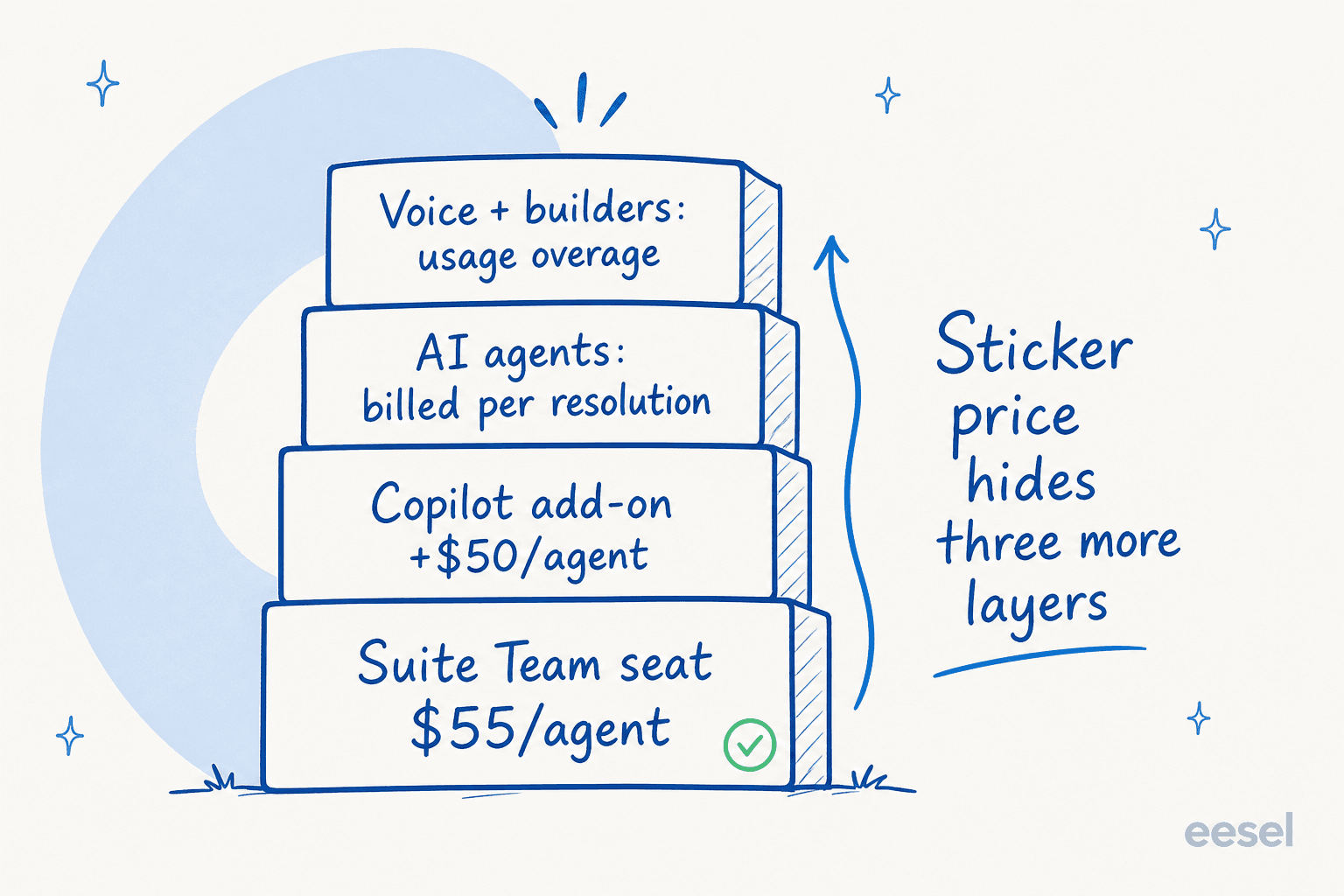
Here's where it bites. The cheapest Zendesk plan, Support Team, is $19/agent/month and includes no AI at all. AI agents first appear on Suite Team at $55/agent/month, and even then the AI is billed separately, per "automated resolution," on top of the seat. Want the proactive Copilot? That's another $50/agent/month. Voice and the app builders bill on usage over your allowance. None of those numbers are outrageous on their own, but they stack, and the sticker price hides three more layers underneath it.
The teams I hear from describe the same trust problem, too. One CX lead at a DTC supplements brand put the core fear plainly in a call with us: "the AI will never be able to answer 100% of the questions... I need an AI who is only handling the tickets that it's confident to handle, and all the other ones, leave them alone." When a buyer can't tell what the AI will do or what it'll cost to find out, they start shopping. We've watched confident-sounding bots quietly give wrong answers across years of live rollouts, which is exactly why a startup should weigh control and predictable pricing as heavily as the feature list.
That said, switching has a real cost of its own, and the best move depends on your stack. So let's get specific.
How I picked these alternatives
I weighted this list for startups, not enterprises. That changed the ranking from a generic "best helpdesk software" list in a few ways:
- Real free tier or genuinely low entry price. A startup shouldn't pay enterprise seat prices to answer a few hundred tickets a month.
- Fast to set up. If a tool needs a six-week implementation, it's the wrong tool for a team that's still finding product-market fit.
- Predictable AI cost. I flagged exactly how each tool charges for its AI, because that's the line item that surprises people.
- Fits a real channel or stack. Gmail-native, Shopify-native, open source, and collaborative-inbox tools each win for different teams.
Everything below is grounded in each vendor's live pricing and product pages as of June 2026. Where the AI matters, I've noted whether it's bundled, metered, or gated to a top tier. And a quick fairness note: I name what each tool isn't good at, not just what it shines at.
The 7 best Zendesk alternatives for startups at a glance
| Tool | Best for | Free tier | Starting paid price | Built-in AI pricing | Native AI |
|---|---|---|---|---|---|
| Help Scout | Relationship-first email support | Yes (5 users) | $25/user/mo | $0.75 per AI resolution | AI Answers, Inbox Assistant |
| Freshdesk | Closest like-for-like Zendesk swap | Yes (2 agents, 6 mo) | $19/agent/mo | First 500 sessions free, then $49/100 | Freddy AI Agent + Copilot |
| Front | Cross-team customer operations | No (14-day trial) | $25/seat/mo | Autopilot from $0.05/conversation | Front AI (Autopilot, Copilot) |
| Zoho Desk | Cheapest full helpdesk | Yes (3 users) | $7/agent/mo | Bundled; advanced Zia is Enterprise | Zia |
| Gorgias | Shopify and ecommerce stores | No (trial) | from $10/mo (ticket-based) | $0.90 per AI resolution | AI Agent |
| Chatwoot | Free, open source, own your data | Yes (2 agents / self-host) | $19/agent/mo | $20 per 1,000 Captain credits | Captain |
| Hiver | Teams that live in Gmail | Yes (free forever) | $25/user/mo | Bundled from Growth up | AI Agents + Copilot |
For broader context beyond startups, our roundup of the best AI helpdesk software and the cheapest AI helpdesk apps cover the wider field.
1. Help Scout
Best for: relationship-first teams that want a clean, email-like inbox with near-zero learning curve.
Help Scout is the tool I recommend most often to small teams that find Zendesk too "ticket-y." It's built around a shared inbox that feels like email, a knowledge base (Docs), and an embeddable widget (Beacon), with AI layered on top. The whole pitch is speed to adoption: you can learn it in under an hour, which matters a lot when your "support team" is a founder and one ops hire.
Features
The shared inbox handles every channel in one email-like view, with collision detection, saved replies, and internal notes. The AI Answers agent resolves customer questions from your knowledge base and claims a 73% average resolution rate, and the Inbox Assistant drafts, summarizes, and edits replies for agents. It's a tidy, focused product rather than a sprawling platform.
Pros
- Genuinely easy to use; new agents are productive almost immediately.
- A free plan for up to 5 users, plus a dedicated startup plan.
- AI Answers comes with a 3-month free trial of unlimited resolutions, so you can test it before paying.
Cons
- The $0.75-per-resolution AI pricing stacks on top of seats and is the top complaint at scale.
- Reporting and advanced customization are thinner than Zendesk's.
- Help Scout's pricing-model history is a sore spot. Reddit users still bring up a per-seat to per-interaction flip that one called "lost all trust with this flip-flopping on pricing" before it reverted.
Pricing
| Plan | Price (per user/mo, annual) | Notes |
|---|---|---|
| Free | $0 | Up to 5 users, 1 inbox, 1 Docs site |
| Standard | $25 | Growing teams moving beyond email |
| Plus | $45 | Higher volume, more channels |
| Pro | $75 | Scale and security (min 10 users) |
| AI Answers | $0.75 / resolution | Usage-based; 3-month free trial |
Our take: the best fit if support is a relationship, not a queue, and you value calm over configurability. Skip it if you need deep reporting or you're nervous about per-resolution AI billing. See more options in our Help Scout alternatives guide.
2. Freshdesk
Best for: teams that want the closest like-for-like Zendesk replacement without the layered bill.
If you want everything Zendesk does at a friendlier price, Freshdesk is the obvious swap. It's a full omnichannel helpdesk built around what Freshworks calls the Command Center, trusted by 74,000+ businesses, and its 2026 story is a hard pivot to agentic AI with Freddy. For a startup, the headline is the free tier. We compare the two directly in our Zendesk vs Freshdesk breakdown.
Features
Freshdesk gives you advanced ticketing, omnichannel routing, SLAs, and a self-service knowledge base. Freddy AI Agent ships 50+ prebuilt agentic workflows that take action, not just suggest, and Freddy AI Copilot assists agents with summaries and reply suggestions.
Pros
- A real free plan: $0 for up to 2 agents for 6 months, no card required.
- Paid plans start at $19/agent/month, undercutting Zendesk's AI tier.
- Freddy's Email AI Agent includes the first 500 sessions free, so early testing is cheap.
Cons
- Freddy AI is consumption-priced ($49 per 100 sessions after the free 500), which climbs for high volume.
- Some teams hit API throttling and feel steered toward Freddy rather than their own tooling.
- The full agentic experience (Freshdesk Omni) is a separate, pricier SKU.
Pricing
| Plan | Price (annual) | Notes |
|---|---|---|
| Free | $0 | 1-2 agents, for 6 months |
| Growth | $19/agent/mo | Core ticketing and reports |
| Pro | $55/agent/mo | Custom objects, routing, 500 free Freddy sessions |
| Enterprise | $89/agent/mo | Audit logs, approvals, skills routing |
Our take: the safest migration if your team already thinks in tickets and SLAs. It's a smaller leap than any other tool here. Just model the Freddy session costs before you commit. Our Freshdesk alternatives and open-source Freshdesk alternative posts cover the edges.
3. Front
Best for: startups where support spills across teams (ops, success, finance) and collaboration matters more than ticket mechanics.
Front is a collaborative inbox first and a helpdesk second, and that's the point. It's built for complex customer operations that span departments rather than simple FAQ deflection, and the standout is how naturally a team works a shared conversation together. Branch's CTO reported a 40% productivity improvement after moving member support off Zendesk.
Features
Front blends a shared inbox, real ticketing, and omnichannel messaging with deep internal collaboration (comments, shared drafts, guest accounts). Front AI adds Autopilot (an omnichannel agent that claims to resolve up to 70% of requests), Copilot, Smart QA, and Smart CSAT.
Pros
- Best-in-class collaboration; conversations don't get lost in Slack threads.
- A reported 428% average ROI and 9,300+ companies on the platform.
- The Starter plan is approachable at $25/seat/month.
Cons
- No free tier, only a 14-day trial.
- Most of the AI (Copilot, Smart QA, Smart CSAT) is a paid add-on unless you're on Enterprise at $105/seat.
- Starter is single-channel only, so true omnichannel means Professional or above.
Pricing
| Plan | Price (per seat/mo, annual) | Notes |
|---|---|---|
| Starter | $25 | Up to 10 seats, single channel |
| Professional | $65 | Up to 50 seats, omnichannel |
| Enterprise | $105 | AI Copilot, Smart QA, Smart CSAT included |
Our take: pick Front if support is a team sport at your company and email collaboration is the daily pain. Skip it if you're a pure cost shopper, the AI add-ons add up. More in our Front alternatives guide and the Front vs Hiver comparison.
4. Zoho Desk
Best for: budget-conscious startups that want a full-featured helpdesk for the least money.
Zoho Desk is the value pick, full stop. It's an omnichannel ticketing platform that's trusted by 125,000+ businesses and rates 4.5/5 on Gartner Peer Insights across 2,403 reviews. On Reddit it's consistently framed as "almost everything that Zendesk does at like half the cost." A paid seat starts at $7/agent/month, which is hard to beat.
Features
You get omnichannel inbox, SLAs, Blueprint process automation, and Zia, Zoho's AI assistant spanning self-service chatbots, in-ticket assist, and admin automation. If you already use Zoho's CRM or other apps, the native integration is a real draw.
Pros
- The cheapest credible full helpdesk here, plus a Free Forever plan for 3 users.
- Strong automation (Blueprint, routing, SLAs) that reviewers call excellent value.
- Bundled AI tokens (up to 30M/month of Zoho's in-house LLM) across all tiers, including Free.
Cons
- Zia gets mixed reviews; one user called it "a trainwreck of unhelpful responses."
- The best AI (Answer Bot, sentiment, auto-tagging) is gated to the Enterprise tier at $40/agent.
- A steep learning curve and cluttered UI; G2 has 112 tagged "learning curve" mentions.
Pricing
| Plan | Annual | User limit |
|---|---|---|
| Free Forever | $0 | 3 users |
| Express | $7/agent/mo | 5 users |
| Standard | $14/agent/mo | Unlimited |
| Professional | $23/agent/mo | Unlimited |
| Enterprise | $40/agent/mo | Unlimited |
Our take: unbeatable on price, especially if you're already in the Zoho ecosystem. Set expectations on Zia, and plan to bring your own AI if you want the good stuff without paying for Enterprise. See our best AI for Zoho Desk and AI integrations for Zoho Desk guides.
5. Gorgias
Best for: Shopify and ecommerce startups where support and revenue are the same conversation.
If you sell online, Gorgias is built for you in a way general-purpose helpdesks aren't. It powers 40% of Shopify brands and pulls orders, refunds, and subscriptions straight into the ticket view, so an agent (or the AI) can cancel, discount, or upsell without leaving the conversation. Its AI Agent is pre-trained on 1B+ ecommerce conversations.
Features
Beyond the Shopify-native inbox, Gorgias does macros, rules, flows, intent detection, and revenue attribution. The AI Agent handles pre- and post-sale FAQs, processes returns, and gives product recommendations, escalating to humans with context. BareMinerals reported an 8.83x ROI on AI-driven conversations.
Pros
- The deepest Shopify integration of any tool here; no other helpdesk pulls store data as cleanly.
- Ticket-based pricing starts at just $10/month for low volume.
- The AI is built to drive sales, not just deflect tickets.
Cons
- It's roughly 3x Zendesk for similar ticket volumes; community wisdom is it pays off only once ~40%+ of tickets need Shopify actions.
- The AI Agent is metered at $0.90 per resolved conversation, and each AI interaction also counts as a billable ticket.
- Overkill if you're not running an ecommerce store.
Pricing
| Plan | Starting price (monthly) | Tickets/mo |
|---|---|---|
| Starter | from $10/mo | 50 |
| Basic | from $50/mo | 300 |
| Pro | from $300/mo | 2,000 |
| Advanced | from $750/mo | 5,000 |
| Enterprise | Custom | 5,000+ |
Our take: the right call for a Shopify or ecommerce startup with real order-action volume. For everyone else it's expensive for what you'd use. See our Gorgias alternatives guide.
6. Chatwoot
Best for: technical startups that want a free, open-source helpdesk and full control of their data.
Chatwoot is the option for teams that bristle at SaaS lock-in. It's an open-source, omnichannel support platform you can run on Chatwoot's cloud or self-host on your own infrastructure, so you own your customer data outright. It has 32k stars on GitHub and is SOC 2 Type II compliant.
Features
Chatwoot bundles an omnichannel inbox, a knowledge base, and Captain, its native AI suite (an autonomous assistant, an agent-side co-pilot, smart FAQs, and per-customer memory). For developers, open APIs and an Agent Bots framework make it easy to wire in your own AI. Our Chatwoot deep dive covers it in detail.
Pros
- The Community Edition is free and open source; self-hosting means no per-seat fees at all.
- Transparent, cheap cloud pricing; one G2 reviewer called $19/month worth the functionalities.
- Developer-friendly and extensible.
Cons
- Self-hosting is a real maintenance burden: you own upgrades, storage, and security.
- The native AI and reporting are thinner than the commercial tools here.
- Captain AI isn't available on the free Community Edition.
Pricing
| Plan | Price (per agent/mo, annual) | Notes |
|---|---|---|
| Hacker | $0 | Up to 2 agents, live chat only |
| Startups | $19 | 300 Captain credits/mo |
| Business | $39 | 500 Captain credits/mo |
| Enterprise | $99 | 800 Captain credits/mo |
| Community (self-host) | $0 | Open source, no Captain |
Our take: the best pick if "own our data" or "no recurring SaaS bill" is a hard requirement, and you have the engineering time to run it. If you don't, the maintenance cost will quietly eat the savings. More in our Chatwoot alternatives guide.
7. Hiver
Best for: teams that already run on Gmail and want a helpdesk without leaving the inbox.
Hiver is the lightest possible switch if your team already lives in Gmail. It layers ticketing, SLAs, automation, and AI directly inside the Gmail (or Outlook) you already use, so the learning curve is near zero. It's trusted by 10,000+ teams and rates 4.6/5 on G2 across 1,283 reviews. In 2026 it repositioned as an AI-native platform and explicitly names Zendesk as the tool it replaces.
Features
You get a shared inbox with email assignment and collision detection, SLAs, round-robin routing, analytics, and an AI suite covering AI Agents (autonomous resolution) and an AI Copilot. Hiver's pitch is that channels and AI are native, "no add-ons, no credit pricing."
Pros
- Runs inside Gmail, so adoption is the fastest of any tool here.
- AI is bundled from the Growth plan up, not metered per resolution.
- A free-forever tier and strong security (SOC 2 Type II, ISO 27001, HIPAA on Elite).
Cons
- Per-seat cost climbs fast as you add users and inboxes.
- Critics call it a "thin layer on Gmail," and its AI is thinly reviewed by independent users.
- A 2-seat minimum on all plans, and one sharp billing complaint on G2 to be aware of.
Pricing
| Plan | Annual | Notes |
|---|---|---|
| Free | $0 | Shared inbox + ticketing, no AI |
| Growth | $25/user/mo | First tier with AI |
| Pro | $55/user/mo | Customer portal, SLAs, analytics, API |
| Elite | $85/user/mo | AI QA, AI Insights, SSO, HIPAA |
Our take: if you're a Gmail shop, Hiver is the path of least resistance and your team will be live in a day. If you're already omnichannel or cost-sensitive at scale, look at Help Scout or Zoho Desk first.
So which Zendesk alternative should a startup pick?
The fastest way to narrow it down is to start from where your team already works, not from a feature checklist.
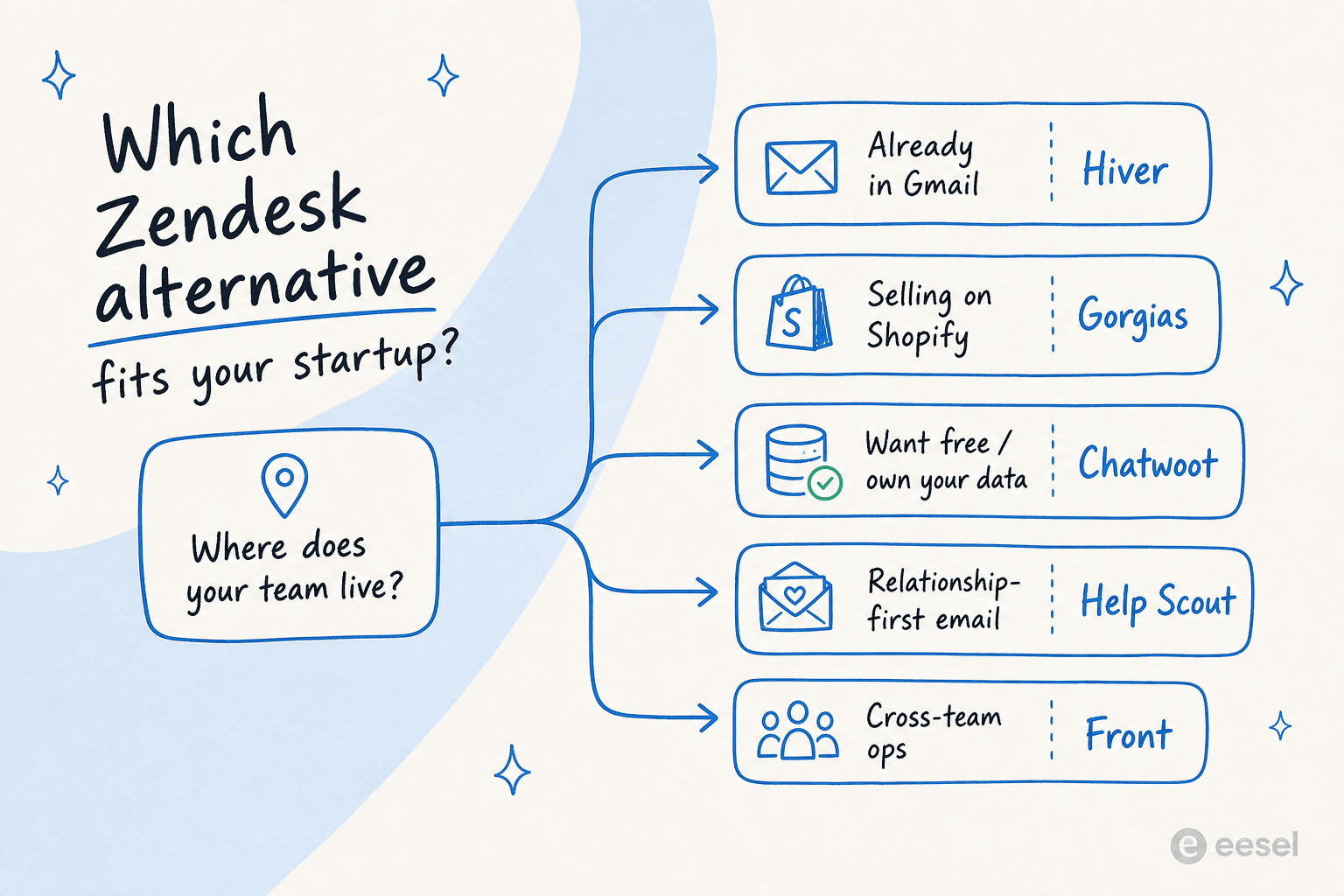
- Already in Gmail: Hiver.
- Selling on Shopify: Gorgias.
- Want free or to own your data: Chatwoot.
- Relationship-first email support: Help Scout.
- Cross-team operations: Front.
- Cheapest full helpdesk: Zoho Desk.
- Closest Zendesk swap: Freshdesk.
Whatever you land on, the deciding factor for most startups is total cost over the first year, including the AI. That's the number to model before you migrate anything, and our AI agent vs human agent cost breakdown is a good place to sanity-check it.
Switch the helpdesk, keep the AI with eesel
Here's the thing I tell founders before they spend a weekend migrating: the helpdesk and the AI are two separate decisions, and you don't have to marry them. The reason teams feel locked in to Zendesk's AI pricing is that they assume the AI has to be native. It doesn't.
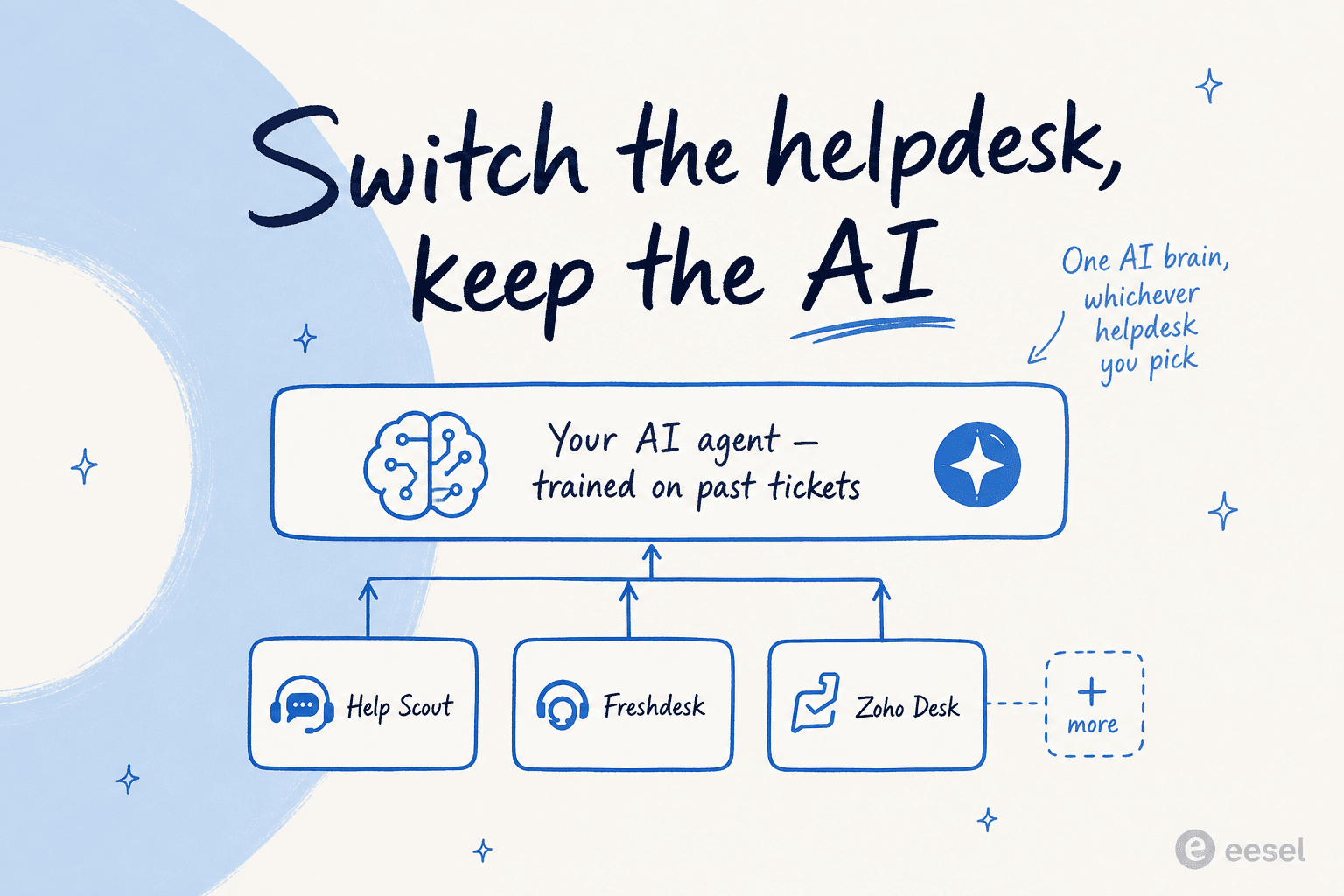
eesel AI is an AI support agent that plugs into whichever helpdesk you pick (Zendesk, Freshdesk, Front, Help Scout, Gorgias, and more) in a few minutes. It trains on your past tickets and help docs so years of history becomes knowledge on day one, then drafts, triages, and resolves tier-1 tickets. Because it's usage-based at $0.40 per resolved ticket with no per-seat fee and no platform minimum, the cost scales with the work, not with your headcount, which is exactly the predictability the layered-bill problem lacks.

Two things make it a genuinely safe bet for a small team. First, simulation mode runs the agent against your historical tickets before it ever touches a customer, so you see coverage and accuracy up front. Second, confidence-based routing means the AI only auto-answers what it's sure about and leaves the rest for a human, which is the exact control that DTC supplements CX lead was asking for earlier. Gridwise saw eesel resolve 73% of tier-1 requests in the first month, with results landing during a 7-day trial.
And if you're tempted to build your own on the OpenAI or Claude API, hear it from a customer who weighed that exact choice. As Karel at GENERAL BYTES put it: "We could try to write our own LLM application but we didn't want to invest our time into that. We wanted something that we would not have to maintain." For a startup, that maintenance time is the most expensive thing you have. You can try eesel free with $50 of usage, no credit card.
Frequently Asked Questions
What is the best Zendesk alternative for a startup?
Why do startups leave Zendesk?
How much does a helpdesk cost for a small team?
Can I keep my AI support agent if I switch helpdesks?
Is there a free Zendesk alternative for startups?


Article by
Riellvriany Indriawan
Riell is a designer and writer at eesel AI with about two years of experience researching CX platforms, AI chatbots, and helpdesk software. She combines her design background with a sharp eye for how these tools actually look and feel in practice — making her comparisons unusually visual and user-focused.