

The 7 best Zendesk AI alternatives at a glance
We weighed these on the things that actually decide a switch: how the AI is priced, whether it replaces or layers onto Zendesk, the resolution rate the vendor claims, review scores, and security posture. Product-name links go to each tool's deeper write-up.
| Tool | Best for | AI pricing model | Starting price | Sits on top of Zendesk? | Claimed resolution | G2 rating | SOC 2 |
|---|---|---|---|---|---|---|---|
| eesel AI | Keeping Zendesk, swapping the AI | Pay-per-use, no per-seat | Free to start ($0.40/task) | Yes | 73% tier-1 (Gridwise) | 4.6/5 | Yes (Type II) |
| Freshdesk (Freddy) | A full like-for-like platform swap | Per-session add-on | $0 (1-2 agents) | No | Up to 80% | 4.4/5 | Yes |
| Ada | Enterprise autonomous CX | Volume / contact sales | Contact sales | Yes (layer) | 76%+ (case studies) | 4.6/5 | Yes + AIUC-1 |
| Gorgias | Shopify and e-commerce | Per-resolution add-on | $10/mo | No | 60% (claim) | 4.6/5 | Yes |
| Help Scout | Small, relationship-driven teams | $0.75/resolution add-on | $0 (up to 5 users) | No | ~73% | 4.4/5 | Yes |
| Gladly | Retail, voice, and lifetime value | Per-resolution / per-seat | Contact sales | No | 76% (claim) | 4.7/5 | Yes |
| Tidio (Lyro) | SMBs on a budget | Per-conversation | Free | Yes (Lyro Connect) | 67% (claim) | Enterprise tier |
A quick note on what's not here: we left out Forethought, because Zendesk acquired it and folded it into the Advanced AI Agents tier, so it isn't really an independent alternative anymore.
Why teams leave Zendesk AI in the first place
Before the list, it's worth being honest about why you're reading this. Zendesk is a capable, mature platform, named a 2025 Gartner Magic Quadrant Leader for customer engagement, and for a lot of teams the ticketing core is excellent. The friction is almost always in the AI layer, and it shows up in three predictable ways.
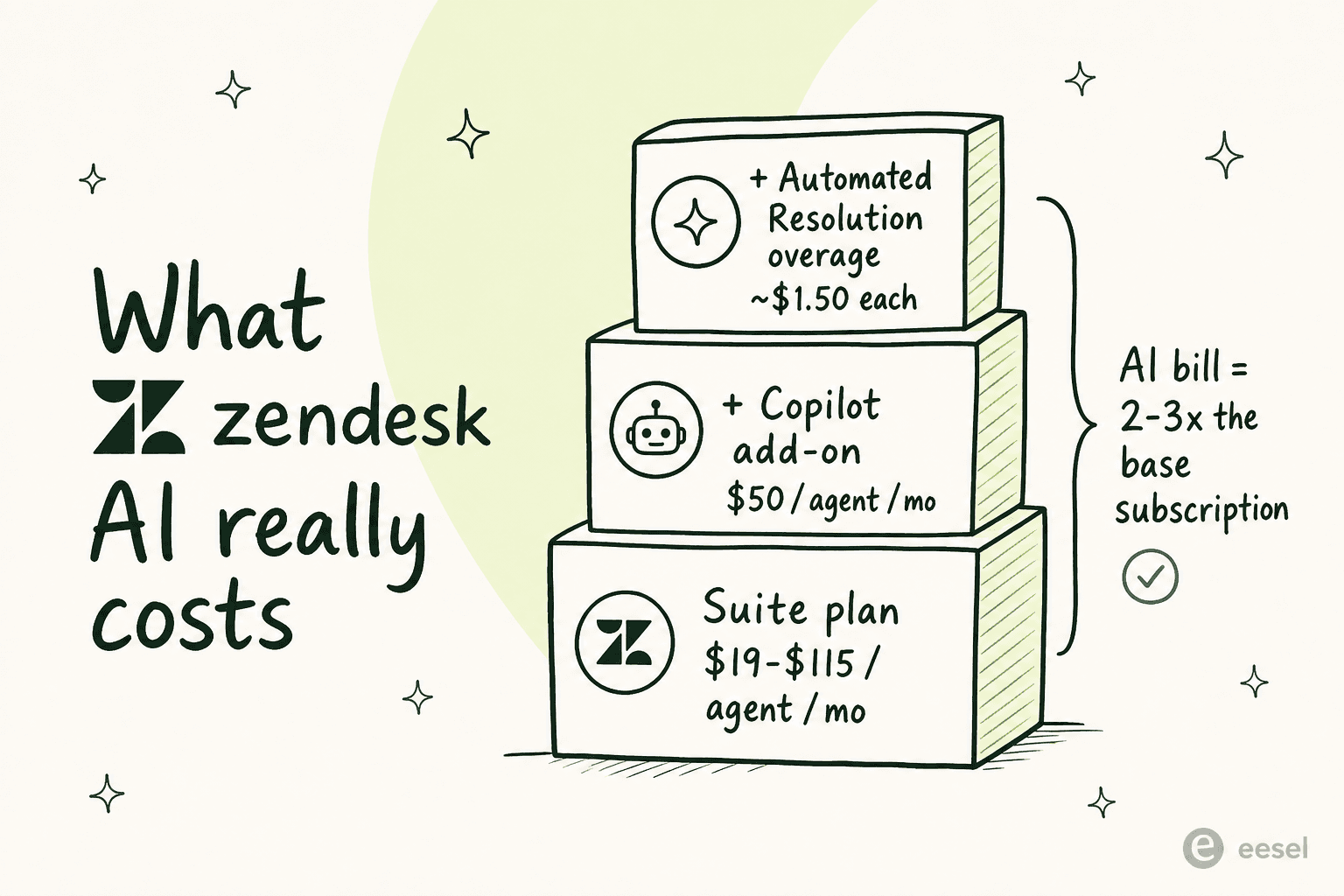
The cost stacks in layers. Zendesk's Suite plans run from $19 to $115 per agent per month, Copilot is a $50-per-agent add-on, and AI Agent usage bills on top via "automated resolutions" at roughly $1.50 each over your allowance. Stack those and the AI portion of the bill routinely lands at 2-3x the base subscription. One support buyer we spoke to, a US physical-therapy team running about 500 tickets a month, put it plainly: they'd "kicked the tires on Zendesk AI solutions and found it largely inadequate and overpriced."
The billing unit is hard to predict. Until May 2026, a customer who simply stopped replying for 72 hours counted as a resolved conversation, billable whether or not the AI actually helped. Zendesk has since moved to a three-tier resolution model where only LLM-verified resolutions draw from your allowance, which is a real improvement, but there's still no soft cap. Your only overage control is to pause AI entirely. Sentiment on r/Zendesk has been blunt about the earlier model:
"No, it's just terrible and a rip off. You can't even export the data on like what people ask the bot... We stopped using it because ARs are a rip off, and it's a rushed product to get into the AI hype."
u/OGShakey, r/Zendesk discussion on AI Agents

The good AI is gated. The bundled "Essential" tier is, by most accounts, a knowledge-base lookup with the word AI on the box. Anything that actually takes actions, branches through a dialogue, or hits your APIs lives in the paid Advanced tier or the Copilot add-on. That gap is the single most common reason teams start shopping. If you want the deeper version of this argument, our Zendesk review and Zendesk AI pricing guide go further.
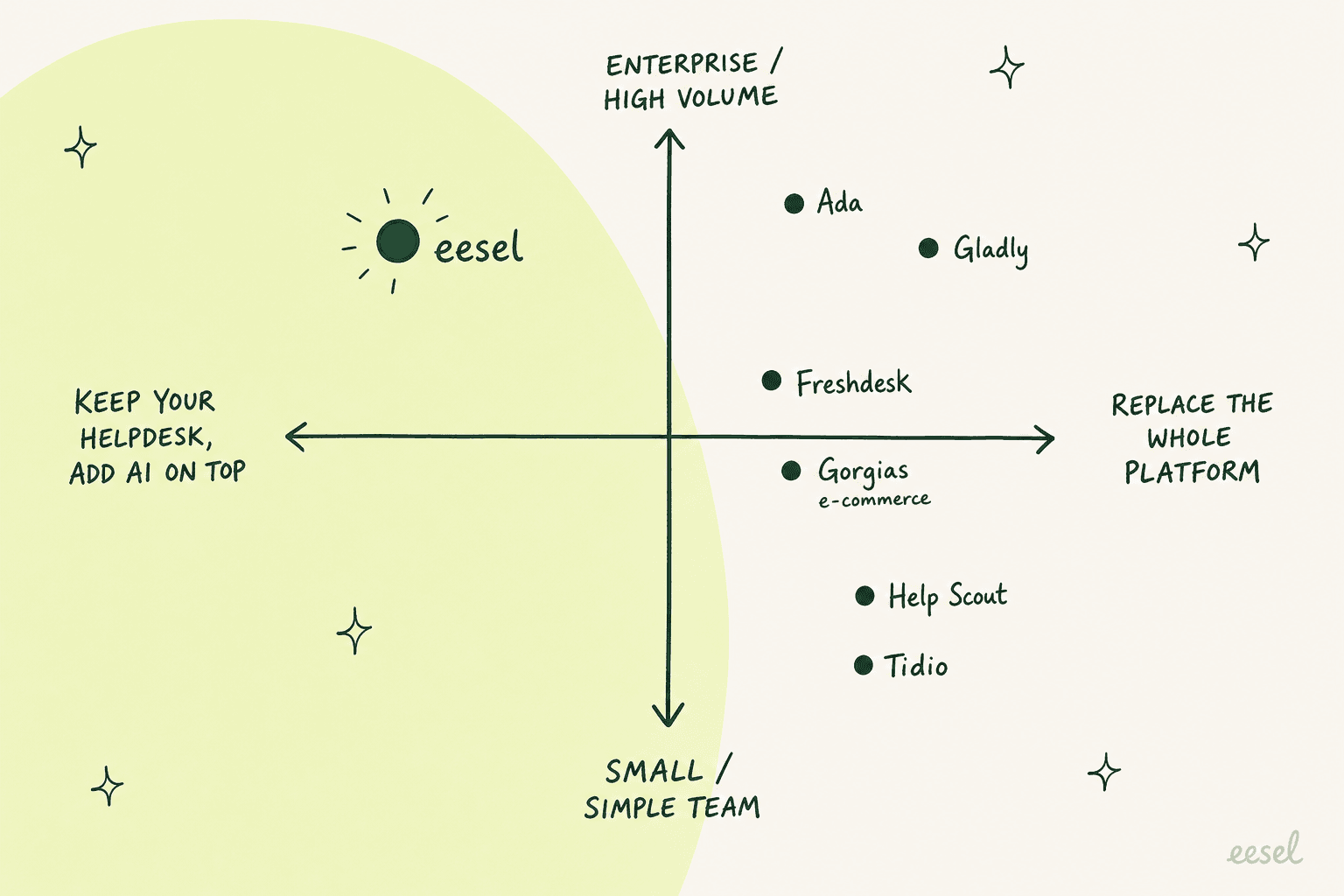
The key realisation: switching AI doesn't have to mean switching helpdesks. Some of the tools below replace Zendesk wholesale; others keep it exactly as-is and just run a smarter agent on top. Here's how that splits out.
1. eesel AI
Best for: teams that like their Zendesk setup and want to swap only the AI, without a migration or a per-resolution meter.

eesel AI is the one tool on this list built specifically to sit on top of the helpdesk you already have. It connects to Zendesk (and Freshdesk, Gorgias, Help Scout, Salesforce, and 100+ other sources), trains on your past tickets and help center, and then either drafts replies for agents or resolves tickets autonomously, all inside your existing workspace.
Here's how that "layer on top" model actually works in practice.
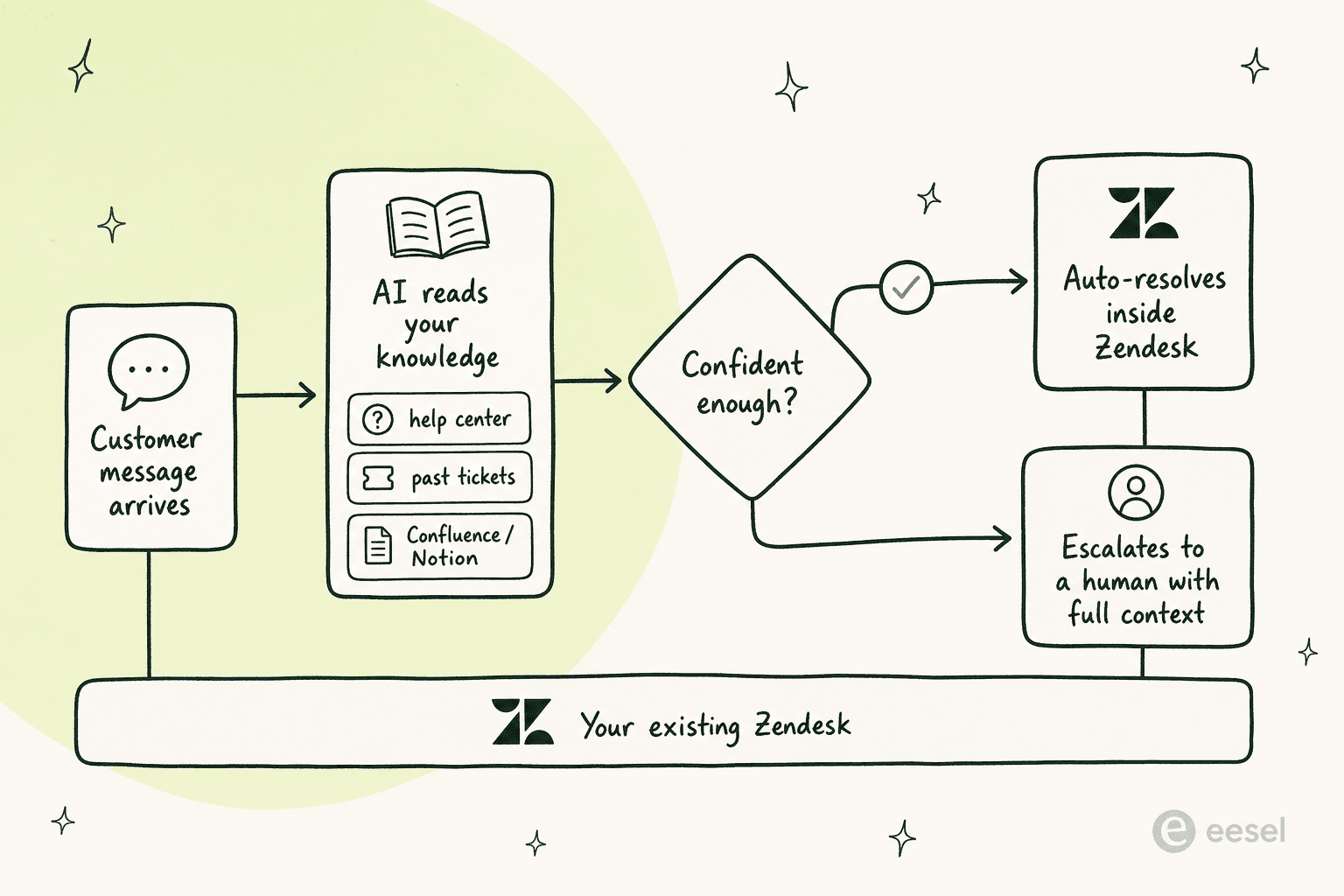
You can watch it run live against a Zendesk queue here:
Features. A helpdesk agent that resolves, tags, and escalates tickets; training on your historical tickets so the tone matches your team from day one; a simulation mode that replays thousands of past tickets so you can see your projected resolution rate before going live; and confidence-based routing, so low-confidence answers get drafted for review instead of sent. It supports 80+ languages and reports 80%+ time savings for teams in their first month.
Pros. No replatforming and no per-seat fees. The setup is fast, which comes up again and again in reviews:
"Connecting eesel to zendesk helpcenter and messaging is ridiculously simple and we managed to get a chatbot and AI assistant that does some pretty complex actions with relative ease."
Richard Westerhof, Cloud86, on G2

Cons. It's an AI layer, not a full helpdesk, so if you're trying to leave Zendesk entirely (ticketing and all), eesel isn't the destination, it's the brain you'd point at whatever helpdesk you land on. And like any usage-based tool, very high autonomous volumes need a quick cost forecast.
Pricing. Pay-as-you-go with no platform fee and no per-seat charge. Light lookups are free, regular tickets and chats are $0.40 each, and an annual commit saves 25%. There's a flat $1,000/month Enterprise tier for SSO, HIPAA, and higher limits. You can start free with $50 of usage and no credit card.
Our take: if your problem is "Zendesk's AI is too expensive and too rigid, but I don't want to rip out Zendesk," this is the cleanest answer on the list. Teams like Gridwise report 73% of tier-1 tickets resolved in month one on exactly this setup. Skip it only if you're set on leaving Zendesk's ticketing behind too.
2. Freshdesk (Freddy AI)
Best for: teams that do want a full platform swap and want the most direct Zendesk-style replacement.
If you're going to replace Zendesk outright, Freshdesk from Freshworks is the closest like-for-like. It's a full helpdesk (ticketing, omnichannel, knowledge base) wrapped around Freddy AI, a three-part suite of an autonomous AI Agent, an agent-facing Copilot, and leadership Insights. Freshworks says it's trusted by 74,000+ businesses including Bridgestone and PepsiCo.
Features. Freddy AI Agent ships with 50+ prebuilt agentic workflows and a no-code studio, and Freshworks claims it resolves up to 80% of queries autonomously. Copilot drafts replies and summarises threads in-workspace, and there's a Shopify integration for order actions.
Pros. A mature, full-featured platform with a real free tier, and Freddy lifts confidence for less technical agents. Strong omnichannel unification.
Cons. Freddy AI Agent sessions are consumption-priced ($49 per 100 sessions after the free allowance), so the "cheap helpdesk" reputation gets complicated once AI usage scales. And it's still a full migration off Zendesk.
Pricing. Plans run Growth $19, Pro $55, Enterprise $89 per agent per month (annual), with 1-2 agents free for 6 months. Freddy AI Agent gives 500 free sessions on Pro/Enterprise, then $49 per 100. Our Freddy AI pricing breakdown has the full math.
Our take: the safe, conventional choice if you're committed to leaving Zendesk and want a near-identical replacement. Just price the Freddy sessions honestly before you assume it's cheaper.
3. Ada
Best for: large enterprises with very high volume that want a dedicated, autonomous AI agent layer.

Ada is a Toronto-based, enterprise-only platform that calls its category "Agentic Customer Experience." Like eesel, it's an AI layer that sits on top of helpdesks like Zendesk, Salesforce, and ServiceNow rather than owning the ticketing itself, but it's pitched squarely at the top of the market. Ada has raised around $190M, including a $130M Series C in 2021 at a $1.2B valuation.
Features. A multi-LLM "Reasoning Engine," omnichannel delivery including voice, Playbooks for multi-step SOPs, and a Coaching loop where you review past conversations and the agent applies the feedback. It's also one of the few vendors leading with the AIUC-1 AI-specific compliance certification and zero data retention with its LLM providers.
Pros. Strong autonomous results at scale (Monday.com reports a 42% drop in handle time), serious compliance posture, and a real voice product.
Cons. Enterprise-only by design, Ada states it's a fit for companies with at least 300,000 annual conversations. There's no public pricing, no free trial, and no self-serve signup.
Pricing. Contact sales only. Pricing is volume-based and gated behind that 300k-conversation floor, so it's irrelevant for SMB and most mid-market teams.
Our take: if you're a large consumer brand doing millions of conversations a year, Ada is a credible Zendesk AI alternative. If you're not, you'll bounce off the qualification gate before you see a price.
4. Gorgias
Best for: Shopify and e-commerce brands where most tickets are order, refund, and return questions.
Gorgias is a Shopify-first helpdesk that powers 40% of the top Shopify brands. Its edge is depth of Shopify integration: order history, refunds, and subscription edits all happen inside the ticket, and its AI Agent handles both pre-purchase shopping questions and post-purchase support.
Features. Native Shopify actions (cancel, refund, track) the AI can execute directly, proactive chat campaigns that drive revenue, and a shopping assistant mode. Gorgias claims its AI automates up to 60% of support, and it scores 4.6/5 across 560+ G2 reviews.
Pros. The best Shopify data integration on the market, full stop. Even skeptics on Reddit concede no other tool pulls order data into the ticket as cleanly.
Cons. Pricing is the recurring objection, at roughly 3x Zendesk for similar ticket volumes, and the community rule of thumb is that it's worth it only if 40%+ of your tickets need direct Shopify actions. It's also overkill outside e-commerce.
Pricing. Five tiers by ticket volume: Starter $10, Basic $60, Pro $360, Advanced $900 per month, plus Enterprise. The AI Agent add-on is $0.90-$1.00 per resolved conversation.
Our take: if you're a Shopify brand, this is one of the strongest options here. If you're not selling physical products, the Shopify-shaped design works against you.
5. Help Scout
Best for: small, relationship-driven teams that want a clean, email-like inbox without enterprise bloat.
Help Scout is the gentlest off-ramp from Zendesk for a small team. It's built around a shared inbox that feels like email, a Docs knowledge base, and the Beacon widget, with AI layered on top. It's used by 12,000+ companies and leans hard into "easy to learn in under an hour."
Features. An autonomous AI Answers agent (Help Scout claims a 73% resolution rate across 50+ languages), plus an Inbox Assistant that drafts, summarises, and edits replies for human agents.
Pros. The cleanest, least intimidating interface in this roundup, the most-praised thing in reviews. A real free plan and fast onboarding.
Cons. Reviewers flag thin reporting and limited advanced features, and the AI Answers add-on ($0.75 per resolution) stacks on top of seats, so cost climbs at volume. Help Scout also caused some trust damage in 2025 by flip-flopping on its pricing model before reverting.
Pricing. Free for up to 5 users, then Standard $25, Plus $45, Pro $75 per user per month (annual). AI Answers is $0.75 per resolution with a 3-month free trial.
Our take: great for a small team that finds Zendesk overwhelming and wants something humane. Growing teams tend to outgrow the reporting and the per-resolution AI cost.
6. Gladly
Best for: retail and consumer brands that want voice, a unified customer view, and an AI built around lifetime value.
Gladly flips the ticket model on its head: instead of discrete tickets, it organises everything around a single, lifelong conversation per customer. Its AI agent, Sidekick, explicitly aims to engage customers (and drive revenue) rather than just deflect them. The customer roster skews consumer retail: TUMI, UGG, Crate & Barrel, Nordstrom.
Features. Sidekick resolves end-to-end and takes real actions (cancel order, return, price adjustment) across chat, voice, email, SMS, and social, all tied to a 360° customer profile. Gladly claims 76% of conversations fully resolved by AI and scores an impressive 4.7/5 across 1,112 G2 reviews.
Pros. The unified customer view and channel breadth (especially voice) are loved by reviewers. Strong fit for high-touch retail.
Cons. The most consistent complaints are price and fragmented reporting (lots of manual exports), plus a learning curve on a dense interface.
Pricing. No public platform pricing, contact sales for the core "Hero" packages. The only listed self-serve option is its Shopify app, at $1.50 per AI resolution plus $120/month per seat.
Our take: a strong, opinionated pick for consumer brands that treat support as a revenue and loyalty channel. The opaque pricing and reporting gaps are the things to test before committing.
7. Tidio (Lyro)
Best for: small businesses and e-commerce shops that want capable AI on a real budget.
Tidio bundles live chat, ticketing, and its Lyro AI agent into one affordable product aimed squarely at SMBs. Lyro is powered by Anthropic's Claude and claims a 67% average resolution rate, and Tidio is used by 300,000+ businesses.
Features. The Lyro AI agent (with a money-back guarantee if it resolves under 50%), no-code Flows for proactive automation, and native Shopify actions on higher tiers. Notably, Lyro Connect lets you add Lyro on top of an existing Zendesk instance, so like eesel, it doesn't strictly require leaving.
Pros. Affordable with a free tier, easy to set up without engineers, and an AI praised for staying grounded in your data rather than hallucinating.
Cons. The stacked usage pricing (per billable conversation and per Lyro conversation and per Flows visitor) gets hard to predict, and the jump from Growth to the $749/month Plus tier is steep.
Pricing. Free (50 Lyro conversations lifetime), Starter ~$24.17/mo, Growth from ~$49.17/mo, Plus from $749/mo. Standalone Lyro AI starts at ~$32.50/mo.
Our take: the best budget entry point here, and the free tier makes it easy to try. Watch the conversation-based meter as you grow, and know the cheap plans are email-support only.
So which Zendesk AI alternative should you pick?
After all that, the decision mostly comes down to one question: are you replacing Zendesk, or just its AI?
- Replacing the whole platform? Go Freshdesk for a like-for-like swap, Gorgias if you're on Shopify, Help Scout for a small team that wants simplicity, Gladly for consumer retail with voice, or Ada if you're a true enterprise.
- Keeping Zendesk and swapping the AI? That's a much smaller, lower-risk move, and it's where eesel AI and Tidio's Lyro Connect live. For most teams whose only real complaint is Zendesk's AI cost and rigidity, this is the path we'd start with.
If you want to go broader, our roundups of the best AI for customer service and the best AI helpdesk software for 2026 cover adjacent options, and our guide to deflection rate helps you sanity-check the resolution numbers every vendor on this list quotes.
Try eesel AI on top of your Zendesk
If your issue with Zendesk is the AI and not the helpdesk, eesel AI is the lowest-friction fix: it plugs into your existing Zendesk, trains on your past tickets and help center, and lets you simulate the projected resolution rate on real historical tickets before a single customer sees it. There's no per-seat fee and no per-resolution meter, just pay-as-you-go usage, and you can start free with $50 of credit and no card.
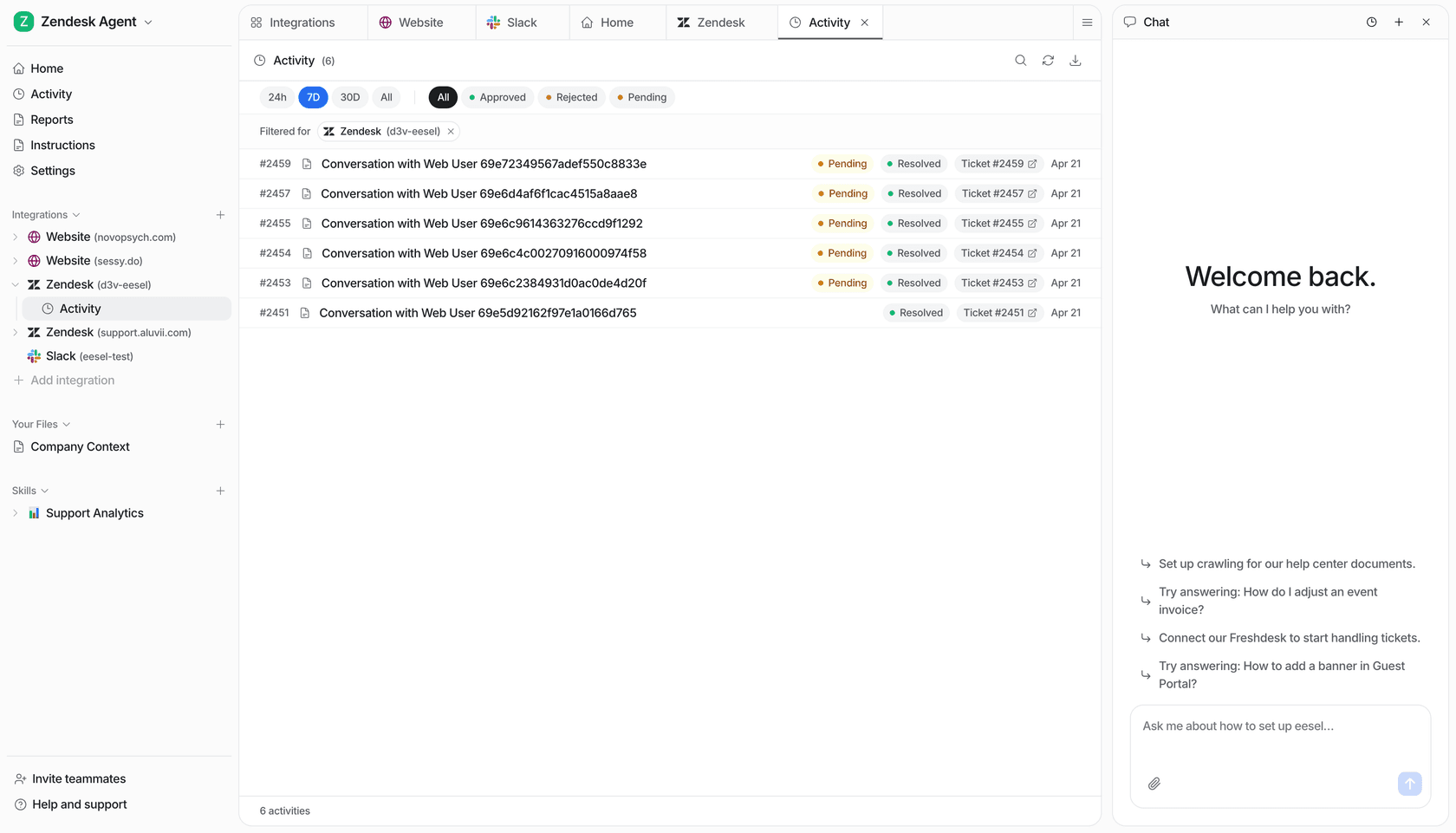
It's the answer one Gcore reviewer landed on after a head-to-head bake-off:
"I've tested many AI agent solutions, but so far Eesel is one of the best. It has many features we need, such as broad sources availability, variety of options, integrations, and so on. Highly recommended."
Mikita Tsybulka, Gcore, on G2
Try eesel free, or book a quick demo to see it run against your own Zendesk queue.
Frequently asked questions
What is the best Zendesk AI alternative in 2026?
Is there a free Zendesk AI alternative?
Why are teams switching away from Zendesk AI?
Do I have to leave Zendesk to use a different AI?
How much does Zendesk AI actually cost compared to the alternatives?


Article by
Alicia Kirana Utomo
Kira is a writer at eesel AI with a Computer Science background and over a year of hands-on experience evaluating AI-powered customer service tools. She focuses on breaking down how helpdesk platforms and AI agents actually work so that support teams can make better buying decisions.