

Why support teams are looking past Zendesk AI and Freshdesk Freddy
Zendesk and Freshdesk both shipped AI suites in the post-ChatGPT scramble, and both have real customers getting real value from them. The complaints we hear over and over fall into three buckets.
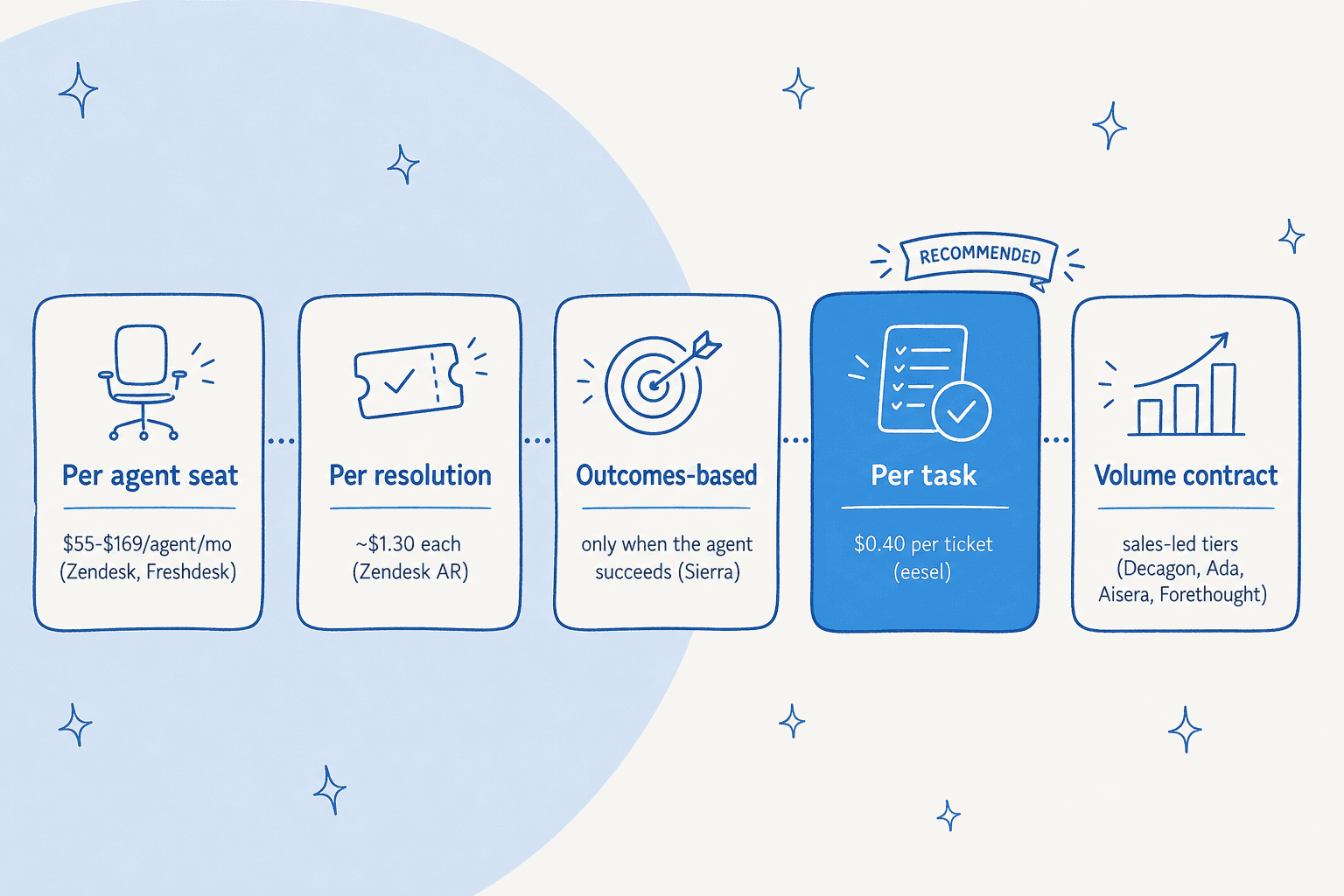
Pricing surprises. Zendesk's Copilot add-on adds $50/agent/month on top of a Suite seat, and the automated resolutions meter charges around $1.30 per resolution above your monthly commit, with no graceful cap. One Reddit reviewer put it bluntly:
"ARs are a rip off, and it's a rushed product to get into the AI hype."

Freshdesk Freddy hides similar economics in its per-session pricing - $49 per 100 additional sessions once you blow through your bundled 500 (Freshdesk pricing).
Shallow features on the cheap tiers. Zendesk's bundled AI Agents - Essential is described on Reddit as a routing layer with the word AI on the box. The Advanced tier with real dialogue building and authorized actions used to be a paid add-on; it's now rolling into Suite Professional plans through mid-2026 (Zendesk service/ai). Freddy's bundled tier is similar - the knowledge-base Q&A is fine, but anything agentic (taking actions, calling external APIs) needs the Pro plan and the add-on Copilot.
Heavy onboarding for the AI layer. Even teams who love the agent UX consistently flag that configuring AI Agents, Copilot, and Intelligent Triage feels like a full-time job in the back end. At ProductLab 2025, a Zendesk-run poll found only about 10% of AI agents built in the prior six months were still in production - a tell that getting the AI to stay on isn't the easy lift the marketing pages imply.
That trio - opaque pricing, shallow defaults, hard onboarding - is what's pushing teams to look at standalone alternatives, AI layers that run on top of the existing helpdesk, or both. Our AI ticket deflection guide and free AI for customer service roundup are the two starting points we point most teams to first.
The 7 AI alternatives at a glance
Here's the comparison most readers come for. Prices are 2026 list pricing (annual where applicable), gathered from each vendor's own page on 2026-06-09.
| Tool | Best for | Pricing model | Starting price | Free tier | Deployment | Channels | SOC 2 / GDPR | Compliance extras | Public customer roster |
|---|---|---|---|---|---|---|---|---|---|
| eesel AI | Layering AI on top of Zendesk or Freshdesk without leaving them | Fixed monthly credits (1 credit per ticket or chat) | From $299/mo for 500 credits, $4 / blog post | 100 free credits, no card | Helpdesk-native (Zendesk, Freshdesk, Slack, Intercom, Salesforce + 100 more) | All channels of the host helpdesk | SOC 2, GDPR | HIPAA (talk to us) | Smava, Design.com, Anytime Fitness, BitGo, CartonCloud, Ecosa |
| Decagon | AI-native consumer brands at high volume | Sales-led, ticket-volume brackets | Contact sales | None | Standalone agent platform | Chat, voice, email, SMS, API | SOC 2, GDPR | Trust Center | Chime, Duolingo, Hertz, Oura, ClassPass, Rippling, Notion, Figma, Dropbox, Riot Games |
| Sierra | Enterprises that want outcomes-based pricing | Outcomes-based | Quote only | None | Standalone agent platform | Chat, voice, SMS, WhatsApp, email, ChatGPT | SOC 2, GDPR, HIPAA | ISO 27001, ISO 42001 (AI mgmt), EU AI Act | Rocket Mortgage, SoFi, Vanguard, Ramp, Brex, FINRA, SiriusXM, Sonos, ASOS, ADT |
| Ada | Enterprise CX with strict AI compliance | Sales-led, conversation-volume bands | Contact sales (300k+ conv./yr floor) | None | Standalone agent platform | Chat, voice, email, WhatsApp, SMS, Instagram, custom | SOC 2, GDPR, HIPAA | AIUC-1 (AI-specific), zero LLM retention | Monday.com, IPSY, Cebu Pacific, Tilt, Loop Earplugs, Pinterest, Sky, Barnes & Noble |
| Forethought | Staying on your current helpdesk (Zendesk, Salesforce, Intercom) | Platform fee + outcome-based | Quote only (~$30K-$150K+ ACV per third-party sources) | Proof of value engagement | Standalone, helpdesk-agnostic | Chat, email, voice, SMS, Slack, mobile, API | SOC 2, GDPR | Multibrand, Analytics API add-ons | Upwork, Carta, Grammarly, Acorns, ActiveCampaign, Justworks, Lattice, UPS |
| Aisera | Consolidating IT, HR, and CX onto one platform | Sales-led, enterprise contracts | Contact sales | None | Cross-functional agent platform | Chat, voice, email, Teams, Slack | SOC 2, GDPR, HIPAA | ISO 27001, CSA STAR L1, CCPA, TRAPS framework | Adobe, Cisco, Workday, Zoom, NJ Transit, Gilead, McAfee, Instacart |
| Tidio Lyro | SMB and Shopify stores | Per AI conversation + seat | $24.17 / mo (Starter), Lyro from $32.50/mo | Yes - 50 Lyro conversations lifetime free | SMB-friendly suite + Lyro Connect for Zendesk | Chat, email, Messenger, WhatsApp, Instagram | SOC 2, GDPR | (Standard) | Under Armour, The Body Shop, Dermalogica, Stanley, ADT |
A few things to notice in that table:
- Three different pricing philosophies show up. Seat + per-resolution (the model Zendesk and Freshdesk use); outcomes-based (Sierra); fixed monthly credit plans (eesel); and pure usage / volume (Tidio, the enterprise-quote tools). The model you pick matters more than the per-unit number, because each has a different way of getting expensive.
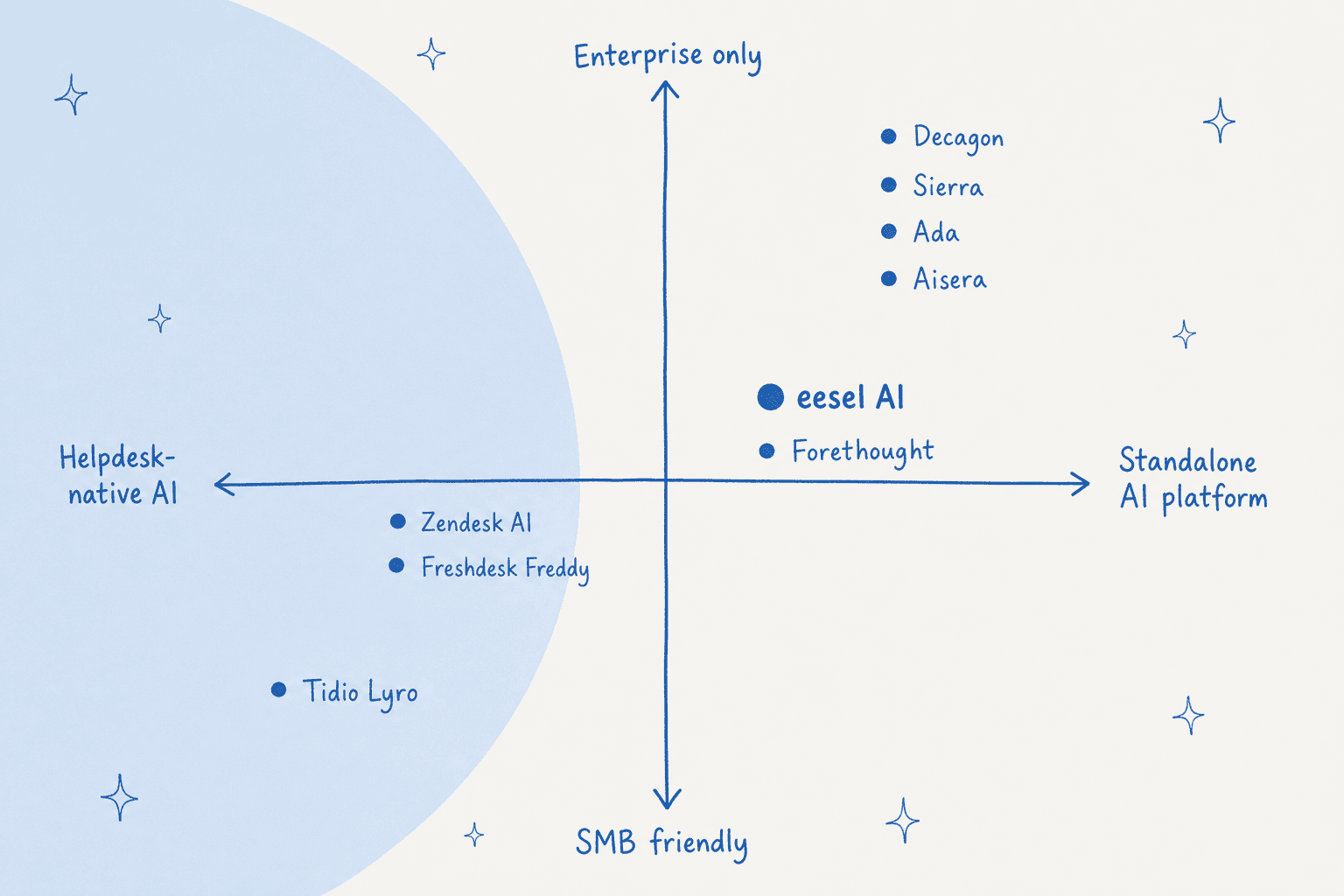
- The standalone AI platforms cluster at the top of the volume curve. Decagon, Sierra, Ada, and Aisera all start at contact sales with mid-six-figure-plus ACVs, because that's where outcomes-based or volume-based pricing earns its rate.
- Compliance certifications increasingly distinguish the upper tier. Sierra's ISO 42001 (AI management system) and Ada's AIUC-1 are AI-specific frameworks the incumbent helpdesks haven't surfaced yet. If you're in financial services, healthcare, or government, that's not cosmetic.
How we picked these seven
We started from the public market - every vendor publicly competing against Zendesk AI and Freshdesk Freddy AI as of mid-2026 - then narrowed to seven against four criteria:
- Real production customers. Each pick has 10+ named customers visible on its homepage with verifiable case studies. We dropped a few candidates whose customer lists were all logos we couldn't trace to real deployments.
- Different shape of buyer. A SMB on Shopify and a Fortune-500 bank are not shopping for the same product. We wanted at least one strong pick in each band - SMB, mid-market, enterprise - so a reader can actually find themselves on the list.
- AI as the product, not a feature. We deliberately excluded helpdesks where AI is one of fifty checkboxes. The lineup here is tools you'd buy for the AI, not in spite of it.
- Public signal we can verify. Funding rounds, case-study numbers, security certifications, G2 review counts. Every claim in the items below traces to a primary source linked in-line. Where we couldn't get a verifiable number, we say so rather than round it.
The two big names we left out: Intercom Fin (for legal reasons specific to our history with that vendor - we'd rather not), and a handful of contact-center AI vendors (Cresta, Replicant) that are stronger in voice-call analytics than in helpdesk-style ticket resolution. If voice agents are your main thing, those are worth a look on their own.
1. eesel AI - best for layering AI on top of Zendesk or Freshdesk
Best for: Teams who like their helpdesk and want better AI without ripping it out.
"It feels like a partnership, not a vendor relationship."
Jon Miron, Director of Support & Operations, Yellowdig (eesel homepage)
What it is
eesel AI is an AI teammate platform built around the idea that the AI should live in the tools the team already uses - Zendesk, Freshdesk, Slack, Intercom, Gmail, Shopify, Salesforce - rather than asking the team to learn a new app. You connect the helpdesk and any knowledge sources (help center, Google Docs, Confluence, Notion, past tickets), brief the agent in plain language ("draft replies for refund tickets under $500; escalate the rest"), and it starts handling tickets the same day. Production customers run 100,000+ tickets/month through eesel teammates (Smava case study on the homepage).
The three things that make it a real Zendesk / Freshdesk alternative rather than another co-pilot:
- It takes action, not just drafts replies. eesel calls out to your Shopify, Stripe, Salesforce, and Jira through the helpdesk - refunds, order status, ticket creation. Same surface as a human agent.
- It's briefed in natural language, not a flow builder. You write the rules the same way you'd onboard a junior. There's no decision tree to draw.
- The pricing is per credit, not per seat or per resolution. A ticket or chat the agent handles is one credit, however long it runs; a blog draft is $4. You pick a fixed monthly plan sized to volume, and it does not change with how many people on the team touch the helpdesk.
Where it falls short
- Not a helpdesk on its own. eesel sits on top of Zendesk or Freshdesk; if you're starting from scratch with no ticketing in place, you'd need to pick one of those (or a lighter SMB tool like Tidio) first.
- The deeper agentic features lean on a clean knowledge base. Same caveat as every AI alternative: if your help center is three years out of date, your agent will be too. eesel's onboarding flow includes a knowledge-gap report up front, but the work still has to get done.
Pricing
| Item | Cost |
|---|---|
| Free plan | 100 credits, no card |
| 500 credits / month | $299/mo |
| 1,000 credits / month | $499/mo |
| 2,500 credits / month | $999/mo |
| 5,000 credits / month | $1,899/mo |
| Blog post | $4 each |
| Pay a year upfront | Two months free |
1 credit covers one ticket or chat, however long. No seat fees and no per-resolution surcharges. If you run out of credits, agents pause until they reset, or you can turn on overage with a monthly cap you set ($0.80 per extra credit). Full eesel pricing.
Worked example. A 1,500-ticket-a-month team would pay $699/month on the 1,500-credit plan. The closest Zendesk equivalent - Suite Professional at $115/agent times 4 agents + Copilot add-on at $50/agent + about $1,300 in automated-resolution overages on 1,000 deflected tickets - comes to about $2,260. That's the math driving the migration.
Our take
eesel is the answer to I want better AI than what Zendesk or Freshdesk ships, and I don't want to migrate. If you'd be happy keeping your current helpdesk's ticketing, routing, and reporting and just swapping the AI layer underneath, this is the cheapest, fastest path. The pricing is also unusually buyer-friendly: one fixed monthly price with every integration and channel included, and no seat fees. For deeper picks-of-picks, see our best AI customer support tools 2026 and best AI helpdesk for small teams roundups.
The team you'd push to a heavier platform is one where the AI agent needs to be the customer experience layer (voice + chat + email + custom surfaces orchestrated together, with outcome-based commercial terms). For that, look at Decagon or Sierra next.
2. Decagon - best for AI-first consumer brands at high volume
Best for: AI-native consumer brands deflecting tens of thousands of tickets a month.
Capture as taken from decagon.ai/product/overview.
What it is
Decagon is an AI-native conversational agent platform built around a single concept: Agent Operating Procedures (AOPs) - natural-language SOPs that compile into executable agent code. The pitch is that AOPs let non-technical CX leads author and iterate agent logic, while engineers retain control over guardrails, integrations, and versioning. It's explicitly positioned against developer SDK + decision-tree rivals.
Founded in 2023 by Jesse Zhang and Ashwin Sreenivas, Decagon has raised roughly $230M+ across seed (a16z + Accel), Series A ($35M Accel), Series B ($65M Bain Capital), and a 2025 Series C of about $131M led by a16z and Accel at a ~$1.5B valuation (Crunchbase - Decagon). The customer roster reads like a list of every AI-curious consumer brand of the last two years: Chime, Duolingo, ClassPass, Hertz, Oura, Affirm, Square, Rippling, Notion, Figma, Dropbox, Eventbrite, Mercado Libre, Rituals, Quince, Riot Games, Fanatics.
Headline outcomes from Decagon's published case studies:
| Customer | Result |
|---|---|
| Chime | 70% chat + voice resolution with Decagon Voice (case study) |
| Duolingo | 80% deflection (named replacement of the previous vendor) (case study) |
| ClassPass | 95% cost reduction, 10x deflection vs. expected (case study) |
| Hunter Douglas | $1M revenue from fully AI-handled conversations (case study) |
| Rippling | 32% deflection increase (case study) |
The competitive line Decagon stages on its homepage, via the Duolingo quote:
"With the previous vendor, at least half my week was dedicated to maintaining their system. With Decagon, it's been a night-and-day difference."
Duolingo, via Decagon case study
Where it falls short
- Sales-led only. decagon.ai/pricing returns 404 - every CTA routes to a demo form gated by a Monthly Support Tickets dropdown starting at <9,999 and stretching to 250,000+. Below mid-market, it's not the right buy.
- It expects to be the AI layer. Decagon is a replacement for the AI you'd otherwise buy from Zendesk or Freshdesk, not a co-pilot on top of one. If you want to keep Zendesk's built-in AI agents and add Decagon, you're not really the customer it's optimised for.
Pricing
Sales-led, annual contract, ticket-volume brackets. No public list. The demo form's volume bands (<9,999 / 10K-50K / 50K-250K / 250K+) make the bracketing visible. Third-party deal data (Vendr et al.) typically puts Decagon ACVs in the low- to mid-six figures.
Our take
Decagon is the right shortlist pick when you're already at consumer scale, your CX leader can defend an outcomes-based annual contract, and the failure mode you're worried about is the agent breaks production for a million users at once. AOPs and the deep observability story address that.
The teams Decagon is wrong for are anyone under ~10,000 monthly tickets and anyone who wants public pricing they can stress-test on a spreadsheet. That's where eesel and Tidio come in.
3. Sierra - best for enterprises that want outcomes-based pricing
Best for: Enterprises (especially regulated industries) where the procurement team would rather pay for results than seats.
Capture as taken from sierra.ai.
What it is
Sierra is the conversational AI agent company co-founded in early 2023 by Bret Taylor (ex-CTO of Facebook, co-CEO of Salesforce, co-creator of Google Maps, current Chair of the OpenAI board) and Clay Bavor (18 years at Google, led Google Labs, AR/VR, and Project Starline). That founder team is half the story - Sierra has the rare combo of AI-native architecture and enterprise procurement pedigree, which is why the customer roster includes Rocket Mortgage, SoFi, Vanguard, Ramp, Brex, FINRA, SiriusXM, Sonos, ASOS, ADT, Sutter Health, and Discord.
The other half of the story is outcomes-based pricing:
"Pay for a job well done - Ensure you only pay for the value Sierra delivers with outcome-based pricing."
There's no public per-seat or per-message rate card. Outcomes are defined per customer - typically resolved support outcomes, completed transactions, retention saves, or upsell conversions - and you only pay when the agent achieves them. That's a structurally different commercial deal from Zendesk's per-resolution model, because the implementation risk sits on Sierra.
Sierra's most distinctive product wedge is Ghostwriter, an agent that builds agents from SOPs, transcripts, audio recordings, or plain-English goals - collapsing the 6-12 week implementation cycle competitors typically need. The platform also ships both an Agent SDK (the code-first surface used by teams like Ramp's engineering org) and Agent Studio (no-code, for CX ops). Most rivals pick one lane.
Funding: a 2024 round of about $110M took Sierra past $1B, an October 2024 Series C added $175M at $4.5B, and a late-2025 Series D added about $350M at roughly $10B - making Sierra one of the most-capitalised private AI agent companies on Earth.
Where it falls short
- Enterprise-only by deliberate design. No self-serve sign-up, no published pricing, no free trial. If you're under ~$10M ARR, Sierra isn't going to call you back.
- The outcomes-based pricing is opaque until you negotiate. Buyers we've talked to like the principle of paying for results - but pinning down which outcomes count, at what rate, takes weeks of legal and procurement work.
Pricing
Outcomes-based, sales-led, annual contract. No public number. Reported deal sizes from secondary sources put first-year ACVs in the mid- to high-six figures for the named regulated-industry deals.
Our take
Sierra is the right pick when the procurement bottleneck is we don't want to commit to per-seat or per-resolution pricing for an AI we haven't seen produce results yet. The outcomes-based model gets past that, and Bret Taylor's ISO 42001 AI management system compliance story is one of the only ones in the market that actually maps to EU AI Act requirements.
If your buyer is a head of support rather than a procurement-led transformation team, the heavier sales motion is overkill - try eesel or Decagon first. For the equivalent enterprise-readiness comparison, see our best AI helpdesk for enterprise roundup.
4. Ada - best for enterprise CX with strict AI compliance needs
Best for: Enterprises with 300K+ annual conversations and strict AI compliance requirements (financial services, healthcare, government).
Capture as taken from ada.cx.
What it is
Ada is a Toronto-headquartered enterprise AI customer service platform that brands its category as Agentic Customer Experience (ACX). The product is a standalone AI agent layer that sits on top of (and integrates with) helpdesks like Zendesk, Salesforce Service Cloud, Freshworks, ServiceNow, and Genesys. The ACX Platform breaks into four pieces:
- Reasoning Engine - multi-LLM orchestration brain with safeguards
- Conversation Hub - omnichannel + multilingual delivery (voice, email, chat, Messenger, WhatsApp, SMS, Instagram, in-app, custom)
- Performance Center - Playbooks (multi-step SOPs) and Coaching (review queue feeding applied learning)
- Developer Toolkit - APIs, MCP, SDKs
Wrapped around the software, Ada sells two adjacent service pillars: ACX Practice (methodology) and ACX Experts (services / extension of your team). It's sold as one operating model, not as a SaaS subscription.
Ada is enterprise-only by stated qualification. Their pricing page calls out the floor explicitly:
"We are a great fit for companies with at least 300,000 annual customer service conversations."
The qualification form's volume bands run up to More than 100 million. Below ~300K conversations a year, Ada won't engage.
Funding: Ada raised a $130M Series C at a $1.2B valuation in May 2021, led by Spark Capital, on top of an earlier $44M Series B (Accel + Bessemer). Total disclosed funding sits around $190M+. Customers include Monday.com (42% reduction in average handle time, 225K+ active customers), IPSY ($2.7M estimated annual savings, "943% ROI in four months"), Tilt (84% automated resolution on chat, +8 CSAT), Cebu Pacific (34%+ higher automated resolution vs. their declarative chatbot), Pinterest, Sky, Barnes & Noble, Digicel, Malaysia Airlines, and Grab.
The compliance footprint is where Ada genuinely separates from incumbents: SOC 2 and GDPR yes - but also AIUC-1 (an AI-specific industry compliance certification rarely surfaced by competitors), HIPAA, and zero data retention with LLM providers, with independent annual pen testing including the LLM layer.
Where it falls short
- Below 300K conversations/year, Ada is not the right buy. Their own qualification form will route you elsewhere.
- The services wrap can feel heavy. ACX Practice + ACX Experts add real value if you don't have an in-house AI ops team, but they're also a commercial commitment beyond the software.
- No public pricing. Same enterprise-only sales motion as Decagon, Sierra, and Aisera - expect a multi-week procurement cycle.
Pricing
No public per-seat, per-conversation, per-resolution, or tiered rates. Sales-led, annual enterprise contract, volume-bracketed by conversations. No free trial.
Our take
Ada is the right pick when you're an enterprise CX leader at a brand whose AI compliance posture is going to get audited - and you want the agent layer audited at the same level as the rest of your stack. The combination of AIUC-1, zero LLM retention, and the ACX Practice methodology is unusually strong for regulated industries.
It's not the right pick for anyone under their stated 300K-conversation floor, for buyers who want to go from contract to live agent in under a quarter, or for teams that already love their helpdesk and just want better AI on top. For that last case, see eesel or Forethought instead.
5. Forethought - best for staying on your current helpdesk
Best for: Mid-market and enterprise teams committed to Zendesk, Salesforce Service Cloud, or another helpdesk who want agentic AI without switching.
Capture as taken from forethought.ai.
What it is
Forethought is one of the older enterprise AI-for-support companies - founded in 2017/2018 by Deon Nicholas, won TechCrunch Disrupt SF Startup Battlefield 2018, and raised a $65M Series C in December 2021 (TechCrunch) for a total of about $92M. The platform now markets a coordinated multi-agent system:
| Product | What it does |
|---|---|
| Discover | Insights agent - analyses historical tickets + KB content to surface gaps and auto-generate Autoflows |
| Solve | Flagship customer-facing agent - resolves inquiries end-to-end across chat, email, voice, SMS, Slack, mobile, API |
| Triage | Classification agent - sentiment, language, urgency, custom handoff models |
| Assist | Agentic copilot for human agents inside the helpdesk |
| Agent QA | Automated QA across 100% of interactions |
| SupportGPT | The generative-AI brand layer launched 2023, now folded into the multi-agent narrative |
| Forethought Voice | Newer voice-channel agent (blog announcement) |
The strongest pitch is helpdesk-agnostic deployment. Forethought sits on top of Zendesk, Salesforce, Intercom, Freshdesk, or whatever helpdesk you already have via native integrations. That's the same wedge eesel uses - Forethought is just the heavier, enterprise-priced version of it.
Customers from the homepage logo strip include Upwork, Carta, Grammarly, Acorns, Fetch Rewards, Thumbtack, WordPress.com, ActiveCampaign, Justworks, Lattice, Descript, Cohere, Scale AI, Corsair, iFit, CookUnity, Viome, UPS, Redis, and Cotopaxi. Public case studies: Upwork (50% reduction in time to resolution, 65% self-serve rate), YAZIO (80% deflection, absorbed 40% ticket growth without new hires), Cotopaxi (168% ROI in six months).
Headline performance claims from their 2025 AI in CX Benchmark Report: 15x average ROI, 55% average reduction in first response time, up to 98% resolution rate, 100+ languages.
Where it falls short
- Quote-only pricing. Three tiers (Team / Professional / Enterprise), every CTA is Get a Quote. Third-party deal data (Vendr, G2, SaaSworthy) suggests roughly $30K-$150K+/year ACVs, but Forethought won't confirm.
- No free trial. They offer a Proof of Value engagement run on your data instead - a real test, but a multi-week sales motion.
- Maturity cuts both ways. Forethought predates the post-ChatGPT generative wave. The SupportGPT launch in 2023 was their generative pivot, and on some feature pages you can still feel the older deflection-bot DNA.
Pricing
Three named tiers with Get a Quote CTAs. The pricing FAQ describes the model as a blend of platform access fees and an outcome-based pricing cost, with optional add-ons (Multibrand, Analytics API, Discover). Usage above plan limits triggers extra charges.
Our take
Forethought is the right pick when you're an enterprise on Salesforce Service Cloud or older Zendesk Support, you don't want to swap helpdesks, and you've already passed the budget threshold for an annual quote-only commitment. The five-agent narrative + Browser Agent (which lets Solve operate legacy systems that lack APIs) is a real differentiator for companies whose stack pre-dates the API era.
If you want the same AI on top of your helpdesk pattern but priced for a smaller team, eesel is the lighter-weight equivalent. Our best Forethought AI competitor post does the side-by-side comparison if Forethought is already on your shortlist.
6. Aisera - best for consolidating IT, HR, and CX onto one platform
Best for: Fortune-500-scale enterprises rolling one AI platform across IT service desk, HR helpdesk, and external customer service.
Capture as taken from aisera.com.
What it is
Aisera is an enterprise AI Service Experience platform that delivers autonomous AI agents and assistants across IT, HR, customer service, finance, procurement, and ops - not a CX-only product. Unlike Zendesk AI and Freshdesk Freddy, Aisera is positioned as cross-functional from day one: a single platform whose Universal Agent orchestrates Domain Agents (IT, HR, Finance, Customer Service) and Task Agents (narrow repeatable functions).
The platform's distinctive pieces:
- Aisera Unify - open-standards orchestration backbone built on A2A, MCP, and AGNTCY for integrating third-party agents, apps, and systems.
- A Reasoning & Orchestration Engine for multi-step agentic planning.
- An LLM Gateway that supports AiseraLLM, domain LLMs, or any leading foundation model (OpenAI, Claude, Google) with OpenTelemetry observability.
- The TRAPS framework - Trusted, Responsible, Auditable, Private, Secure - for enterprise governance.
- Compliance: SOC 2, GDPR, ISO 27001, CSA STAR Level 1, CCPA, HIPAA.
Founded in 2017 in Palo Alto by Muddu Sudhakar (a repeat founder - sold Caspida to Splunk and Cetas to VMware) and co-founder Saravanan Adiseshan. Total raised is about $171M across five rounds, including a Series E of $90M in June 2023 at a $1.6B valuation with Goldman Sachs Asset Management, Zoom Ventures, Khosla, and Menlo.
In November 2025, Automation Anywhere announced an acquisition of Aisera (landing page). Going forward, Aisera's go-to-market is increasingly bundled into Automation Anywhere's Agentic Automation platform - which matters for buyers whose RPA stack already runs on Automation Anywhere.
Customers: Adobe, Cisco, Nokia, Workday, Zoom, Dave, McAfee, Gilead Sciences, S&P Global, Instacart, BNSF Railway, Marmon Holdings, Pacific Dental Services, Unisys, Old Republic, LifeScan, BDO Canada, NJ Transit, OmniTRAX, City & County of Denver. Headline outcomes: NJ Transit lifted agent productivity 60% via internal agent Travis on Microsoft Teams, OmniTRAX auto-resolved 70% of tickets, LifeScan saved $2.2M, BDO Canada saw a 72% productivity gain.
Where it falls short
- Too heavy for CX-only buyers. If you're 50-500 seats and just want a better support bot, Aisera is overkill - the buyer it's designed for is a transformation leader at a 5,000-person enterprise.
- Brand momentum is now tied to the Automation Anywhere acquisition. That's a plus if you're already on AA, a question mark if you weren't planning to be.
- No public pricing. Both
/pricingand/demoreturn 404. Contact-sales only.
Pricing
Sales-led, annual enterprise contract, scoped per use case and volume (tickets / employees / conversations). No free tier, no trial, no per-seat published rate.
Our take
Aisera is in the natural shortlist when the real buyer is a CIO or transformation lead consolidating IT service desk, HR support, and external CX onto one AI platform - alongside ServiceNow Now Assist and Moveworks. The Gartner MQ for AI in ITSM and the IDC MarketScape for Conversational AI both feature Aisera, and the cross-functional scope is genuinely real, not just marketing.
For a head of support buying for the support team alone, this is the wrong tool - the cross-functional weight gets in the way. Pick eesel, Forethought, or Decagon for that case. Our best AI for IT helpdesk and best AI for internal support teams roundups dig deeper on the IT/HR side of the same problem.
7. Tidio Lyro - best for SMB and Shopify stores
Best for: Small businesses, ecommerce brands, and Shopify stores who want production AI support without an enterprise contract.
Capture as taken from tidio.com/lyro.
What it is
Tidio is a complete customer service platform built for SMBs and mid-market ecommerce. It combines an AI agent (Lyro), live chat, a help desk, and proactive automation (Flows) into a single product, sold either as a suite or in standalone modules. Tidio's tagline is more automation, less I-hate-your-support.
Two things make Tidio interesting on this list:
- Lyro is powered by Anthropic's Claude, not OpenAI - and Tidio claims a 67% average resolution rate, positioned as the highest in the SMB AI customer-support market. With 300,000+ businesses as customers including Under Armour, The Body Shop, Dermalogica, Stanley, and ADT, the SMB credibility is real. Aggregate review scores: 4.6/5 across 1,879+ Tidio reviews, 4.8/5 on Shopify App Store (1,300+ reviews), 4.8/5 on Capterra (200+ reviews).
- Lyro Connect lets you bolt Lyro on top of Zendesk, Salesforce, or Intercom - the AI on top of your existing helpdesk pattern, but on the SMB end of the price curve. Available on Tidio's Plus and Premium plans.
Notable customer outcomes Tidio publishes: Gecko Hospitality automating 90% of repetitive tasks, Bella Sante generating $66K+ in revenue via Lyro, Suitor cutting response time by 97%. Tidio also offers a money-back guarantee if Lyro's resolution rate falls under 50%.
Where it falls short
- Usage-based pricing gets complex at scale. You pay per billable conversation and per Lyro conversation and per Flows visitor - three meters. Predicting the bill at 5,000+ conversations a month takes work.
- The Growth-to-Plus jump is steep. Growth tops out around $49/mo; Plus starts at $749/mo. There's no smooth middle band.
- Enterprise/Premium pricing is opaque. Contact sales - third-party sources suggest roughly $2,999/mo, but it's not confirmed on the pricing page.
Pricing
| Plan | Price (annual) | Billable conversations | Key unlock |
|---|---|---|---|
| Free | $0/mo | 50 | 50 Lyro convos lifetime, 100 Flows visitors |
| Starter | $24.17/mo | 100 | Live visitors list, operating hours |
| Growth | from $49.17/mo | 250-2,000 | Advanced analytics, Shopify actions, macros |
| Plus | from $749/mo | Custom | Departments, Lyro Connect, OpenAPI, CSM |
| Premium | Contact sales | Custom | Guaranteed 50% resolution, managed AI, SSO |
| Lyro AI (standalone) | from $32.50/mo | - | AI only, layered on existing helpdesk |
| Flows (standalone) | from $24.17/mo | - | Proactive automation only |
Seven-day free trial on every paid plan, no credit card. Source: tidio.com/pricing.
Our take
Tidio Lyro is the only tool on this list with a real free tier and a sub-$50/month entry point - which makes it the right starting place if you're a 1-5-person team and you don't yet have a helpdesk. The 67% resolution-rate claim is well above the SMB norm, and the Claude-backed agent reads as cleaner than most rule-based chatbots.
If you grow past ~2,000 conversations/month, the per-conversation math starts to add up - and that's where eesel's fixed credit plans or a heavier platform becomes the cheaper option. Worth knowing the cliff is there. See also our Tidio alternatives roundup for adjacent picks.
How to choose between them
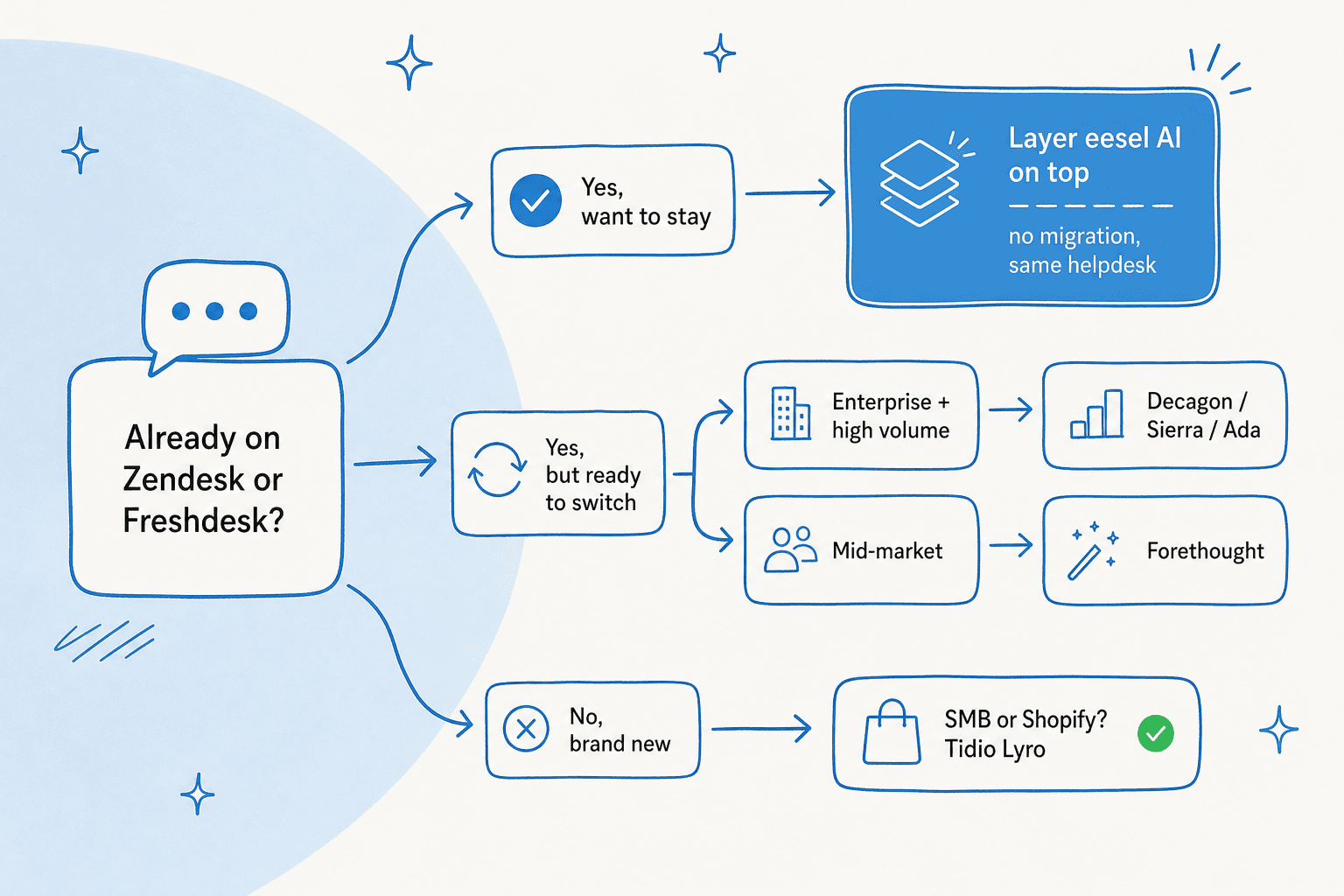
Most of the picking logic comes down to two questions: how big is the team, and how committed are you to your current helpdesk. The diagram below maps the most common answers to the tool we'd put on the shortlist.
A few practical heuristics on top of that:
- If you're already on Zendesk or Freshdesk and you like the ticketing, the cheapest, fastest path is eesel for Zendesk or eesel for Freshdesk. Same inbox, better AI, no migration. The next-heaviest option is Forethought, which fits enterprises that have already gotten budget approval for an annual quote-only contract.
- If you're scoping a full helpdesk replacement at consumer scale, the AI-native picks (Decagon, Sierra, Ada) are the right shortlist. Decagon if you want the agent-building-agent narrative and AOPs; Sierra if outcomes-based pricing is the unblock; Ada if AI-specific compliance is the gating concern.
- If your real buyer is the CIO, Aisera (and ServiceNow Now Assist, and Moveworks) are the candidates - cross-functional IT + HR + CX, not CX alone.
- If you're SMB or Shopify, start at Tidio Lyro. The free tier is real, the Claude-backed agent is genuinely good, and the Shopify integrations are first-class. For the Shopify-specific deep dive, see our best AI customer service software for ecommerce and best AI for Shopify customer support guides.
The most common mistake we see in this category is teams over-buying - picking a $200K-ACV enterprise platform for a team that would have been fine with eesel's credit-based pricing or Tidio's $49/mo Growth tier. The second most common is teams under-buying - picking the cheapest tool for a problem that needed Sierra-grade outcomes accountability. The decision tree above is meant to keep both errors in check.
For a fuller comparison of every AI agent on the market, our best customer service AI, best AI helpdesk software 2026, and best helpdesk software with AI roundups go broader.
A note on the incumbents
We've spent the whole post talking about alternatives, but the right way to read it is complement rather than replace. Zendesk and Freshdesk are still excellent helpdesks - what's stale is the AI layer they ship. The pattern we see working:
- Keep the helpdesk you trained your agents on.
- Swap the AI layer underneath (eesel, Forethought, or a standalone if you're at scale).
- Re-measure resolution rate and cost-per-resolved-ticket after one quarter.
That sequence preserves the ticketing, routing, SLA, and reporting investment you've already made while fixing the part of the stack that's actually behind. Our deeper guides on how to add AI to Zendesk, how to automate Freshdesk tickets, and how to reduce support tickets using AI walk through the practical mechanics. For the broader competitive picture, see our Zendesk vs Freshdesk comparison and the Zendesk pricing breakdown - the per-resolution math is what trips most buyers up.
If your shortlist is narrower than the whole market, our targeted comparisons help too: Zendesk AI alternative, Freshdesk AI alternative, best Forethought AI competitor, best Chatbase alternatives, and ChatGPT alternative trained on your company's data.
Try eesel AI for Zendesk and Freshdesk
If you're already on Zendesk or Freshdesk and you've nodded through most of the complaints in the Why teams are looking past Zendesk AI and Freshdesk Freddy section above - you're our reader. eesel AI sits on top of your existing helpdesk, drafts replies and takes actions in the channels you already use, and charges one fixed monthly price rather than per seat or per resolution. You can start free with 100 credits, brief the agent in plain language, and have it handling tickets in a few hours rather than a few months.

Try eesel - no card, no demo gate. Or talk to us about your stack on the eesel pricing page if you want the worked example for your ticket volume first. If escalation rules and human-handover are the bottleneck for your team, the AI chat escalation playbook walks through how eesel handles those moments specifically.
Frequently Asked Questions
What are the best AI alternatives to Zendesk and Freshdesk in 2026?
The seven we keep coming back to are eesel AI, Decagon, Sierra, Ada, Forethought, Aisera, and Tidio Lyro. They cover the range from layering AI on top of Zendesk without ripping it out to full enterprise replacement priced on outcomes. For wider context see our Zendesk AI alternatives and Freshdesk Freddy AI alternatives roundups.
Why are teams looking for AI alternatives to Zendesk and Freshdesk?
The pattern is the same in both camps: pricing surprises and shallow bundled features. Zendesk's Copilot add-on adds $50/agent/month on top of per-resolution charges for AI agents with no monthly cap, and Freshdesk Freddy sessions stack on top of seat fees. On top of that the bundled AI agents on the cheapest tiers feel like routing layers with the word AI on the box. That combination is what pushes teams to look at standalone alternatives or AI layers like eesel that don't require ripping the helpdesk out.
Do I have to leave Zendesk or Freshdesk to get a better AI?
No. eesel for Zendesk and eesel for Freshdesk sit on top of your existing ticketing - same inbox, same workflows, same reporting - and replace the AI layer underneath. Forethought does the same thing on a heavier enterprise contract. Both let you keep your stack. The how to add AI to Zendesk guide walks through the mechanics.
Which AI alternative is cheapest for a small team?
For a true SMB starting from scratch, Tidio Lyro has a real free tier and starts around $24/month, with Lyro itself at about $0.50 per AI conversation. If you already have a helpdesk, eesel AI is usually cheaper still because there are no seat fees - you pay one fixed monthly price from $299 for 500 credits (1 credit per ticket or chat). Our cheapest AI helpdesk apps breakdown goes deeper on small-team math.
Which AI alternative is best for enterprises with 10M+ conversations a year?
At that volume, Decagon, Sierra, and Ada are the obvious shortlist. Decagon is the AI-native pick with the heaviest consumer-brand roster (Chime, Duolingo, ClassPass, Hertz); Sierra leans into outcomes-based pricing and has Bret Taylor's name pulling regulated-industry deals (Rocket Mortgage, Vanguard, FINRA); Ada is enterprise-only by design - they won't engage under 300,000 annual conversations. Aisera joins the shortlist if you want one platform spanning IT, HR, and CX rather than CX alone.
How do AI agents like eesel and Decagon work with my existing knowledge base?
All of these tools ingest knowledge sources - help center articles, internal docs, past tickets - and build a retrieval index the LLM grounds its replies in. The split is in how aggressive the agent is allowed to be: eesel exposes the rules in plain language (escalate refunds over $500), Decagon's Agent Operating Procedures compile natural-language SOPs into executable code, and Ada's Reasoning Engine orchestrates multiple LLMs with safeguards. The knowledge base management playbook walks through how that index gets built and maintained.
What's the difference between Zendesk's built-in AI agents and a standalone AI agent platform?
Zendesk's own AI agents (their advanced features are now included in every Suite and Support plan) live inside Zendesk - you build procedures, generative replies, and authorized actions in the Zendesk admin, and you pay per automated resolution, plus $50/agent/month for the Copilot add-on if you want agent assist. A standalone platform (Decagon, Ada, Sierra, eesel) runs as its own agent and integrates with Zendesk via API - same end-user experience, but the AI logic, knowledge base, and analytics live outside Zendesk. The standalone route is what you pick when you want to move helpdesks later without losing the AI work, or when you want better economics than per-resolution.