Disclosure: This article is published by eesel AI, a competitor of Decagon. We encourage you to read Decagon's own materials for their perspective.
If you're researching Decagon AI pricing, you've probably noticed something frustrating. There is no pricing page. No "Starter" plan. No "Enterprise" tier with a dollar amount next to it. Just a button that says "Get a demo."
This is intentional. Decagon operates on a custom-quote model where every deal is negotiated. For large enterprises with complex needs and deep pockets, this approach makes sense. For everyone else, it's a barrier.
Here's what Decagon actually costs, how their pricing model works, and whether it fits your budget.
What is Decagon AI?
Decagon builds AI "concierge" agents for enterprise customer support. Unlike basic chatbots that answer FAQs, Decagon's agents are designed to resolve tickets end-to-end across chat, email, and voice channels.
The company's key differentiator is something called Agent Operating Procedures (AOPs). These let you define agent workflows in natural language rather than code. A non-technical support manager can write instructions like "If a customer asks for a refund over $100, verify their purchase date and escalate to the billing team" and the AI follows that logic.
Decagon's customer list reads like a who's who of tech and consumer brands: Duolingo, Chime, Classpass, Hertz, Oura, Affirm, Dropbox, Notion, and Rippling. The company claims 100+ enterprises and hit a $4.5 billion valuation in March 2026 after raising $250 million in fresh funding.
How Decagon AI pricing works
Decagon's pricing philosophy is simple: AI agents are workers, not tools. Traditional SaaS charges per seat because humans use the software. Decagon charges for the work the AI performs.
This leads to two pricing models:
Per-conversation pricing
You pay a fixed rate for every conversation the AI handles. If the AI touches 10,000 tickets in a month, you pay for 10,000 conversations.
This is the model most customers choose. It's predictable. You can forecast costs based on your ticket volume. There's no ambiguity about what counts as 'resolved.'
The downside? You pay even when the AI fails. Escalations to human agents, simple one-message inquiries, and incomplete resolutions all count toward your bill.
Per-resolution pricing
You pay a higher rate, but only for tickets the AI fully resolves without human help. If the AI solves 6,000 out of 10,000 tickets, you pay for those 6,000 resolutions.
This sounds appealing in theory. You're paying for outcomes, not effort. The problem is defining what "resolved" means. If a customer gets frustrated and abandons the chat, was that a resolution? If the AI gives a partial answer that technically addresses the question but doesn't solve the underlying issue, do you pay?
Decagon acknowledges this ambiguity. Their own glossary entry on resolution-based pricing notes that 'defining what a resolution is can be tricky' and that 'gray areas can lead to billing disagreements.'
What Decagon AI actually costs
Decagon does not publicly list its pricing. The figures below are third-party estimates from buyer marketplace data; to get actual numbers, you must request a demo from their sales team. Marketplace data from Vendr provides estimates based on real contracts:
| Metric | Value |
|---|---|
| Median contract value | $400,000/year (not publicly disclosed) |
| Contract range | $100,000 - $580,000/year (not publicly disclosed) |
| Redline threshold | ~$50,000 minimum (not publicly disclosed) |
| Payment terms | Net 30, Net 60 |
| Best months to negotiate | January, February, March |
These are enterprise numbers. Decagon is not priced for startups or small businesses. The $50,000 redline threshold means if your annual contract value would be below that, you're not a fit for their sales process.
What drives your quote
Several factors influence where you land in that $100K-$580K range:
- Ticket volume. This is the primary driver. Higher volume means higher total cost, though per-unit rates may improve.
- Channel mix. Voice AI typically costs more than chat due to real-time processing and telecom infrastructure.
- Integration complexity. Connecting to custom ERPs or legacy ticketing systems adds professional services fees.
- Workflow depth. Basic Q&A is cheaper than multi-step workflows involving refunds, identity verification, or order lookups.
- SLA requirements. 99.99% uptime guarantees and dedicated customer success managers come at a premium.
Hidden costs to budget for
The base contract is just the starting point. Real-world deployments often include:
- Implementation fees. Not advertised publicly, but common for enterprise AI platforms.
- Professional services. Custom integrations and workflow development.
- Premium support tiers. Dedicated CSMs and priority response times.
- Volume spike exposure. Black Friday, product launches, or outages can spike your bill under per-conversation pricing.
Decagon AI features that justify the cost
At $400K median annual spend, Decagon needs to deliver serious value. Here's what you get:
Core capabilities
- Autonomous resolution. AI agents that handle tickets end-to-end, not just draft responses for humans.
- Agent Operating Procedures (AOPs). Natural language workflow definition that non-technical teams can iterate on.
- Omnichannel deployment. Unified voice, chat, and email within a single intelligence layer.
- User memory. Conversational context maintained across interactions for personalized experiences.
- Testing and QA. Simulated conversations and unit testing before production deployment.
- Transparent observability. Full visibility into why the AI made specific decisions.
- Watchtower. Real-time monitoring, sentiment analysis, and automated guardrail enforcement.
Reported performance metrics
Decagon publishes customer results that justify the investment for large teams:
| Customer | Metric | Result |
|---|---|---|
| Chime | Chat and voice resolution | 70% |
| Duolingo | Deflection rate | 80% |
| Classpass | Cost reduction | 95% |
| Oura | CSAT increase | 3x |
| Rippling | Deflection increase | 32% |
Enterprise compliance
- SOC 2 Type II
- ISO 27001
- GDPR compliance
- Multi-region deployment
- Enterprise-grade guardrails for identity verification and sensitive operations
Is Decagon AI worth the investment?
The honest answer: it depends entirely on your situation.
Who Decagon is for
Decagon makes sense if you:
- Process 10,000+ support tickets monthly
- Have complex, repeatable workflows that justify automation investment
- Operate across multiple channels (especially voice)
- Have dedicated support operations resources for implementation
- Need enterprise-grade compliance and security
- Can absorb a $400K+ annual contract
Who should look elsewhere
Decagon is a poor fit if you:
- Are a startup or SMB with limited budget
- Need to deploy AI support quickly (sales cycles are long)
- Want predictable, transparent pricing without negotiation
- Lack dedicated resources for implementation and ongoing optimization
- Have modest ticket volumes that don't justify enterprise investment
The transparency problem
The biggest issue with Decagon isn't the price itself. It's that you can't evaluate whether the price makes sense for your situation without engaging their sales team.
You can't self-serve. You can't run a quick trial. You can't even get a ballpark figure without a discovery call and likely multiple follow-up conversations. For agile teams that value speed and clarity, this friction is a genuine operational bottleneck.
Super impressive autonomous agent. Fast to spin up and great demos. The tradeoff is limited transparency you can't always see why it decided something or tune behavior as granularly as you might want.

A transparent alternative: eesel AI pricing
If Decagon's opaque, enterprise-only model doesn't fit your needs, we built eesel AI as a transparent alternative.
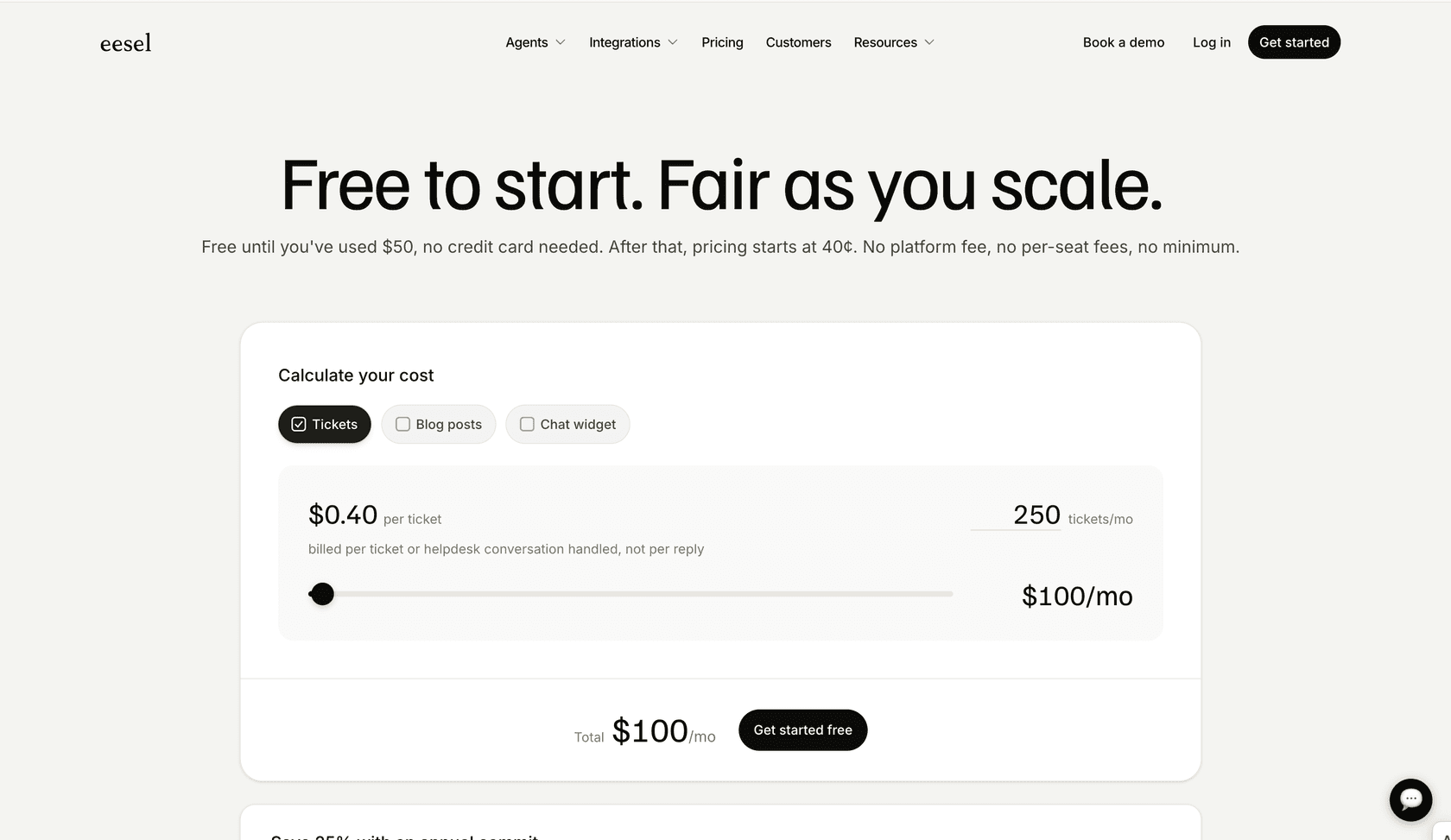
Here's how we differ:
Transparent, published pricing
We believe you should know what something costs before talking to sales. Our pricing is public, predictable, and scales with your usage.
| Usage type | Price | What it covers |
|---|---|---|
| Helpdesk task | $0.40/task | One AI reply or action in any supported helpdesk |
| Heavy task | $4.00/task | Complex automations and multi-step workflows |
| Enterprise add-on | $1,000/month | SSO, HIPAA, BAA, dedicated engineer |
No per-agent fees. No surprise bills. New accounts start with $50 in free trial credits. See full pricing.
How our AI agent works
Like Decagon, we believe AI should resolve tickets, not just draft replies. Our AI Agent learns from your past tickets, help center, and connected docs to handle support conversations autonomously.
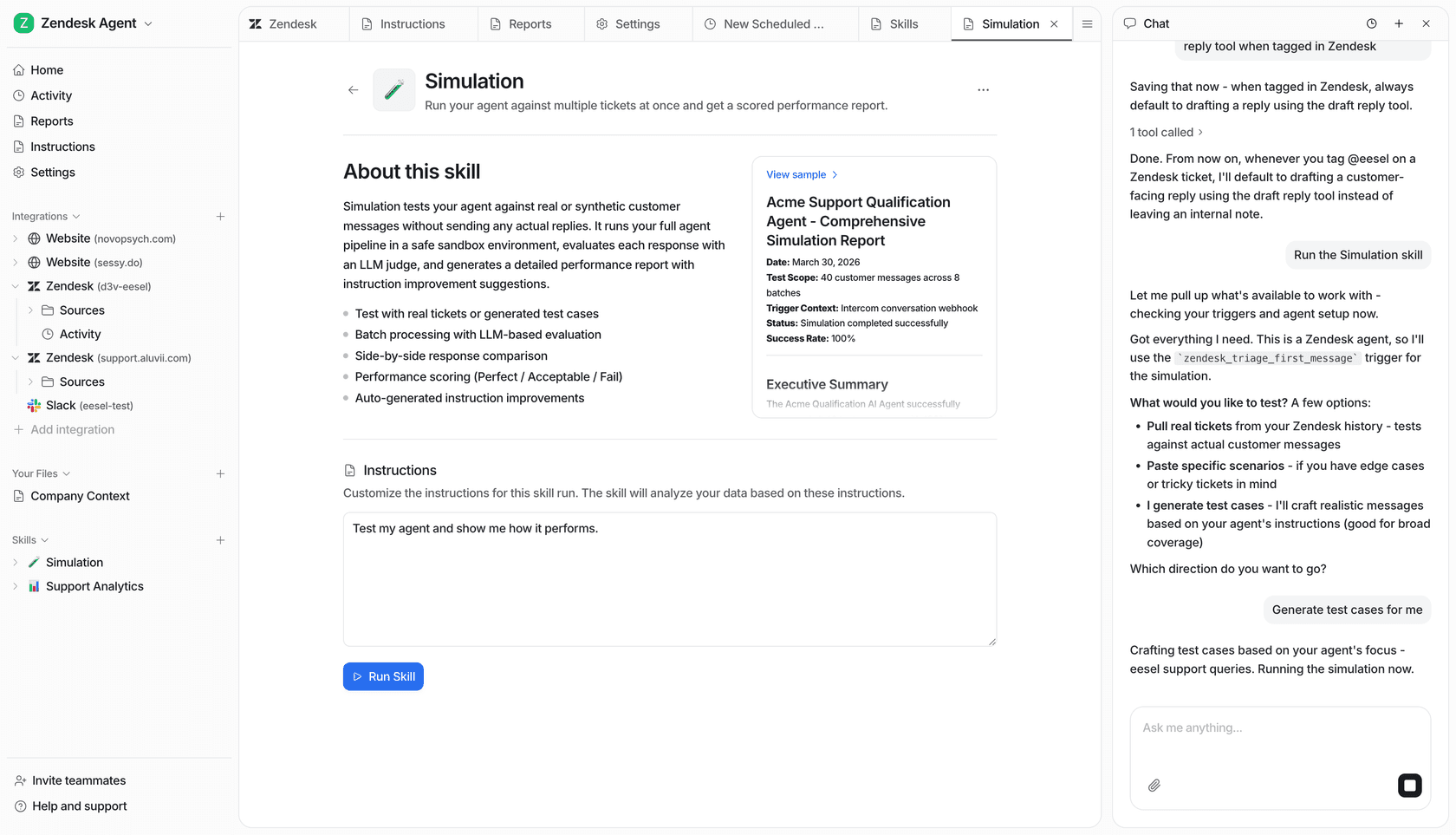
Key differences:
- Start in minutes, not months. Connect your help desk and we learn your business instantly. No lengthy implementation.
- Progressive rollout. Start with AI drafting replies for review, then level up to full autonomy as you gain confidence.
- Plain-English control. Define escalation rules and workflows in natural language, no code required.
- Works with your stack. We integrate with Zendesk, Freshdesk, Intercom, and 100+ other tools.
Why teams choose us over Decagon
- No sales barrier. See pricing instantly, start a trial immediately, deploy this week.
- Predictable costs. Know exactly what you'll pay based on your interaction volume.
- Scales with you. Pay $0.40 per helpdesk task and grow. No $50K minimums.
- Unlimited agents. Add support team members without increasing your AI bill.
Choosing the right AI support solution
Let's cut to the chase.
Choose Decagon if: You're a large enterprise with 10,000+ monthly tickets, complex omnichannel needs, a budget for $400K+ annual contracts, and dedicated resources for implementation. Their AI agents are powerful, their customer list is impressive, and if you have the budget and patience for their sales process, they deliver results.
Choose eesel AI if: You want transparent pricing, quick deployment, and predictable scaling. We're built for teams that need AI support automation without the enterprise overhead. Our AI Agent handles frontline support autonomously, our AI Copilot drafts replies for human review, and our AI Triage keeps your queue clean automatically.
The bottom line? The right choice depends on your budget, timeline, and team size. If you need clarity and speed, try eesel AI free and see how AI support should work.
Frequently Asked Questions
Why doesn't Decagon AI publish its pricing publicly?
What is the typical Decagon AI pricing for mid-market companies?
How does Decagon AI's per-resolution pricing model work?
What factors affect the final Decagon AI quote I receive?
How does eesel AI pricing compare to Decagon AI?


Article by
Kurnia Kharisma Agung Samiadjie
Kurnia is a software engineer and writer at eesel AI with two years of SEO experience, writing about AI tools, helpdesk software, and customer support. He pairs a developer's understanding of how these products are built with search-driven research into what actually ranks and resonates with the people searching for them.