Choosing an AI customer support platform is a big decision. The right tool can deflect hundreds of tickets, cut response times, and free your team to focus on complex issues. The wrong one becomes another dashboard to manage.
Two platforms getting a lot of attention right now are Decagon and Maven AGI. Both launched in 2023, both raised significant Series A rounds, and both promise autonomous AI agents that handle customer conversations end-to-end. But they take different approaches to solving the same problem.
Let's break down what each platform offers, how they differ, and which one might work better for your specific situation.
What is Decagon?
Decagon positions itself as "the AI concierge for every customer." Founded in 2023 by Jesse Zhang and Ashwin Sreenivas, the San Francisco-based company has grown to roughly 102 employees and raised $30 million in Series A funding.
The core idea behind Decagon is giving non-technical teams direct control over AI agent behavior. Their flagship innovation is something called Agent Operating Procedures (AOPs), which let you define complex workflows in natural language rather than code. Think of it like creating standard operating procedures for a human agent, except the AI follows them automatically.
Decagon's customer list reads like a who's who of high-growth tech companies: Duolingo, Chime, ClassPass, Notion, Bilt, Figma, Dropbox, and Rippling all use the platform. These are companies with complex products and high support volumes that need AI to actually resolve issues, not just deflect them.
The platform emphasizes proactive engagement. Unlike traditional chatbots that wait for customers to ask questions, Decagon's agents can reach out when they detect issues, offer help during key moments, and maintain context across channels so customers never have to repeat themselves.
What is Maven AGI?
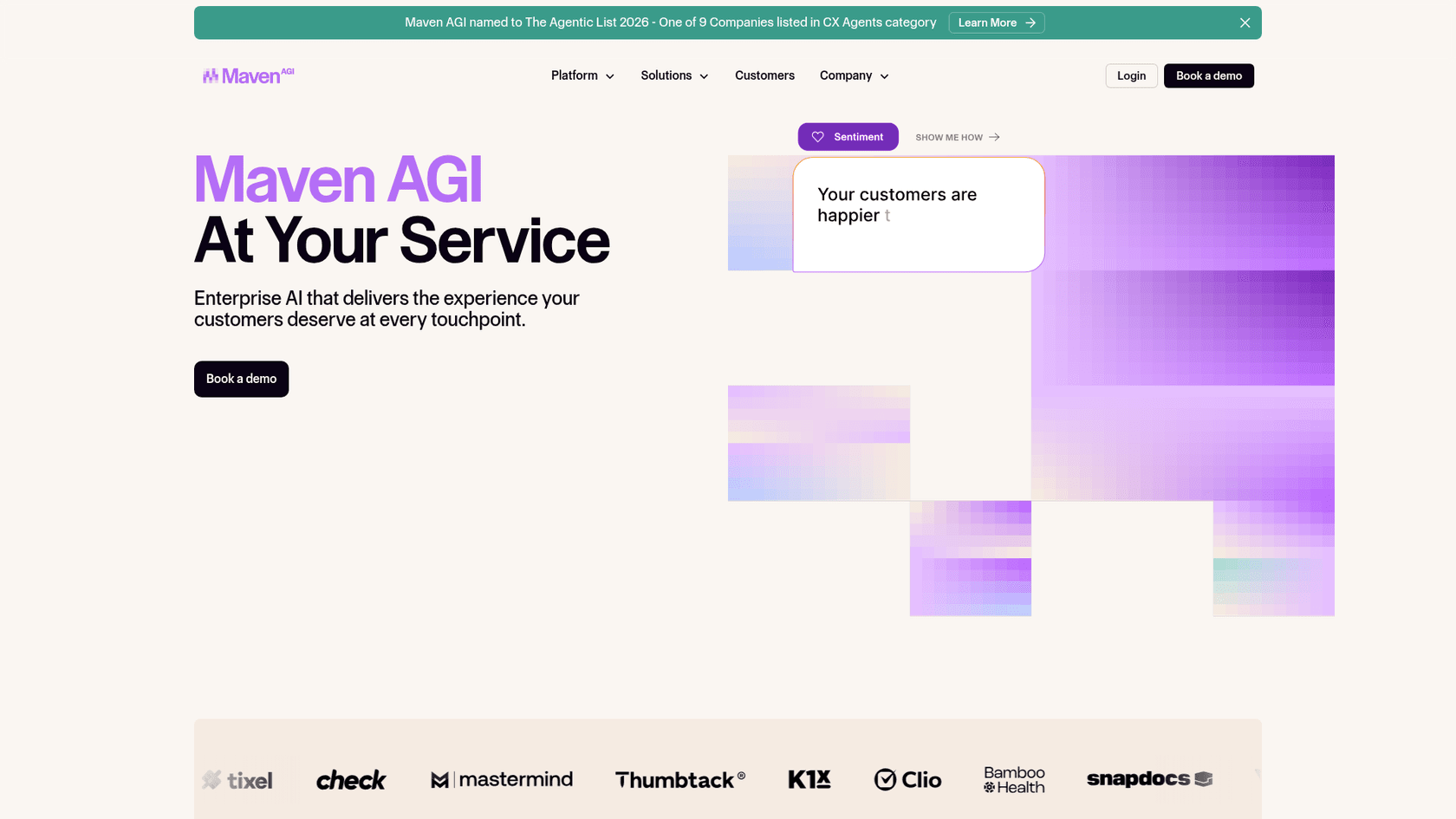
Maven AGI takes a slightly different angle, positioning itself as a "Business AGI" platform. Founded in early 2023 by Jonathan Corbin, Sami Shalabi, and Eugene Mann, the company raised $20 million in Series A funding and currently serves 50+ enterprise customers.
The founding team brings serious pedigree. Jonathan Corbin previously ran global customer success at HubSpot after stints at Adobe and Marketo. Sami Shalabi led engineering for Google News and Google Play Newsstand, and holds over 50 patents. Eugene Mann led applied machine learning at Stripe after working on personalization for a billion-user product at Google.
Maven's approach focuses on being an "intelligence layer" between your existing systems, AI models, and human teams. Rather than just handling support tickets, Maven aims to automate complex workflows across the entire customer journey, from initial inquiry through ongoing success.
The platform claims up to 93% autonomous resolution rates and emphasizes handling complexity. While Decagon focuses on giving teams direct control, Maven focuses on deep system integration and sophisticated reasoning capabilities.
Decagon vs Maven AGI: Feature comparison
Both platforms cover the basics you'd expect from enterprise AI support tools. They offer omnichannel support across chat, email, and voice. They both integrate with major help desks and CRMs. They both emphasize security and compliance for enterprise deployments.
But the differences matter.
Where Decagon stands out
Decagon's Agent Operating Procedures are genuinely different from how most AI agents work. Instead of training models on historical data and hoping they respond appropriately, you explicitly define workflows in plain English. The system combines the flexibility of natural language with the precision of code-based logic.
This matters because it gives non-technical teams direct control. Your CX leads can iterate on agent behavior without filing engineering tickets or waiting for vendor professional services. Decagon claims this approach delivers faster time to value and greater transparency into why agents make specific decisions.
Voice AI is another area where Decagon has invested heavily. Their voice agents are designed for natural dialog and can be customized to match your brand voice. Chime's COO Janelle Sallenave noted that Decagon Voice lets them "combine high performance and seamless brand customization with cross-channel memory."
Cross-channel memory means a customer can start a conversation in chat, continue via email, and finish on a voice call without the AI losing context. This sounds obvious but is surprisingly hard to execute well.
Where Maven AGI stands out
Maven's emphasis on complexity handling sets it apart. The platform is designed for enterprises with sophisticated workflows that span multiple departments. While Decagon focuses primarily on support, Maven positions itself across customer service, support, and customer experience teams.
The AI Agent Designer gives teams visual tools to build and customize AI agents. Maven also offers an AI Voice Agent for phone support, plus deep analytics and what they call an "Inbox & Knowledge Graph" for unified knowledge management.
Maven's founding team's enterprise background shows in their approach to security and compliance. The platform lists SOC 2, ISO 27001, HIPAA, and PCI DSS compliance prominently. For regulated industries like healthcare and financial services, this matters.
The platform's claim of up to 93% autonomous resolution is among the highest in the industry. Tripadvisor's Head of Data and AI Rahul Todkar stated that Maven "autonomously handles 90% of incoming queries allowing our support agents to focus on strategic initiatives."
Integration comparison
| Integration | Decagon | Maven AGI |
|---|---|---|
| Salesforce | ✓ | ✓ |
| Zendesk | ✓ | ✓ |
| Freshdesk | ✓ | ✓ |
| Slack | ✓ | ✓ |
| HubSpot | ✓ | ✓ |
| Shopify | ✓ | ✓ |
| Snowflake | ✓ | Not listed |
| Notion | ✓ | Not listed |
| Jira | ✓ | Not listed |
| GitHub | ✓ | Not listed |
Both platforms integrate with the major systems most enterprises use. Decagon lists more specific integrations on their website, while Maven emphasizes the breadth of their integration capabilities without naming every tool.
Pricing breakdown
Here's where things get frustrating. Neither Decagon nor Maven AGI publishes transparent pricing. Both operate on an enterprise "contact sales" model.
This is common in the AI support space, where pricing typically depends on conversation volume, feature requirements, and integration complexity. But it makes direct comparison difficult without getting quotes from both vendors.
What we do know:
- Both offer free trials or personalized demos
- Both target mid-market to enterprise customers
- Industry norms suggest pricing likely ranges from $0.50 to $2.00 per resolution for AI agents at scale
If you're evaluating either platform, plan to go through their sales process to get accurate pricing for your specific volume and requirements. For context on how AI support pricing typically works, check out our guide to AI customer service tools.
Performance and results
Both platforms publish impressive customer metrics. Here's what their customers report:
Decagon results
| Metric | Result | Customer |
|---|---|---|
| Deflection rate | 80% | Duolingo |
| Chat and voice resolution | 70% | Chime |
| Cost reduction | 95% | ClassPass |
| CSAT increase | 3x | Oura |
| Voice deflection | 50%+ | Valon |
Duolingo's Senior Operations Manager Ian Riggins noted that with their previous vendor, "at least half my week was dedicated to maintaining their system. With Decagon, it's been a night-and-day difference."
Maven AGI results
| Metric | Result | Customer |
|---|---|---|
| Autonomous resolution | Up to 93% | Platform claim |
| Resolution time improvement | 10x vs traditional | Platform claim |
| Response time reduction | Up to 60% | Platform claim |
| Rep solves per hour increase | 25% | ClickUp |
| Autonomous query handling | 90% | Tripadvisor |
ClickUp's Head of Customer Support David Doyle shared that "just one week into the trial, rep solves per hour increased 25%."
A few things to keep in mind when evaluating these numbers. First, your results will vary based on your existing support quality, the complexity of your product, and how well you implement the platform. Second, "deflection rate" and "autonomous resolution" are not the same thing. Deflection just means the customer didn't create a ticket. Resolution means the issue was actually solved.
Who should choose Decagon?
Decagon tends to work best for teams that want direct control over AI behavior without depending on engineering resources or vendor professional services. If your CX team wants to iterate quickly on agent workflows, test new approaches, and refine responses based on real conversations, Decagon's AOP model is built for that.
The platform also makes sense if voice AI is a priority. Their investment in voice capabilities and cross-channel memory shows in customer results. Chime's 70% chat and voice resolution rate suggests the technology works at scale.
Companies with high-growth, complex products tend to gravitate toward Decagon. The customer list (Duolingo, Notion, Figma, Rippling) suggests the platform handles sophisticated use cases well.
Who should choose Maven AGI?
Maven AGI fits enterprises with complex, cross-departmental workflows that span sales, success, and support. If you need AI that integrates deeply with multiple systems and handles sophisticated reasoning across the entire customer journey, Maven's approach may work better.
The platform's security certifications (SOC 2, HIPAA, PCI DSS) make it a safer choice for regulated industries. Healthcare, financial services, and other compliance-heavy sectors should pay attention here.
Maven also makes sense if you want a more managed implementation. The founding team's enterprise background suggests they understand how large companies buy and deploy software. If you prefer a vendor that acts as a strategic partner rather than a tool provider, Maven's approach may resonate.
A third option: eesel AI
Before you commit to either platform, it's worth considering whether you actually need full autonomy on day one. Most teams benefit from starting with AI assistance and gradually increasing automation as they build confidence.
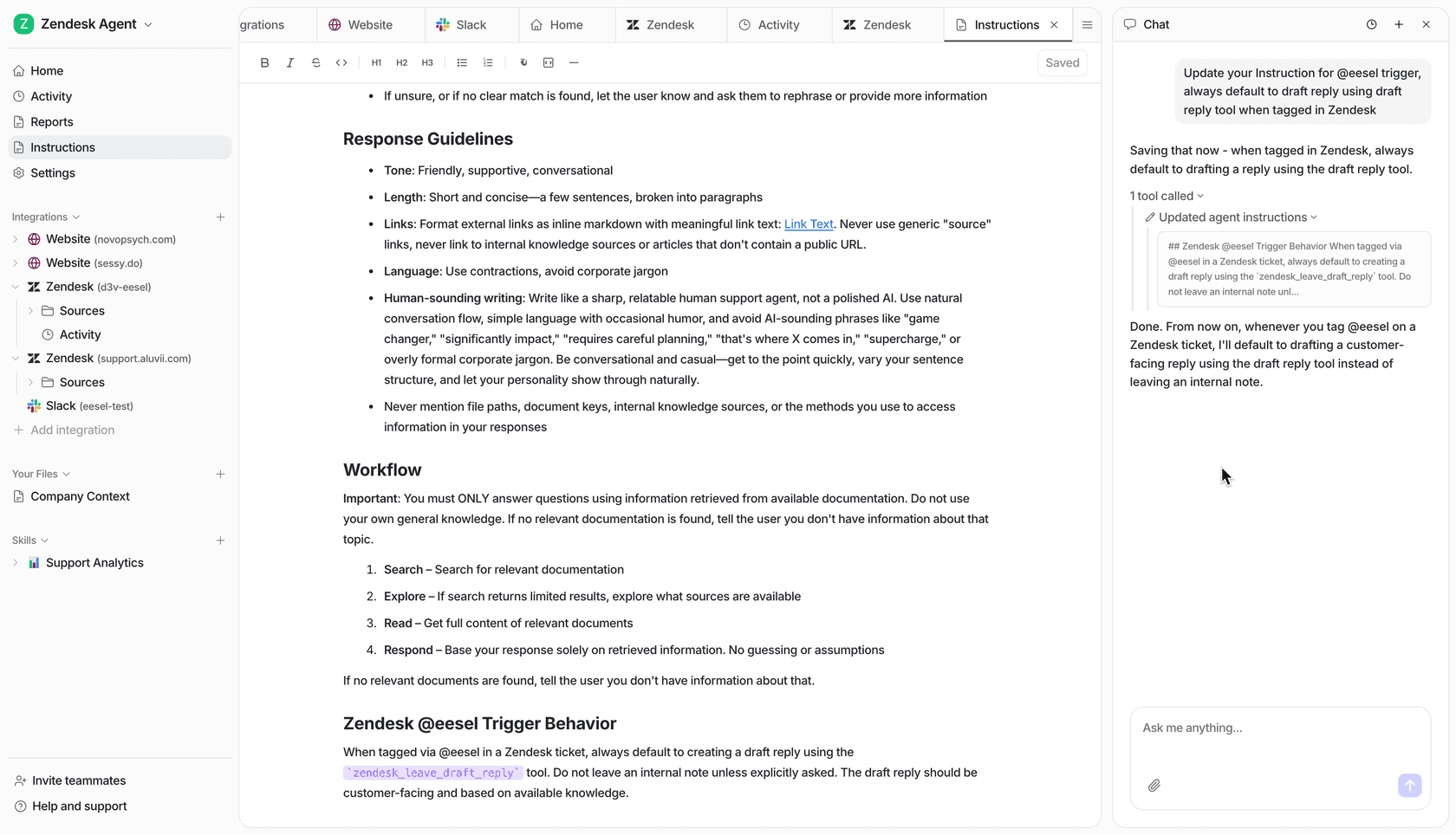
That's the approach we take at eesel AI. Instead of treating AI as something you configure and turn on, we treat it like a teammate you hire and level up over time.
Here's how it works. You start by connecting eesel to your help desk. We learn from your past tickets, help center articles, and any connected documentation. Then you begin with oversight: eesel drafts replies that your agents review before sending. As the AI proves itself, you expand its scope until it's handling full frontline support autonomously.
The key difference is control and transparency. You can run simulations on thousands of past tickets before going live, so you know exactly how eesel will perform with your actual data and customers. You define escalation rules in plain English. And you can correct mistakes in real time, which the AI learns from immediately.
Our pricing is transparent: Team plans start at $299 per month, Business at $799 per month. No "contact sales" required to understand what you'll pay.
If you're evaluating Decagon and Maven AGI, consider whether you need full autonomy immediately or would benefit from a more gradual, controlled rollout. Both approaches work. The right choice depends on your team's risk tolerance and how much visibility you want into AI performance before it touches real customers.
Making the right choice
Choosing between Decagon and Maven AGI comes down to your priorities.
If you want direct control over AI behavior, rapid iteration without engineering dependencies, and strong voice AI capabilities, Decagon is worth a closer look. Their AOP approach genuinely differs from traditional AI agent platforms, and their customer results back up the claims.
If you need deep enterprise integration, cross-departmental workflow automation, and a vendor that acts as a strategic partner, Maven AGI may fit better. Their founding team's enterprise background and security certifications signal serious enterprise readiness.
Either way, run a pilot with your actual data before committing. Both platforms offer trials or demos. Test them with real tickets, measure the results against your current baseline, and make sure the AI actually improves your customer experience, not just reduces ticket volume.
And if you want to explore a more gradual approach to AI support automation, check out how eesel AI works. Our teammate model gives you the benefits of AI assistance with the control and transparency that most teams need when first adopting AI for customer support.