
Every week, another CTO asks the same question: should we build our AI customer support in-house or buy a solution off the shelf?
It sounds like a straightforward choice. But after watching dozens of companies navigate this decision, I've noticed something important. The teams that get it right aren't the ones with the best engineers or the biggest budgets. They're the ones who reframe the question entirely.
The real question isn't whether to build or buy. It's this: what creates competitive advantage for your business, and what's just good infrastructure?
This distinction changes everything about how you approach AI for customer support. Let's break it down.
The real question isn't build or buy it's where you create value
Most companies frame the build vs buy decision around control. Building gives you complete control over the roadmap, the data, the features. Buying means trusting a vendor with critical infrastructure.
But this framing misses the point. Control is only valuable when it creates differentiation.
Think about it this way: nobody builds their own email infrastructure from scratch. They use Gmail or Outlook and focus their engineering talent on what makes their product unique. Email is infrastructure, not advantage.
The same logic applies to AI customer support. For 90% of companies, the AI agent handling routine tickets isn't your competitive moat. It's infrastructure that needs to work reliably so your team can focus on what actually differentiates your business.
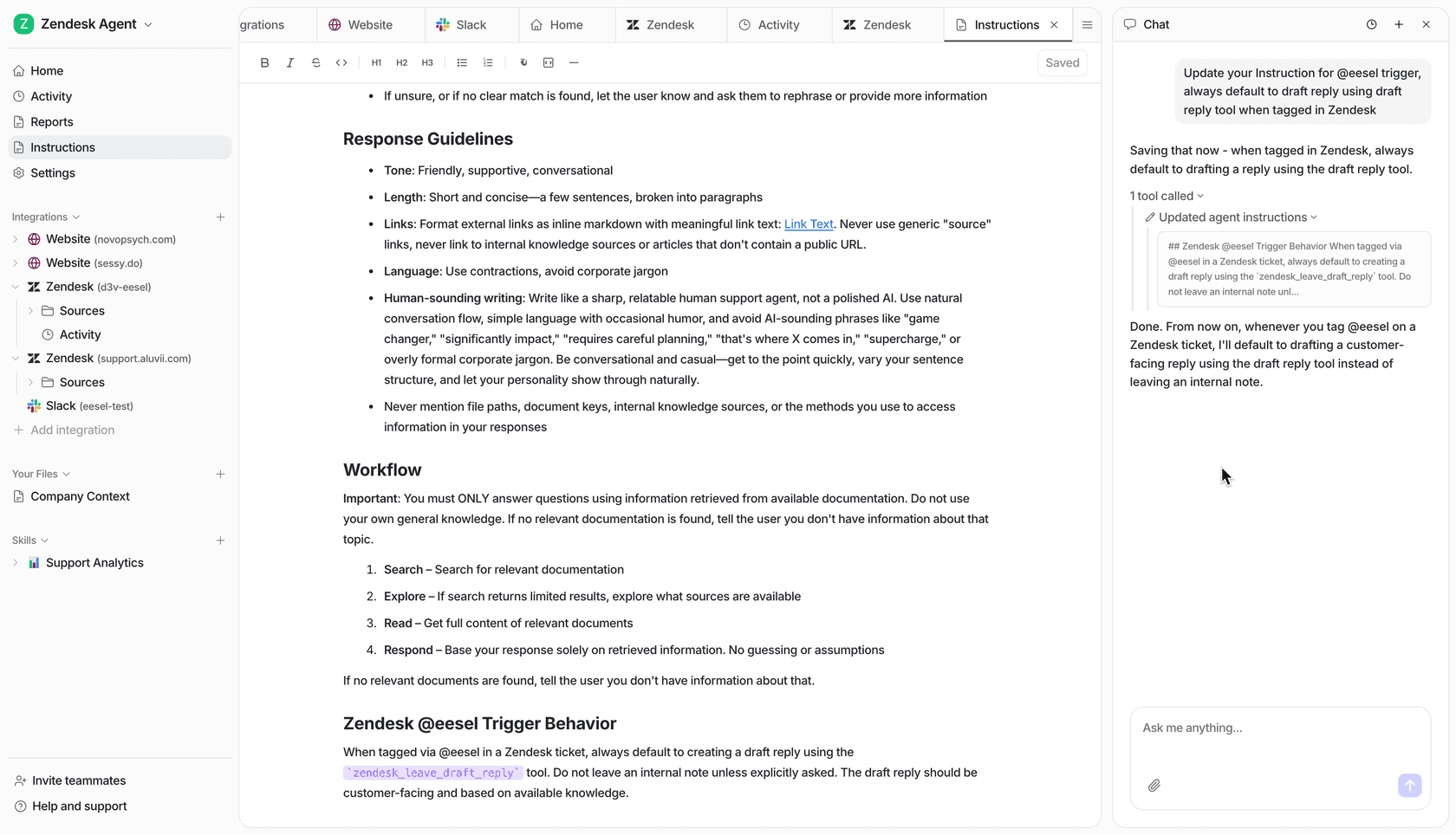
This is where we take a different approach at eesel AI. Instead of asking you to configure another tool, we designed our AI Agent as a teammate you hire and level up. You don't need to build complex workflows or train models from scratch. You connect eesel to your help desk, and it learns your business from your existing data past tickets, help center articles, macros in minutes, not months.
The question isn't whether you can build AI support. It's whether you should.
What building AI customer support actually requires
Let's get specific about what "building" actually means. It's not the 3-month demo your engineering lead prototyped over a weekend. Production-grade AI support is a different beast entirely.
The team you'll need
Building in-house requires a dedicated team of 6+ full-time employees:
- AI/ML engineers to build and tune models ($200K+ each)
- Product managers to define requirements and prioritize features
- Designers to craft the customer experience
- Backend engineers for integrations and infrastructure
- DevOps for deployment, monitoring, and scaling
- Data scientists for ongoing model improvement
According to research from Aisera, the annual cost for AI/ML talent alone runs $1.5M to $2.5M. That's before infrastructure, before compute costs, before the inevitable hiring delays as you compete for scarce talent.
The timeline reality
Here's where expectations diverge sharply from reality.
Most teams estimate 3-6 months to get something in production. The actual timeline? 12-24 months before you have a production-ready system handling real customer volume.
Why the gap? Because the demo is easy. Handling edge cases, maintaining accuracy at scale, integrating with your existing stack, building monitoring and observability, ensuring security and compliance this is where the work actually lives.
MIT research cited by Aisera found that 95% of in-house AI initiatives fail. Not because the technology doesn't work, but because organizations underestimate the ongoing operational burden.
The hidden infrastructure
Beyond the team, you'll need:
- LLM orchestration layers to route queries and manage context
- Vector databases for semantic search and retrieval
- Security layers for data isolation and compliance
- Monitoring and observability to track performance and catch drift
- Testing frameworks to validate changes before production
- Continuous retraining pipelines as your data evolves
Each of these requires specialized expertise and ongoing maintenance. As Retool notes, "Unlike traditional software where maintenance might consume 20% to 30% of resources, AI systems require continuous updates as models evolve, best practices change, and security requirements shift."
When building makes sense
Despite these challenges, building is the right choice in specific scenarios:
- The AI agent is your core IP. If you're building an AI-native product where the agent itself is the differentiator, owning the stack makes sense.
- You have truly unique workflows. Not "we do things slightly differently" genuinely unique processes no vendor could reasonably support.
- Sovereign data requirements. Defense, national security, or highly regulated industries where data cannot leave controlled environments.
For everyone else, the math rarely works.
What buying AI customer support actually looks like
Buying doesn't mean settling for a generic chatbot that can't handle your specific needs. Modern AI support platforms have evolved significantly.
Speed to value
The biggest advantage of buying is time. While your competitors spend 18 months building infrastructure, you can deploy in weeks.
As Ada points out, "If you spend 6 months building a solution in-house, that's 6 months where you're not automatically resolving support inquiries and losing out on savings while you build."
With a platform like eesel AI, deployment looks different. Connect to your help desk, and eesel immediately learns from your existing data. No manual training, no documentation uploads. You can run simulations on past tickets to verify quality before going live. Most teams start seeing value within days, not quarters.
Predictable economics
Building shifts AI from operational expense to capital investment. You're committing millions upfront with uncertain returns.
Buying converts this to predictable OpEx. Our pricing scales with usage, not seats. You pay for interactions, not headcount. No surprise infrastructure bills when usage spikes.
Built-in expertise
Here's something that's hard to replicate in-house: accumulated learning.
Vendors like eesel AI have processed millions of support interactions across hundreds of companies. We've seen the edge cases, the failure modes, the compliance requirements. That expertise gets baked into the platform.
You also get ongoing innovation without additional engineering. When new models drop or capabilities improve, the platform updates. You're not stuck maintaining a system built on 2024 technology in 2026.
Integration ecosystems
Modern support doesn't live in isolation. Your AI needs to connect to your help desk, your CRM, your order management system, your knowledge base.
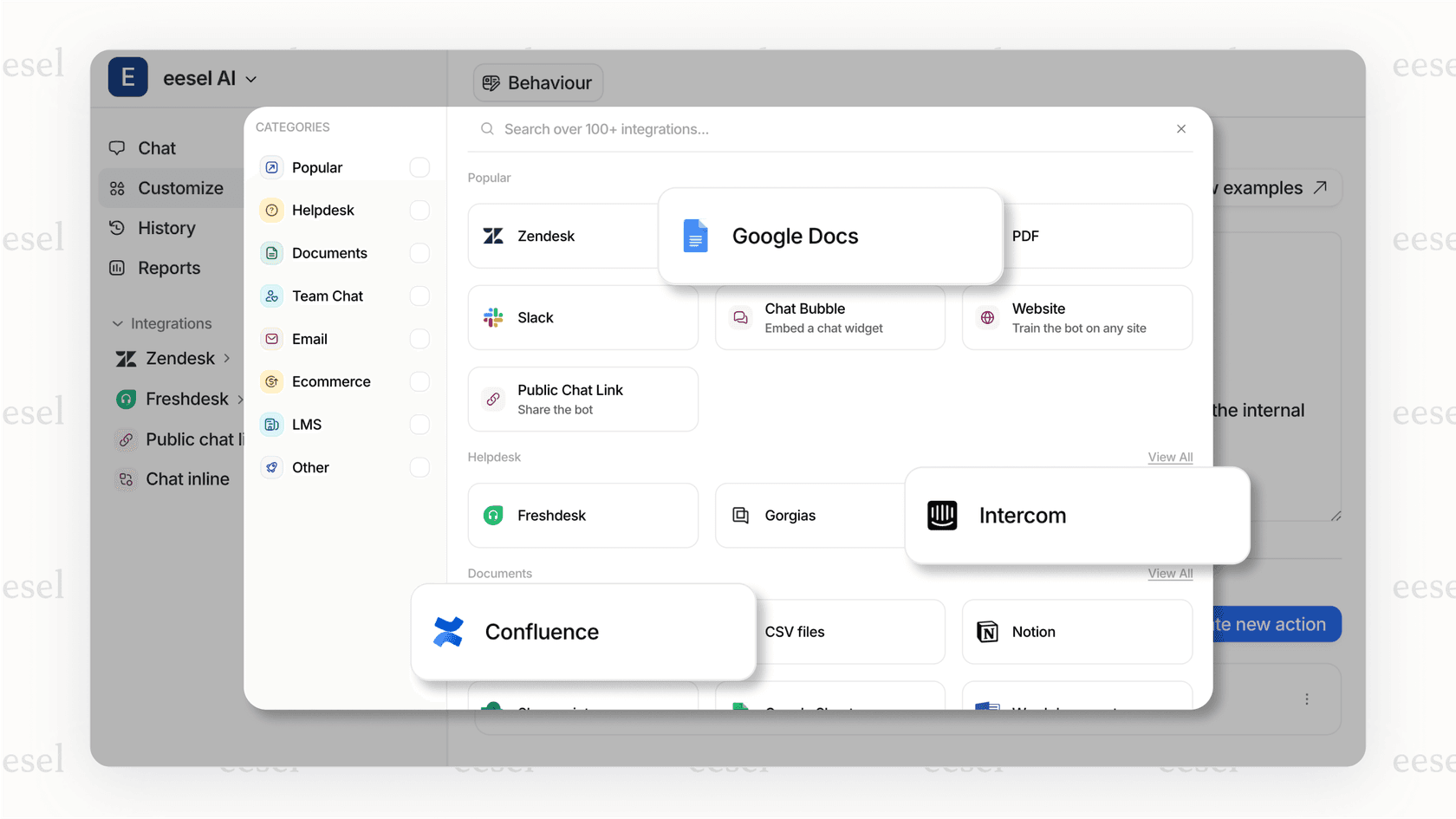
Building these integrations yourself means months of API work, testing, and maintenance. Buying gives you pre-built connectors to the tools you already use. eesel AI integrates with Zendesk, Freshdesk, Gorgias, Shopify, and 100+ other systems out of the box.
Addressing the lock-in concern
The most common objection to buying is vendor lock-in. It's a valid concern, but manageable with the right evaluation.
Look for platforms that:
- Support open standards (MCP, A2A protocols)
- Allow data export in standard formats
- Offer hybrid deployment options
- Have transparent pricing without punitive egress fees
The risk of lock-in is often overstated compared to the risk of a failed 18-month build project.
The hidden costs everyone underestimates
Whether you build or buy, there are costs that don't show up in the initial proposal. Let's surface them.
Hidden costs of building
Talent competition and retention. AI engineers command premium salaries, and they're in high demand. You'll compete with OpenAI, Google, and well-funded startups for the same talent. When your lead ML engineer leaves after 14 months, you don't just lose a person you lose institutional knowledge about your custom system.
Infrastructure at scale. Your prototype ran on a single GPU. Production requires clusters, load balancing, failover systems. Compute costs scale non-linearly with usage.
Opportunity cost. Every engineer working on AI infrastructure isn't working on your core product. While you're building ticket routing, your competitors are shipping features that customers actually pay for.
Maintenance burden. AI systems require 3-5x more ongoing care than traditional software. Models drift. APIs change. New compliance requirements emerge. This isn't a "set it and forget it" system it needs constant attention.
Hidden costs of buying
Customization limits. No vendor platform will match your exact workflows perfectly. You'll need to adapt some processes or accept workarounds.
Integration complexity. Even with pre-built connectors, connecting to legacy systems or custom internal tools requires effort.
Vendor pricing changes. Subscription costs can increase. Features can move to higher tiers. Budget for some uncertainty.
Change management. Your team needs to learn the new system. Human agents need to understand how to work alongside AI. This training takes time and attention.
The key difference: buying's hidden costs are manageable and predictable. Building's hidden costs can sink projects entirely.
A practical decision framework
Here's a simple test to cut through the complexity. Ask yourself four questions:
-
Is the AI agent itself your competitive advantage? Would customers choose you specifically because of how your AI support works?
-
Do you have 18+ months before you need results? Can you afford to wait while competitors deploy faster solutions?
-
Can you dedicate 6+ full-time engineers indefinitely? Not just to build, but to maintain, improve, and operate the system long-term?
-
Do you have unique data or workflows no vendor can reasonably support? Truly unique, not just "we're a special case."
Score interpretation:
- 4 Yes answers: Consider building. You have the time, resources, and genuine differentiation to justify the investment.
- 3 Yes answers: Consider a hybrid approach. Buy the platform, build custom logic where you truly differentiate.
- 0-2 Yes answers: Buy. The economics and risk profile favor proven platforms.
Most companies land in the 0-2 category. They need reliable AI support, but the AI agent itself isn't their secret sauce.
The hybrid middle ground
There's a third option that many successful companies choose: buy the platform, build the differentiation.
Use a proven platform for the undifferentiated heavy lifting security, compliance, integrations, core AI capabilities. Then build custom workflows, specialized logic, and unique experiences on top.
This is the approach we see working at eesel AI. Our platform handles the infrastructure: learning from your data, maintaining accuracy, ensuring security. You define what eesel handles and when it escalates in plain English, not code.
"If the refund request is over 30 days, politely decline and offer store credit." "Always escalate billing disputes to a human." "For VIP customers, CC the account manager."
No engineering required. No deployment cycles. Just natural language instructions that eesel follows.
Making the transition: from decision to deployment
Once you've made the decision, the real work begins.
If you're building
- Month 1-3: Staff the team, define requirements, choose technology stack
- Month 4-9: Build core infrastructure, integrate with existing systems
- Month 10-15: Train models, test with production data, iterate on accuracy
- Month 16-24: Pilot with limited users, expand gradually, build monitoring
Set monthly milestone checkpoints. If you're not seeing measurable progress, be willing to pivot.
If you're buying
Start with a proof of concept:
-
Define success criteria. What does "working" look like? 70% automated resolution? 50% reduction in response time?
-
Run simulations. Before going live, test the platform against your historical tickets. See how it would have performed.
-
Start with guidance. Have the AI draft replies that human agents review before sending. Verify it understands your business before expanding scope.
-
Level up gradually. As the AI proves itself, expand from drafting to direct responses, from simple FAQs to complex issues, from business hours to 24/7.
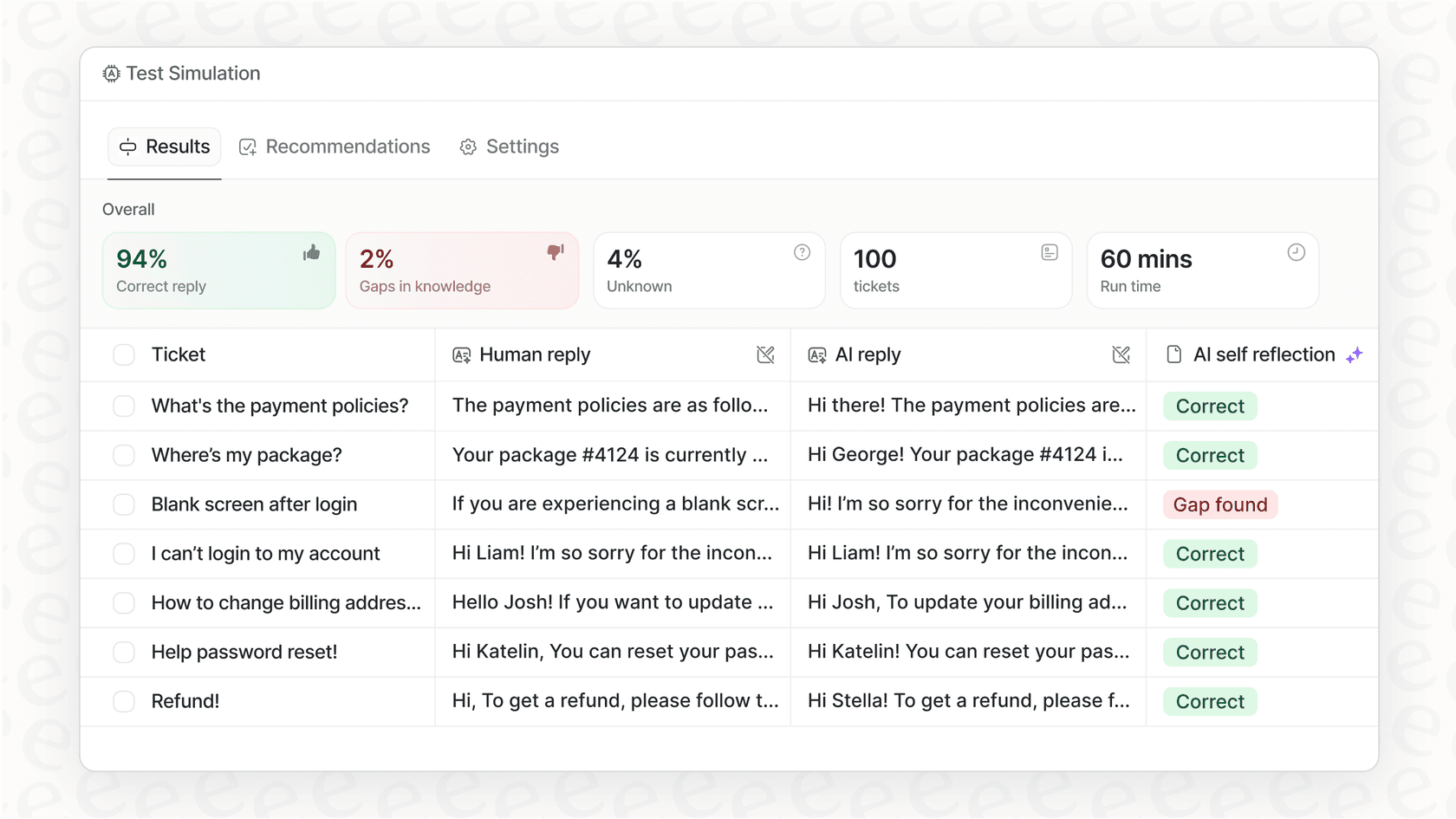
This progressive rollout is how we recommend teams adopt eesel AI for customer support automation. Start with oversight, expand based on performance. You decide when to promote eesel based on actual results, not promises.
Change management matters
Whether you build or buy, don't underestimate the human side. Your support team needs to understand how AI fits into their workflow. They need training, clear escalation paths, and confidence that the AI won't make them look bad to customers.
Measure success beyond cost savings. Track customer satisfaction, agent satisfaction, resolution quality. The goal isn't just cheaper support it's better support.
Making the right choice for your team
The build vs buy decision for AI customer support isn't about finding the "best" approach universally. It's about finding the right approach for your specific situation.
Most companies will find that buying a proven platform delivers faster value with lower risk. The 95% failure rate for in-house AI initiatives isn't a statistic to ignore. It's a warning about the gap between demo and production, between prototype and operational system.
But for companies where AI support truly is core IP where the agent itself creates competitive advantage building may be worth the investment. Just go in with eyes open about the timeline, costs, and ongoing commitment required.
If you're evaluating AI support options, we'd love to show you how eesel AI works. You can see eesel in action on your own tickets, or try it free and see how quickly an AI teammate can learn your business.
The future of support isn't choosing between human and AI. It's combining both intelligently letting each do what they do best.



