SaaS companies are under constant pressure to deliver fast, personalized support without ballooning headcount. Decagon has emerged as one of the most talked-about solutions, promising to turn customer service from a cost center into a strategic advantage. But what exactly does it offer, and is it the right fit for your SaaS business?
Let's break down what Decagon brings to the table, how it works, and what alternatives exist if you're evaluating AI customer service platforms.
What is Decagon?
Decagon is a conversational AI platform founded in 2023 by Jesse Zhang and Ashwin Sreenivas. The company positions itself as an "AI concierge" for customer experience, building AI agents that handle support conversations across voice, chat, and email.
The growth trajectory has been impressive. In approximately 18 months, Decagon went from launch to eight figures in annual recurring revenue. The company recently raised $131 million in Series C funding co-led by Accel and Andreessen Horowitz, with participation from Bain Capital Ventures and others. The team of roughly 100 people operates entirely in-person from their San Francisco headquarters.
Decagon's customer roster includes modern SaaS and consumer brands: Notion, Duolingo, Chime, ClassPass, Rippling, Hertz, Oura, and Substack among them. The platform has served over 10 million customers to date.
Key features for SaaS companies
Agent Operating Procedures (AOPs)
Decagon's signature feature is Agent Operating Procedures, or AOPs. These allow non-technical team members to define AI agent workflows using natural language instructions. The system compiles these instructions into structured logic that agents execute reliably.
Here's how it works in practice. Instead of coding complex decision trees or relying on professional services, a CX manager can write instructions like: "If a customer asks for a refund within 30 days, process it automatically. If it's been more than 30 days, escalate to the retention team." The AI agent follows these procedures while technical teams retain control over integrations, guardrails, and versioning through Git.
This approach aims to eliminate the traditional trade-off between flexibility and control. Business teams get the agility to iterate quickly without engineering bottlenecks. Technical teams maintain oversight of the underlying systems and data flows.
Omnichannel support
Decagon operates across voice, chat, email, and SMS through a unified intelligence layer. This matters because customers increasingly expect seamless experiences when they switch channels. A conversation that starts in chat can continue via email without losing context.
The voice capabilities deserve particular attention. Decagon's voice AI handles real-time conversations with interruption management, customizable voice profiles, and smooth handoffs to human agents. The system can also run outbound campaigns for appointment reminders, proactive support, or lead qualification.
User memory and personalization
The platform maintains conversational context across interactions, creating what Decagon calls "user memory." This means the AI recognizes returning customers, recalls previous issues, and personalizes responses based on history. For SaaS companies with complex products, this continuity improves the customer experience.
Cross-channel memory ensures that if a customer starts a conversation in chat and later calls, the voice agent knows what was already discussed. No repeating information. No disconnected experiences.
Enterprise-grade security
Decagon was built with enterprise requirements from day one. The platform offers SOC 2 compliance, data residency options, and strict guardrails for sensitive operations like identity verification and refunds. Version control through Git integration allows teams to track changes, roll back if needed, and maintain audit trails.
For SaaS companies in regulated industries or handling sensitive customer data, these security features are essential rather than optional.
Customer results and case studies
The proof is in the numbers. Decagon publishes specific metrics from customer deployments:
| Customer | Metric | Result |
|---|---|---|
| Duolingo | Deflection rate | 80% |
| Chime | Chat and voice resolution | 70% |
| ClassPass | Cost reduction | 95% |
| ClassPass | Deflection vs. anticipated | 10x higher |
| Rippling | Deflection increase | 32% |
| Oura | CSAT increase | 3x |
The typical ROI Decagon cites is $800,000 in savings for every $250,000 spent. Platform-wide averages include an 80% deflection rate, 65% reduction in support costs, and a 93% agent quality score.
A VP of Customer Support at Rippling noted: "Rippling has a very broad surface area with distinct products that require unique treatments. We brought this problem statement to Decagon and they delivered. We are able to tailor the experience and responses to customers to not only deliver strong deflection results, but also enhance the customer experience along the way."
The Director of CX Operations Strategy and AI at ClassPass reported: "Though we already had a robust Voice of the Customer program and an understanding of customer inquiries we thought we could deflect, we saw 10x higher deflection at launch than we anticipated."
Decagon pricing model
Here's where things get less transparent. Decagon doesn't publish pricing on its website. The pricing page returns a 404 error, and the company operates on an enterprise sales model where interested parties must request a demo to receive a quote.
What we do know: Decagon uses a per-conversation pricing model rather than per-seat pricing. This aligns costs with actual usage rather than team size. For high-volume support operations, this can be more predictable than traditional SaaS pricing that charges per agent seat.
The lack of public pricing makes it difficult to evaluate Decagon against alternatives without engaging their sales team. For smaller SaaS companies or those wanting to self-serve, this friction could be a consideration.
Integration ecosystem
Decagon connects to existing support infrastructure through pre-built integrations and APIs:
CRM and helpdesk: Salesforce, Zendesk, Intercom
Knowledge bases: Confluence, Contentful, Kustomer
Voice platforms: Amazon Connect, RingCentral
Connectivity options: MCP (Model Context Protocol), REST APIs, SIP trunking
The platform also integrates with internal systems through custom endpoints, allowing AI agents to retrieve data and trigger actions in proprietary tools.
eesel AI: An alternative approach to AI customer service
While Decagon positions itself as an AI concierge, eesel AI takes a different approach: the AI teammate model.
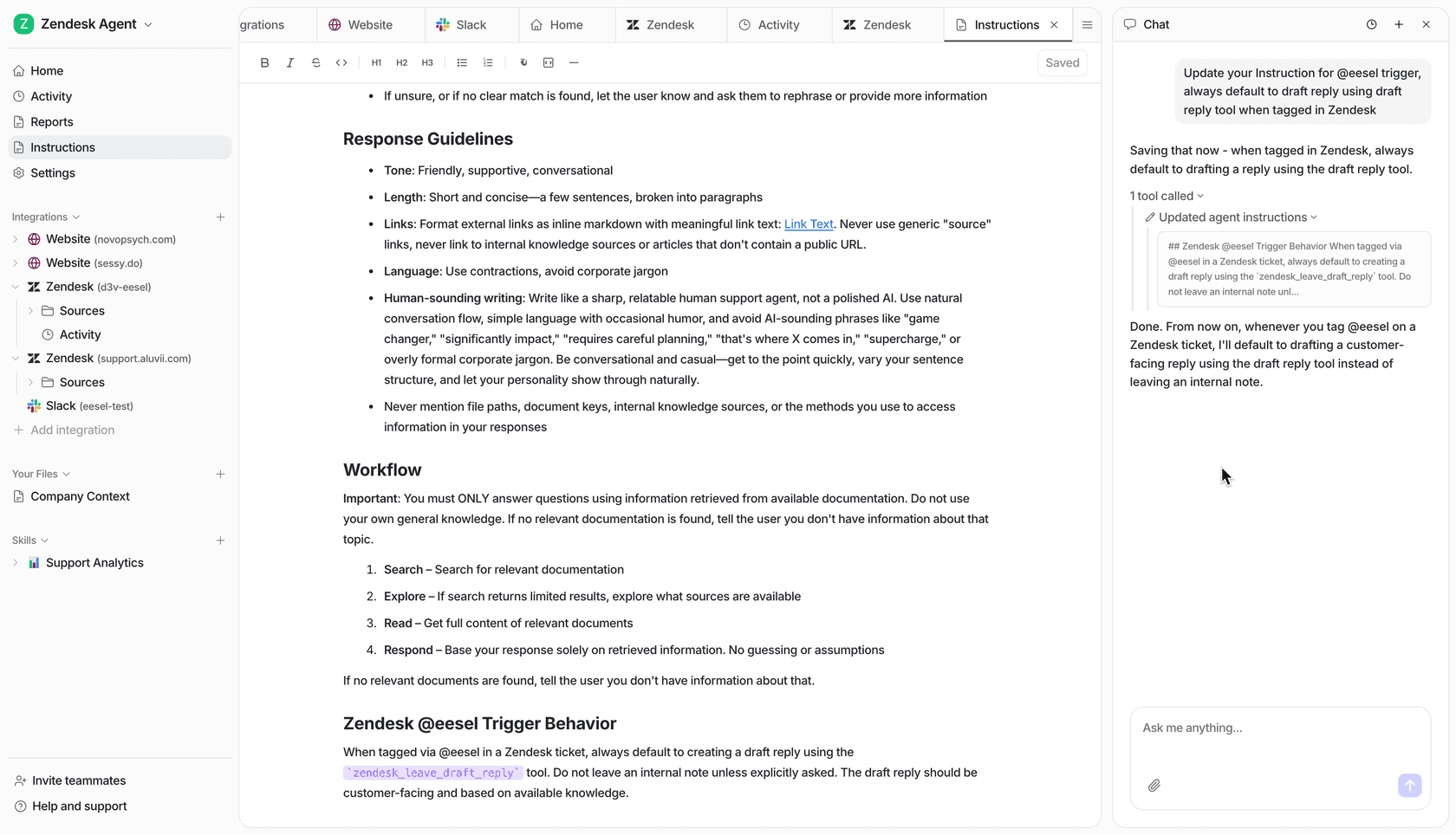
Here's the distinction. Decagon treats AI as a system you configure. eesel treats AI as a teammate you hire and develop. Like any new team member, eesel learns your business, starts with guidance, and levels up to work autonomously as it proves itself.
Key differences in approach
Progressive rollout: With eesel, you don't flip a switch and go fully autonomous on day one. You start with eesel drafting replies that agents review before sending. As confidence builds, you expand scope: specific ticket types first, then broader queues, eventually full frontline support. This gradual approach reduces risk and lets you verify quality before customers see AI responses.
Plain-English control: Instead of complex configuration languages or decision trees, you define behavior in natural language. "If the refund request is over 30 days, politely decline and offer store credit." "Always escalate billing disputes to a human." "For VIP customers, CC the account manager." No code required.
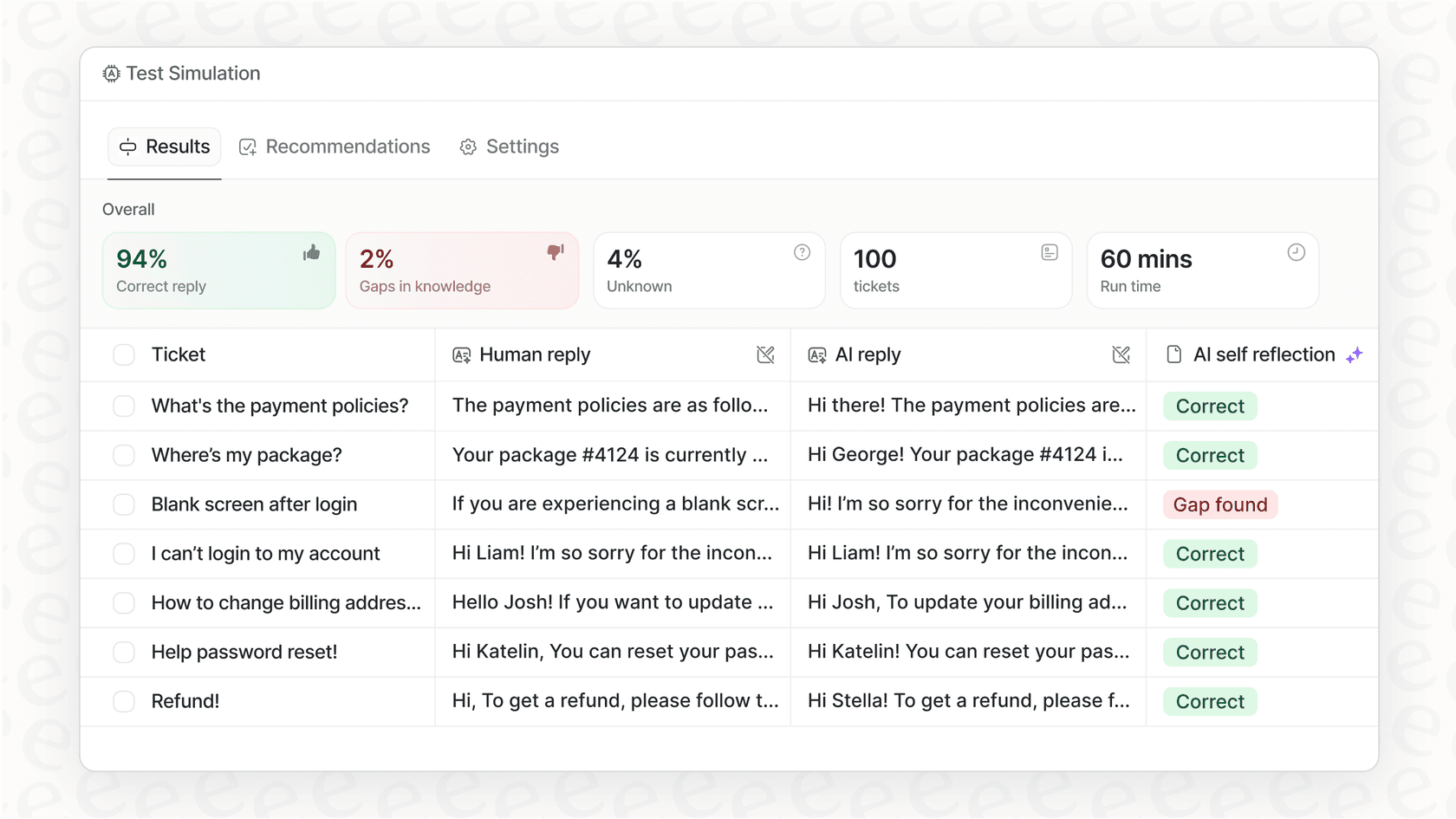
Pre-go-live testing: eesel lets you run simulations on thousands of past tickets before going live. See exactly how it would respond. Measure resolution rates. Identify gaps. Tune instructions. This testing capability addresses one of the biggest fears with AI deployment: discovering problems through customer complaints.
Transparent pricing: eesel publishes its pricing openly. The Team plan starts at $299 per month ($239 annually) for up to 3 bots and 1,000 interactions. The Business plan at $799 per month ($639 annually) includes unlimited bots, 3,000 interactions, and advanced features like bulk simulation and EU data residency. No sales calls required to understand costs.
When eesel AI might be a better fit
Consider eesel AI if:
- You prefer gradual adoption with oversight rather than immediate full automation
- You want predictable, published pricing without enterprise sales cycles
- Your team values testing and validation before customer-facing deployment
- You need an AI solution that learns continuously from corrections and feedback
Both platforms handle the core use cases: autonomous ticket resolution, copilot drafting for human agents, intelligent routing and triage. The difference lies in philosophy and implementation approach.
Choosing the right AI customer service solution for your SaaS
Selecting an AI customer service platform requires evaluating several factors beyond features and pricing:
Deployment speed: How quickly can you get value? Decagon emphasizes fast time-to-value with AOPs. eesel emphasizes testing and gradual rollout. Consider your risk tolerance and timeline.
Technical resources: Do you have engineering capacity for integration and ongoing maintenance? Both platforms aim to reduce engineering dependency, but your existing stack complexity matters.
Pricing predictability: Per-conversation models like Decagon's align costs with usage but can be harder to forecast. Per-interaction models like eesel's offer more predictable budgeting.
Integration requirements: Audit your current support stack. Ensure your chosen platform connects to your CRM, helpdesk, knowledge base, and any proprietary systems.
Testing and validation: How important is pre-deployment testing? If discovering issues through live customer interactions concerns you, prioritize platforms with robust simulation capabilities.
Support volume and complexity: High-volume, relatively straightforward inquiries suit full automation. Complex, nuanced situations may benefit from a copilot approach where AI assists rather than replaces human agents.
The right choice depends on your specific context: company size, support volume, technical resources, risk tolerance, and growth trajectory.