Why look past Forethought in the first place
Let's be fair to Forethought before we talk about leaving it. The company has been doing this since 2017, won TechCrunch Disrupt's Startup Battlefield in 2018, and has raised around $92M to build a real multi-agent platform: Solve for customer-facing resolution, Triage for classification, Assist for agent help, plus Discover and Agent QA. Its single best pitch is that it sits on top of any helpdesk rather than locking you into one, and the G2 reviews back up the substance, especially the customization and the hands-on customer success team.
So why do people search for alternatives? Two recurring reasons, both straight from real reviewers.
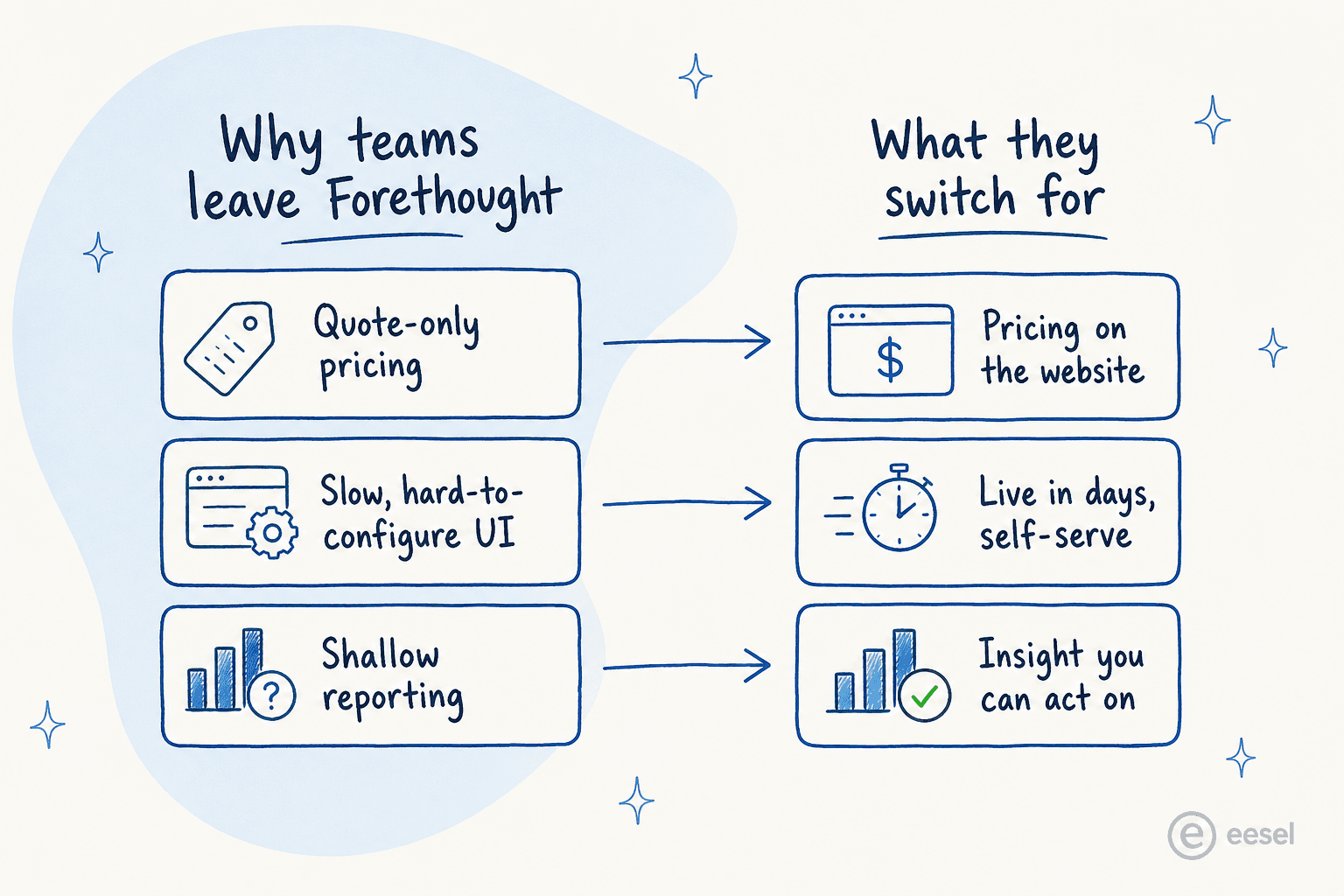
First, the money. Forethought publishes no pricing at all: every tier ends in "Get a Quote," and the model is a blend of platform fees plus outcome-based charges. Secondary sources like Vendr and G2 typically peg it as a mid-five to low-six-figure annual contract, but you can't confirm that without a sales call. For a deeper look, we wrote a full guide to Forethought pricing.
Second, the friction. The praise for Forethought's depth comes paired with a steady drumbeat about speed and setup:
"Increasing internal team efficiency with Assist, however we are yet to reap the benefits of this. The product is slow and hard to configure."
Ovidiu L., verified G2 review (Sep 2025)
Others echo it: "the web interface sometimes experiences latency and 'save' buttons occasionally don't work," and a recurring note that there's a "higher than expected learning curve." A finance-sector reviewer wanted "more granular insights into failure points" out of the reporting. None of this makes Forethought bad. It makes it a heavy enterprise platform that some teams find slow to wrangle and impossible to budget for up front.
The interesting part is that the operators saying this aren't anti-AI. On Reddit, one described their stack plainly: "We use Forethought with Zendesk and the trigger is a web hook," confirming the most common real-world setup. Another, talking about the day-to-day reality of running these agents, noted that "AI support agents don't really stay up to date automatically in real setups. Most teams still do manual updates" (r/CustomerSuccess). That gap, between the "fully agentic, ready day one" marketing and the maintenance reality, is the thing every alternative below is trying to close in its own way.
How we evaluated these alternatives
A quick word on method, since "best" is doing a lot of work in the title. We dug into each platform's own product pages, docs and pricing, pulled real numbers wherever a vendor published them, and read through G2, Capterra and Reddit for the unvarnished operator view. Where a tool has a public UI we could see, we describe what's actually there rather than the tagline.
The four dimensions that separated these tools:
- Helpdesk model. Does it sit on top of your existing stack (like Forethought) or is it a feature bolted into one suite? This is the single biggest architectural fork.
- Pricing transparency. Is the price on the website, or is it a quote-only enterprise contract? This decides whether you can even budget without a sales cycle.
- Time to value. Multi-week implementation, or live in days? Forethought's runs through a "Proof of Value" engagement; some alternatives go live the same afternoon.
- Control. Can you choose which tickets the AI touches and dial up autonomy as trust builds? In our research, trust and control was the single biggest objection support leaders raised about handing tickets to AI.
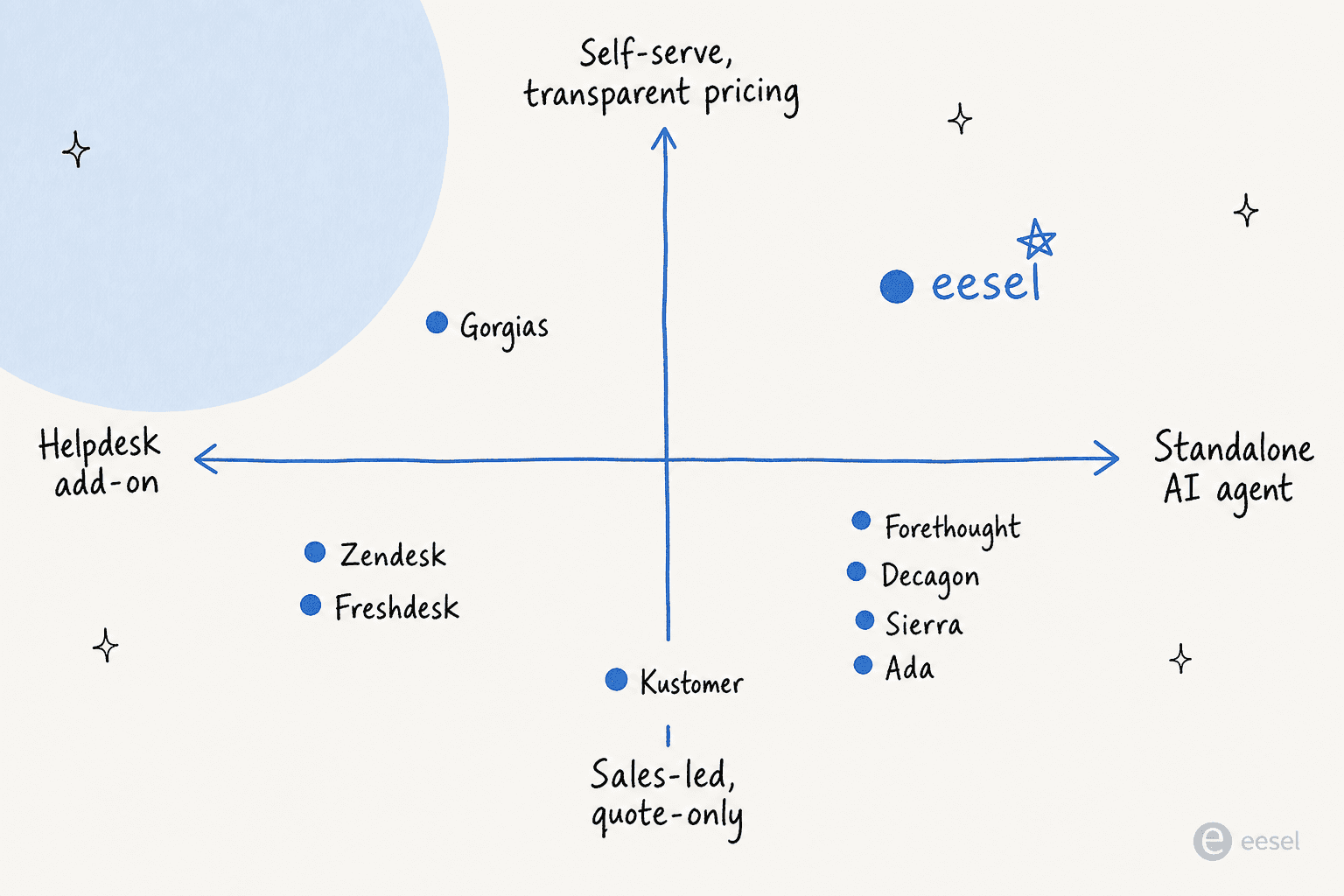
Plot those out and the market separates cleanly. The AI-native platforms cluster in the bottom-right (powerful, standalone, but sales-led and enterprise-priced). The helpdesk incumbents sit on the left (cheaper and self-serve, but tied to their own suite). One corner stays mostly empty, which is exactly where eesel positions itself.
The best Forethought alternatives at a glance
| Tool | Best for | Architecture | Starting price | AI billing unit | Public pricing? | Free trial | Security |
|---|---|---|---|---|---|---|---|
| eesel AI | Teams who want agentic AI on their current helpdesk, fast | Standalone agent, runs inside your helpdesk | From $299/mo (500 credits), no seats | 1 credit per ticket or chat | Yes | Yes (100 free credits, no card) | SOC 2, HIPAA (talk to us) |
| Decagon | High-volume consumer brands replacing a bot | AI-native, standalone | Quote only | Sales-led, ticket-volume bracketed | No | No | SOC 2 (Trust Center) |
| Sierra | Fortune 500 / regulated enterprise | AI-native, standalone | Quote only | Outcome-based | No | No | SOC 2, ISO 27001, ISO 42001, HIPAA |
| Ada | Enterprises with 300k+ conversations/year | AI-native, standalone | Quote only | Volume / conversation-based | No | No | SOC 2, HIPAA, GDPR, AIUC-1 |
| Zendesk AI | Teams already living in Zendesk | AI add-on inside Zendesk Suite | $55 / agent / mo (Suite Team) | Per automated resolution | Partial | Yes (trial) | SOC 2, ISO 27001, HIPAA |
| Freshdesk Freddy | Freshworks shops on a budget | AI add-on inside Freshdesk | $19 / agent / mo (Growth) | $49 / 100 AI sessions | Yes | Yes (14-day) | SOC 2, GDPR |
| Gorgias | Shopify / ecommerce support | Ecommerce helpdesk + AI | $10 / mo (Starter) | $0.90–$1.00 / resolution | Yes | Yes (7-day) | GDPR, CCPA |
| Kustomer | B2C brands wanting a CRM-led timeline | AI-native CX/CRM platform | Quote only (~$89–$139/seat) | ~$0.60 / engaged conversation | No | No | SOC 2, HIPAA add-on |
Now the detail. We'll start with the closest match to what Forethought is actually trying to be, then work through the AI-native heavyweights and the helpdesk incumbents.
1. eesel AI
Best for: teams that like Forethought's "AI on top of your helpdesk" idea but want it live this week, with pricing they can read on the website.

eesel AI is the alternative that maps most directly onto Forethought's core promise. Like Forethought, it's not a helpdesk; it's an autonomous agent that plugs into the one you already run, whether that's Zendesk, Freshdesk, Gorgias, Help Scout, Slack, or one of 100+ other tools. The difference is everything around that agent: where Forethought runs a Proof of Value engagement and quotes you a contract, eesel is self-serve, goes live in minutes, and charges per resolution.
The mental model eesel uses is "hire an AI teammate." You point it at your existing knowledge (past tickets, help center, internal docs), give it plain-language instructions, and it starts drafting and resolving. There's no prompt-engineering ceremony and no separate interface for your agents to learn, the AI works inside the tools they already use.
What stands out against Forethought specifically:
- It trains on your historical tickets out of the box. One of the most-requested capabilities we see, and it means the agent picks up your tone and your edge cases from day one rather than from a blank knowledge base.
- You control the autonomy. You can scope the AI to only the ticket types it's confident on, leave everything else for humans, and ramp up as trust grows. This directly answers the biggest objection we hear from support leads: "I need an AI who is only handling the tickets that it's confident to handle and all the other ones, leave them alone."
- A simulation mode lets you replay thousands of past tickets to forecast deflection and cost before you turn anything on for real customers, which is a far gentler on-ramp than a multi-week implementation.
On the reporting gap that Forethought reviewers complained about, eesel's analytics surface where the AI is succeeding and, more usefully, where it's punting to humans so you can fill the knowledge gap.
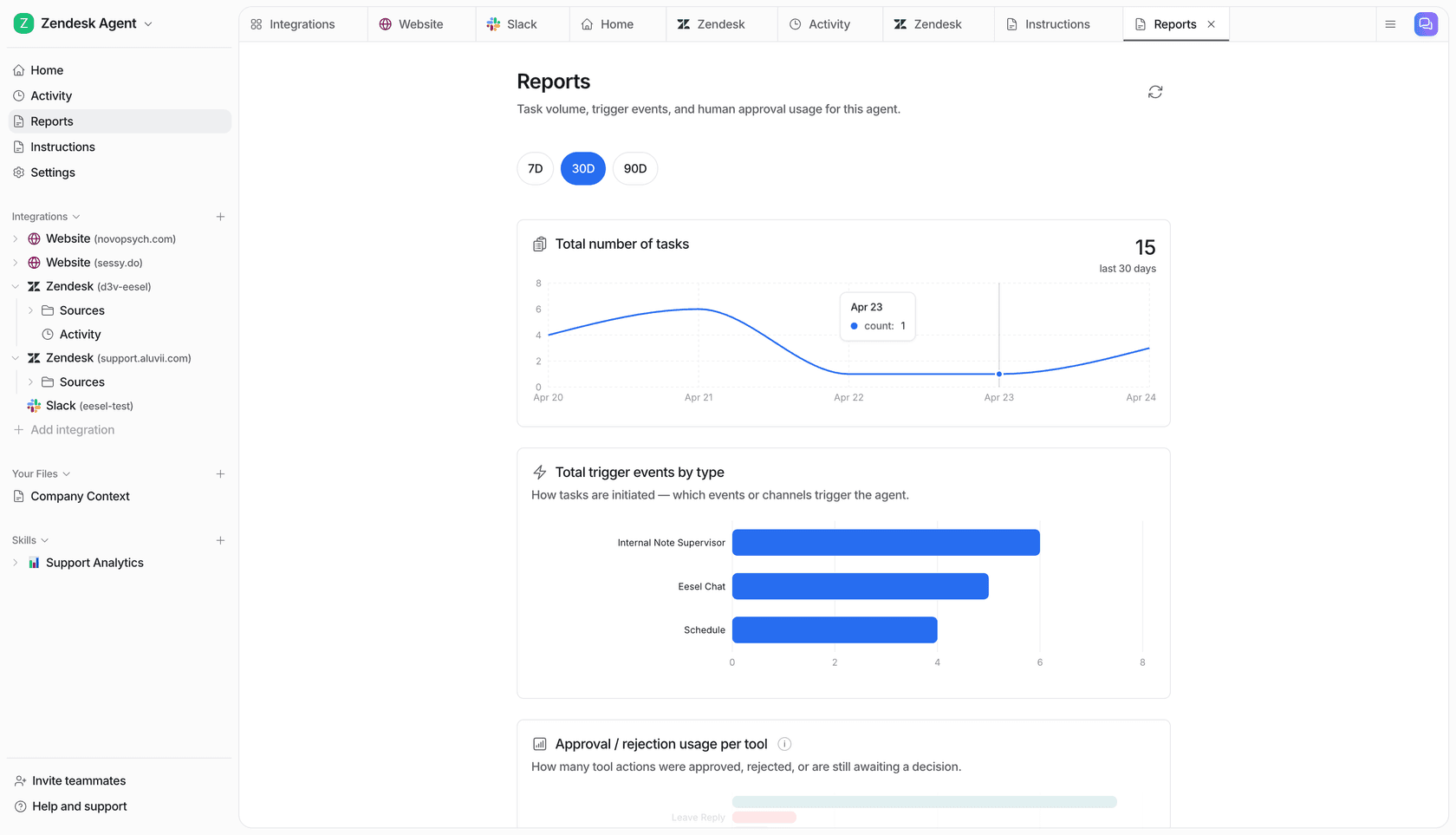
Pricing: refreshingly simple. eesel's pricing starts at $299 per month for 500 credits (1 credit per ticket or chat), $4.00 per blog post if you use the content agent, and most dashboard questions are free. No per-seat fees and no platform fee. A free plan gives you 100 credits (no card), and optional add-ons cover SSO and MFA (from $199/month), priority support (from $299/month) and data residency ($500/month). At 1,000 tickets a month, that's the $499 plan, a number you can sanity-check before talking to anyone.
Pros:
- Works with your existing helpdesk; no migration
- Transparent monthly credit pricing you can model yourself
- Live in minutes, with simulation to de-risk the rollout
- Granular control over which tickets the AI handles
Cons:
- It's an AI layer, not a full helpdesk, so you keep your existing ticketing system (a feature if you like your helpdesk, a gap if you wanted an all-in-one)
- Newer brand than the enterprise incumbents, so fewer Fortune 500 logos on the wall
Our take: if you came to this list because Forethought looked right but the price tag and implementation timeline didn't, eesel is the first one to try. It keeps the "agentic AI on top of your stack" thesis and strips out the enterprise sales cycle. Real results back the model up: one customer, Gridwise, reported eesel "resolving 73% of our tier 1 requests" within the first month, and another saw up to 80% time savings. Start small, watch the deflection number, scale when it earns it.
2. Decagon
Best for: high-volume consumer brands that want to rip out a brittle legacy bot and run a true AI-native agent.
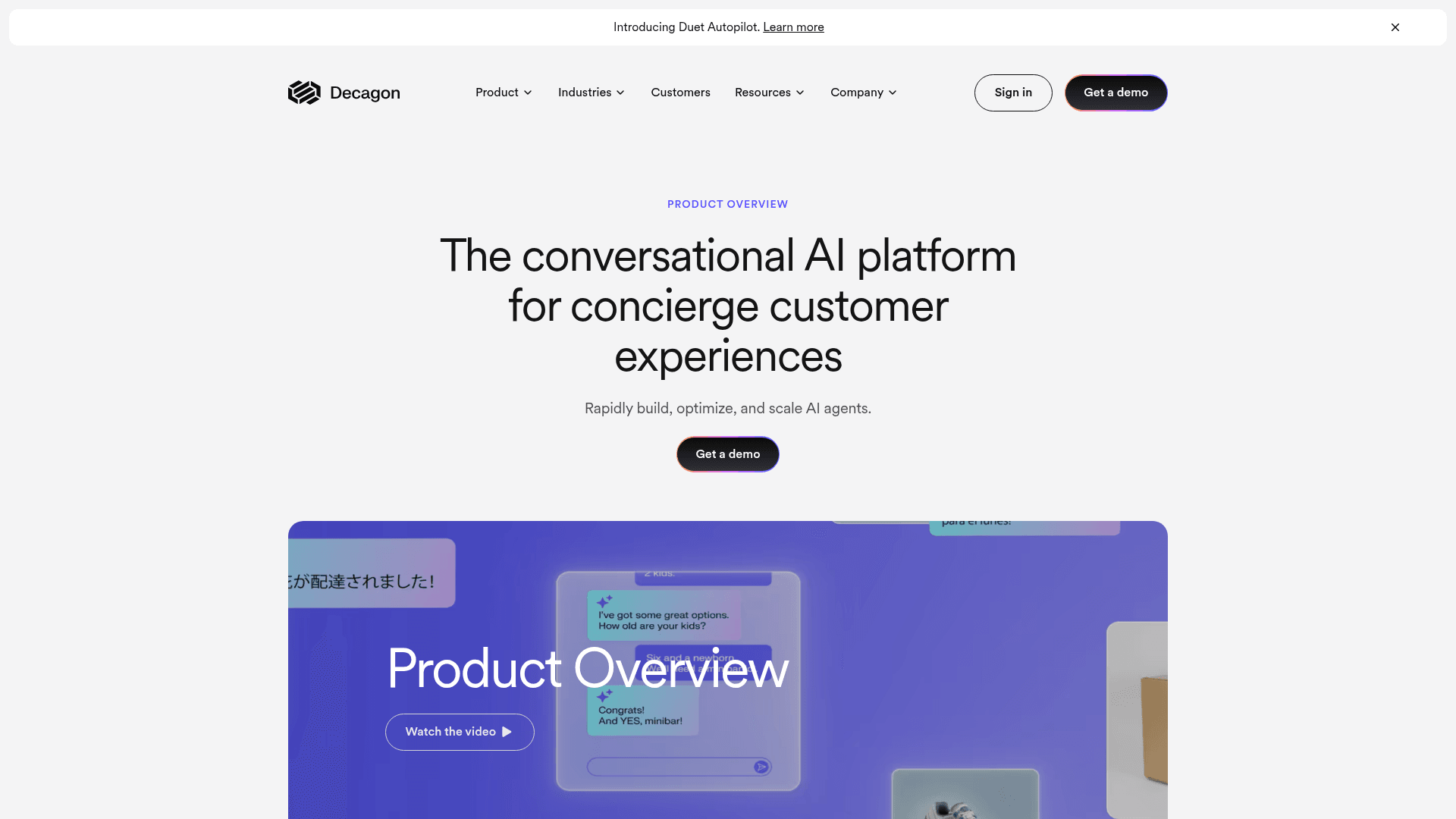
Decagon is the AI-native pure-play that's been winning the logo war. Founded in 2023 by Jesse Zhang and Ashwin Sreenivas, it's reportedly raised its way to a ~$1.5B valuation and stacked up a customer list most competitors would envy: Chime, Duolingo, Notion, Figma, Hertz, ClassPass and Riot Games among them.
Its technical wedge is Agent Operating Procedures (AOPs): natural-language instructions that compile into executable code, so CX ops can author agent logic while engineers keep control of guardrails and integrations. It runs one agent across chat, voice, email, SMS and custom API surfaces, with user memory that persists across conversations. The case studies are loud: Duolingo cites an 80% deflection rate after replacing a previous vendor, and ClassPass reports a 95% cost reduction.
The Duolingo quote is the whole positioning in one line: "With the previous vendor, at least half my week was dedicated to maintaining their system. With Decagon, it's been a night-and-day difference." That's Decagon telling you it's what you buy when you're replacing a bot, not adding one.
Pricing: sales-led and quote-only. The /pricing URL 404s, and every CTA routes to a demo form whose first question is your monthly ticket volume (brackets run from under 10,000 to 250,000+). No free trial, no self-serve. It's an annual enterprise contract bracketed by volume.
Pros:
- AI-native architecture; not a bolt-on
- Strong omnichannel (voice is first-class)
- Heavyweight consumer-brand track record
Cons:
- No public pricing and no trial; enterprise sales motion only
- Mid-market and smaller teams aren't really the target
- You're adopting a full agent platform, not augmenting your current tools
Our take: Decagon is one of the most credible Forethought alternatives at the top of the market, and arguably the strongest if you're a large consumer brand with a serious ticket volume. But it shares Forethought's two friction points exactly, opaque pricing and an enterprise implementation, so it solves the "is Forethought good enough" question without solving the "can I just see the price and start" one. If those frictions are what sent you here, keep reading.
3. Sierra
Best for: Fortune 500 and regulated enterprises that want the most pedigreed AI-agent vendor on the market.
Sierra is the AI-native platform with the most enterprise gravity, mostly because of who built it. Co-founders Bret Taylor (former co-CEO of Salesforce, current chair of OpenAI's board) and Clay Bavor (18 years at Google) give Sierra a level of boardroom pull that explains its regulated-industry roster: Rocket Mortgage, SoFi, Vanguard, FINRA, Sutter Health, ADT, SiriusXM. It's reportedly raised its way to a ~$10B valuation.
Two things really set it apart. The first is outcome-based pricing, where you "pay for a job well done" rather than per seat or per resolution, which shifts implementation risk onto Sierra. The second is Ghostwriter, an agent that builds agents from SOPs, transcripts and plain-English goals, designed to collapse the long implementation cycle competitors require. It also leads on compliance harder than almost anyone, with ISO 42001 (the AI-management-system standard) visible on the homepage alongside SOC 2, ISO 27001 and HIPAA.
Pricing: quote-only, outcome-based. No price list, no per-seat rate, no self-serve sign-up, no free trial. Everything goes through a sales contact form, and outcomes are defined per customer.
Pros:
- Best-in-class founder and investor credibility
- Outcome-based pricing aligns vendor incentives with yours
- Strongest compliance posture in the category (ISO 42001)
Cons:
- Aimed squarely at large enterprise; overkill for most teams
- Outcome-based pricing still means a custom contract and a sales cycle
- Weeks-long deployment, even with Ghostwriter
Our take: if you're a regulated enterprise and you want the safest-sounding name in AI agents, Sierra is a defensible pick, and the outcome-based model is unusually buyer-friendly if you can negotiate the KPIs. But it's the opposite end of the spectrum from "start this afternoon." For a head-to-head on where it lands against the incumbent, our Sierra vs Forethought breakdown goes deeper.
4. Ada
Best for: large enterprises (300k+ conversations a year) that want a standalone, multilingual agent layer with serious AI-specific compliance.
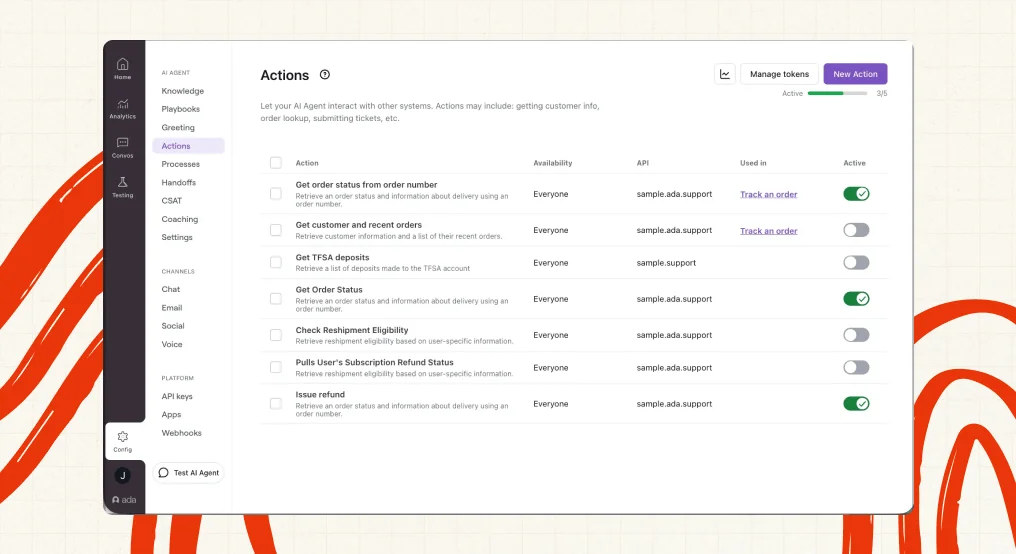
Ada is the Toronto-based veteran of this group, around since 2017 and a unicorn since its 2021 Series C. It brands its category as "Agentic Customer Experience" and, like Forethought, it's a standalone platform that sits on top of helpdesks like Zendesk, Salesforce, Freshworks and ServiceNow rather than replacing them. The platform is built around a multi-LLM Reasoning Engine, with Playbooks for multi-step SOPs and a Coaching loop where you review past conversations and the agent applies the notes automatically.
Ada's results lean large and consumer: Monday.com cut average handle time 42%, and IPSY reported a "943% ROI in four months" with millions in estimated annual savings. It also leads on compliance in an unusual way, surfacing AIUC-1 (an AI-specific certification) plus zero data retention with its LLM providers, which is reassuring if your security team is nervous about AI.
Pricing: no public pricing, and an explicit enterprise gate. Ada's own page states it's "a great fit for companies with at least 300,000 annual customer service conversations." Pricing is conversation-based and sales-led; there's no trial, no freemium, no self-serve.
Pros:
- True standalone platform; helpdesk-agnostic like Forethought
- Strong multilingual and omnichannel (including voice)
- Leads on AI-specific compliance (AIUC-1, zero retention)
Cons:
- Hard enterprise floor; explicitly not for SMB or low-volume teams
- No public pricing and no trial
- Sold as a services-wrapped platform, not a quick SaaS add-on
Our take: Ada is the most direct architectural twin to Forethought on this list, a standalone agent layer for big enterprises, so if you specifically want "Forethought but a different vendor" and you clear the volume bar, it's the natural comparison. Below 300k conversations a year, it isn't built for you, and you'll get further with eesel or one of the helpdesk-native options. See our Ada vs eesel comparison if you're weighing those two.
5. Zendesk AI
Best for: teams already living in Zendesk who want AI without adopting a separate platform.
If your team is already in Zendesk, the path of least resistance is Zendesk's own AI. After acquiring Ultimate.ai, Zendesk rolled AI Agents, a Copilot for human agents, and Intelligent Triage into the Suite. The appeal is obvious: it's one toggle away, it lives in the workspace your agents already use, and you're not signing a second vendor contract.
The catch is the billing. Zendesk charges per automated resolution, and the mechanics matter. A resolution is counted when the AI handles a conversation without escalation, verified by an LLM check, and historically a customer simply going silent for 72 hours could count as a "resolution" even if nothing got solved. Zendesk restructured this in May 2026 into tiers so only verified resolutions draw from your allowance, which is fairer, but the layered cost (seats + Copilot add-on + resolution overages) can still surprise you. One Zendesk community member put it bluntly: "If a client just leaves a conversation, it doesn't mean that it is resolved. I'm surprised that you're going to charge $1.5 per such conversation."
Pricing (per agent / month, billed annually):
| Plan | Price | AI included |
|---|---|---|
| Support Team | $19 | None natively |
| Suite Team | $55 | AI Agents, AI knowledge base |
| Suite Professional | $115 | + AI writing tools, basic Copilot |
| Suite Enterprise + Copilot | Contact sales | Full Copilot, Intelligent Triage, voice AI |
Copilot is a $50/agent/month add-on below Enterprise, and automated-resolution overages bill monthly on top.
Pros:
- Zero migration if you're already on Zendesk
- Mature, full-suite ticketing underneath the AI
- Capable triage and copilot features
Cons:
- Per-resolution billing can stack up unpredictably at volume
- AI is tied to the Zendesk Suite; no helpdesk freedom
- The total cost can 2–3x your base subscription once AI adoption is high
Our take: Zendesk AI is the sensible default for Zendesk-committed teams, and it's improving fast. But it's the opposite of Forethought's helpdesk-agnostic pitch, you're all-in on Zendesk, and the resolution pricing needs modeling before you commit. If you like Zendesk but not its AI economics, eesel runs on top of Zendesk at a flat per-resolution rate, which is often the cheaper way to add AI to the same workspace.
6. Freshdesk Freddy AI
Best for: Freshworks shops that want capable AI on a small-team budget.
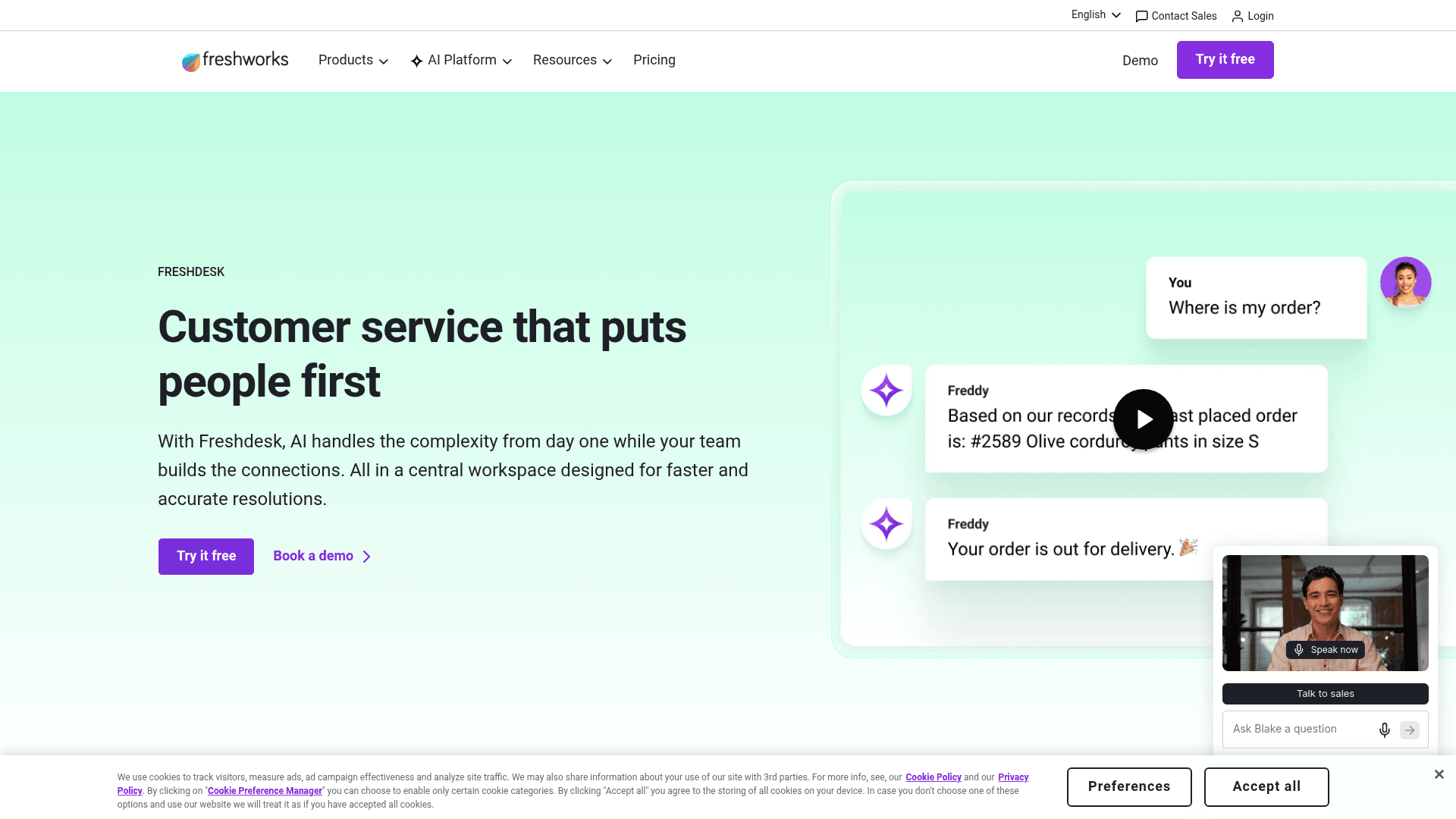
Freddy AI is Freshdesk's answer, and it's the most budget-friendly entry point into "real" support AI here. It comes in three flavors, the customer-facing Freddy AI Agent, the agent-facing Copilot, and Insights, all layered onto Freshdesk's ticketing. For a small team that already uses Freshworks, it's an easy yes.
The thing to watch is how AI usage is metered. The Email AI Agent includes the first 500 sessions, then runs $49 per additional 100 sessions, where a "session" is a 72-hour window from a customer's first email. Copilot is sold separately as a per-agent add-on (around $29/agent/month). It's cheap to start, but like Zendesk, the AI cost is a separate meter running on top of your seats.
Pricing (per agent / month, billed annually):
| Plan | Price | Notable |
|---|---|---|
| Growth | $19 | Ticketing + Email AI Agent (500 sessions) |
| Pro | $55 | Custom reporting, routing, Freddy AI Agent |
| Enterprise | $89 | Audit logs, approval workflows, skills-based assignment |
Plus Freddy AI Agent overage at $49/100 sessions and Copilot as an add-on. There's a 14-day free trial and a limited free tier for 1–2 agents.
Pros:
- Lowest entry price of the helpdesk-native options
- Full Freshdesk suite underneath
- Public, readable pricing
Cons:
- AI is tied to Freshworks; not helpdesk-agnostic
- Session-based AI metering is a separate cost to track
- Reviewers note the action-taking story is weaker outside Freshdesk-native flows
Our take: Freddy is the value pick for teams already on Freshdesk, and the published pricing is a refreshing contrast to Forethought's quote wall. It's not in the same agentic-depth league as Decagon or Sierra, but for many mid-market teams it doesn't need to be. If you want stronger autonomy on top of Freshdesk specifically, eesel also integrates with Freshdesk and trains on your existing tickets.
7. Gorgias
Best for: Shopify and ecommerce brands that want AI tuned for orders, returns and revenue.
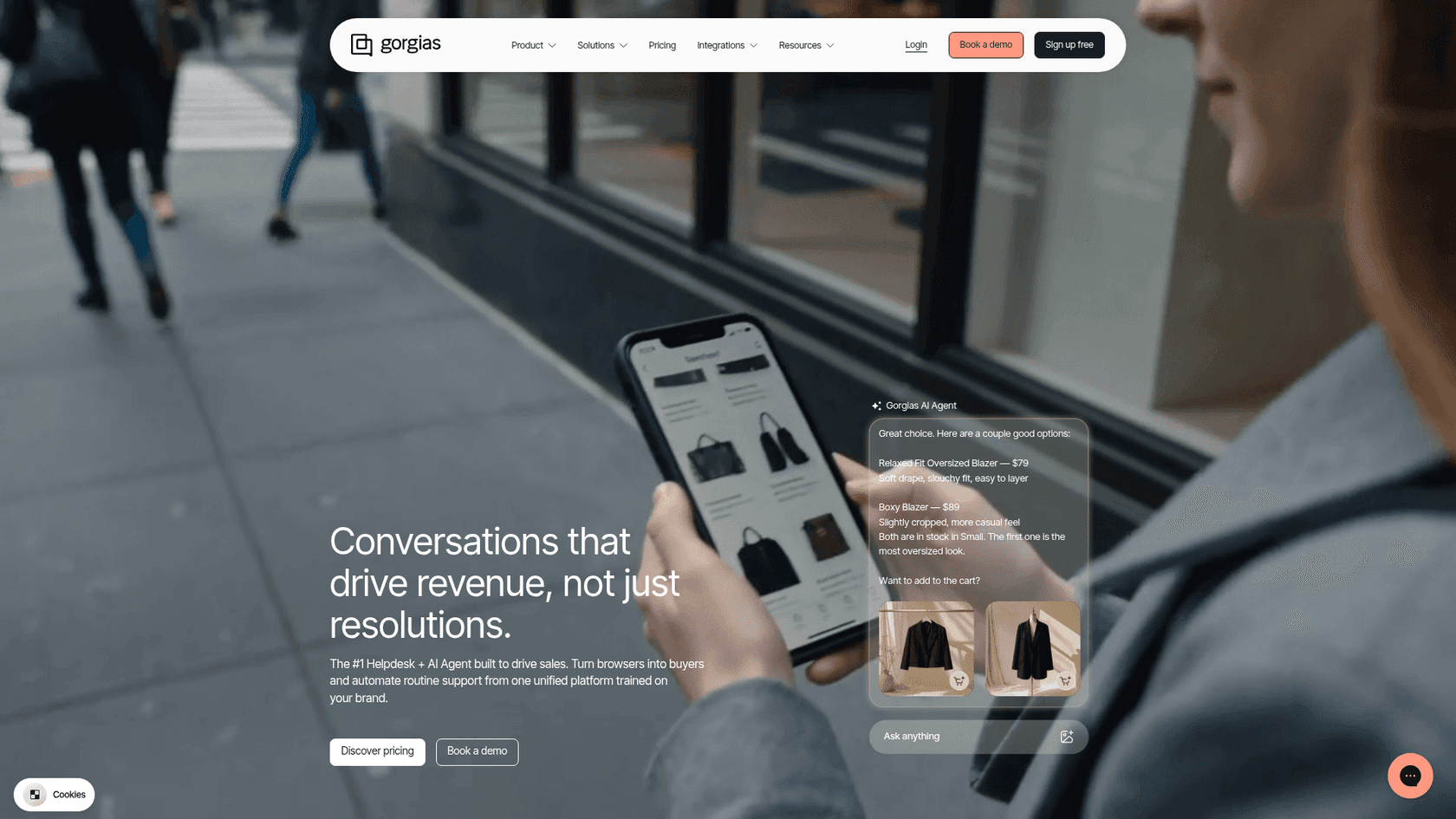
If your support is ecommerce-shaped, Gorgias is the specialist. It's a helpdesk built for online stores, with deep Shopify ties (plus Klaviyo, Recharge, Loop Returns and 150+ commerce integrations), and its AI Agent handles the things ecommerce teams actually drown in: order edits, returns and refunds, subscription changes, dynamic discounts and product questions.
Its pricing philosophy is "scales with your growth, not your headcount," so plans are based on monthly ticket volume with unlimited users. One customer captured the payoff: "At 6pm on the second day of Black Friday week, our CX agent said: 'Alright, I'll see you tomorrow. We're at inbox zero.' Without AI Agent, that wouldn't happen" (Ron Shah, CEO of Obvi, via Gorgias).
Pricing (monthly, ticket-based, unlimited seats):
| Plan | Price | Tickets included |
|---|---|---|
| Starter | $10 | 50 |
| Basic | ~$50–60 | 300 |
| Pro | ~$300–360 | 2,000 |
| Advanced | ~$750–900 | 5,000 |
The AI Agent is an add-on at $0.90–$1.00 per resolved conversation, charged only when fully automated.
Pros:
- Purpose-built for ecommerce; deep Shopify integration
- Unlimited seats; volume-based pricing
- Public pricing and a 7-day trial
Cons:
- Really only makes sense for ecommerce/retail
- It's a full helpdesk switch if you're not already on it
- AI billed per resolution on top of plan tickets
Our take: for a Shopify store, Gorgias is a better fit than any generic enterprise platform, including Forethought, because the AI already understands order data. For everyone else, it's too vertical. If you love Gorgias but want a more autonomous agent on top, eesel also runs inside Gorgias and trains on your store's ticket history.
8. Kustomer
Best for: B2C brands that want AI working off a unified customer timeline rather than isolated tickets.
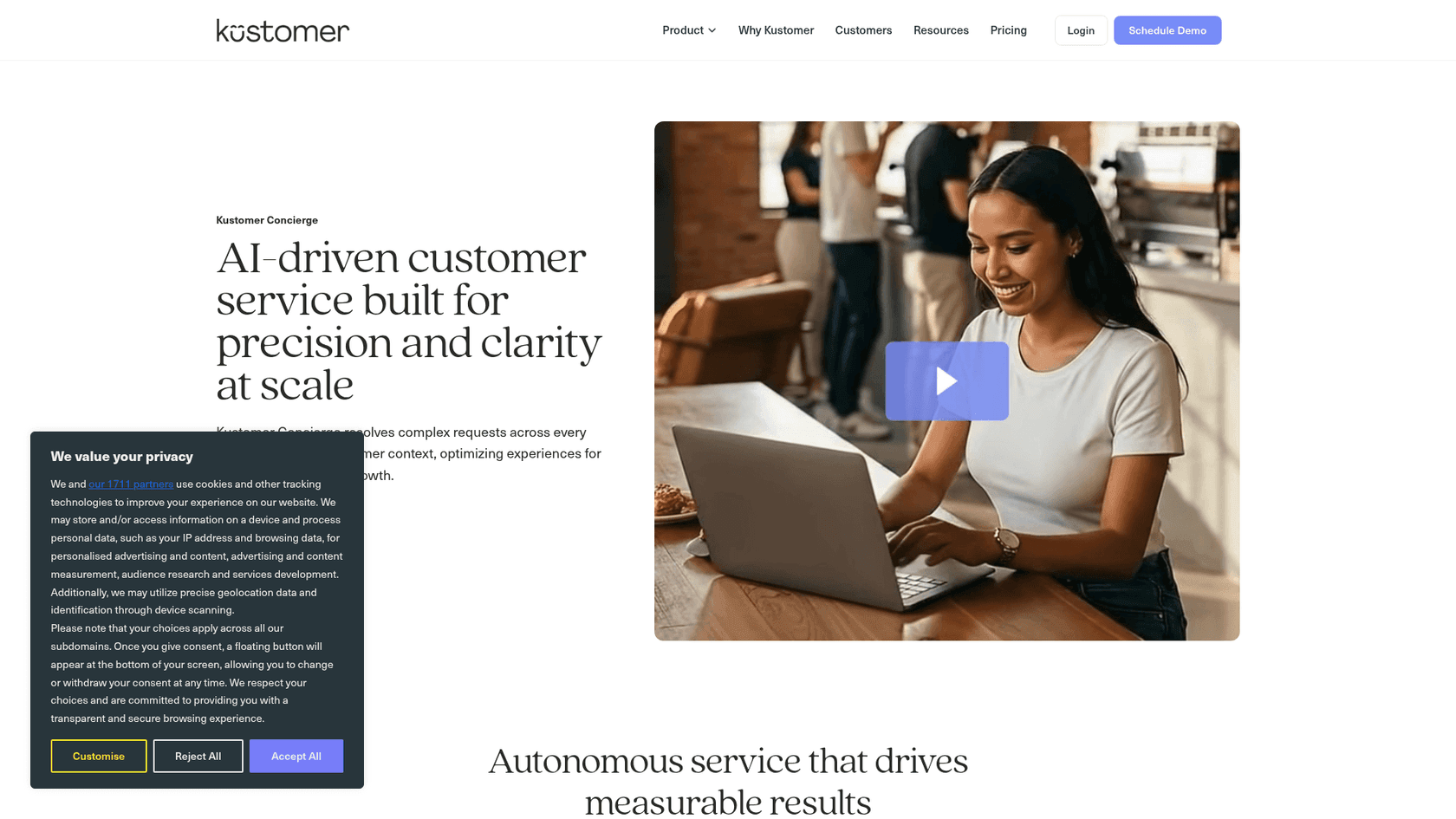
Kustomer takes a different architectural stance: it's a CX platform built around a customer-centric data model, so every interaction ties to a full customer record (order history, loyalty tier, past conversations) and the AI works off that timeline rather than a single ticket. Its AI suite, Concierge (customer-facing), Envoy (agent copilot), Architect (no-code builder) and Data Explorer (analytics), sits on top, and it skews heavily toward retail and on-demand brands like Turo, Skims, Rappi and Vuori. Kustomer cites 70% of chat conversations fully automated at Vuori.
The thing to flag honestly: the homepage advertises a "5.0 rating from 500+ G2 reviews," but the actual G2 seller page shows 4.4 out of 5 from 555 reviews. The real score is still solid; the marketing version is cherry-picked. Operators also note a buggy voice channel and a UI that newcomers find complex.
Pricing: quote-only. Kustomer's page routes everything to "Talk to Sales" with no published figures. Competitor teardowns (treat as directional) put it around $89–$139 per seat per month with an 8-seat minimum, plus AI billed separately at roughly $0.60 per engaged conversation and around $40/user/month for agent-assist AI.
Pros:
- Unified customer timeline gives the AI rich context
- Strong fit for high-volume B2C and retail
- Native MCP support in its Architect builder
Cons:
- Quote-only pricing with a seat minimum and separately-metered AI
- Reviewers flag a complex UI and a buggy voice channel
- It's a full platform migration, not an add-on
Our take: the unified-timeline idea is a good one, and for a B2C brand that wants the CRM and the AI in one place, Kustomer is worth a look. But the quote-only pricing and seat floor put it on the same "book a call to learn anything" footing as Forethought, which is the exact friction a lot of this list's readers are trying to escape.
A quick word on who actually shows you the price
Step back and one pattern jumps out. The AI-native heavyweights, Forethought, Decagon, Sierra, Ada, and Kustomer too, all keep their pricing behind a sales call. The helpdesk-native tools, and eesel, put it on the website.
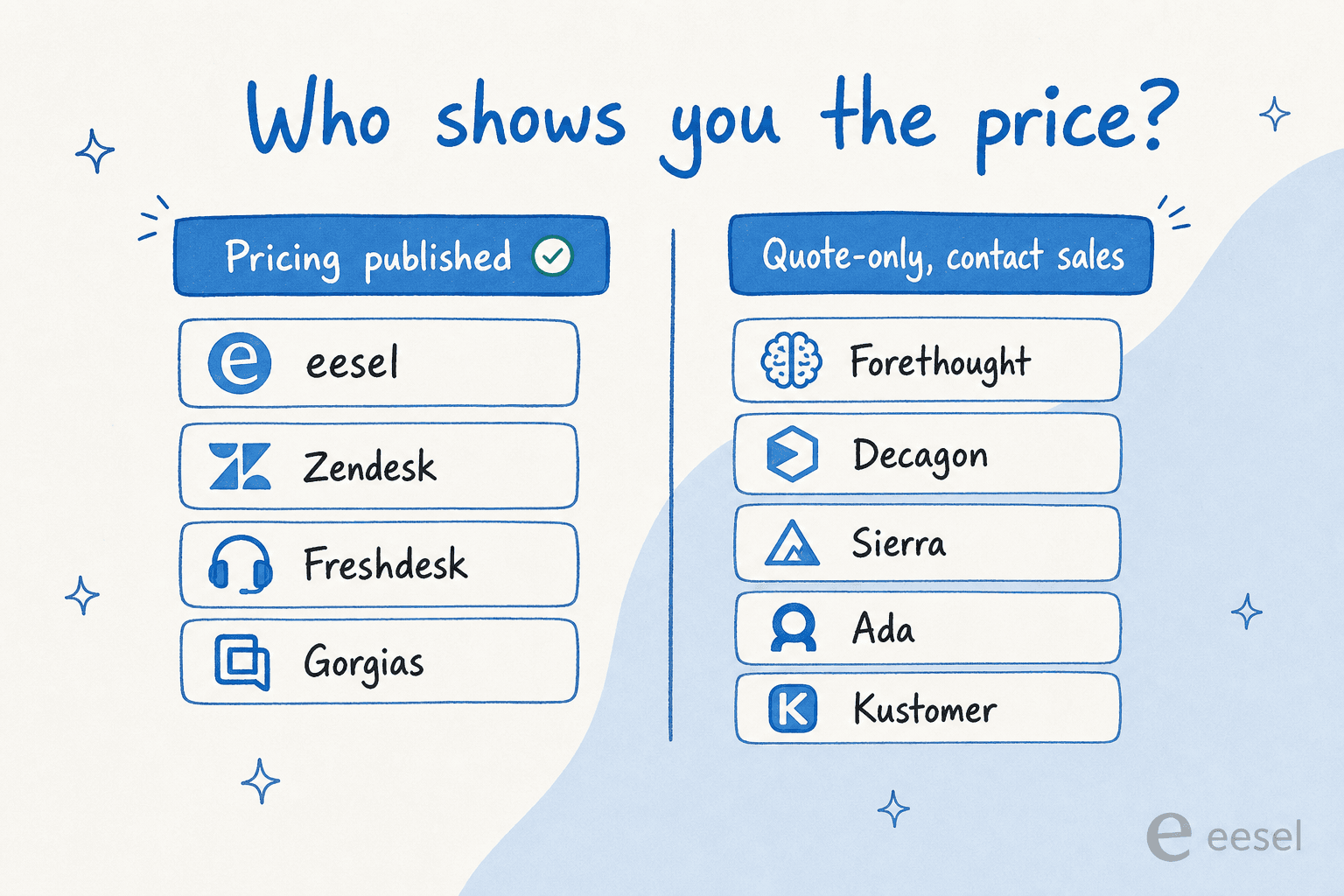
This isn't a moral judgment, enterprise contracts really are complex, and outcome-based deals like Sierra's can be very buyer-friendly once negotiated. But it does shape who each tool is for. If you're a large enterprise with a procurement team and a year-long buying cycle, the quote-only camp is built for you. If you're a support lead who wants to see a number, run a trial, and prove ROI before involving finance, the published-pricing camp will get you there faster, and eesel is the only one in that camp that also gives you the standalone, helpdesk-agnostic model Forethought pioneered.
How to actually choose
Strip away the logos and it comes down to three questions:
- Do you want to keep your helpdesk? If yes, your real options are Forethought, Ada or eesel (all standalone) or the native AI inside whatever you already run. If you're open to switching, the whole list is fair game.
- What's your scale? Above ~300k conversations a year with a procurement process, Decagon, Sierra and Ada are credible. Below that, the enterprise-only vendors aren't built for you, and you'll move faster with eesel, Zendesk, Freshdesk or Gorgias.
- How much does budget-predictability matter? If you need to model cost before a sales call, rule out the quote-only camp and look at per-resolution or per-seat pricing.
For most teams reading a "Forethought alternatives" post, the honest answer is that you're not actually shopping for a bigger enterprise platform, you're shopping for the same capability with less friction. That's the gap eesel was built for.
Try eesel AI on your current helpdesk
eesel AI is the Forethought alternative for teams that want agentic support automation without the enterprise sales cycle. It runs inside the helpdesk you already use, trains on your past tickets, lets you scope exactly which tickets it handles, and shows you forecasted deflection in a simulation before a single customer sees it.
The differentiator is the lack of friction: published pricing from $299 per month for 500 credits, a free plan with 100 credits and no card, and a setup measured in minutes rather than weeks. You can start on the free plan, watch the numbers, and scale when it earns it. Try eesel or book a quick walkthrough to see it on your own tickets.
Frequently Asked Questions
Who are Forethought's main competitors?
Is there a cheaper alternative to Forethought?
Does Forethought publish its pricing?
What should I look for in a Forethought AI competitor?


Article by
Kira
Kira is a writer at eesel AI with a Computer Science background and over a year of hands-on experience evaluating AI-powered customer service tools. She focuses on breaking down how helpdesk platforms and AI agents actually work so that support teams can make better buying decisions.