

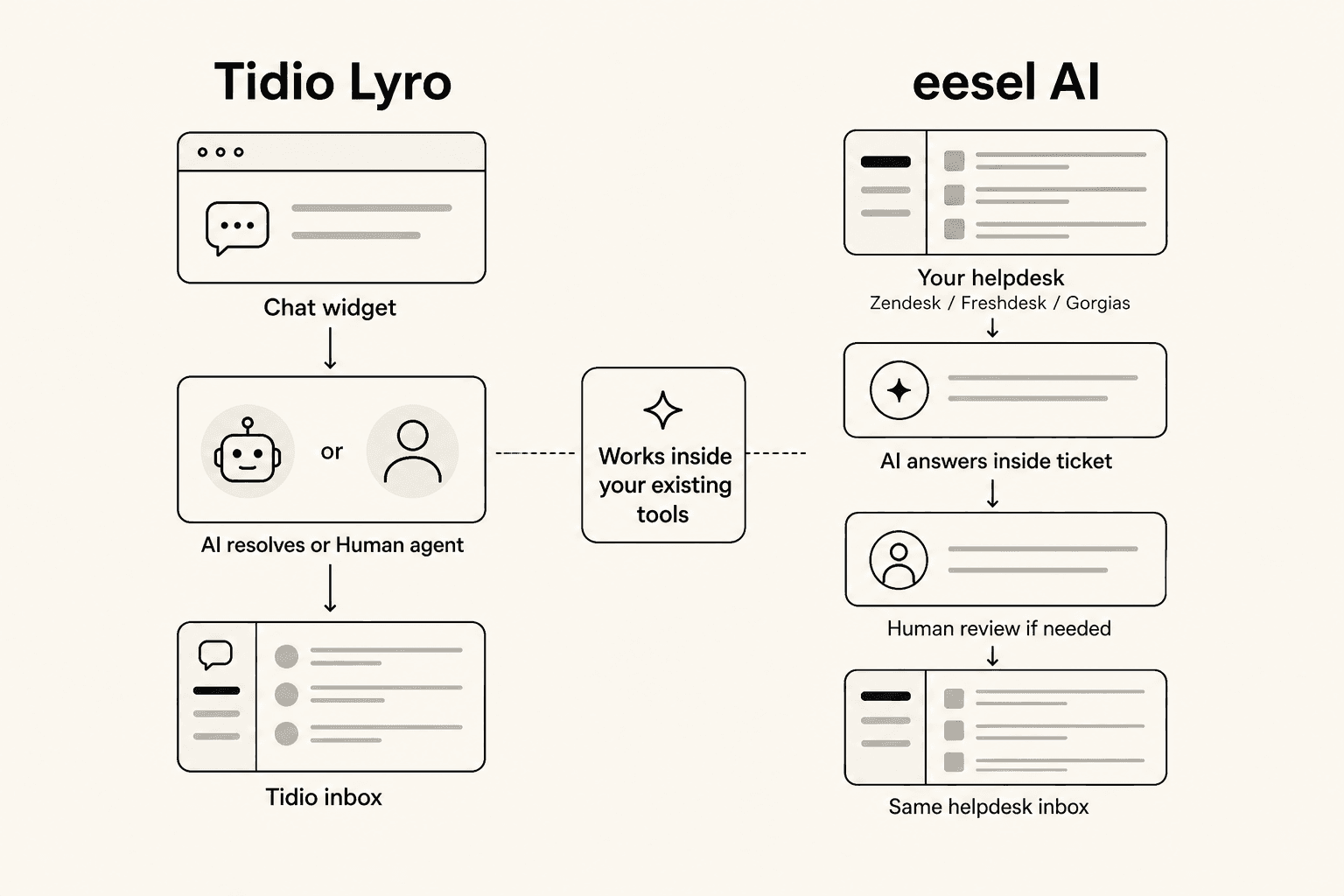
Tidio Lyro is genuinely good. It's Claude-powered, it learns from your knowledge base, and Tidio claims a 67% average resolution rate - among the highest advertised in its category. But the pricing model creates real friction at scale: every AI conversation costs roughly $0.50, and the free tier caps at 50 conversations lifetime. At 1,000 conversations a month that's $500 in Lyro costs on top of your Tidio subscription. And if you're already running support through Zendesk, Freshdesk, or Gorgias, Lyro requires either migrating to Tidio or paying for Lyro Connect on their Plus or Premium plan.
That's the actual reason most people start looking. Not that Lyro is bad - but that its pricing compounds quickly, its ecosystem is closed, and for teams already invested in another helpdesk, it asks a lot. We've tested the field and found seven alternatives worth serious consideration, ranging from tools that drop into your existing stack to free live chat for teams just getting started.
What separates a real Lyro alternative from a simple chatbot
Not every tool that puts "AI" in its marketing is doing what Lyro does. Lyro's core value is specific: it reads your support content, answers questions grounded in that content (not hallucinations), handles multi-turn conversations, and routes to humans when it's stuck. A replacement needs to do at least that.
The things worth comparing across tools:
- Resolution rate - what percentage of conversations the AI closes without human involvement
- Pricing model - per conversation, per seat, flat-rate, or credit-based (they behave very differently at volume)
- Helpdesk fit - does it work inside your existing tool, or does it require you to move everything?
- Ecommerce depth - can it look up order data and process a return, or just answer FAQs?
- Human handoff - how smooth is the escalation, and does context transfer?
Lyro scores well on the first two and the last one. Where it falls short: it doesn't work inside other helpdesks without extra cost, and its per-conversation pricing gets painful above ~500 conversations a month.
Quick comparison
| Tool | Best for | AI resolution | Starting price | Helpdesk-native |
|---|---|---|---|---|
| eesel AI | Teams on Zendesk/Freshdesk/Gorgias | 73-81% (verified) | From $299/mo (500 credits) | Yes |
| Zendesk AI Agent | Enterprise on Zendesk | 80%+ (claimed) | Included in Suite plans | Zendesk only |
| Crisp | Small teams, flat-rate budgets | Not disclosed | $95/month (Essentials) | No |
| Siena AI | Ecommerce DTC brands | 90%+ faster resolution | $750/month + $0.90/ticket | No |
| LiveChat | Sales-focused teams | AI Copilot (assist mode) | $19/month | No |
| Zowie | Compliance-heavy enterprises | 100M convs/year processed | Enterprise (contact sales) | No |
| tawk.to | Free human live chat | None | Free | No |
1. eesel AI - best if you're already on a helpdesk
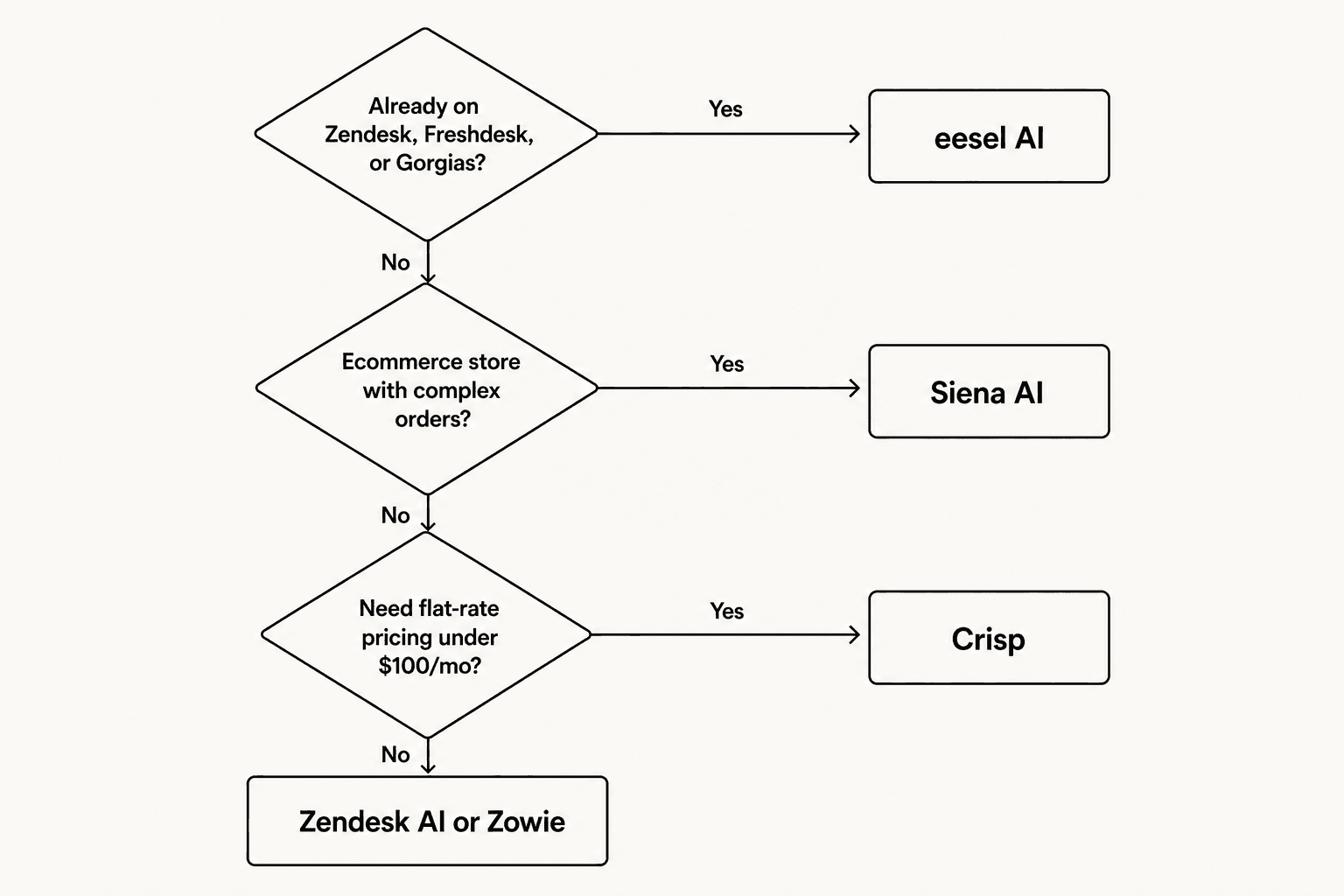
eesel AI is the closest thing to a drop-in Lyro replacement if you're already running support through Zendesk, Freshdesk, Gorgias, or another major helpdesk. The key difference from Lyro: eesel doesn't add a chat widget on top of your tools. It works inside them, reading incoming tickets, drafting replies, adding internal notes, updating tags, and routing escalations - all within the interface your agents already use.
The underlying model learns from your past tickets and help documentation on day one, with no manual training required. Teams typically see a 73-81% tier-1 resolution rate. Kim Simpson at Gridwise reported 73% of tier-1 requests resolved in the first month, and Smava processes over 100,000 tickets a month in German through eesel on Zendesk.
Where eesel shines compared to Lyro: you don't switch platforms. If you're on Zendesk, eesel runs as a Zendesk integration. If you're on Gorgias, it's a Gorgias-native agent that reads live Shopify order data and resolves questions about returns, tracking, and inventory in the same ticket thread. No Lyro Connect workaround needed.
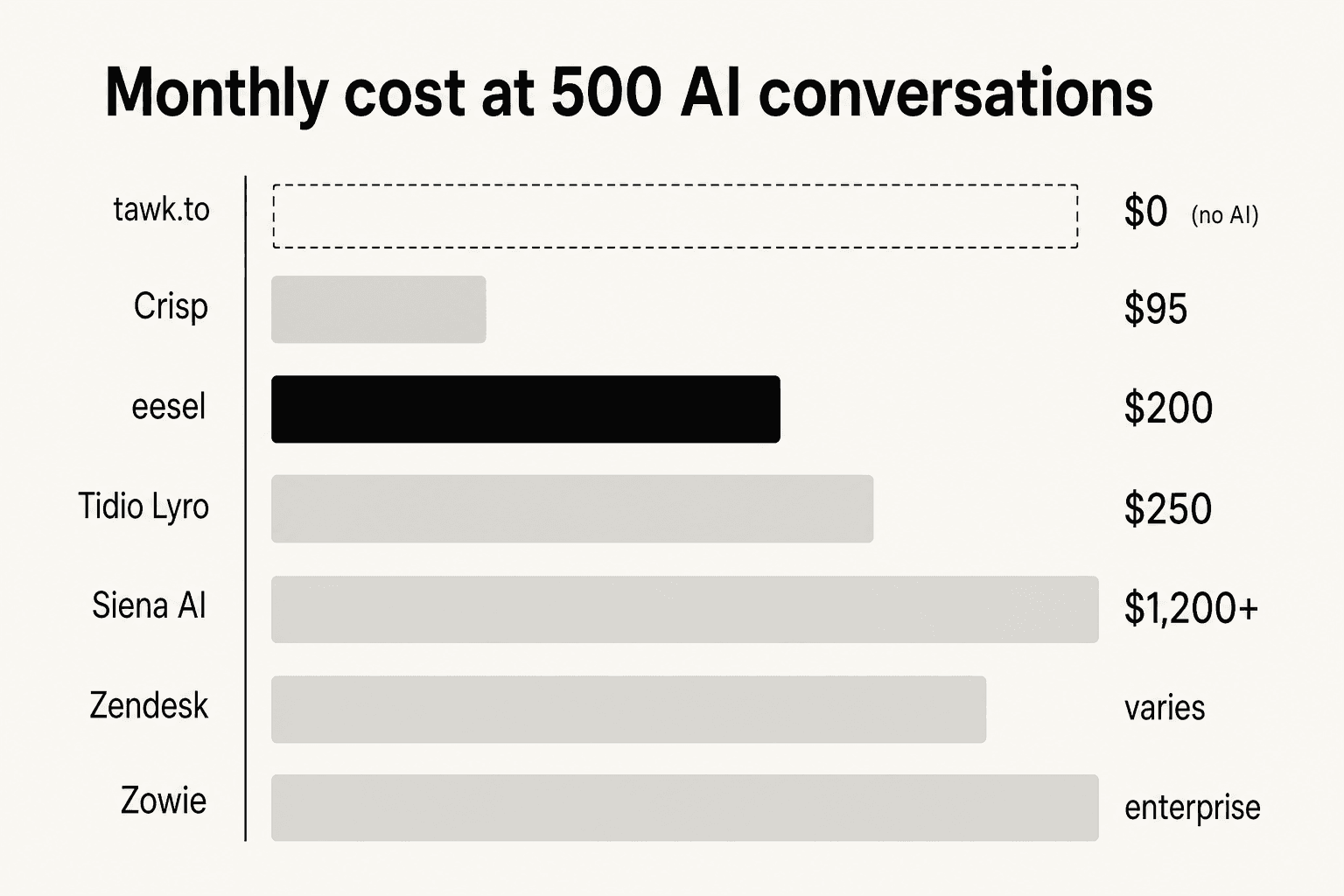
The pricing model also differs from Lyro's in a way that matters at scale. eesel charges one fixed monthly price, and 1 credit covers a ticket and all its replies, where Lyro charges ~$0.50 per conversation. At 500 tickets a month, eesel costs $299 vs. Lyro's $250, so Lyro is cheaper at low volume. The gap closes as volume grows: 2,500 tickets is $999 on eesel (about $0.40 each) against roughly $1,250 on Lyro. Paying a year upfront gets two months free. eesel also gives every new account 100 free credits with no card required.
"In the first month, eesel is resolving 73% of our tier 1 requests. eesel offers easy Zendesk implementation and setup. Our team implemented and achieved results quickly during our 7-day trial."
Kim Simpson, Gridwise (G2)

Pricing
| Plan | Price | What's included |
|---|---|---|
| Free | 100 credits | No card required, all features |
| 500 credits | $299/mo | 1 credit per ticket or chat |
| 1,000 credits | $499/mo | Every integration and channel |
| 2,500 credits | $999/mo | Unlimited agents and seats |
| 5,000 credits | $1,899/mo | More than 5,000: talk to us |
| Annual | Two months free | Pay a year upfront |
Our take: eesel is for teams that already have a helpdesk and want AI inside it - not as a separate layer on top. If you're on Zendesk and tired of context-switching between Lyro's dashboard and your ticket queue, eesel fixes that directly. It won't replace Tidio's standalone live chat widget, but if your frustration with Lyro is about cost at higher volume, helpdesk integration, or resolution rates, eesel is worth the free plan.
2. Zendesk AI Agent - best enterprise option
Zendesk AI Agent is the native AI automation layer inside Zendesk's Suite plans. It's a meaningfully different product from Lyro: where Lyro is a conversation-based AI chatbot you bolt onto a helpdesk, Zendesk's AI agents are built into the platform itself, handling tickets across messaging, email, voice, and social channels without external configuration.
The current agentic generation (which replaced the legacy "Essential" bot builder declared legacy May 11, 2026) uses what Zendesk calls generative procedures - the AI reasons across multi-step tasks and adapts in real time without predefined scripts. Hello Sugar reported a 66% automation rate; Lush attributed $434,000 in annual savings to the platform. Zendesk also includes built-in QA scoring on 100% of AI interactions, which Lyro doesn't offer natively.
The catch is cost and complexity. Zendesk AI agents are priced by Automated Resolution (AR) - each fully resolved ticket costs $1.50 (committed) or $2.00 (pay-as-you-go) beyond the included allowance. Suite plans include only 5-15 ARs per agent per month in the base allowance, which runs out fast for active teams. The advanced builder features - integrations, reasoning controls, custom analytics - require an add-on priced via a sales call. If you're not already on Zendesk, this is a heavy platform commitment to make just for AI.
Pricing
| Plan | Monthly/agent (annual) | Included ARs | Additional AR |
|---|---|---|---|
| Suite Team | $55 | 5/agent/month | $2.00 PAYG / $1.50 committed |
| Suite Professional | $115 | 10/agent/month | $2.00 PAYG / $1.50 committed |
| Suite Enterprise | Custom (sales) | 15/agent/month | $2.00 PAYG / $1.50 committed |
Our take: If you're already on Zendesk and want AI deeply embedded in the platform rather than a separate tool to manage, the native AI agents are the cleanest path. The QA scoring and voice AI (currently early access) are genuinely ahead of what Lyro offers. But if you're not on Zendesk, the platform lock-in and pricing complexity make it harder to justify than something like eesel, with one fixed monthly price and no seat fees.
3. Crisp - best flat-rate option for small teams
Crisp is an all-in-one customer support platform with a live chat widget, shared inbox, knowledge base, CRM, and AI agent built in. It's closest in spirit to what Tidio as a whole does - a full platform, not just an AI layer - but with flat-rate pricing that removes per-conversation billing anxiety.
Crisp's AI feature is called Hugo. On the Essentials plan at $95/month, Hugo handles up to ~450 AI conversations per month, auto-ingests your website and knowledge base for training, and works across web chat, WhatsApp, email, SMS, and Messenger. It detects intent, generates responses from your training data, handles escalations, and supports 50+ languages. It's not as battle-tested as Lyro at high resolution rates, but for teams under 10 people who want a single tool and a predictable bill, the value equation is different.
Crisp has a 4.5/5 rating on G2 from 194 verified reviews, with reviewers consistently praising the centralized inbox and how quickly new staff get up to speed. The main community complaint: Hugo AI is capable but still maturing - some users report inconsistencies in responses on edge cases, and the mobile app lags behind the web version.
Pricing
| Plan | Monthly | Seats | AI conversations |
|---|---|---|---|
| Free | $0 | 2 | None |
| Mini | $45 | 4 | ~90/month |
| Essentials | $95 | 10 | ~450/month |
| Plus | $295 | 20+ | ~1,350/month |
| Enterprise | Custom | Custom | Custom |
Our take: Crisp is the right call if you're leaving Tidio because per-conversation billing makes budgeting unpredictable, and you want a single flat bill that covers both the chat platform and the AI. The tradeoff is that Hugo isn't quite as polished as Lyro yet, and Crisp is a full platform you're adopting. If you're already on another helpdesk and want to stay there, Crisp doesn't help with that - it's its own ecosystem.
4. Siena AI - best for ecommerce brands
Siena AI is built specifically for ecommerce customer service. Where Lyro is a general-purpose AI chatbot that can handle ecommerce if you configure it, Siena is designed from the ground up for DTC brands - handling order management, returns, subscriptions, product recommendations, and post-purchase automation as native workflows, not add-ons.
The platform handles what Siena calls the full commerce lifecycle: customers can cancel an order, swap a subscription, generate a return label, or get personalized product recommendations through AI without human intervention. Siena also runs a Reviews Agent, Shopping Agent, and QA Agent as separate configurable modules for different parts of the customer journey.
The numbers from G2 back up the positioning. Siena has a 4.8/5 rating from 28 verified reviews, with reviewers at brands like HexClad, Thrive Causemetics, and EightSleep reporting that response times improved from 16 hours to 10 minutes and that Siena's empathy and brand voice matching outperform generic chatbots. The honest community caveat: Siena is not a "set and forget" tool. It requires ongoing fine-tuning, and some users report the AI occasionally draws out conversations instead of routing to a human when it should.
"Siena empowers our agents to focus on high-touch tickets... By automating responses to routine inquiries like auto-renewals and subscription questions, Siena delivers answers with remarkable speed - outpacing any human team."
Rebecca B., Senior Manager CX Strategy (G2)
Pricing
| Component | Cost |
|---|---|
| Platform fee | $750/month |
| Per automated ticket | $0.90 |
| Example: 500 tickets/month | $1,200/month |
| Example: 1,000 tickets/month | $1,650/month |
Our take: Siena is excellent for ecommerce brands with complex post-purchase workflows and enough volume to justify the platform fee. It's genuinely better than Lyro at ecommerce-specific automation. The tradeoff is meaningful cost - at 500 tickets a month, Siena runs $1,200 vs. eesel's $299 or Lyro's $250. If your tickets are mostly FAQ-style support rather than transactional workflows, you're paying for capabilities you won't use.
5. LiveChat - best for sales-focused teams
LiveChat is an established live chat platform serving 35,000+ companies across 150+ countries, with a 4.4/5 rating from 806 G2 reviews. Where most tools on this list lead with AI autonomy, LiveChat leads with human-in-the-loop support done well - the AI features are designed to make human agents faster, not replace them.
The reason LiveChat makes this list: it's what many Tidio users reach for when they outgrow Tidio's chat infrastructure and want something more proven at scale. Features like message sneak-peek (seeing what customers are typing before they send it, which agents consistently cite as a response-time advantage) and analytics that tie chat directly to sales conversion make LiveChat meaningfully different from Lyro in what it optimizes for. Sephora reported a 25% increase in average order value through LiveChat's proactive messaging.
The AI Copilot provides real-time suggestions, summaries, and tone adjustment during conversations - but it's assist mode. It doesn't resolve tickets autonomously the way Lyro does. If you need full AI deflection, LiveChat can connect to a separate chatbot product from the same parent company, sold separately. That's the meaningful limitation: LiveChat is excellent at what it does, but "AI autonomous resolution" requires adding another product and cost layer.
Pricing
| Plan | Monthly/agent | Active visitor limit | AI Copilot |
|---|---|---|---|
| Starter | $19 | 100 | Included |
| Team | $49 | 400 | Included |
| Business | $79 | 1,000 | Included |
| Enterprise | Custom | Unlimited | Included |
Our take: LiveChat is the right pick if you want best-in-class human chat tooling and don't necessarily need the AI to be autonomous. For sales support, lead qualification, or ecommerce where a human touch converts better, LiveChat's infrastructure and analytics beat Lyro. For pure AI ticket deflection without human agents in the loop, you'll need to add a separate chatbot product on top.
6. Zowie - best for enterprises needing compliance
Zowie is built for enterprises where AI mistakes have real consequences - financial services, insurance, regulated ecommerce. The core architectural choice that separates Zowie from every other tool on this list: critical business logic (refunds, eligibility, identity verification) runs as deterministic programs, not LLM probabilistic inference. The LLM handles language understanding and response generation; decisions run on rules that don't vary by prompt or temperature.
Zowie processes 100 million conversations annually across customers like Payoneer, Decathlon, InPost, and AirHelp. The Supervisor module scores 100% of conversations (not a sample), logging the exact reasoning behind every decision - directly useful for GDPR and EU AI Act compliance audits. Zowie is SOC 2 Type II certified and HIPAA capable.
The honest limitation: Zowie is entirely opaque on pricing (no public pricing page; enterprise sales only), and the platform is sized for large organizations. There's no self-serve onboarding and no free tier. If you're a Tidio Lyro customer looking for something more affordable or simpler, Zowie is almost certainly not it.
"We knew we needed automation, but most AI platforms felt like black boxes. They charged per seat, limited access, and gave us no control over how AI actually worked."
Mike Wu, Senior Director of Ecommerce and CX, Monos (getzowie.com)
Pricing
| Plan | Price |
|---|---|
| All plans | Contact sales (enterprise only) |
| Free trial | Not offered |
Our take: Zowie is excellent for the specific problem it solves - deterministic, auditable AI for regulated industries. If that's your situation, it's worth the conversation. For most Tidio Lyro users evaluating options because of cost or helpdesk fit, Zowie is over-engineered and effectively inaccessible.
7. tawk.to - best free option
tawk.to is the world's most widely used live chat software by adoption - more than 35% of all websites using live chat use tawk.to, with over 6 million business users and roughly 3 billion monthly end-user interactions. The platform is 100% free forever: live chat, ticketing, knowledge base, CRM, unlimited agents, unlimited conversations, unlimited history.
The important caveat for anyone comparing to Lyro: tawk.to does not have an AI chatbot. There's no autonomous resolution, no knowledge-base-powered AI agent, no automated ticket deflection. Automated triggers and canned responses exist, but that's rule-based automation, not AI. If your primary goal is replacing Lyro's AI resolution capability, tawk.to does not deliver that.
Where tawk.to makes sense: you're leaving Tidio because you want to stop paying for the platform entirely, and you have enough human agents to handle chat volume manually. Or you're a very early-stage team that needs a chat widget with no budget and plans to layer in AI later. 4.5/5 on G2 from 202 reviews, with users consistently praising setup speed and zero cost. The recurring criticism: the mobile app is inconsistent, and the UI feels dated compared to newer tools.
Pricing
| Plan | Price | AI capability |
|---|---|---|
| Core (everything) | Free | None |
| Remove branding | $19/month per property | None |
| Video + Voice + Screen sharing | $29/month per property | None |
| Hired chat agents | $1/hour | Human, not AI |
Our take: Pick tawk.to if cost is the absolute constraint and you're comfortable handling conversations manually or with hired agents. It's the right call for bootstrapped teams in the early stages. It's not a Lyro alternative in the AI sense - it removes cost from the equation entirely, but the AI automation goes with it.
How we'd actually choose
The decision mostly comes down to two questions.
First: are you already on a helpdesk? If you're running support through Zendesk, Freshdesk, or Gorgias and want to add AI without migrating, eesel AI is the cleanest path. It plugs into your existing workflow rather than adding a parallel tool to manage. If you're on Zendesk specifically and want everything under one vendor, Zendesk AI Agent is the alternative - though the AR-based overage pricing requires careful planning.
Second: what kind of AI do you actually need? If the goal is autonomous ticket resolution (what Lyro does), eesel, Zendesk AI Agent, Crisp, and Siena all deliver versions of that. If the goal is helping human agents respond faster without replacing them, LiveChat with its Copilot is genuinely good at that. If you need deterministic, auditable decisions for regulated workflows, Zowie is the serious option. And if cost is the primary constraint and human chat is acceptable, tawk.to removes the expense entirely.
One thing worth naming: the 67% resolution rate Lyro advertises is competitive but not the ceiling. eesel customers see 73-81% in the first month. At 1,000 tickets a month, that's 60-140 more tickets resolved automatically than Lyro's average. With a fixed plan that includes everything, those extra resolutions don't add per-conversation fees.
Try eesel AI
eesel AI is an AI agent that works inside the tools your support team already uses - Zendesk, Freshdesk, Gorgias, Slack, and more. Instead of adding a chat widget on top of your helpdesk, eesel reads tickets as they come in, drafts replies grounded in your documentation and past tickets, routes anything it's not confident about for human review, and closes the ticket when it's done.
For teams switching from Lyro specifically, the setup is similar - connect your knowledge base and past tickets, run a simulation against historical data to check coverage before going live, then let it handle tickets. The typical team is handling real tickets autonomously within a day. The free trial gives you 100 free credits (roughly 100 tickets) with no card required.
Teams like CartonCloud, Ecosa, and Anytime Fitness started with the same question: can we get Lyro-level automation without migrating off our current helpdesk? For all three, the answer was yes - and without migrating. If that's the question you're trying to answer, start a free trial and find out within the week.