9 best Zowie alternatives for AI customer support in 2026

Kurnia Kharisma

Katelin Teen
Last edited October 14, 2026

Why teams look for a Zowie alternative
I'll say the fair thing first: Zowie is a real product, not a wrapper. Its pitch is a smart one, splitting the language model that understands the customer from a separate Decision Engine that executes refunds and claims deterministically, so sensitive actions don't drift. It has genuine ecommerce roots, a strong Shopify App Store rating, and an enterprise compliance stack (SOC 2, GDPR, EU AI Act, DORA, HIPAA). Reviewers consistently praise how quickly it goes live.
So why the search for alternatives? A few reasons keep coming up.
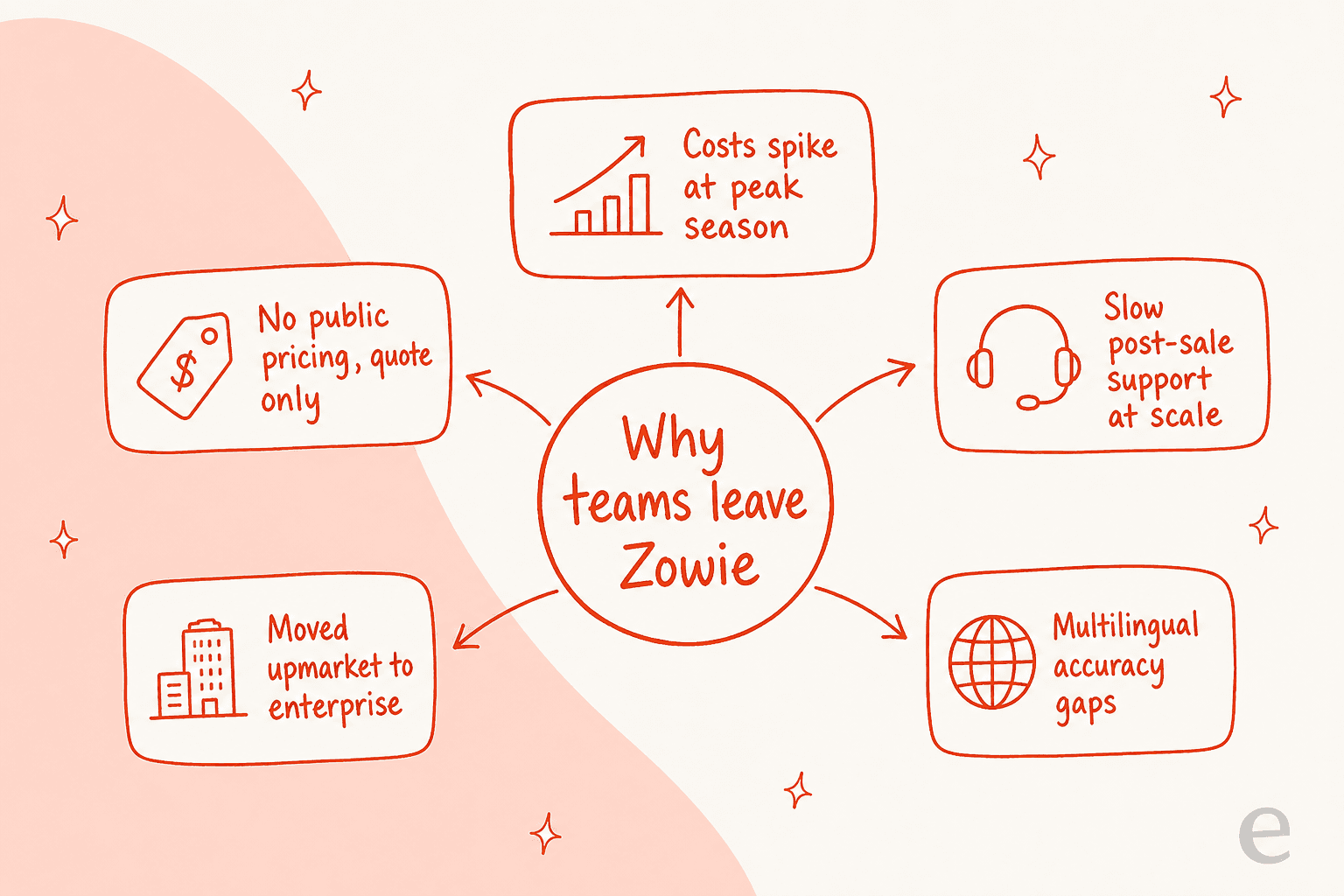
The pricing is a black box. Zowie publishes no rates. The pricing page returns a 404, the homepage only offers "Book a demo," and Capterra confirms there's no free trial and no free version. The one hard number I could verify is the AWS Marketplace listing: roughly $34,500 a year for 25,000 conversations, or about $1.38 each. That's fine if you have budget approved, but it means you can't estimate cost without a sales cycle.
It moved upmarket. Zowie's current site foregrounds banking, insurance, and telecom, and cites six-week rollouts for regulated insurers. That's a great story for a Fortune 500 buyer and a slower, heavier one for a 10-person support team that wants to be live by Friday.
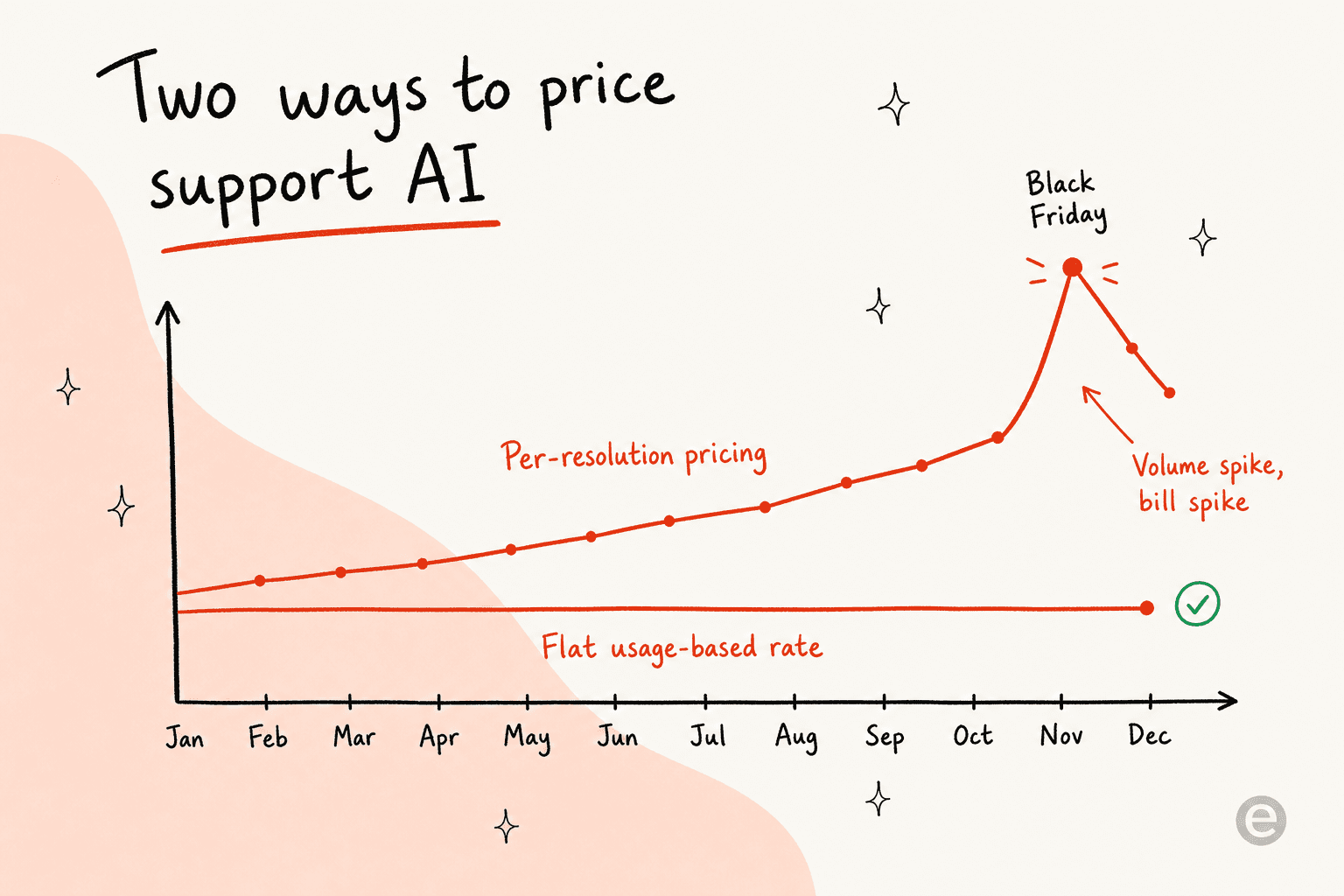
Per-outcome pricing can punish your good months. This is the part I've actually run the math on with real ecommerce teams. Per-resolution or per-outcome pricing sounds fair (you only pay for work done), but it scales with two things you don't control: your volume and your resolution rate. In one cost comparison we did for a store handling about 1,000 tickets a month, per-resolution pricing at an 80% resolution rate came to roughly $792 a month. Push that to a Black Friday spike of 4,000 tickets and the same model jumps to about $3,168 a month, while a fixed monthly plan stays put (extra overage is optional and capped by you). The better your AI gets and the busier you are, the more per-resolution pricing costs you.
Post-sale support and localization draw complaints. The onboarding love is real, but the sharpest reviews land after the sale. One G2 reviewer paying around $2,100 a month described the service as "non-existent," with support taking hours or days. Others flag multilingual accuracy (the translator "didn't always work when needed") and thin analytics export. These are edge cases, not the norm, but they're worth knowing before you sign an annual contract.
"The service is non-existent."

None of this makes Zowie a bad tool. It makes it a specific tool, aimed at a specific (large, well-resourced) buyer. If that's not you, here's where I'd look.
How I picked these alternatives
I've spent the last few years putting AI agents on live support queues, and I've watched confident-sounding bots quietly give wrong answers, which is why I now care less about demo polish and more about a few boring things:
- Pricing you can see. Can you get a real number without a sales call?
- How you start. Self-serve trial, or demo-and-procurement only?
- Control before go-live. Can you test on your own historical tickets before it touches a customer?
- Fit with your stack. Does it layer onto the helpdesk you already run, or force a migration?
- The unglamorous stuff. Languages, real order actions, end-to-end resolution (not just deflection), escalation, and whether costs stay sane during your busy season.
Everything below is judged on those. Here's the shortlist at a glance.
| Tool | Best for | Pricing model | Starting price | Free trial / self-serve | Runs on your existing helpdesk | Compliance |
|---|---|---|---|---|---|---|
| eesel AI | Teams wanting control + clear pricing | Fixed monthly, credit-based | From $299/mo (500 credits), no seat fee | Yes (100 free credits) | Yes | SOC 2 Type II certified, GDPR, HIPAA (talk to us) |
| Gorgias | Shopify stores | Tiered + AI add-on | From $10/mo + $0.90/AI resolution | Yes | It is the helpdesk | GDPR, CCPA |
| Richpanel | Ecommerce wanting one bill | Usage + seats | ~$0.20/AI convo + $99/seat | Demo-led | It is the helpdesk | GDPR |
| Tidio (Lyro) | Small stores & SMBs | Per conversation | $0.50 / AI conversation | Yes (free tier) | Yes (bolt-on) | SOC 2, HIPAA (Enterprise) |
| Sierra | Large enterprise / regulated | Outcomes-based | Quote only | No | Replaces / fronts it | SOC 2, ISO 27001, ISO 42001, HIPAA |
| Decagon | High-volume enterprise CX | Volume-bracketed | Quote only | No | Fronts / replaces it | See Trust Center |
| Ada | Enterprise (300k+ convos/yr) | Volume-based | Quote only | No | Layers on top | SOC 2, HIPAA, AIUC-1 |
| Maven AGI | Enterprise, complex workflows | Quote only | Quote only | No | Layers on top | SOC 2, ISO 27001, HIPAA, PCI |
| Yuma AI | Mid-size and high-volume DTC brands | Outcome-based (full resolutions only) | $14,400/yr (12,000 resolutions, ~$1.20 each) | First 30 days free, demo-led | Layers on top | SOC 2 Type II |
Not sure which row is you? This quick guide points you at the right starting place.
1. eesel AI
Best for: support, IT, and ecommerce teams that want transparent pricing, a self-serve start, and an AI agent that layers onto the helpdesk they already run.
eesel AI is the tool I'd reach for first if you're leaving Zowie because of the black-box pricing and the enterprise-only feel. Instead of replacing your stack, eesel drops an AI helpdesk agent into the tools you already use, learning from your past tickets, help docs, and workflows so that, as the team puts it, "years of history becomes knowledge on day one."

The part that matters most against Zowie is the simulation mode: before the agent touches a live customer, you run it against thousands of your historical tickets to see the resolution rate by topic, spot gaps, and fill them. You start supervised (drafts only), then hand over autonomy on the easy stuff once you trust it. That "co-pilot first, full auto later" pattern is the one nearly every team actually wants, and it's how Gridwise resolved 73% of tier-1 requests in its first month, on results seen during a 7-day trial.
It's also genuinely multilingual (80+ languages, answering in the customer's language), which directly addresses one of Zowie's recurring gripes. And with 100+ integrations covering Zendesk, Freshdesk, HubSpot, Gorgias, Front, Slack, and Shopify, it fits an ecommerce or a SaaS stack without a migration. At the top end, Smava runs a fully automated Zendesk agent on 100,000+ German tickets a month.
Pros
- Transparent, fixed monthly pricing: from $299/month for 500 credits (1 credit per ticket or chat), no per-seat fee. You can estimate your bill before you ever talk to sales.
- Simulation on your real tickets before go-live, so you're not guessing at coverage.
- Self-serve free plan (100 credits, no credit card), which is the exact thing Zowie's model won't give you.
- 80+ languages and 100+ integrations; layers on your helpdesk instead of replacing it.
Cons
- It is SOC 2 Type II certified, and HIPAA is available on request (see pricing).
- It's an AI agent layer, not a full helpdesk with its own ticketing UI, so you keep (and pay for) your existing helpdesk.
Pricing
| Plan | What you pay |
|---|---|
| Free plan | 100 credits, no card |
| Teammate, 500 credits | $299/mo (1 credit per ticket or chat, no seat fee) |
| Teammate, 1,000 credits | $499/mo |
| Teammate, 2,500 credits | $999/mo |
| Teammate, 5,000 credits | $1,899/mo (more than that: talk to us) |
| Pay a year upfront | Two months free |
| Add-ons | SSO and MFA from $199/mo, data residency $500/mo, priority support from $299/mo |
Our take: if the reason you're leaving Zowie is "I want a real number and I want to try it myself," this is the shortest path. Skip it only if you specifically need a single vendor to own the ticketing UI too.
2. Gorgias
Best for: Shopify and ecommerce brands that want the helpdesk and the AI agent to be the same product.
If Zowie appealed to you because of its ecommerce chops, Gorgias is the most direct like-for-like. It's an ecommerce-first helpdesk with a native Shopify integration at its core (orders, customers, and store data live inside the ticket view with no syncing), and it claims to power support for 40% of Shopify brands and 17,000+ stores.
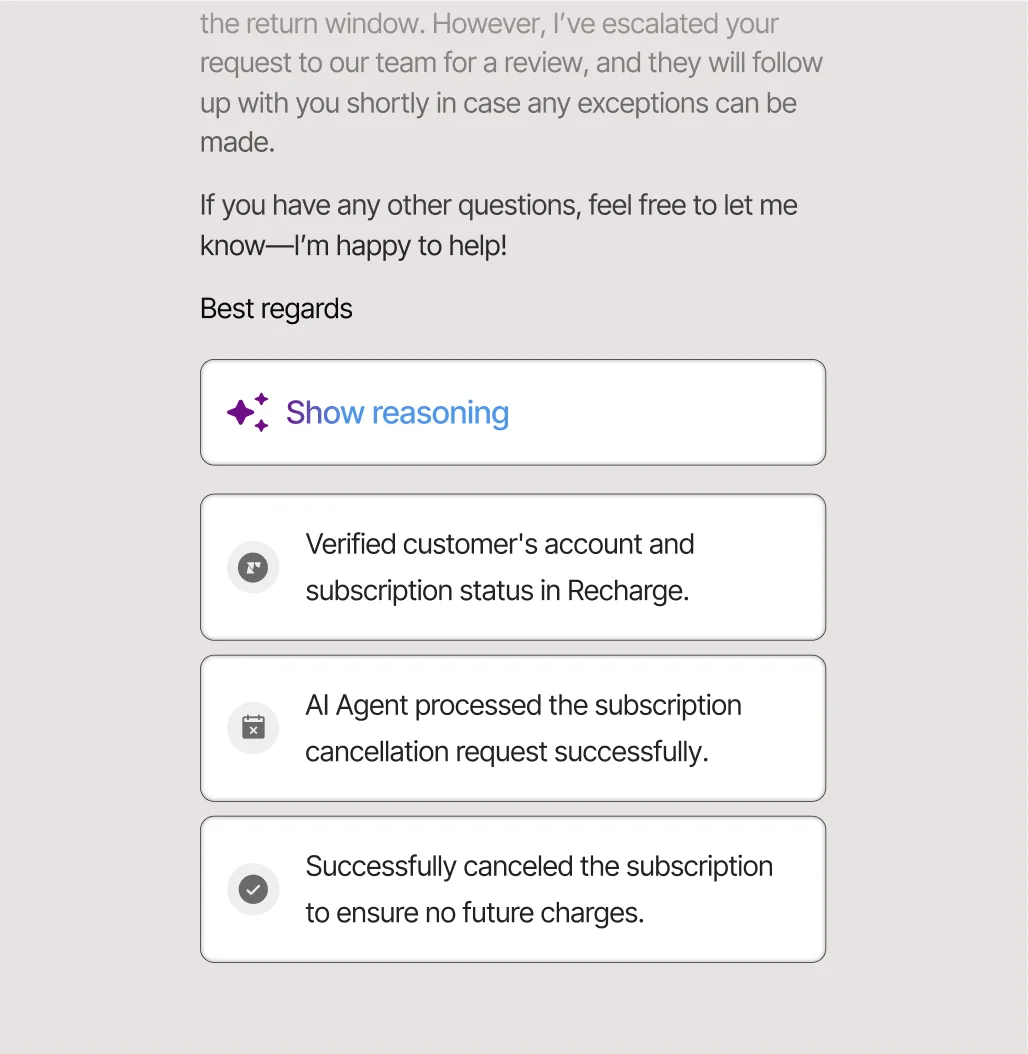
The AI Agent is pre-trained on a billion-plus ecommerce conversations and takes real actions: returns, refunds, order edits, subscription changes, and even conversational upsells. Orthofeet hit 56% automation in under two months, and one brand reported an 8.83x ROI on AI-driven sales. Where it differs from Zowie is transparency: Gorgias actually publishes its pricing.
Pros
- Deepest Shopify integration of any tool here; the AI takes native store actions.
- Public, tiered pricing you can read without a sales call.
- Handles support and revenue (upsells) in one inbox.
Cons
- The AI Agent is a usage-based add-on at $0.90-$1.00 per resolved conversation, and each AI interaction also counts as a billable ticket, so watch the double-meter at peak.
- Community consensus is that it runs roughly 3x the price of Zendesk for similar volumes; it pays off mainly once 40%+ of your tickets need real Shopify actions.
Pricing
| Plan | Starting price (monthly) | Tickets/mo |
|---|---|---|
| Starter | from $10 | 50 |
| Basic | from $50 | 300 |
| Pro | from $300 | 2,000 |
| Advanced | from $750 | 5,000 |
| AI Agent | $0.90 (annual) / $1.00 (monthly) per resolved conversation | usage add-on |
Our take: the obvious pick if you're Shopify-first and want one platform. Just model the AI add-on at your real volume before you commit, because per-resolution pricing plus per-ticket billing adds up fast in November. If you'd rather keep your current helpdesk, eesel's Gorgias integration gets you the agent without the switch.
3. Richpanel
Best for: ecommerce teams that are tired of paying twice (helpdesk + a separate AI add-on) and want one bill with a results guarantee.
Richpanel is an AI-native ecommerce support platform that leads with a hard promise: "Cut your tickets by 50% and reduce support costs by 30%. Guaranteed." Its whole pitch is aimed at exactly the frustration a Zowie or Gorgias buyer feels: it combines the helpdesk and the AI agent into a single invoice, with no per-resolution charge stacked on top of seats.
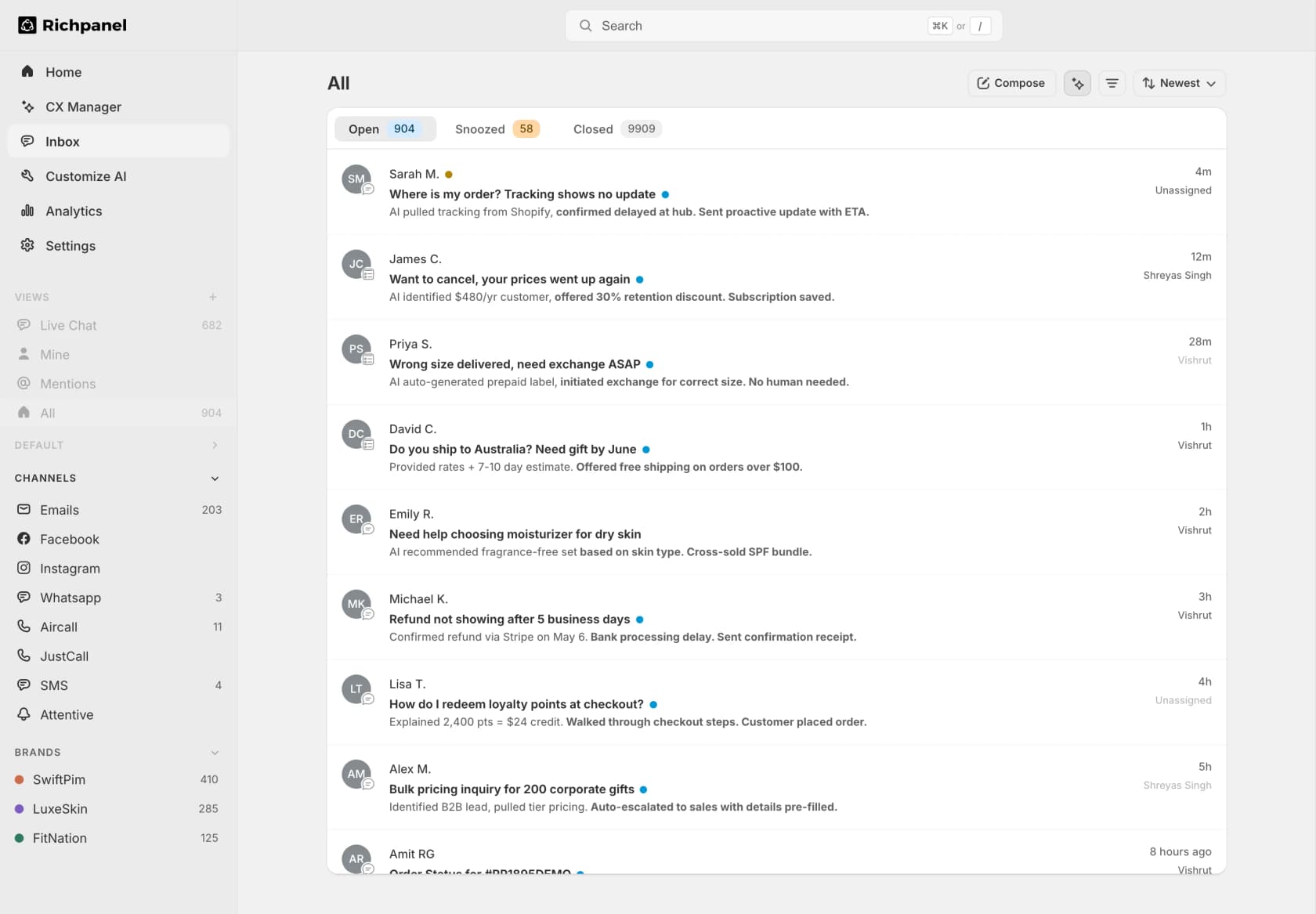
The AI agents resolve end-to-end (refunds, cancellations, order actions) rather than just deflecting, and there's a migration wizard for moving off Zendesk, Gorgias, Help Scout, or Kustomer. The commercial hook is the Double-Savings guarantee: hit at least 50% AI resolution in 30 days or get a full refund, with no proration even on an annual contract.
"72% decrease in ticket volume."
Mehtab S. Bhogal, Co-founder of Karta Ventures (Richpanel customer)
Pros
- One bill, no per-resolution charge on top of seats; averages around $0.20 per AI conversation on actual token use.
- A genuine money-back automation guarantee, which is rare.
- Ecommerce-native with a done-for-you migration.
Cons
- Pricing is demo-led (an interactive calculator, no self-serve checkout), so you still book a call to buy.
- Younger and smaller than the enterprise names here; best fit is DTC/Shopify, not regulated enterprise.
Pricing
| Component | Cost |
|---|---|
| AI handled conversations | from $200 / 1,000 conversations (~$0.20 each) |
| Helpdesk seats | $99 / seat / month |
| Example bill | $299/mo (1,000 AI conversations + 1 seat) |
| Annual | saves ~17% |
Our take: the strongest Richpanel argument is the guarantee, which flips the risk onto them. If you're an ecommerce team that got burned by add-on stacking, it's worth the demo. Enterprises with heavy compliance needs will want one of the platforms further down.
4. Tidio (Lyro)
Best for: small stores and SMB teams that want a genuine free tier and a printed per-conversation price.
Tidio is the most SMB-friendly option on this list, and its Lyro AI Agent is the direct Zowie alternative for smaller teams. Lyro is powered by Claude plus Tidio's own models, answers only from your support content to limit hallucinations, and posts a headline 67% resolution rate, backed by a money-back guarantee if it doesn't lift you to at least 50%.
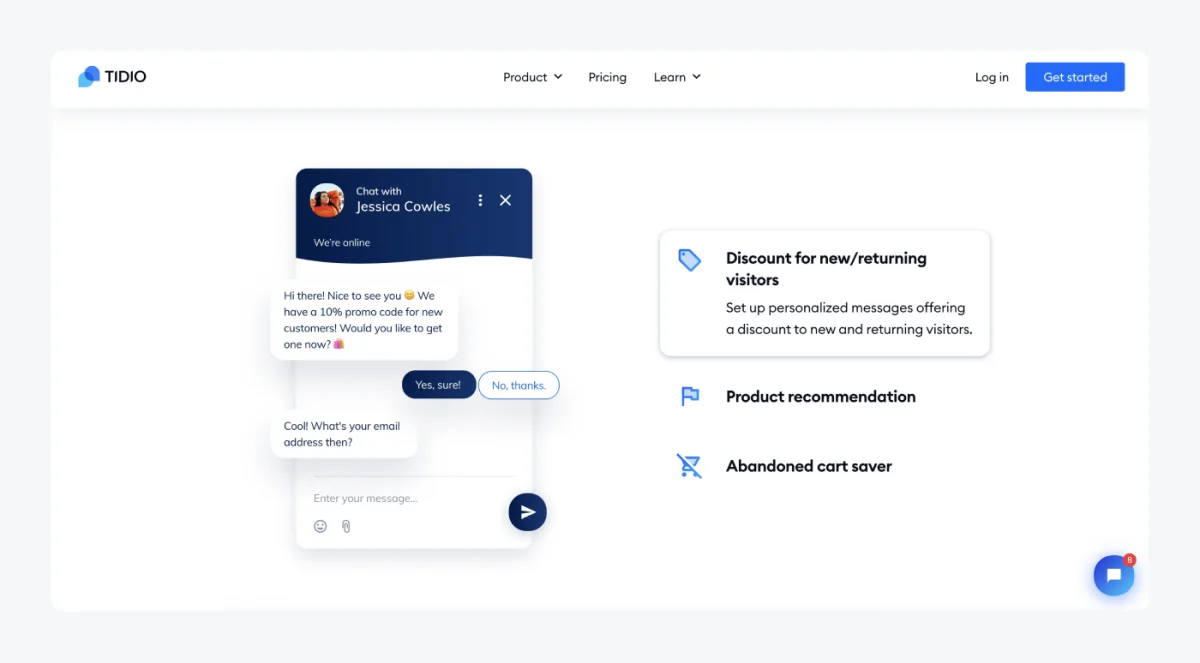
What makes it approachable is the pricing: Lyro is printed at $0.50 per conversation, you get 50 free Lyro conversations to start, and there's a free plan for the base help desk. You can also bolt Lyro onto Zendesk or Salesforce and pay only for AI conversations, so you don't have to migrate.
Pros
- Real free tier plus a clearly printed $0.50-per-conversation rate.
- Self-serve setup in a few clicks; feed it links, PDFs, or manual entries.
- Standalone Lyro option that layers onto your existing help desk.
Cons
- Cross-platform integrations (Zendesk, Salesforce, and 20+) require the Premium/Plus tiers.
- "Dozens of languages" is less precise than eesel's stated 80+, and per-message auto-detection isn't clearly documented.
Pricing
| Plan | Price (annual, monthly-equiv.) | Notes |
|---|---|---|
| Free | $0 | 50 billable convos, 50 Lyro convos (one-time) |
| Starter | $24.17/mo | 100 convos |
| Growth | from $49.17/mo | advanced analytics, automations |
| Lyro add-on | from $32.50/mo | $0.50 per AI conversation |
| Premium | Contact sales | guaranteed 50% resolution, pay-per-resolution |
Our take: the best low-commitment starting point for a small store. If you outgrow the SMB tiers or need more than "dozens" of languages, look at eesel or Gorgias.
5. Sierra
Best for: large, consumer-facing and regulated enterprises that want an outcomes-priced agent and have the budget to match.
Sierra is the enterprise heavyweight, co-founded by Bret Taylor (former Salesforce co-CEO and current OpenAI board chair) and Clay Bavor. It's built AI-first, meaning the agent is the product rather than a bolt-on to a ticketing system, and it now carries a $15.8B valuation after a $950M Series E.
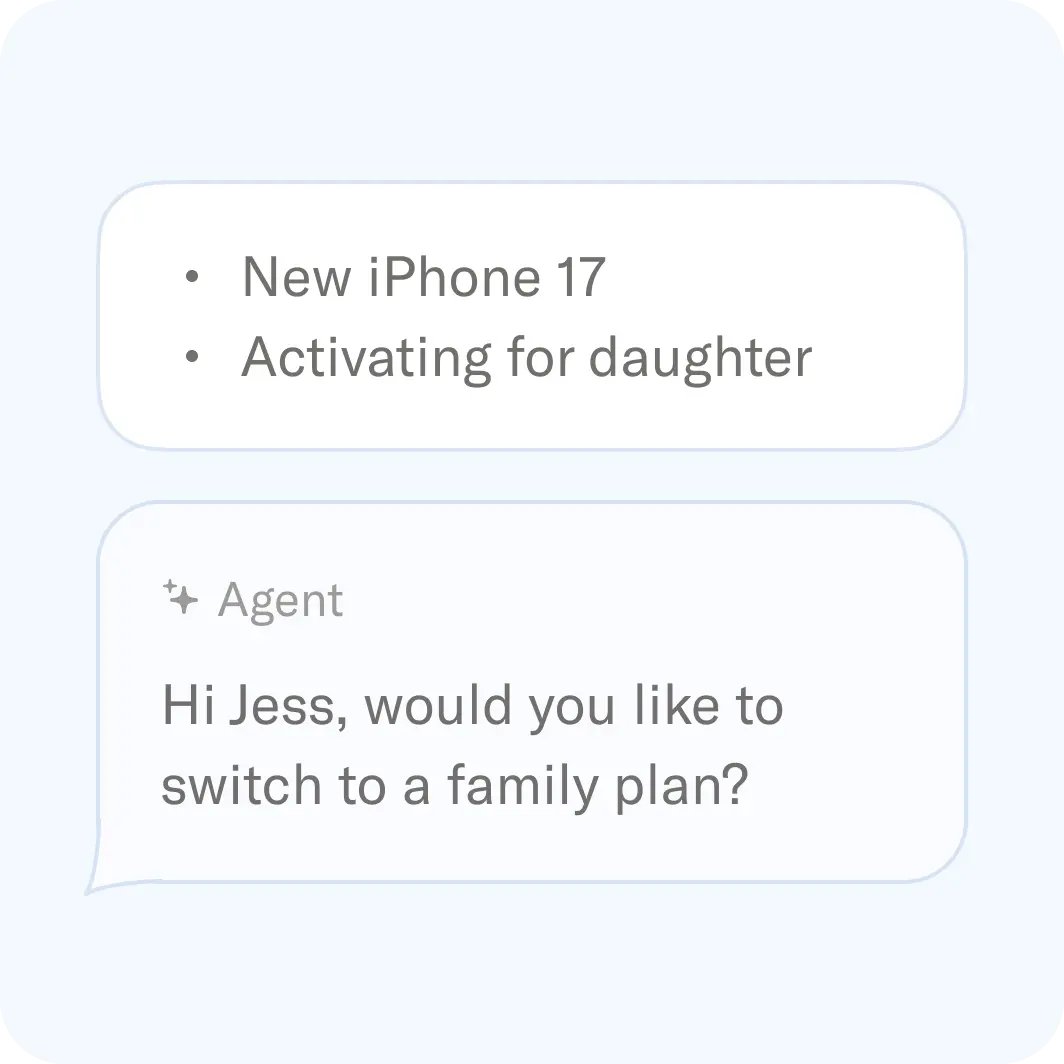
"We now have more than $1 billion to invest in becoming the global standard for companies wanting to transform their customer experiences with AI."
Sierra's real wedge is Ghostwriter (an agent that builds agents from SOPs and transcripts) and its outcomes-based pricing: you pay when the agent achieves the contracted outcome, which shifts implementation risk onto Sierra. It's one of the few vendors with ISO 42001 (an AI-specific management standard) on the homepage, and it serves 40%+ of the Fortune 50.
Pros
- Deepest enterprise credibility and compliance (SOC 2, ISO 27001, ISO 42001, HIPAA).
- Outcomes-based pricing aligns cost with results.
- Both a code-first Agent SDK and a no-code Agent Studio.
Cons
- No public pricing, no free trial, no self-serve; everything is a sales contact form.
- Squarely enterprise; overkill (and overpriced) for mid-market or SMB.
Our take: if you're a Fortune 500 with regulated workflows and a procurement team, Sierra is a serious choice. For everyone else, it's the same "quote-only, upmarket" pattern that made you leave Zowie, just bigger. And remember outcomes-based pricing is still a per-result meter, so model your peak season.
6. Decagon
Best for: high-volume enterprise CX teams that want to author agent logic in natural language.
Decagon is the other AI-native enterprise darling, valued at $4.5B after a $250M Series D in January 2026. Its technical wedge is Agent Operating Procedures (AOPs): natural-language instructions that compile into executable code, so CX operators can author agent logic while engineers keep guardrails and versioning.
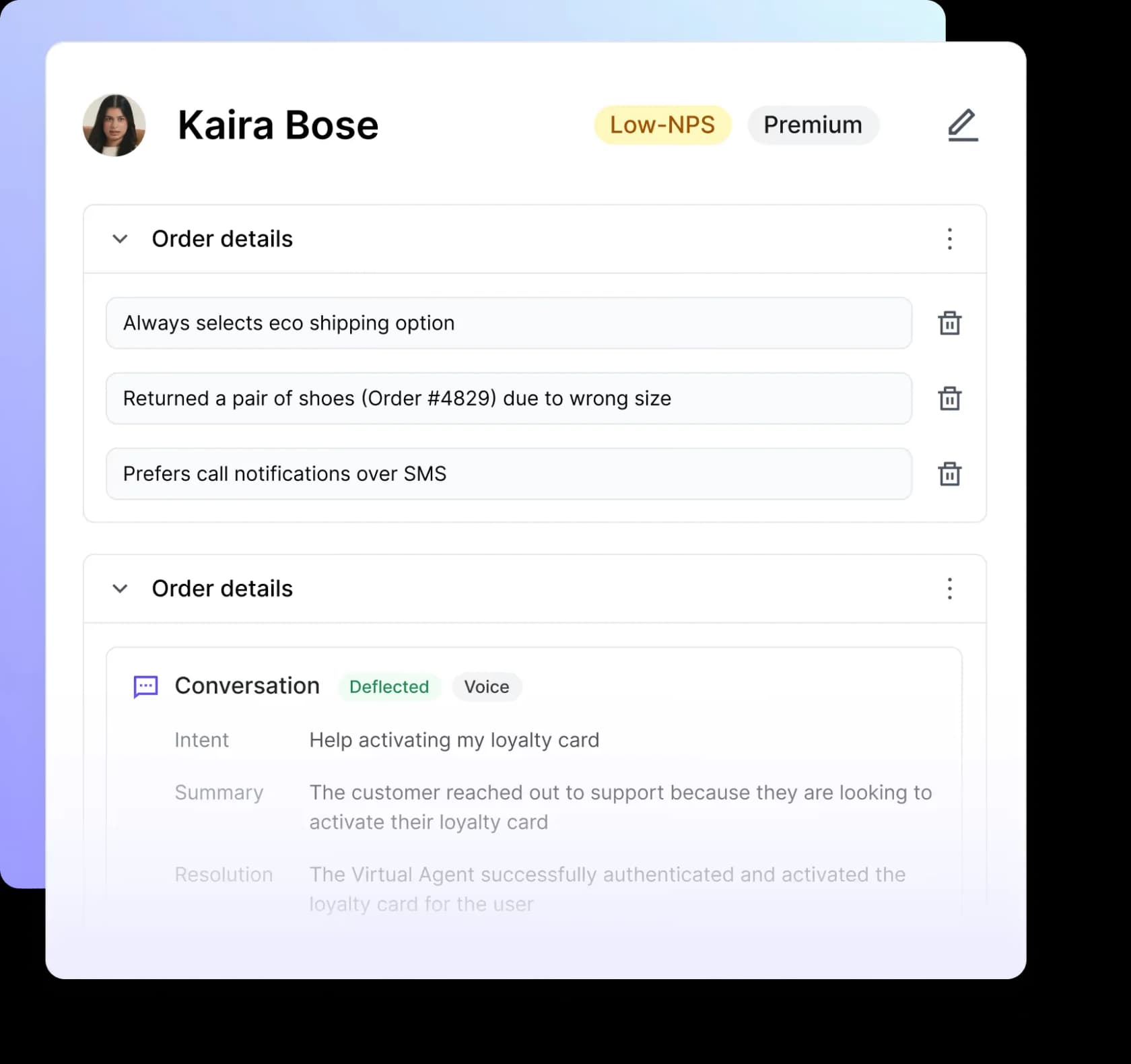
The customer roster is unusually brand-heavy for its stage: Chime hit 70% resolution across chat and voice, and Duolingo reports 80% deflection. One agent runtime spans chat, voice, email, SMS, and custom API surfaces, with the same knowledge across all of them.
Pros
- AOPs are a genuinely nice authoring model for non-engineers.
- True omnichannel parity, voice included.
- Strong observability (every model call and KB lookup traced) and QA tooling.
Cons
- Sales-led, volume-bracketed pricing (the demo form's ticket brackets start at "<9,999" and run to "250,000+"); no self-serve, no free tier.
- Aimed at mid-market-to-large enterprise; the deployment is a weeks-long project, not a Friday switch-on.
Our take: if you're high-volume and want operators (not just engineers) shaping the agent, Decagon is one of the best-built platforms here. But you're back in demo-and-procurement territory, so weigh that against the reasons you left Zowie.
7. Ada
Best for: large enterprises with 300,000+ annual conversations that want a standalone, multi-LLM agent layer.
Ada coined its own category ("Agentic Customer Experience") and is one of the longest-standing standalone AI CX platforms, a Toronto unicorn that raised a $130M Series C at a $1.2B valuation. Its Reasoning Engine orchestrates across multiple LLMs rather than betting on one, and it sits on top of helpdesks like Zendesk, Salesforce, and ServiceNow.

The catch is right there on the pricing page: Ada states it's "a great fit for companies with at least 300,000 annual customer service conversations." This is a deliberate enterprise gate. In return you get Playbooks (multi-step SOPs), Coaching (review the AI and it learns), an MCP-native developer toolkit, and one of the strongest compliance stories anywhere, including the AI-specific AIUC-1 certification and zero data retention with LLM providers. Monday.com cut average handle time 42%.
Pros
- Multi-LLM orchestration and a deep, AI-specific compliance posture (SOC 2, HIPAA, AIUC-1).
- Strong autonomous voice product and MCP support.
- Genuinely helpdesk-agnostic (layers on top of what you have).
Cons
- Explicitly not for SMB or low-volume mid-market; 300k+ conversations is the floor.
- No public pricing and no self-serve; sold as a services-wrapped enterprise engagement.
Our take: if you clear the 300k-conversation bar and want a vendor-neutral, multi-model agent, Ada is excellent. Below that volume, it isn't built for you, and you'll get more value from eesel or Tidio.
8. Maven AGI
Best for: enterprises automating complex, cross-system workflows on top of an existing helpdesk.
Maven AGI rounds out the enterprise set. Founded by ex-HubSpot CS leader Jonathan Corbin and backed by $78M including a $50M Series B led by Dell Technologies Capital, it positions Agent Maven as an intelligence layer between your data, the models, and your team, deploying on top of Zendesk, Salesforce, or Freshdesk.
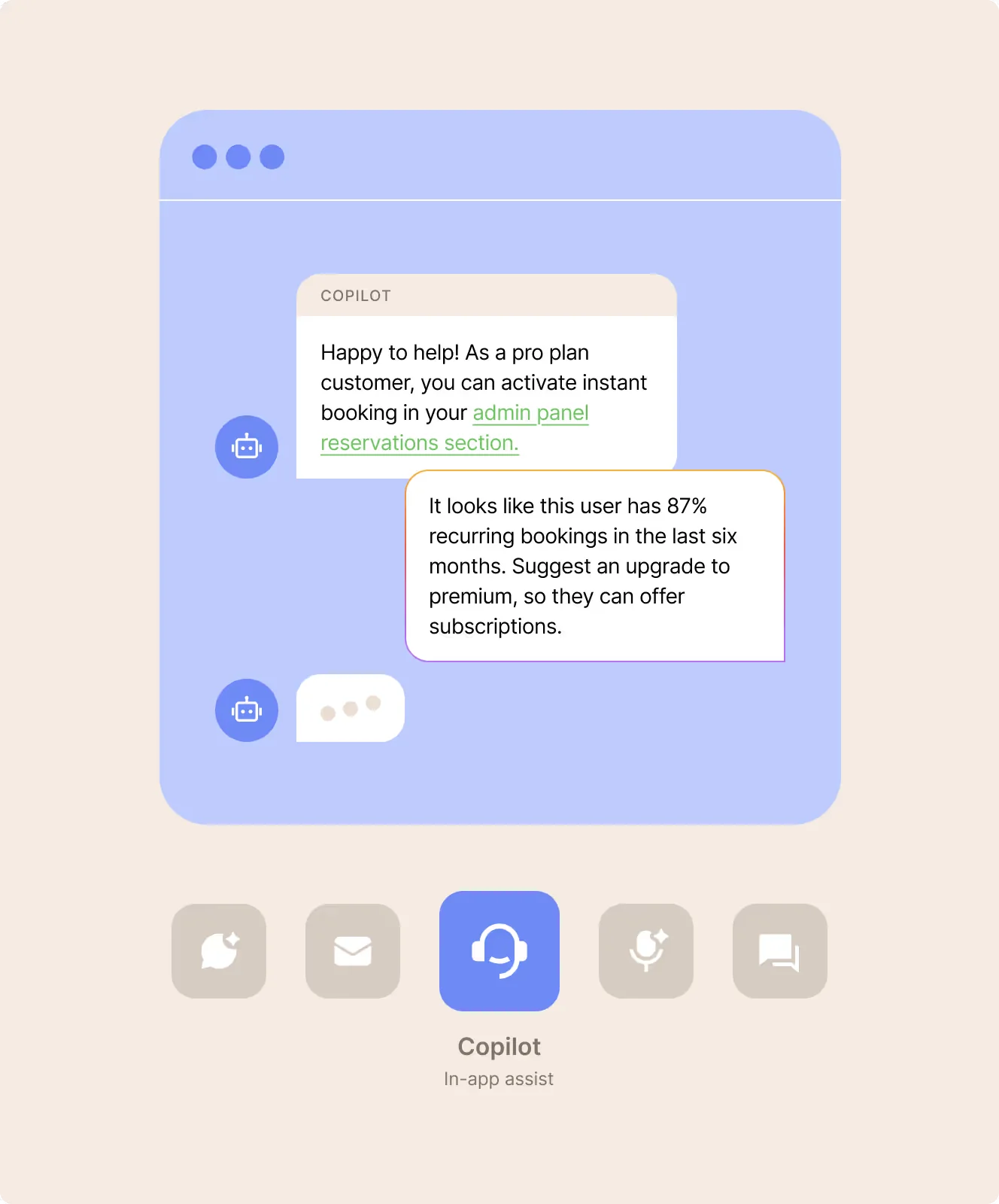
It claims up to 93% autonomous resolution and has real logos (Tripadvisor says it handles 90% of incoming queries). The compliance stack is broad (SOC 2, ISO 27001/27701/42001, HIPAA, PCI DSS). But the public track record is thin (~16 G2 reviews), and buyers name two friction points.
"Pricing is not good and Need continuous maintenance."
Pros
- Enterprise-grade compliance and a serious founding team.
- Layers on your existing helpdesk rather than replacing it.
- Handles complex, multi-system workflows well.
Cons
- No public pricing, no free tier, quote-only, exactly the pattern you're escaping.
- Reviewers flag ongoing tuning ("needs continuous maintenance") and a thin, young review base.
Our take: a credible enterprise option, especially if your workflows span many systems. But between the quote-only pricing and the maintenance overhead, it's a demo-cycle commitment, not a quick try.
9. Yuma AI
Best for: mid-size and high-volume DTC brands that want an AI agent on top of their current helpdesk and only want to pay for tickets it fully resolves.
Yuma AI is an ecommerce AI agent that layers on your existing helpdesk instead of replacing it. It connects to Shopify, Gorgias, Zendesk, Kustomer, Salesforce Service Cloud, Front and Gladly, and on the Shopify side it reads live order, inventory and customer data, then refunds, cancels, reships and tags orders. Yuma says it autonomously resolves up to 89% of conversations across pre-purchase questions, support tickets and social DMs, and its homepage shows a 4.8/5 rating on G2.
The pricing is the part that stands out next to Zowie: the outcome model comes with printed numbers. Yuma bills only for a "full resolution", meaning a ticket it handled end to end with no human involved, counted once. If an agent steps in, the ticket doesn't count, and escalations are never charged. Every plan carries a 12-month commitment, and on annual plans usage pauses when you reach your bundle instead of billing overage. Yuma labels the plan prices as illustrative and sizes your exact bundle to your forecast.
Pros
- Published plan prices and a plain definition of what you pay for.
- Works on top of the helpdesk you already run, including Gorgias and Zendesk.
- No per-seat fees, no implementation fee, and the first 30 days are free.
- SOC 2 Type II.
Cons
- Every plan is a 12-month commitment, and the entry plan is $14,400 a year paid upfront, which is a bigger first step than a monthly tool.
- Each plan's button is "Book a demo," so buying still goes through a sales call.
- It's purpose-built for ecommerce and DTC, so SaaS or IT support teams are outside its focus.
Pricing
| Plan | Price (annual, paid upfront) | Notes |
|---|---|---|
| Starter | $14,400/yr | 12,000 resolutions (~$1.20 each); monthly plan bills $1.50 per over-quota ticket |
| Growth | $40,000/yr | |
| Scale | $90,000/yr | |
| Higher volume | Custom | rate drops toward a $0.55 floor past 120,000 resolutions a year |
Our take: if you liked Zowie's ecommerce focus but want to keep your helpdesk and see the price per resolution up front, Yuma belongs on the shortlist. The annual commitment is the main thing to weigh. If you want a monthly plan you can start yourself, eesel or Tidio is the lighter first step.
Where these land against each other
If you zoom out, the nine tools split cleanly along two axes: ecommerce-first versus enterprise, and self-serve/transparent versus sales-led/quote-only. Zowie sits in the bottom-right (enterprise, quote-only), which is exactly why an ecommerce or mid-market team feels the squeeze.
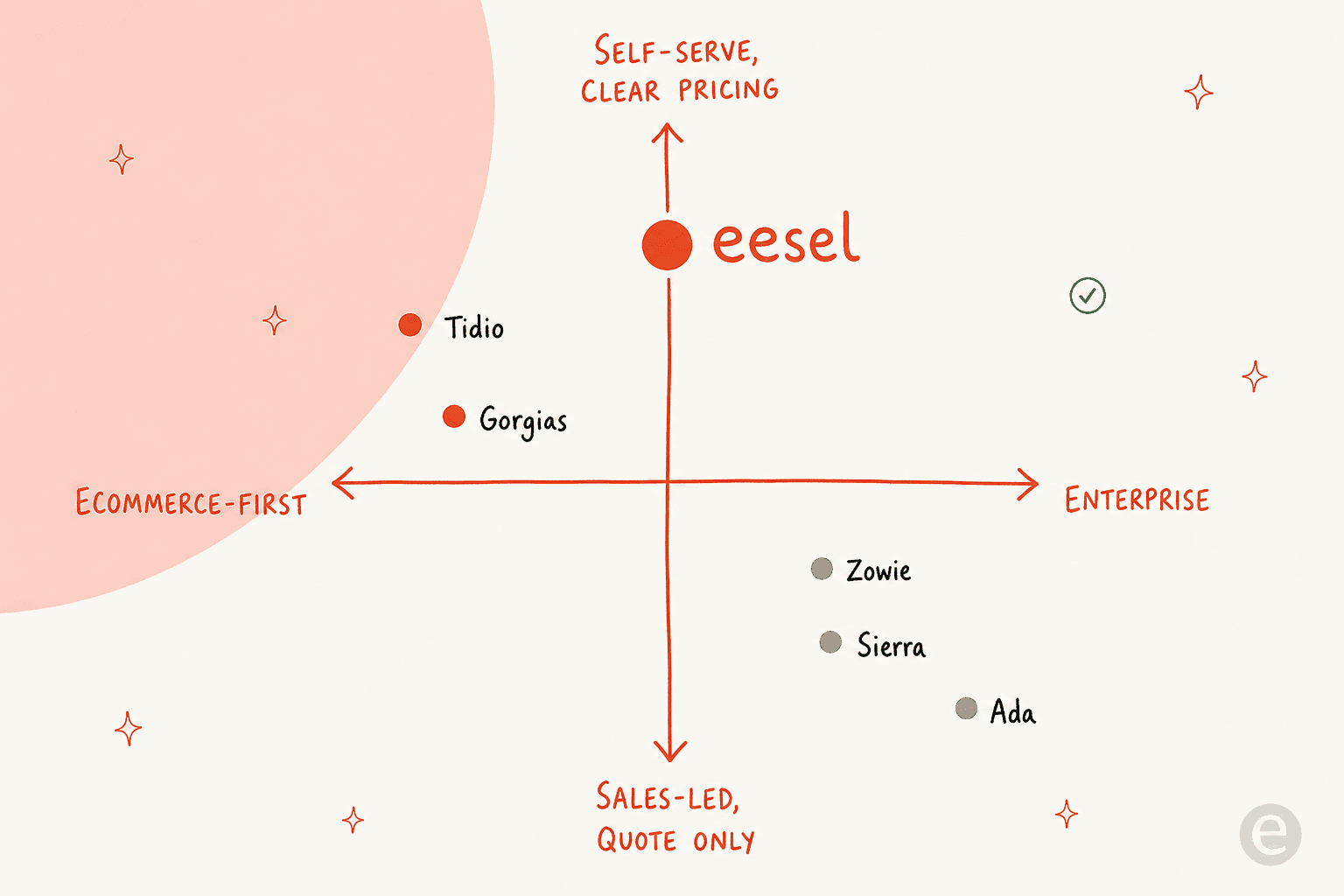
The pattern worth noticing: most of the "AI-native enterprise" alternatives (Sierra, Decagon, Ada, Maven AGI) share Zowie's quote-only, sales-led motion. They're bigger and more capable, but if the reason you're leaving is the black-box pricing and the heavy rollout, swapping Zowie for another enterprise platform doesn't fix that. The tools that actually change the buying experience are the ones with a number on the page and a trial you can start yourself.
Try eesel AI
If you've read this far, you're probably a support or ecommerce team that wants Zowie's automation without Zowie's sales cycle. That's the gap eesel AI is built for. It plugs into the helpdesk you already run (Zendesk, Freshdesk, Gorgias, Front, and 100+ more), learns from your past tickets and docs, and lets you simulate the agent on your real history before it ever answers a customer, so you see the resolution rate first, not after you sign.
And the pricing is the whole point: a fixed monthly price from $299/month, with no per-seat fees, so your November bill doesn't punish you for a good Black Friday. You can start on the free plan with 100 credits and no credit card. Running a store? The ecommerce agent connects to Shopify and takes real order actions. Try eesel and see your own resolution rate this week.