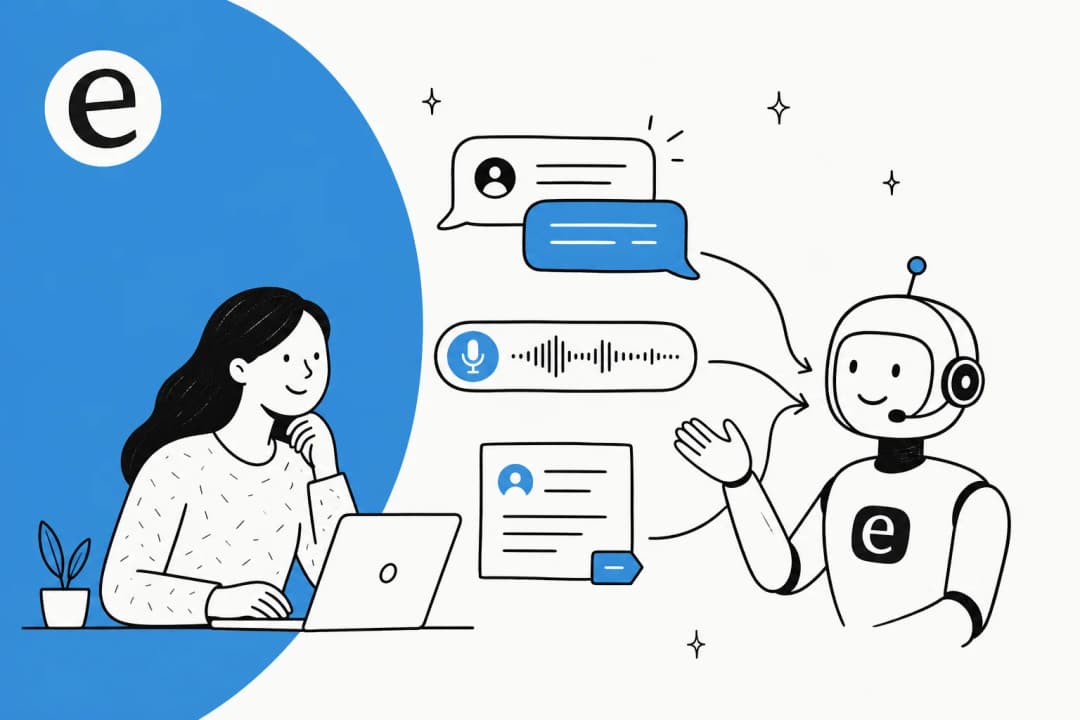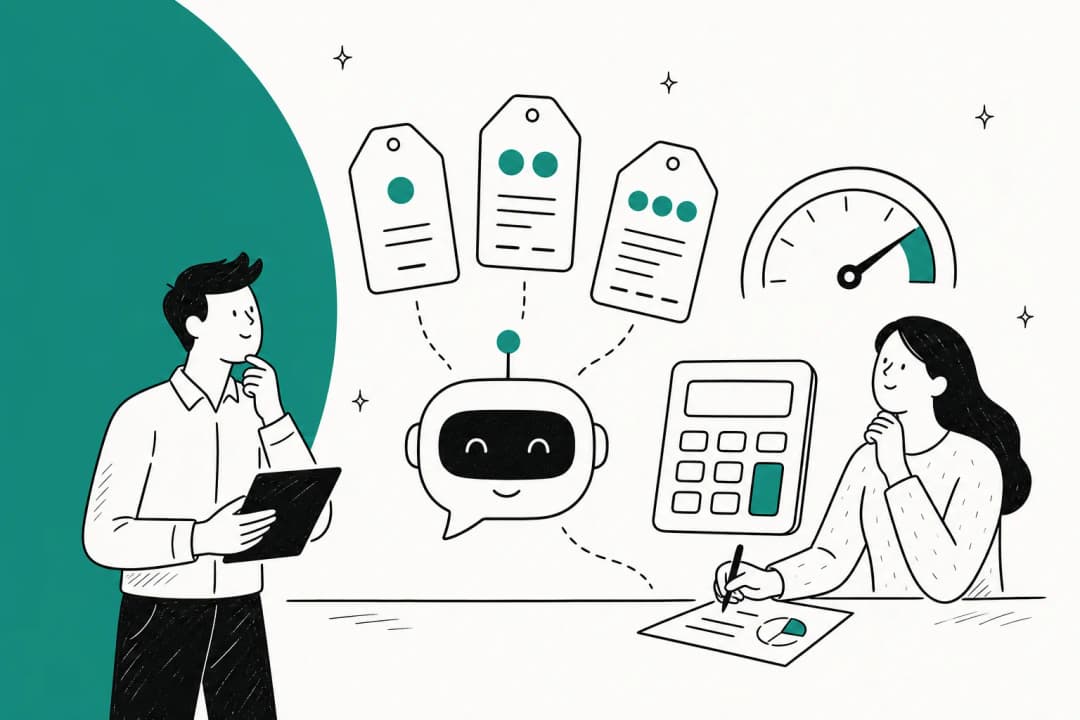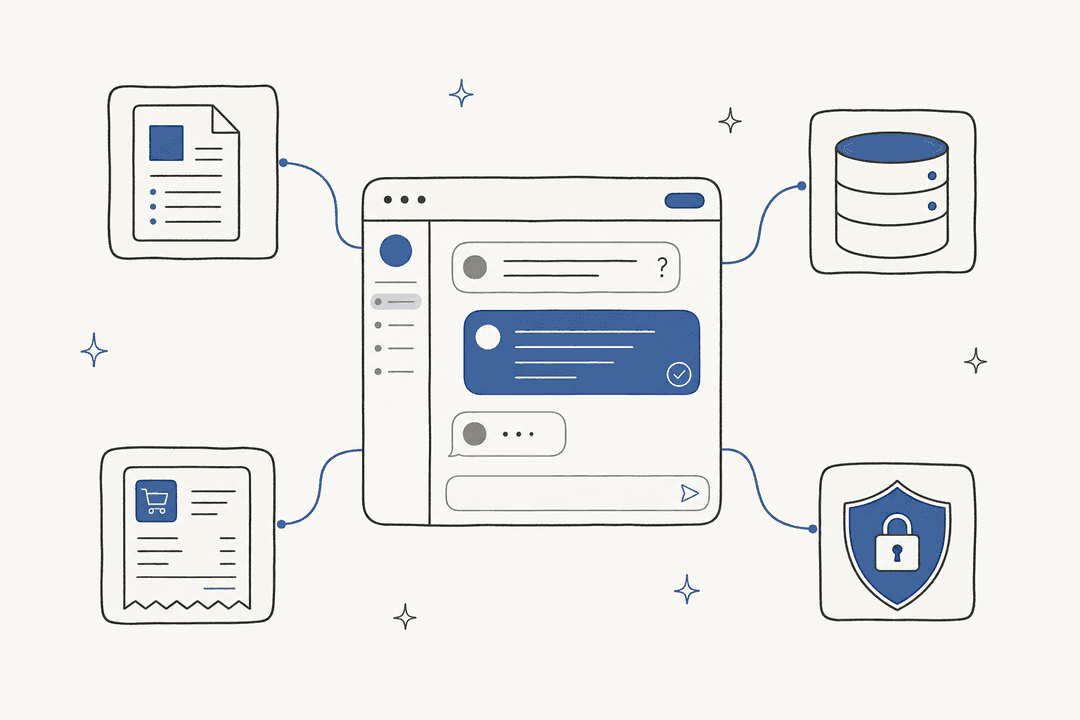

A rule-based chatbot is a good fit when the next step is known in advance. An AI agent is useful when the next step depends on what the customer means, what the available evidence says, and which tools are permitted.
Neither label proves that a product can handle your workflow. A scripted bot can call an API. An AI agent can give a wrong answer. The useful comparison is how each system chooses its next step, what happens when information is missing, and how your team controls the result.
This guide explains the difference, then shows how to evaluate an eesel teammate through eesel CLI. The CLI gives a person, script, or coding agent access to the same teammate and workspace as the dashboard.
What is a rule-based chatbot?
A rule-based chatbot follows predefined conditions and conversation paths. A customer selects “Track my order,” supplies the required details, and the bot follows the configured lookup and response steps. IBM's chatbot overview distinguishes these scripted flows from systems that use AI to interpret a wider range of requests.
A rule-based flow does not have to be a static FAQ. Developers can connect it to databases, appointment systems, or order APIs. Its defining feature is that the decision path is specified ahead of time, not that it cannot take action.
Where rules work well
Rules are useful for structured intake, fixed eligibility checks, required notices, and a small number of known choices. They can make the permitted paths easy to inspect.
For example, a booking flow can ask the customer to choose a location, service, and available time slot. Adding free-form reasoning may provide little value if those three choices are all the process needs.
The maintenance burden grows when customers introduce combinations the designer did not anticipate. A bot might recognize an order-status request but not understand that the customer already received one item and is asking about the missing second parcel. You then need another branch, better input handling, or a human fallback.
What is an AI agent?
An AI agent can choose steps toward a goal using the information and tools available to it. Modern customer-support agents commonly use language models to interpret requests, retrieve relevant information, and decide whether to answer, use a tool, or involve a person. IBM's AI agent overview describes goal-directed systems that act on their environment.
This flexibility does not remove the need for rules. Your refund policy, identity checks, action permissions, and escalation requirements still apply.
For a missing-parcel question, an agent might inspect fulfillment information, notice a split shipment, and explain which item is still in transit. A refund is a separate action requiring the right integration, policy conditions, and permissions. Do not assume the agent can or should issue one simply because it understands the complaint.
What an agent does not automatically provide
- Correctness: A fluent answer may still lack supporting evidence.
- Persistent learning: A correction in one chat does not establish that saved instructions or knowledge changed.
- Access: The agent can use only the data and tools actually connected and authorized.
- Autonomy: Some actions may remain off or require approval.
- Cross-conversation memory: Retention and access depend on the product and configuration.
These are features to inspect and test, not promises inherent in the word “agent.”
AI agent vs rule-based chatbot at a glance
| Question | Rule-based chatbot | AI agent |
|---|---|---|
| How is the next step chosen? | Predefined conditions and branches | Interprets the request and selects from permitted steps |
| How are unusual phrasings handled? | Depends on configured input matching | Can interpret more varied language, but can misinterpret |
| Can it call business APIs? | Yes, if configured | Yes, if tools and authorization are available |
| What needs maintenance? | Branches, integrations, and response content | Knowledge, instructions, integrations, permissions, and evaluations |
| What happens outside scope? | A configured fallback is needed | A tested escalation or refusal is still needed |
| Does it improve automatically? | Changes normally need deliberate updates | Do not assume feedback changes persistent behavior |
| How should cost be judged? | Build and maintenance plus operation | Usage and maintenance plus remaining human work |
The comparison is not “rules versus no rules.” It is a fixed conversation path versus more flexible interpretation inside defined boundaries.
Compare both on the same customer request
Consider a fictional customer who writes:
“The shoes arrived, but the bag from the same order didn't. The tracking page says delivered. Can someone check?”
A rule-based bot can handle this well if its flow supports partial shipments. It can collect the order identifier, check the configured fulfillment fields, and route an unresolved case. If its only branch treats “delivered” as the end of the process, it may miss the customer's actual problem.
An AI agent may connect the clues and inspect the separate fulfillments. But it still needs the correct order data. It should not invent a second tracking number or promise a replacement without evidence and authority.
Evaluate both systems on the result:
- Did they identify the missing item rather than repeat the whole-order status?
- Did they use the authorized customer's order?
- Did they distinguish confirmed facts from missing information?
- Did they take only permitted actions?
- If a person was needed, did that person receive the relevant context?
A natural-sounding reply alone is not enough to pass.
Test the difference through eesel CLI
The eesel CLI is an agent-friendly way to operate your eesel teammate. People can use it from a terminal, scripts can inspect JSON output, and coding agents such as Claude Code, Cursor, or Codex can help with setup and review. Changes apply to the same workspace your support team sees in the dashboard.
For this comparison, use it to inspect the saved rules and test how the teammate handles an exception. That is more informative than asking whether the product is “truly agentic.”
Inspect the agent before testing
For an existing workspace, start with Node.js 18.17 or newer:
npx @eesel/cli login
npx @eesel/cli whoami
npx @eesel/cli agents
Replace AGENT_ID with the intended teammate's ID:
npx @eesel/cli instructions --agent AGENT_ID
npx @eesel/cli integrations --agent AGENT_ID
npx @eesel/cli automations --agent AGENT_ID
Check the actual knowledge sources, connected systems, and enabled triggers. A source being connected does not prove it contains the required policy or that every download is complete. Use npx @eesel/cli status --agent AGENT_ID to inspect connection and download state, then check the relevant content.
Review action permissions in the dashboard before sending a test. CLI chat can invoke actions. Keep consequential actions off or subject to approval while you evaluate the reasoning.
Give it a bounded fictional case
npx @eesel/cli new --name "rule-exception-review" --agent AGENT_ID
npx @eesel/cli chat "For a fictional order, the shoes arrived but the bag is missing, while the order-level tracking says delivered. Explain what information is needed before deciding the next step. Use our support policy, mark any missing evidence, and do not look up real customers or change records." --agent AGENT_ID
This prompt tests the explanation and information requirements. It does not verify a live order lookup or end-to-end resolution. The instruction not to change records expresses intent; the configured permissions provide the control.
Look for a response that separates the items, requests or identifies the necessary fulfillment information, and avoids promising a refund or replacement. If the policy is absent, an honest gap is preferable to a fabricated answer.
Then test the actual permitted lookup in a controlled helpdesk case. Confirm both the retrieved information and the resulting customer-facing response.
Check what persisted and what actually happened
npx @eesel/cli activity --agent AGENT_ID
npx @eesel/cli approvals --agent AGENT_ID
npx @eesel/cli instructions --agent AGENT_ID
An approval waiting for a person is not an executed action. An activity entry is not proof that the customer got a correct answer; compare it with the actual case.
If a test reveals a missing policy, you can upload an approved local document with npx @eesel/cli files upload ./shipping-policy.pdf --agent AGENT_ID. Replace that path with your file. Uploading adds knowledge, not a standing rule or permission to issue refunds.
If a standing instruction needs changing, run npx @eesel/cli instructions --help for the current editing options, then read the saved version back with npx @eesel/cli instructions --agent AGENT_ID. Repeat the original case and a nearby exception in a fresh conversation. A successful correction within one chat does not prove later conversations will behave correctly.
Let a coding agent help with the review
A useful bounded request is: “Inspect this eesel teammate's instructions and automations. Identify conflicting shipping rules and cases that require a person. Report the findings without editing configuration.”
The coding agent can work with the CLI's structured output while a support lead reviews the same setup in the dashboard. The prompt does not alter eesel permissions. For scripts, select the agent explicitly, keep EESEL_API_TOKEN secret, and verify the intended EESEL_API_URL.
For writes, --dry-run prints the server request without sending it. It does not simulate a customer conversation or prove that an action will succeed.
When to choose rules, an agent, or both
Choose a rule-based flow when the path is known
A fixed flow can be the simpler option when customers need a few explicit choices, a standard form, or a prescribed sequence. Keep it if it works and is easy to maintain.
That does not make it inherently compliant or secure. Authentication, authorization, logging, and error handling still need their own checks.
Choose an AI agent when interpretation adds value
An agent is worth evaluating when customers describe the same problem in many ways, questions combine several topics, or selecting the next step depends on retrieved evidence.
Start with a narrow category and measure correctness, human effort, reopens, and handoff quality. The presence of integrations alone is not a reason to choose AI; a fixed workflow can use integrations too.
Combine them when different steps need different controls
You can use fixed checks for eligibility or required fields while an AI agent interprets the question and explains the result. A person can retain approval of consequential actions.
If two separate bots are active, define who owns the conversation and how control passes between them. Otherwise both may reply, repeat questions, or act on stale context. Verify the handoff in the actual channel rather than relying on a diagram.
Compare costs without assuming one model wins
A small rule-based flow can be inexpensive to operate, but maintaining many branches takes time. An AI agent adds usage and evaluation costs, while potentially reducing manual handling. Either can be the better choice depending on the workload.
eesel's pricing documentation lists regular tasks, including support tickets and chat sessions, at $0.40 each on pay as you go, with no platform fee, monthly minimum, or per-seat fee. That is a task price, not a guarantee of resolution.
Compare the total cost of the same cases, including escalations and maintenance. Do not compare an ROI percentage with a deflection percentage: they measure different things.
Start with one exception worth handling better
Pick a case your current bot gets wrong for a clear reason, such as the split-shipment example. Keep the parts of the existing process that work. Test whether an agent handles the missing context better without exceeding its permissions.
Try eesel and use eesel CLI to inspect the rules, test the explanation, and review the resulting activity. The goal is a reliable next step for the customer, not replacing every rule with AI.
Frequently Asked Questions
What is the main difference between an AI agent and a rule-based chatbot?
Can a rule-based chatbot call an API?
Do AI agents automatically learn from every conversation?
How does eesel CLI help compare the approaches?


Article by
Riellvriany Indriawan
Riell is a designer and writer at eesel AI with about two years of experience researching CX platforms, AI chatbots, and helpdesk software. She combines her design background with a sharp eye for how these tools actually look and feel in practice — making her comparisons unusually visual and user-focused.