

Why teams leave Dixa in the first place
Let's give Dixa its due first. It is an agentic, omnichannel customer service platform trusted by 850+ brands across 42 countries, with names like Rapha, Mejuri, and AllSaints on the roster. Its native voice channel is very good (one reviewer clocked "98% of the calls going without interruptions"), and around 70% of its customers migrated over from Zendesk. On aggregate review scores it sits at a respectable 4.2 out of 5 across 391 G2 reviews, and our own Dixa review for support teams goes deeper on where it shines. The product is well liked.
The friction is commercial. Read the low-star reviews and a pattern jumps out: almost none of them are about the software. They are about how Dixa is sold and billed.
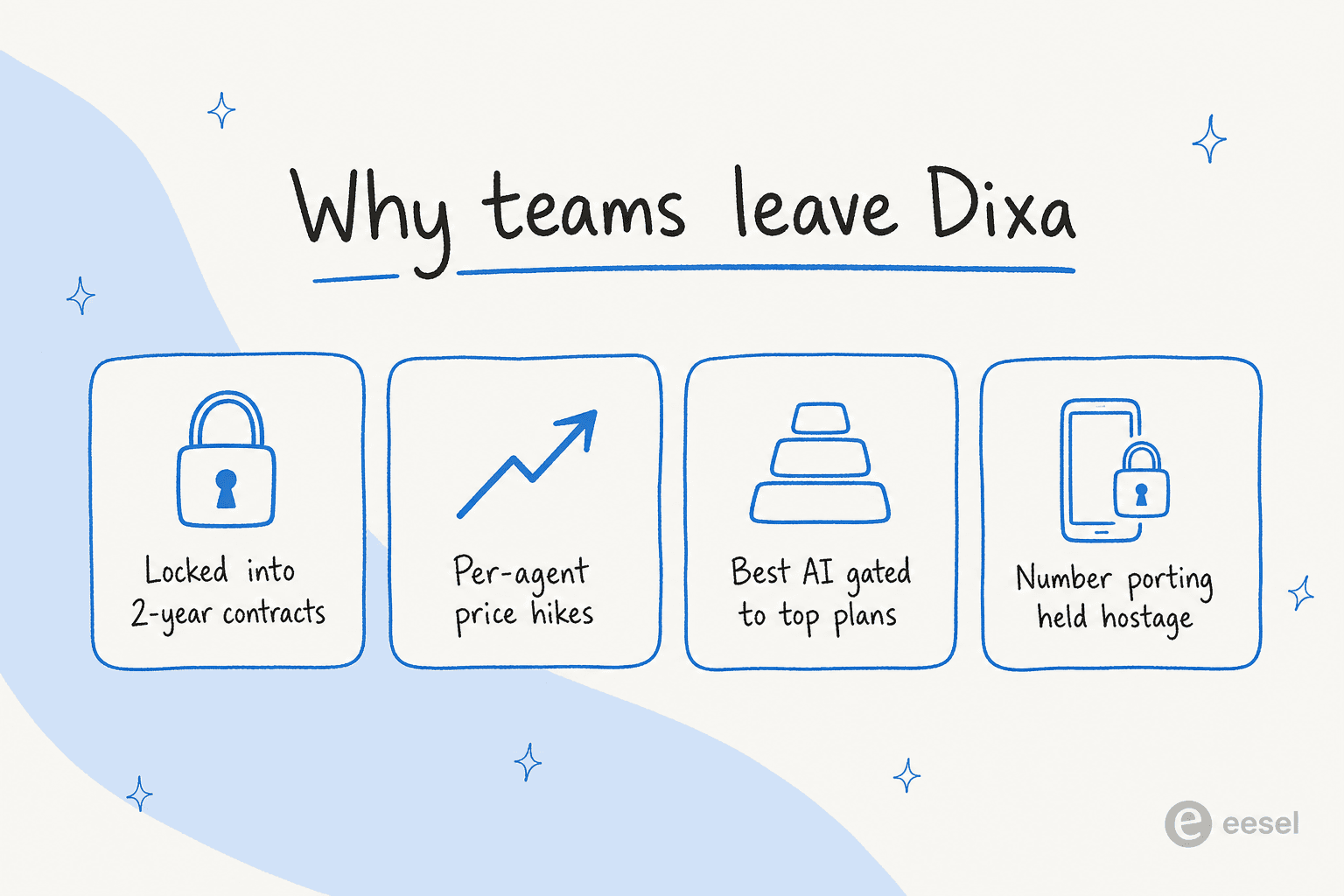
The single most repeated complaint is contract lock-in tied to upgrades. One manager described what he called a "trick-sale" upgrade:
"It started off fine with big promises and no limits to what the software could do... I feel I have been tricked into an upgrade, and a new 2-year binding period, despite our previous commitment... we have now found another solution and closed our connection to Dixa, even though we still have to pay a long time for software that we can not use."
Rune F., Manager, Printing, 2/5, on Capterra

The sharpest review takes aim at how Dixa handles ported phone numbers, the very thing that makes its voice channel sticky:
"They didn't want to give us our ported number back to keep us in the contract... They lock you in and you cannot escape. DO NOT PORT YOUR NUMBER! THEY USE IT TO KEEP YOU WITH THEM!"
Verified reviewer, titled "Scam", 1/5, on Capterra
Then there's the AI question. Dixa's customer-facing agent, Mim, claims to resolve up to 80% of inquiries autonomously, and its AI Co-Pilot drafts replies for human agents. But the powerful parts are paywalled. As CloudTalk's 2026 pricing teardown puts it, "Dixa gates its most powerful AI and automation features behind its Ultimate and Prime tiers," and the platform offers "no AI tools or automation without add-ons". That matters because AI is exactly why most teams are shopping for a new platform in 2026, and being told the good stuff costs extra (with no published price) is a hard sell.
Put a real team through it: ten agents on Dixa's Ultimate plan is €139 × 10 = €1,390 a month before you've added a cent of AI, and the AI add-on price only appears after a sales call. For a lot of teams, that "talk to sales to find out what AI costs" model is the dealbreaker, not the product.
How the alternatives actually differ: the billing model
When you compare these tools, the feature lists blur together. The thing that actually changes your bill, and your risk, is how each one charges for AI.
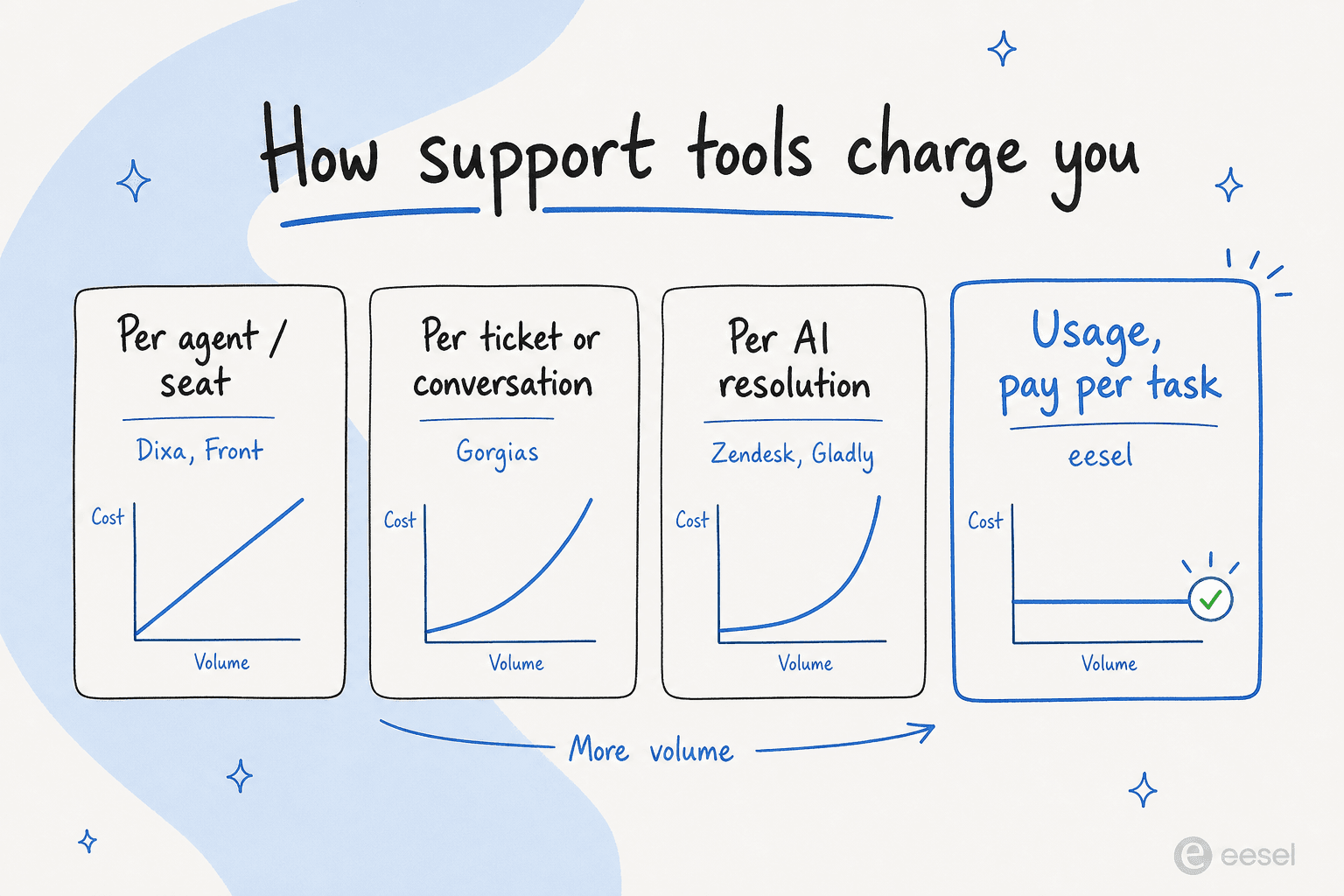
There are four broad models, and they scale very differently:
- Per agent / seat (Dixa, Front): predictable, but you pay for AI even on tickets it never touches, and costs climb with headcount.
- Per ticket or conversation (Gorgias): your bill tracks volume, which can sting in a busy season.
- Per AI resolution (Zendesk, Gladly): you pay each time the AI closes something, and these per-unit fees stack fastest.
- Usage-based, pay per task (eesel): you pay for work done with no per-seat fee, which tends to be flattest as you scale.
None of these is automatically "best", but the per-resolution model is the one that surprises finance teams, because a successful AI rollout (more resolutions) directly means a bigger bill. We dig into the math in our piece on AI agent vs human agent cost. Keep the billing model in mind as you read each option below.
The 8 best Dixa alternatives at a glance
| Tool | Best for | AI billing model | Entry price | Free trial | Native voice | G2 rating |
|---|---|---|---|---|---|---|
| eesel AI | Adding AI to your existing helpdesk | Usage, pay per task | $0.40 / task, no seat fee | Yes ($50 credit) | Via helpdesk | New entrant |
| Gorgias | Shopify and ecommerce brands | Per resolved conversation | $10 / mo (50 tickets) | Yes | No (add-on) | 4.6 (560+) |
| Gladly | Premium DTC and retail | Per AI resolution | Quote-only | 30-day (Shopify app) | Yes | 4.7 (1,112) |
| Kustomer | High-volume B2C with a CRM model | Per engaged conversation | Quote-only | No self-serve | Yes (PAYG) | 4.4 (555) |
| Zendesk | Mid-market and enterprise all-rounder | Per automated resolution | $19 / agent / mo | 14-day | Voice add-on | 4.3 (6,837) |
| Freshdesk | Value-focused full suite | Per AI session | $19 / agent / mo | 14-day + free tier | Add-on (Freshcaller) | 4.4 (Capterra) |
| Front | Complex cross-team operations | Per conversation (Autopilot) | $25 / seat / mo | 14-day | No | High Performer (G2) |
| Zoho Desk | Budget teams and Zoho users | Bundled (Zia) | $7 / agent / mo | 15-day + Free plan | Telephony | Gartner 4.5 |
A quick note on how to read this: the tools split cleanly into three camps. There are the full-platform replacements (Zendesk, Freshdesk, Zoho Desk, Front), the ecommerce and consumer-brand specialists (Gorgias, Gladly, Kustomer), and the AI layer you add on top (eesel AI). Which camp you're in matters more than any single feature.
1. eesel AI
Best for: teams that like their current helpdesk and want to add real AI without a migration.
Every other tool on this list asks you to move in. eesel AI takes the opposite bet: instead of replacing your helpdesk, it sits on top of the one you already run, whether that's Zendesk, Freshdesk, Gorgias, Help Scout, or just a shared inbox. You connect your existing tools and knowledge, and an autonomous AI agent for customer service starts drafting and resolving tickets inside the interface your team already uses. For a team that's frustrated with Dixa's commercials but dreads ripping out a platform, that's the lowest-risk path forward.

The pitch is that briefing an eesel agent feels less like configuring a bot and more like onboarding a new hire: you give it plain-language instructions, point it at your past tickets and docs, and it learns your tone and escalation rules. It can resolve tickets at scale (eesel cites teams handling 100,000+ tickets a month), and you can run it in a simulation mode over historical tickets before it ever touches a live customer, so you know your resolution rate up front.
Pros:
- Runs inside your existing helpdesk and inbox, so there's no migration and no retraining.
- Usage-based pricing with no per-seat fee, so the cost doesn't balloon as you add agents.
- Self-serve trial with credit included; you don't have to book a demo to find the price.
Cons:
- It's an AI layer, not a full ticketing system with native voice, so you keep your helpdesk for the system-of-record work.
- As a newer entrant, it doesn't carry the thousands of legacy reviews the incumbents do.
Pricing: Usage-based at roughly $0.40 per regular task (a ticket or chat handled), with no seat fees, no platform fee on self-serve, and a spend cap you set yourself. Annual commitments over $300/month get 25% off. Full detail on the pricing page.
Our take: If the thing driving you off Dixa is the commercial model (gated AI, opaque pricing, lock-in), eesel is the most direct answer, because it removes the migration entirely. Pick it if you want to keep your stack and add automation; skip it if you specifically need to replace your helpdesk and want native phone support in the same product.
2. Gorgias
Best for: Shopify and ecommerce brands that live and die by order data.
Gorgias is the most ecommerce-native platform here. It powers 40% of the top 1,500 Shopify brands and is Shopify's only Premier Partner for CX, and the reason is its integration depth: order history, product catalog, refunds, and subscription edits all live inside the ticket, so agents (and the AI) never tab away to Shopify. If Dixa's ecommerce angle is what drew you in, Gorgias does that part better.
Its AI Agent runs in two modes, a pre-purchase shopping assistant and a post-purchase support agent, and Gorgias claims it can automate around 60% of support. Community sentiment backs the Shopify story: on G2 it scores 4.6 out of 5 from 560+ reviews, and even skeptics concede the Shopify integration is best-in-class.
Pros:
- The deepest Shopify integration on the market, full stop.
- Priced by ticket volume, not seats, so you can add unlimited agents.
- Strong proactive-sales features (chat campaigns, discount delivery) that tie support to revenue.
Cons:
- The AI Agent bills $0.90 to $1.00 per resolved conversation on top of your plan, which adds up.
- Reddit's recurring objection is cost: it runs roughly 3x Zendesk for similar volumes, and only pays off if a big chunk of your tickets need real Shopify actions.
Pricing: Five volume-based plans: Starter $10/mo (50 tickets), Basic $60 (300), Pro $360 (2,000), Advanced $900 (5,000), and custom Enterprise. The AI Agent is a per-resolution add-on. See our Gorgias pricing breakdown for the full math.
Our take: For a Shopify-first brand, Gorgias is the obvious Dixa replacement and probably the strongest pick on this list. The catch is the same per-resolution billing we flagged earlier, so model your ticket volume first. If the price gives you pause, our Gorgias alternatives guide covers the cheaper routes, including running eesel's AI on top of Gorgias itself.
3. Gladly
Best for: premium DTC and retail brands that want voice and a lifelong customer view.
Gladly shares Dixa's "people, not tickets" philosophy but takes it further. Its whole model is one continuous conversation per customer across chat, voice, email, SMS, and social, rather than discrete tickets, and it markets itself as "the only AI built for LTV" (lifetime value) rather than deflection. The customer roster (TUMI, UGG, Crate & Barrel, Nordstrom, Bombas) tells you exactly who it's for: premium consumer brands where every interaction is a retention moment.
Its AI agent, Sidekick, takes real actions (cancel order, process a return, apply a price adjustment) and Gladly claims it resolves 76% of conversations. Users clearly rate it: it holds a 4.7 out of 5 across 1,112 G2 reviews, the highest score in this lineup. The most consistent praise is the unified customer profile, where nobody has to repeat themselves.
Pros:
- The strongest native voice story here besides Dixa itself, with AI handling phone calls.
- A truly unified, channel-agnostic customer profile that reviewers love.
- Top-rated on G2 (4.7) with a clear premium-brand focus.
Cons:
- Price is the most consistent complaint; the per-seat, flat-rate model is "less flexible for small businesses."
- The #1 functional gripe is fragmented reporting that often needs manual Excel exports.
Pricing: Mostly quote-only. The only public figures are on its Shopify app: a 30-day free trial (100 AI interactions), then a $250/month cap plan billing $1.50 per AI resolution, $0.25 per AI assist, and $120 per seat per month. Third-party sources put the core platform around $180 to $210 per seat.
Our take: Gladly is a fantastic Dixa alternative if you're a mid-to-large premium retail brand that really needs AI-powered voice and is willing to pay for it. Smaller teams will hit the same "too expensive, no transparent pricing" wall that pushed them off Dixa, so go in clear-eyed about the budget. If you're weighing AI against headcount here, our take on AI vs human customer support is worth a read.
4. Kustomer
Best for: high-volume B2C operations that want a CRM-style data model under their support.
Kustomer is an AI-native CX platform built around a customer record rather than a ticket. Every interaction ties to a complete profile (order history, loyalty tier, churn risk), so its AI works off the full timeline instead of an isolated message. Its tagline, "the only CX platform where AI runs on context, not guesswork," is the whole pitch. It skews to retail, DTC, marketplaces, and on-demand brands like Turo, Skims, Rappi, and Vuori.
The native AI suite is broad (we cover the options in our best AI for Kustomer guide): Concierge (the customer-facing agent), Envoy (the agent copilot), Architect (a no-code AI builder with native Model Context Protocol support), and Data Explorer (conversational analytics). Vuori reports 70% of chat conversations fully automated with it. It's a capable platform, though worth noting its homepage advertises a "5.0 rating" while the real G2 aggregate is 4.4 from 555 reviews, so treat the marketing number with a pinch of salt.
Pros:
- The unified customer timeline pays off for high-volume, repeat-customer B2C.
- A deep, modern AI suite with no-code building and MCP connectivity.
- Reviewers praise how easy it is to find and organize conversations.
Cons:
- The voice channel is repeatedly described by hands-on users as "incredibly buggy," with dropped calls.
- Expensive and rigid: an 8-seat minimum, annual-only billing, and AI metered separately on top of seats.
Pricing: Quote-only. Every path leads to "Talk to Sales." Competitor teardowns put it around $89 per seat (Enterprise) to $139 (Ultimate) with an 8-seat minimum, plus roughly $0.60 per engaged AI conversation and $40 per user per month for agent-assist AI. Voice, SMS, and WhatsApp are pay-as-you-go.
Our take: Kustomer is a strong Dixa alternative for large B2C teams that want a CRM-grade data foundation, not just a help desk. For where it sits among the field, see our roundup of the best AI customer service software. But if you came to Dixa specifically for rock-solid voice, the buggy-telephony reports are a real flag, and the opaque, high-floor pricing will feel familiar in the worst way.
5. Zendesk
Best for: mid-market and enterprise teams that want the safe, full-featured incumbent.
Zendesk is the default the other 70% of Dixa's customers came from, but it's worth a fresh look in 2026 because it has rebuilt itself as "the Resolution Platform": a ticketing core wrapped in AI Agents (customer-facing autonomy), Copilot (agent assist), intelligent triage, and AutoQA. It's a 2025 Gartner Magic Quadrant Leader with 1,800+ marketplace apps and 80+ languages, and it scores 4.3 from a massive 6,837 G2 reviews. For sheer breadth and ecosystem, nothing else here matches it.
The catch in 2026 is the same one the whole industry is grappling with: cost and complexity. Zendesk bills AI per "automated resolution," and Reddit's dominant complaint is the runaway math, with reviewers citing $1.20 to $1.50 per resolution above their commit and no spend cap beyond "pause the AI entirely." Admins also describe configuring the AI layer as "burdensome." If you want the full picture before committing, our complete guide to Zendesk AI agents goes deep on the setup and the bill.
Pros:
- The most mature, complete platform here, with an enormous app marketplace.
- AI Agents and Copilot are powerful once configured.
- Massive community and hiring pool; everyone knows Zendesk.
Cons:
- Per-resolution AI billing with no graceful cap is the most-cited 2026 frustration.
- The bundled "Essential" AI tier is widely described as thin, pushing you to the $50/agent Copilot add-on.
Pricing: Support Team $19, Suite Team $55, Suite Professional $115 per agent/month (annual), Enterprise on request. Copilot is a $50/agent add-on (bundled at Enterprise). AI bills per automated resolution on top. Our explainer on how Zendesk works covers the structure.
Our take: Zendesk is the low-regret choice for a mid-market or enterprise team that wants one vendor to do everything. The trade-off is exactly what sent people to Dixa in the first place (cost and complexity), so the smart move many teams make is to keep Zendesk's ticketing and run a cheaper AI layer like eesel on top, rather than paying per resolution. See our Zendesk deep dive for more.
6. Freshdesk
Best for: value-focused teams that want a complete suite without enterprise pricing.
Freshdesk, from Freshworks, is the pragmatic full-suite alternative: ticketing, omnichannel, self-service, and AI under one roof, trusted by 74,000+ businesses including Klarna and PepsiCo (here's our full Freshdesk breakdown). Its AI layer, Freddy AI, comes in three parts (an autonomous Agent, an agent-side Copilot, and leadership Insights), and Freshworks claims up to 80% autonomous resolution. The appeal versus Dixa is straightforward: a recognizable, broad platform at a noticeably lower entry price, with an actual free tier.
Pros:
- Low entry price and a free tier for very small teams (1 to 2 agents free for 6 months).
- Freddy AI is approachable, with 50+ prebuilt agentic workflows and a no-code studio.
- Reviewers cite fast setup and quick time-to-value.
Cons:
- Freddy AI Agent sessions are consumption-priced and get expensive at scale.
- The Shopify integration sits at a middling 3.0/5, so ecommerce-heavy teams should test it carefully.
Pricing: Growth $19, Pro $55, Enterprise $89 per agent/month (annual). Freddy AI Agent includes 500 free sessions on Pro/Enterprise, then $49 per 100 sessions; Copilot is a per-agent add-on. Our Freshdesk AI pricing page breaks down the session math.
Our take: Freshdesk is the value pick: if you want a Dixa-style full platform but the price was the problem, this is the most natural step down without going fully budget. Just price out Freddy sessions against your real ticket volume, since consumption billing is the one place it can surprise you. For other routes, see our Freshdesk alternatives guide.
7. Front
Best for: teams whose customer work is complex, multi-step, and crosses departments.
Front is the contrarian on this list. It explicitly positions against "AI for simple support," pitching itself instead as a customer operations platform for complex, cross-team work, things like logistics exceptions, financial-services requests, and B2B accounts where a single issue touches several teams. It keeps the feel of a shared inbox while layering ticketing, collaboration, and AI on top, and it's trusted by 9,300+ companies. If Dixa felt too rigidly "support ticketing" for your operation, Front is the most different model here, and our best AI for Front guide covers how to push its automation further.
Front AI claims to resolve up to 70% of requests, "not just the low-hanging fruit," and one customer (Branch) reported a 40% productivity jump after switching from Zendesk. It carries multiple G2 Winter 2026 badges for enterprise and is on Capterra's 2026 Customer Service Shortlist.
Pros:
- Best-in-class for collaborative, cross-departmental work with 160+ integrations.
- The shared-inbox feel is easy for teams to adopt; strong on internal commenting and escalation.
- Transparent, published per-seat pricing.
Cons:
- AI is largely à la carte: Copilot, Smart QA, and Smart CSAT are paid add-ons except on Enterprise.
- No native voice channel, which is a real gap if phone was your reason for considering Dixa.
Pricing: Starter $25, Professional $65, Enterprise $105 per seat/month (annual). AI add-ons: Autopilot from $0.05 per conversation, Copilot $20/seat, Smart QA $20/seat, Smart CSAT $10/seat (all bundled at Enterprise).
Our take: Front is the right Dixa alternative for ops-heavy teams whose work doesn't fit neat support tickets, especially if a helpdesk copilot for your agents is higher on the list than full autonomy. But if you're a more traditional support org, especially one that wanted Dixa for voice, Front's no-phone, AI-as-add-on shape will feel like a sidestep rather than an upgrade.
8. Zoho Desk
Best for: budget-conscious teams and anyone already living in the Zoho ecosystem.
Zoho Desk is the budget answer to Dixa's premium pricing. It's an omnichannel help desk, trusted by 125,000+ businesses, that consistently shows up on Reddit as "almost everything that Zendesk does at like half the cost." Its AI assistant, Zia, spans self-service bots, in-ticket assist, and admin automation, and it carries a Gartner Peer Insights 4.5 from 2,403 ratings. If price was the wall with Dixa, this is the most dramatic step down.
The honest caveat is the AI. Zoho's own users are blunt about Zia: Reddit threads call it "a trainwreck of unhelpful responses," and the most useful AI features (sentiment analysis, the Answer Bot) are gated to the Enterprise tier. Many teams bolt ChatGPT or a third-party agent on top to compensate. There's also a steep learning curve, with 112 "learning curve" mentions tagged on G2.
Pros:
- The cheapest serious option here, with a real free tier (3 users).
- Excellent value and strong, structured automation (Blueprint) praised by reviewers.
- Deep integration if you already use Zoho CRM and the wider suite.
Cons:
- Zia's AI quality is the weakest here by user consensus, and the best bits are Enterprise-only.
- Cluttered UI and a real learning curve; quality-of-support scores trail Freshdesk.
Pricing: Free Forever ($0, 3 users), Express $7, Standard $14, Professional $23, Enterprise $40 per agent/month (annual). See the Zoho Desk pricing breakdown for the full ladder.
Our take: Zoho Desk is the value champion, ideal if budget is the driver and you're already in the Zoho world. Just go in knowing the native AI is its weak spot, which is exactly the case for pairing a cheap Zoho Desk plan with a stronger external AI agent rather than relying on Zia. Our Zoho Desk alternatives guide has more.
How to actually choose
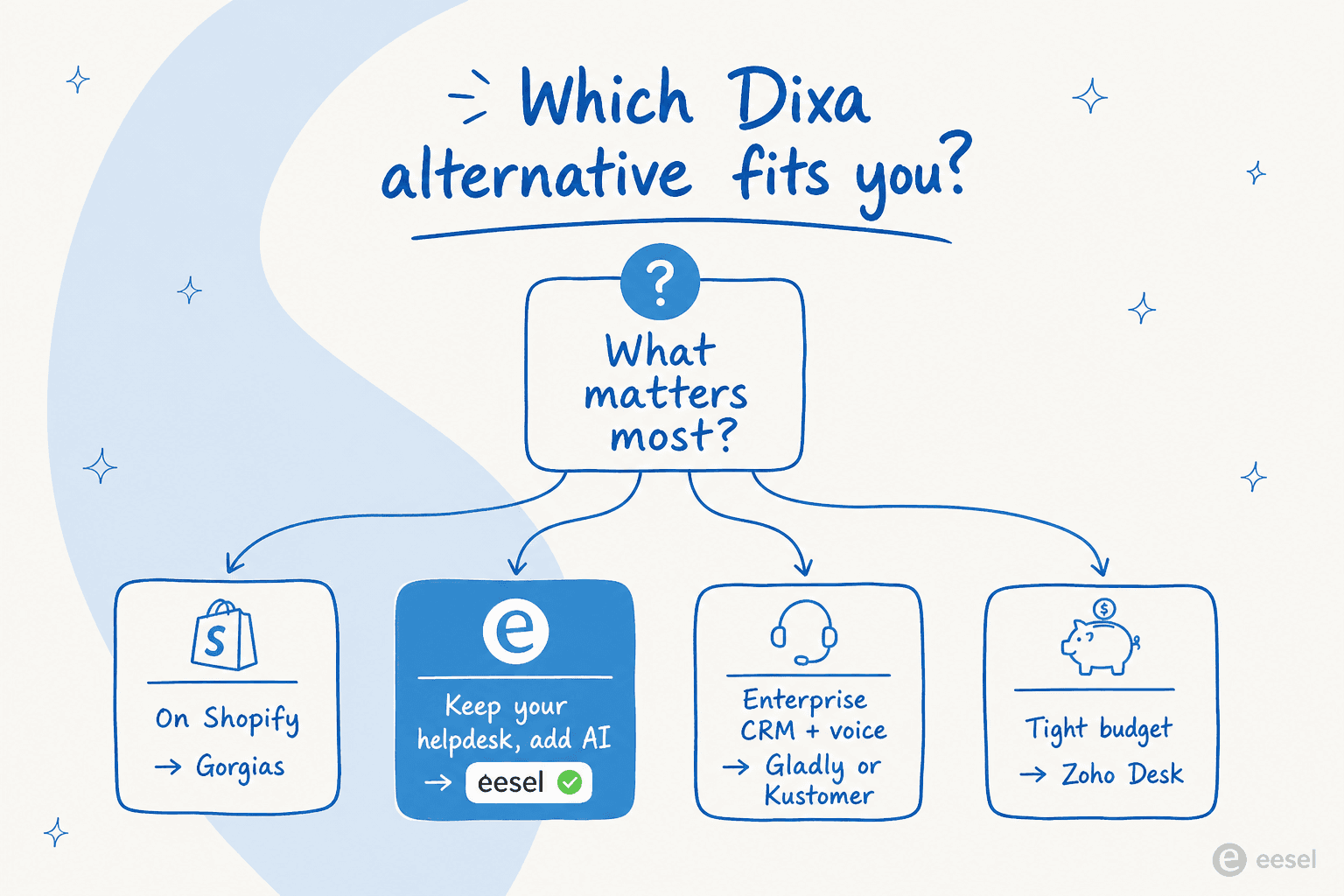
After running through all eight, the decision comes down to one question you've probably already half-answered: do you need to replace Dixa, or just fix what's wrong with it?
If the product is fine and the commercials are the problem (gated AI, no pricing transparency, lock-in), the lowest-risk move is to keep your helpdesk and add an AI layer like eesel AI on top, no migration, usage-based pricing, and you can simulate the resolution rate before you commit. It also sidesteps the rule-based chatbot vs AI agent trap that older deflection tools fall into.
If you do need a new platform, match it to your shape: Gorgias for Shopify, Gladly or Kustomer for premium and high-volume B2C, Zendesk or Freshdesk for a safe full suite, Front for complex cross-team ops, and Zoho Desk when budget rules. Whatever you pick, model the AI billing first, because that's the number that bites later. Our roundup of the best customer service AI tools and our guide to AI customer service metrics can help you pressure-test the shortlist.
Try eesel AI
If the reason you're reading a "Dixa alternatives" post is that you're tired of being told you have to migrate platforms and book a demo just to learn what AI costs, eesel AI is built for exactly that frustration. It plugs into the helpdesk you already run (Zendesk, Freshdesk, Gorgias, Help Scout, or your inbox), learns from your past tickets and docs, and starts resolving tickets autonomously, with usage-based pricing and no per-seat fee.
The differentiator versus everything above is that you can run it in simulation over your real historical tickets to see your exact resolution rate and savings before a single customer talks to it, and you set your own spend cap so the bill never runs away. You can start a free trial with credit included, no sales call required.
Frequently Asked Questions
What is the best Dixa alternative in 2026?
Can I add AI to my helpdesk without replacing Dixa?
Does Dixa offer a free trial?
Which Dixa alternative is best for Shopify stores?


Article by
Alicia Kirana Utomo
Kira is a writer at eesel AI with a Computer Science background and over a year of hands-on experience evaluating AI-powered customer service tools. She focuses on breaking down how helpdesk platforms and AI agents actually work so that support teams can make better buying decisions.