
Gladly pricing at a glance (2026)
Here's the whole picture in one place. The Shopify rows are confirmed from Gladly's own app listing; the platform rows are from third-party comparison sources because Gladly doesn't publish them, so treat those as a ballpark rather than a quote.
| Plan / item | Price | What it covers |
|---|---|---|
| Shopify "Free to install" | $0 | 30-day trial, 100 AI interactions, 1 seat, no credit card |
| Shopify "Starter cap" | $250/mo cap, pay-as-you-go | $1.50 per AI resolution, $0.25 per AI assist, $120/mo per seat |
| Hero package (platform) | ~$180/seat/mo, annual | 10-seat minimum; secondary sources only, not on gladly.ai |
| Superhero package (platform) | ~$210/seat/mo, annual | 45-seat minimum; secondary sources only |
| Sidekick (legacy AI add-on) | ~$0.60/conversation | Separate product, billed extra, usage-based |
| Voice AI | +$0.06216/min | Added on top of standard telephony |
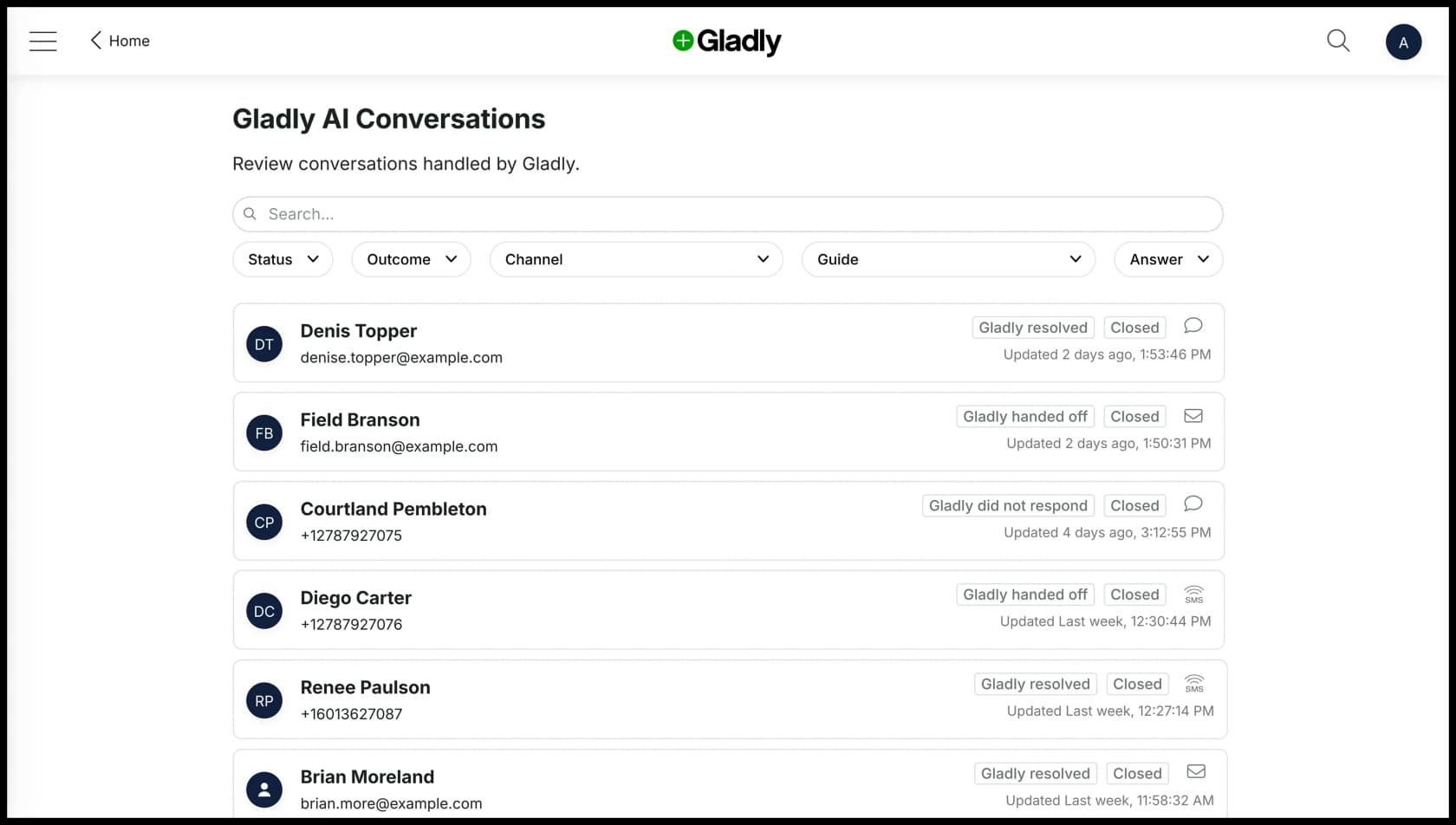
A quick orientation before we dig in: Gladly is a customer-service platform built around a "people, not tickets" model, where every customer is one lifelong conversation instead of a stack of separate tickets. The AI layer (branded Sidekick) sits on top of that. The screenshot below is Gladly's own AI conversations view, and it's the clearest way to understand how billing works, because each row is tagged with an outcome that maps straight to a price.
What you're actually paying for: resolutions, assists, and seats
The most important thing to understand about Gladly pricing isn't the dollar amount, it's the billable unit. On the public Shopify plan, Gladly charges three different ways at once, and they don't move together.

Here's what each one means in practice:
- AI resolution, $1.50. The AI handles the whole conversation end to end without a human. This is the outcome Gladly wants you to pay for, and it's the expensive one.
- AI assist, $0.25. The AI gathers context, drafts, or does part of the work, then hands off to a person. Six assists cost about the same as one resolution.
- Agent seat, $120/mo. A flat per-human fee, separate from the AI usage above. Your bill is the AI usage plus the seats.
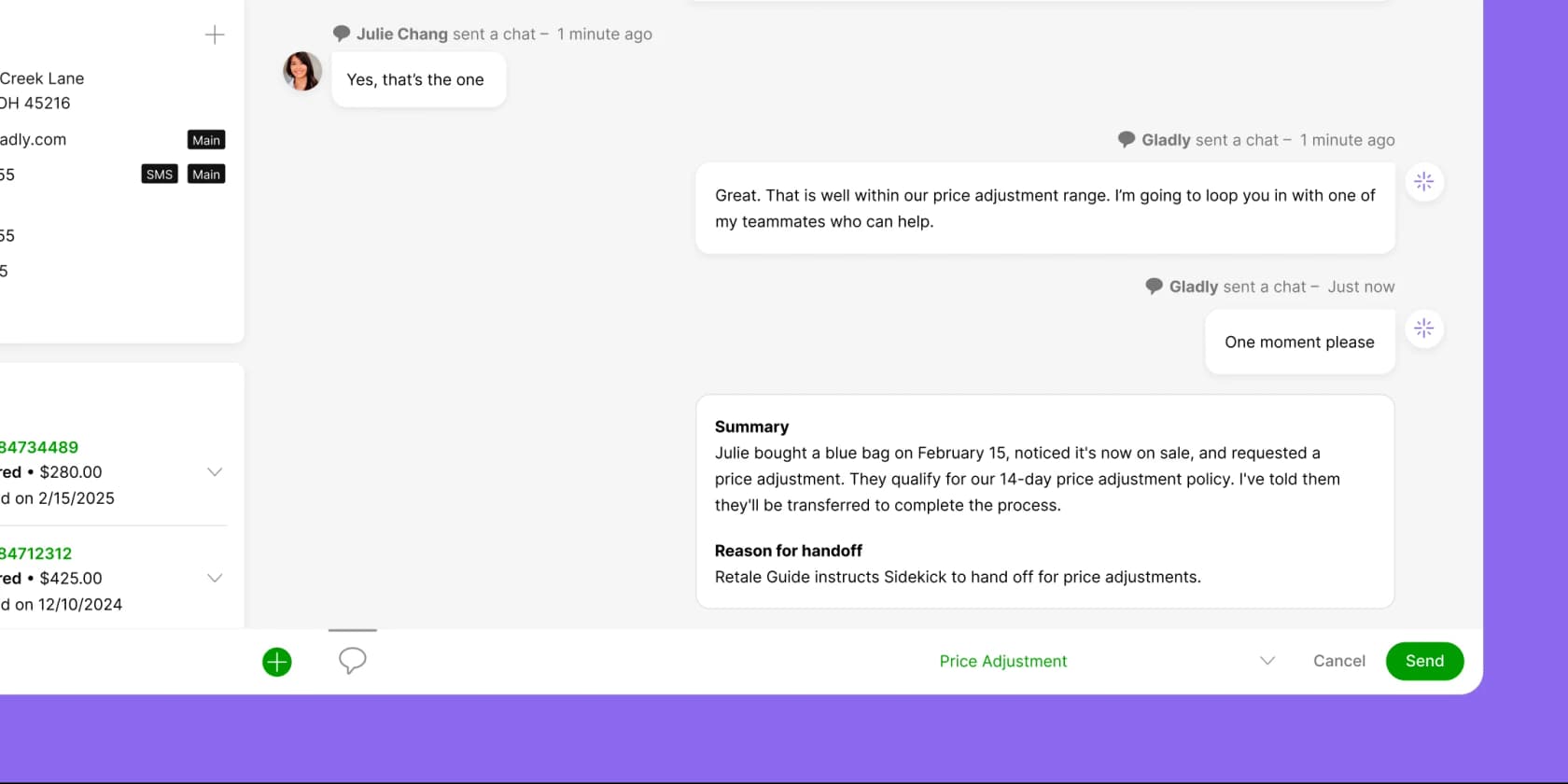
The reason this matters: a customer who chats for ten minutes and still needs a human bills as a $0.25 assist, not a $1.50 resolution. That's actually fair, and it's better than the older model (more on that below). But it also means your monthly total swings with your resolution rate, which is hard to predict before you've run the AI on your own ticket history. The handoff itself is clean. Gladly summarises the conversation and tells the agent why it's being transferred, as in this price-adjustment example:
The Shopify plan: Gladly's only public pricing
If you run a Shopify store, this is the version of Gladly you can actually sign up for without a sales call. The app listing is the single place Gladly publishes real numbers, and it's aimed squarely at smaller merchants.
The free tier is a real trial: $0 for 30 days, 100 AI interactions, one seat, no credit card, with the AI agent working across chat and email plus Shopify product recommendations. Once you're past that, the "Starter cap" plan lets you set a monthly spending limit (the listing shows $250) and pay as you go up to it, with the $1.50 / $0.25 / $120 rates above. Gladly confirmed in a June 2026 review reply that they "just launched a version of Gladly built specifically for smaller businesses," which is exactly this plan.
The spend cap is the nicest part of this model. You set the ceiling, the agent works up to it, and you don't get a surprise bill. For a small DTC brand testing AI on order-status and returns questions, that's a low-risk way in, and it's more transparent than the enterprise side we're about to get into.
The enterprise packages: Hero, Superhero, and the contact-sales wall
This is where Gladly pricing gets murky. The core platform that most of Gladly's named customers run (TUMI, Ulta, Crate & Barrel, Breeze Airways) isn't the Shopify app. It's the "Gladly Hero" platform, and Gladly doesn't publish a cent of it. The pricing page is a "Get a demo" CTA with no tables.

From third-party trackers, here's the rough shape:
- Hero package: about $180 per seat per month, billed annually, with a 10-seat minimum, per Hiver and smbguide.
- Superhero package: about $210 per seat per month, billed annually, with a 45-seat minimum, per Kustomer.
Two honest caveats. First, the sources don't fully agree. HappyFox and Kustomer both also cite a "$169 per agent per month" figure, and a couple of trackers list an entirely different "Growth / Pro / Enterprise" tier structure, so the per-seat number you actually get quoted may not match any of these. Second, these are competitor-published comparison pages, which is the weakest source tier, so we'd verify every figure on your own demo call rather than treat it as gospel. What's solid is the shape: per-seat, annual, with a minimum that locks out small teams. The 45-seat Superhero floor alone means you're committing to roughly $113,000 a year before you've added a single AI feature.
The add-ons that don't show up on the sticker price
This is the part of Gladly pricing that bites after the quote. A few costs ride on top of the seat fee:
- Voice AI, +$0.06216/min. Sidekick on voice is a real differentiator, but per Gladly's own docs it carries an added per-minute fee on top of standard telephony. For a phone-heavy voice support operation, that adds up fast.
- Sidekick, the legacy per-conversation model. Older comparison posts cite Sidekick at roughly $0.60 per conversation, billed extra as a separate product from Hero. Gorgias's competitive page argues pointedly that this bills you "$0.60 per conversation, even when it doesn't resolve" the issue, which is the kind of claim worth pressure-testing in a demo. The newer Shopify rates ($1.50 resolution / $0.25 assist) look like Gladly's attempt to fix exactly that complaint, so make sure you know which model your contract uses.
- Implementation time. G2 reviewers report Gladly takes about two months to implement and roughly 12 months to ROI. That's not a line item, but it's a real cost in team time, especially against tools that go live in days.
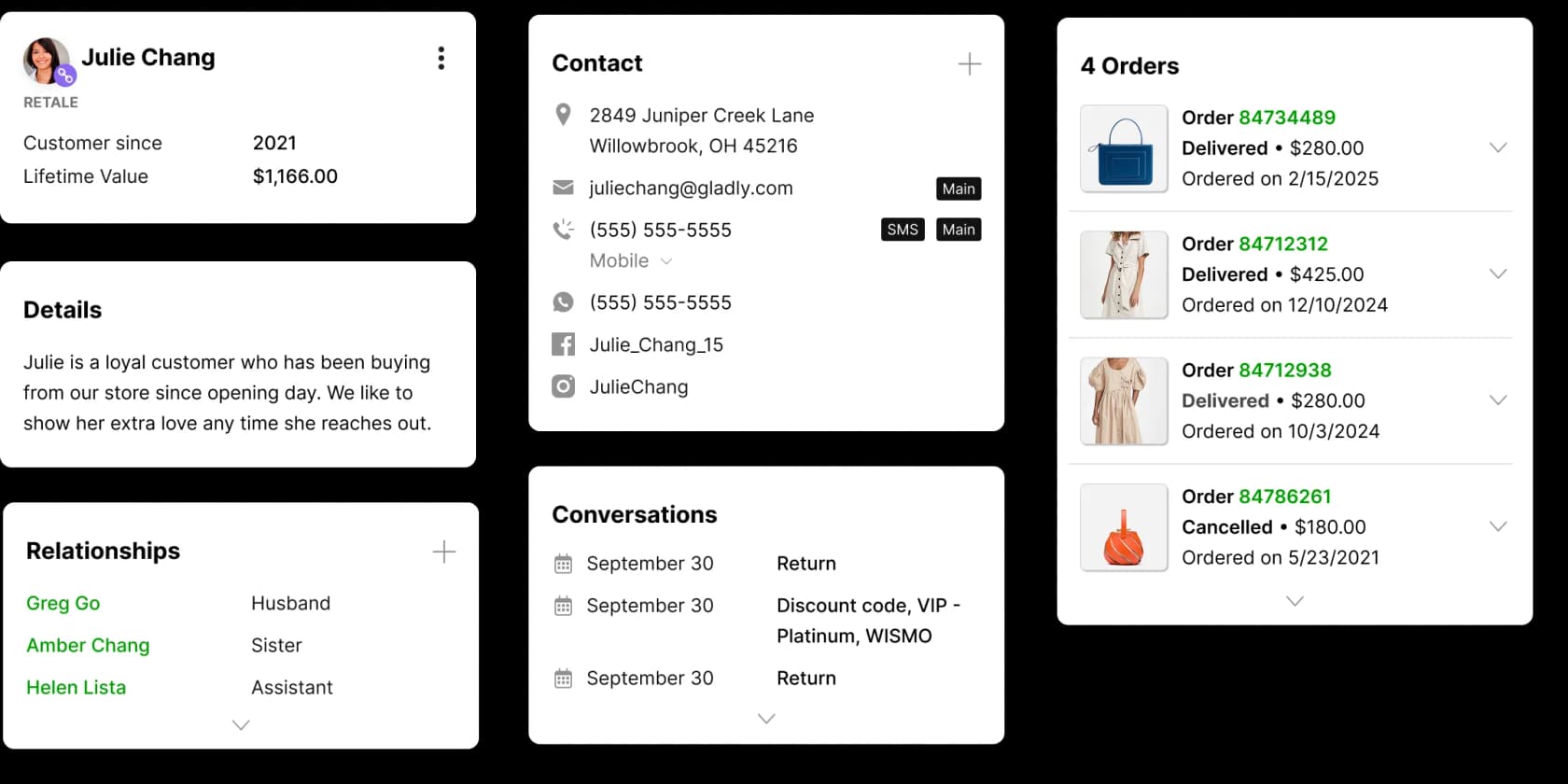
Part of what you're paying for is the underlying "people, not tickets" model, where the AI works from a complete customer profile (every order, conversation, and preference in one place) rather than a one-off ticket. It's a really nice experience, and it's the thing reviewers love most. If the relationship model appeals but the price doesn't, it's worth seeing how rivals stack up in our Kustomer vs Gladly comparison.
A worked example: what a real team actually pays
Pricing tiers are abstract until you put a team behind them, so here are two realistic scenarios.
| Scenario | Setup | Rough monthly cost |
|---|---|---|
| Small Shopify brand | 1 seat + ~150 AI resolutions on the Shopify plan | ~$120 seat + ~$225 AI ≈ $345, capped at your limit |
| Mid-size retail team | 15 Hero seats at ~$180, annual | ~$2,700/mo in seats alone, before AI usage and voice |
| Enterprise brand | 45 Superhero seats at ~$210 | ~$9,450/mo (≈ $113K/yr) before AI add-ons |
The jump from the Shopify plan to the platform is the thing to watch. There's no gentle middle. You're either on the self-serve usage app or you're signing an annual, seat-minimum enterprise contract, and the gap between them is where a lot of growing teams get stuck. This is also where a usage-based AI helpdesk prices the same work very differently: instead of paying per seat, you pay per ticket the AI handles, so a 1,000-ticket month is a flat $400 whether you have 5 agents or 50.
What users actually say about the cost
Gladly reviews are strong overall (4.7/5 from 1,112 reviews on G2), and the praise is real. People love the unified customer view and the channel breadth. But on price specifically, the sentiment is consistent, and it's worth reading before you sign.
"To be quite frank, gladly is very expensive. The per-user cost may be very expensive to a mid-sized company and they lack a flexible plan."
G2 review, captured via G2's Gladly pricing page

The flat, per-seat structure is the recurring friction. A Reddit thread comparing ecommerce helpdesks frames it the way most practitioners do: Gladly "is customer-centric, perfect for long-term relationships but comes at a higher cost." It's a premium tool, and people who pick it know they're paying for the relationship model, not the cheapest seat.
The sharper complaint is about account management around renewals, which is a cost in its own right:
"I also did not like that we had not been reached out to by any Account manager during the life of the contract, and were strong-armed into renewing due to the run-around provided when trying to reach one."
Ashley D., Customer Experience Manager, Apparel & Fashion (rated Value for Money 1/5), Capterra

That one voice isn't a verdict on the company, and plenty of Gladly customers renew happily. But the practical takeaway is the same one we'd give for any premium, annual contract: negotiate the term, the AI add-on rates, and the exit before you sign, not after.
Is Gladly worth the price?
Short version: yes, for a fairly specific team.

Pick Gladly if you're a consumer or retail brand that competes on customer experience, you run real volume across chat, voice, SMS, and social, and the lifetime-value model (one continuous relationship per customer) is core to how you want to operate. The 360-degree profile and the omnichannel handling are best-in-class, and the AI taking real actions (cancel order, process a return, price adjustment) is more than a deflection bot. If that's you and you're at 45+ seats, the premium can pay for itself.
Skip it if you're a smaller team, you want to start for free and scale gradually, or your main goal is to automate ticket volume cheaply. The seat minimums, the contact-sales wall, and the per-seat-plus-usage stacking all point the same way: Gladly is built for buyers who've already decided they want the relationship model, not for teams who want to test cheaply and see. If that's you, the best Gladly alternatives are worth a look, and our full Gladly AI deep dive goes deeper on the product itself.
Try eesel
If the part of Gladly pricing that bothers you is paying per seat for AI you can only price on a sales call, eesel AI is built the other way around. It's an AI support agent that plugs into the helpdesk you already run (Zendesk, Freshdesk, Gorgias, Front, Help Scout and more), learns from your past tickets and docs on day one, and bills purely by usage: $0.40 per ticket it handles, no per-seat fee, no platform fee, and free to start with $50 of usage and no credit card.
The differentiator we'd point at is simulation mode: you run the AI against thousands of your real past tickets before going live, see exactly what it would have resolved, and roll it out gradually. No demo gate to find the price, no annual seat minimum to test the product. One retail customer, Gridwise, saw eesel resolve 73% of tier-1 requests in the first month, with results showing inside a 7-day trial. You can see the pricing in full and start whenever.

Frequently Asked Questions
How much does Gladly cost per month?
Does Gladly publish its pricing?
What is the difference between an AI resolution and an AI assist in Gladly pricing?
Is Gladly expensive compared to other helpdesks?
Does Gladly charge extra for AI on voice?
What is the cheapest way to use Gladly?
How does Gladly pricing compare to a pay-per-ticket model?


Article by
Riellvriany Indriawan
Riell is a designer and writer at eesel AI with about two years of experience researching CX platforms, AI chatbots, and helpdesk software. She combines her design background with a sharp eye for how these tools actually look and feel in practice — making her comparisons unusually visual and user-focused.