

Why I'm writing this the way I am
I've spent a couple of years on the search and product side of this space, watching which AI support tools ecommerce teams actually keep past month three. Here's the pattern almost nobody puts in a pricing post: the thing that kills an ecommerce AI rollout usually isn't the AI being wrong. It's the bill.
A real example from our own sales calls (anonymized): a US swimwear brand on Gorgias ran twelve test chats with an AI agent, every one of them landed, the team was sold, and then someone opened the billing page and within minutes filed two cancel requests. The product worked. The pricing model spooked them. Another operator scaling toward roughly 150,000 tickets a month got so tangled in per-interaction-versus-per-ticket math mid-call that he projected a $30k monthly bill and walked.
That's the lens I'm bringing to eDesk pricing. The plans are clear enough; the part that decides whether you're happy in six months is the metered AI layer underneath. So that's where I'll spend the most time.
eDesk pricing plans at a glance
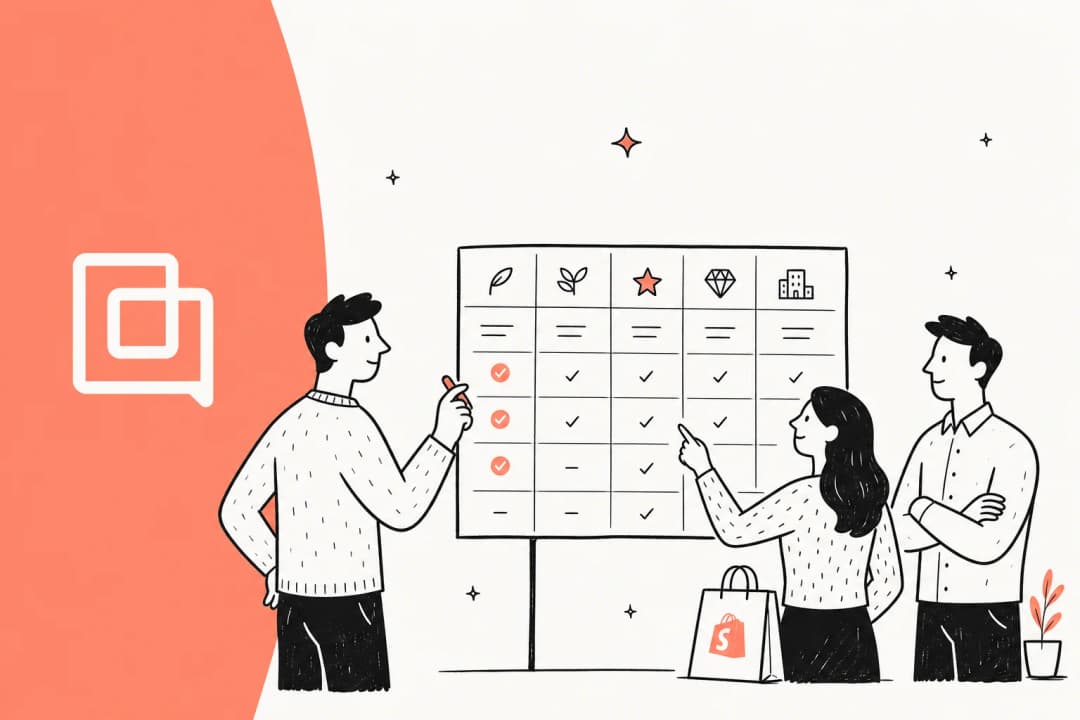
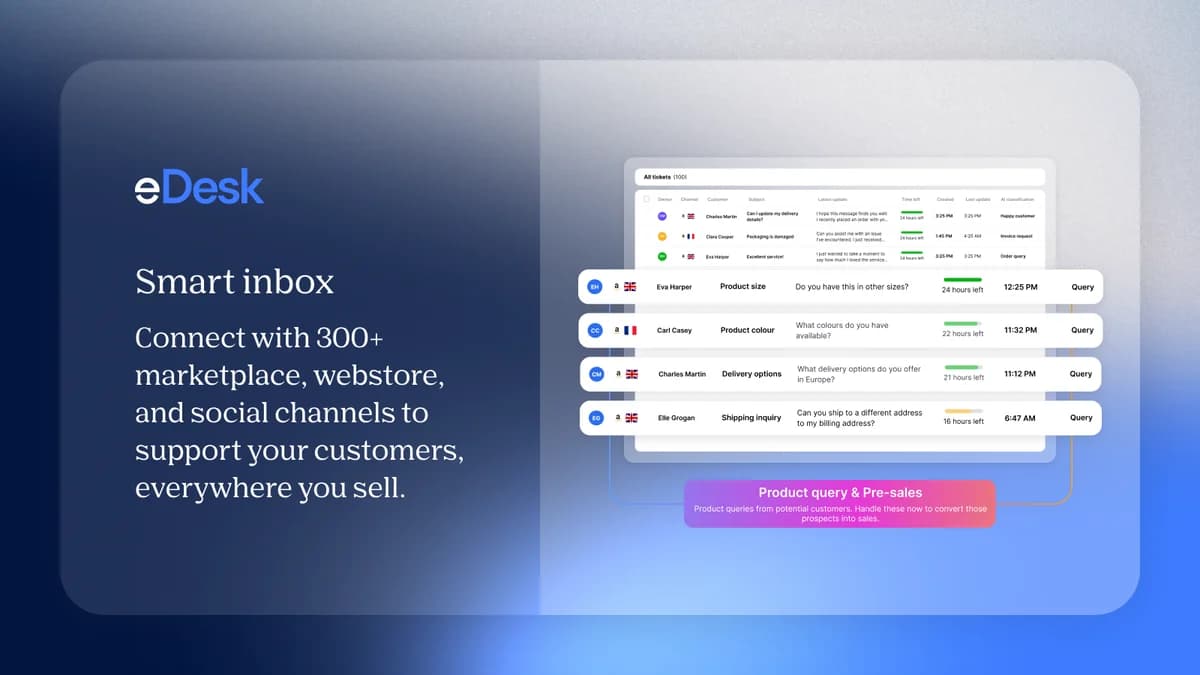
eDesk is an AI helpdesk built for ecommerce sellers, pulling Amazon, eBay, Walmart, Shopify, social, email, and live chat into one "Smart Inbox." There are four tiers, and the headline numbers eDesk shows by default are the annual rates (the page advertises "save 20%" versus monthly).
| Plan | Price (per agent/mo, annual) | Stores / marketplaces | Best for |
|---|---|---|---|
| Essential | $39 | 1 | Small teams starting with AI support |
| Growth | $89 | 5 | Multichannel automation at scale |
| Professional (recommended) | $119 | 10 | High-volume teams needing more control |
| Enterprise | Custom | Unlimited | Large or complex operations |
The thing the grid doesn't shout: it's the store/marketplace count, not just the seat, that pushes you up a tier. Add a sixth sales channel and you've outgrown Growth, regardless of how many agents you have. For a multichannel seller, that ceiling tends to arrive sooner than the seat count does.
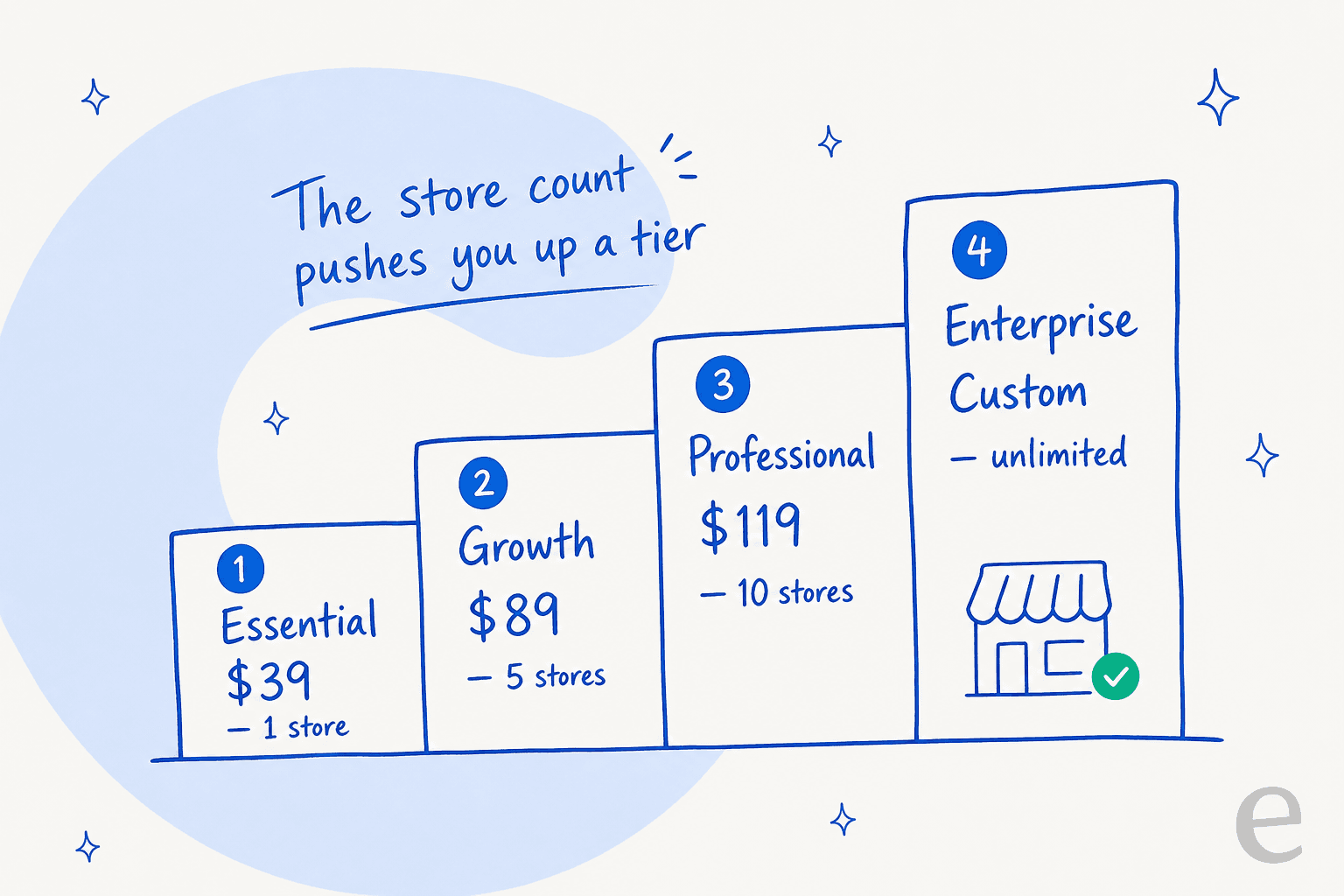
Each tier also gates features you might assume are standard. Rule-based automations, CSAT surveys, and performance reporting don't appear until Growth. Assisted onboarding, custom roles, 2FA, and the advanced RESTful API wait until Professional. Multi-brand workflows and custom API access are Enterprise only. So the seat price isn't the only thing climbing as you move up; the capability you need can drag you a tier higher than your headcount would.
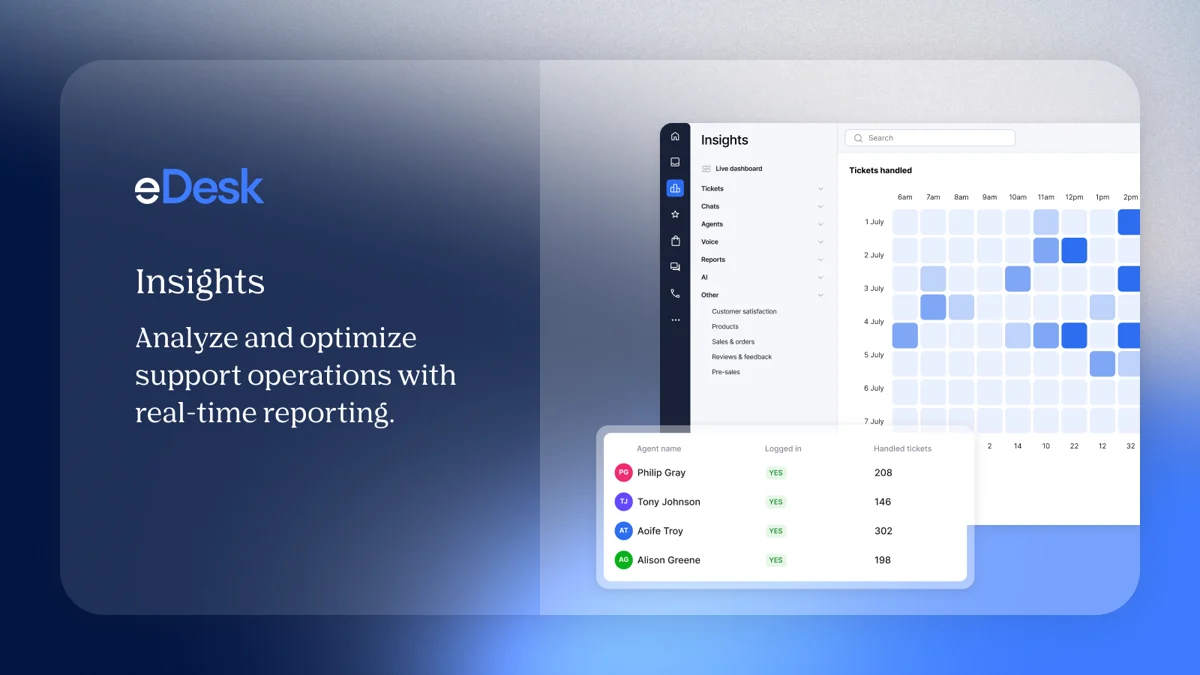
This is the inbox you're paying for, by the way:
The part that isn't on the sticker: the $0.99 AI resolution fee
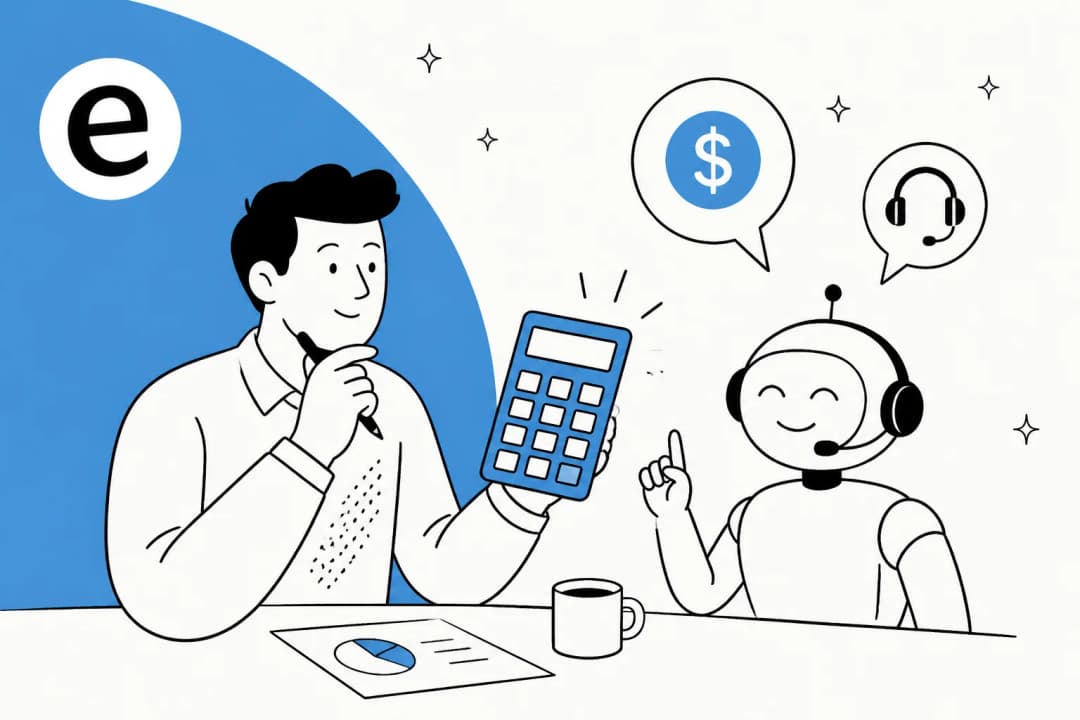
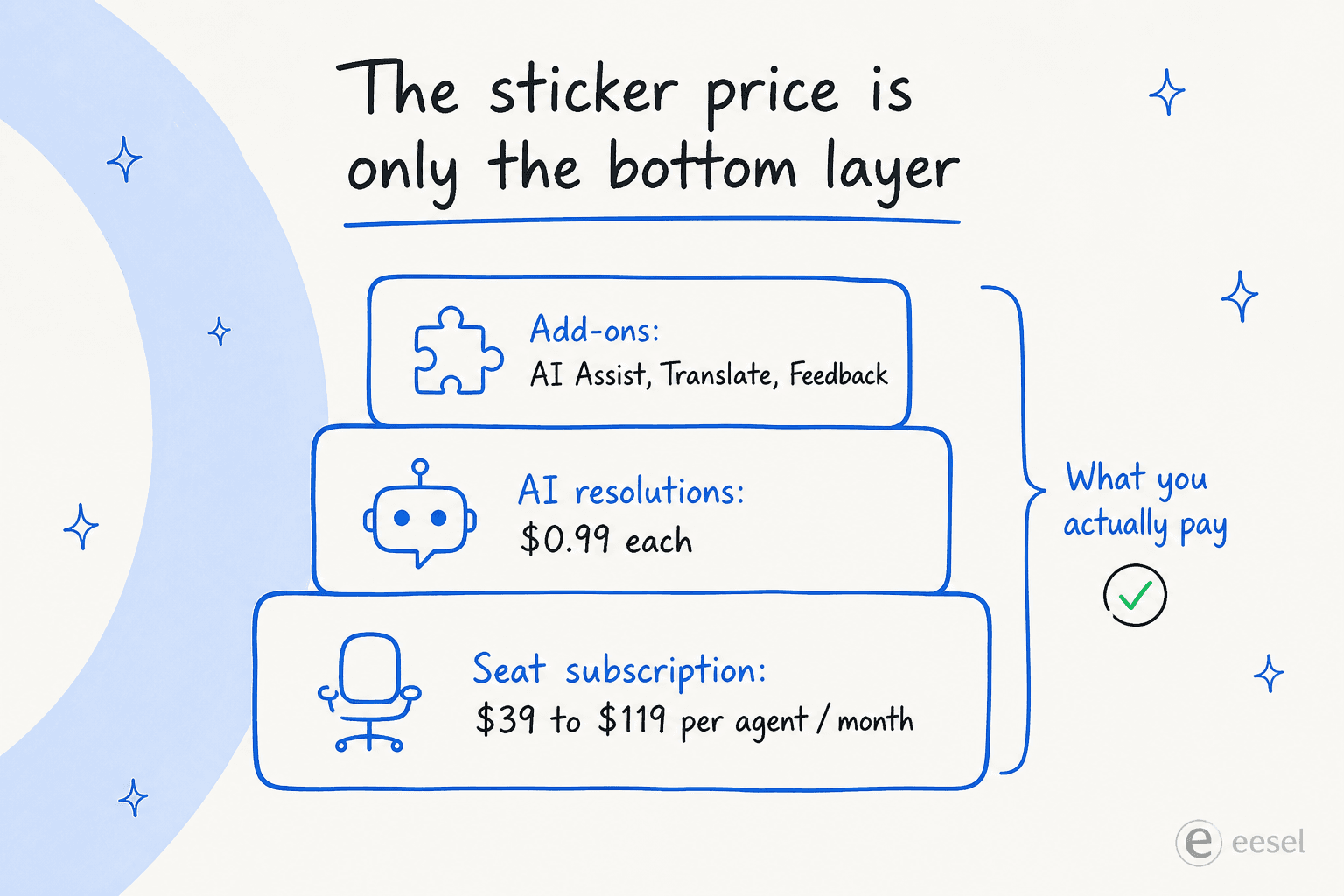
Here's the line that changes the whole calculation. The AI Agent is "included" in every plan, but that only means access. Every resolution the AI completes costs $0.99 (or €0.99 depending on region), billed separately from your seats.
eDesk frames it fairly: if the AI doesn't resolve something, you don't pay. A conversation starts when a customer engages the agent and runs through to either resolution or escalation, and you're only charged on the resolved ones.
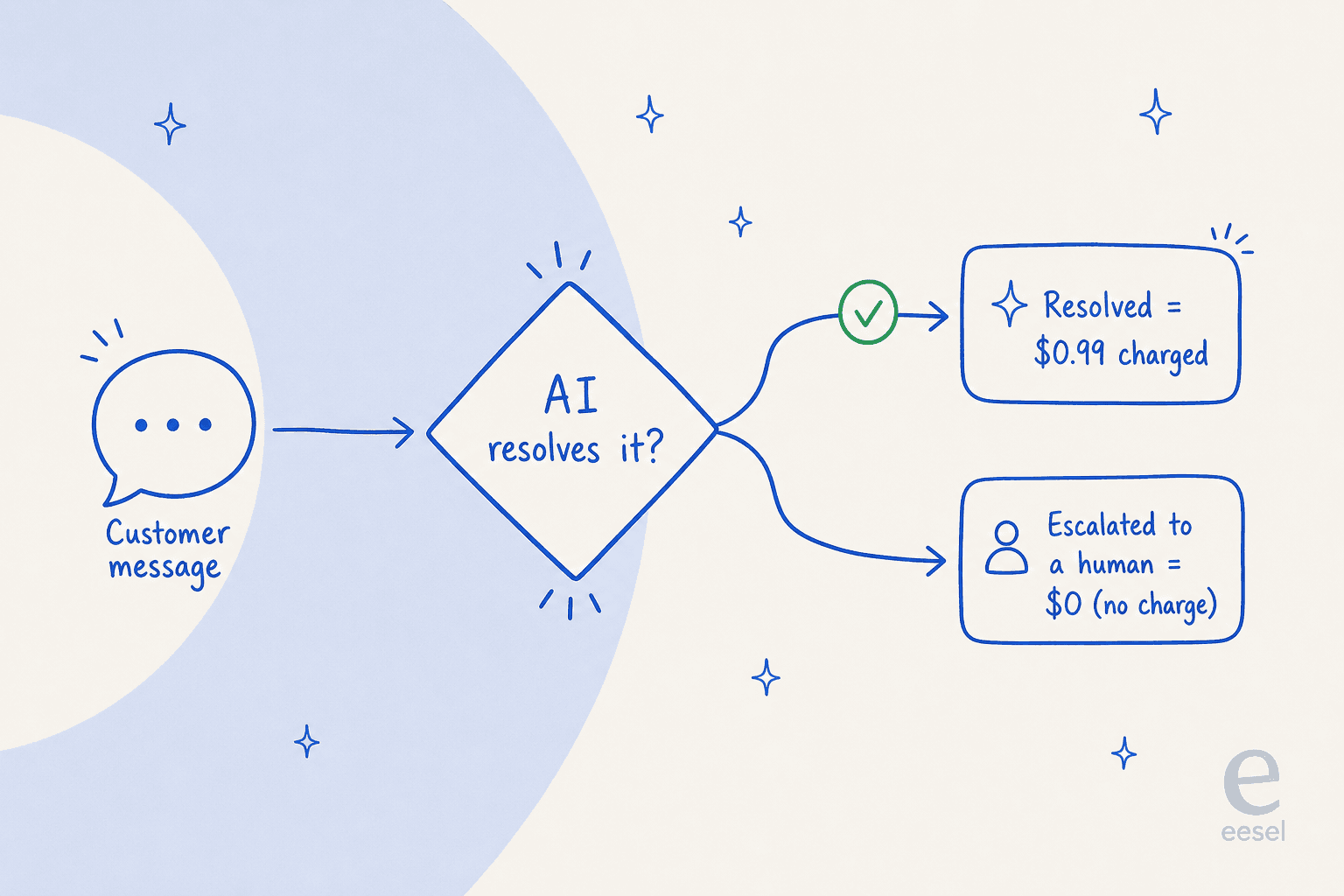
This is the same family as Zendesk's pay-per-resolution model and Gorgias's automation pricing, and it has the same upside and the same trap. The upside: a successful resolution is worth far more than a dollar, so on paper the unit economics are great. The trap: the better your AI gets, the bigger your bill gets, and it's the line item that's hardest to predict month to month. eDesk's own AI Agent claims it can automate up to 65% of support, so if you're doing real volume, that meter is running on most of your tickets.
A note worth flagging: there's a separate Ava AI chatbot that eDesk markets as deflecting up to 70% of pre-sales and product queries, and the same resolution-based billing logic applies to the AI conversation layer. If you're weighing chatbots specifically, we ranked the best Shopify chatbots separately.
Add-ons that stack on top
The seat fee and the resolution meter still aren't the full bill. Several capabilities most people think of as "AI features" sit behind separate add-ons, and crucially, the AI Assist intelligence layer is an add-on even on Professional and Enterprise.
| Add-on | Price (annual) | Price (monthly) | Billing unit | What it adds |
|---|---|---|---|---|
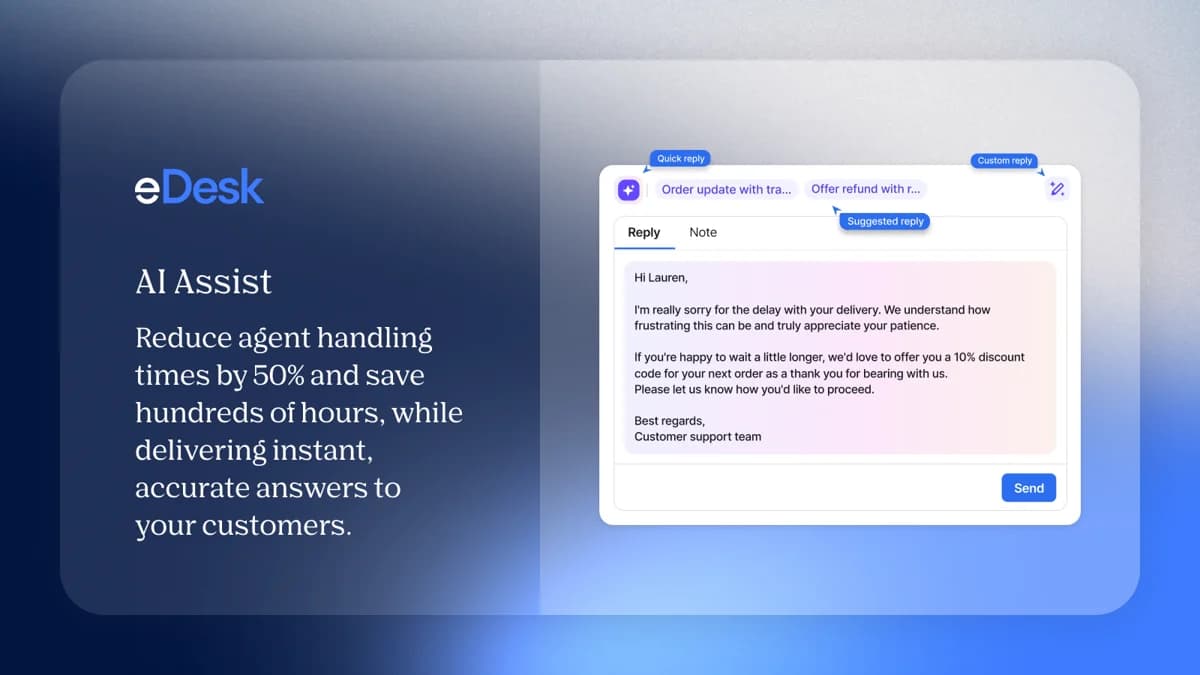
| AI Assist | $30 | $39 | per agent/mo | Suggested replies, tone adjustment, summaries, classifications, translation & routing |
| Translate | $19 | $21 | per agent/mo | AI translations so you can answer in any language |
| Feedback | $99 | $109 | per account/mo | Automated review requests, negative-review funnel, proactive messaging |
| Voice | Add-on | Add-on | via eDesk Talk / Aircall | Phone support |
So the "reduce handle time by 50%" AI Assist panel that drafts and rewrites replies? That's $30-$39 per agent on top of the seat. Translation is another $19-$21 per agent. For a three-person team that wants AI Assist and Translate, that's roughly $147-$180 a month of add-ons before a single resolution is metered.
Here's the whole stack in one picture:
Work out your real eDesk bill
Because the meter does most of the work, a plan grid won't tell you what you'll actually pay. Plug in your own numbers below: pick a plan, set your agent count and monthly AI resolutions, and toggle the add-ons.
Two worked examples
Numbers in the abstract don't land, so here are two realistic teams.
A small single-store seller. One agent on Essential ($39), running maybe 300 AI resolutions a month ($297), with AI Assist for the reply drafting (+$30). That's about $366 a month for what's effectively a small-business helpdesk. Drop the resolutions and it's almost all seat fee; lean on the AI and the meter quietly becomes your biggest line item.
A growing multichannel brand. Three agents on Growth ($267), 1,500 AI resolutions ($1,485), plus AI Assist (+$90) and Translate (+$57) across the team. That's roughly $1,899 a month - and the seats are only 14% of it. At this scale, every point of AI automation you add is also a point of cost you add. For context, the same 1,500 conversations handled at a flat $0.40 each would be $600, before you even net out the seat fees you're no longer paying.
That gap is the whole reason to read past the plan grid.
The pricing complaint that keeps coming up
eDesk earns a solid 4.5 out of 5 on G2 across 72 reviews and a 4.8 on the Shopify App Store. People genuinely like the marketplace breadth and, repeatedly, the human support team. Credit where it's due.
But the most consistent negative theme is price, specifically how it moves over time. One long-tenured reviewer didn't mince words:
"Hugely overpriced and they regularly increase your pricing. Our price has grown to 360% of where it started in only 3 years... Initially, we were promised an 'unlimited user' model. However, eDesk pivoted to a 'per-user' system, capping our usage without a proportional adjustment in price."
James M., Small-Business (G2, Nov 2023)

Another flagged the billing itself being hard to reconcile:
"Customer support admits that they do not understand how their own billing works... eDesk claimed that we had 130 support tickets when we actually had no more than 5."
Frank C., CEO (G2, Sep 2023)
Even a happy long-term Shopify reviewer noted the AI "seems a little weak compared to current" competitors while still recommending the product. None of this makes eDesk a bad tool. It does mean the metered, multi-layered pricing is the part to model carefully before you commit, because a per-resolution meter plus a history of seat-price increases is exactly the combination that produces a nasty renewal quote.
Is eDesk worth it?
Verdict: if you're a multichannel seller living across Amazon, eBay, Walmart, and Shopify, eDesk's unified inbox is a real, specific value, and the 14-day trial (no card, "Safe Mode" on) plus the 30-day guarantee make it low-risk to find out. The marketplace-native order, refund, and tracking actions are things a generic helpdesk genuinely can't match.
The catch is the cost model. You're paying for seats, then paying again per resolution, then paying again for the AI Assist and Translate features that make the agents actually good. For a high-volume team that combination can outrun the value, and the review history says the bill tends to drift upward, not down. If predictability matters more to you than an all-in-one marketplace inbox, a usage-based tool layered on the helpdesk you already run is usually the calmer path, and often the cheaper one too. We compare the field in our guide to the best ecommerce helpdesks and the best Gorgias alternatives.
Try eesel AI for ecommerce support
If the per-resolution meter and stacked add-ons are what's giving you pause, that's the exact problem eesel AI was priced to solve. eesel layers an AI agent onto the helpdesk you already use, Gorgias, Zendesk, Freshdesk, or Shopify, and bills a flat $0.40 per ticket with no seat fees, no platform fee, and no separate charge for drafting or translation. You set a monthly spend cap, get alerts at 50/75/100%, and the agents pause at the limit, so there's no surprise renewal.
Before you go live, simulation mode runs the agent against your past tickets so you can see resolution coverage and the projected cost before a single customer touches it, the kind of AI customer service software decision that's hard to reverse once you've committed budget. One ecommerce-adjacent team, Gridwise, saw 73% of tier-1 requests resolved in the first month, with results landing during a 7-day trial. You can start with $50 of free usage, no credit card, and route just a slice of your tickets to keep the spend honest while you build trust.
Frequently Asked Questions
How much does eDesk cost per month?
What is eDesk's AI Agent pricing?
Does eDesk have a free trial?
Is eDesk expensive for small businesses?
What is a cheaper alternative to eDesk for ecommerce support?


Article by
Kurnia Kharisma Agung Samiadjie
Kurnia is a software engineer and writer at eesel AI with two years of SEO experience, writing about AI tools, helpdesk software, and customer support. He pairs a developer's understanding of how these products are built with search-driven research into what actually ranks and resonates with the people searching for them.