

The moment a price page changes a deal
Here's something I've watched happen more times than I can count. A support lead runs a few test conversations with an AI agent, the bot answers well, everyone's nodding, and then they open the billing page. The whole mood shifts.
One case stuck with me: a US swimwear brand running on Gorgias, about 151 help docs loaded, ran a dozen successful test chats. The agent did everything right. Then they saw how the pricing worked and opened two cancellation requests the same day. Nothing about the product had changed in those ten minutes. The pricing model just didn't fit the shape of their business.
That's why a pricing breakdown is worth doing properly before you book a demo, and why "contact us for a quote" deserves a closer read. So let's go through Siena AI pricing the way I'd want it laid out if I were the one signing.
What is Siena AI?
Quick context, because the pricing only makes sense against the product. Siena AI calls itself "the AI CX operating system for consumer brands." It's built specifically for DTC ecommerce and retail, and it runs on top of your existing helpdesk rather than replacing it. The pitch is a suite of agents sharing one intelligence layer: a Customer Service agent, a Shopping agent for product recommendations, a Reviews agent, a QA agent, and a voice-of-customer layer called Topics Explorer. On the support side it handles the DTC staples: order tracking, returns and refunds, and subscription changes.
Its real differentiator is brand voice. Siena's AI Personas feature tunes the agent to your tone (the Coterie case study names a persona "Chloe"), and the testimonials lean hard into that empathy angle. It overlays Gorgias, Zendesk, Kustomer, Gladly, and Dixa, and goes deep on the subscription stack (Recharge, Skio, Smartrr, and more), which tells you exactly who it's for: subscription-heavy Shopify brands.
Siena markets up to 80% automation with a +94.7% average CSAT. Good numbers. Now let's see what they cost.
How much does Siena AI cost?
Siena doesn't list named tiers (no Starter / Pro / Enterprise ladder). Instead, the pricing page is a quote form that asks for your team size and monthly ticket volume, then routes you to sales. But it does disclose three concrete cost components, and those are the real story.
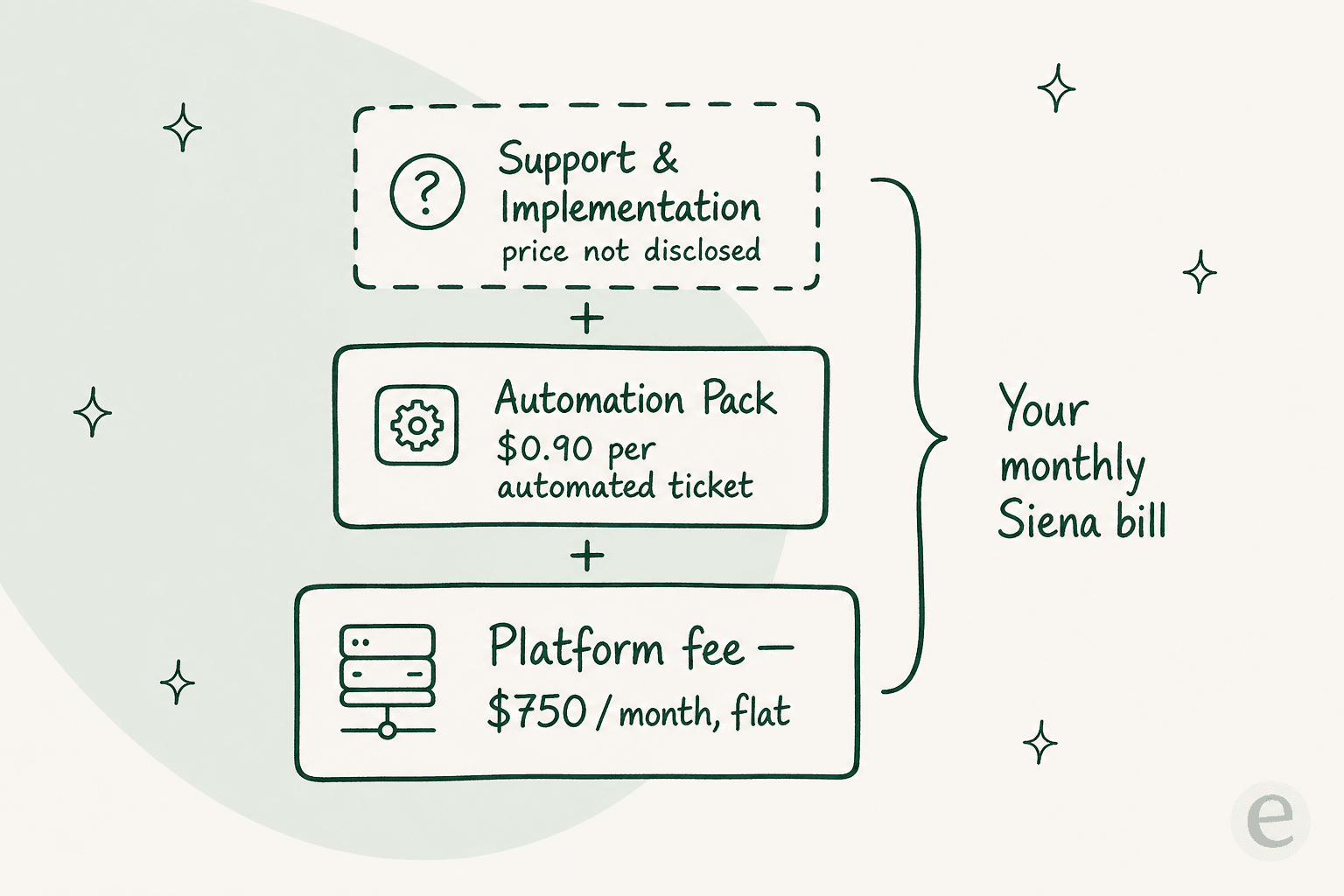
Here's how the three layers break down:
| Component | Price | What it covers |
|---|---|---|
| Platform fee | $750 / month (flat) | Access to the core AI engine plus an unlimited sandbox for testing |
| Automation Pack | $0.90 per automated ticket | Usage-based; billed per "automated ticket" |
| Support & Implementation | Not disclosed | Onboarding plus dedicated Slack support |
| Free tier | None | No free plan; the only no-cost path is a demo |
So the honest answer to "how much does Siena AI cost" is: at minimum $750/month plus $0.90 for every automated ticket, plus an onboarding fee nobody outside a sales call can quote you. The platform fee is the part that catches people, because it's a fixed cost you pay whether you process 50 tickets or 5,000.
To Siena's credit, the unlimited sandbox bundled into that $750 is genuinely useful. You can build and tune workflows without metering every test. It's just bundled into a fee you can't avoid.
What counts as an "automated ticket"?
This is the question I'd want nailed down before signing, because it's where conversation-based pricing and your actual bill diverge.
Siena bills $0.90 per automated ticket, and the company is explicit that this is conversation-based pricing, not outcome-based. Siena even argues against outcome-based pricing directly: its logic is that if your volume grows 10%, your AI cost grows 10%, and as the AI gets more effective you keep paying the same per conversation while your cost-per-resolved-issue quietly drops.
That's a coherent argument. The catch is what it means for you in practice.
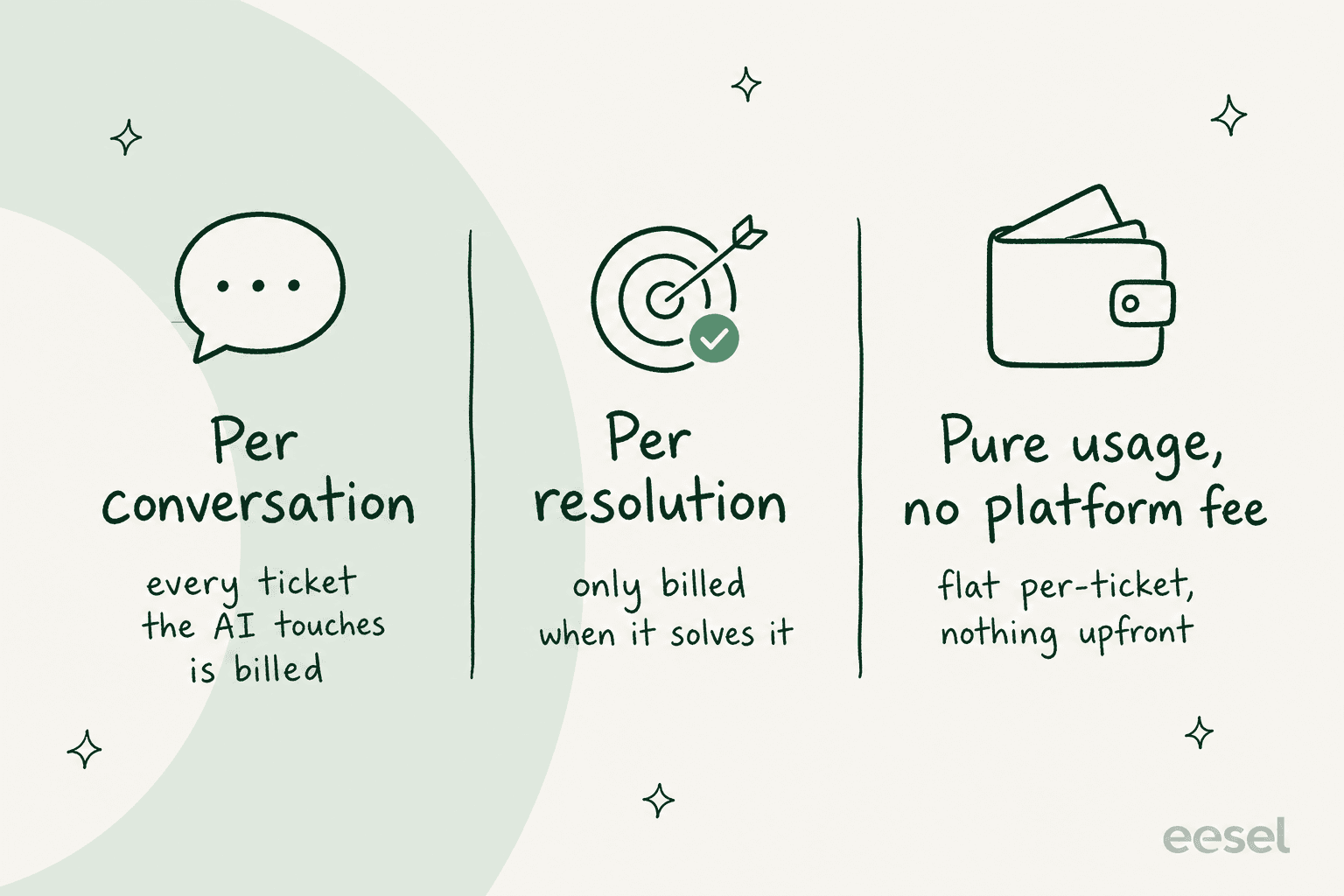
There are three broad ways AI support gets priced:
- Per conversation / ticket (Siena's model): you pay for every ticket the AI engages, resolved or not.
- Per resolution / outcome: you only pay when the AI actually closes the issue.
- Pure usage, no platform fee: a flat per-ticket rate with nothing fixed upfront.
The wrinkle with Siena's page is that "automated ticket" isn't defined further. It doesn't say whether a ticket the AI picks up, fumbles, and hands to a human still counts as automated, or whether an out-of-scope ticket it closes by itself is billable. That matters, because Siena's most common complaint is exactly that escalation behavior (more on that below). If a tricky ticket that the AI couldn't really solve still bills at $0.90, your effective cost per resolved ticket is higher than the sticker. Get the billable unit in writing.
Siena AI pricing at scale: the real numbers
Fixed fees are sneaky because their weight depends entirely on volume. The $750 platform fee is rounding error for a brand doing 10,000 tickets a month. For a brand doing 200, it's the whole story.
Here's what the all-in monthly cost looks like at a few volumes (platform fee + Automation Pack, before the undisclosed implementation line):
| Monthly automated tickets | Platform fee | Automation Pack ($0.90 each) | Total / month | Effective $ per ticket |
|---|---|---|---|---|
| 100 | $750 | $90 | $840 | $8.40 |
| 500 | $750 | $450 | $1,200 | $2.40 |
| 1,000 | $750 | $900 | $1,650 | $1.65 |
| 2,500 | $750 | $2,250 | $3,000 | $1.20 |
The pattern is the whole point: your effective cost per ticket starts absurdly high and slides toward $0.90 as volume climbs. At 100 tickets a month you're effectively paying $8.40 a ticket; at 2,500 you're down to $1.20.
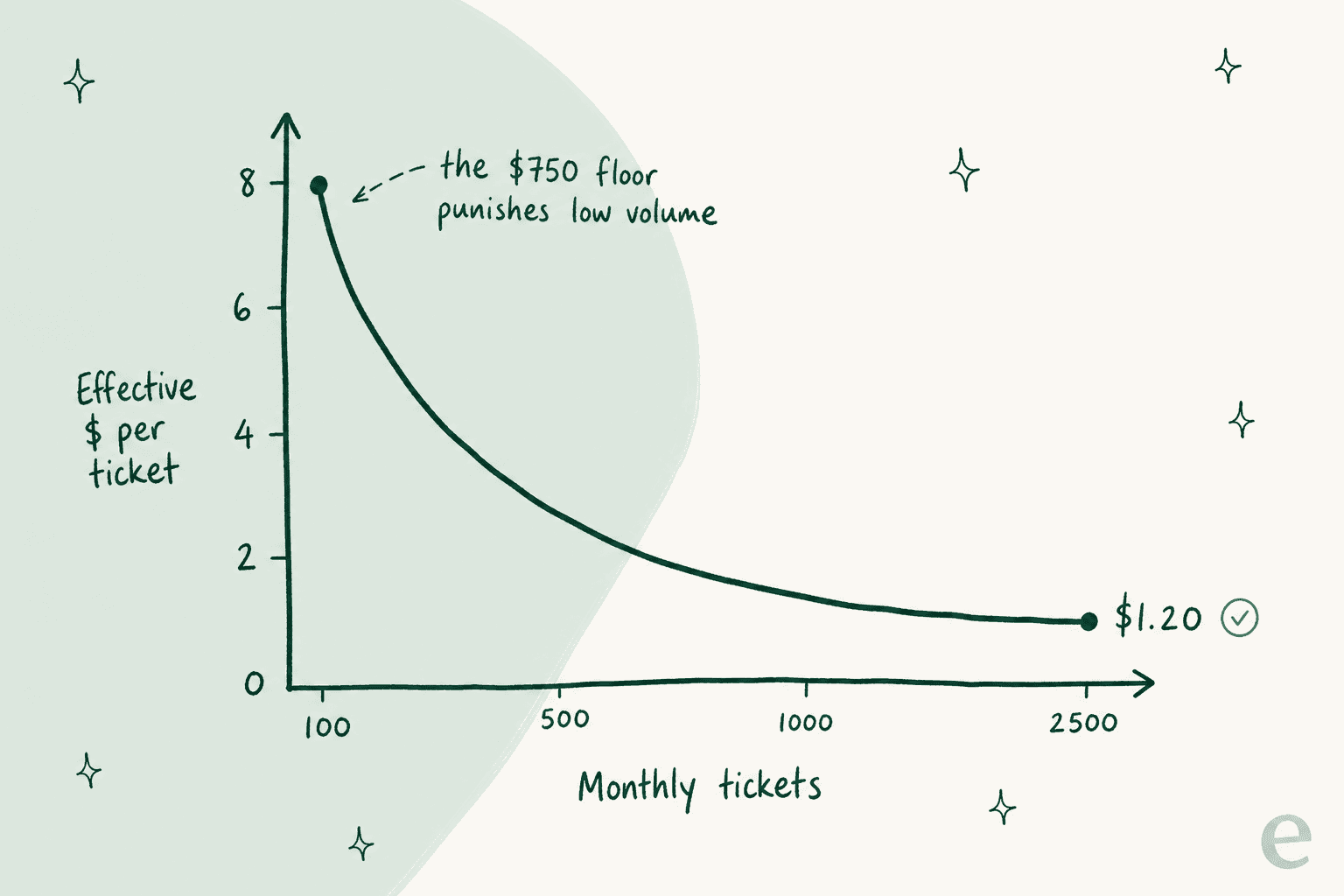
This is the trap a lot of smaller brands walk into. The $0.90 headline reads cheap, so they don't run the math on the floor. Plug your own number in below to see where you actually land, and how a no-platform-fee model compares at the same volume.
Two caveats on that comparison, to be fair to Siena. First, it's only counting support cost, and Siena's pitch includes revenue work (shopping recommendations, subscription retention) that a pure support agent doesn't do. Second, the $0.40 line assumes a tool that prices that way. The point isn't that $0.40 beats $0.90 head to head, it's that the $750 floor, not the per-ticket rate, is what drives the bill at most real volumes.
Where Siena AI pricing pinches
Three things to weigh before you sign, none of which are dealbreakers on their own.
The platform fee punishes small teams. This is the big one. If you're a growing Shopify store doing a few hundred support tickets a month, the $750 floor means you're paying a premium per ticket for the privilege of being small. Siena is honestly built for brands past that stage.
Everything is quote-gated. No public plan ladder and no self-serve signup means you can't size the cost yourself without a sales conversation, and the Support & Implementation line has no number attached at all. Compare that to vendors who publish exact per-ticket cost and let you start without talking to anyone.
You pay for conversations, not resolutions. Siena scores a strong 4.8/5 across 28 G2 reviews, and most reviewers love it. But the single most-repeated complaint is escalation behavior, where the agent keeps responding after a handoff or closes an out-of-scope ticket instead of routing it. As one reviewer put it:
"There are times when Siena will draw out a conversation instead of routing it to a Human to solve, as well as closing out tickets when a customer asks... good 93% of the time, really bad the other 7%."
Nate B., Small-Business, G2 review

Under conversation-based pricing, those fumbled-then-escalated tickets still bill. It's a small tax, but it's worth knowing it's there, and it's why I'd want hallucination and escalation behavior tested against your real tickets before you trust the automation rate.
How Siena pricing compares to usage-based AI
If the platform fee is the thing giving you pause, the alternative model worth understanding is pure usage-based pricing. This is the lane eesel AI plays in, and since I work on it, here's the honest side-by-side rather than a sales line.
| Siena AI | eesel AI | |
|---|---|---|
| Platform / base fee | $750 / month | $0 (self-serve) |
| Per-unit price | $0.90 per automated ticket | $0.40 per ticket |
| Per-seat fees | None | None |
| Free trial | Demo only | $50 in free usage, no card |
| Pricing transparency | Quote-gated | Public, self-serve |
| Try before you buy | Sandbox (inside the $750) | Simulate on past tickets |
| Built for | DTC / subscription Shopify brands | Any helpdesk (Zendesk, Gorgias, Freshdesk, more) |
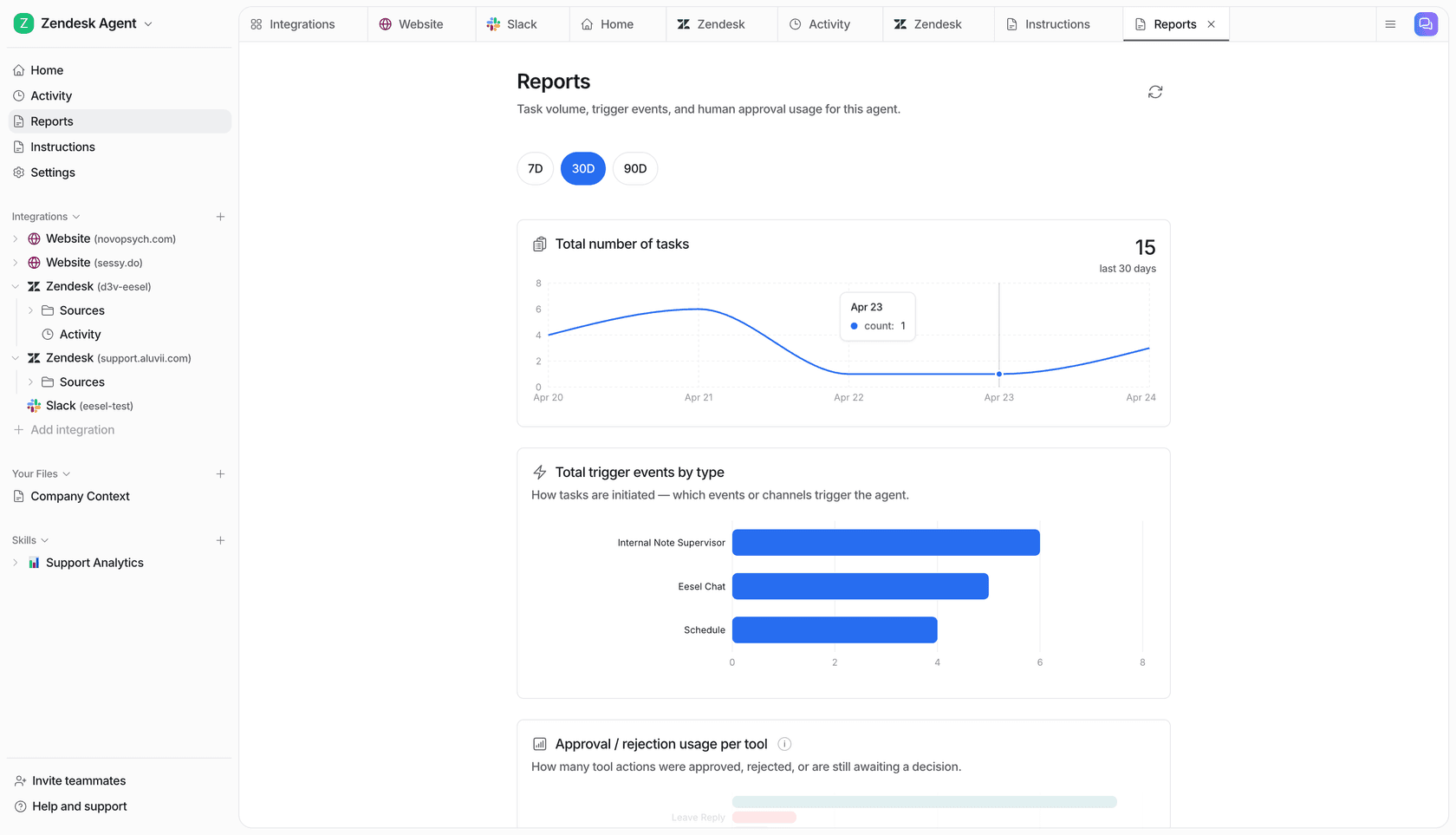
The difference that actually matters isn't the 90-cents-vs-40-cents line, it's the floor and the front-loaded risk. With no platform fee, your bill starts at zero and tracks usage from ticket one, so a partial or gradual rollout costs exactly what you route to it. And because eesel lets you simulate against your historical tickets before going live, you see the real resolution rate first, instead of buying a sandbox and hoping. That simulation habit comes from a scar: we've watched confident-sounding bots quietly give wrong answers, so we'd rather you see the coverage number before the invoice than after.
To be fair to Siena, none of that replicates its persona depth or its subscription-retention workflows. If brand-voice fidelity for a subscription DTC brand is your top priority, Siena earns its look. If predictable, usage-tracking cost is the priority, the no-platform-fee model wins.
Is Siena AI worth the price?
Here's my actual take after going through it.
Siena is worth it if you're a mid-to-high-volume DTC or subscription brand on Gorgias or Shopify, you care a lot about on-brand, empathetic responses, and your volume is high enough that the $750 platform fee disappears into the per-ticket math. At a few thousand tickets a month, your effective cost lands near $1.20 and the persona work is real value. That's the brand Siena was built for, and the customer results back it up.
Look elsewhere if you're a smaller team where $750/month before your first ticket is a meaningful line item, you want to size and start the cost yourself without a sales call, or you'd rather pay per outcome than per conversation. In those cases a usage-based AI agent with no platform fee, or one of the Siena AI alternatives like Yuma AI, fits the shape of the business better.
Either way, do what that swimwear brand didn't get to do: run the numbers at your volume before the demo, not after. The product is rarely the surprise. The pricing model is.
Try eesel on Gorgias, billed per ticket
If the $750 floor is the part giving you pause, eesel AI is the usage-based answer for the same DTC stack. It plugs into Gorgias, Shopify, Zendesk, and more, learns from your past tickets and help docs on day one, and bills at 40 cents per ticket with no platform fee and no per-seat cost. The part I'd actually use first: simulate it on past tickets to see the real resolution rate and projected cost before you ever go live, then route as little or as much as you want. It's free to start with $50 of usage and no credit card.

Frequently asked questions
How much does Siena AI cost?
Does Siena AI have a free plan?
What counts as an 'automated ticket' in Siena AI pricing?
Is Siena AI worth it for a small Shopify store?
What are the best Siena AI alternatives?



Article by
Kurnia Kharisma Agung Samiadjie
Kurnia is a software engineer and writer at eesel AI with two years of SEO experience, writing about AI tools, helpdesk software, and customer support. He pairs a developer's understanding of how these products are built with search-driven research into what actually ranks and resonates with the people searching for them.