
Every ecommerce support team knows the pattern: it's 9 AM, the queue is open, and the first 40 tickets are all some version of "where is my order?" By noon you've answered the same question a hundred times. Your agents are ready to quit. Your customers are annoyed. And somewhere in that pile, a genuinely complex issue -- a missing package, a billing dispute, a damaged item -- is waiting for attention that never arrives.
WISMO ("Where Is My Order?") is the biggest single category of customer support volume in ecommerce. Depending on your vertical and how proactive your shipping notifications are, it represents 20-40% of your total support tickets under normal conditions -- and climbs to 50% or higher during peak seasons. Gorgias, with data from thousands of merchant accounts, puts the platform average at 18%.
The frustrating part: the answer to most of these questions already exists in your systems. Your Shopify or Gorgias account has the order data. The carrier API has the tracking status. The information is there -- it just has to be retrieved, interpreted, and communicated. Manually, dozens of times a day, by people who have better things to do.
AI changes that equation entirely. A properly configured AI agent answers WISMO queries in under 10 seconds, at any volume, around the clock. But "AI for order tracking" covers a wide spectrum -- and getting it wrong can make things worse, not better.
Why WISMO is so persistent (and so painful to handle manually)
WISMOlabs defines WISMO as the aggregate volume of inbound customer communications triggered by a perceived lack of shipment status clarity. The human version: customers feel like they're in the dark, so they contact you.
Three psychological forces drive it. Once a customer pays, they psychologically own the item before it arrives -- any gap in information feels like a threat to their property. After purchase, customers are in an anticipation state, and when a delivery date passes without confirmation, that anticipation turns to stress and a support ticket. And customers are more motivated to prevent losing money to a failed delivery than they are by the joy of the original purchase. A stalled tracking number triggers fear.
Amazon has trained shoppers to expect hyper-transparency: live maps, delivery photos, proactive SMS at every milestone. Every other merchant gets measured against that standard. When you don't meet it, customers fill the gap by contacting support.
The cost adds up fast. Crisp.chat estimates that agents spend 2-3 hours daily on WISMO lookups. LateShipment.com puts the math directly: if you handle 10,000 support tickets monthly with a 30% WISMO rate, that's 3,000 order tracking tickets. At roughly $22 per ticket in agent time and overhead, you're spending $66,000 per month answering "where is it?" Deflect even 40% and you save $26,000 a month.
The retention impact makes the math harder to ignore. 70% of customers won't repurchase after a poor delivery experience. 44% of US consumers stopped shopping at a brand after one bad customer service experience (Statista 2024). WISMO isn't just a support problem -- it directly touches repeat purchase rates.
And then there's the peak season problem. During Black Friday through December 24, WISMO rates surge 3x to 5x the annual average, driven by carrier capacity crunches, missed scans, and customers with hard emotional deadlines ("Christmas delivery"). Human teams can't scale in the two weeks before BFCM. If you've been managing WISMO manually, that's when the wheels come off. See also: AI for peak season support.
Why old chatbots made this problem worse
The history of WISMO automation is full of well-intentioned bots that backfired. A practitioner on r/EcommerceWebsite put it plainly:
"If the bot gives a template response that doesn't hit the carrier API directly, it's not automation; it's just a delay tactic."

The reason: most first-generation chatbots were FAQ-matching systems. They could recognise the phrase "where is my order" and respond with "check your tracking email" -- but they couldn't look up the actual order. The customer already knew to check their email. They contacted support because the email wasn't helping.
Crisp.chat is direct about this: "basic chatbots made WISMO worse." A bot that gives a template response disconnected from real carrier data frustrates customers more than no response, as r/EcommerceWebsite noted, because the customer now knows the system isn't actually trying to help them.
The problem was always integration depth, not AI sophistication. A WISMO bot that can't query live order data is useless. Modern AI agents solve this at the foundation: they connect directly to your Shopify, WooCommerce, or BigCommerce store, pull real-time carrier data, and answer based on what's actually happening with the order right now. Our chatbot guide for order status and shipping covers how this architecture works in detail.
What AI does differently for order tracking
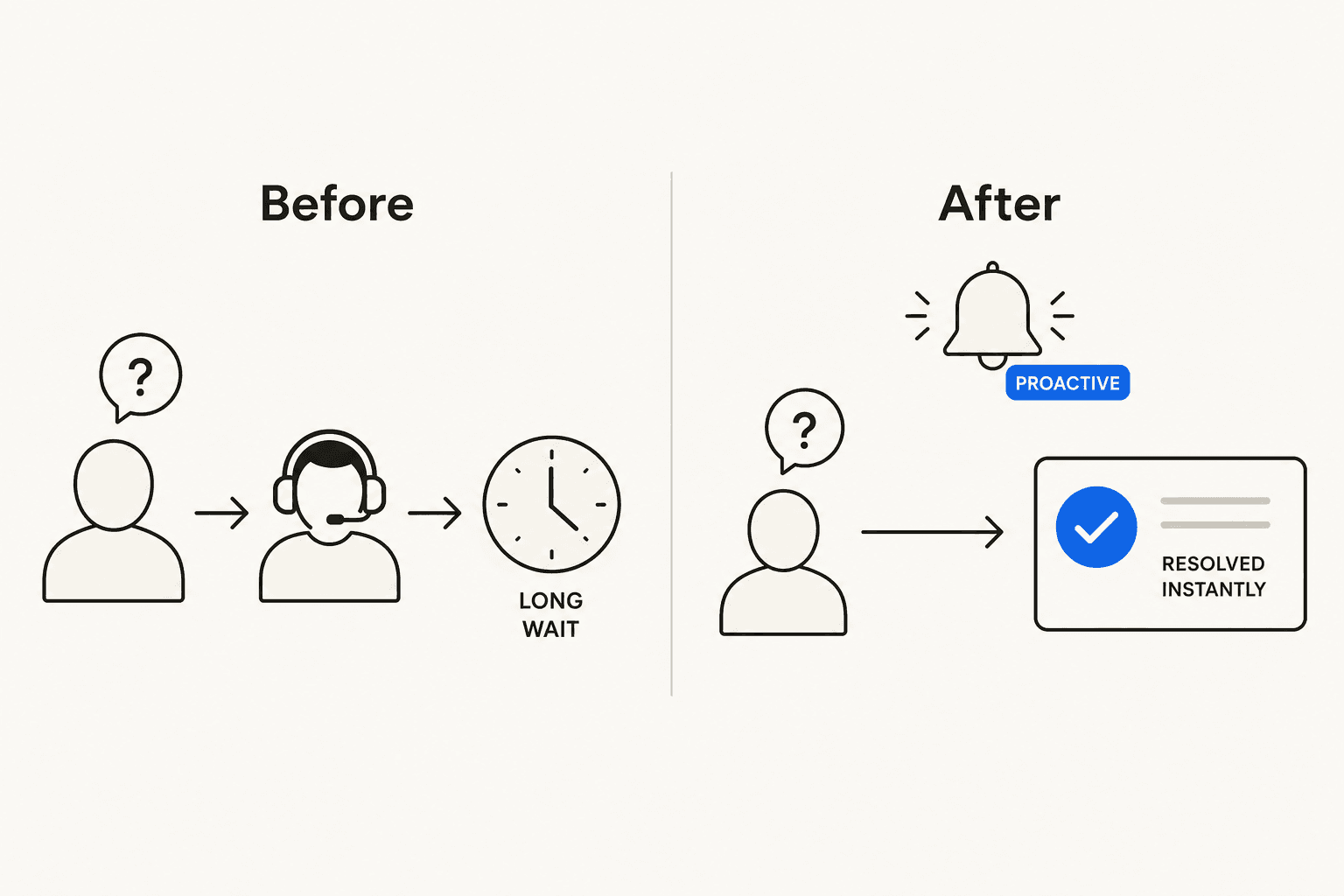
Modern AI agents for order tracking differ from rule-based bots in several meaningful ways.
Real-time data retrieval. When a customer asks "where's my order?", the AI queries your OMS and carrier API simultaneously -- returning the current fulfillment status, latest carrier scan, and estimated delivery in one answer. It doesn't send the customer to a tracking page; it brings the tracking data into the conversation.
Natural language understanding. Customers don't ask in clean keyword-matchable phrases. They ask "did my package leave the warehouse?", "I ordered this for a birthday on Saturday -- will it arrive?", or "the tracking app shows delivered but I don't have it." An AI agent understands intent regardless of phrasing, then reasons over the available data to give a genuinely useful response.
Multi-system synthesis. When your OMS says "Fulfilled" but the carrier API says "Label Created, Awaiting Item," those two pieces of data appear contradictory. An AI agent recognises that the package is likely on the warehouse dock waiting for carrier pickup and communicates that accurately, rather than confusing the customer with conflicting statuses. Thunai describes this dual-system query as one of the core capabilities separating AI agents from basic automation.
Logistics translation. Carrier exception codes like "Terminal Sortation Exception Code 43" or "Departure Scan" mean nothing to customers. An AI agent translates them: "There was a weather delay -- your package is safe and delivery is set for tomorrow." This reduces anxiety without requiring a human to interpret the code.
Action capability. WISMO rarely exists in isolation. After answering "where's my order?", customers often need to update a delivery address, initiate a return, or get a replacement for a lost package. An AI agent can take those actions -- not just describe what the customer should do. This is the line between an AI that reduces ticket volume and one that resolves it.
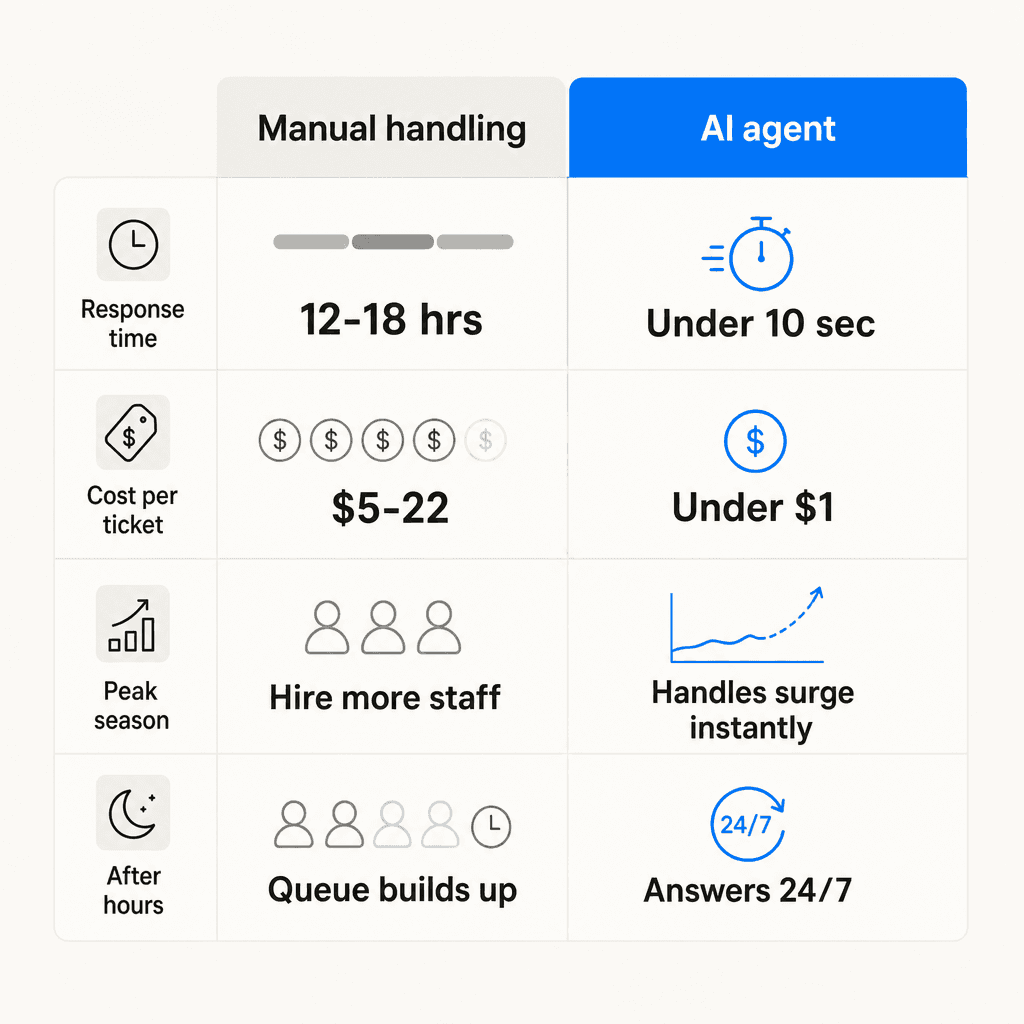
Here's how the capabilities compare directly:
The six moments WISMO queries peak
Order tracking questions don't arrive at random. WISMOlabs identifies the predictable moments where WISMO inquiries cluster -- and where your AI agent needs to be ready with a good answer.
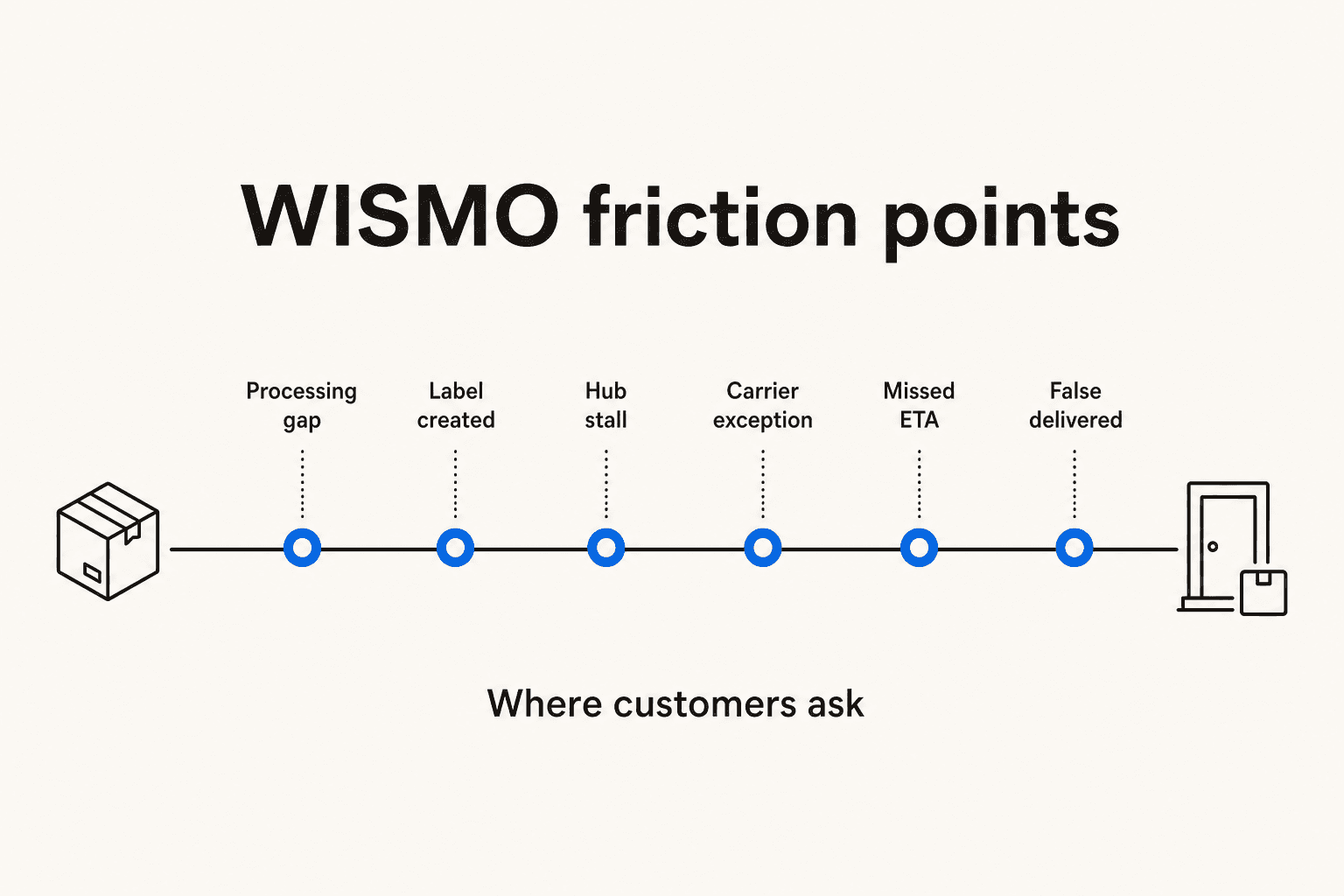
Processing gap (12-48 hours after order placement). The order is paid, no carrier scan yet. Customers wonder if it was received. An AI agent can confirm the order status, pull the expected fulfillment window from your OMS, and set accurate expectations -- even when there's technically nothing to report yet.
"Label Created" limbo. A tracking number exists but the carrier hasn't physically scanned the package. The customer sees that tracking hasn't moved. The AI explains this is normal -- the package is still at the fulfillment center or in transit to carrier pickup -- and sets a realistic expectation for the first scan.
Hub stall. The package sits in a sorting facility for 24-48 hours without movement. The AI identifies this, checks whether a carrier exception has been flagged, and can communicate proactively rather than waiting for an anxious follow-up ticket.
Carrier exception events. "Weather Delay," "Delivery Exception," "Held at Terminal" -- cryptic codes customers can't interpret. The AI translates each one into plain language with a revised ETA, rather than routing the ticket to a human for what amounts to basic status communication.
Missed ETA. The promised delivery date has passed. The AI checks carrier data for the latest status, delivers a revised estimate, and -- depending on your brand policy -- can offer a proactive goodwill gesture like a discount code.
"False delivered." The carrier marked the package as delivered but the customer can't find it. The AI checks carrier delivery logs for drop-off notes, and if the package is genuinely missing, walks the customer through waiting periods and opens a replacement or claim ticket automatically.
Going from reactive to proactive
The biggest shift AI enables isn't faster reactive responses -- it's preventing WISMO queries from reaching your support queue at all.
Traditional support is purely reactive: the customer experiences a gap, contacts you, and an agent handles it. AI-powered systems flip this. Rather than waiting for a customer to ask "where is my order?", the AI monitors your logistics pipeline, detects when a package has gone silent (no carrier scan for 48+ hours), and proactively notifies the customer before they even think to ask.
Proactive notifications sent at four key delivery milestones -- order confirmed, shipped, out for delivery, and exception or delay -- can reduce incoming WISMO tickets by 50-80%. Brands that make this shift see 70-90% drops in WISMO call volume right after launch.
The psychology backs this up. Customers are 3x more forgiving of delays when notified proactively via SMS or WhatsApp, compared to discovering issues on their own. Being the one to proactively communicate a problem transforms an anxiety-driven support interaction into a trust-building moment.
Kai USA -- which runs Kershaw Knives, ZT Zero Tolerance, and Shun Cutlery across multiple websites -- achieved a 92% reduction in weekly customer support inquiries about order tracking after implementing proactive email and SMS shipping notifications. Their VP of Operations, Matt Matsushima, noted: "WeSupply has helped us reduce weekly customer inquiries on shipping and tracking by 92%, enabling us to focus more on our core business."
Setting up AI for order tracking: what it actually takes
The integration setup matters more than the AI model. A powerful language model connected to stale order data is worse than nothing. Here is what a working AI order tracking setup requires.
Live connections to your order systems. The AI needs real-time access to your ecommerce platform (Shopify, WooCommerce, BigCommerce, Magento) for order status and fulfillment data, carrier APIs for live tracking events and ETAs, your helpdesk for ticket context and escalation, and your CRM for customer history.
Configured AI actions. It is not enough to give the AI read access to your systems. It needs to be able to act: create tickets, close tickets, fetch specific order details by customer email, update tracking, and escalate to a human with full context when needed. These are discrete configured actions, not emergent capabilities.
Escalation logic. Not every WISMO query is simple. "My package was stolen from my porch" is different from "what's the status of order #8294." The AI needs clear rules for when to involve a human -- and when it does escalate, the human should receive the full conversation context, not a cold handoff.
Tulipy, a UK ecommerce company running four gardening brands on Shopify with support managed through Zendesk, is a direct example of this working at scale.
Their agents were constantly switching between Shopify and Zendesk to answer order status questions -- a slow, error-prone process that consumed the team's day. After configuring eesel AI with Shopify Actions (Fetch Order Details, Fetch Order History, Get Product Variants), the AI handles these lookups on demand without any agent involvement. The case study describes the result plainly: "Nearly all of the 'Where Is My Order?' and stock questions are now handled automatically. The change was immediate." Busy seasons no longer require temporary hires -- the AI absorbs volume spikes without configuration changes.
Years.com, a DTC pet food subscription brand serving over 2 million dog owners per year, took a different approach. Their challenge wasn't just volume -- it was maintaining the personalised, dog-specific tone their brand runs on. Agents using eesel AI as a copilot inside Gorgias get draft replies with the customer's dog name and order details already incorporated, pulling live Shopify data without leaving their helpdesk. The result: consistent, personalised answers at scale, without the tab-switching overhead. Full Years case study here.
What the results actually look like
A few benchmarks from teams that have implemented AI order tracking:
| Metric | Before AI | After AI |
|---|---|---|
| Response time to WISMO query | 12-18 hours average | Under 10 seconds |
| Cost per WISMO ticket | $5-22 | Under $1 |
| Peak season capacity | Requires additional staff | Handles surge automatically |
| Agent time on order lookups | 60-70% of day | Near zero |
| Customer satisfaction (CSAT) | ~70% | 90%+ |
For a concrete financial picture: a store handling 10,000 support tickets monthly with a 30% WISMO rate has 3,000 order tracking tickets. At $22 per ticket, that's $66,000 monthly in WISMO handling costs. With eesel AI at $0.40 per conversation handled, the same volume costs $1,200 -- even accounting for tickets that still escalate to humans. Parcel Perform documents AI cutting resolution times from 38 hours to 5.4 minutes across e-commerce deployments. The AI vs. hiring math gets pretty clear once you run the numbers at your actual ticket volume.
"WISMO isn't a support problem, it's an information problem. Customers chase you only when they don't know what's happening."
What to look for in an AI order tracking solution
When evaluating options, these are the criteria that actually determine whether your implementation works.
Real-time data access. Many tools connect to your helpdesk and nothing else -- they can look up past ticket history but can't query live Shopify order data. Verify the integration depth: does the AI pull from your ecommerce platform and carrier API directly, or just from your help center articles?
Action capability. Can the AI close tickets, create escalations, send tracking links, initiate returns? Or is it read-only? A read-only AI saves time on lookups but an action-capable AI removes the human from most WISMO flows entirely.
Multi-channel consistency. Customers ask about orders on your website chat, via email, through Instagram DMs, and over WhatsApp. The answer needs to be the same everywhere, with conversation context carried across channels -- so a customer who asks via chat and follows up by email isn't starting from scratch.
Multilingual support. International stores have customers writing in German, French, Portuguese, Japanese, and dozens of other languages. A WISMO query in German is still a WISMO query, and it needs the same real-time data access to resolve well. Check whether the tool handles language detection automatically.
Smart escalation. The best AI order tracking setup handles routine cases instantly and escalates genuinely complex ones -- stolen packages, wrong items, billing disputes -- to humans with full context. The escalation logic matters as much as the AI's core capability.
For a comparison of ecommerce support platforms, the 7 best AI helpdesks for ecommerce runs through the leading options with pricing.
Try eesel AI
eesel AI's e-commerce agent connects directly to Shopify, WooCommerce, BigCommerce, and Magento, and works inside Gorgias, Zendesk, and Freshdesk. It handles order tracking queries in real time by querying live store data -- not just help center articles -- and can take actions like fetching order history, checking inventory, and escalating complex cases with full conversation context.
Pricing is $0.40 per chat session handled -- no platform fee, no per-seat charges. The free trial includes $50 in usage credit with no credit card required. For teams already handling significant WISMO volume, the math is straightforward.
Frequently Asked Questions
What percentage of ecommerce support tickets are order tracking queries?
Can AI actually look up live order and shipping data?
How much does manual order tracking support cost compared to AI?
Will AI handle peak season order tracking surges without extra setup?
What is the difference between a basic chatbot and an AI agent for order tracking?



Article by
Riellvriany Indriawan
Riell is a designer and writer at eesel AI with about two years of experience researching CX platforms, AI chatbots, and helpdesk software. She combines her design background with a sharp eye for how these tools actually look and feel in practice — making her comparisons unusually visual and user-focused.