Choosing between Kustomer and Gladly comes down to one fundamental question: do you want a CRM-centric platform that treats conversations like data, or a people-first platform that treats customers like relationships?
Both platforms promise to modernize customer service, but they approach the problem from opposite directions. Kustomer builds around conversations with powerful CRM and workflow capabilities. Gladly organizes everything around the customer, creating a continuous thread of interactions across every channel.
Let's break down what each platform actually offers, how they compare on features and pricing, and which one makes sense for different types of teams.
What is Kustomer?
Kustomer is an AI-driven customer service CRM founded in 2016 by Salesforce alumni. After being acquired by Meta in 2020 for approximately $1 billion, the company spun out as an independent entity in 2023. That Meta heritage shows in Kustomer's DNA: strong social channel integration, robust data management, and a conversation-centric approach that treats every interaction as part of a larger customer record.
The platform is built for teams that need serious CRM capabilities alongside their support tools. Kustomer doesn't just handle tickets; it builds a comprehensive customer profile that agents can query, update, and use to trigger automated workflows. If your support team regularly needs to look up order history, process refunds, or update customer records across multiple systems, Kustomer's native workflow engine handles this without relying on third-party automation tools like Zapier.
Kustomer's AI Agent Studio lets you design custom AI agents without developers. You define their purpose, connect them to knowledge bases, give them tools to take actions, and set guardrails to keep them on track. Every AI agent team includes a quality assurance agent that reviews responses before they reach customers.
The platform targets mid-market to enterprise teams managing high support volumes across multiple digital channels. It's particularly strong if Instagram, Facebook, or WhatsApp are primary support channels for your business.
What is Gladly?
Gladly takes a fundamentally different approach. Founded in 2014, the platform rejects the ticket-based model entirely. Instead, Gladly organizes support around people. Every customer gets a single, continuous conversation thread that spans voice, chat, email, SMS, and social channels. When a customer contacts you, agents see their complete history instantly, not a series of disconnected tickets.
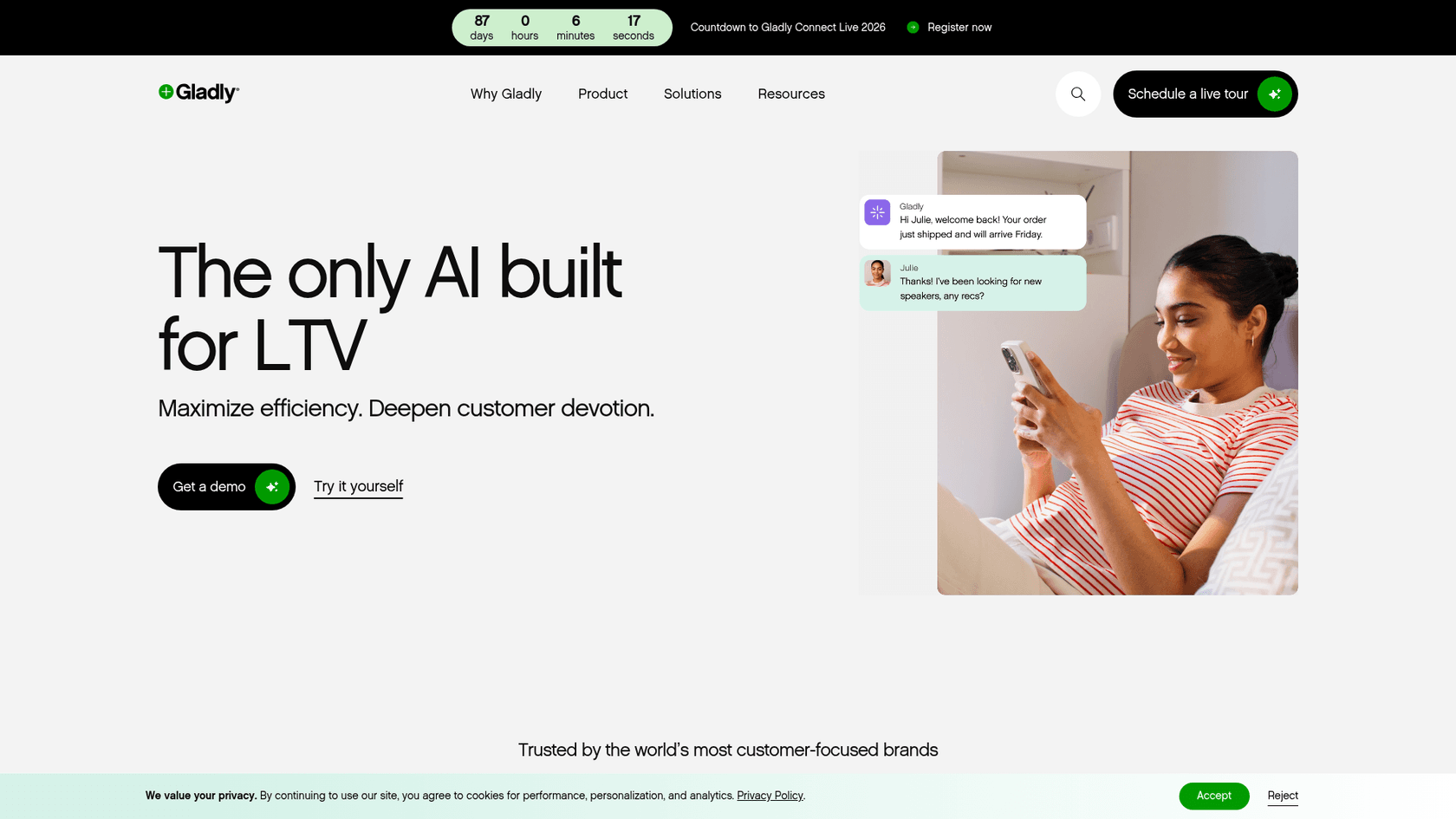
This philosophy matters in practice. A customer might email about an order, then call two days later with a follow-up question. In traditional systems, those are two separate tickets handled by potentially different agents. In Gladly, it's one ongoing conversation with full context preserved.
The platform's Sidekick AI handles automation through plain English instructions rather than complex configuration. You write Guides that teach Gladly your brand voice, policies, and when to escalate to humans. The AI can resolve common inquiries autonomously or work alongside agents, handing off seamlessly when conversations get complex.
Gladly targets retail and e-commerce brands that prioritize personalized service and customer loyalty. Their customer list reads like a who's who of direct-to-consumer brands: Nordstrom, Crate & Barrel, Allbirds, Bombas, UGG, and HOKA among them. These companies care about lifetime value, not just ticket resolution.
Kustomer vs Gladly: Feature comparison
Channel support
Both platforms cover the standard channels: email, chat, SMS, and social messaging. The key difference is voice.
Gladly includes native voice support. Phone calls integrate directly into the same conversation thread as digital channels. Agents can see the customer's full history while talking to them, and the call recording attaches to their profile.
Kustomer requires third-party telephony integration. They offer pre-built integrations with Amazon Connect, 8x8, Aircall, and Twilio, but you'll need to purchase and configure voice separately. This adds cost and complexity, though it also gives you more flexibility to choose your telephony provider.
For social channels, Kustomer's Meta heritage gives it an edge on Instagram, Facebook, and WhatsApp integration. Gladly handles these channels well too, but Kustomer's native connections run deeper.
AI and automation
Kustomer's AI Agent Studio offers more customization. You can build specialized AI agents for different tasks, define their tools and permissions, and create complex workflows. The trade-off is complexity: getting the most from Kustomer's AI requires more setup and ongoing management.
Gladly's Sidekick AI prioritizes simplicity. You write instructions in plain English, import your product catalog with a click, and the AI learns from interactions. The platform emphasizes quick deployment: most teams are up and running in days rather than weeks. Gladly claims their customers see 3x resolution rate increases in the first 30 days.
Both platforms offer sentiment analysis, smart routing, and automated quality assurance. Kustomer gives you more control over the details. Gladly gets you to results faster with less configuration.
CRM and customer data
This is where the philosophical difference becomes practical.
Kustomer functions as a full CRM. You can store extensive customer data, create custom fields, build complex workflows, and integrate deeply with other systems. The platform archives data after 18 months on standard plans, which may matter if you need long-term historical analysis.
Gladly focuses on conversation history rather than data storage. You get unlimited historical data retention, so you can see every interaction a customer has ever had with your brand. But the platform is intentionally lighter on traditional CRM features. If you need heavy data manipulation or complex customer segmentation, you might find Gladly limiting.
Reporting and analytics
Both platforms offer real-time dashboards and reporting. Kustomer's analytics go deeper, with more customization options and the ability to build complex reports. Gladly's reporting is simpler but focuses on actionable metrics that tie customer service to business outcomes like lifetime value.
Pricing comparison
| Plan | Gladly | Kustomer |
|---|---|---|
| Entry | Task Based: $38/user/month | Enterprise: $89/user/month |
| Advanced | Customer Facing: $150/user/month | Ultimate: $139/user/month |
| Minimum users | None | 8 users |
| Free trial | No | No |
| Billing | Monthly or annual | Annual only |
Source: Gladly pricing, Kustomer pricing
The pricing structures reveal each platform's target market. Gladly's Task Based plan at $38 per user opens the door for smaller teams or those with simpler needs. Kustomer's $89 entry point and 8-user minimum clearly signals enterprise focus.
Hidden costs matter too. Kustomer's voice integration requires separate telephony costs. Gladly includes voice natively but may require add-ons for advanced features. Neither platform offers a free trial, so you'll need to commit to demos and sales conversations before testing.
For a team of 10 agents, Kustomer Enterprise costs $890 monthly ($10,680 annually) with annual billing required. Gladly Task Based costs $380 monthly with flexibility to pay month-to-month. At the higher tier, Gladly Customer Facing ($1,500/month) exceeds Kustomer Ultimate ($1,390/month), but Kustomer still requires annual commitment.
Ease of use and setup
User ratings tell a clear story here. On TrustRadius, Gladly scores 9.4 for ease of use and 9.3 for ease of setup. Kustomer scores 8.6 and 8.1 respectively. That's a meaningful gap that reflects real differences in implementation experience.
Gladly emphasizes fast onboarding. The platform claims 5x faster implementation than competitors, with most teams operational in days. The interface is designed for CX users rather than technical administrators, so business users can make changes without IT involvement.
Kustomer offers more power but demands more expertise. The AI Agent Studio, workflow builder, and CRM features require investment in learning and configuration. Teams with technical resources can build sophisticated systems. Teams without may find themselves underutilizing the platform.
Training requirements differ too. Gladly's simpler model means agents get productive quickly. Kustomer's depth means more upfront training but potentially greater efficiency once workflows are optimized.
Who should choose each platform
Choose Gladly if:
- You want people-centric support rather than ticket management
- Native voice support is essential to your operation
- You prefer easier setup and faster time to value
- Your team needs unlimited access to historical customer data
- You have variable team sizes or fewer than 8 support agents
- You value ease of use over extensive customization
Gladly excels for retail and e-commerce brands where customer relationships drive repeat business. The platform's focus on loyalty and lifetime value aligns with businesses that see support as a revenue driver, not just a cost center.
Choose Kustomer if:
- You need robust CRM capabilities integrated with support
- Workflow automation and custom processes are critical
- You have 8 or more support agents
- Social and digital channels are your primary support channels
- You want deep AI customization through AI Agent Studio
- You have technical resources to configure and optimize the platform
Kustomer fits teams managing complex support operations across multiple systems. If your agents regularly need to check orders, process returns, update customer records, or trigger actions in other platforms, Kustomer's native workflow engine streamlines these processes.
A modern alternative: eesel AI
Both Kustomer and Gladly represent established approaches to customer service platforms. But there's another option worth considering, especially if you're drawn to the AI capabilities of these platforms.
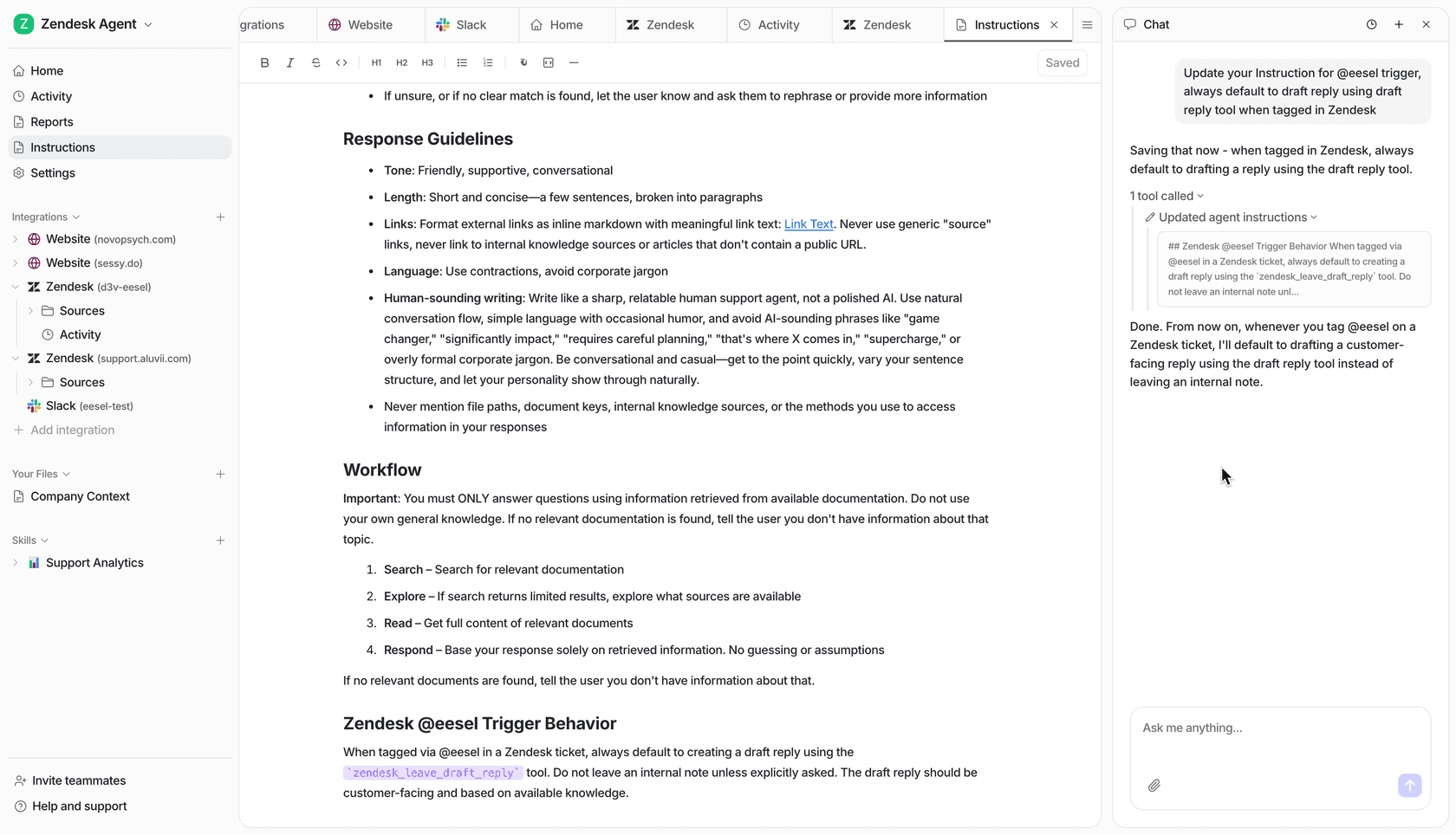
eesel AI takes a different approach: rather than replacing your help desk, eesel AI acts as an AI teammate that works within your existing tools. You don't migrate to a new platform. You add AI capabilities to what you already use.
Here's how it works. Connect eesel AI to your help desk (Zendesk, Freshdesk, Intercom, Gorgias, or others). It immediately learns from your past tickets, help center articles, macros, and connected documentation. Within minutes, it understands your business context, tone, and common issues.
Like any new hire, eesel AI starts with guidance. You can have it draft replies for agent review, limit it to specific ticket types, or set business hours when it can respond. As it proves itself, you expand its scope: eventually handling full frontline support, working 24/7, and escalating only the edge cases you define.
The key difference is control through plain English. You don't configure complex workflows or write code. You simply tell eesel AI your policies: "If the refund request is over 30 days, politely decline and offer store credit." "Always escalate billing disputes to a human." "For VIP customers, CC the account manager."
For teams comparing Kustomer vs Gladly primarily for their AI features, eesel AI offers a way to get advanced AI capabilities without replacing your entire support infrastructure. You keep your existing help desk, your existing processes, and your existing team structure. You just add an AI teammate that learns your business and scales with your needs.
Pricing starts at $299 per month for up to 3 bots and 1,000 AI interactions, with no per-seat fees. That makes it cost-effective for teams of any size, whether you have 3 agents or 30.
Making the right choice for your team
The decision between Kustomer and Gladly ultimately depends on your priorities and constraints.
If you need a full platform replacement and want CRM depth with powerful automation, Kustomer delivers. Just budget for the 8-user minimum, annual commitment, and implementation time required to unlock its full potential.
If you want faster setup, easier adoption, and a people-first approach that your agents will love using, Gladly makes more sense. The lower entry price and lack of minimums make it accessible to smaller teams.
For teams primarily evaluating these platforms for their AI capabilities, consider whether you need to replace your entire help desk or just add intelligent automation to what you already have. Modern AI tools like eesel AI integrate with your existing stack, letting you get AI benefits without the migration headache.
Whatever you choose, start with a clear evaluation of your actual needs. Both Kustomer and Gladly are capable platforms that serve different use cases well. The right choice is the one that fits how your team actually works.