

What empathy in customer service actually means
Empathy is the ability to feel with someone, to put yourself in their position and understand what they're experiencing. Sympathy is feeling sorry for them from a distance. In a support context the difference is huge: sympathy says "that's a shame"; empathy says "I get why this is stressful, and here's what I'm doing about it right now."
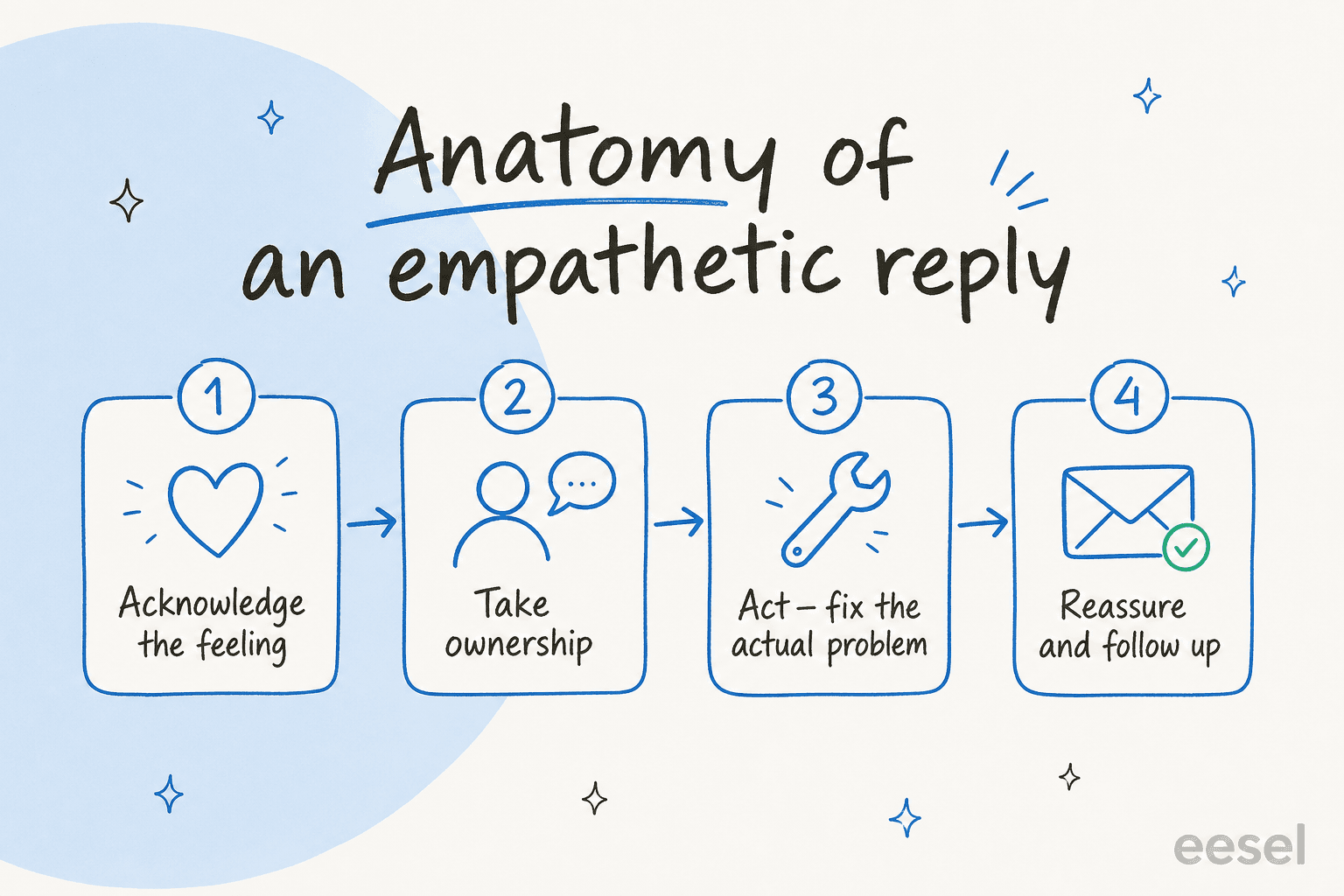
The part people miss is that empathy in customer service is not a phrase. It's a sequence. A real empathetic response acknowledges the feeling, takes ownership instead of deflecting, actually fixes the underlying problem, and then reassures the customer it won't happen again. Skip the "act" step and all the warm language in the world reads as hollow.
If you want the exact wording for each of those steps, we keep a running library of empathy statements sorted by situation. But hold the phrases loosely, because the way they're used matters far more than the words themselves, which is where most teams get this wrong.
Why empathy is the whole ballgame
Here's the business case in one number. In PwC's Experience is Everything study of 15,000 consumers, 32% said they'd walk away from a brand they love after just one bad experience. In Latin America that figure was 49%. The same report found people will pay up to a 16% price premium for a better experience, and its blunt headline finding was that companies "have lost the human touch."
That last line is the one to sit with. As support gets more digital, customers are not asking for more automation for its own sake. They're asking not to feel like a ticket number. Empathy is how you deliver that at the exact moment a customer is most likely to leave, which is when something has gone wrong. Get it right and a complaint becomes loyalty. Get it wrong and you've handed a paying customer a reason to shop your competitor.
This is why empathy shows up in every excellent customer service example worth studying, and why it's the first thing that collapses when a team is stretched too thin.
The empathy paradox: is AI killing it?
Now the argument everyone's actually having. Ask a room of CX people whether AI is killing empathy and you'll get a genuine fight. I went and read what support agents themselves say about it, and the split is real.
On one side, the "AI makes room for empathy" camp. A support agent put it well in a thread on whether AI is killing empathy:
"I don't think AI kills empathy at all. It just exposes whether it was really there in the first place. When teams use AI to help clear the noise, they actually get time to listen and really listen. When they use it to avoid people, that's when empathy dies. As with all new tech, it's less about the tech and more about the intent."
jnoble100, r/CustomerSuccess

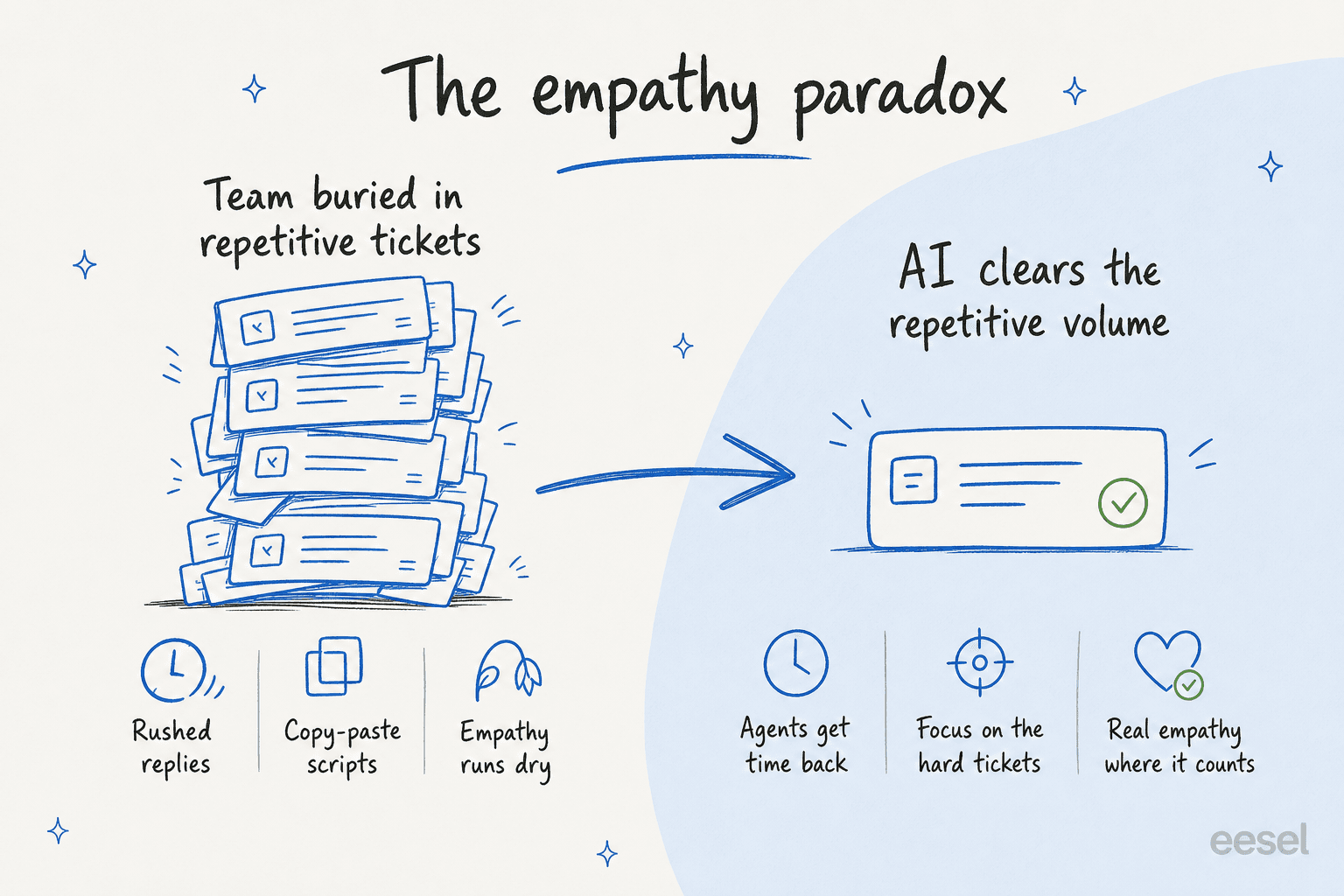
The frontline version of the same point, from a companion thread, is even sharper: "Most of us don't lose empathy because we stop caring. We lose it because we're exhausted, juggling the same 100 'where's my order?' tickets." When a bot handles those, the argument goes, agents get back the one thing empathy needs most, which is time.
But the skeptics have earned their skepticism, and they push back hard. The top-voted reply in that same thread:
"In places I've worked in the past, automating tasks did not free up time for people. They just cut people, still making it very burdensome for the workers. And for some reason, prices still go up."
Electrical_Goat_8311, r/CustomerService
Both of these are true at once, and that's the paradox. The technology is neutral; the intent isn't. Automation deployed to shrink a team leaves fewer, more burnt-out agents answering the emotional tickets. The exact same automation deployed to remove drudgery gives a team its bandwidth back. This is also why the AI versus human support framing is a bit of a trap: the winning setup is almost always a mix, not a replacement.
Why scripted empathy backfires
There's a specific failure mode worth calling out, because a lot of teams walk straight into it: they try to manufacture empathy, either by mandating word-for-word statements from human agents or by scripting them into a bot. Both tend to backfire.
The most honest account of this I found came from an engineering director at a CX vendor, recounted by an employee in a call centre thread:
"They scripted empathy into automated chat responses. 'I understand your frustration.' 'I hear you.' etc etc. All triggered at the right moments... super human sounding. And it rang completely false. They scrapped it. Her point... is that it's not the script or the timing. 'I understand your fear, I'm here to help' lands badly from a bot because there's no stakes. no real humanity."
ujet-cx, r/CallCenterWorkers
That phrase, "there's no stakes," is the whole thing. A customer knows a bot can't actually feel their fear, so a bot performing feeling reads as phoniness, and phoniness is worse than a plain, efficient answer. It doesn't only apply to bots either. When empathy gets graded as a compliance metric, humans start performing it too, and it gets just as fake. One agent described being coached for not using an empathy line "word for word" when a customer reordered dog food. Another cut to the point: teams "cram your required scripting with empathy laced words" because it's cheaper than actually fixing the customer's problem.
The takeaway isn't "drop empathy." It's that empathy only works when it's attached to a real fix. Say less, solve more. If you're rewriting your support playbook, this is also the mindset that makes dealing with angry customers go better, because de-escalation is empathy plus a concrete next step, not empathy on its own.
Burnout is the real empathy killer
If you want to know why empathy disappears from a support queue, it's usually not AI and it's not bad hiring. It's exhaustion. Compassion fatigue is real, and no script survives it. The bleakest, most upvoted comment I read in a thread about mandatory empathy training summed it up:
"My manager told me once, 'The world is a crazy place, and people are going through a lot.' And I told him that I am a people, too."
ItAllWent19, r/callcentres
You can't train or mandate your way out of that. An agent handling the same 100 repetitive tickets a day, getting dinged on a QA scorecard for empathy while being "bitched at all day," is not going to have deep reserves of warmth left for the customer who really needs it. This is the same overwhelm we hear about constantly from small teams: as one director of support at a fast-growing startup put it, "our customers far outnumber our employees."
So protecting empathy is really a capacity problem. The way you keep it alive isn't a poster on the wall about caring more, it's making sure your best people aren't drowning in ticket volume that never needed a human in the first place. Which brings us back to where AI earns its place.
Where AI actually helps you be more empathetic
Here's the part that reconciles the whole paradox. Used well, AI doesn't replace empathy, it protects the conditions empathy needs. A few concrete ways, drawn from how teams actually run this.
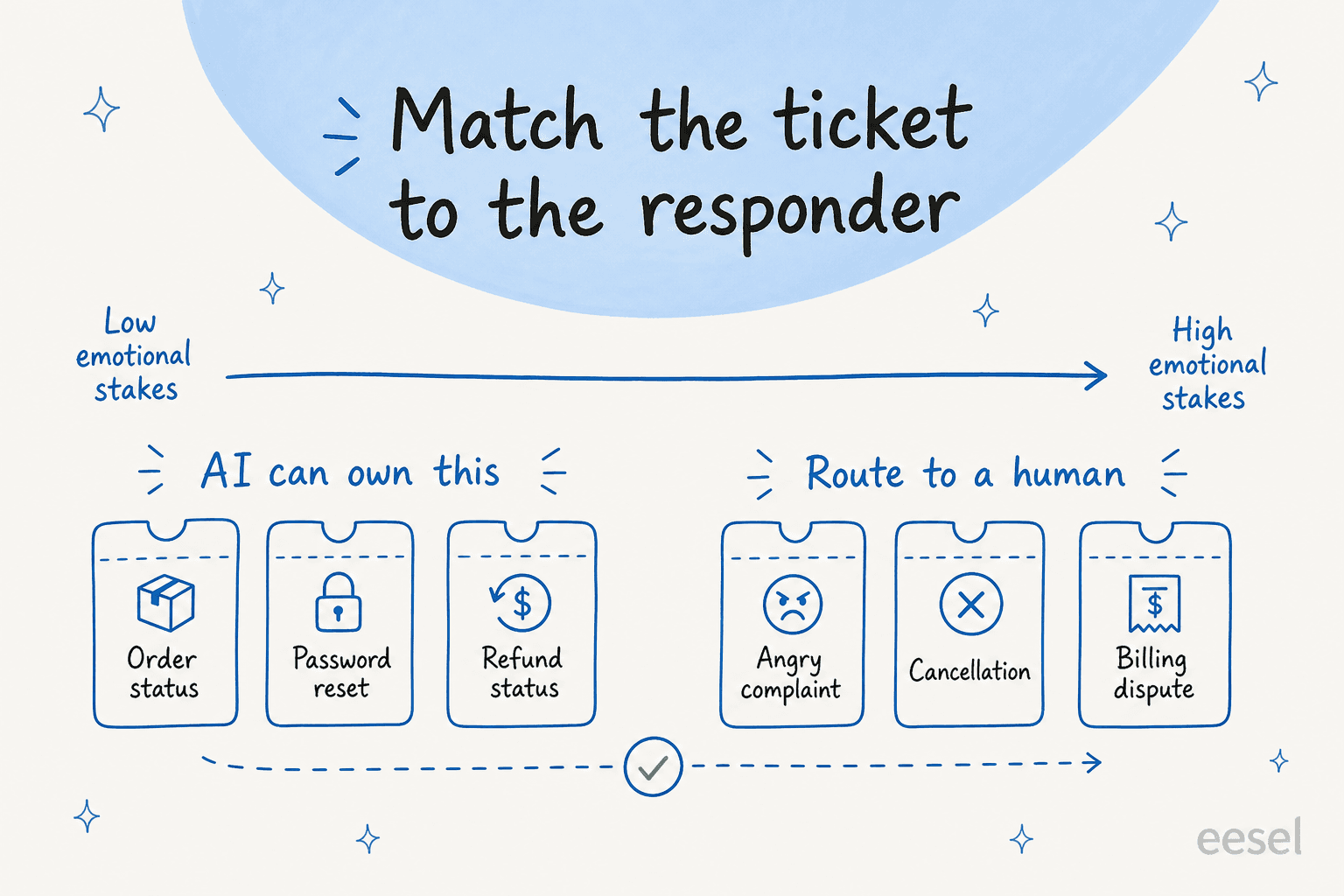
Match the ticket to the responder. Not every ticket has emotional stakes. "Where's my order?" and "how do I reset my password?" don't need a human's compassion, they need a fast, correct answer. The high-emotion tickets, an angry complaint, a cancellation, a billing dispute, are where a human's empathy is worth its weight. The trick is routing by emotional stakes, so people spend their finite empathy where it counts.
Keep a human in the loop with AI drafting. Instead of a bot talking directly to an upset customer, an AI copilot drafts the reply and a human reviews, tweaks the tone, and hits send. The customer still gets a real person's judgement; the agent just skips the blank-page part. Done right, it also holds your brand voice, so the reply sounds like your team and not a generic bot.
Make the handoff carry context. This is the one most teams botch, and a support agent nailed why:
"Offloading repetitive work does create space, but that only helps if the handoff between automation and humans is clean and obvious. Where this usually breaks is when AI removes volume but also removes context, so agents spend their extra time reconstructing what already happened. Empathy scales when humans inherit a clear story and clear ownership, not just fewer tickets."
quietvectorfield, r/CustomerService
That's the difference between a good AI handoff and the maddening loop where a customer repeats their problem to five bots and never reaches a person.
And customers are more open to this than the "AI kills empathy" headlines suggest. Zendesk research found 67% of customers actually want AI that adjusts its tone to how they're feeling, and 71% believe AI will make experiences more empathetic, not less. The catch, per the same research, is that nearly three in four already feel their emotional state gets ignored on digital channels. The bar is low; the opportunity is real.
Try eesel for empathetic support at scale
If the goal is more empathy and not less, the practical move is to take the repetitive volume off your team so they can spend their attention on the tickets that actually need a human. That's what eesel is built for. It plugs into your existing helpdesk, learns from your past tickets and help centre, and either drafts replies for your agents to review or handles the routine questions end to end, escalating the emotional and complex ones to a person with the full context attached.

The bit I'd flag most is the simulation: you can run eesel over thousands of your historical tickets to see exactly how it would have replied, and how much it would have handled, before it's ever live to a customer. That's the honest way to check whether AI is going to free your team up or just add noise. It's free to try, and you can point it at your own tickets in a few minutes to find out.
Empathy statements give you the words; customer service AI gives your team the time to mean them.
Frequently Asked Questions
What is empathy in customer service?
Why is empathy important in customer service?
Can AI show empathy in customer service?
Does AI customer service reduce empathy?
How do you train a support team to be more empathetic?


Article by
Riellvriany Indriawan
Riell is a designer and writer at eesel AI with about two years of experience researching CX platforms, AI chatbots, and helpdesk software. She combines her design background with a sharp eye for how these tools actually look and feel in practice — making her comparisons unusually visual and user-focused.