

What "trust" actually means to a customer
Ask ten support leaders what customer trust is and you'll get ten fuzzy answers about "relationships" and "loyalty." That's not wrong, but it's not something you can act on. On the queue, trust is much more concrete: it's a customer's confidence that when they come to you with a problem, you'll handle it the same competent way you did last time.
That confidence rests on a handful of things you can actually control. When I break down why some accounts stay loyal for years and others churn after one incident, it almost always comes back to five pillars.
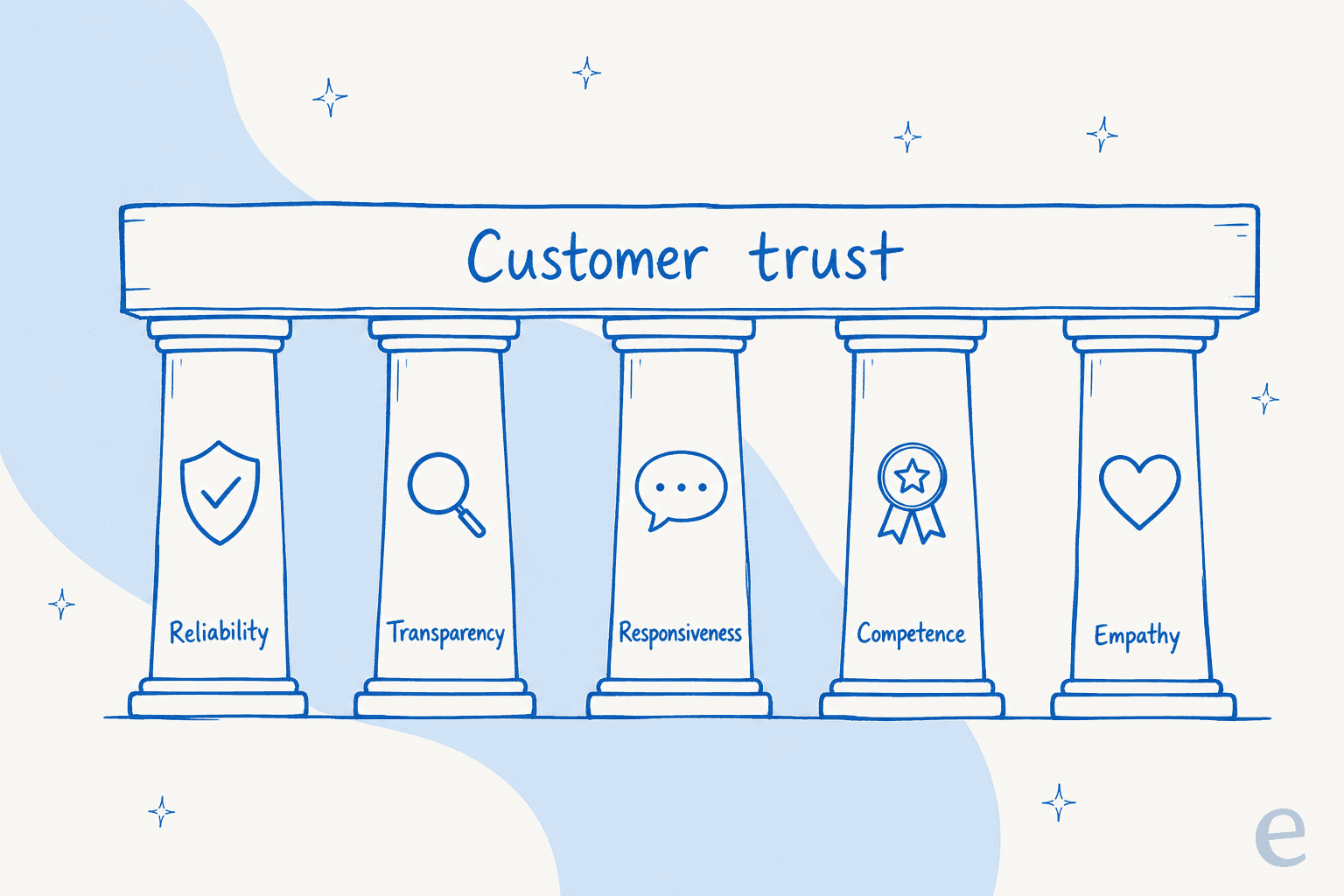
- Reliability is doing what you said you'd do, every time. A refund that lands when you promised it. A callback that actually happens.
- Transparency is showing your work: where an answer came from, what the timeline really is, and an honest "I don't know" when that's the truth.
- Responsiveness is speed. A customer left waiting assumes they've been forgotten, and forgotten customers stop trusting.
- Competence is getting it right. Warmth without correctness is just a pleasant way to be wrong.
- Empathy is proving you understand the problem is theirs, not a ticket number in your queue. It's as much a customer service mindset as a skill.
None of these is a campaign you run once. They're standards you hold on every single interaction, which is exactly what makes trust hard, and exactly why it's worth doing. If you want a fuller framework for the operational side, the guide to customer service standards goes deeper on turning these into repeatable practice.
Trust is asymmetric: slow to build, fast to lose
Here's the thing most "delight your customers" advice skips: trust doesn't move symmetrically. You earn it in small increments over a long time, and you can lose most of it in a single interaction.
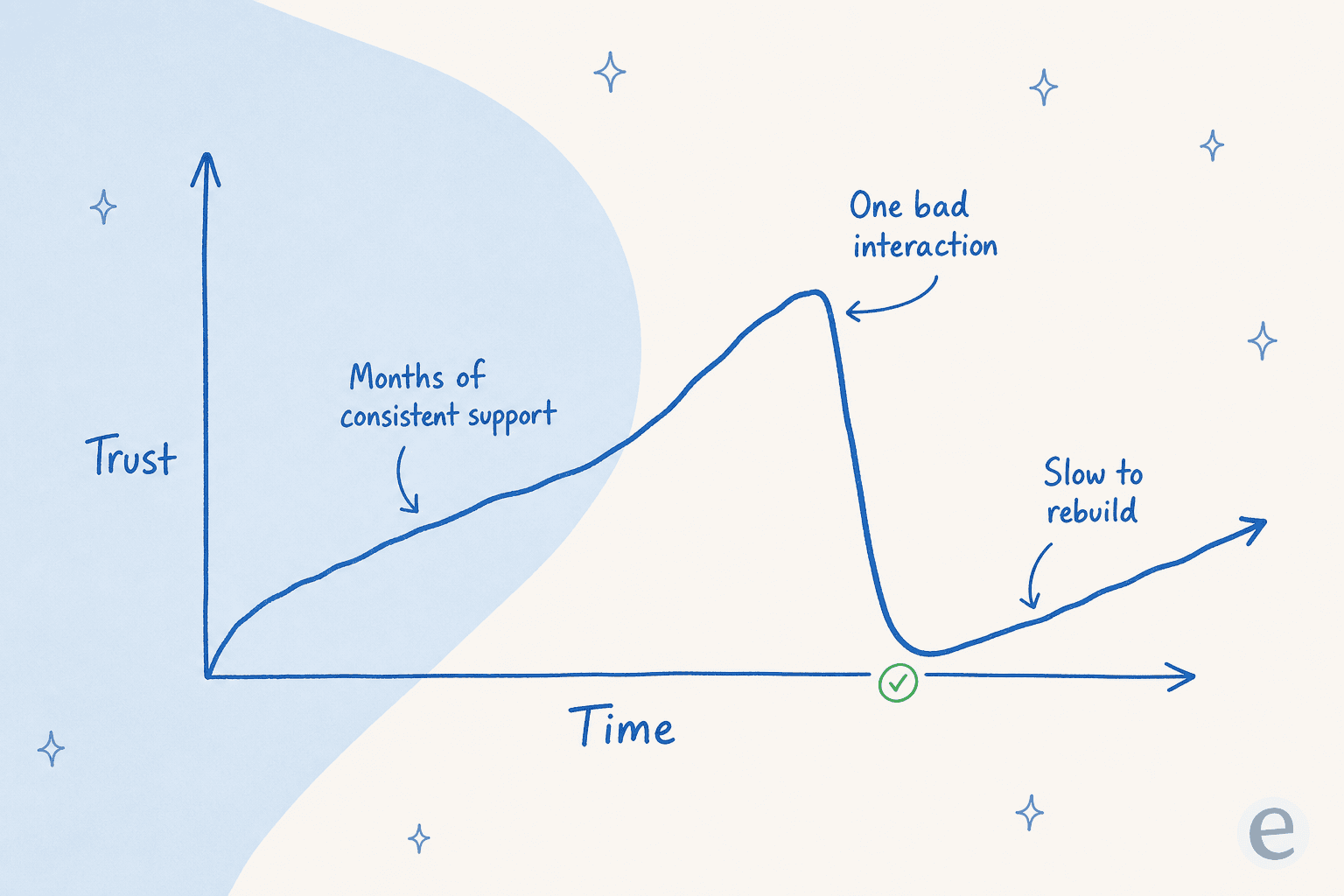
Picture a customer who's had twelve smooth interactions with you. On the thirteenth, they get a wrong answer that costs them money, or they wait three days for a reply that never mentions their actual question. Those twelve good experiences don't average out the bad one. The bad one becomes the story they tell, and it's the one they repeat to colleagues.
This asymmetry is the single most useful thing to internalize, because it reorders your priorities. It means consistency beats brilliance. A team that's reliably good on every ticket builds more trust than one that's dazzling four times out of five and disastrous the fifth. It's also why a bad customer experience is so expensive; if you want to see how these failures actually play out, the patterns in real bad customer service stories are remarkably consistent, and mostly avoidable.
The practical takeaway: hunt down the interactions where you're inconsistent before you chase the ones where you could be amazing. The floor matters more than the ceiling.
Be consistent: the same answer, everywhere, every time
The fastest way to lose trust quietly, no dramatic blowup required, is to give a customer one answer on chat and a different one over email. Now they don't know which of you to believe, and "your company" stops feeling like a single entity that knows what it's doing.
Consistency has two enemies. The first is fragmented knowledge: policies living in three different docs, half of them out of date, so which answer a customer gets depends on which agent picks up the ticket. The fix there is a single source of truth, a real knowledge base that every agent (and every AI) reads from, so the answer to "what's your return window?" is the same no matter who's asked.
The second enemy is channel sprawl. Customers now reach out over email, chat, WhatsApp, social, and phone, and they expect the same competent answer on each. Keeping that consistent by hand across a multichannel setup is genuinely hard, which is one of the honest arguments for AI support: a system that draws from one knowledge base will say the same thing on every channel by default, where a team of humans has to be trained and re-trained to.
Be transparent: show your work and admit limits
Transparency is the most underrated trust lever, because it feels counterintuitive. Admitting you don't know something, or that a fix will take three days, feels like it should weaken confidence. In practice it does the opposite, because customers can tell the difference between honesty and a confident dodge, and they trust the honest one.
Three habits do most of the work here:
- Cite where the answer came from. "Per our refund policy, [link]" is worth more than the same sentence with no source, because the customer can verify it and doesn't have to just take your word.
- Be honest about timelines. "This will take about two business days" beats a cheerful "right away!" that turns into three days of silence. The specific, slightly-disappointing truth builds more trust than the vague, optimistic promise.
- Say "I don't know" when it's true, and pair it with what you'll do next. A dodge is obvious, and it's corrosive.
This is one area where good AI can actually raise the transparency bar rather than lower it. A support lead at an SMS platform put it plainly in a G2 review, noting the AI "answers confidently but not too confidently." That "not too confidently" is the trust-preserving part. The best implementations attach source citations to every answer, so both the customer and your team can see exactly where a claim came from.
Be responsive: speed is a trust signal
Waiting is where trust leaks out. A customer who's been left hanging for hours doesn't think "they must be busy," they think "I've been forgotten," and forgotten customers start shopping around.
You don't have to answer everything instantly, but you do have to acknowledge fast. The gap between a customer hitting send and getting any human-feeling response is where anxiety grows, so reducing first response time is one of the highest-leverage trust investments there is, especially outside business hours when a slow reply feels like being ignored.
This is the clearest case for AI on the front line. Not to replace the nuanced, human conversations, but to make sure nobody sits in silence at 2am. An AI that covers the first response instantly, then hands the hard cases to a human in the morning, closes the exact gap where trust usually erodes.
Where AI builds trust, and where it quietly breaks it
Let's be honest about the double-edged part. AI in customer support can be one of the strongest trust-builders you have, or one of the fastest ways to torch it, and the difference isn't the model, it's how you route the work.
The failure mode is the confident wrong answer. A customer asks a question, the bot invents a plausible-sounding policy that doesn't exist, the customer acts on it, and now you've broken trust and created a mess to clean up. I've watched a confident-sounding bot quietly give wrong answers, which is exactly why the serious tools don't let the AI answer everything.
The safeguard is confidence-based routing: the AI only replies to questions it's genuinely sure about and escalates the rest to a human, untouched.
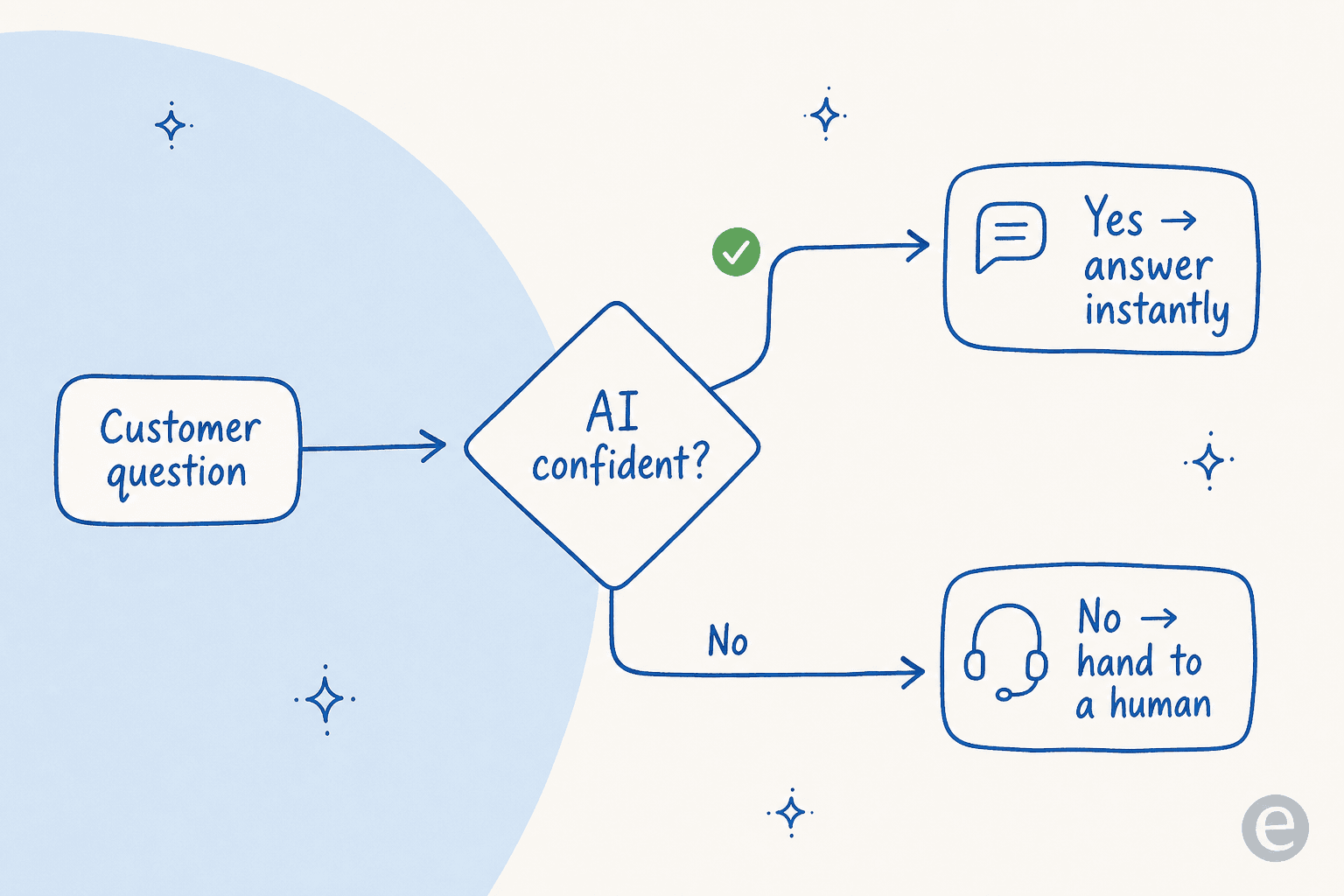
This isn't a nice-to-have, it's the number one thing serious buyers ask about before they'll let AI near their customers. One CX lead at a DTC supplements brand on Gorgias and Shopify, running around 7,000 tickets a month, said the deal came down to exactly this: they needed an AI that "is only handling the tickets that it's confident to handle and all the other ones, leave them alone." They couldn't afford a bot that answers everything and hopes for the best, because they can't manually re-check 7,000 tickets to catch its mistakes. That's the whole trust question in one sentence.
Get the routing right and the AI becomes a trust asset: fast, consistent, honest about its limits. Before you flip anything live, the responsible move is to simulate the AI against your past tickets to see exactly what it would have said, where it would have been confident, and where it would have (correctly) backed off. That's how you find out whether it protects trust or risks it before a real customer is on the other end.
Measure it: the trust metrics that matter
You can't manage what you don't measure, and "vibes" is not a trust metric. No single number captures trust, but a few together tell you honestly whether you're building it or bleeding it:
- CSAT after resolution: the direct read on whether that interaction landed.
- Repeat-contact rate: how often a customer has to come back about the same issue. High repeat contact means you're "resolving" without actually resolving, which quietly erodes trust.
- Resolution rate: what share of issues actually get closed out, not just responded to.
- First response time: the speed signal from above.
Track these with a proper set of customer service KPIs and AI customer service metrics rather than eyeballing your inbox. The point isn't to hit a dashboard target, it's to catch the inconsistency, the slow-creeping repeat-contact rate, the dip in CSAT on a specific topic, before it becomes the interaction a customer tells their colleagues about.
Try eesel for trustworthy, consistent support
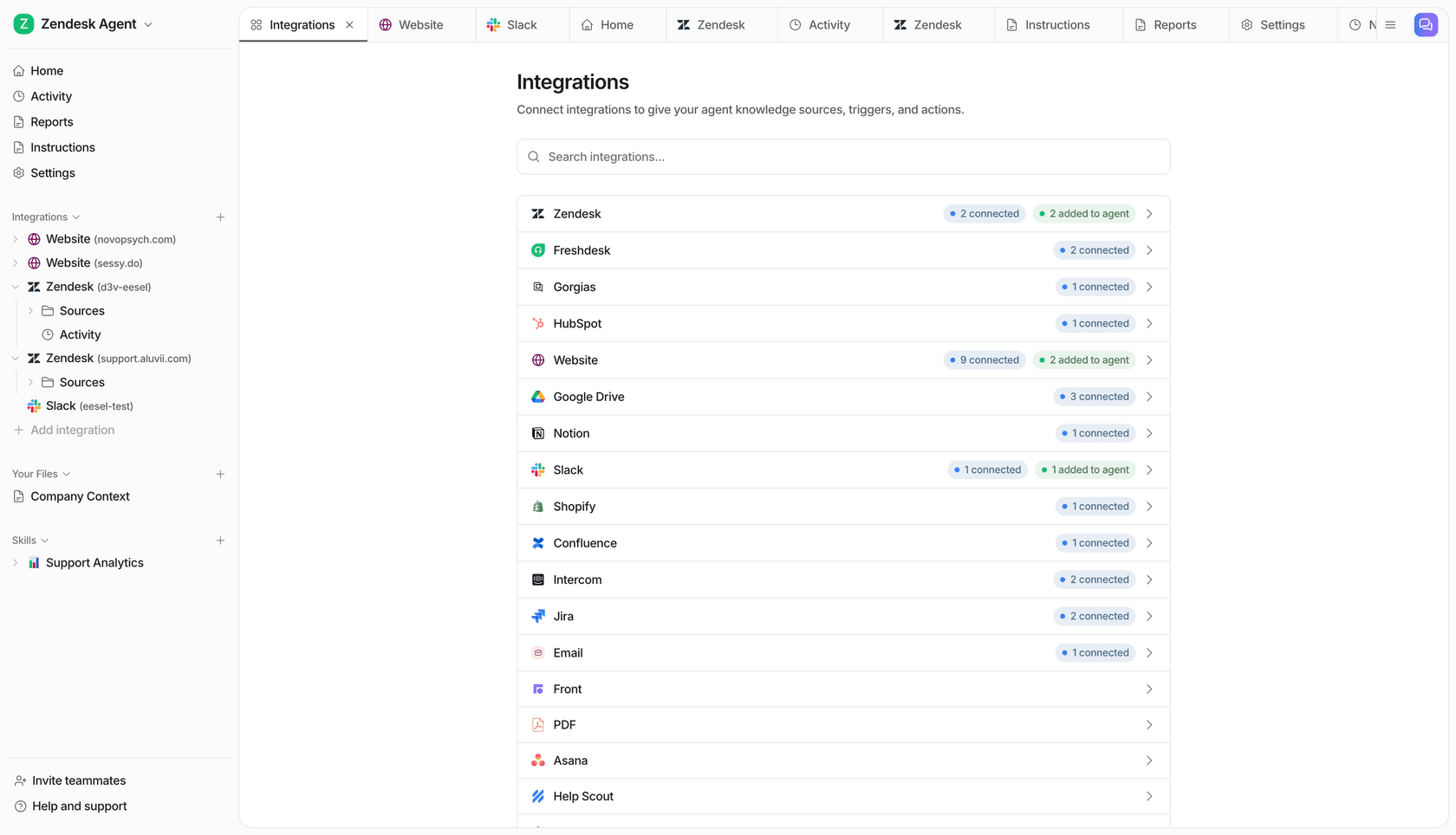
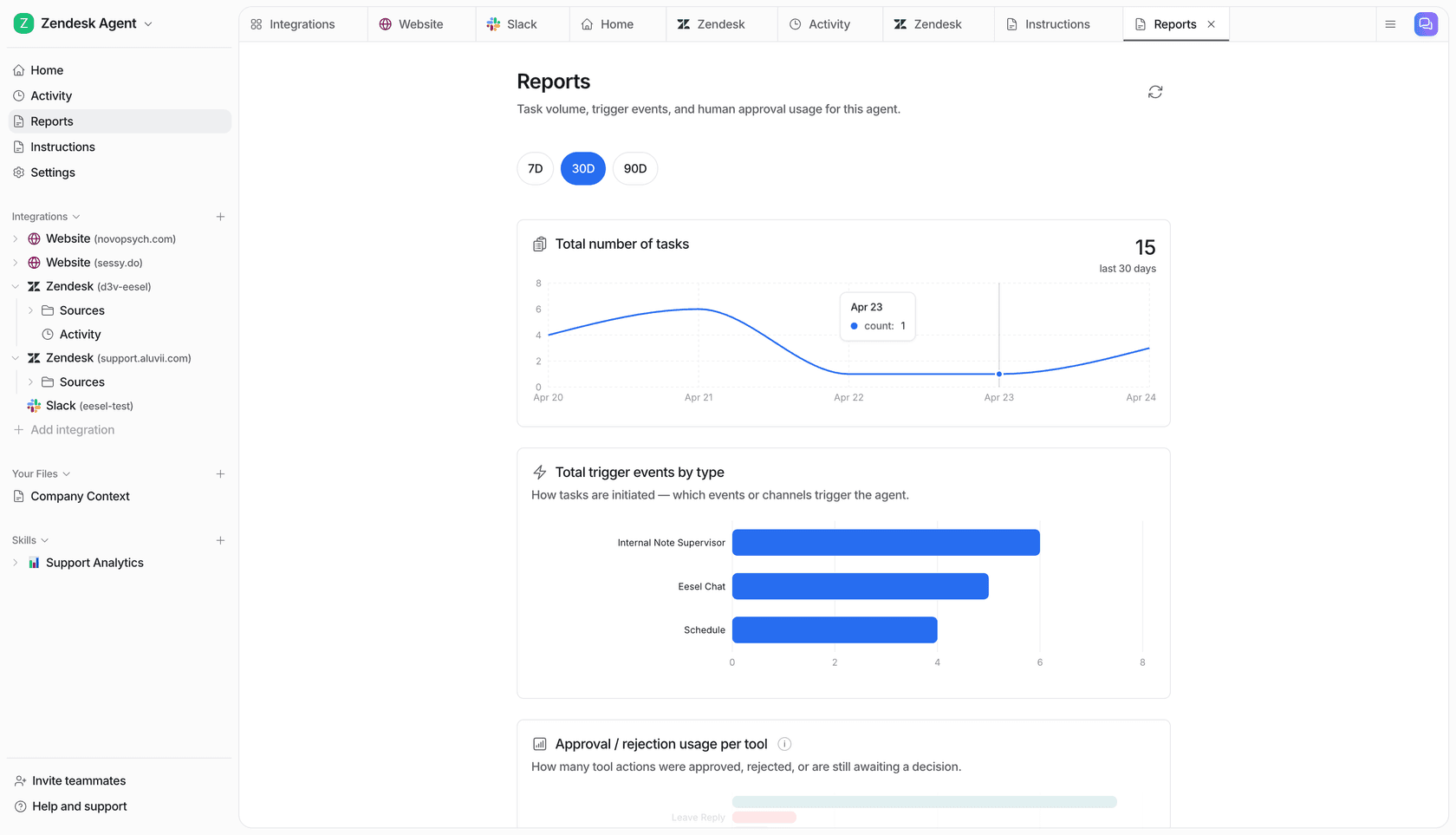
If the theme running through all of this is "be consistent, be transparent, be fast, and don't let anyone answer what they're not sure of," that's more or less the design brief for eesel. It's an AI support agent that plugs into the helpdesk you already run, Zendesk, Freshdesk, Gorgias, Front, and learns from your past tickets and help docs so it answers the same way your best agent would.
The parts that matter for trust are built in: confidence-based routing so it only answers what it's sure of and escalates the rest, source citations on its answers, and a simulation mode that runs it against your historical tickets so you can see exactly how it behaves before a single customer talks to it. One customer, Jon Miron at Yellowdig, described it as a partnership rather than a vendor relationship:
"It feels like a partnership, rather than a vendor relationship... Recently, a new customer success hire joked that our eesel AI bot was their best friend during onboarding and interviewing."
Jon Miron, Director of Support & Operations, Yellowdig (case study)
You can connect it and run a simulation on your own tickets for free, before it ever answers a live customer.

Frequently Asked Questions
How do you build trust with customers in customer service?
How long does it take to build trust with customers?
Can AI help or hurt customer trust?
What metrics measure customer trust?
How do you rebuild trust after a bad customer experience?
Does transparency really build customer trust?
How do small teams build trust with customers without a big support budget?


Article by
Riellvriany Indriawan
Riell is a designer and writer at eesel AI with about two years of experience researching CX platforms, AI chatbots, and helpdesk software. She combines her design background with a sharp eye for how these tools actually look and feel in practice — making her comparisons unusually visual and user-focused.