
Why the types of customers matter more to support than to marketing
I work a support queue, and I'll be honest: the tidy five-box model of customer types that shows up in every marketing deck almost never matches who lands in my inbox. Marketing sorts people by intent to buy. That's useful when you're writing an ad. It's close to useless at 9am when there are 200 open tickets and you're deciding who to answer first.
Support sorts people by something else entirely: what they need from this conversation, and how much it costs you to give it to them. A customer who wants a tracking number and a customer threatening to cancel are both "customers," but they are not the same job. Answer the tracking-number question with a warm three-paragraph apology and you've wasted everyone's time. Answer the cancellation with a canned macro and you've probably lost the account.
So the reason to care about types of customers isn't taxonomy for its own sake. It's triage. Once you can name the type in front of you, you know the right response, the right tone, and whether it should even reach a human at all. Get that sorting right and a small team can feel like a big one. Get it wrong and you're spending your best people on password resets.
The five classic customer types
Before the support-queue version, it's worth knowing the model everyone references, because it still shapes how the rest of your company talks about customers. The framework is usually credited to retail consultant Murray Raphel and popularised in customer-experience writing over the years. It breaks buyers into five types.
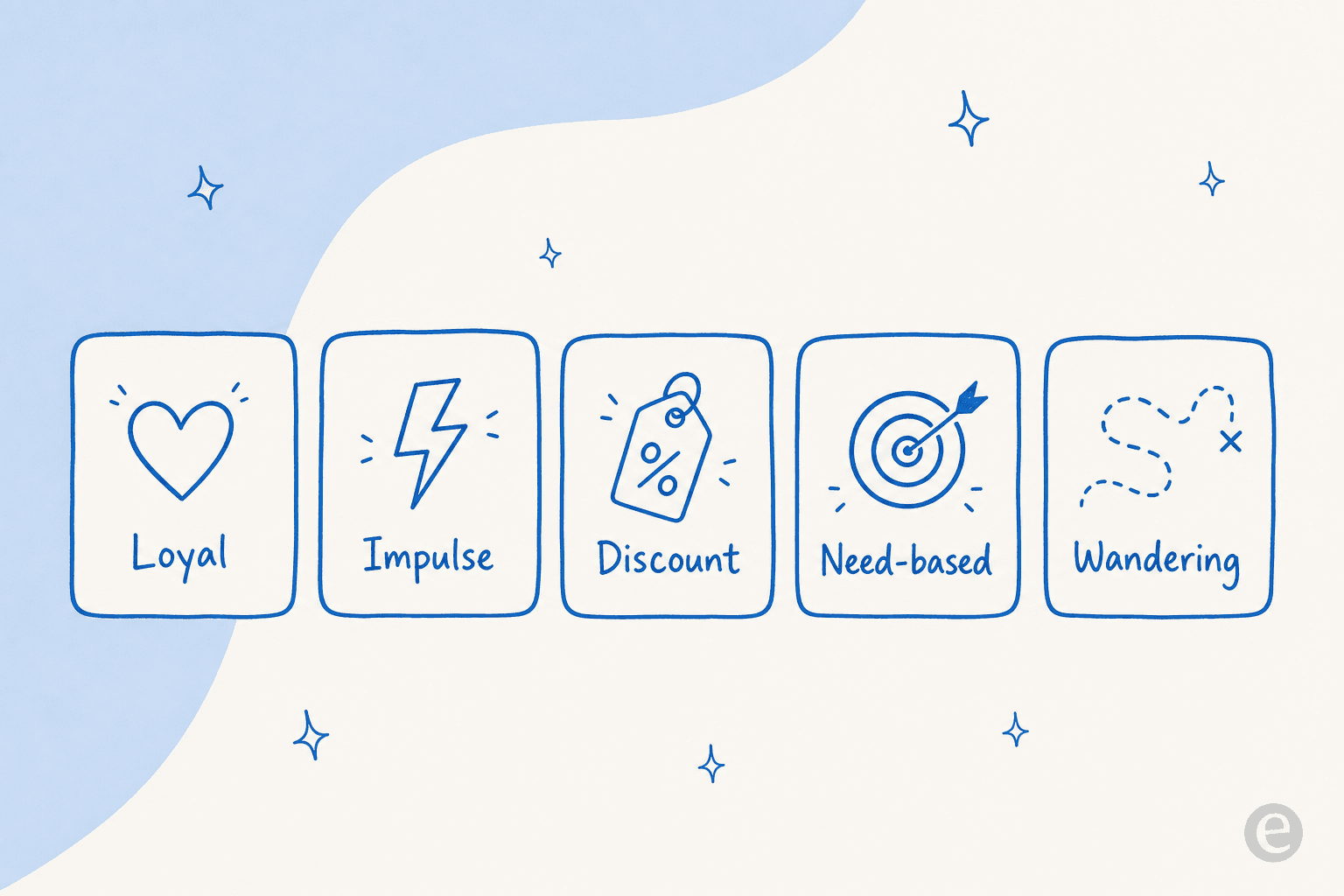
- Loyal customers. The small share of your base that buys repeatedly and refers others. They're a fraction of the headcount and a large share of the revenue, so they earn disproportionate care.
- Impulse customers. They buy on the moment, without a long research phase. Friction is their enemy; anything that slows the path to checkout loses them.
- Discount customers. They buy, but rarely at full price. Valuable for moving inventory, harder to keep loyal once the deal ends.
- Need-based customers. They come with a specific problem and a specific product in mind. Easy to serve if you have what they need, easy to lose to a competitor if you don't.
- Wandering customers. Browsers with no clear intent. High in traffic, low in conversion, and usually not where you should spend your support energy.
This model is a fine shared vocabulary. Its limit for a support leader is that it says nothing about how the person behaves once they contact you, which is the only thing you actually control from the helpdesk.
A more useful lens: customer types in your support queue
Here's the reframe I'd hand any support team. Stop sorting customers by why they bought, and start sorting them by two things you can see from inside the helpdesk: how much value the relationship carries, and how much effort each contact takes to resolve well.
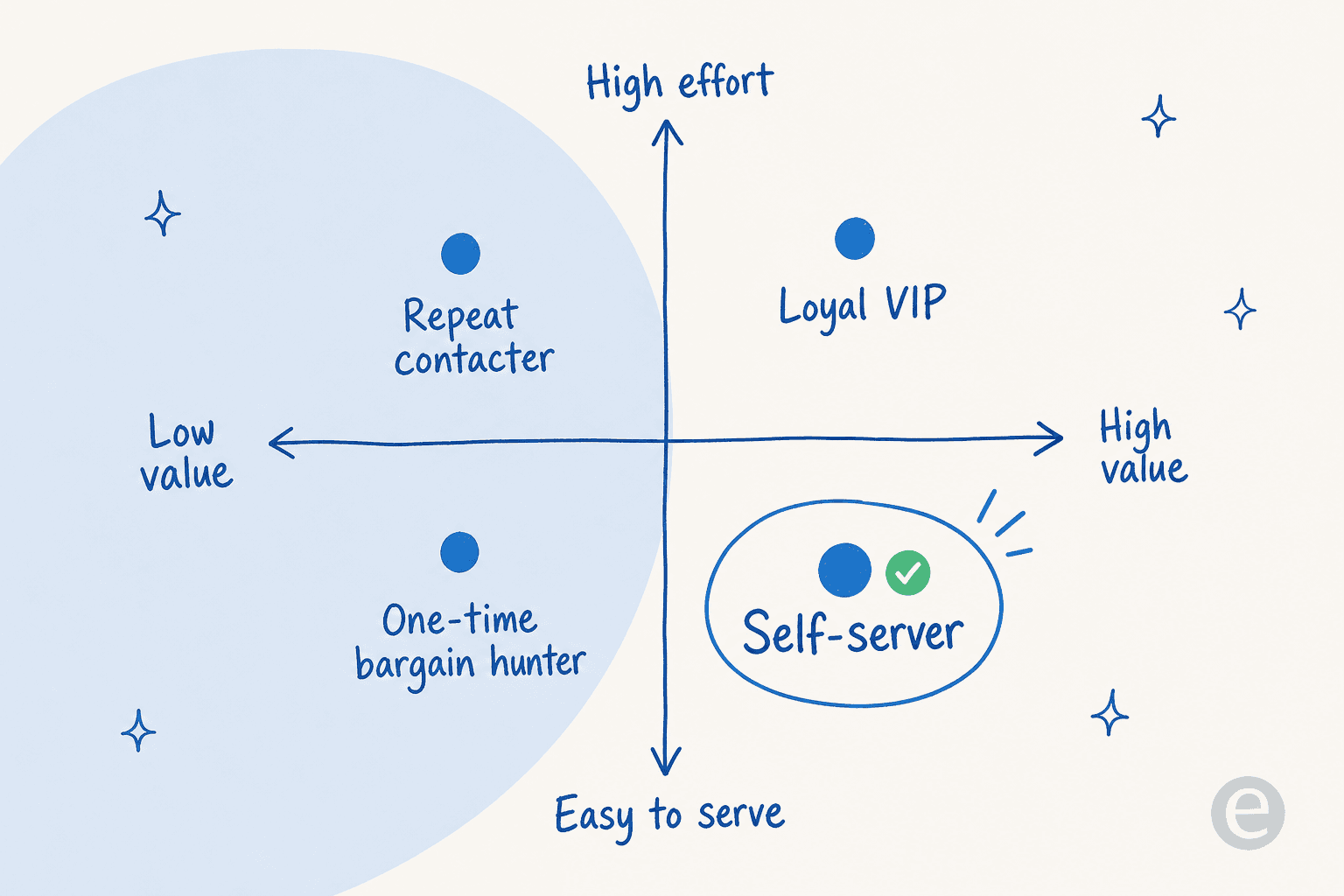
Plot your customers on that grid and five behavioural types fall out. These are the ones that actually shape your day.
The self-server
Wants the answer, not the conversation. "Where's my order," "how do I reset my password," "what's your return window." Low effort, and there are thousands of them. The worst thing you can do to a self-server is make them wait in a queue behind a hard ticket to get a one-line answer. This is the single biggest group in most queues, and the one that pushes teams toward an AI chatbot for their website or a proper self-service layer.
The loyal VIP
High value, and they know it. They've been with you for years or they spend a lot, and a support interaction with them is really a retention interaction. They don't need much, but when they do reach out, being recognised and handled by someone who can actually decide things matters more than speed. One of our customers, Yellowdig, put the relationship they wanted from support well:
"It feels like a partnership, rather than a vendor relationship. eesel AI was flexible enough for us to get started quickly and iterate, with great support from the eesel team. Recently, a new customer success hire joked that our eesel AI bot was their best friend during onboarding."
Jon Miron, Director of Support & Operations, Yellowdig
The repeat contacter
Keeps coming back, often about the same thing. Sometimes that's a loyal customer with a genuinely complex account; more often it's a signal that something upstream is broken (a confusing docs page, a bug, a product that doesn't do what the marketing implied). Repeat contacters are low value per ticket and high effort, so they're the group where you should be asking "why does this keep happening" rather than just answering faster. Your customer service metrics will show them as a spike in contacts-per-customer.
The frustrated customer
Already angry when they arrive. The issue might be small, but the emotional stakes are high, and the cost of getting it wrong is a public review or a churned account. This is the type that should almost never be met by a bot pretending to be a person. What they need is a fast, honest human, and everything you automate elsewhere exists partly to free up time for exactly this moment. (If you want the deeper argument, we wrote up AI vs human customer support on where each one belongs.)
The silent at-risk customer
The one you don't hear from. No tickets, low usage, and then a cancellation out of nowhere. They're the hardest type to serve because support is reactive by design, and this customer never reacts. The answer here is proactive outreach, not a better reply macro, and it usually lives in the space between support and customer success.
The quick reference
| Customer type | What they want | Effort to serve | Best first response |
|---|---|---|---|
| Self-server | A fast, correct answer | Low | Instant AI / self-service |
| Loyal VIP | Recognition and a real decision-maker | Low volume, high stakes | Human, with full context |
| Repeat contacter | The problem to stop recurring | High | AI answer + root-cause flag |
| Frustrated customer | Empathy and a fast fix | High | Human, escalated quickly |
| Silent at-risk | To not be forgotten | Proactive | Outreach before they churn |
How to spot these types in your own data
You don't need a research project to find these customers. The pattern is already sitting in your helpdesk; you just have to look at it on purpose.
A few signals do most of the work:
- Contact frequency separates the one-and-done self-server from the repeat contacter.
- Ticket intent tags show you how much of your volume is genuinely repetitive (usually a lot more than people guess).
- Order value or plan size flags the loyal VIP before they have to announce themselves.
- Sentiment on the incoming message catches the frustrated customer at the door.
- Usage trends are your only early warning for the silent at-risk account.
The honest catch is that most teams have this data and never sort by it, because doing it by hand across thousands of tickets is nobody's favourite Tuesday. That's the part worth automating: not the answers, the sorting. A good customer service workflow tags and routes by type automatically, so the triage happens before a human ever opens the ticket.
Match the type to the move
Here's a quick way to pressure-test your own queue. Pick the type that's eating the most of your team's time right now, and see whether your current setup is actually the right response for it.
Where AI fits: serving every type without cloning your team
The temptation with any list like this is to conclude you need more people. You mostly don't. You need the repetitive types handled automatically so your actual people are free for the types that need them.
That's the whole design of a modern AI support agent. It reads the incoming ticket, works out both the intent and how confident it is in the answer, and then splits the queue: the confident, self-serve questions get resolved on the spot, and the uncertain, angry, or high-value ones get handed to a human with the context already attached.
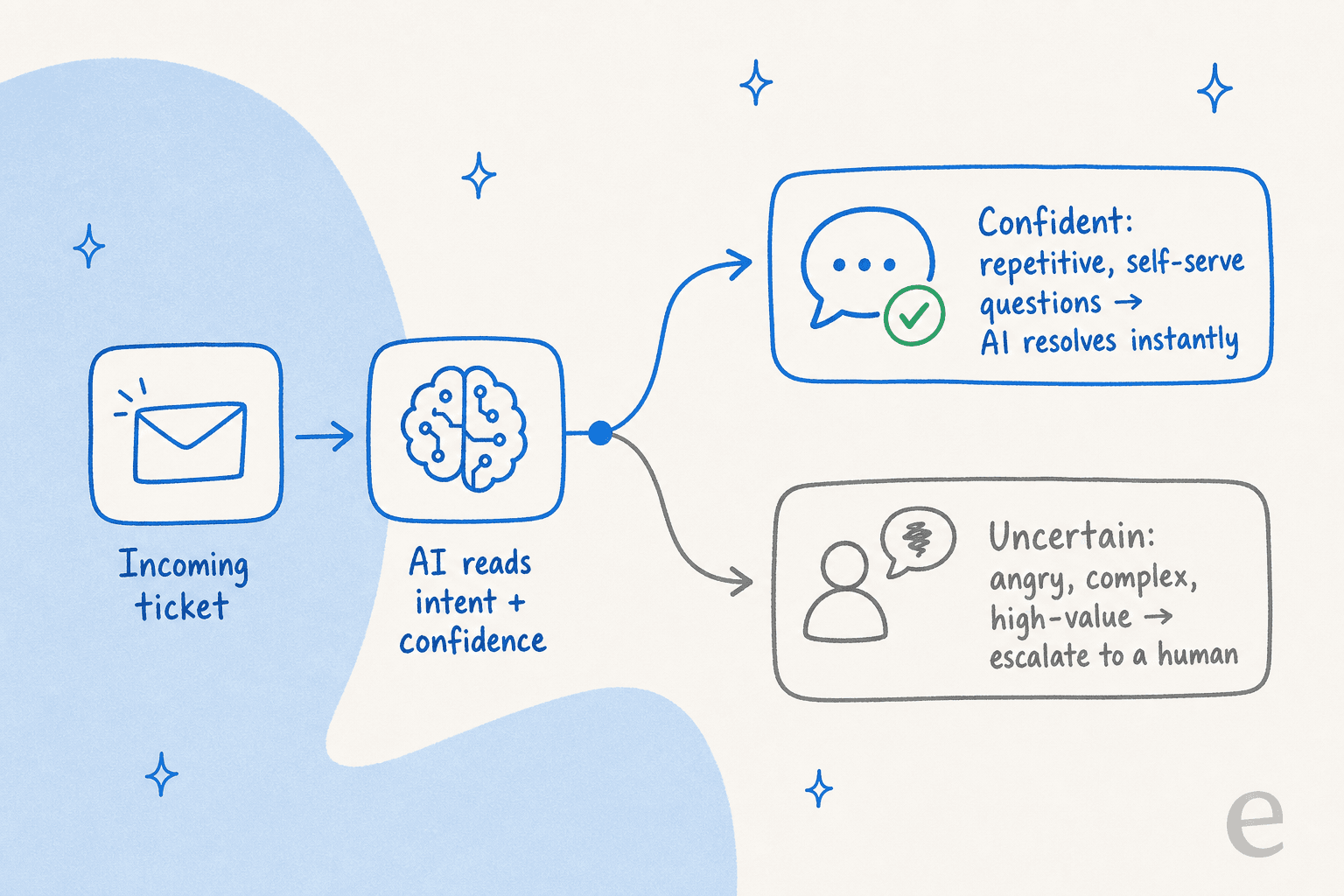
The word doing the heavy lifting there is confidence. A bot that tries to answer everything is how you get the horror stories, because it will confidently answer the frustrated customer wrong. The teams who get this right insist on the opposite. One DTC supplements CX lead we spoke to framed the whole thing in a sentence: they wanted "an AI who is only handling the tickets that it's confident to handle, and all the other ones, leave them alone." That's the correct instinct. Handle the self-servers, leave the hard humans to humans.
Done well, the effect compounds. Kellen Brown at Textla, an SMS platform, described the balance he was after as an AI that "answers confidently but not too confidently, and training it has been super easy." That "not too confidently" is the difference between an AI that serves your customer types and one that embarrasses you in front of them.
The common mistakes
A few traps I see teams fall into once they start thinking in customer types:
- Treating segmentation as a one-time exercise. Your mix shifts. A product change can turn a quiet self-serve category into a wall of repeat contacters overnight, so revisit the split every quarter.
- Automating the frustrated customer. The most expensive automation mistake there is. Empathy at speed is a human job; use AI to protect the time for it, not to replace it.
- Ignoring the silent type entirely. It's the one that never shows up in support reports because support is reactive, and it's often the one costing you the most in churn.
- Over-serving low-value types. Spending your senior agents on one-time bargain hunters while VIPs wait is a resourcing bug, not generosity.
Try eesel for every type of customer
If the takeaway is "match the response to the type," the practical problem is doing that across thousands of tickets without hiring for it. That's what eesel is built for. It plugs into your existing helpdesk, learns from your past tickets and help center, and then handles the high-volume, self-serve types on its own while routing the frustrated and high-value ones to your team with the context already gathered.

The part that matters for the anxious middle of this decision: you can simulate it against your own historical tickets before it ever replies to a real customer, so you see exactly which types it would have handled and which it would have escalated. We've run this across more than 180,000 real support conversations, and the pattern holds every time: a large slice of any queue is self-server volume the AI can take instantly, which is precisely the slice that's currently keeping your best people from the customers who need them. It's free to try, and it works like a new hire that already read every doc you have.
Frequently Asked Questions
What are the main types of customers?
Why do the types of customers matter for customer service?
How do I identify different types of customers in my support data?
Can AI handle every type of customer?
How much does it cost to support customers with AI?


Article by
Riellvriany Indriawan
Riell is a designer and writer at eesel AI with about two years of experience researching CX platforms, AI chatbots, and helpdesk software. She combines her design background with a sharp eye for how these tools actually look and feel in practice — making her comparisons unusually visual and user-focused.