


What call center outsourcing actually means
Call center (or contact center) outsourcing means hiring a third-party BPO firm to handle some or all of your customer contacts instead of running the team yourself. The provider supplies the agents, the workspace, the tooling, training, and management, and bills you on a rate model. It spans everything from a single dedicated agent at a growth-stage vendor to a several-thousand-seat program at a mega-BPO like Teleperformance or Concentrix.
The decision has two main axes. First, geography:
- Onshore: agents in your customers' own country. Highest labor cost, best cultural and language fit, easiest to oversee.
- Nearshore: a nearby country and timezone. Middle cost, strong timezone overlap.
- Offshore: a distant low-cost market, historically India and the Philippines. Lowest cost and the largest talent pool, but the widest gap on timezone, culture, and (for voice) accent.
Second, direction: inbound support that customers initiate, versus outbound telesales and collections. This guide is about inbound support, the customer-experience-critical bucket that is most sensitive to a quality drop. Voice, live chat, and email each behave differently once you move them offshore, which matters later.
You will get quoted on one of four rate models: per-hour, per-minute, per-dedicated-agent monthly, or per-ticket/outcome. Real contracts mix them and then layer on setup fees, minimum-seat commitments, and early-termination penalties. Hold onto that last part, because it is where the headline savings quietly leak away.
The pros: why teams still outsource
Let me be fair before I get critical, because the upsides are genuine and they are why this market keeps growing.
Cost is the obvious one, and it is real. An offshore dedicated agent on Influx's published card starts at $1,400/month in APAC, roughly $16,800 a year all-in to you. The US in-house median is $42,830 a year in wage alone, before benefits, desk, and IT. That is the ~60% labor saving the whole category is built on.
24/7 and follow-the-sun coverage is the second draw. Spinning up overnight cover with your own hires means night-shift differentials and a hiring market that hates graveyard slots. A BPO with teams across APAC, EMEA, and the Americas gives you round-the-clock coverage as a line item.
Fast, flexible scaling matters if your volume is spiky. Seasonal ecommerce, a product launch, a viral moment: a provider can add seats faster than you can recruit, and shed them when the wave passes.
Language coverage is the fourth. And here is a nuance worth internalizing, because it explains why offshoring works for some channels and not others. As one operator put it on Hacker News:
"Most Fortune 500 companies are more willing to outsource live chat outside of the US because it's easier for a non native speaker to chat than to talk on the phone."

That is why the Philippines took so much English-language work. Overheads are low and, as another commenter noted, "the educated population speaks English at a high level." If your volume is chat and email, the accent problem that hurts voice largely disappears.
The cons: where it bites
Now the honest half. Every one of these I have watched play out in real support queues, ours and our customers'.
You lose control over quality, and customers feel it. The single sharpest complaint about outsourced support is not the accent. It is that the agent has no power to help you:
"When you outsource your customer support to a call centre where the people there have no power whatsoever to actually help you, who are just trained to get you off the call... why bother? Support needs to be in-house, and the people doing it need to have the power to actually do something when you call them."
When anything off-script has to route to a supervisor with real authority, your first-contact resolution drops and every hard issue costs multiple contacts. That is a quality problem and a cost problem at the same time.
It can read as a signal you stopped caring. This one is reputational and hard to undo. A blunt take from the same community:
"To me, deciding to outsource customer support and hiring are huge red flags. People / Customers are not at the center of the company any more, but behind a wall."
And it is not hypothetical. One commenter described Monro Muffler Brake moving scheduling for every auto shop to an offshore center, and hearing "nothing but complaints from both fellow customers as well as the shop managers themselves" about a local number being handed off "to try to schedule vehicle service from thousands of miles away."
The hidden cost eats the headline saving. This is the part I wish more buyers modeled before signing. A former outsourced-center worker laid out the real math:
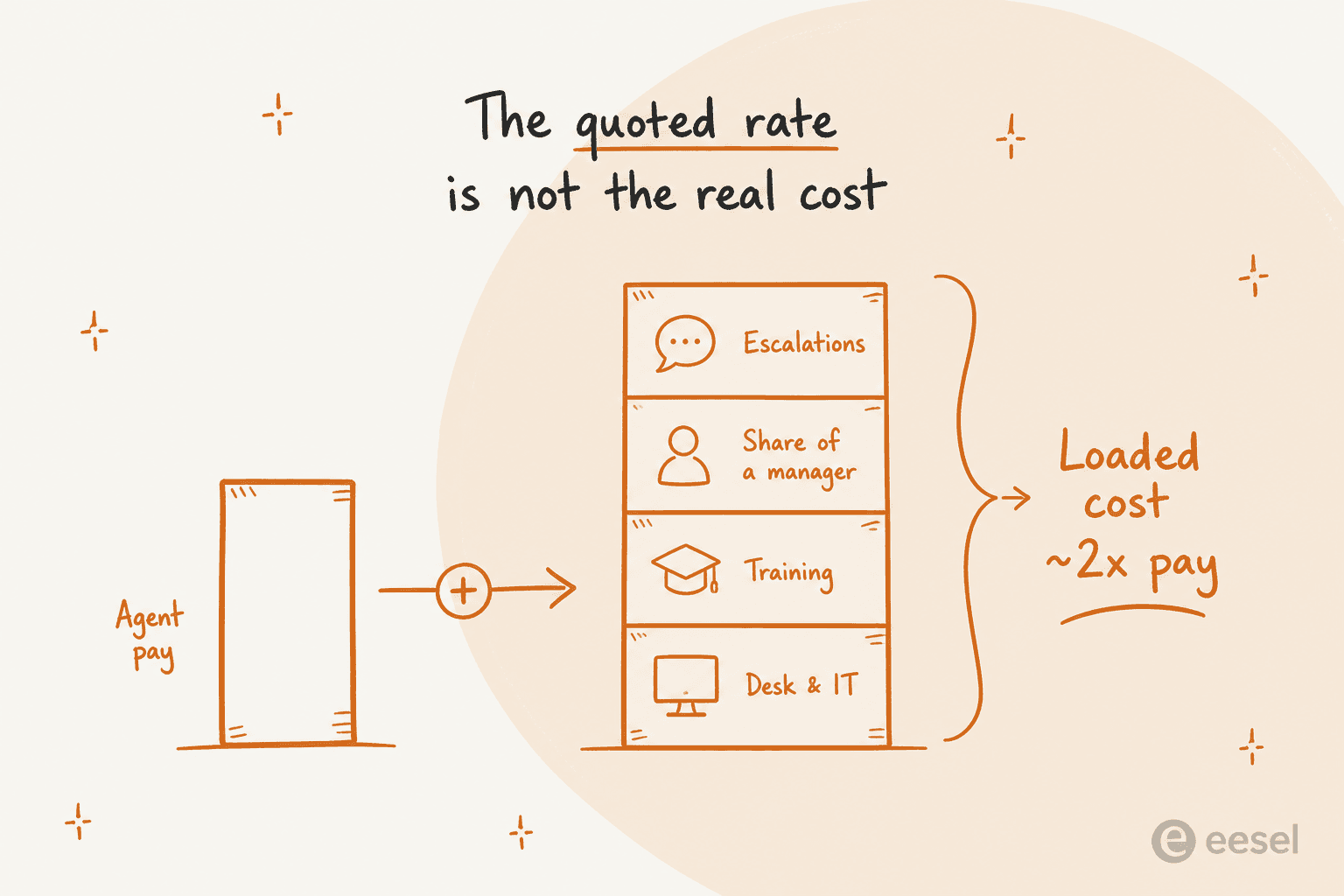
"What you are paid is not what it costs the business (desk, training, IT support, part of a manager, etc.), that can easily be double what they are paid. For anything outside the script someone with supervisor access and the authority to make high level decisions needs to get involved, those people cost even more."
Loaded cost is roughly 2x agent pay, and complex queries averaged around $30 each in that operator's experience. So the $1,400 quote is not the number that hits your P&L.
Ramp time and knowledge distance round it out. A new outsourced team does not know your product on day one, and the churn on outsourced floors means you are often re-teaching the same context. The knowledge lives in your help center and past tickets; getting it into a rotating offshore team is a permanent tax.
The real numbers, side by side
Enough qualitative back-and-forth. Here is what a single support seat actually costs across the main options, using only figures I can point you at rather than the region rate tables that float around SEO blogs with no source.
| Option | Rate (sourced) | Roughly per agent / year | Control | Notes |
|---|---|---|---|---|
| In-house US rep (wage only) | $20.59/hr median (BLS) | ~$42,830 wage | Full | Loaded cost is meaningfully higher |
| Offshore BPO agent | from $1,400/mo (Influx, APAC) | ~$16,800 | Low to medium | No setup fee, single-agent minimum |
| Americas BPO agent | from $1,700/mo (Influx) | ~$20,400 | Medium | Better timezone overlap |
| Managed operations | from $2,100/mo (Influx) | ~$25,200 | Medium | Provider owns QA and SLA |
| AI support agent (eesel) | From $299/mo for 500 credits | Fixed monthly price, sized to volume | You set the rules | No seat, no ramp, no night shift |
Two things to read out of that table. First, Influx is a rare BPO that publishes rates at all; the mega-providers quote-gate everything, so treat any "onshore is $25-42/hr" table you find elsewhere as marketing, not fact. Second, the in-house line is wage-only. Apply the 2x loaded-cost rule from above and a US seat is closer to $85k all-in, which reframes the whole comparison.
It is also worth knowing why the industry itself has changed its story. Deloitte's 2024 Global Outsourcing Survey frames it as "skilled talent and agility joining cost reduction as key drivers." Translation: pure cost-cutting is no longer the main reason companies outsource, which tells you the old cheap-labor pitch is losing its edge.
The third option most lists skip: AI
Here is where I have to be straight with you, because I sell one of these and I would rather you trust the reasoning than the pitch.
The work you outsource to tier-1 (order status, password resets, "where is my refund," the same twenty questions) is the most scriptable, repetitive work in your queue. That is precisely the work large language models now handle end to end. The people closest to the BPO industry see it coming:
"If I were running an offshore call center (or writing software to support them), I'd be sweating bullets, right now. This may not be the thing that kills them, but it's only a matter of time. This is also entirely predictable."
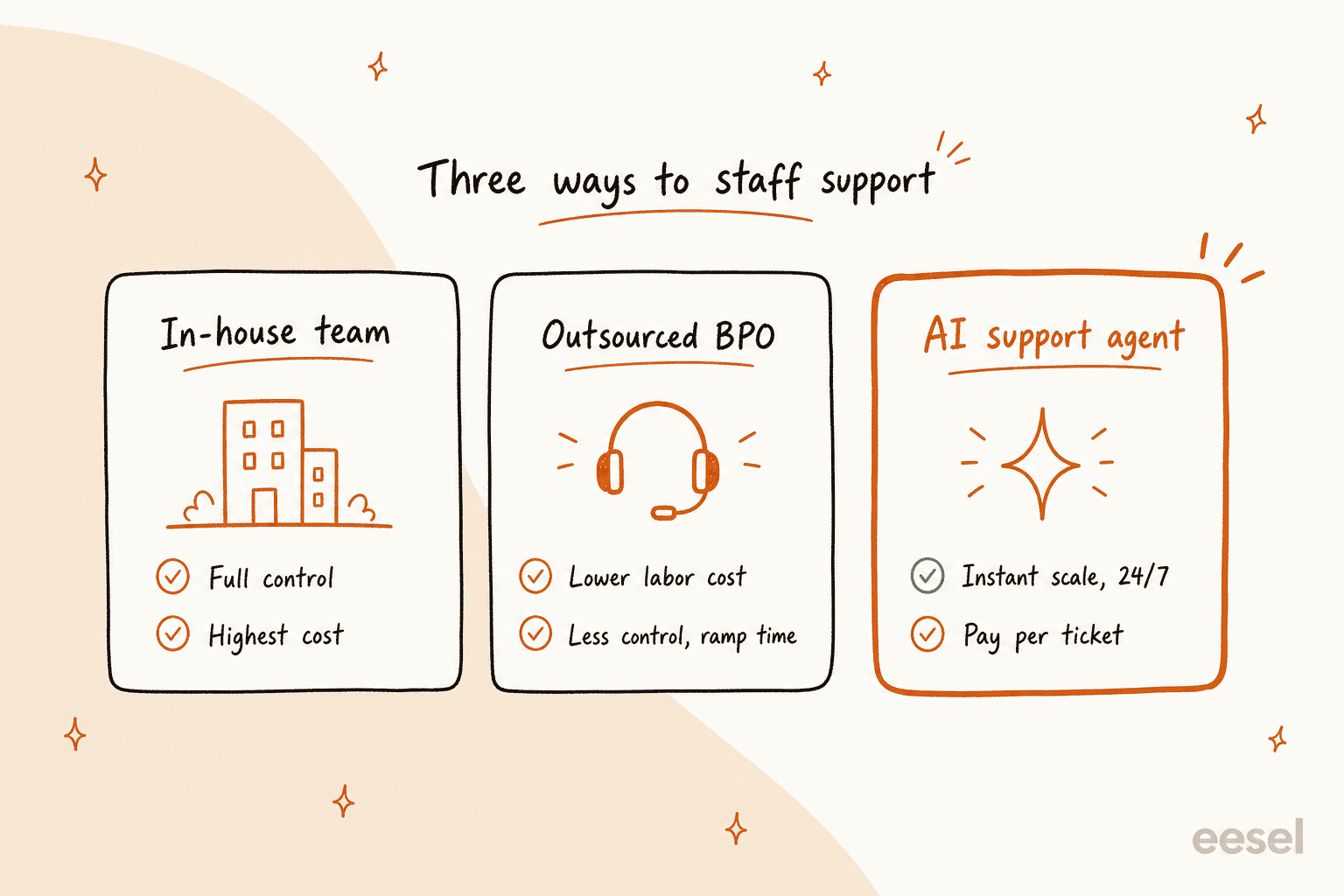
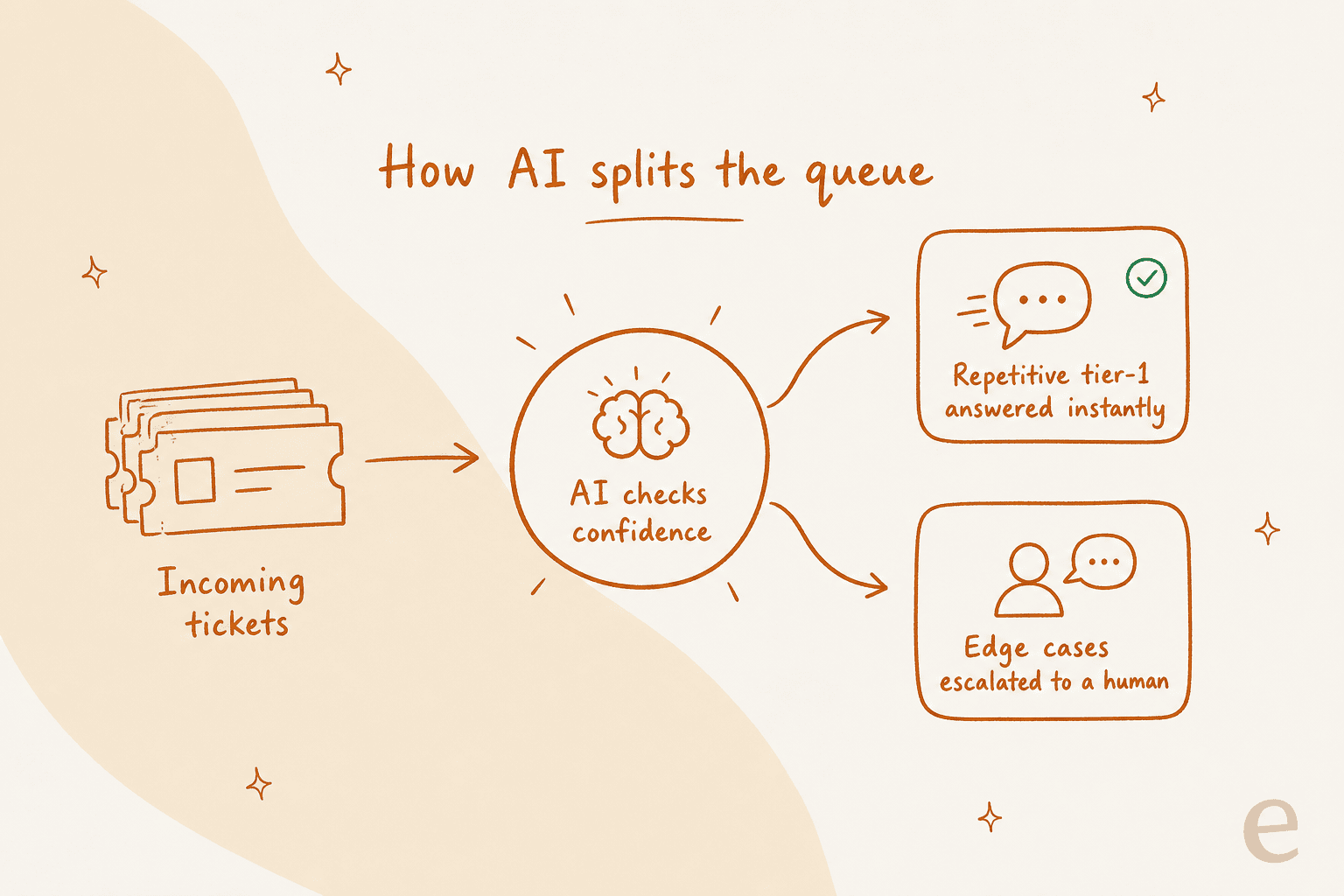
So the modern decision is not in-house versus BPO. It is three-way, and AI changes the shape of the other two. An AI agent answers the confident, repetitive volume instantly, handles ticket triage and routing, and escalates the genuinely hard cases to a small, empowered human team. You outsource the boredom, not the judgment.
But I have to name the failure mode too, because dumping support on a bad bot repeats the exact mistake of cheap outsourcing:
"Just had to deal with this with a company that had outsourced its support to 'AI'... once you get to the point where you have to contact support you're almost certainly in a situation that no stochastic parrot has any hope of comprehending, let alone solving."
That is the whole game. A deflection wall that traps customers is a disempowered offshore agent with a worse temper. The version that works is an AI trained on your real history that knows when it is out of its depth. As one CX lead we spoke with put it, the goal is "an AI who is only handling the tickets that it's confident to handle, and all the other ones, leave them alone." That confidence-based routing is the difference between ticket deflection that helps and the kind that gets screenshotted on social media.
The numbers hold up when it is done that way. A logistics-tech customer of ours saw eesel resolve 73% of tier-1 requests in the first month. A payments company reported up to 80% time savings on answers and onboarding. That is the tier-1 layer a BPO would have staffed, handled on plans from $299/month for 500 credits (1 credit per ticket or chat) with no seats to ramp.
How to actually decide
There is no single right answer, so here is the framing I would use in your shoes.
Outsourcing still makes sense when you need real overnight voice coverage you genuinely can not hire for, you are entering a new language market fast, or you have a short, predictable volume spike (a seasonal peak, a launch) that does not justify permanent hires. In those cases, favor a provider with no setup fee and month-to-month terms so you are not locked in, and keep your escalation path to an empowered in-house owner.
Lean in-house when your product is complex, your brand lives or dies on support quality, or your volume is steady enough that a small expert team beats a large disempowered one. Give those people the power to fix things; that is the entire lesson of the complaints above.
Reach for AI first when a large share of your tickets are repetitive and answerable from your existing docs and past tickets, which for most teams is the majority. Automate that layer, measure what is left, and only then decide whether the remainder needs more humans, in-house or outsourced. If you are still shopping tools, my roundup of the best customer service AI is a good starting point, and our guide to scaling support walks through sequencing it without breaking SLAs.
Use the walkthrough below to get to a starting recommendation in about thirty seconds.
Try eesel for the tier-1 layer
If your honest read is that most of your queue is repetitive, you do not have to choose between hiring and outsourcing it. eesel AI plugs into your existing help desk, learns from your past tickets and help center, and answers the confident, repetitive volume on its own, while escalating anything it is unsure about to your team. It is the tier-1 layer a BPO would staff, on plans from $299/month for 500 credits (1 credit per ticket or chat) with no seats and no ramp.
The part that matters for the quality concerns above: you can simulate it against your real historical tickets before it ever touches a customer, and set exactly which ticket types it is allowed to handle. That is the opposite of a deflection wall.

It connects to the tools you already run, from Zendesk and Freshdesk to Gorgias, and you can try it free without a sales call. Before you sign a seat contract, it is worth seeing how much of your volume never needed a seat in the first place.