


What an order management system actually is
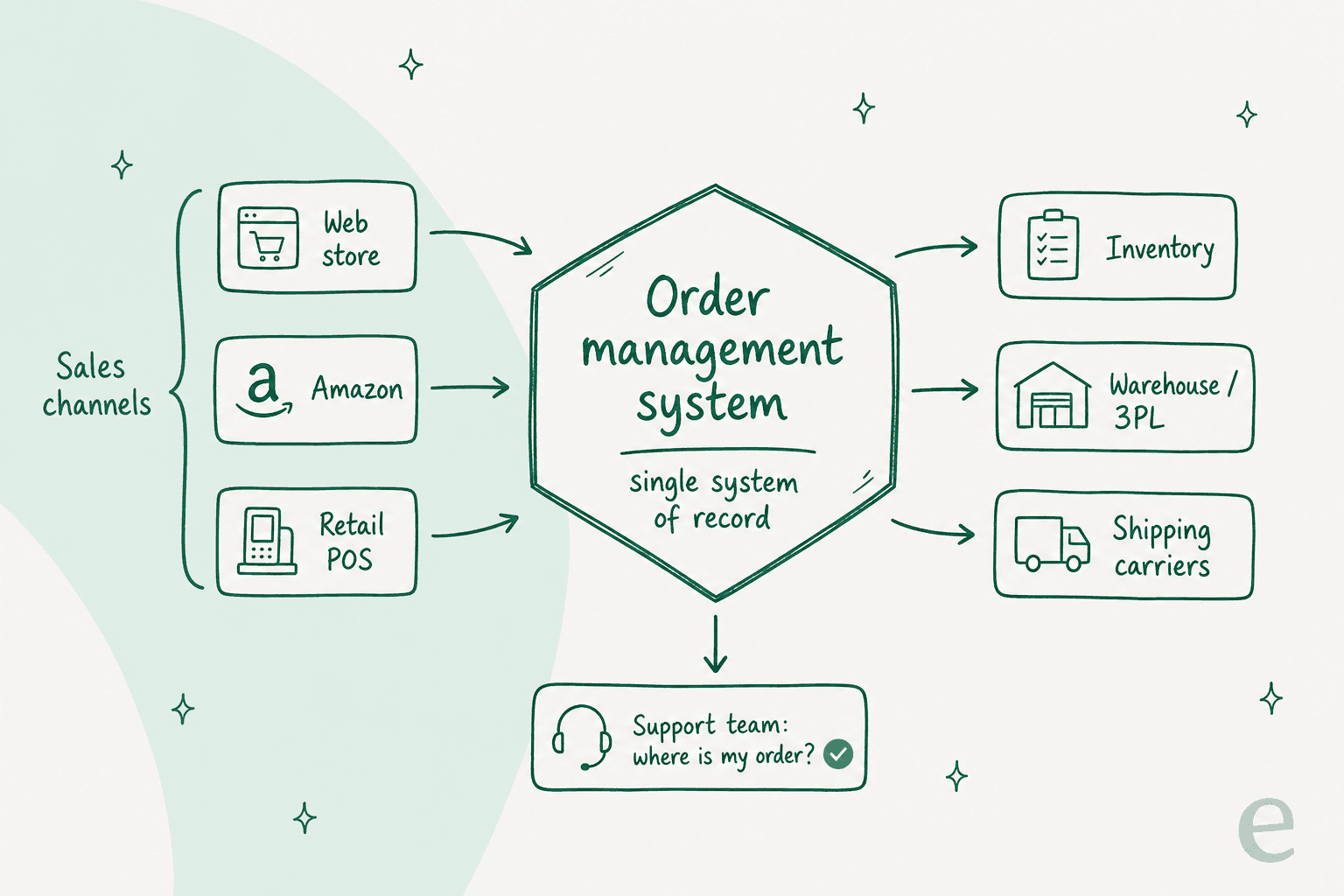
An order management system sits in the middle of your stack. On one side are the places orders come from: your web store, marketplaces like Amazon and eBay, a retail point of sale. On the other side are the systems that actually fulfill them: inventory, a warehouse or 3PL, the shipping carriers. The OMS is the layer that catches an order from any channel and follows it all the way through to delivery or return, so there's one place that knows the current state of every order.
That "one place" bit is the whole point. Without it, order data is scattered, and the person who feels that most is whoever is answering the customer.
I hear the scattered version constantly. One Shopify merchant doing around $6M a year described tracking orders on physical paper pulled from a filing cabinet, then re-checking them in Shopify, because their fulfillment system was never digitized:
"There is heavy disconnect between the customer service people and the fulfillment people because of this."

A consultant on r/ecommerce framed the same problem from the buyer's side: their client wanted to stitch payments, warehouse, and shipping into one order view specifically to stop handling "where is my order" reactively. A reply named the root cause bluntly:
"This is honestly one of the biggest pain points in ecommerce right now because data sits everywhere... Orders in Shopify... Email in Klaviyo... Marketplace data in Amazon or TikTok Shop."
That's what an order management system is for: one order view, so the storefront, the warehouse, and the customer support team are all reading the same truth.
Why order management is really a support problem
Buyers usually shop for an OMS to fix operations: overselling, split shipments, messy returns. Fair. But the sharpest daily pain lands on the support desk, and it has a name: WISMO, short for "where is my order".
Per Gorgias's own usage data, WISMO is the single most common ecommerce support request, averaging 18% of incoming volume. And it's expensive in a way that compounds. Gorgias's cost math breaks a single order-status answer into three very different lines:
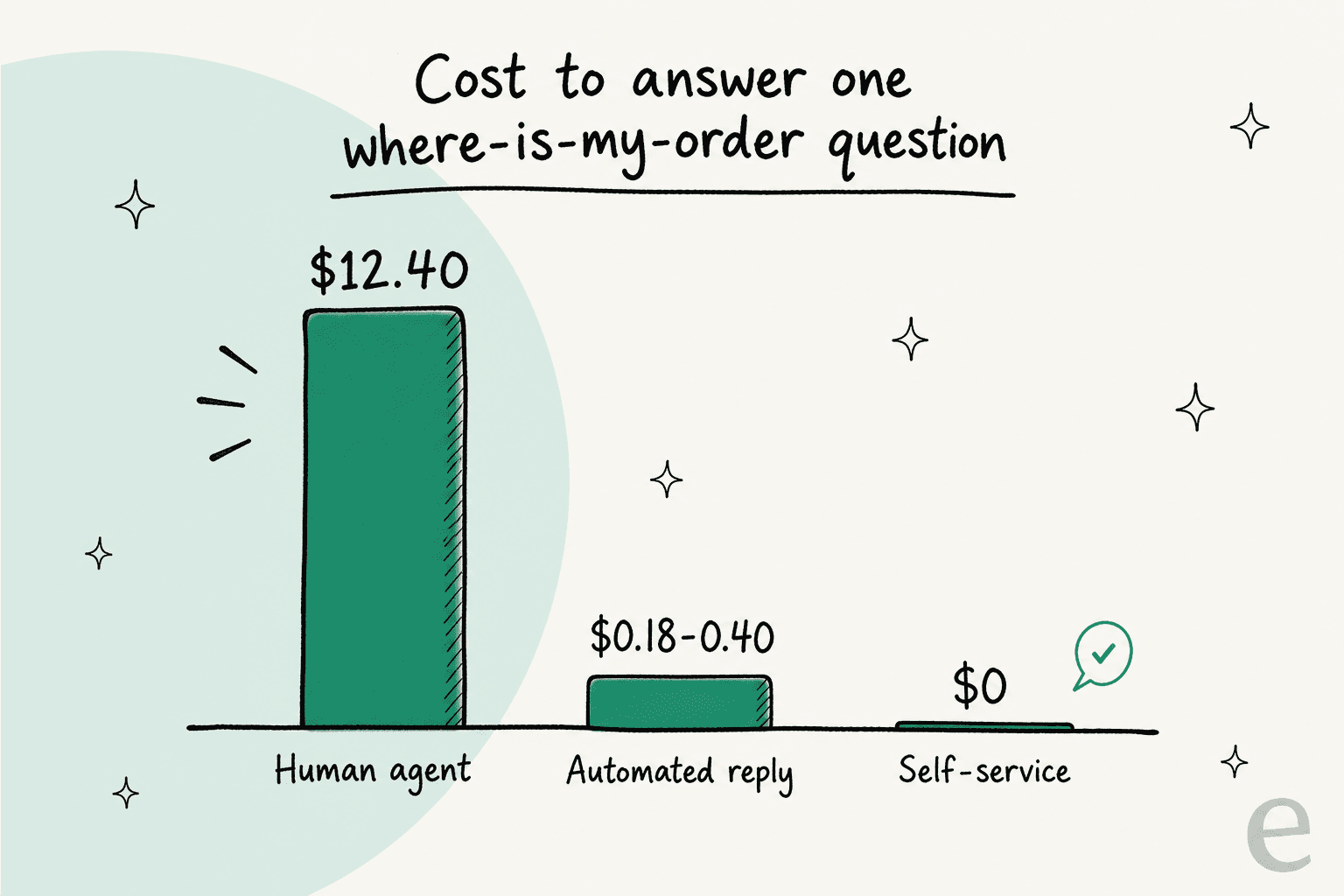
- A human agent: roughly $12.40 per ticket once you fold in labour.
- A rule-based automated reply: just the billable ticket cost, $0.18 to $0.40.
- True self-service, where the customer finds the status before a ticket exists: $0.
On Gorgias's worked example, a store doing 1,000 orders a month generates about 150 WISMO tickets, which is roughly $1,860 a month spent just answering "where is my order". That's the line an order management system is quietly supposed to shrink, and usually doesn't on its own.
The reason it stays expensive is that customers ask more than once. Per Forbes data cited by Gorgias, the average customer checks their order status 4.6 times. Every one of those checks is a chance to either deflect a ticket or create one. This is exactly the ground where tier-1 deflection and live chat deflection earn their keep, and it's why I'd treat order status as the first thing any ecommerce AI helpdesk has to nail.
What an order management system does
Stripped down, an OMS does a handful of jobs. Here's the shortlist, and who each one matters to.
| Job | What it does | Who feels it |
|---|---|---|
| Order capture | Pulls orders from every channel (web store, marketplaces, POS) into one queue | Ops, support |
| Inventory sync | Keeps stock counts accurate across channels to stop overselling | Ops, buyers |
| Order routing | Decides which warehouse or 3PL fulfills each order | Fulfillment |
| Status tracking | Holds the live state of every order: paid, picked, packed, shipped, delivered | Support (WISMO) |
| Returns and exchanges | Manages the reverse flow when an order comes back | Support, ops |
| Reporting | Order volume, fulfillment speed, return rates | Ops, finance |
A verified G2 reviewer summed up why teams buy one at all, reviewing Salesforce Order Management:
"Salesforce Order Management solves the problem of disconnected fulfillment and service systems. By centralizing the entire order lifecycle, it improves visibility, automates complex workflows, and delivers a more seamless experience for both customers and teams."

Notice the word "visibility". An OMS gives your team visibility. What it doesn't do, by itself, is hand that visibility to the customer. If you want the wider picture of how these tools slot into a support stack, our roundup of AI customer service software and the best AI helpdesk for Shopify both go deeper on the connection points.
The gap most order management buyers miss
Here's the reframe I'd want anyone shopping for an OMS to walk away with. An order management system stores the answer to "where is my order". It does not deliver that answer to the customer. Something else has to sit on top and do the reading and replying.
For years that "something" was a human agent copy-pasting a tracking number, or a brittle macro that fired the wrong template half the time. Both are why WISMO stays at $12-ish a ticket. The order data was there the whole time; the bottleneck was the layer that turns data into a reply.
This is where I've watched teams get it wrong in the opposite direction too. An ops lead at a DTC supplements brand doing around 7,000 Gorgias tickets a month, on Shopify, came to us looking for a copilot to help agents type faster. Halfway through, they realized the actual fix was an autonomous agent that could handle at least half of their email volume outright, WISMO and subscription changes and basic product questions, without a person in the loop. The order data was never the problem. The layer reading it was.
So when you evaluate an order management system, I'd add one question to the ops checklist: what is going to read this and answer customers automatically? If the answer is "a human, for now", you've bought visibility for your team and left the WISMO bill untouched.
How AI turns order data into answers
The modern version of that "something on top" is an AI agent connected to your store data. The flow is simple, and it's the part that actually moves the WISMO number.
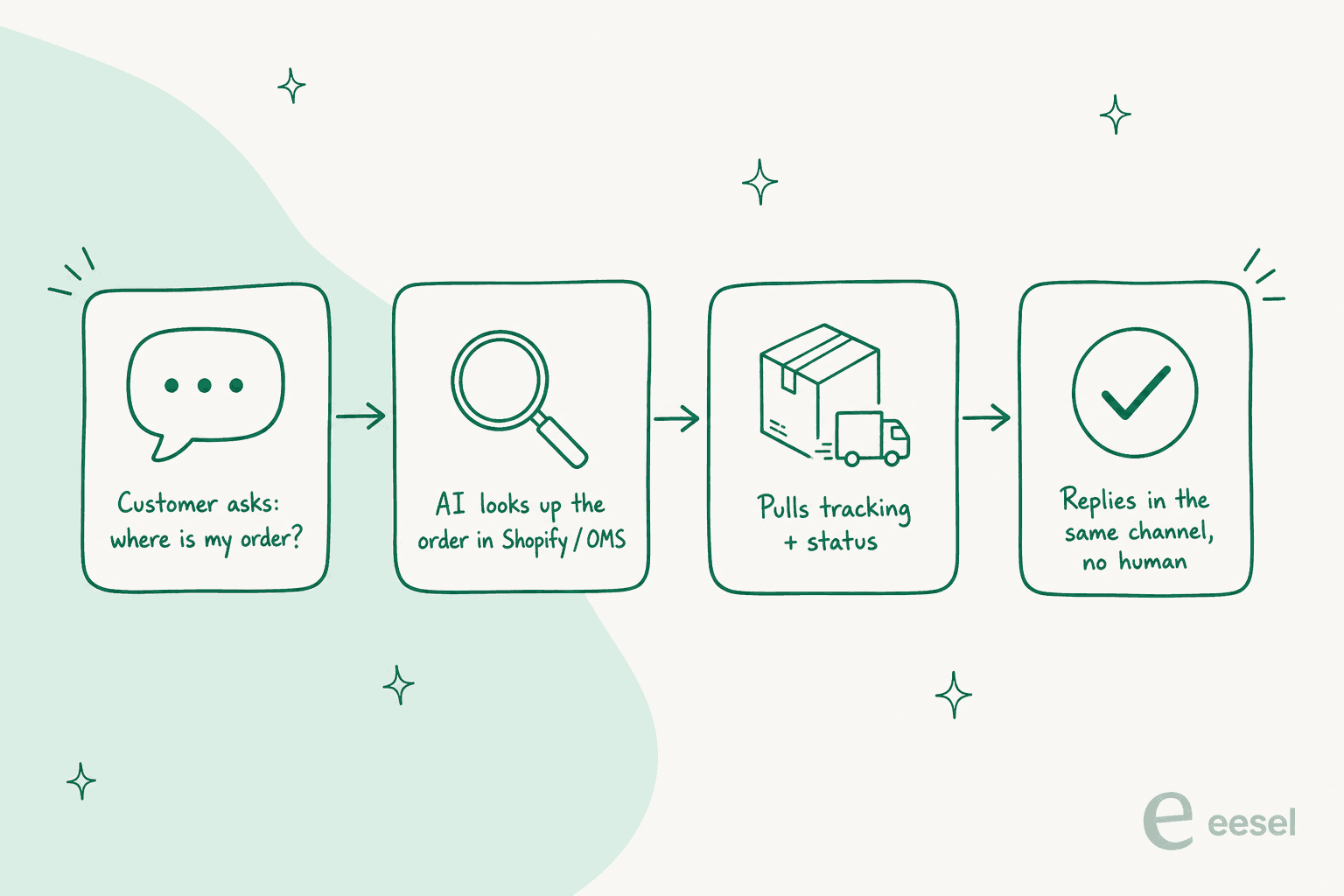
A customer asks "where's my order?" in chat, email, or WhatsApp. The AI looks the order up in the store or OMS, pulls the live tracking and status, and replies in the same channel the customer already used, with no agent touching it. When the question is really a human one, a refund dispute, a damaged item, it escalates instead of guessing.
The reason this beats the old macro approach is that it's reading real order data per conversation, not firing a fixed template. eesel's Shopify integration does exactly this, reading catalog and order data so an AI chatbot for orders can confirm the actual shipping status. On the Gorgias side, it joins as a real agent inside the helpdesk, reads the ticket, and pulls Shopify order data into every reply rather than bouncing the customer to a separate widget.

The channel matters as much as the lookup. Order questions arrive wherever the customer already is, which increasingly means WhatsApp and Instagram DMs, not just a support portal. A verified merchant on that same r/shopify thread put a number on what switching to an automated helpdesk did for them:
"You will not regret using Gorgias... its worth the cost. I cut my CS team in half and around 35% of tickets are automated now."
If you want to see how other teams wire this up, the AI agent for Gorgias breakdown and our list of the best AI for Gorgias both walk the order-lookup setup, and the AI chatbots for Shopify roundup compares the options for a Shopify stack specifically.
Where this fits for different stores
The right shape depends on how you sell:
- Single Shopify store: you probably don't need a heavyweight standalone OMS. Shopify itself is your order record, and the win is layering an AI assistant for ecommerce on top to answer from it. Start with AI for Shopify customer support.
- Multi-channel or multi-warehouse: this is where a dedicated OMS (Salesforce Order Management, NetSuite, Cin7, Linnworks) earns its licence, because inventory management across channels is legitimately hard. The support layer still sits on top.
- On Magento or Adobe Commerce: the order record lives there; see Adobe Commerce pricing for what that platform runs, then connect a support agent to it.
- On Gorgias, Freshdesk, or Zendesk already: you're closest to done. Connect the AI to both the helpdesk and the store so it reads orders in context, the way the best Freshdesk Shopify apps do.
Whatever the stack, the principle from a verified G2 reviewer in support ops holds. Reviewing Salesforce Order Management, they named the core pain as "siloed systems: disconnected data between storefronts, warehouses, and support teams". The order management system fixes the storefront-to-warehouse silo. Closing the last silo, warehouse-to-support, is what the AI layer is for, and it's the same principle behind a good AI customer service workflow or agentic commerce setup.
Try eesel for order-related support
I've spent enough time on live support queues to be blunt about this: buying an order management system and leaving the WISMO answers to humans is like installing a great filing cabinet and still reading every file aloud on the phone. eesel is the layer that reads the cabinet for you.
It connects to your store through the Shopify, WooCommerce, and helpdesk integrations, learns from your past tickets and policies, and answers order status, tracking, and returns automatically, in 80+ languages and in the channel the customer used. Because you can simulate it against past tickets before going live, you see how much of your WISMO volume it would have handled before you trust it with a single real customer.
Pricing is one fixed monthly price from $299/month for 500 credits (1 credit per ticket or chat), with no per-seat fee, so the comparison against a $12.40 human answer is simple math you can do on the back of a napkin. You can route a slice of tickets first, since only tickets the AI actually works on use credits. Try eesel free, or read how it fits an ecommerce helpdesk end to end.
Frequently Asked Questions
What is an order management system in simple terms?
Do I need an order management system or a helpdesk?
How much of my support volume is order status questions?
Can AI answer order status questions from my order management system?
What does an order management system cost to run for support?



Article by
Riellvriany Indriawan
Riell is a designer and writer at eesel AI with about two years of experience researching CX platforms, AI chatbots, and helpdesk software. She combines her design background with a sharp eye for how these tools actually look and feel in practice — making her comparisons unusually visual and user-focused.