


The short version: same customer, different job
I work the support queue every day, so I get a front-row seat to how muddled these titles have become. I have watched the same person get called a "success manager" at one company and a "client services lead" at the next, doing more or less identical work. And I have watched teams argue over which box a task belongs in while the customer just waits for an answer.
So let me strip the branding off. Every post-sale team is trying to do one of two things at any given moment: respond to something the customer brought to you, or get ahead of something before they have to. Client services lives mostly on the responding side. Customer success lives mostly on the getting-ahead side. Customer support is the pure-response engine that both of them rely on. Once you see it that way, the org-chart fights mostly dissolve.
Here is what each one actually is.
What client services actually is
Client services is the team that delivers what the customer bought. If you sell implementations, managed services, custom onboarding, or any kind of done-for-you work, client services is the group that scopes it, runs it, and ships it. Think agencies, professional services arms, and B2B vendors with a heavy delivery component.
The defining trait is that client services owns the contracted scope. The relationship is built around a statement of work or a service agreement, and success is measured by whether the promised work got delivered well and on time. It is relationship-heavy and often account-management-flavored, but the core loop is reactive: the client asks, client services responds and delivers.
That reactive loop is exactly why client services teams live so close to the support and ticketing side of the house. A lot of what lands on a client services person's desk is really a request that could have been a ticket, which is one reason the roles blur.
What customer success actually is
Customer success (often abbreviated CS or run by CSMs, customer success managers) is the proactive counterpart. Its job is not to deliver a fixed scope, it is to make sure the customer actually gets value from what they bought, keeps using it, renews, and ideally expands.
Shep Hyken, the customer-service author, draws the line cleanly:
"The traditional customer service department resolves problems and answers questions. They react to customer needs and requests. The customer success department, however, works with customers to ensure success and avoid problems before the customer even knows an issue might exist. In other words, the customer success department is proactive."

That "avoid problems before the customer knows" part is the whole game. Customer success is measured on retention, churn, expansion revenue, and adoption, not on tickets closed. It is why a good CS function reaches for proactive engagement and health scores rather than waiting for the phone to ring. And the economics back it up: Bain & Company's often-cited research found that a 5% lift in retention can raise profits by 25% to 95%.
Client services vs customer success: the real differences
Put side by side, the split gets obvious. One team is graded on work delivered, the other on value realized and revenue retained.
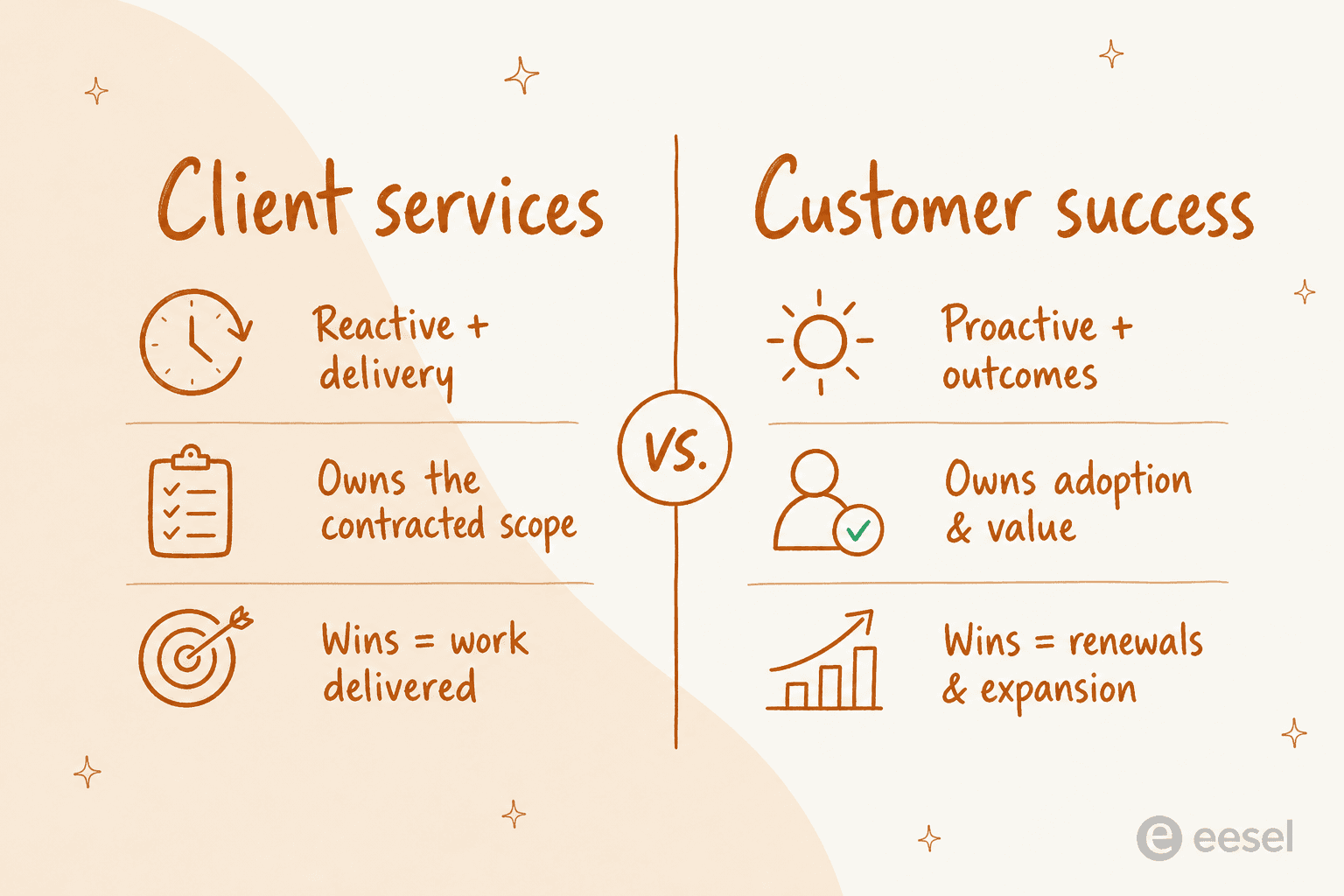
Here is the same breakdown in table form, including where each one overlaps with plain customer service:
| Dimension | Client services | Customer success | Customer support |
|---|---|---|---|
| Core posture | Reactive delivery | Proactive value | Reactive fixes |
| Owns | The contracted scope of work | Adoption, outcomes, retention | Tickets and issues |
| Measured by | Work delivered, on time, on scope | Renewals, expansion, churn rate | Resolution time, CSAT |
| Typical title | Client services manager, account manager | Customer success manager (CSM) | Support agent |
| Triggered by | A client request or project | A milestone, risk signal, or renewal | An inbound ticket |
| Revenue link | Protects the account you already have | Grows the account | Keeps the account happy |
| Common in | Agencies, services firms, B2B delivery | SaaS, subscription businesses | Everyone |
The cleanest tell: if the team's day is shaped by what customers ask for, it is client-services-flavored. If it is shaped by what customers should be doing next, it is customer-success-flavored.
Where customer support fits (and why people mix all three up)
The reason these titles get tangled is that they sit on a single spectrum, from reactive to proactive, and the lines between them are fuzzy.
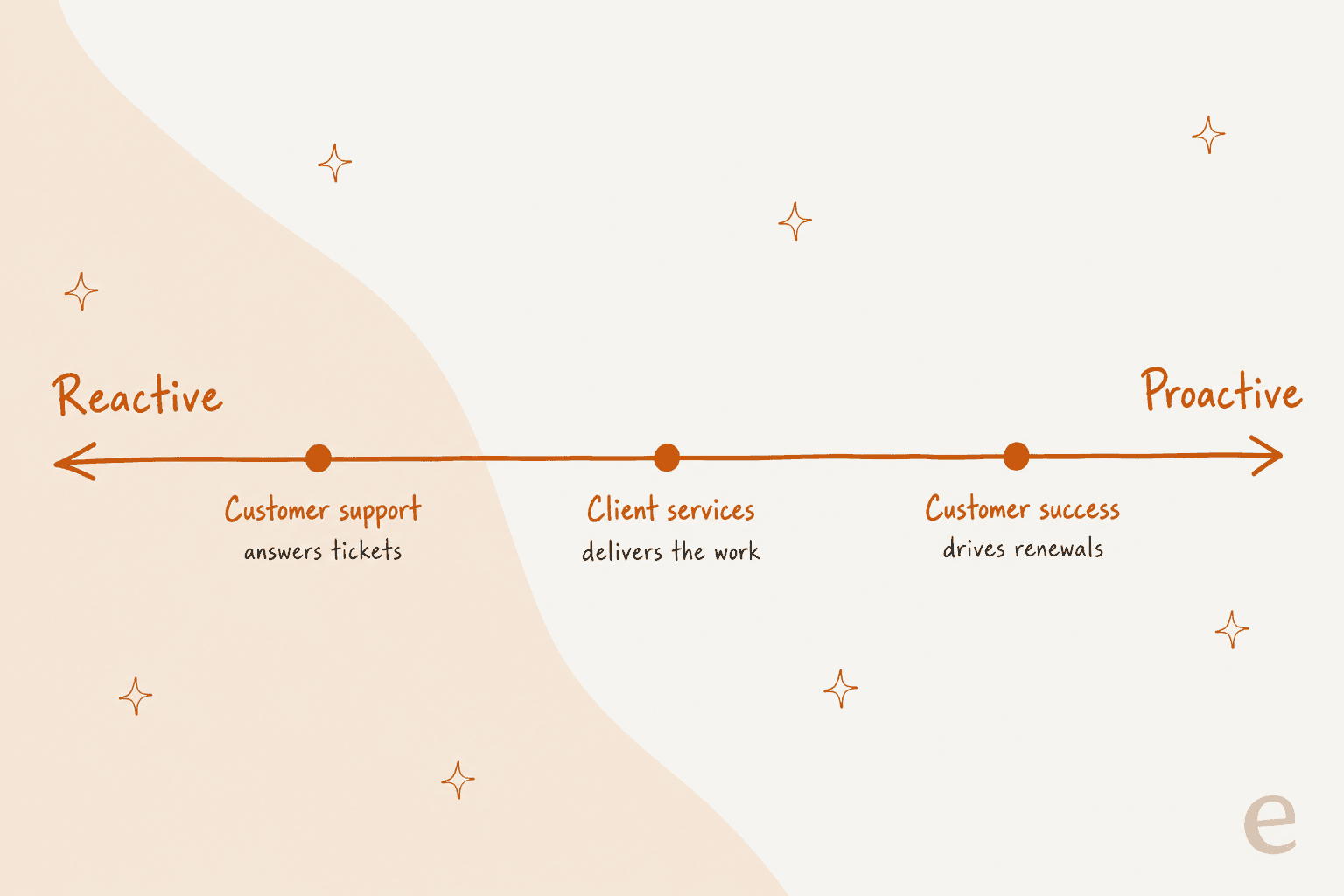
Customer support is the reactive anchor: someone has a problem, support solves it. Client services sits a step over, still largely responding but around delivery rather than break-fix. Customer success is furthest toward proactive. The trouble starts when companies collapse the spectrum into one team and pick a label almost at random.
Practitioners argue about this constantly. On r/CustomerSuccess, a recurring complaint is that "a lot of companies are just rebranding their customer support dept to customer success and that's wrong", because a renamed support team is still reactive, no matter what the door says. And even the "client" versus "customer" wording carries weight for some operators:
"Many [have] written or asked me why I choose to use the label 'Client Success' versus 'Customer Success' ... because of the many similarities and nuanced differences many businesses use the terms interchangeably. However, in my perspective they shouldn't."
The takeaway is not that one label is correct. It is that the work differs, and if your team's title does not match the work it actually does, your metrics and your handoffs will be a mess. Naming the reactive-versus-proactive split honestly matters more than picking the trendiest word.
Which one does your team actually need?
Most teams do not need to stand up all three functions on day one. The right first hire (or first AI teammate) depends on where your bottleneck actually is. Pick the line below that sounds most like you today.
Which team should you build first?
Pick the situation that sounds most like you today.
Notice how often the answer routes back to the reactive layer first. That is not an accident. The proactive work (the actual customer success and client-services value) only happens when your people are not buried in repetitive requests. Which is where AI comes in.
How AI changes who does what
For years the honest constraint on both client services and customer success was time. A CSM who spends the afternoon answering "how do I reset my password" is not doing the strategic account review that actually moves retention. That reactive drag is exactly what a good AI agent removes.
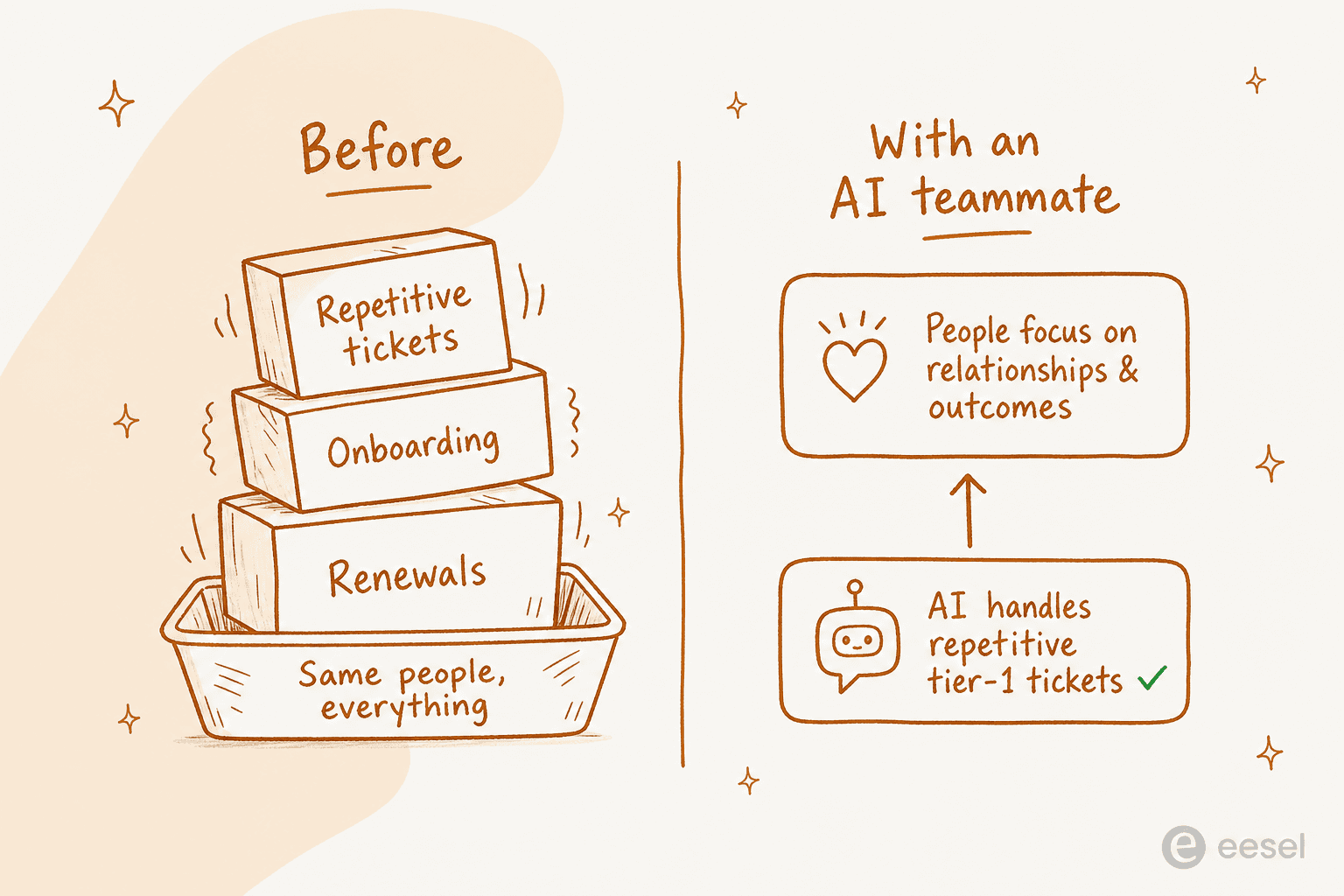
This is the part I have actually lived. We have spent the last few years putting AI agents on live support queues, and the pattern is consistent: when the AI absorbs the repetitive tier-1 volume, the humans do not get replaced, they get promoted into the proactive work they never had time for. One customer, Gridwise, saw eesel resolve tier-1 requests at a 73% clip in the first month, which is a lot of hours handed back to people who would otherwise be typing the same answer over and over.
And it changes the onboarding experience too, which is squarely customer-success territory. Jon Miron at Yellowdig put it this way:
"It feels like a partnership, rather than a vendor relationship. Recently, a new customer success hire joked that our eesel AI bot was their best friend during onboarding and interviewing."
That is the shift in one sentence: the AI becomes the thing a new CS hire leans on to get up to speed, instead of the tedious work they dread.
The important nuance, and the mistake I see teams make, is thinking AI replaces the proactive functions. It does not. An AI teammate is superb at the reactive layer and genuinely bad at the judgment-heavy, relationship-heavy work that defines client services and customer success. The winning setup is the split the diagram shows: let AI own the reactive tier, keep humans on the proactive tier, and get the escalation handoff between them clean. If you want the fuller playbook, our customer service vs customer success breakdown and the support scaling guide go deeper on sequencing, and the customer service team structure piece covers how to draw the org lines.
Try eesel for the reactive layer
Whatever you call your post-sale teams, they share the same tax: repetitive reactive work eating the hours meant for relationships. eesel is the AI teammate that takes that layer off their plate. It plugs into your existing helpdesk (Zendesk, Freshdesk, Gorgias, Help Scout, and more), learns from your past tickets and docs, and handles the tier-1 questions so your client services and customer success people can do the proactive work they were hired for.
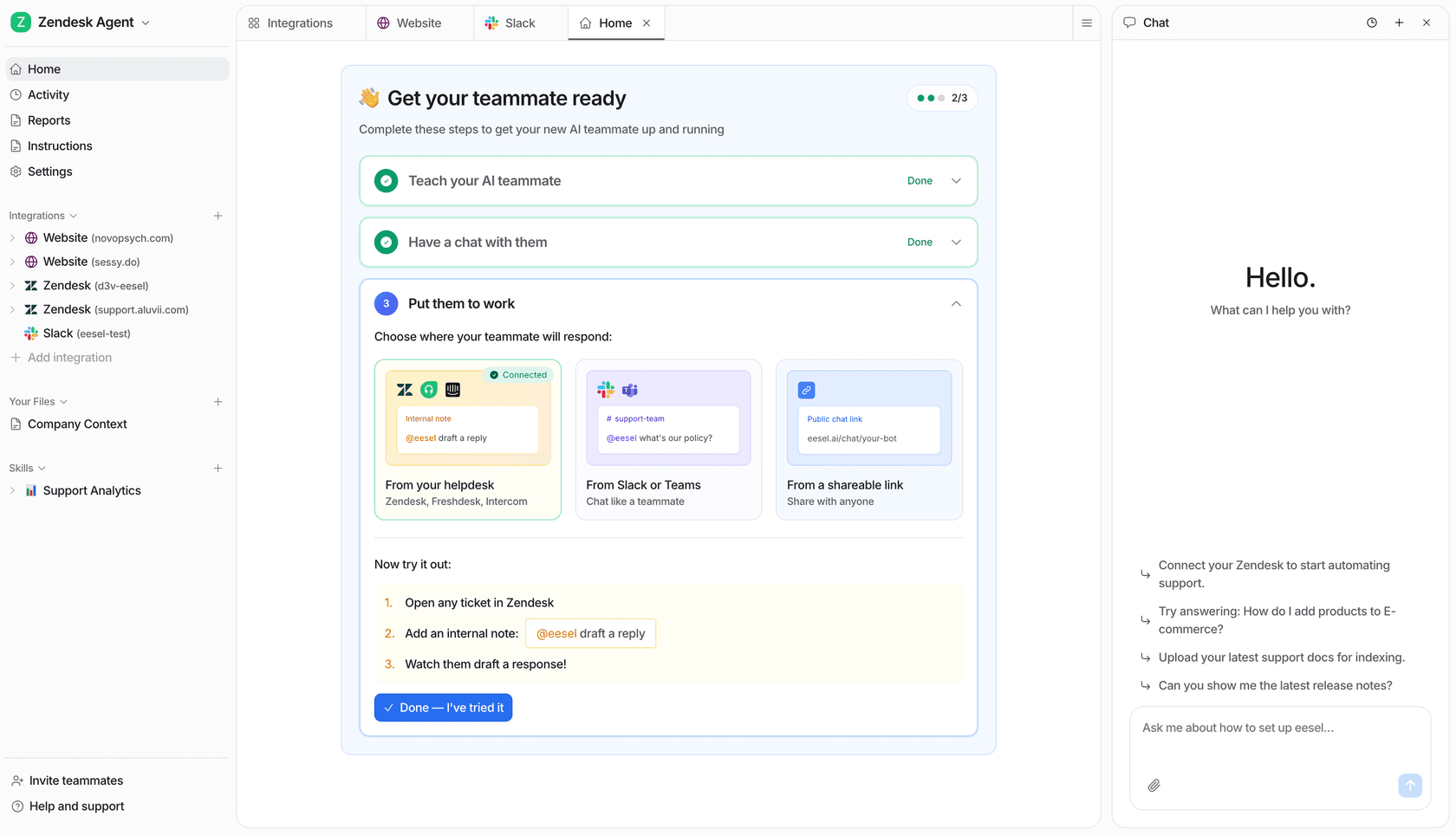
The part that matters for a cautious buyer: you can simulate it on your own historical tickets before it ever touches a live customer, so you see the real resolution rate up front. Pricing is one fixed monthly price sized to your ticket volume (from $299/month for 500 credits, 1 credit per ticket or chat) with no per-seat fees, so it scales with your volume instead of your headcount. You can try eesel free with 100 credits and point it at a slice of your queue to see how much reactive work it clears in a week.