What a customer strategy actually is
A customer strategy is the set of deliberate choices about which customers you serve, what value you promise them, and how you organize the whole company to keep that promise profitably. That is it. It is not a slide with the word "delight" on it, and it is not the same thing as your marketing plan.
Here is the useful way to think about the layers, because they get muddled constantly:
- Customer strategy is the top layer. Who do we want as customers, and what do we promise them?
- Customer experience strategy is how that promise feels across every touchpoint, from the first ad to the third renewal.
- Customer service strategy is a slice of the experience: how you handle questions, problems, and complaints once someone is already a customer.
You can run great customer service and still have no customer strategy, which is exactly how companies end up delivering heroic support to customers who were never going to be profitable. The strategy is the part that says "these are the people worth being heroic for."
The test of whether you have one is simple: can two people in different departments describe the same target customer and the same core promise without checking a document? If not, you have activities, not a strategy.
The five pillars of a customer strategy
Every durable customer strategy I have seen rests on the same five pillars. Skip one and the whole thing wobbles: skip "know your customers" and you optimize for the wrong people, skip "measure and adapt" and you never find out.
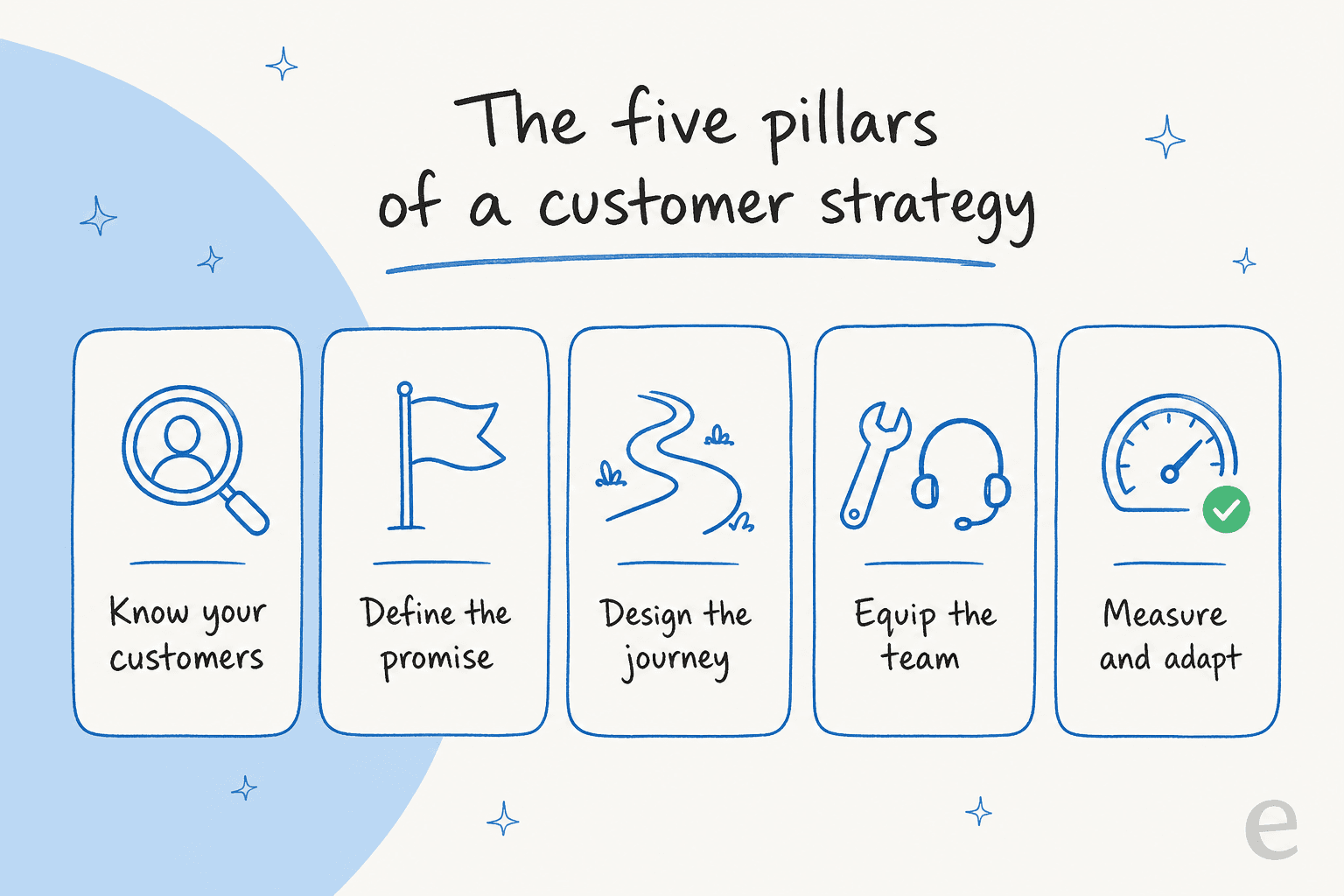
1. Know your customers. Not personas invented in a workshop, but the real segments in your data, what they are worth, and what they actually contact you about. This is where identifying customer needs and understanding the different types of customers you serve pays off, because a strategy built on a guess about who your customer is fails quietly.
2. Define the promise. One sentence a customer would recognize. "We answer within an hour, in your language, and we never make you repeat yourself" is a promise. "World-class service" is a wish.
3. Design the journey. Map the path from first contact to renewal and mark where the promise is kept or broken. Most breakage hides in the handoffs, the moments a customer gets bounced between a chatbot, an email queue, and a human who has to ask them to start over.
4. Equip the team. Your promise is only as good as the people and tools delivering it. That means a clean knowledge base, sane ticket routing, and enough automation that humans are not drowning in the repetitive stuff.
5. Measure and adapt. Pick the two or three numbers that prove the promise is being kept, watch them, and change course when they slip. More on this below.
How to build a customer strategy, step by step
You do not need a six-month consulting engagement. You need a focused pass through these steps, then the discipline to revisit them.
Step 1: Pull the data you already have
Before any workshop, read your own support ticket data. Your tickets are the least filtered voice-of-customer source in the building: they tell you what customers struggle with, in their own words, ranked by volume. Tag the last few thousand by theme and you will usually find that a handful of topics drive most of the contacts.
I have sat in on plenty of strategy conversations where a team's assumptions dissolved the moment we looked at the actual ticket mix. One support lead at a multi-brand e-commerce operator was sure their problem was "complex" questions, right up until the data showed refunds, unsubscribes, and order-tracking made up the bulk of the volume. The strategy for that is completely different from the one you would build for genuinely complex work.
Step 2: Segment and pick your targets
Not all customers are equal, and pretending they are is how strategies get diluted. Group customers by value and by need, then decide, explicitly, who you are built for. This is the choice most companies flinch at, but a customer focus strategy that tries to be everything to everyone ends up being memorable to no one.
Step 3: Write the promise and the journey
With real segments in hand, write the one-sentence promise, then sketch the customer journey for your primary segment. Mark every point where the promise is on the line. Those are your priorities.
Step 4: Close the biggest gaps first
Look at where the journey breaks and fix the highest-volume breakage first. Often that is slow first response, a knowledge base written for the wrong audience, or multilingual gaps you did not know you had. One team I looked at had built their entire help center for administrators while every incoming ticket came from end users. No amount of AI fixes an audience mismatch like that; the strategy work has to come first.
Step 5: Instrument it and make it a loop
A strategy you set once and file away is a document, not a strategy. The companies that pull ahead treat it as a loop.
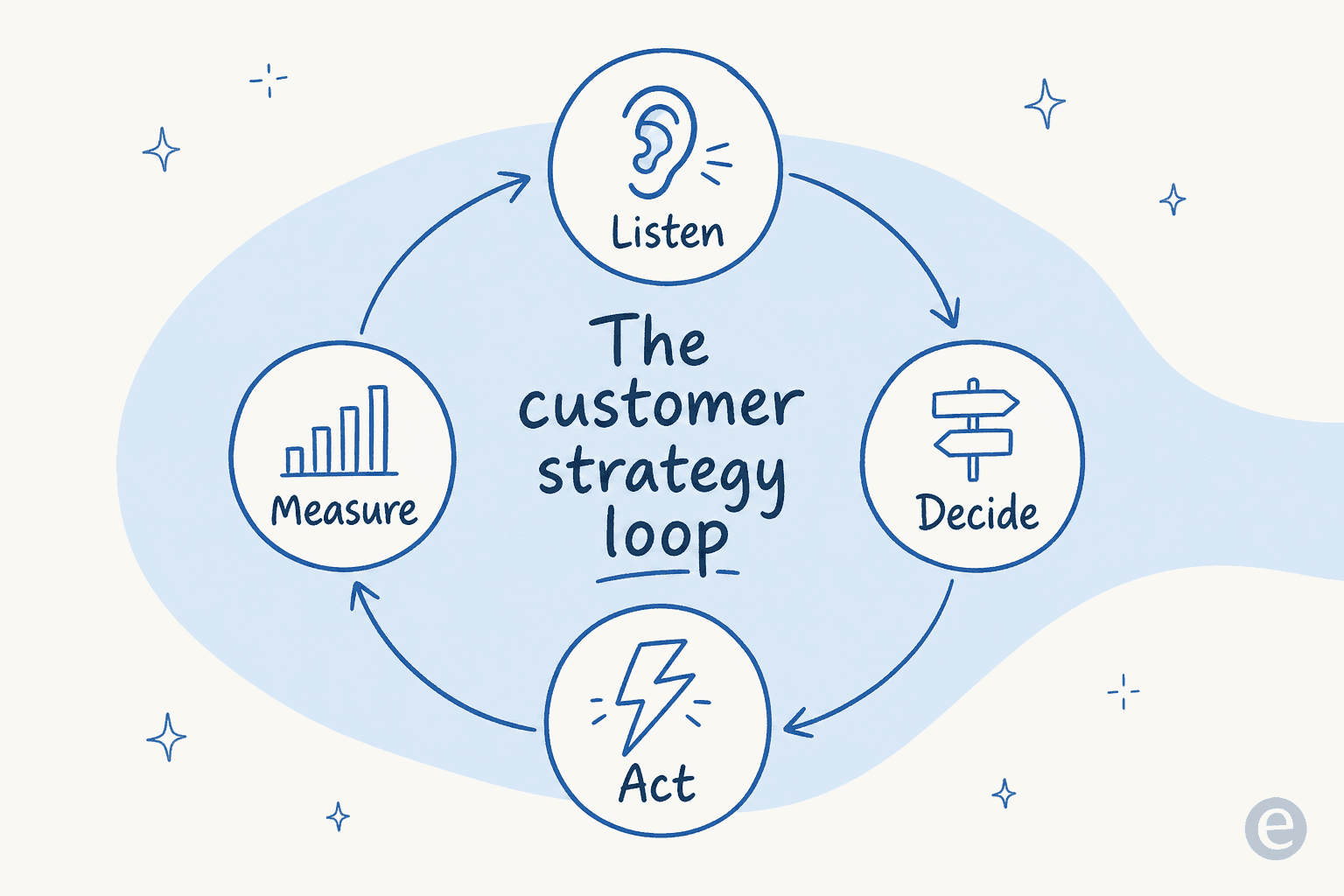
You listen to what customers tell you through tickets and surveys, decide what it means, act on it, and measure whether the action worked, then start again. The teams that win are not the ones with the cleverest strategy on day one; they are the ones with the shortest loop.
Where AI actually fits in a 2026 customer strategy
Here is where I get to lead from experience rather than theory. I work at eesel, and we have spent the last few years putting AI agents on live support queues across thousands of real tickets. That vantage point makes one thing obvious: AI is not your customer strategy, and any vendor telling you it is should worry you. AI is the lever you pull on the operational layer of the strategy, the "equip the team" and "close the gaps" pillars.
The mental model that holds up is a funnel of who handles each contact.
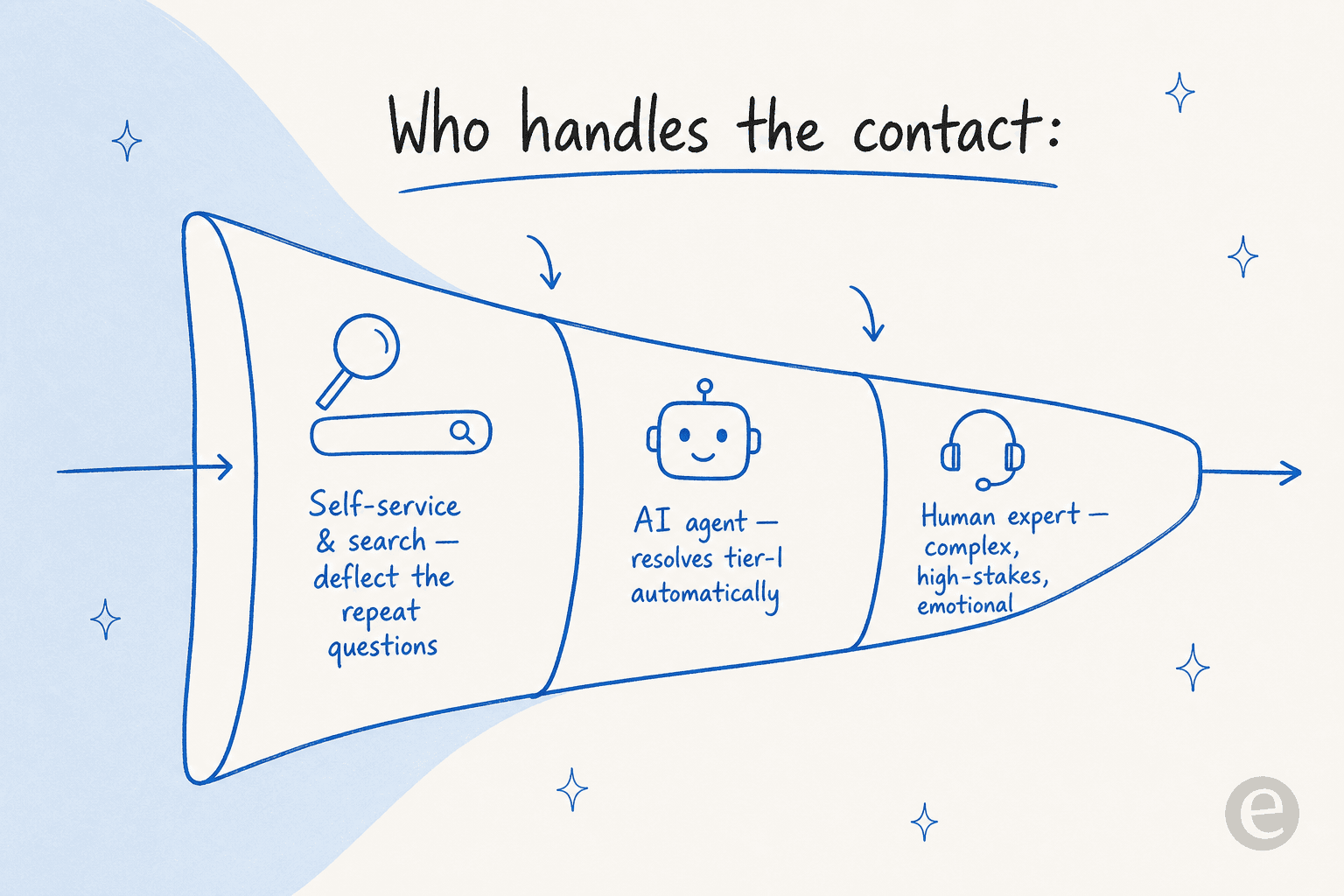
Self-service and search deflect the repeat questions. An AI agent resolves the tier-1 volume that is high in count and low in nuance. Humans take the complex, high-stakes, and emotional cases where judgment matters. Done well, this is not "replace the team," it is "point the team at the work worth their time." A gig-economy analytics app on Zendesk saw it play out fast:
"In the first month, eesel is resolving 73% of our tier 1 requests. eesel offers easy Zendesk implementation and setup. Our team implemented and achieved results quickly during our 7-day trial."
Kim Simpson, Gridwise, in a G2 review
The scars are worth naming too, because they shape how the AI should fit. We have watched confident-sounding bots quietly hand customers wrong answers, which is why every eesel rollout is simulated against past tickets before it goes live, and why the agent uses confidence-based routing to draft or escalate instead of guessing. The single biggest objection I hear from buyers is not "will it work," it is "I will not let it auto-reply to everything." That is the right instinct, and the fix is control, not blind autonomy.
There is also the build-versus-buy temptation, which comes up in almost every strategy conversation with a technical team. It usually ends the way it did for one hardware customer:
"We could try to write our own LLM application but we didn't want to invest our time into that. We wanted something that we would not have to maintain."
Karel, GENERAL BYTES, customer story
The strategy question is not "can we build a chatbot," it is "where is our team's time best spent," and for most companies it is not on maintaining an LLM pipeline.
How to know your customer strategy is working
Vanity metrics are the enemy here. "Deflection rate" on its own can look great while customer satisfaction quietly craters, because a bot that refuses to help "deflects" a ticket too. Pick a small, honest set instead:
| Layer | Metric | What it tells you |
|---|---|---|
| Outcome | Retention, expansion, lifetime value | Whether the strategy makes money |
| Experience | CSAT, customer effort score | Whether the promise feels kept |
| Operational | Resolution rate, first response time, AI resolution quality | Whether the machine is running |
The trick is reading them together. A rising resolution rate with falling CSAT means your AI is closing tickets, not solving problems. A good analytics and reporting view should let you see all three layers next to each other, and simulate a change before you ship it, so you are not finding out in production.
Common mistakes that quietly sink a customer strategy
- Confusing activity with strategy. A wall of initiatives is not a strategy; a clear choice about who and what is.
- Optimizing for the wrong customer. Heroic support for unprofitable accounts is a very expensive way to feel good.
- Treating AI as the strategy. AI executes the plan. If the plan is wrong, faster execution just gets you to the wrong place sooner.
- Deploying AI with no guardrails. Autonomy without confidence routing and escalation is how you get a viral screenshot of your bot saying something absurd.
- Setting it and forgetting it. No loop, no learning. The strategy goes stale the moment the market moves.
Try eesel for the support layer of your strategy
Once your customer strategy names "handle tier-1 at scale without adding headcount" as a goal, the execution question is which tool actually delivers it. eesel AI is an AI agent that plugs into the helpdesk you already run, whether that is Zendesk, Freshdesk, Gorgias, or Front, learns from your past tickets and help docs on day one, and lets you simulate the whole thing against historical tickets before a single customer sees it.
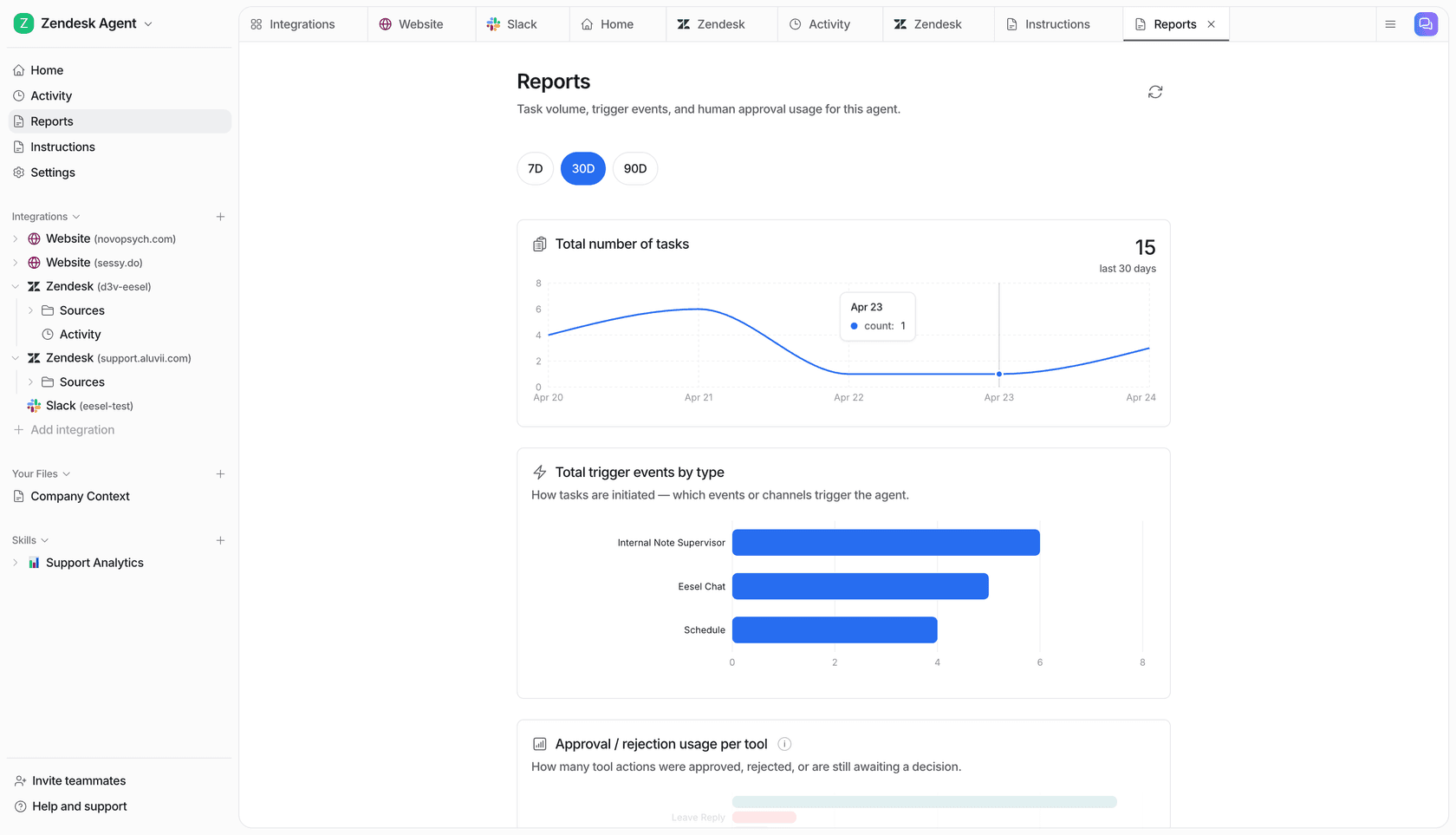
What makes it fit a strategy rather than fight it: confidence-based routing so it only answers when it is sure, 100+ integrations and 80+ languages out of the box, and usage-based pricing from $0.40 per ticket with no per-seat fees, so the cost tracks volume you can forecast. It is free to try, and you can have a simulation running against your own tickets in an afternoon.
Frequently Asked Questions
What is a customer strategy?
What's the difference between a customer strategy and a customer service strategy?
How do you measure whether a customer strategy is working?
How much does it cost to add AI to your customer strategy?
What happens if AI gives a customer the wrong answer?


Article by
Kurnia Kharisma
Kurnia is a software engineer and writer at eesel AI with two years of SEO experience, writing about AI tools, helpdesk software, and customer support. He pairs a developer's understanding of how these products are built with search-driven research into what actually ranks and resonates with the people searching for them.