Your team spends hours every week searching for information. Customers wait too long for answers. New hires take weeks to get up to speed. An AI powered knowledge base changes all of this.
Unlike traditional knowledge bases that rely on exact keyword matches and manual updates, AI powered knowledge bases understand context, learn from interactions, and deliver accurate answers instantly. They transform how organizations manage and share information, both internally and with customers.
Let's break down what these systems actually do and why they matter for your business.
What is an AI powered knowledge base?
An AI powered knowledge base is a centralized information hub that uses artificial intelligence to understand, process, and surface accurate information to users on demand. It goes far beyond simple document storage.
Traditional knowledge bases work like basic search engines. You type a keyword, and they return documents containing that word. If you search "password reset" but the article is titled "login issues," you might not find what you need. AI powered knowledge bases solve this problem through several core technologies:
- Natural Language Processing (NLP) understands the meaning behind queries, not just the words used
- Machine Learning (ML) improves results based on user interactions and feedback
- Embeddings convert text into numerical representations that capture semantic meaning
- Retrieval-Augmented Generation (RAG) combines real-time data retrieval with AI-generated responses for accuracy
The result is a system that understands questions like "I can't get into my account" and knows to surface password reset instructions, account recovery options, and related troubleshooting steps. It learns what works and continuously improves.
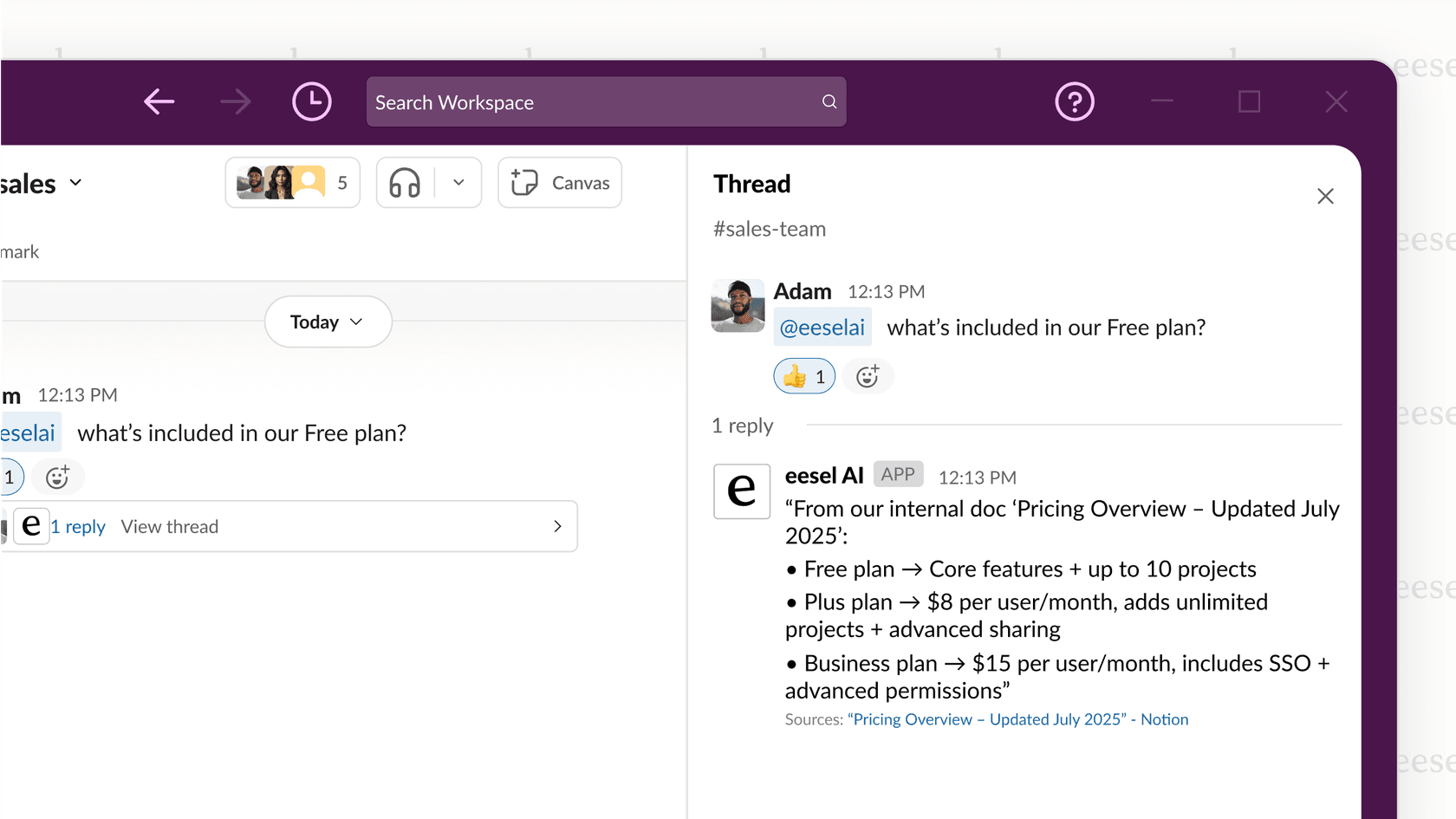
For internal use cases, eesel AI's internal chat solution acts as an AI teammate that learns your company's knowledge from day one. Instead of configuring a tool, you're inviting a teammate who absorbs your documentation, past conversations, and institutional knowledge.
Key benefits of AI powered knowledge bases
Organizations implementing AI powered knowledge bases see measurable improvements across multiple dimensions. Here's what the data shows.
Faster, more accurate answers
Context-aware search understands what users actually mean, even when they don't use the right technical terms. A customer asking "why won't my thing turn on" gets routed to power troubleshooting, not left scrolling through irrelevant results.
This matters for your metrics. Companies using AI knowledge bases report up to a 50% increase in first-contact resolution rates. When agents and customers find the right answer the first time, everyone saves time.
24/7 customer self-service
AI knowledge bases never sleep. Customers get answers at 2 AM on a Sunday without waiting for business hours or paying for round-the-clock staffing.
The demand is there. Over 60% of consumers prefer automated self-service for simple tasks, and 81% try to find answers themselves before contacting support. An AI knowledge base meets this expectation, deflecting routine tickets and letting your team focus on complex issues. According to Zendesk's research, companies that implement AI knowledge bases see significant improvements in customer satisfaction scores.
Improved agent efficiency
Your support team wastes too much time hunting for information. Research from Coveo shows employees waste an average of 3.6 hours daily searching through cluttered inboxes, unorganized repositories, and colleagues' brains. Gartner reports that 47% of employees don't use their company's knowledge base at all, often because traditional systems are too difficult to navigate.
An AI powered knowledge base creates a single source of truth. Agents get instant access to verified information, reducing handle times and eliminating the need to escalate for answers that should be readily available.
Consistent customer experience
When every agent draws from the same knowledge source, customers get consistent answers regardless of who they talk to or which channel they use. This builds trust and prevents the frustration of getting different answers to the same question.
AI also maintains brand voice consistency. The system learns your company's tone and applies it across all responses, whether through chatbot, email, or agent-assisted channels.
Reduced operational costs
Fewer tickets, faster resolution, and less time searching translate directly to cost savings. Organizations report up to a 30% drop in support ticket volume when customers can self-serve effectively.
Onboarding costs drop too. New hires gain access to comprehensive, searchable knowledge instead of shadowing senior team members for weeks. Slack's research shows 50% reduction in onboarding time when teams use AI knowledge tools. Organizations with formal knowledge management programs save an average of 3.9 hours per employee per week, according to Bloomfire's Value Report.
Continuous learning and improvement
Unlike static knowledge bases that grow outdated, AI systems identify content gaps by analyzing what users search for but don't find. They flag outdated articles, suggest new content based on emerging questions, and preserve institutional knowledge before experienced employees leave.
This "tribal knowledge" capture ensures that when your best support agent retires, their expertise stays in the system for others to access.
AI powered knowledge base vs. traditional knowledge base
Understanding the differences helps you evaluate whether an upgrade makes sense for your organization.
| Aspect | Traditional Knowledge Base | AI Powered Knowledge Base |
|---|---|---|
| Search capability | Keyword matching, exact phrases required | Natural language understanding, semantic search |
| Response accuracy | Returns all documents with keywords, user must find the answer | Surfaces specific answers, summarizes relevant content |
| Updates | Manual, often outdated | Automated suggestions, continuous learning |
| Availability | Static content, business hours for updates | 24/7, real-time responses |
| Scalability | Becomes harder to navigate as content grows | Improves with more data and interactions |
| Personalization | One-size-fits-all results | Context-aware, tailored responses |
Traditional knowledge bases still work for small teams with limited content and simple queries. But as your organization grows and customer expectations rise, the limitations become costly. AI powered systems handle complexity at scale without proportional increases in management overhead. As noted by Dixa, companies implementing AI knowledge bases see improved customer satisfaction scores alongside reduced operational costs.
What is the 30% rule for AI knowledge bases?
You might have seen this question in search results. While competitors skip over it, the 30% rule is worth understanding if you're planning an AI knowledge base rollout.
The rule suggests that when implementing AI for knowledge management, you should initially target having the AI handle approximately 30% of queries autonomously, with human oversight for the remaining 70%. This isn't a hard technical limit. It's a practical guideline for rollout strategy.
Here's why it matters: starting with full automation often leads to problems. The AI needs time to learn your specific knowledge domain, understand edge cases, and build confidence scores. By starting with a narrower scope (that 30%), you:
- Validate answer quality before scaling
- Identify knowledge gaps that need filling
- Build team confidence in the system
- Reduce risk of customer-facing errors
This aligns with how we approach AI implementation at eesel. Our practical guide to AI automation recommends starting with AI drafting responses for agent review, then expanding to full autonomy as the system proves itself. You level up your AI teammate based on performance, just like you would with a human hire.
Once that 30% is running smoothly, you expand scope. Mature deployments often reach 70-80% autonomous resolution, but they get there through measured progression, not overnight switches.
Use cases for AI powered knowledge bases
AI knowledge bases deliver value across multiple scenarios. Here are the primary use cases organizations implement.
Customer support and self-service
The most common application. AI knowledge bases power:
- Customer-facing help centers with intelligent search
- Chatbots that answer routine questions instantly
- Agent assist tools that suggest responses during live conversations
- Ticket deflection before issues reach human agents
When customers can find answers themselves, support volume drops and satisfaction rises. According to Talkdesk, AI knowledge management systems can reduce average handle time by up to 20% while improving first-contact resolution rates.
Internal employee support
HR teams use AI knowledge bases to give employees instant access to policies, benefits information, and onboarding materials. IT teams deploy them for troubleshooting guides and system documentation.
For IT service management specifically, our AI for ITSM solution connects to your existing tools and documentation to resolve employee requests without ticket backlogs.
Sales enablement
Sales reps need product information, competitive positioning, and objection handling guidance in real-time during calls. An AI knowledge base puts this at their fingertips instead of buried in slide decks or requiring Slack messages to product teams.
Cross-functional collaboration
Remote and hybrid teams struggle with information silos. AI knowledge bases break down barriers by making documentation from all departments searchable and accessible. Marketing can find sales insights. Engineering can access customer feedback. Everyone works from the same source of truth.
How eesel AI delivers knowledge base benefits
Most AI knowledge base tools position themselves as software you configure. We take a different approach. You don't configure eesel. You hire it.
Here's what that means in practice:
Learning happens in minutes, not weeks. Connect eesel to your help desk, documentation, and past conversations. It immediately absorbs your knowledge, tone, and common issues. No manual training, no documentation uploads, no configuration wizards.
Progressive rollout with guidance. Like any new hire, eesel starts with oversight. Draft responses for agent review. Handle specific ticket types. Work during defined hours. As performance proves out, you expand scope. Eventually, eesel handles full frontline support autonomously.
Plain-English control. Define what eesel handles and when it escalates using natural language: "If the refund request is over 30 days, politely decline and offer store credit." No code, no rigid decision trees.
Works across your existing stack. 100+ integrations mean eesel connects to the tools you already use: Zendesk, Freshdesk, Slack, Confluence, Shopify, and more.
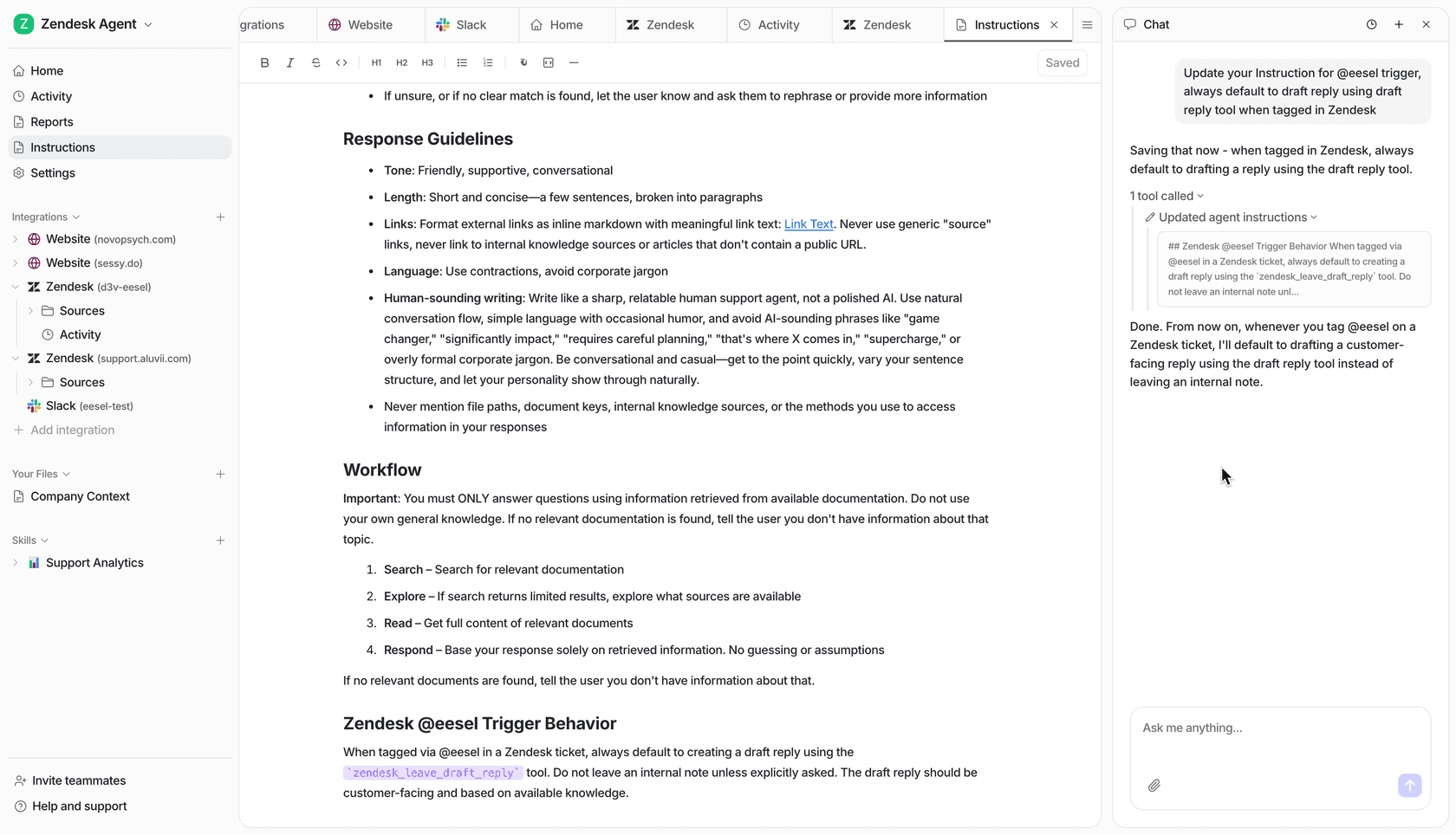
The results speak for themselves. Mature deployments achieve up to 81% autonomous resolution with typical payback periods under two months. You can explore our AI agent capabilities or check pricing to see how it fits your organization.
Getting started with an AI powered knowledge base
If you're considering implementation, here's a practical path forward.
Audit your existing knowledge first. AI is only as good as the information it learns from. Review your help center articles, documentation, and past tickets. Remove outdated content, fix contradictions, and identify gaps. Clean data is essential.
Choose a solution that fits your needs. Consider your use case (customer-facing, internal, or both), existing tech stack, team size, and budget. Look for solutions that integrate with tools you already use rather than requiring wholesale platform changes.
Start with a pilot program. Roll out to a specific team, ticket type, or knowledge domain first. Measure results, gather feedback, and refine before expanding.
Measure what matters. Track metrics like deflection rate, time to resolution, agent handle time, and customer satisfaction. Use these to guide expansion decisions.
Iterate continuously. AI knowledge bases improve with use. Review performance regularly, update content based on gaps the AI identifies, and expand scope as the system proves itself.
Ready to see how an AI teammate can transform your knowledge management? Invite eesel to your team and see the difference in minutes, not months.