

What "excellent customer service" actually means
Before the examples, it's worth naming what I'm looking for, because "excellent" gets thrown around until it means nothing. After years of reading real tickets, the standout interactions almost always hit the same five marks.
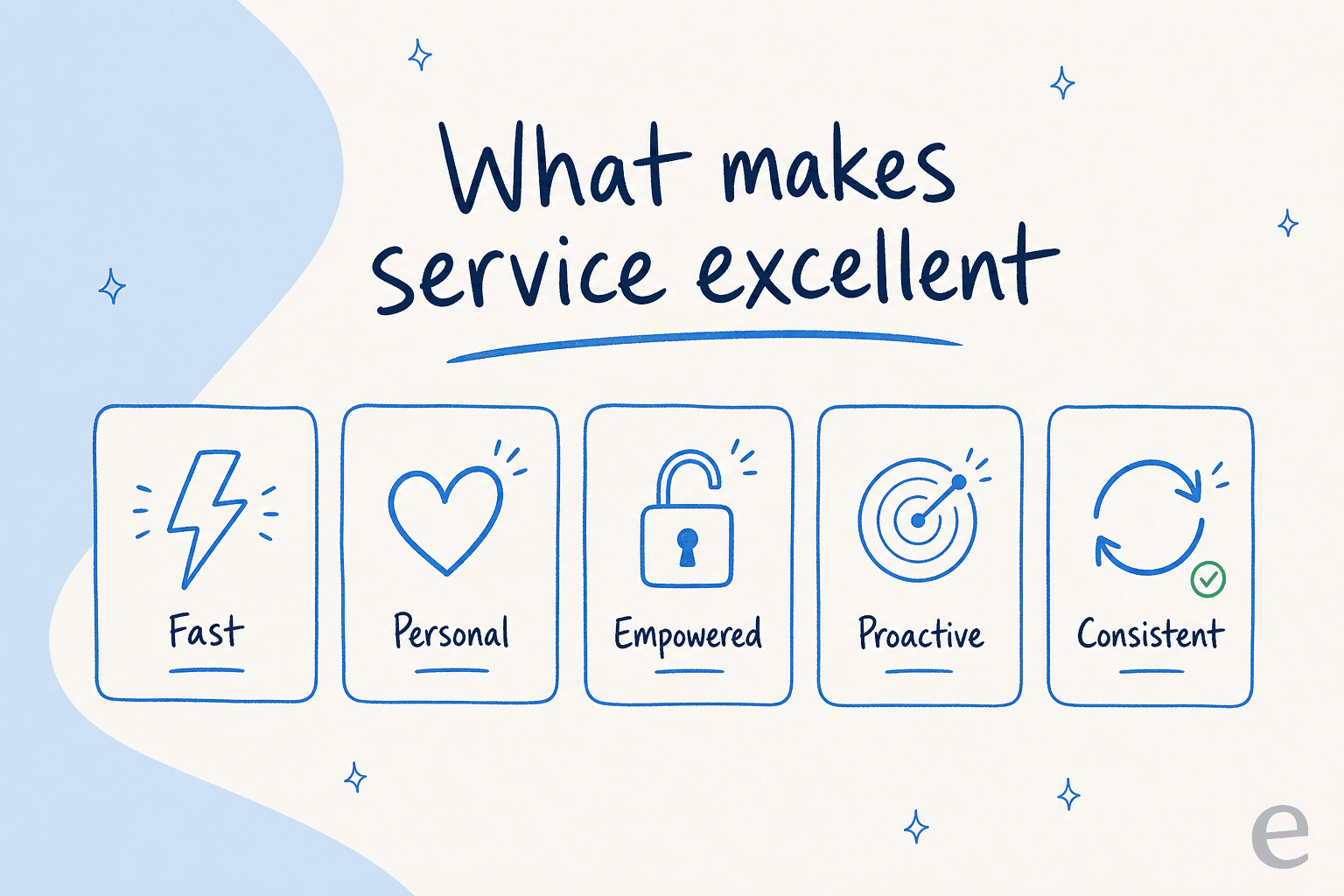
Fast, because a great answer that arrives three days late is a bad experience and quietly drives up customer effort. Personal, so the reply reads like a human who actually looked at your situation, not a macro. Empowered, meaning the person you reach can just fix it instead of escalating you into a queue. Proactive, catching the problem before you have to chase it. And consistent, so you get that same experience on a Tuesday afternoon as you would at 2am on a holiday weekend.
The stakes here are real. In Zendesk's CX Trends 2026 report, 85% of CX leaders say customers will drop a brand over unresolved issues, sometimes on the very first contact. Service isn't a cost centre you tolerate; it's the thing that decides whether the customer comes back. If you want the numbers side of this, I keep a running list of the customer service KPIs worth tracking and a broader guide to customer service management.
9 excellent customer service examples worth stealing
I've picked examples that are verifiable, not internet folklore, and that each teach a different, copyable lesson. The takeaway matters more than the anecdote, so every one ends with the part you can actually reuse. (If you want the inverse, I also pulled together the bad customer service stories worth learning from.)
1. Chewy sends flowers when a pet dies
If there's a modern gold standard, it's Chewy. The pet retailer has a documented pattern of refunding a grieving customer's last order, telling them to donate the food rather than ship it back, and then following up with flowers or a hand-painted portrait of the pet that died. These aren't one-offs; they show up again and again in customer stories.
"When my dachshund passed in 2020 I had just received a $60 shipment and contacted them to see if I could return it... They refunded it and told me to keep or donate. The next day they sent a bouquet of flowers to my house to express their sympathy!"
Reddit user, r/dogs

"A few weeks later I had an unexpected surprise: A commissioned portrait of my sweet dog... with a hand-written condolence card. Seriously! That absolutely won me over. I now purchase all my dogs' food from them."
Reddit user, r/dogs
Entrepreneur editor Jason Feifer summed up why the pattern works on LinkedIn: the refund is nice, but the flowers and the portrait are what turn a customer into a lifelong one. It's worth being honest, though, that no brand is universally loved. In the same thread, one customer described Chewy closing their account over a fraud flag without a conversation. Excellent-on-average still has bad days.
Steal this: empower frontline agents to make small, human calls (a refund, a gesture) without a manager sign-off. The flowers cost Chewy very little; the story is worth a fortune, and it's the kind of moment that shows up in every TED talk on customer service for a reason.
2. The Ritz-Carlton's $2,000 rule
The Ritz-Carlton built "legendary service" on a mechanism, not a vibe. Its Gold Standards spell out a credo, a motto, and 12 service values, but the piece everyone remembers is empowerment. The Ritz-Carlton Leadership Center puts it plainly:
"Empowering employees is an imperative component of our legendary service. At The Ritz-Carlton, empowerment means that our Ladies & Gentlemen can make decisions that impact the well-being of our guests."
The Ritz-Carlton Leadership Center, Culture of Excellence
In practice, that means any employee can spend up to $2,000 per guest, per day to resolve a problem, no approval needed. As they're careful to note, it's rarely about the money; it's about removing the hesitation that kills a good save.
Steal this: give your team a clear "you're allowed to fix this" mandate with a dollar or decision limit. The empowerment is the product. A customer service mindset only scales when people are trusted to use it.
3. Zappos treats service as the whole business
Zappos has sold shoes online since 1999, but ask anyone what they're known for and it's the phone support. The company is direct about it on its own about page: "Founded in 1999, we built our reputation on exceptional service." The famous stories, marathon phone calls, surprise upgrades, reps who'll help you find a pizza, all flow from treating the contact centre as the brand rather than an expense to minimise.
Steal this: decide whether support is a cost to shave or a reason people choose you. That single framing decision changes every staffing, tooling, and training call downstream.
4. Hawaiian Airlines turns a delay into loyalty
Delays are where most airlines lose people. On one Hawaiian Airlines flight, a missing copilot held up departure, but the crew handled it well: they kept passengers out of the cramped cabin while they waited, ran a fast pre-flight checklist once the pilot arrived, and the captain pushed to recover time in the air. The passenger's verdict: "Hawaiian Airlines earned a customer for life that day."
Steal this: you can't prevent every problem, but you control the experience of the problem. Proactive communication and visible effort during a failure often beat a flawless day that no one remembers.
5. Sony fixes an out-of-warranty TV for free
A customer's TV had a known defect but had aged out of warranty. After they explained a rough personal situation, Sony sent a technician to the house, did the repair, and charged nothing. Years later, the set still works and the customer still tells the story.
Steal this: the rulebook is a floor, not a ceiling. Letting agents override policy for a genuine edge case, when the cost is small and the goodwill is large, is what "excellent" looks like in practice.
6. The restaurant that added your usual "just in case"
Not every great example needs a big brand. A local Chinese restaurant noticed a regular had changed their usual order, so they called to check it wasn't a mistake, then included a full portion of the customer's normal lo mein in the delivery with "just in case" written on top. No charge.
Steal this: attention is a service. Noticing a change in a customer's behaviour, and acting on it, is proactive support at its purest, and it's available to any business of any size, especially if you're already listening with customer feedback tools.
7. A book that names the philosophy
When support practitioners in that same thread were asked for the best example, several pointed to Will Guidara's Unreasonable Hospitality and its idea of going above and beyond to make guests feel seen by empowering employees to create extraordinary moments. It's the common thread under every example above: seen, empowered, extraordinary.
Steal this: give your team a shared language for what "great" means. A named standard is easier to coach to than a vibe, which is exactly why written customer service standards matter.
8. A coachable AI that acts like a 24/7 supervisor
Here's a modern one from the eesel side. A small dog-training business, WhenHoundsFly, was drowning in the same repetitive questions and couldn't staff around the clock. Rather than hire, they trained an AI on their own docs and past tickets. Their founder's G2 review captured the shift:
"Finally! A coachable AI agent for supporting Customer Experience accessible to small businesses... effectively letting it read and memorize our company's procedures, products, and policies... when we re-test, it correctly incorporates the coaching."
Founder, WhenHoundsFly, in a G2 review
The excellent-service angle isn't that a robot answered; it's that newer human agents now had "a 24/7 supervisor that coaches them on how to handle inquiries." The AI made the people better.
Steal this: AI's best role often isn't replacing the human, it's giving every agent instant access to the answer a senior teammate would give. That's how you make consistency real.
9. Capturing a departing expert's knowledge before they leave
One pattern I hear constantly on sales calls: a company has one or two senior agents with all the product knowledge in their heads, and those people are about to leave. A French public-sector IT firm running around 3,000 complex tickets a month came to eesel specifically to capture two departing experts' tribal knowledge in AI before it walked out the door.
That's an excellent-service move most people never see, because it happens backstage. If the expertise only lives in one person's head, your service quality drops the day they take vacation. Getting it into a shared, AI-searchable knowledge base is what keeps the bar high after they're gone.
Steal this: treat knowledge as infrastructure. Excellent service that depends on one hero isn't excellent service, it's a single point of failure.
Here's the whole set at a glance:
| Example | The move | What made it excellent | Steal this |
|---|---|---|---|
| Chewy | Refund + flowers + pet portrait | Empowered, deeply personal | Let agents make small human calls |
| The Ritz-Carlton | Up to $2,000 to fix any guest issue | Empowered, no approval friction | Give a clear "fix it" mandate |
| Zappos | Service treated as the brand | Culture, consistency | Decide support is a reason, not a cost |
| Hawaiian Airlines | Managed a delay with visible effort | Proactive, communicative | Control the experience of a problem |
| Sony | Free out-of-warranty repair | Empowered edge-case override | Rules are a floor, not a ceiling |
| Corner restaurant | Free "just in case" portion | Proactive, attentive | Notice changes and act on them |
| Unreasonable Hospitality | A named standard | Shared language for "great" | Write your standards down |
| WhenHoundsFly | Coachable AI on own docs | Consistent, 24/7, scalable | Make AI the agent's supervisor |
| Departing-expert capture | Tribal knowledge into AI | Consistent after turnover | Treat knowledge as infrastructure |
The pattern behind every one of them
Line them all up and the same shape appears. None of these were reactive. Nobody was chasing an answer, getting a different story from each agent, or waiting for a complaint before anything happened. Every example flips that script.
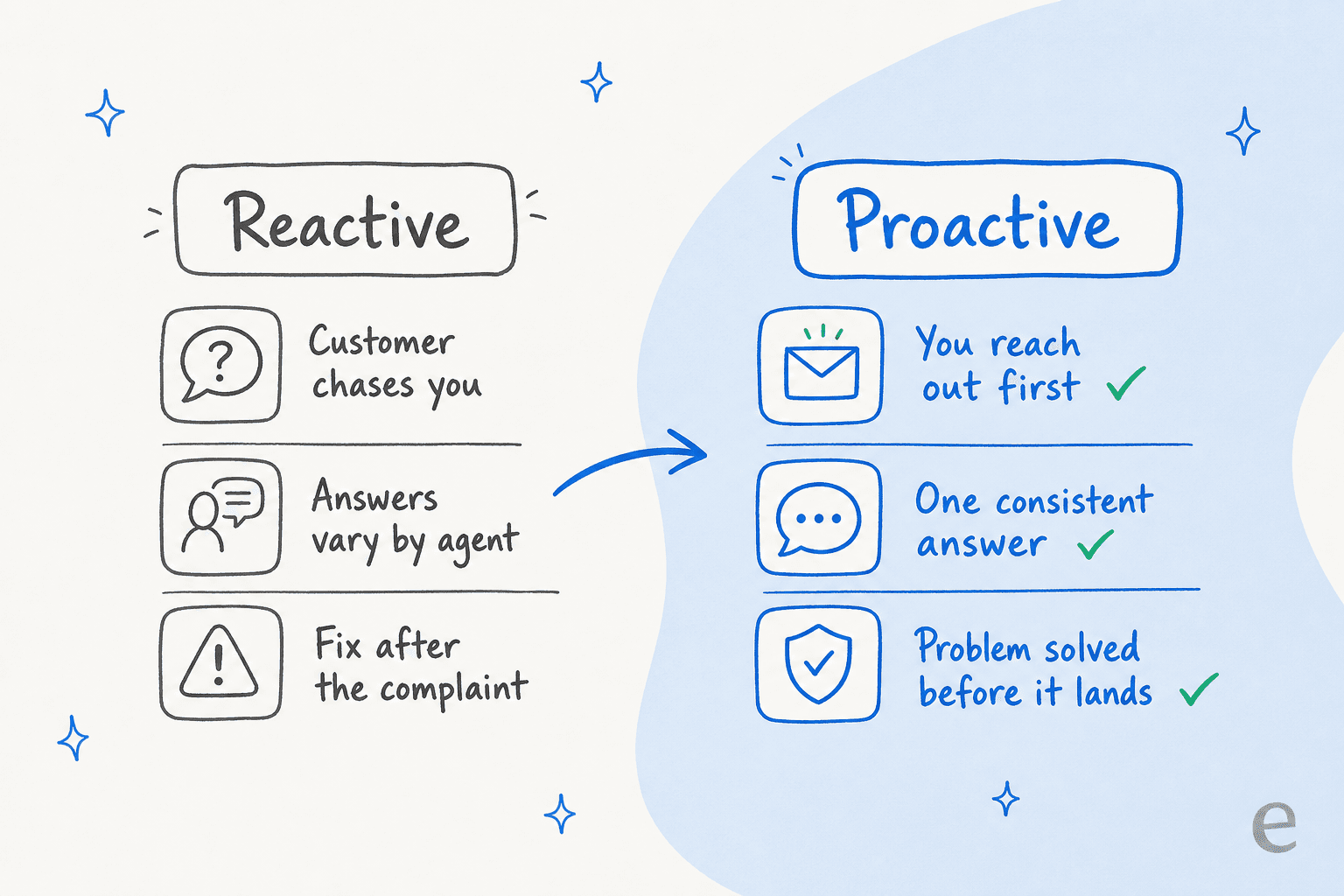
Reactive support waits for the customer to chase you, gives answers that vary by whoever picks up, and fixes things only after the complaint lands. Proactive support reaches out first, gives one consistent answer, and often solves the problem before the customer even feels it. That's the real dividing line, and it maps directly onto how expectations have shifted: per Zendesk's 2026 data, 74% of consumers now expect service to be available 24/7 because of AI, and 95% want an explanation when an AI makes a decision about them.
The uncomfortable truth is that consistency at that level is nearly impossible with humans alone. People have off days, work in shifts, and forget the edge case they saw six months ago. This is where the right customer service AI earns its place, not as a replacement for the human moments, but as the thing that makes the baseline reliably excellent.
How to make excellent service repeatable, not a lucky story
A viral service story is nice. A system that produces good experiences every single day is the actual goal. The way modern teams get there is to split the work with a deliberate AI customer service workflow: let AI own the high-volume, low-nuance tickets instantly, and free your people for the moments that need judgement and empathy.
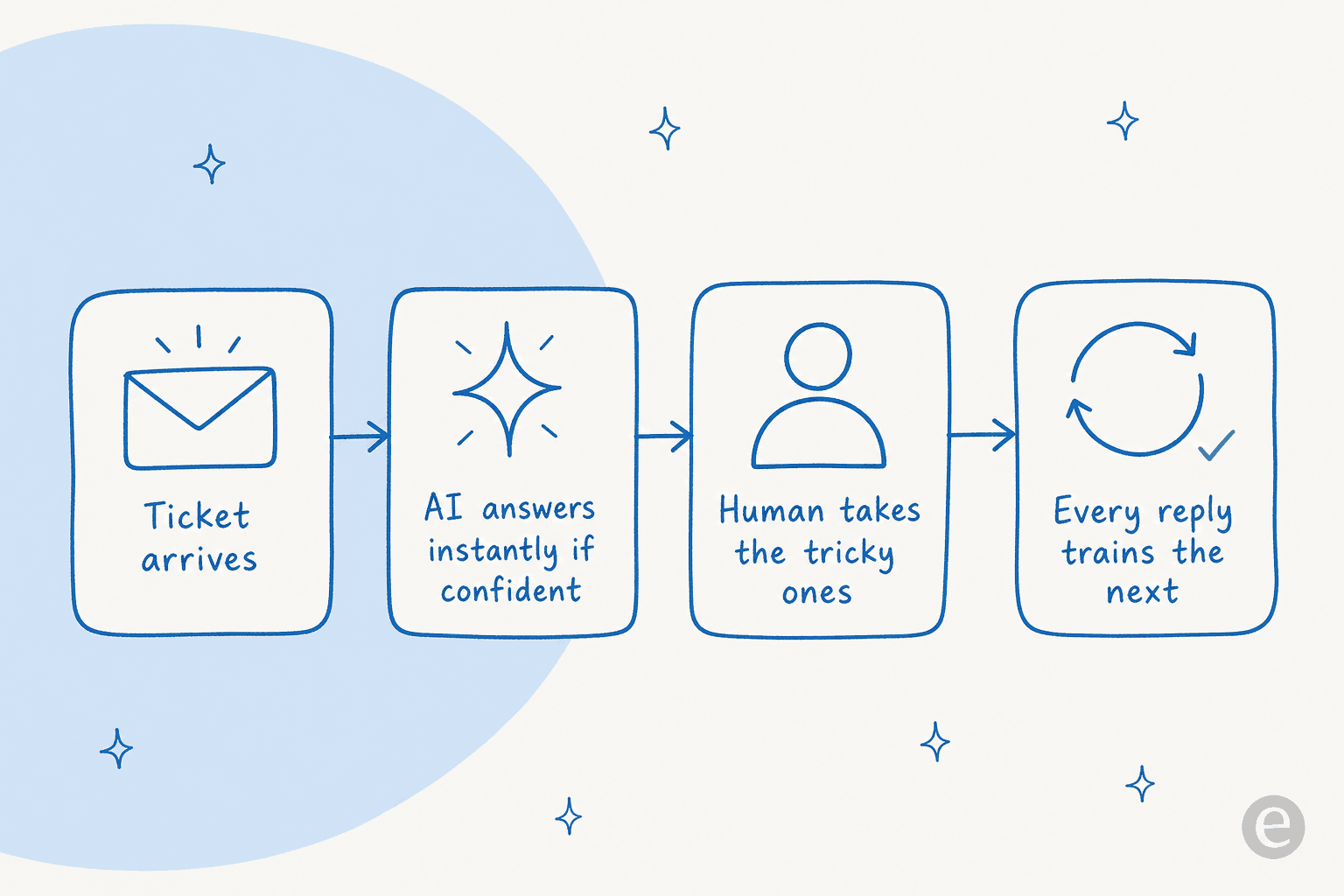
This is exactly what I see work on eesel's own queue. A ticket arrives, the AI answers instantly when it's confident, routes to a human the moment it isn't, and every correction an agent makes trains the next response. The volume that used to eat the whole day, order status, password resets, refund policy, gets handled without a person, which is the only way the team has time left to send the metaphorical flowers. It also saves real money: every deflected tier-1 ticket is an hour your senior agents spend somewhere it counts.

The trust part is what makes or breaks it, and it's the objection I hear most. Nobody wants an AI confidently giving a wrong answer, so the answer is confidence-based routing: the AI only replies to what it's sure about and quietly hands the rest to a human. One legal-tech founder I work with put the bar as high as it gets, needing exact guardrails on sourcing and transparent citations on every answer, and that's the design point. Excellent service and safe automation aren't in tension; the routing is what lets you have both.
Try eesel for excellent service at scale
If your team is stuck in reactive mode because tier-1 volume never lets up, that's the exact problem eesel was built for. It plugs into your existing helpdesk, whether that's Zendesk, Freshdesk, Gorgias, Front, or HubSpot, in minutes, trains on your past tickets and help docs, and starts resolving the repetitive questions so your people can focus on the moments customers actually remember. It works across live chat and email alike, in 80+ languages.
The proof is in the rollouts. A gig-economy analytics app on Zendesk saw eesel resolve 73% of tier-1 requests in its first month, with results during a 7-day trial. And EdTech company Yellowdig described it less like software and more like a teammate:
"It feels like a partnership, rather than a vendor relationship... Recently, a new customer success hire joked that our eesel AI bot was their best friend during onboarding."
Jon Miron, Director of Support & Operations, Yellowdig
You can start free with no credit card, run a simulation on your own historical tickets to see exactly what it would have handled before it ever touches a live customer, and only turn on autonomy when you're comfortable. Excellent service, delivered consistently, is a system you can build, not a story you wait for.
Frequently Asked Questions
What are some examples of excellent customer service?
What makes customer service excellent instead of just good?
How can a small team deliver excellent customer service?
Can AI provide excellent customer service?
What is the difference between good and bad customer service examples?


Article by
Riellvriany Indriawan
Riell is a designer and writer at eesel AI with about two years of experience researching CX platforms, AI chatbots, and helpdesk software. She combines her design background with a sharp eye for how these tools actually look and feel in practice — making her comparisons unusually visual and user-focused.