What makes an apology message actually land
I've read a lot of apologies, on both sides of the desk. The ones that repair the relationship all share the same bones, and the ones that make a customer angrier almost always skip one of them.
Here's the structure I check every apology against before it goes out:
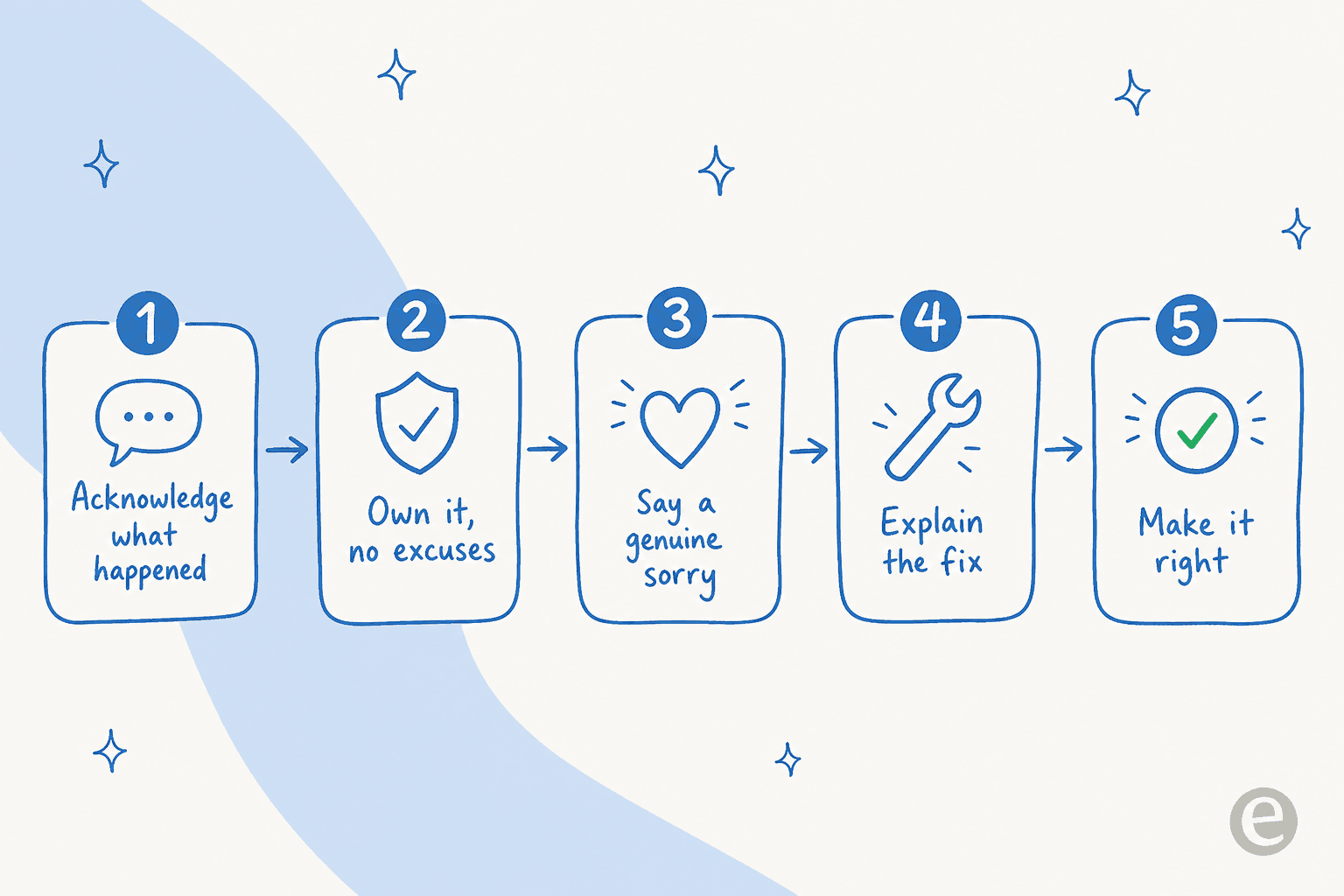
- Acknowledge what happened, specifically. Not "an issue occurred." Say "your order was charged twice." Naming the real thing tells the customer you actually understand their problem, which is half of what they came for.
- Own it, no excuses. "Our system had a sync error" beats "due to unforeseen circumstances." Passive voice and vague causes read as dodging. If it was your fault, say so plainly.
- Say a genuine sorry. One clear "I'm sorry," not five hedged ones. "I'm sorry" is a full sentence; "I'm sorry if you feel" is an insult.
- Explain the fix. What you did, or what happens next, with a timeline. This is where an apology turns from words into trust.
- Make it right. A refund, a credit, a replacement, a follow-up, or just a promise you'll actually keep. The size should match the harm, which brings us to the next question.
That structure is the whole game. Everything below is just applying it to real situations. If tone is the part you struggle with, our deep dive on empathy in customer service pairs well with this.
How far should the apology go?
Not every mistake deserves the same apology. A five-minute chat delay and a billing error that overdrafted someone's account are not the same event, and treating them the same either wastes goodwill or under-serves a genuinely upset customer.
I think about it on two axes: how much the mistake actually hurt the customer, and whether it was our fault. That gives you a simple map for how much to say and how much to give.
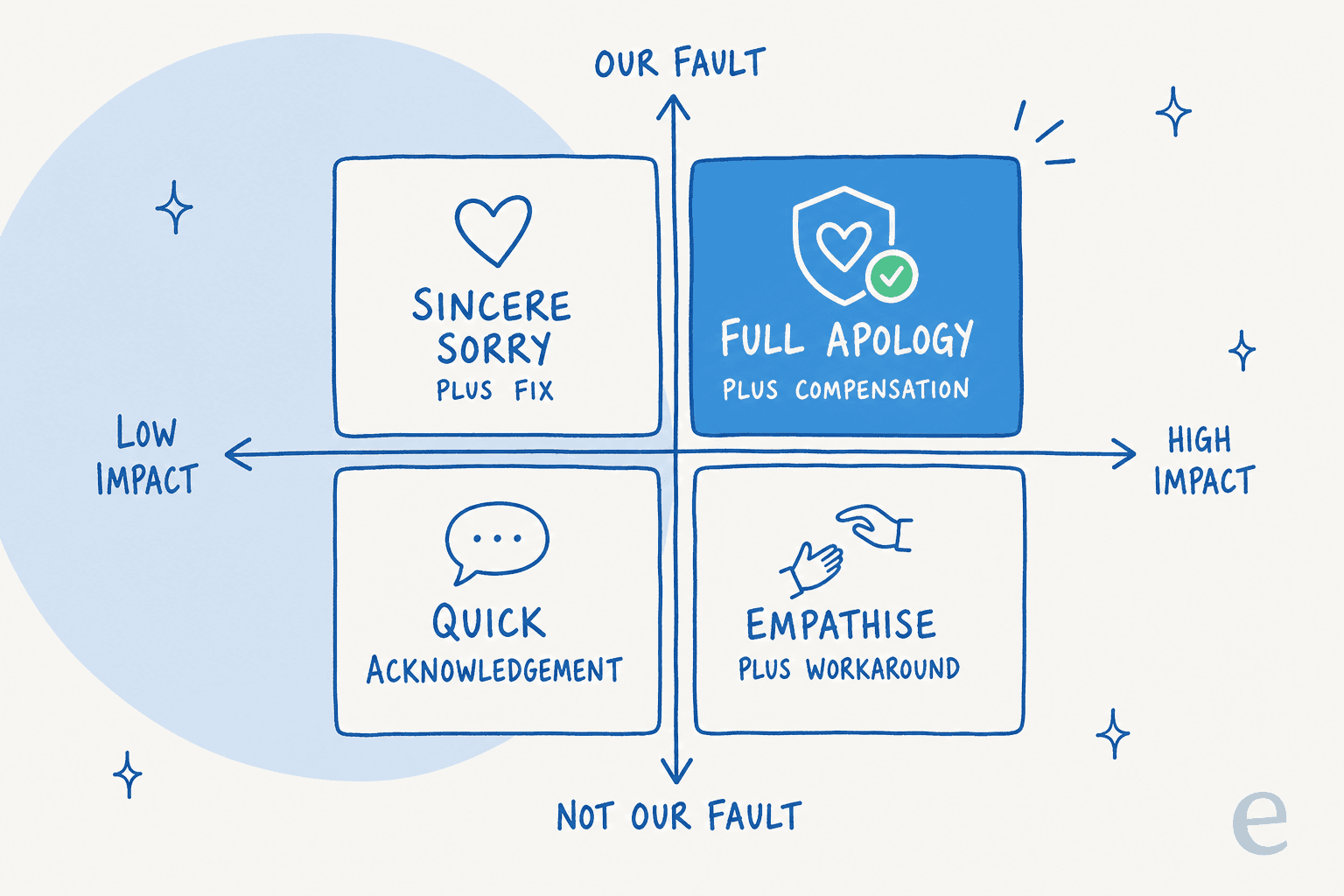
- Low impact, not your fault: a quick, warm acknowledgement. Don't grovel over something minor and outside your control, it reads as insincere.
- Low impact, your fault: own it briefly and move on. "That was my mistake, fixed now."
- High impact, not your fault: lead with empathy and a workaround, even if you're not to blame. The customer's frustration is real regardless of fault.
- High impact, your fault: the full apology, plus a make-good that's proportional. This is the one you cannot phone in.
The trap most teams fall into is treating every ticket like the top-right corner (over-apologising for tiny things) or every ticket like the bottom-left (brushing off things that genuinely hurt). Matching the response to the harm is what makes it feel human. If you want to measure whether you're getting it right, CSAT and satisfaction metrics after a resolved complaint are the clearest signal.
Customer apology message templates
Here are the shapes I actually use, organized by scenario. Every one is a starting point, not a script. Fill the brackets, cut anything that isn't true, and read it out loud before you send it. If it sounds like a robot wrote it, a customer will hear that too.
Late or delayed order
The most common apology in e-commerce, and the easiest to get right because the fix is usually obvious.
Hi [name],
I'm sorry your order (#[number]) is running [X days] behind. You paid for it to arrive on time and it didn't, that's on us.
Here's where things stand: [current status and new delivery date]. I've refunded your shipping cost and added a [amount] credit to your account for the trouble.
If it doesn't arrive by [date], reply here and I'll [next step] right away.
For teams handling these at volume, this is exactly the kind of case AI handles well, since order status and the make-good rule are both predictable. We cover the mechanics in AI for refund requests.
Billing error or double charge
Money mistakes make people anxious, so speed and a concrete timeline matter more than anything else here.
Hi [name],
You're right, we charged you [amount] twice on [date]. I'm sorry, that shouldn't have happened.
I've already reversed the duplicate charge. It'll show back in your account within [X business days], depending on your bank. I've also [what you did to prevent it recurring].
If you don't see the refund by [date], tell me and I'll escalate it directly with our payments team.
Notice there's no "we take billing seriously" filler. The action is the reassurance. Billing disputes are also a common trigger for customer complaints that spiral, so speed here protects more than one ticket.
Service outage or downtime
When the whole product is down, one honest message beats ten status-page updates. Own the impact, not just the incident.
Hi everyone,
[Product] was down from [time] to [time] today. I'm sorry, we know a lot of you couldn't [what they couldn't do], and for some of you that meant [real consequence].
Here's what happened: [plain-language cause]. Here's what we've changed so it doesn't happen again: [fix].
[Any credit or SLA adjustment.] Questions, I'm right here.
For high-impact incidents like this, having clear escalation rules so the right person writes and approves the message is worth setting up before you need it.
Wrong item or shipping mix-up
Hi [name],
I'm sorry, we sent you [wrong item] instead of the [correct item] you ordered. That's frustrating, especially when you were waiting on it.
The correct one is going out today with [expedited shipping], and you'll have it by [date]. Keep or donate the wrong item, no need to send it back. Here's a [discount] on your next order for the hassle.
The "keep it, don't ship it back" move removes work for the customer, which is often worth more than the discount. Macro templates for shipping issues can standardize this across a team.
A bad experience with a support agent
This one's delicate because you're apologizing for the apology channel itself. Don't get defensive, and don't throw a colleague under the bus.
Hi [name],
I read back through your conversation with us, and I'm sorry, we didn't handle that well. You came to us with a straightforward question and left more frustrated than when you started.
That's not the experience we want you to have. Here's what I can do right now: [concrete fix]. And I've shared the thread with our team so we actually learn from it.
Following up after a rough interaction is one of the highest-leverage things a support team does. If you're not sure how customers felt, feedback examples are a good way to check.
Missed deadline or dropped ball
Hi [name],
I told you I'd [commitment] by [date], and I didn't follow through. I'm sorry, that's on me and I know it put you in a tough spot with [their situation].
I've [current action] and it'll be done by [realistic new date]. I'll send you a note the moment it's live so you're not left wondering.
The move that rebuilds trust here is the proactive update at the end. A dropped ball plus silence is what actually kills the relationship, and closing that loop is a big part of building trust with customers over time.
Data or security incident
Handle these carefully. Be sincere about impact, but don't speculate about cause before you know it, and loop in the right people first.
Hi [name],
I'm writing to let you know about [incident] that may have affected [what]. I'm sorry, we know you trusted us with this.
Here's exactly what we know so far: [facts]. Here's what we've done: [actions]. Here's what you should do: [customer steps].
We'll update you by [date] whether or not there's news. If you have questions before then, reach me at [direct contact].
For anything touching security or compliance, this is a case where AI should draft but a human must approve. Good escalation handling makes that automatic instead of a thing someone has to remember.
Apology phrases that actually work
If you strip the templates down, a handful of lines do most of the heavy lifting. These are the ones I keep coming back to:
- "That's on us." (Ownership in three words.)
- "I'm sorry, that's genuinely frustrating." (Names the emotion without performing it.)
- "Here's what I've already done about it." (Past tense beats promises.)
- "You shouldn't have had to chase us for this."
- "I'll follow up personally by [date]."
For a fuller bank of these, we keep a running list of empathy statements for customer service that slot into most of the templates above.
The phrases that quietly make it worse
Some lines feel like apologies but do the opposite. I cut these on sight:
- "We apologize for any inconvenience." The most hollow phrase in support. "Any" pretends you don't know what went wrong; you do. Name it.
- "I'm sorry you feel that way." This apologizes for the customer's emotions instead of your mistake. It's a non-apology, and people can smell it instantly.
- "As per our policy..." Nobody in the history of being upset has been calmed by a policy citation. Explain the reasoning like a person.
- "Unfortunately..." Usually a signal that a "no" is coming with zero effort to soften or solve it.
- Over-apologising. Five sorries in one message reads as anxious, not sincere. One real apology plus a fix beats a paragraph of hedging.
The through-line: a good apology is specific and paired with an action; a bad one is vague and paired with a policy. If you handle a lot of upset customers, our guide on how to deal with angry customers goes deeper on de-escalation.
Scaling apologies without sounding like a robot
Here's the tension every growing support team hits: templates keep your apologies consistent, but the more you lean on them, the more robotic they read. And the customers who need an apology are, by definition, already annoyed, so a form-letter feel makes it worse.
This is where I've found AI genuinely useful, and I say that as someone who's skeptical of most "AI for support" pitches. When we looked at real trial data across a customer's team, agents were rewriting AI-drafted replies mostly for length and tone, not because the AI was wrong; only about 5% of edits were the AI getting a fact wrong. The fix wasn't a smarter model, it was training the AI on the team's own sent replies so the drafts already sounded like them.
That's the whole trick to apologies at scale. An AI helpdesk agent that learns from your past tickets and help docs will draft an apology that already knows your brand voice, your make-good rules, and the customer's history, in 80+ languages. A human reviews and sends. Nobody writes "we apologize for any inconvenience" from scratch at 4pm on a Friday. It's also one of the clearest wins when you add AI to customer service, because the fastest first-response time on an angry ticket is a draft that's already waiting.
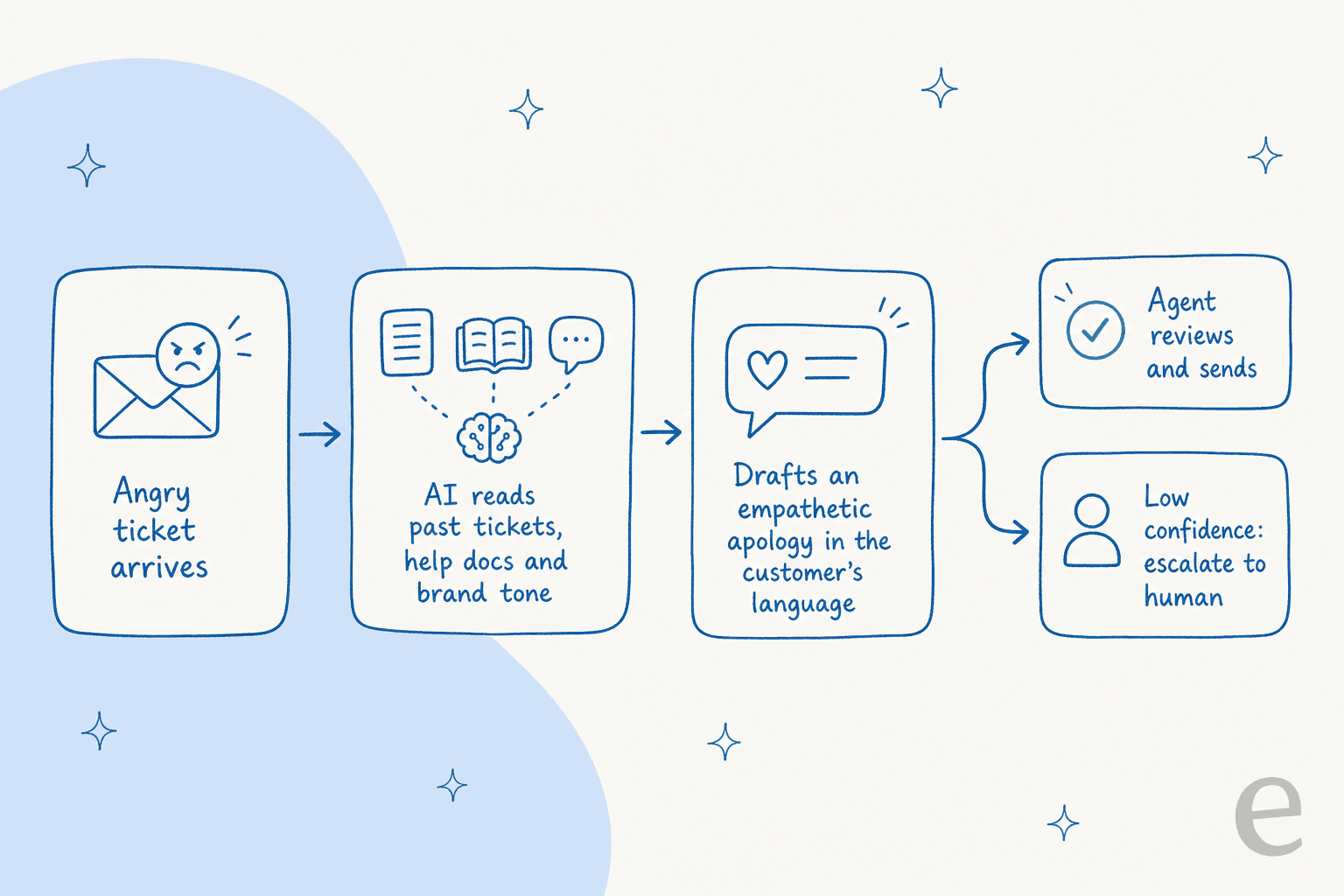
The part that makes this safe for apologies specifically is confidence-based routing: when the AI isn't sure (a security incident, an angry VIP, anything sensitive), it doesn't guess, it drafts and flags for a human instead of sending. That's the difference between AI that helps and AI that creates a second apology you have to write later. We break down where that line sits in AI vs human customer support.
Try eesel for consistent, human apologies
If your team sends the same kinds of apologies over and over, eesel AI drafts them in your brand voice by learning from your own past tickets and help center, then lets a human approve, edit, or send. It plugs into Zendesk, Freshdesk, Gorgias, and 100+ other tools, and you can run it in simulation mode against your historical tickets first, so you see exactly how it would have handled real complaints before it ever replies to a live customer.

Pricing is usage-based at $0.40 per resolved ticket, with no per-seat fees, and there's a free trial with $50 of usage and no credit card. If you're still weighing options, our roundup of the best customer service AI puts it in context alongside the other tools support teams actually use. It's a low-risk way to see whether AI can take the "we apologize for any inconvenience" energy out of your queue for good.
Frequently Asked Questions
How do you write a good apology message to a customer?
What is a good sorry message for a customer?
How do you apologize professionally without admitting legal fault?
Should I use a template for customer apology messages?
Can AI write apology messages to customers?


Article by
Riellvriany Indriawan
Riell is a designer and writer at eesel AI with about two years of experience researching CX platforms, AI chatbots, and helpdesk software. She combines her design background with a sharp eye for how these tools actually look and feel in practice — making her comparisons unusually visual and user-focused.