
What an empathy statement actually is (and why the canned ones backfire)
An empathy statement is a sentence that shows the customer you understand both what went wrong and how it feels to be on their end of it. That second part is the whole game. Plenty of agents acknowledge the facts ("I see your order is delayed") and stop there, which reads as a status update, not empathy.
The reason the famous lines fall flat is that they've been used on all of us, thousands of times. "I completely understand how frustrating this must be" has been said to me by a bot, an offshore script, and a genuinely kind human, and I can't tell which is which anymore. The words stopped carrying meaning. What still lands is specificity: mentioning the actual thing the customer told you. "Missing a delivery the day before you're travelling is the worst timing" works because no script could have guessed it.
Empathy also isn't sympathy. Sympathy is "I feel bad for you" (distance). Empathy is "I get why this is a problem for you" (alignment). The second one puts you on the same side of the table, which is exactly where you want to be before you start problem-solving. It's a core part of any real customer service mindset, and it shapes the service standards a good team writes down.
The anatomy of a good empathy statement
Most strong empathy statements follow the same four-beat shape, whether you're on live chat, email, or the phone. You don't always need all four in one sentence, but the good replies hit them in order.
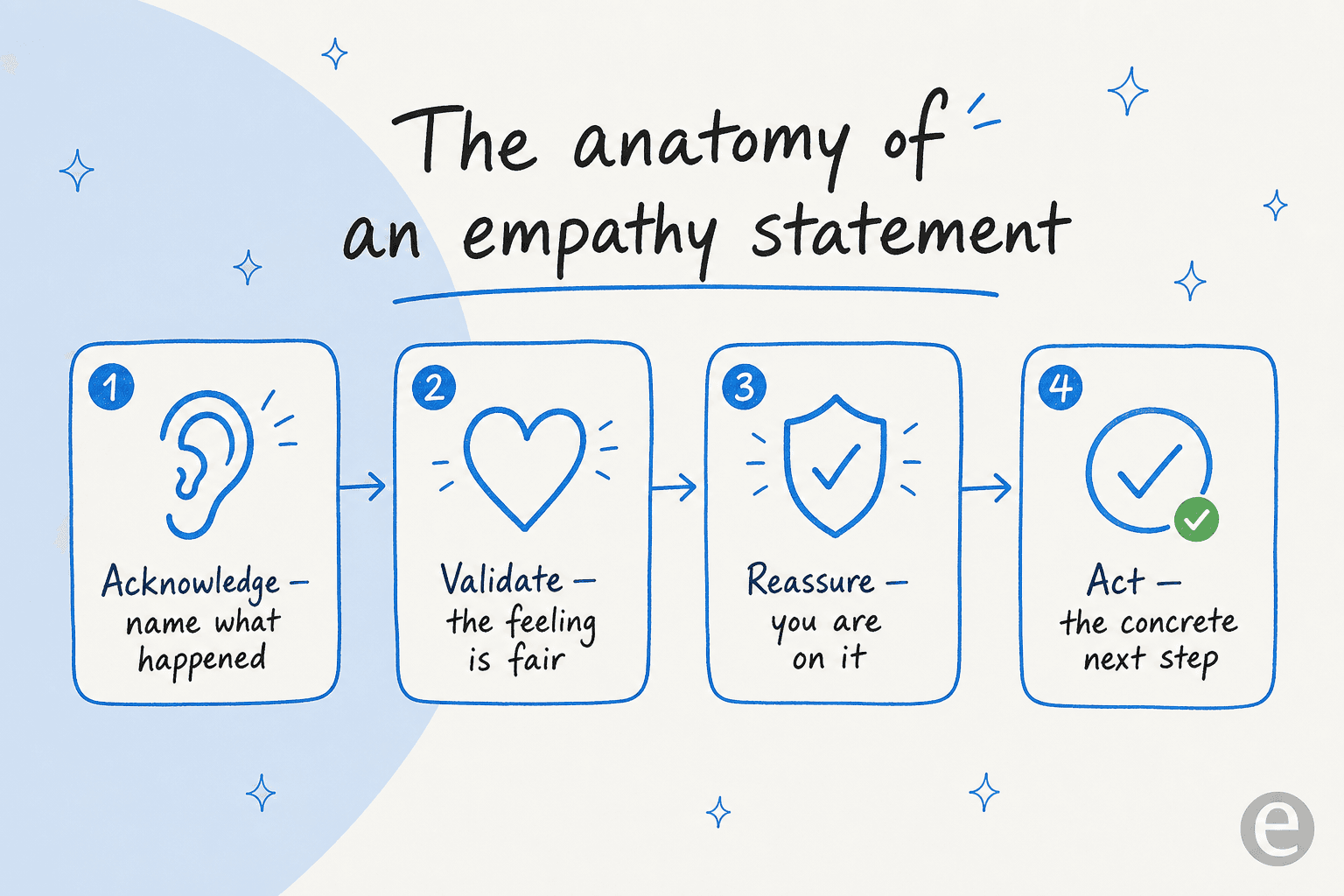
- Acknowledge the specific thing that happened, in their words. Not "your issue," but "your refund still hasn't landed after eight days."
- Validate that the feeling is reasonable. "That's a fair thing to be annoyed about."
- Reassure that you've got it from here. "I'm going to stay on this with you until it's sorted."
- Act with a concrete next step and, ideally, a timeframe. Empathy with no follow-through is just a nice-sounding delay.
The trap is stopping after the first two beats. A customer who hears acknowledgement and validation but no action feels handled, not helped. Empathy buys you about one sentence of goodwill; the fix is what spends it well.
40+ empathy statements, grouped by situation
Here's the part you probably came for. I've sorted these by the moment you're actually in, because the right words for an angry customer are the wrong words for a confused one. Lift them, then swap in the customer's real details, that edit is what makes them yours.
When the customer is angry or feels let down
Anger is usually disappointment wearing armour. Lead by owning it, not explaining it.
- "You're right to be frustrated, and I'm sorry we put you in this position."
- "I'd be annoyed too if this happened to me. Let's fix it."
- "This isn't the experience we want you to have, and I want to make it right."
- "Thank you for staying patient with us, even though we haven't earned it on this one."
- "You've had to chase this more than once, and that's on us, not you."
- "I'm not going to make excuses. Here's what I'm doing about it right now."
The move here is to skip the defence entirely. A customer who's already angry doesn't want to hear why it happened first, they want to hear that you're on it. Save the explanation for after the fix, if they even want it.
When they've been waiting too long
Long waits need an apology and a real ETA. A vague "soon" makes it worse.
- "I know you've been waiting a while for this, and I appreciate you sticking with us."
- "Thanks for your patience, I can see this has been open since Tuesday, and that's too long."
- "I'm sorry for the delay. I'll have an update to you by end of day today, not 'soon.'"
- "You shouldn't have had to wait this long for a straight answer. Let me give you one now."
Long queues are usually a volume problem, not an attitude problem, and they're one of the clearest cases where reducing first response time with AI actually changes the customer's experience rather than just the dashboard.
When you (or the company) made the mistake
Own it plainly. Hedged apologies ("I'm sorry you feel that way") are worse than none.
- "That was our mistake, and I'm sorry. Here's how I'm fixing it."
- "You did everything right, this one's on us."
- "I can see exactly where we dropped the ball, and I understand why that's frustrating."
- "We charged you twice, that's not okay, and I'm reversing it now."
- "I appreciate you flagging this. It helps us not do it to the next person."
When the customer is confused or needs guidance
Confusion needs reassurance, not sympathy. Take the pressure off and guide.
- "Great question, this part trips a lot of people up, so you're not alone."
- "No worries at all, let's walk through it together, one step at a time."
- "That's on us for not making this clearer. Let me show you exactly where to click."
- "You're closer than you think, there's just one setting left to change."
When it's a billing or refund issue
Money makes people anxious, so lead with certainty about what happens next.
- "I understand money matters, so let me be clear about exactly what I'm doing and when you'll see it."
- "I've issued the refund now. It usually takes 3 to 5 business days to land, and I'll email you a confirmation."
- "You were charged for something you didn't use, and I'm sorting that out today."
- "Let's get this off your plate. I've got the details I need to fix the billing on my end."
When you have to say no or deliver bad news
You can't always give the answer they want. You can still be on their side while you do it.
- "I really wish I could do that for you, and I'm sorry the answer here is no."
- "That's a fair thing to ask for, and I hate that it's not something we can offer right now."
- "I can't change [X], but here's what I can do, which might get you most of the way there."
- "I'd feel the same way in your shoes. Let me at least make the rest of this easy."
A clear, kind "no" beats a warm-sounding "maybe" that wastes the customer's time. It's a recurring theme in problem-solving for support teams: the honest answer, delivered kindly, is the one people respect later.
When you're closing the conversation
The last line is the one they remember. Don't waste it on "Is there anything else?"
- "I'm glad we got that sorted, and I'm sorry it took a hiccup to get there."
- "Thanks for being so easy to work with on a not-so-easy issue."
- "If this crops up again, reply right here and it'll come straight back to me."
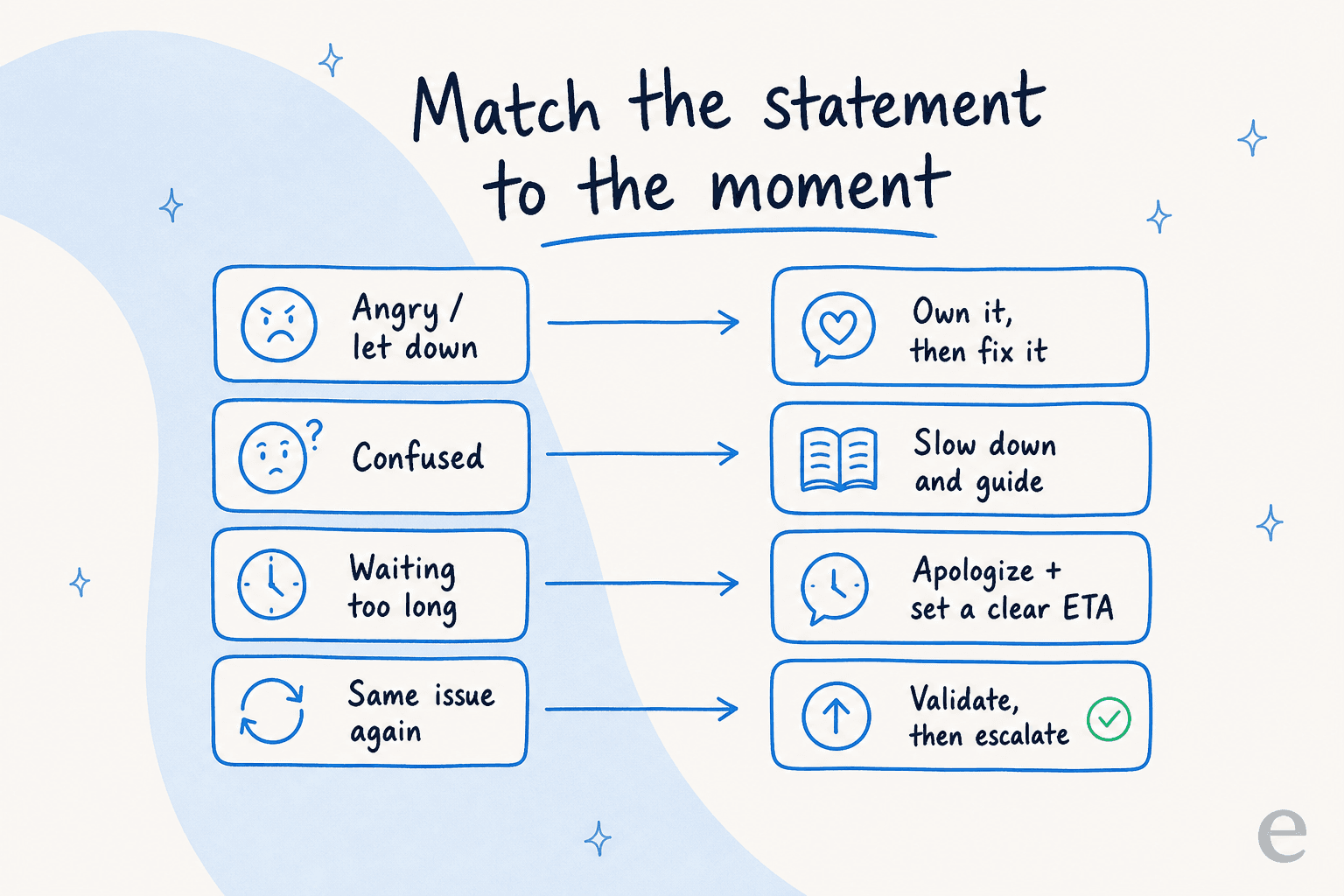
Match the statement to the moment
If there's one thing to take from all those examples, it's that empathy is situational. The list above only works if you reach for the right group at the right time. Angry customers need ownership; confused ones need reassurance; waiting ones need a real ETA. Reading the emotion first, then picking the phrase, is the skill, and it's what separates a good agent from someone pasting the same opener onto every ticket. Baking that judgement into your customer service standards is how you get a whole team doing it consistently instead of one star agent carrying the tone.
Empathy phrases to avoid (the ones that quietly backfire)
Some phrases feel empathetic to write but read as dismissive. These are the ones I'd strike from every team's canned responses:
- "Calm down" / "Please relax." Nobody in the history of being upset has calmed down because they were told to.
- "Per our policy" / "Unfortunately, that's our policy." Hiding behind rules signals you've stopped thinking about the person.
- "As I already mentioned..." Scolds the customer for not understanding you the first time.
- "I'm sorry you feel that way." A non-apology that blames their reaction instead of your action.
- "It's not a big deal." You don't get to decide how big their deal is.
- "I understand your frustration." Not wrong, just so overused it now reads as a script. Say what you understand about their situation instead.
The through-line: any phrase that shifts effort or blame back onto the customer undoes the empathy. These lines show up again and again in the worst customer service stories for exactly that reason.
Can AI actually sound empathetic?
This is the part I get asked about most, because I work alongside AI in the queue every day. The honest answer: AI can't feel anything, but it's surprisingly good at drafting empathetic replies, as long as it's learned from the right examples. The failure mode everyone pictures is the tone-deaf bot that answers a furious customer with "I'm happy to help!" That happens when the AI is running on generic training and has no idea what your team actually sounds like.
The version that works is different. When an AI copilot is trained on your own historical tickets, it picks up your team's real voice, including the empathy statements your best agents already use, and drafts in that tone. A human still reviews and sends, so the judgement stays with a person. That's the pattern I see land: AI drafting, human approving, rather than AI replacing.
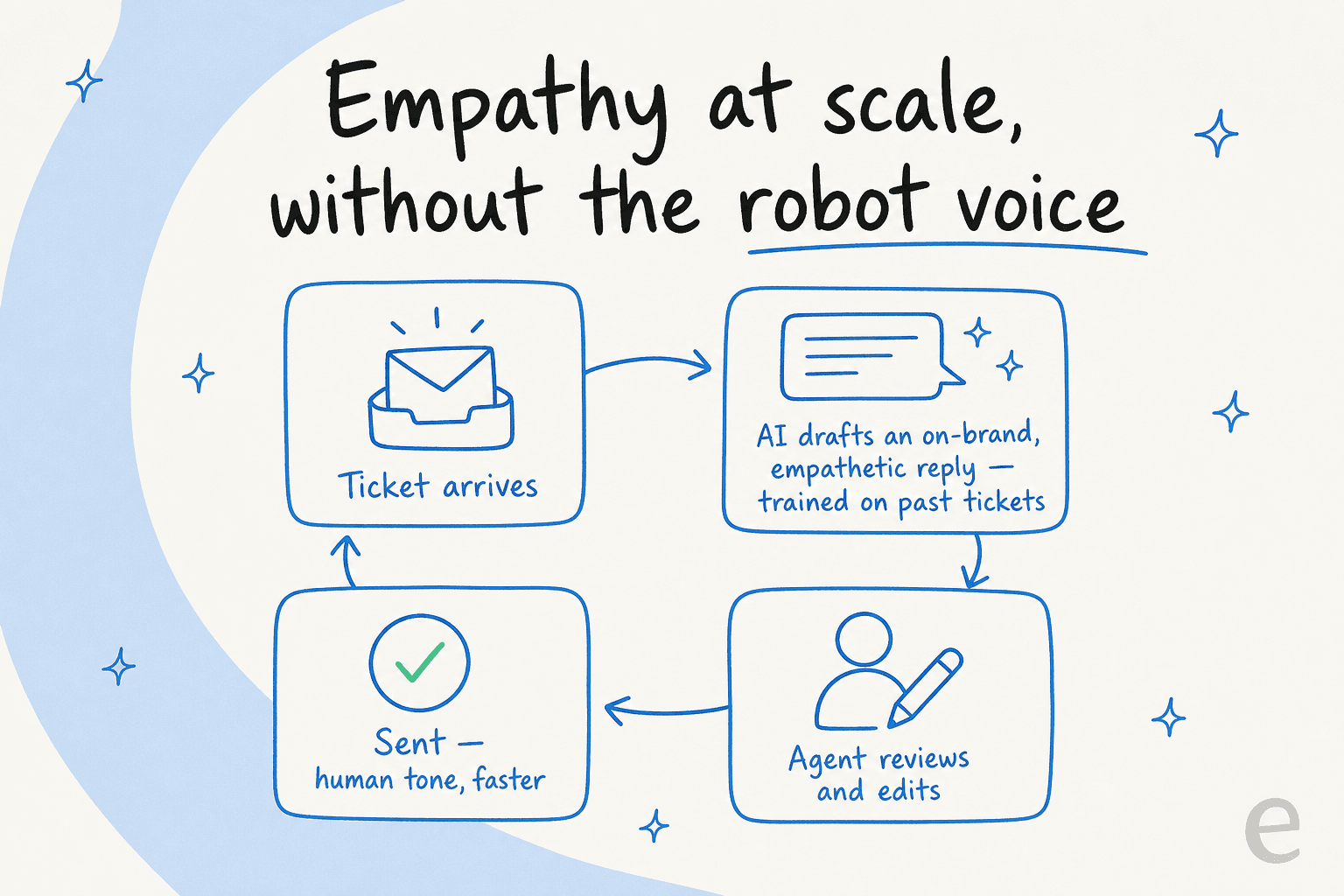
One thing that stuck with me: a service desk lead at a logistics software company told our team the AI was "curating well-formed responses with consistent, on-brand tone, still keeping our own style and still keeping that human touch." That last phrase is the whole point. The tool isn't there to sound like a robot being polite, it's there to help a busy agent sound like the best version of themselves on their tenth hour of tickets.
Here's what that looks like inside a real helpdesk, with the AI drafting a reply on a live ticket:
The reason this matters isn't a productivity stat, it's consistency. On a small team, empathy quality swings wildly: your best agent writes beautiful replies, and the new hire at 6pm on a Friday writes "noted, will look into it." When the AI handles the first draft, everyone starts from the same warm, on-brand baseline, and the tired agent's floor gets a lot higher. It's also where the cost math on AI support stops being abstract, since consistency at the top of the queue is what frees your humans for the hard tickets.
Try eesel for empathetic support at scale
If your team keeps repeating the same empathetic replies across a growing pile of tickets, that's exactly the problem eesel is built for. It plugs into helpdesks like Zendesk, Gorgias, Freshdesk and others, trains on your own past tickets and help center, and drafts replies in your team's actual voice, so the empathy statements your best agents write become the baseline for everyone. You can run it as a copilot (AI drafts, humans send) first, then hand it more once you trust the tone.

Teams that go this route describe it less as automation and more as a floor-raiser. One EdTech support director, whose customers "far outnumber" the team, put it plainly in their case study:
"As a fast-growing startup with a small team, our customers far outnumber our employees. It's crucial that we have robust self-service solutions as well as tools to supercharge the efficiency of our client-facing teams."
That's the real use case for AI here: not to fake empathy, but to give a stretched team the time and consistency to actually show it. You can try eesel free and point it at your own tickets to see how it drafts in your voice.
Frequently Asked Questions
What are empathy statements in customer service?
What are some good empathy statements for angry customers?
How do you show empathy in customer service without sounding scripted?
Can AI use empathy statements in customer service?
What empathy phrases should customer service agents avoid?


Article by
Riellvriany Indriawan
Riell is a designer and writer at eesel AI with about two years of experience researching CX platforms, AI chatbots, and helpdesk software. She combines her design background with a sharp eye for how these tools actually look and feel in practice — making her comparisons unusually visual and user-focused.